Download to read offline
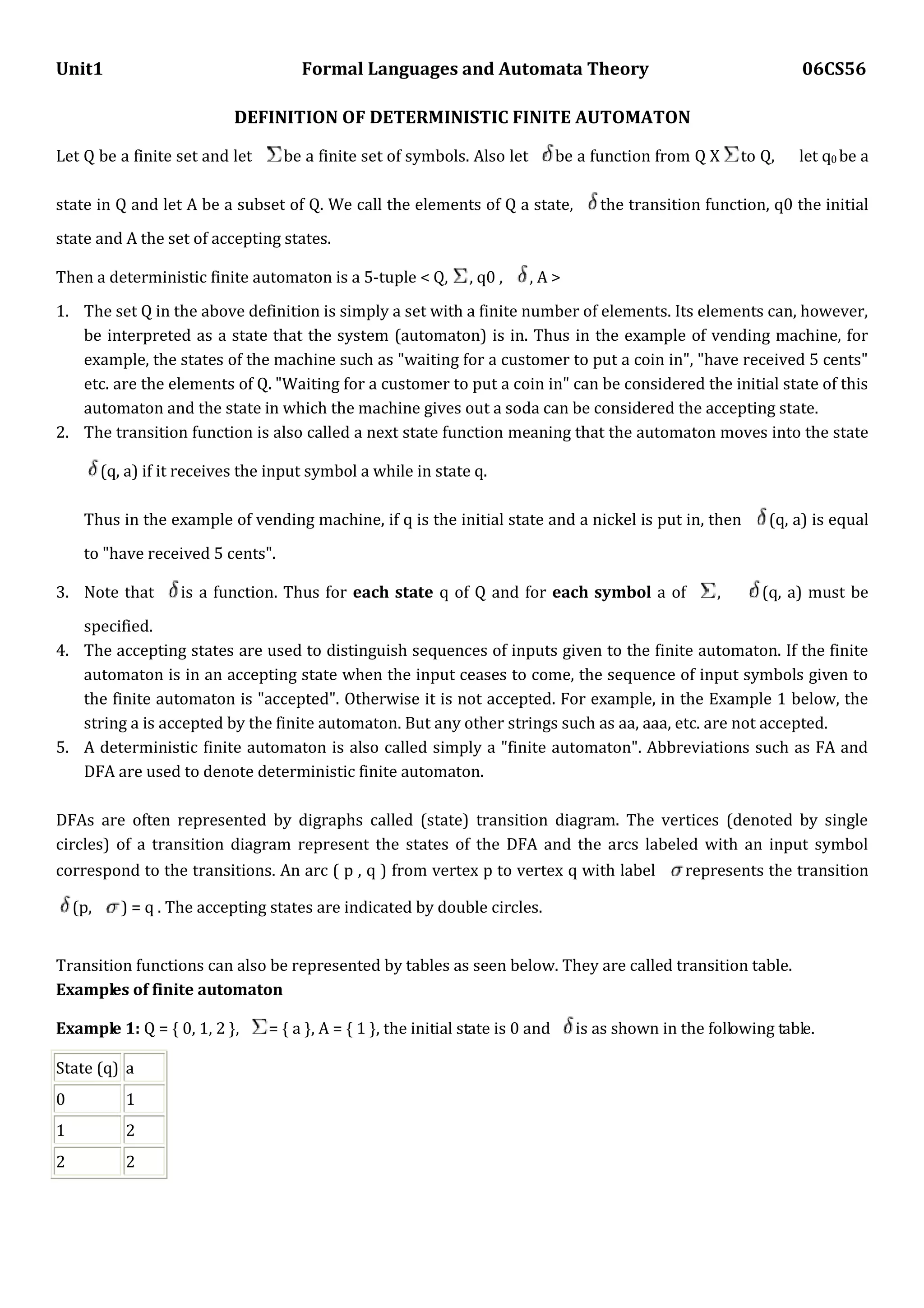


![
Q
2.1 Conversion from NFA to DFA
Let MN = (QN, N, N, q0, AN) be an NFA and accepts the language L(MN). There should be an equivalent DFA MD =
(QD, D, D, q0, AD) such that L(MD) = L(MN). The procedure to convert an NFA to its equivalent DFA is shown
below:
Step1:
The start state of NFA MN is the start state of DFA MD. So, add q0(which is the start state of NFA) to QD
and find the transitions from this state. The way to obtain different transitions is shown in step2.
Step2:
For each state [qi, qj,….qk] in QD, the transitions for each input symbol in can be obtained as shown
below:
1. D([qi, qj,….qk], a) = N(qi, a) U N(qj, a) U ……N(qk, a)
= [ql, qm,….qn] say.
2. Add the state [ql, qm,….qn] to QD, if it is not already in QD.
3. Add the transition from [qi, qj,….qk] to [ql, qm,….qn] on the input symbol a iff the state [ql, qm,….qn] is
added to QD in the previous step.
Step3:
The state [qa, qb,….qc] QD is the final state, if at least one of the state in qa, qb, ….. qc AN i.e., at least one
of the component in [qa, qb,….qc] should be the final state of NFA.
Step4:
If epsilon () is accepted by NFA, then start state q0 of DFA is made the final state.
Convert the following NFA into an equivalent DFA.
Step1: q0 is the start of DFA (see step1 in the conversion procedure).
So, QD = {[q0]} (2.7)
Step2: Find the new states from each state in QD and obtain the corresponding transitions.
Consider the state [q0]:
When a = 0
D([q0], 0) =
=
N([q0], 0)
[q0, q1]
(2.8)
When a = 1
D([q0], 1) =
=
N([q0], 1)
[q1]
(2.9)
Since the states obtained in (2.8) and (2.9) are not in QD(2.7), add these two states to QD so that
QD = {[q0], [q0, q1], [q1] } (2.10)
The corresponding transitions on a = 0 and a = 1 are shown below.
0 1
[q0] [q0, q1] [q1]
[q0, q1]
[q1]
q1q0
0 1
0,1 q2
0, 1](https://image.slidesharecdn.com/06cs56flatunit1-161216072433/75/flat-unit1-6-2048.jpg)
![
Q
Q
Consider the state [q0, q1]:
When a = 0
D([q0, q1],
0)
=
=
=
=
N([q0, q1], 0)
N(q0, 0) U N(q1, 0)
{q0, q1} U {q2}
[q0, q1, q2] (2.11)
When a = 1
D([q0, q1],
1)
=
=
=
=
N([q0, q1], 1)
N(q0, 1) U N(q1, 1)
{q1} U {q2}
[q1, q2] (2.12)
Since the states obtained in (2.11) and (2.12) are the not defined in QD(see 2.10), add these two states to QD so
that
QD = {[q0], [q0, q1], [q1], [q0, q1, q2], [q1, q2] } (2.13)
and add the transitions on a = 0 and a = 1 as shown below:
Consider the state [q1]:
When a = 0
D([q1], 0) =
=
N([q1], 0)
[q2] (2.14)
When a = 1
D([q1], 1) =
=
N([q1], 1)
[q2] (2.15)
Since the states obtained in (2.14) and (2.15) are same and the state q2 is not in QD(see 2.13), add the state q2 to
QD so that
QD = {[q0], [q0, q1], [q1], [q0, q1, q2], [q1, q2], [q2]} (2.16)
and add the transitions on a = 0 and a = 1 as shown below:
0 1
[q0] [q0, q1] [q1]
[q0, q1] [q0, q1, q2] [q1, q2]
[q1]
[q0, q1, q2]
[q1, q2]
0 1
[q0] [q0, q1] [q1]
[q0, q1] [q0, q1, q2] [q1, q2]
[q1] [q2] [q2]
[q0, q1, q2]
[q1, q2]
[q2]](https://image.slidesharecdn.com/06cs56flatunit1-161216072433/75/flat-unit1-7-2048.jpg)
![
Q
Q
Consider the state [q0,q1,q2]:
When a = 0
D([q0,q1,q2], 0) =
=
=
=
N([q0,q1,q2], 0)
N(q0, 0) U N(q1, 0) U N(q2, 0)
{q0,q1} U {q2} U {}
[q0,q1,q2] (2.17)
When a = 1
D([q0,q1,q2], 1) =
=
=
=
N([q0,q1,q2], 1)
N(q0, 1) U N(q1, 1) U N(q2, 1)
{q1} U {q2} U {q2}
[q1, q2]
(2.18)
Since the states obtained in (2.17) and (2.18) are not new states (are already in QD, see 2.16), do not add these
two states to QD. But, the transitions on a = 0 and a = 1 should be added to the transitional table as shown
below:
Consider the state [q1,q2]:
When a = 0
D([q1,q2], 0) =
=
=
=
N([q1,q2], 0)
N(q1, 0) U N(q2, 0)
{q2} U {}
[q2] (2.19)
When a = 1
D([q1,q2], 1) =
=
=
=
N([q1,q2], 1)
N(q1, 1) U N(q2, 1)
{q2} U {q2}
[q2] (2.20)
Since the states obtained in (2.19) and (2.20) are not new states (are already in QD see 2.16), do not add these
two states to QD. But, the transitions on a = 0 and a = 1 should be added to the transitional table as shown
below:
0 1
[q0] [q0, q1] [q1]
[q0, q1] [q0, q1, q2] [q1, q2]
[q1] [q2] [q2]
[q0, q1, q2] [q0,q1,q2] [q1, q2]
[q1, q2]
[q2]
0 1
[q0] [q0, q1] [q1]
[q0, q1] [q0, q1, q2] [q1, q2]
[q1] [q2] [q2]
[q0, q1, q2] [q0,q1,q2] [q1, q2]
[q1, q2] [q2] [q2]
[q2]](https://image.slidesharecdn.com/06cs56flatunit1-161216072433/75/flat-unit1-8-2048.jpg)
![Consider the state [q2]:
When a = 0
D([q2], 0) =
=
N([q2], 0)
{} (2.21)
When a = 1
D([q2], 1) =
=
N([q2], 1)
[q2] (2.22)
Since the states obtained in (2.21) and (2.22) are not new states (are already in QD, see 2.16), do not add these
two states to QD. But, the transitions on a = 0 and a = 1 should be added to the transitional table. The final
transitional table is shown in table 2.14. and final DFA is shown in figure 2.35.
The DFA
0 1
[q0] [q0, q1] [q1]
[q0, q1, q2] [q1, q2]
[q2] [q2]
[q0,q1,q2] [q1, q2]
[q2] [q2]
[q2] [q2]
[q2
]
[q1
]
[q0
]
[q0
, q1
]
[q1
, q2
][q0
, q1
, q2
]
0 1
0 1 0, 1
0, 1
0 1
1
[q0,q1]
[q1]
[q0,q1,q2]
[q1,q2]](https://image.slidesharecdn.com/06cs56flatunit1-161216072433/75/flat-unit1-9-2048.jpg)

The document defines deterministic finite automata (DFA) and provides examples to illustrate their components and operation. It then discusses applications of finite automata in areas like compiler construction, hardware design, games, and more. The document also defines non-deterministic finite automata (NFA) and describes the process to convert an NFA to an equivalent DFA in 4 steps: 1) Set the starting state, 2) Determine new states and transitions, 3) Identify accepting states, 4) Make the starting state accepting if epsilon is allowed. An example NFA is converted to DFA using this process.


