Topic :- Pushdown Automata
Name :- Ashish Duggal
Qualification :- M.C.A.
Pushdown Automata Introduction
 A PDA is more powerful than FA. Any language which can be acceptable by
FA can also be acceptable by PDA. PDA also accepts a class of language which
even cannot be accepted by FA. Thus PDA is much more superior to FA.
 Basically a pushdown automaton is − "Finite state machine" + "a stack"
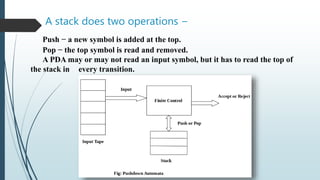
 A pushdown automaton has three components −
an input tape,
a control unit, and
a stack with infinite size.
The stack head scans the top symbol of the stack.
A stack does two operations −
Push − a new symbol is added at the top.
Pop − the top symbol is read and removed.
A PDA may or may not read an input symbol, but it has to read the top of
the stack in every transition.
7 Components of DPDA
 M = (Q, Σ, Γ, δ, q0, Z0, F), where
 Q — finite set of states
 Σ — finite input alphabet
 Γ — finite alphabet of pushdown symbols
 q0 ∈ Q — starting/initial state
 Z0 ∈ Γ — start symbol on the pushdown
 F ⊆ Q — set of final states
 δ — mapping Q × (Σ ∪ {ε}) × Γ → Q×Γ
7 Components of NON-DPDA / NPDA
 M = (Q, Σ, Γ, δ, q0, Z0, F), where
 Q — finite set of states
 Σ — finite input alphabet
 Γ — finite alphabet of pushdown symbols
 δ —transition function -> Q × (Σ ∪ {ε}) × Γ → 2 ^(Q×Γ )
 q0 ∈ Q — starting/initial state
 Z0 ∈ Γ — start symbol on the pushdown
 F ⊆ Q — set of final states
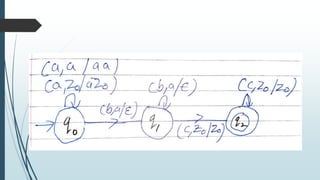
Example
Thank You

Push Down Automata (PDA) | TOC (Theory of Computation) | NPDA | DPDA

  • 1.
    Topic :- PushdownAutomata Name :- Ashish Duggal Qualification :- M.C.A.
  • 2.
    Pushdown Automata Introduction A PDA is more powerful than FA. Any language which can be acceptable by FA can also be acceptable by PDA. PDA also accepts a class of language which even cannot be accepted by FA. Thus PDA is much more superior to FA.  Basically a pushdown automaton is − "Finite state machine" + "a stack"  A pushdown automaton has three components − an input tape, a control unit, and a stack with infinite size. The stack head scans the top symbol of the stack.
  • 3.
    A stack doestwo operations − Push − a new symbol is added at the top. Pop − the top symbol is read and removed. A PDA may or may not read an input symbol, but it has to read the top of the stack in every transition.
  • 4.
    7 Components ofDPDA  M = (Q, Σ, Γ, δ, q0, Z0, F), where  Q — finite set of states  Σ — finite input alphabet  Γ — finite alphabet of pushdown symbols  q0 ∈ Q — starting/initial state  Z0 ∈ Γ — start symbol on the pushdown  F ⊆ Q — set of final states  δ — mapping Q × (Σ ∪ {ε}) × Γ → Q×Γ
  • 5.
    7 Components ofNON-DPDA / NPDA  M = (Q, Σ, Γ, δ, q0, Z0, F), where  Q — finite set of states  Σ — finite input alphabet  Γ — finite alphabet of pushdown symbols  δ —transition function -> Q × (Σ ∪ {ε}) × Γ → 2 ^(Q×Γ )  q0 ∈ Q — starting/initial state  Z0 ∈ Γ — start symbol on the pushdown  F ⊆ Q — set of final states
  • 6.
  • 8.