1
Welcome to !
Theory Of Automata
2
Text and Reference Material
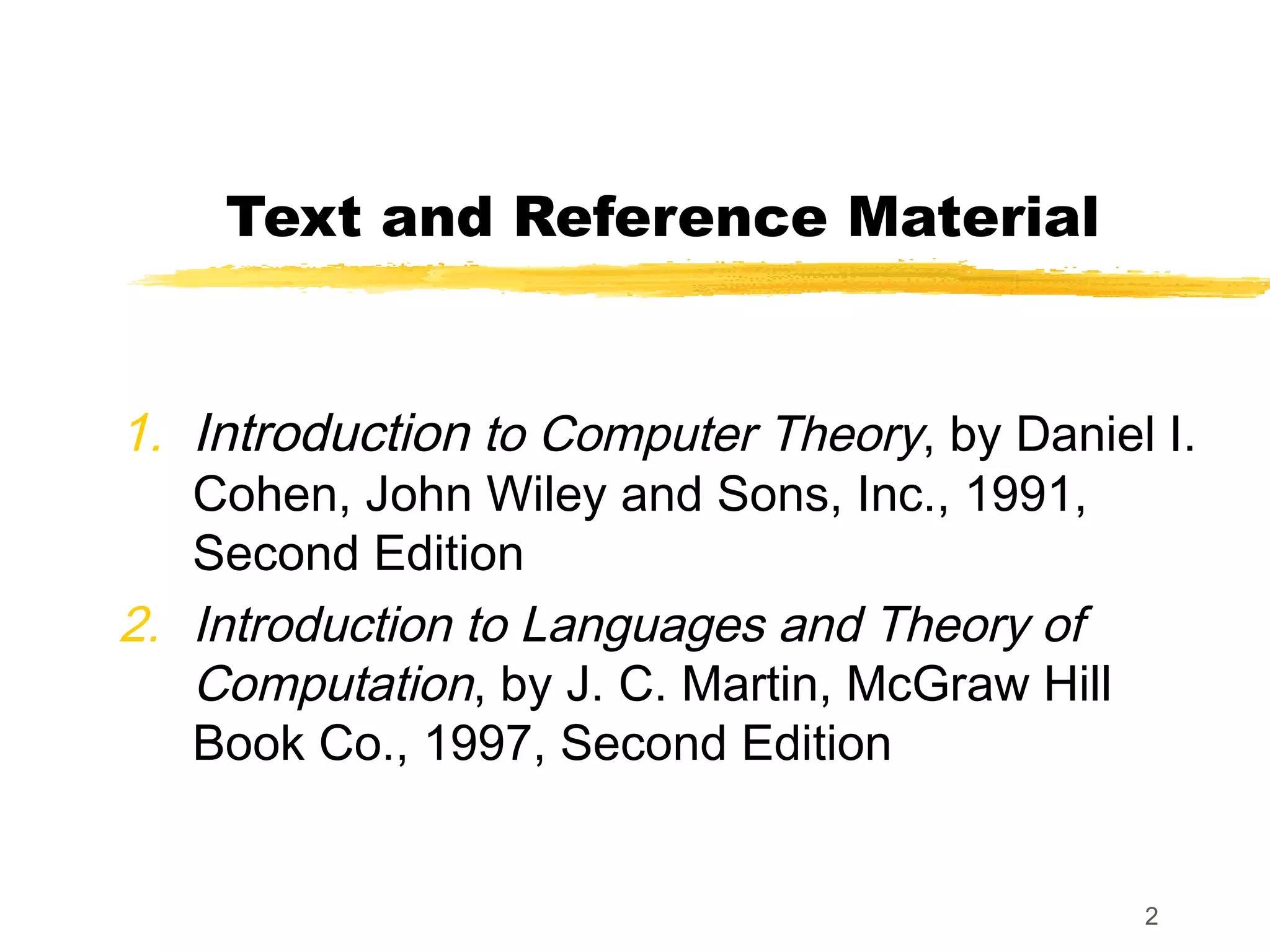
1. Introduction to Computer Theory, by Daniel I.
Cohen, John Wiley and Sons, Inc., 1991,
Second Edition
2. Introduction to Languages and Theory of
Computation, by J. C. Martin, McGraw Hill
Book Co., 1997, Second Edition
3
Grading
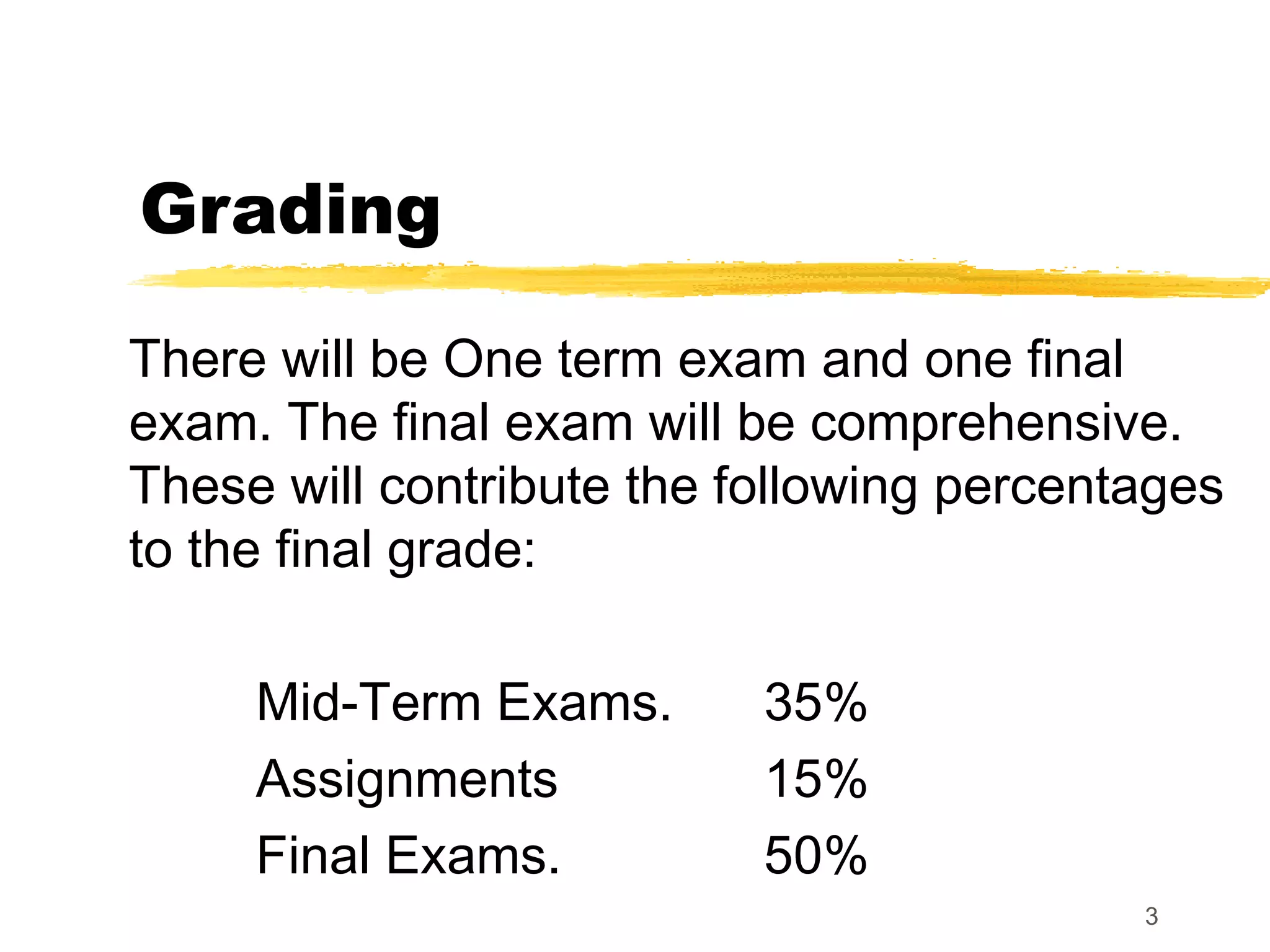
There will be One term exam and one final
exam. The final exam will be comprehensive.
These will contribute the following percentages
to the final grade:
Mid-Term Exams. 35%
Assignments 15%
Final Exams. 50%
4
What does automata mean?
It is the plural of automaton, and it means
“something that works automatically”
5
Introduction to languages
There are two types of languages
Formal Languages (Syntactic languages)
Informal Languages (Semantic
languages)
6
Alphabets
Definition:
A finite non-empty set of symbols (letters), is
called an alphabet. It is denoted by Σ ( Greek
letter sigma).
Example:
Σ={a,b}
Σ={0,1} //important as this is the language
//which the computer understands.
Σ={i,j,k}
7
NOTE:
A certain version of language ALGOL has
113 letters
Σ (alphabet) includes letters, digits and a
variety of operators including sequential
operators such as GOTO and IF
8
Strings
Definition:
Concatenation of finite symbols from the
alphabet is called a string.
Example:
If Σ= {a,b} then
a, abab, aaabb, ababababababababab
9
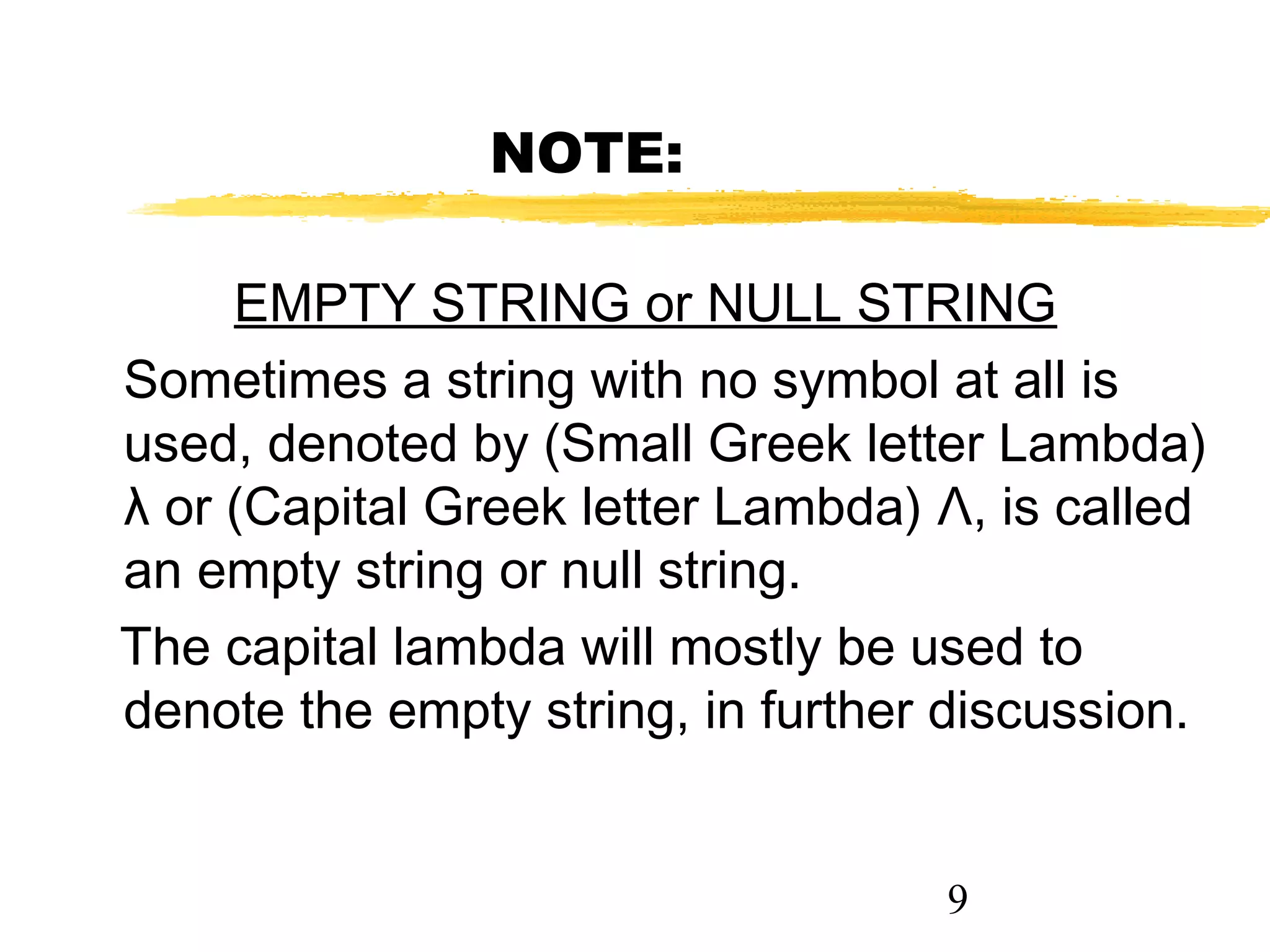
NOTE:
EMPTY STRING or NULL STRING
Sometimes a string with no symbol at all is
used, denoted by (Small Greek letter Lambda)
λ or (Capital Greek letter Lambda) Λ, is called
an empty string or null string.
The capital lambda will mostly be used to
denote the empty string, in further discussion.
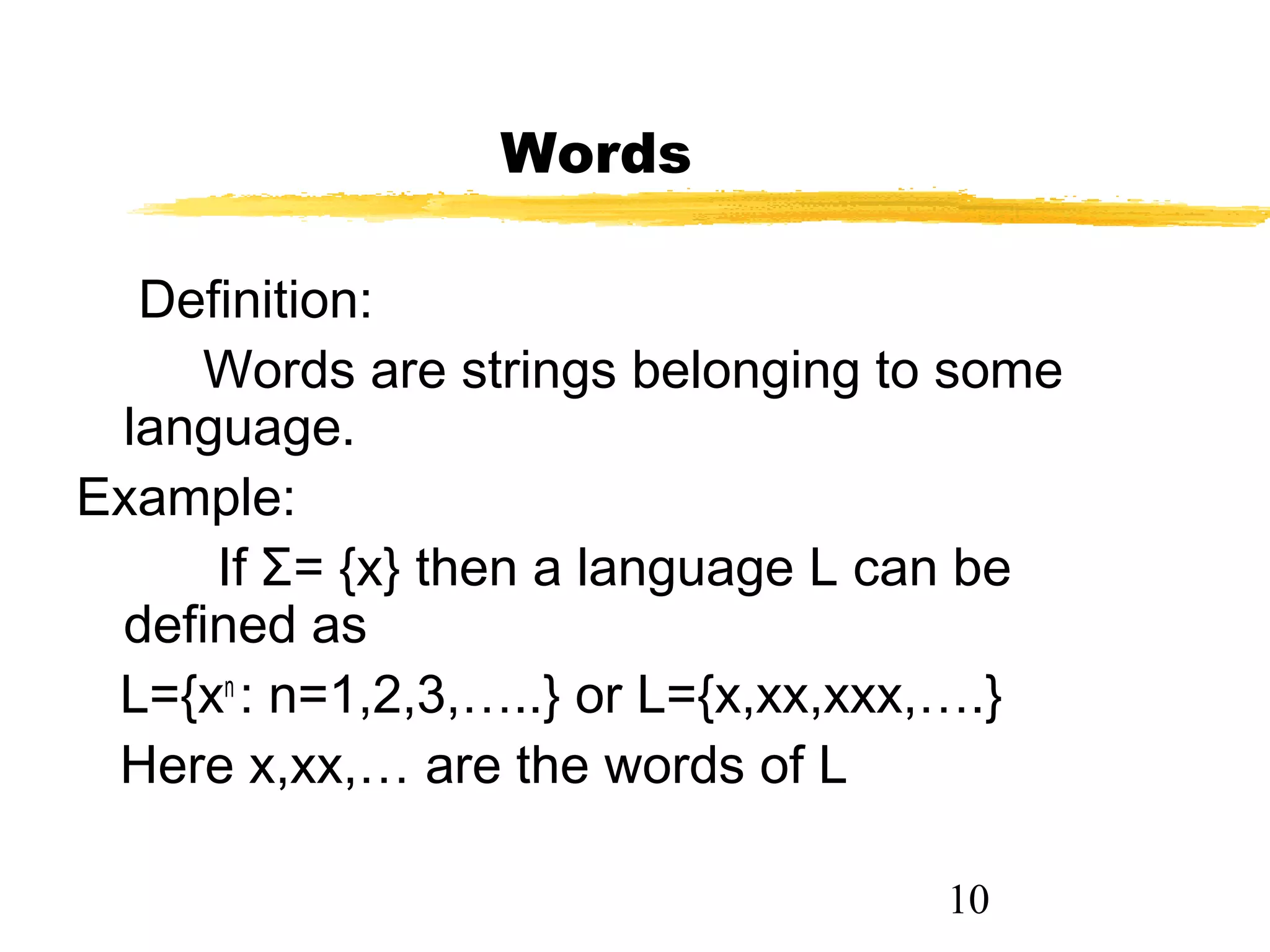
10
Words
Definition:
Words are strings belonging to some
language.
Example:
If Σ= {x} then a language L can be
defined as
L={xn
: n=1,2,3,…..} or L={x,xx,xxx,….}
Here x,xx,… are the words of L
11
NOTE:
All words are strings, but not all strings
are words.
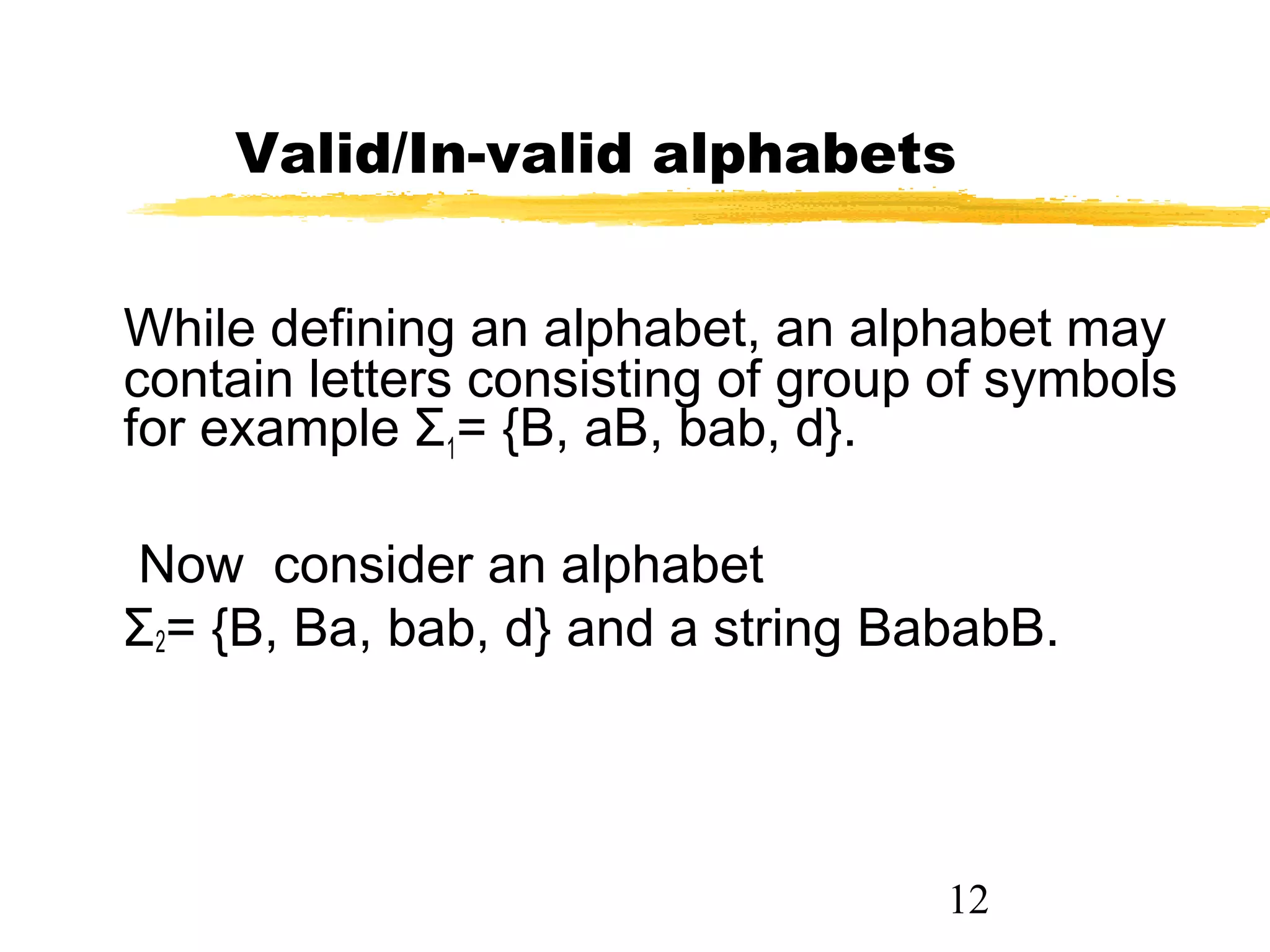
12
Valid/In-valid alphabets
While defining an alphabet, an alphabet may
contain letters consisting of group of symbols
for example Σ1= {B, aB, bab, d}.
Now consider an alphabet
Σ2= {B, Ba, bab, d} and a string BababB.
13
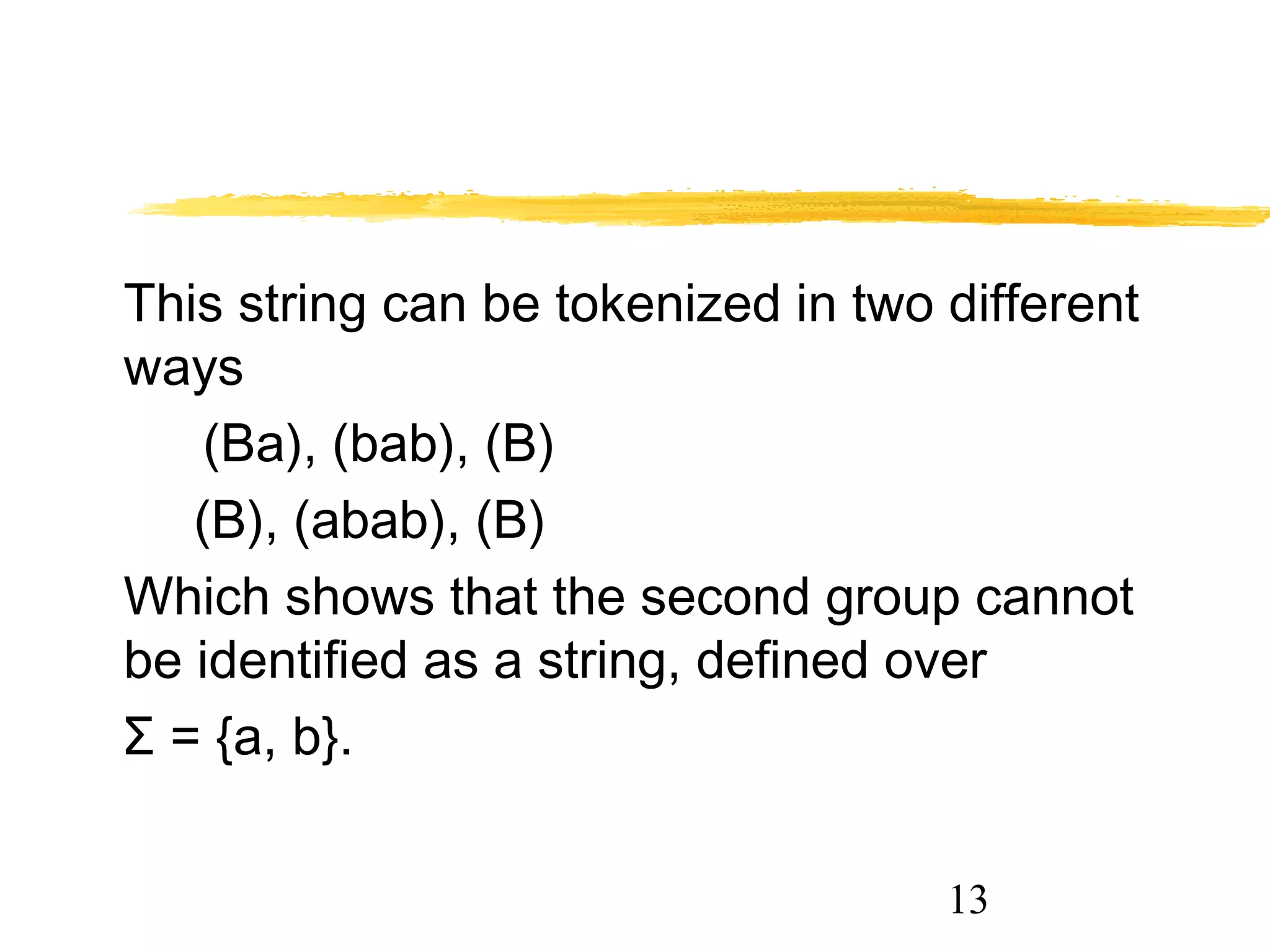
This string can be tokenized in two different
ways
(Ba), (bab), (B)
(B), (abab), (B)
Which shows that the second group cannot
be identified as a string, defined over
Σ = {a, b}.
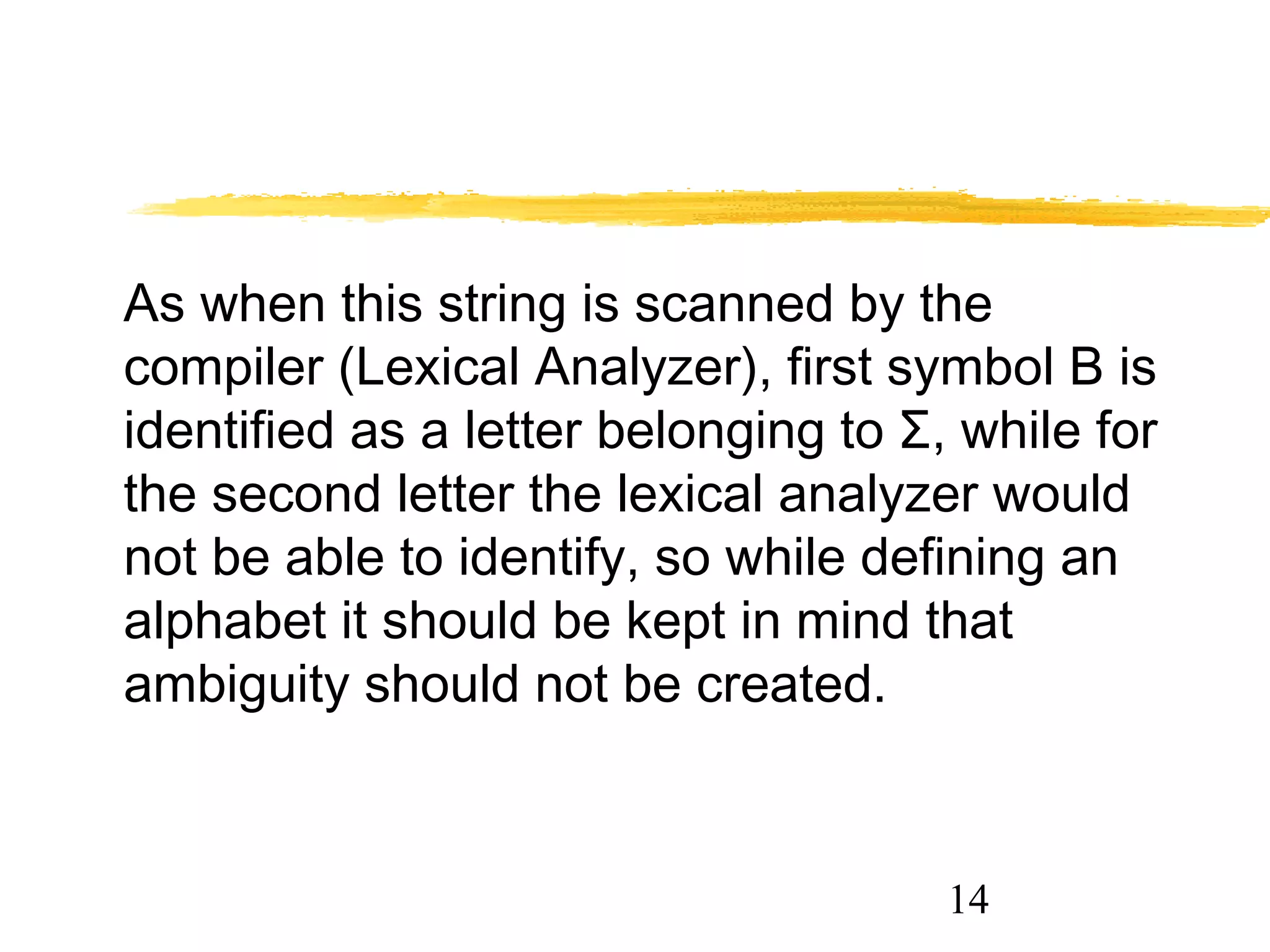
14
As when this string is scanned by the
compiler (Lexical Analyzer), first symbol B is
identified as a letter belonging to Σ, while for
the second letter the lexical analyzer would
not be able to identify, so while defining an
alphabet it should be kept in mind that
ambiguity should not be created.
15
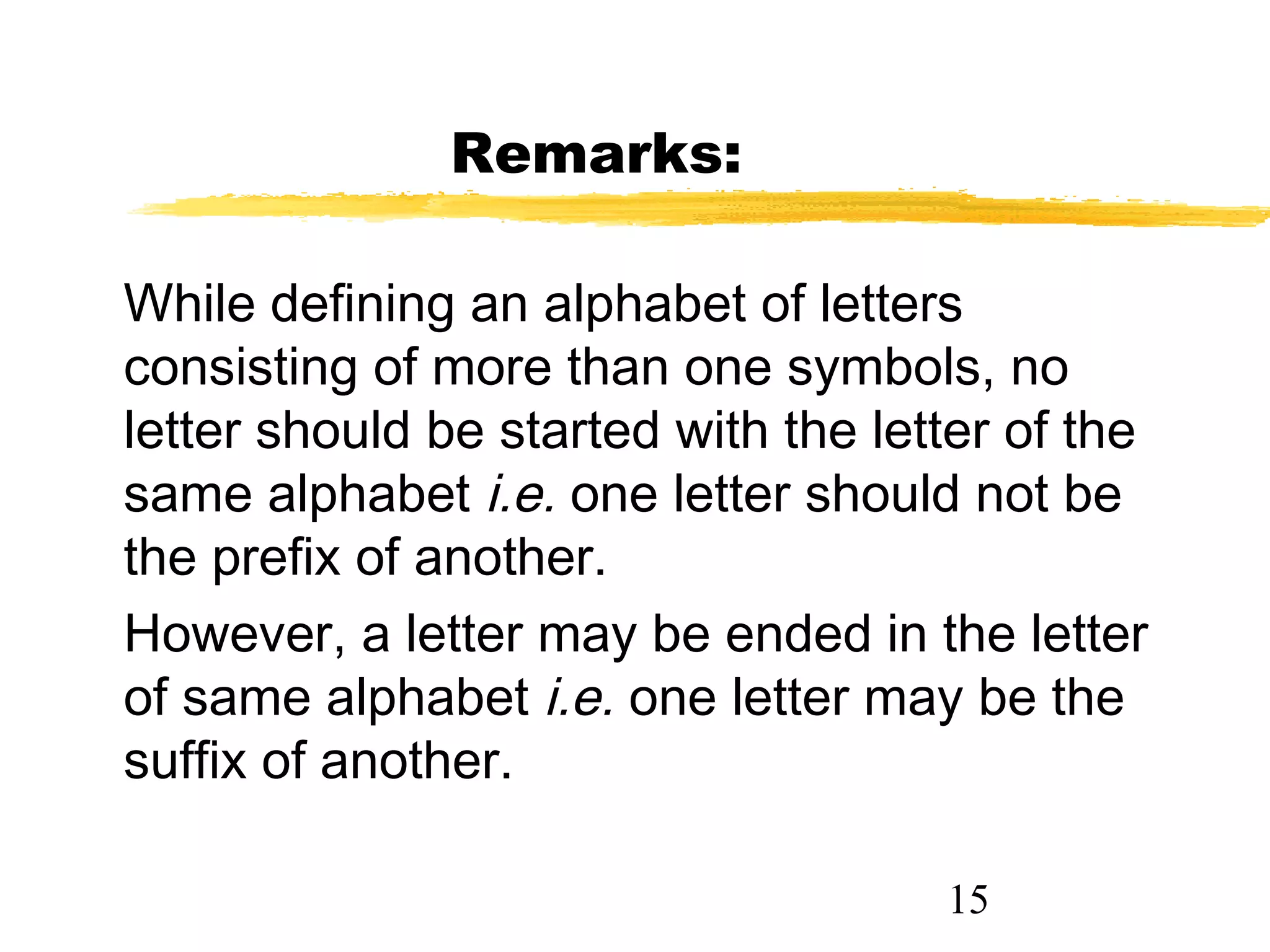
Remarks:
While defining an alphabet of letters
consisting of more than one symbols, no
letter should be started with the letter of the
same alphabet i.e. one letter should not be
the prefix of another.
However, a letter may be ended in the letter
of same alphabet i.e. one letter may be the
suffix of another.
16
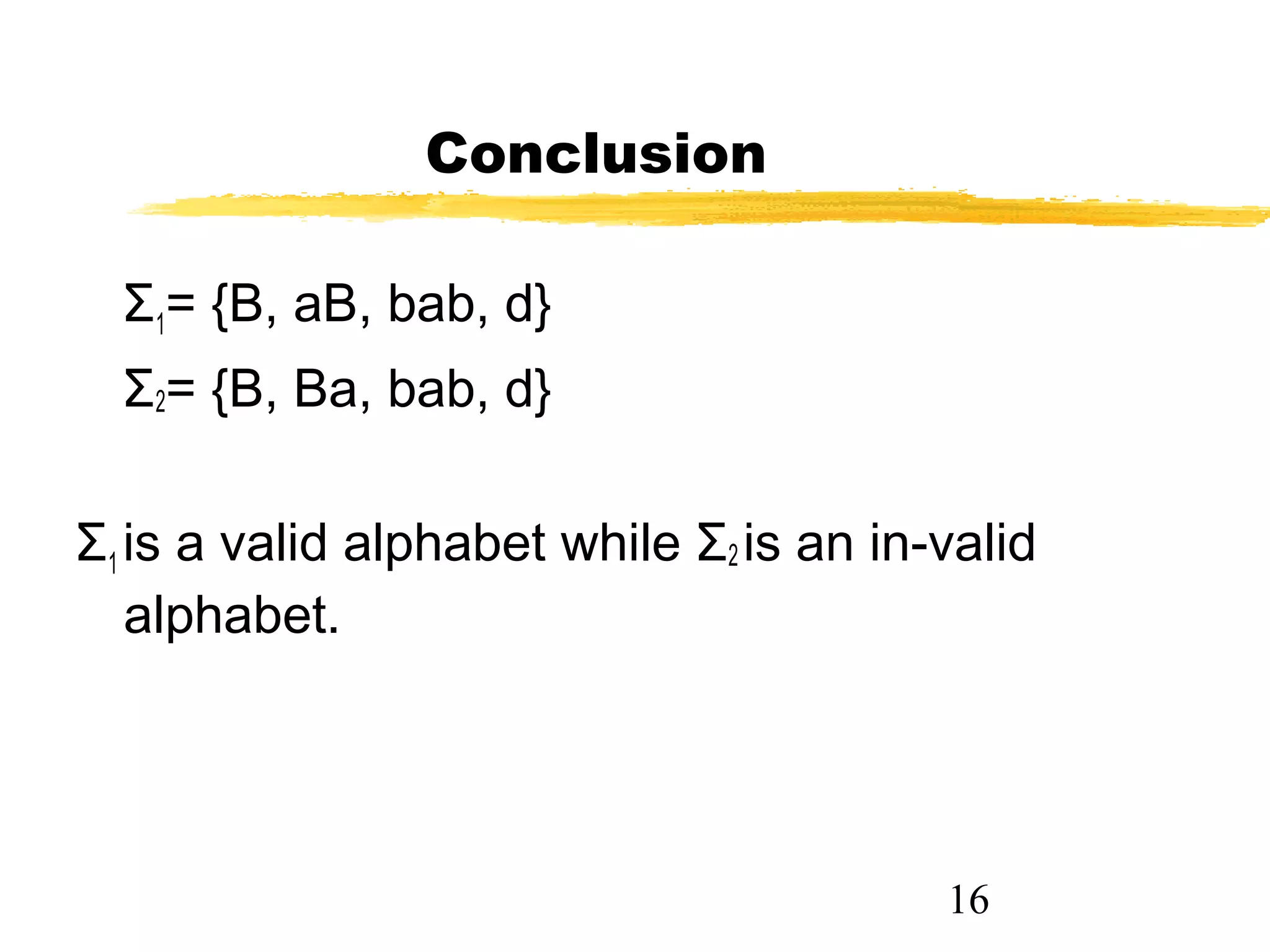
Conclusion
Σ1= {B, aB, bab, d}
Σ2= {B, Ba, bab, d}
Σ1 is a valid alphabet while Σ2 is an in-valid
alphabet.
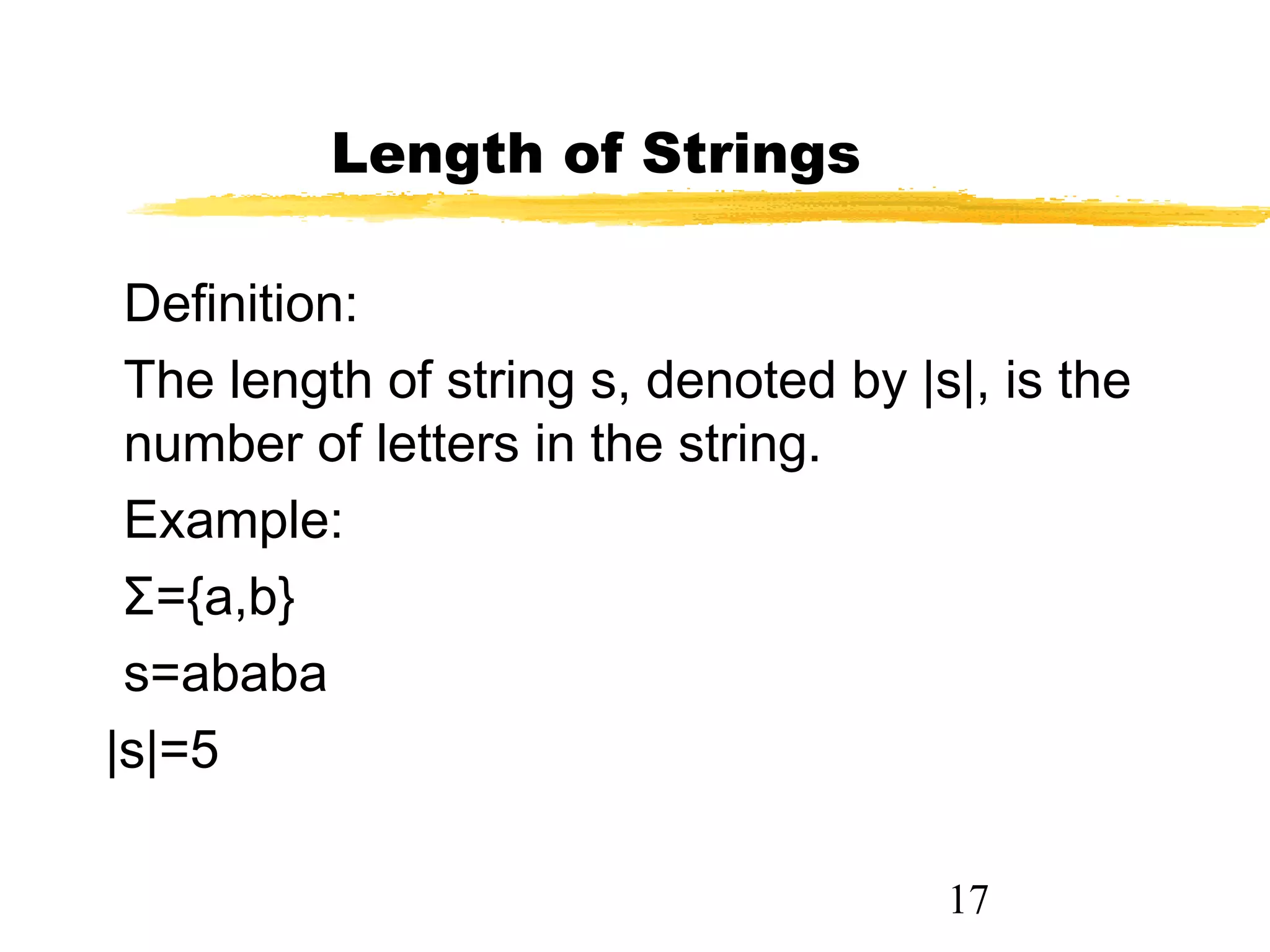
17
Length of Strings
Definition:
The length of string s, denoted by |s|, is the
number of letters in the string.
Example:
Σ={a,b}
s=ababa
|s|=5
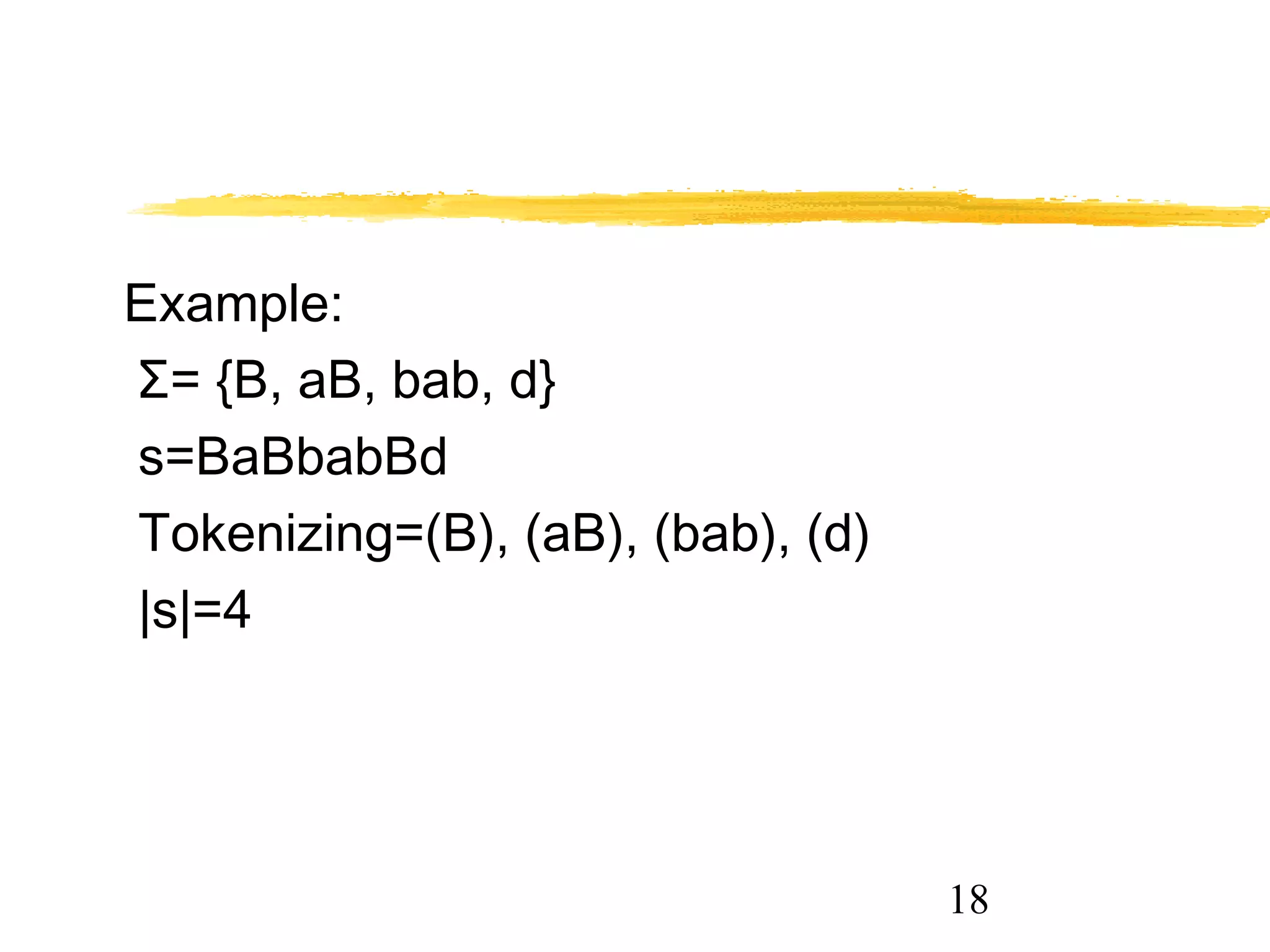
18
Example:
Σ= {B, aB, bab, d}
s=BaBbabBd
Tokenizing=(B), (aB), (bab), (d)
|s|=4
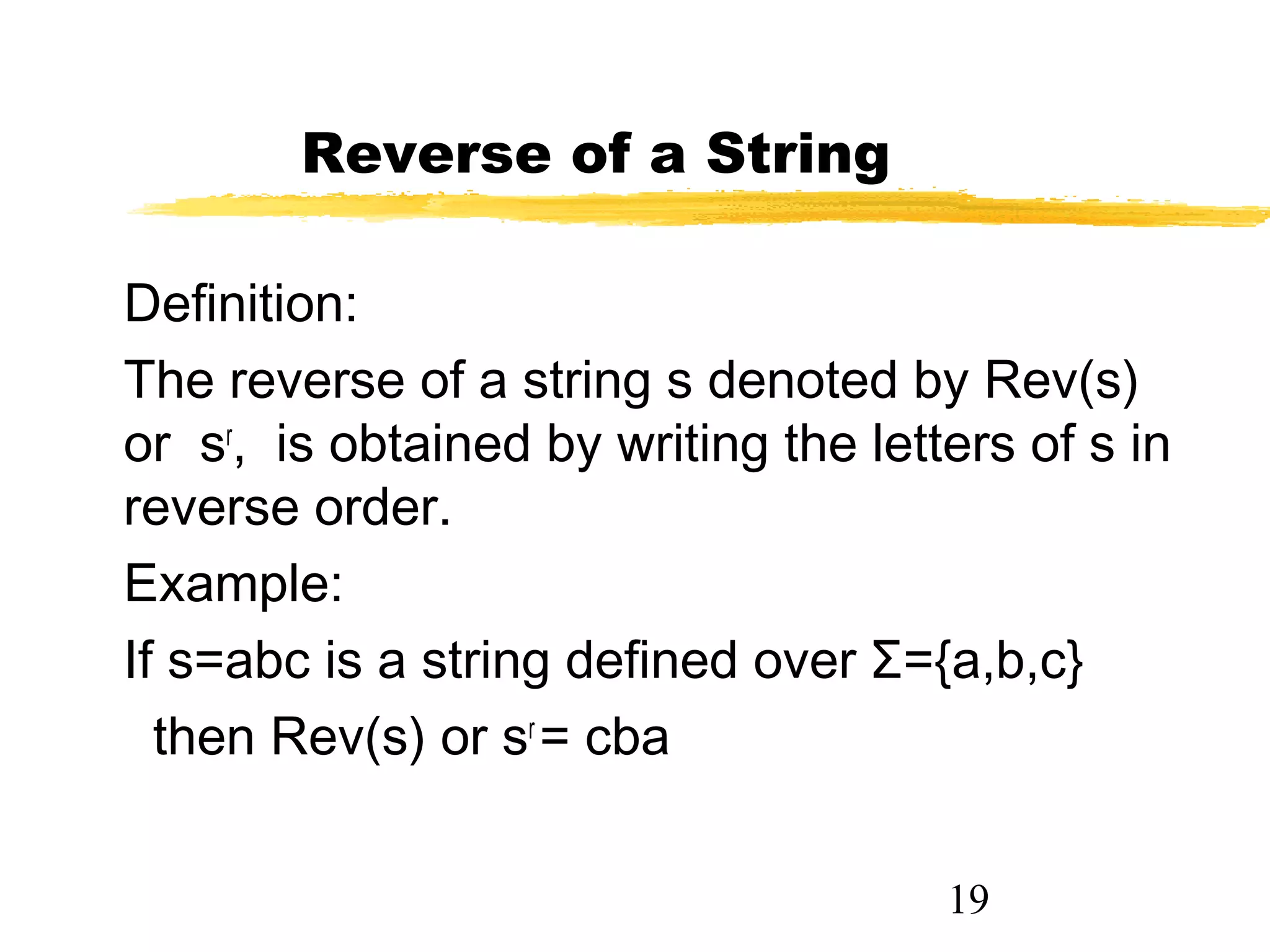
19
Reverse of a String
Definition:
The reverse of a string s denoted by Rev(s)
or sr
, is obtained by writing the letters of s in
reverse order.
Example:
If s=abc is a string defined over Σ={a,b,c}
then Rev(s) or sr
= cba
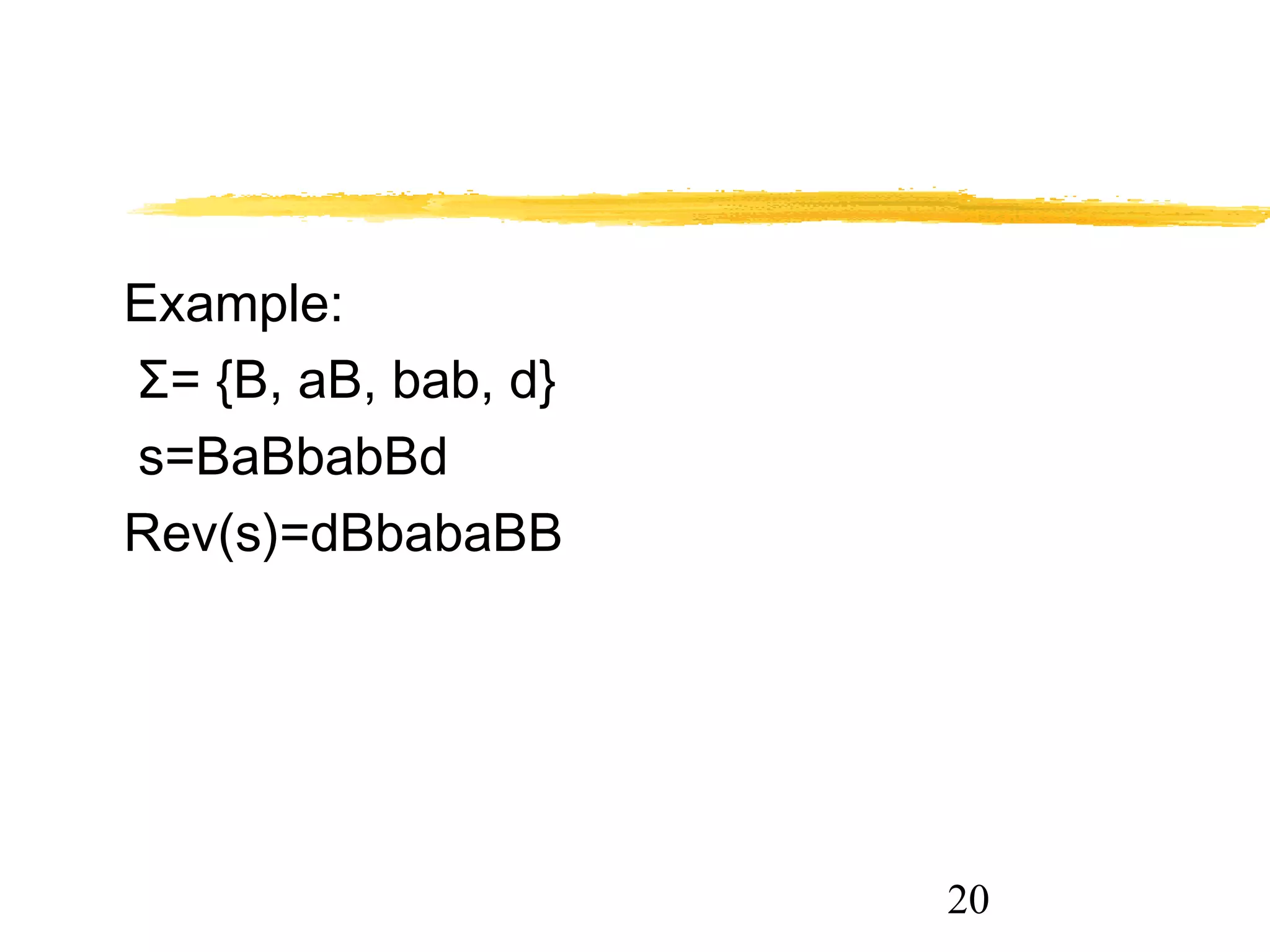
20
Example:
Σ= {B, aB, bab, d}
s=BaBbabBd
Rev(s)=dBbabaBB
21
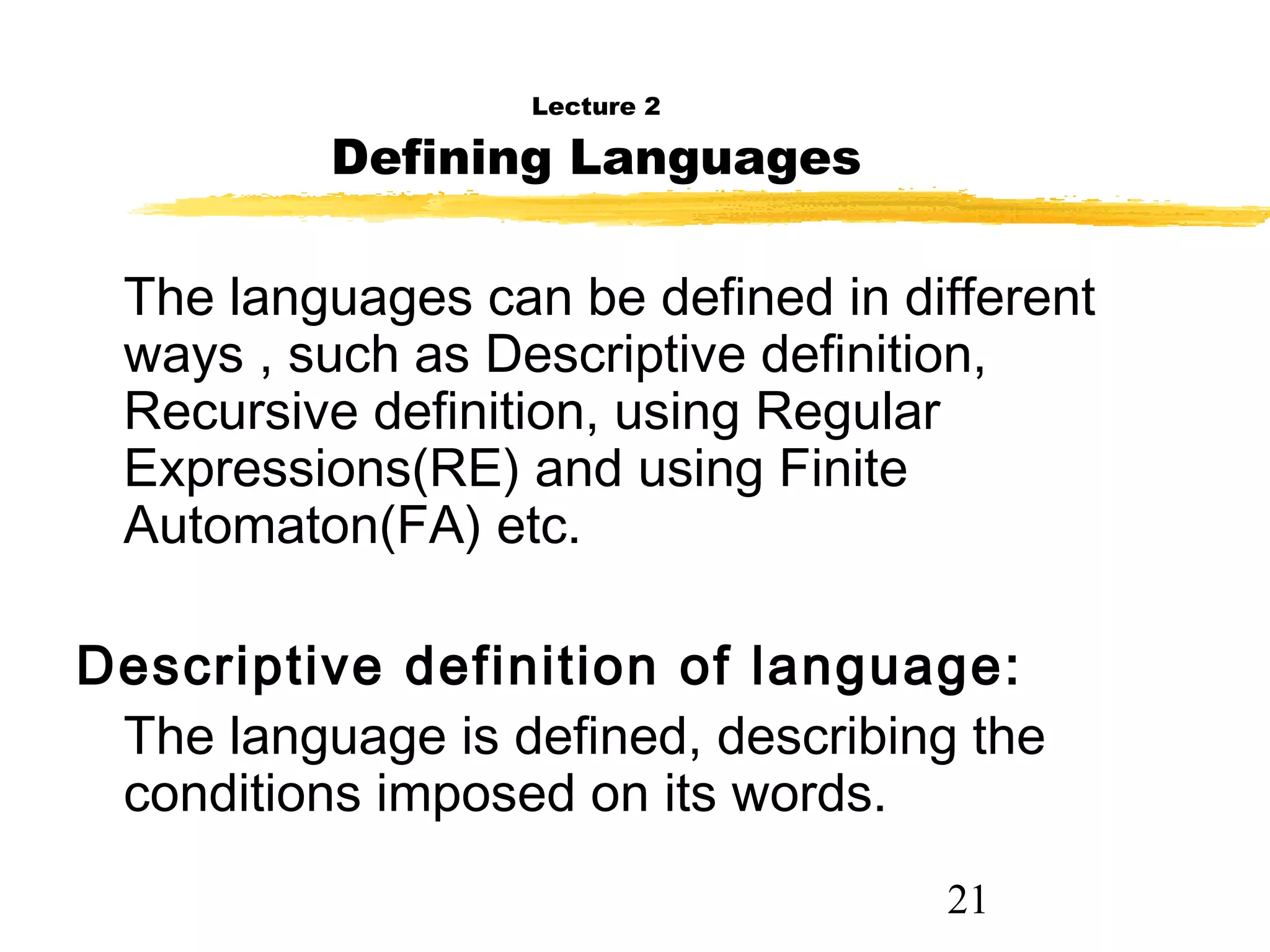
Lecture 2
Defining Languages
The languages can be defined in different
ways , such as Descriptive definition,
Recursive definition, using Regular
Expressions(RE) and using Finite
Automaton(FA) etc.
Descriptive definition of language:
The language is defined, describing the
conditions imposed on its words.
22
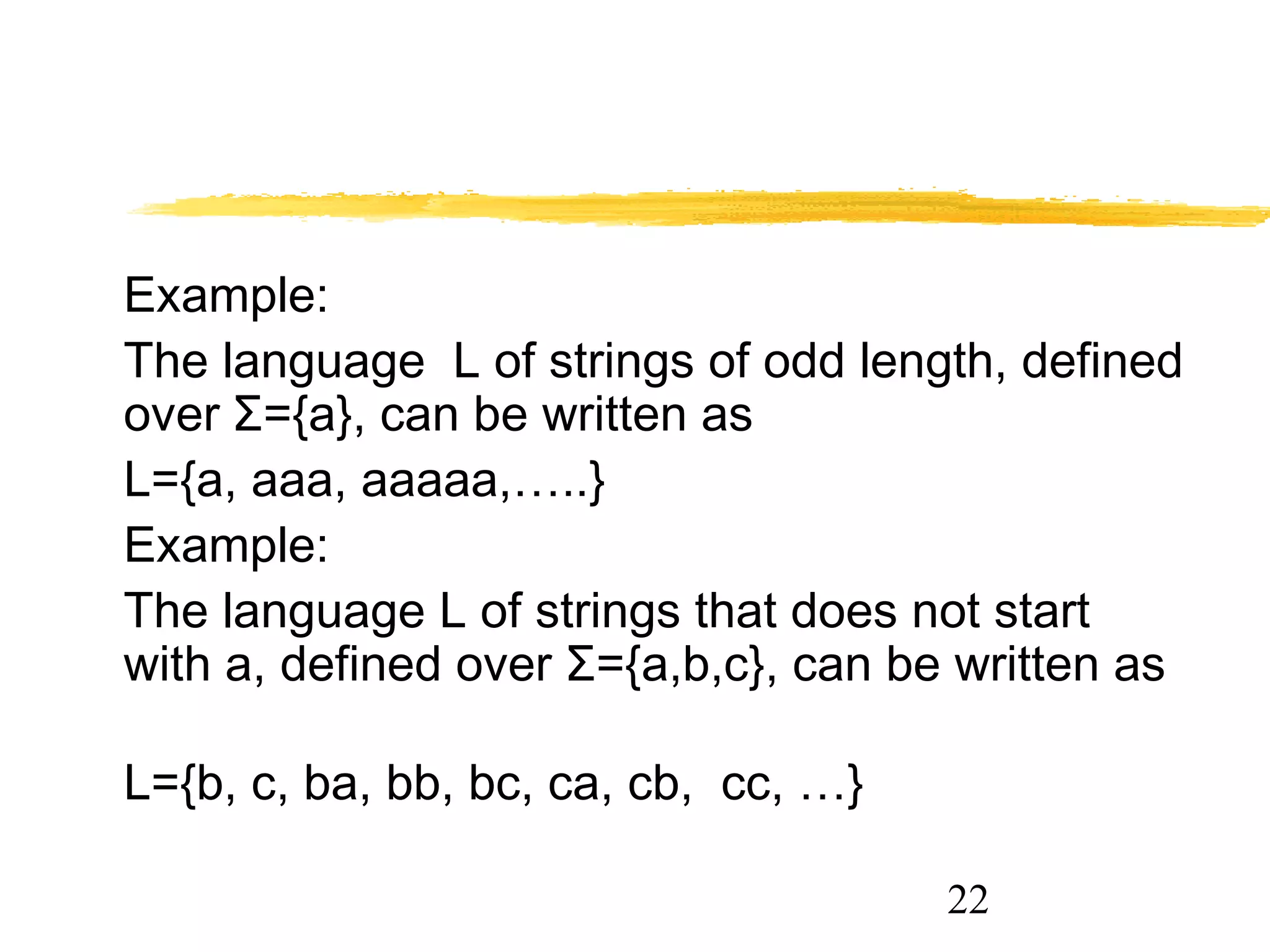
Example:
The language L of strings of odd length, defined
over Σ={a}, can be written as
L={a, aaa, aaaaa,…..}
Example:
The language L of strings that does not start
with a, defined over Σ={a,b,c}, can be written as
L={b, c, ba, bb, bc, ca, cb, cc, …}
23
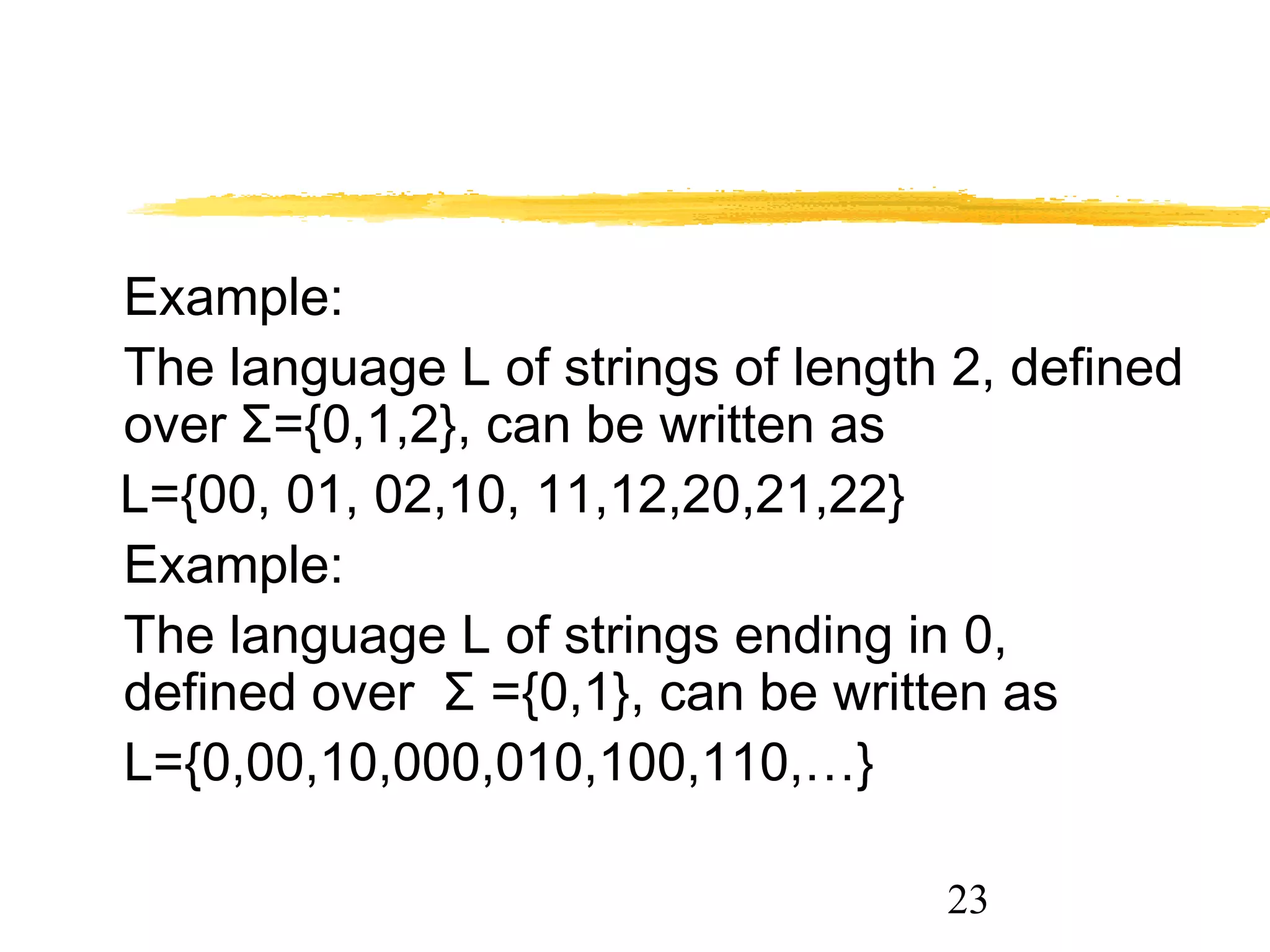
Example:
The language L of strings of length 2, defined
over Σ={0,1,2}, can be written as
L={00, 01, 02,10, 11,12,20,21,22}
Example:
The language L of strings ending in 0,
defined over Σ ={0,1}, can be written as
L={0,00,10,000,010,100,110,…}
24
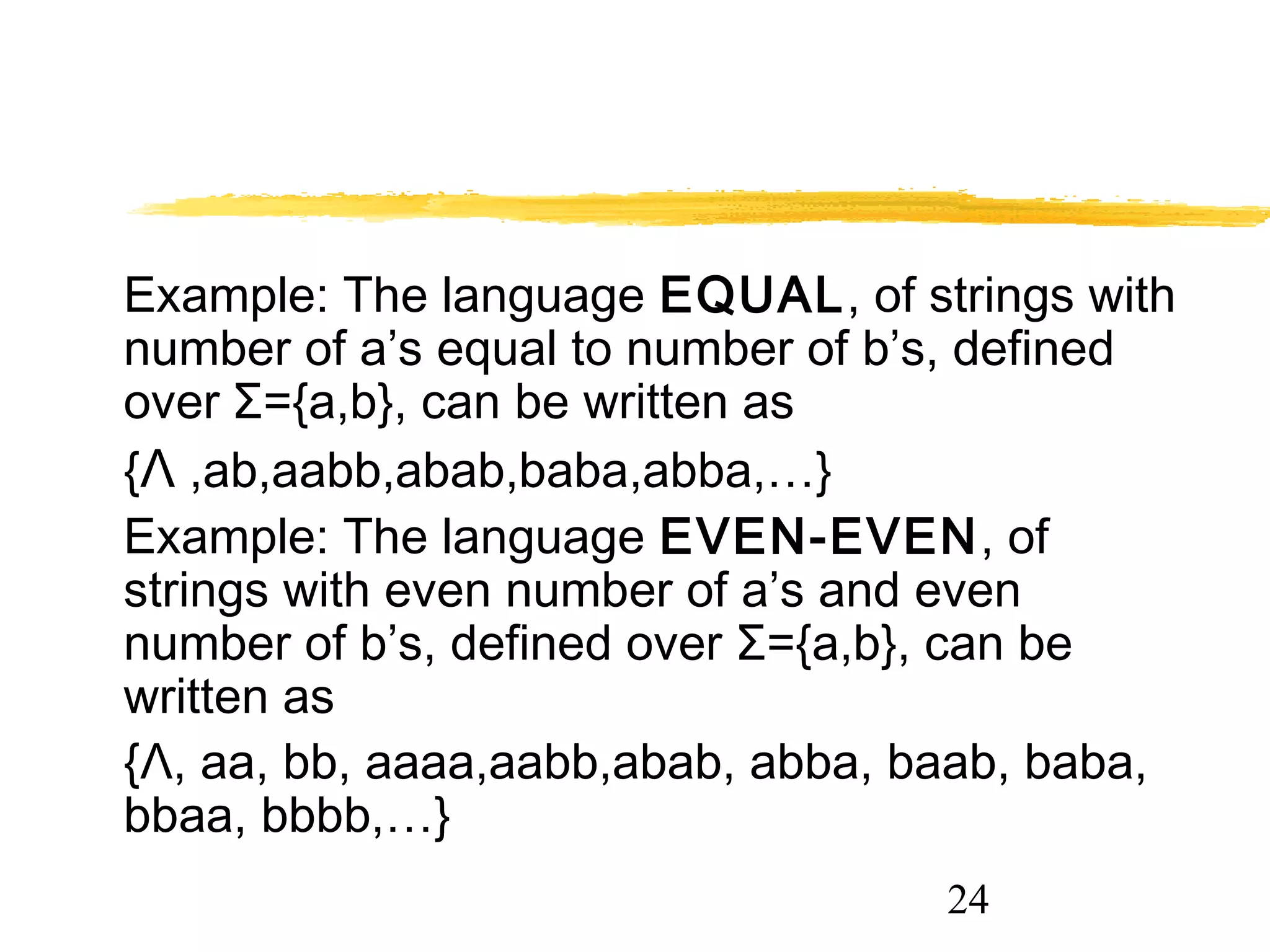
Example: The language EQUAL, of strings with
number of a’s equal to number of b’s, defined
over Σ={a,b}, can be written as
{Λ ,ab,aabb,abab,baba,abba,…}
Example: The language EVEN-EVEN, of
strings with even number of a’s and even
number of b’s, defined over Σ={a,b}, can be
written as
{Λ, aa, bb, aaaa,aabb,abab, abba, baab, baba,
bbaa, bbbb,…}
25
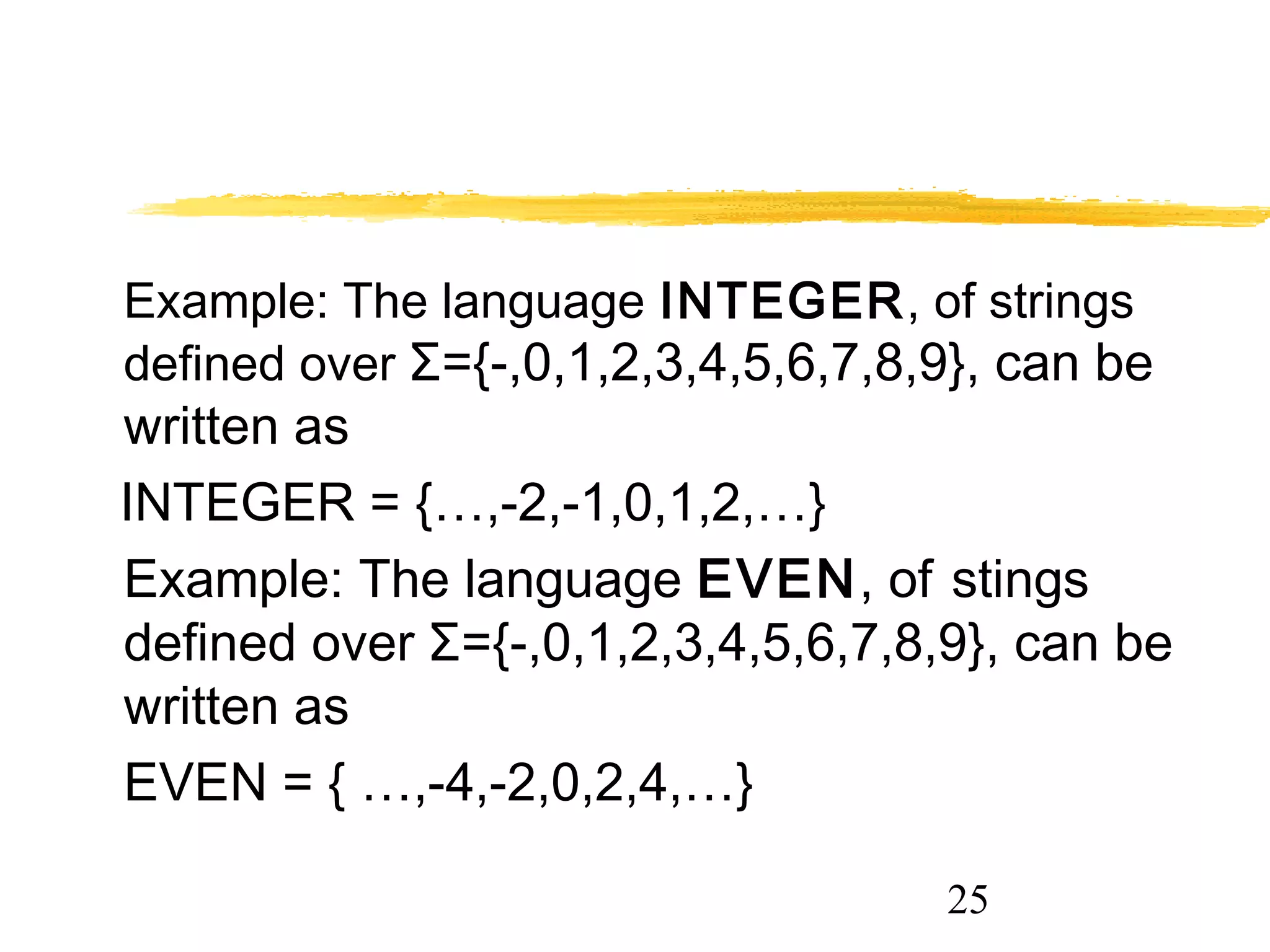
Example: The language INTEGER, of strings
defined over Σ={-,0,1,2,3,4,5,6,7,8,9}, can be
written as
INTEGER = {…,-2,-1,0,1,2,…}
Example: The language EVEN, of stings
defined over Σ={-,0,1,2,3,4,5,6,7,8,9}, can be
written as
EVEN = { …,-4,-2,0,2,4,…}
26
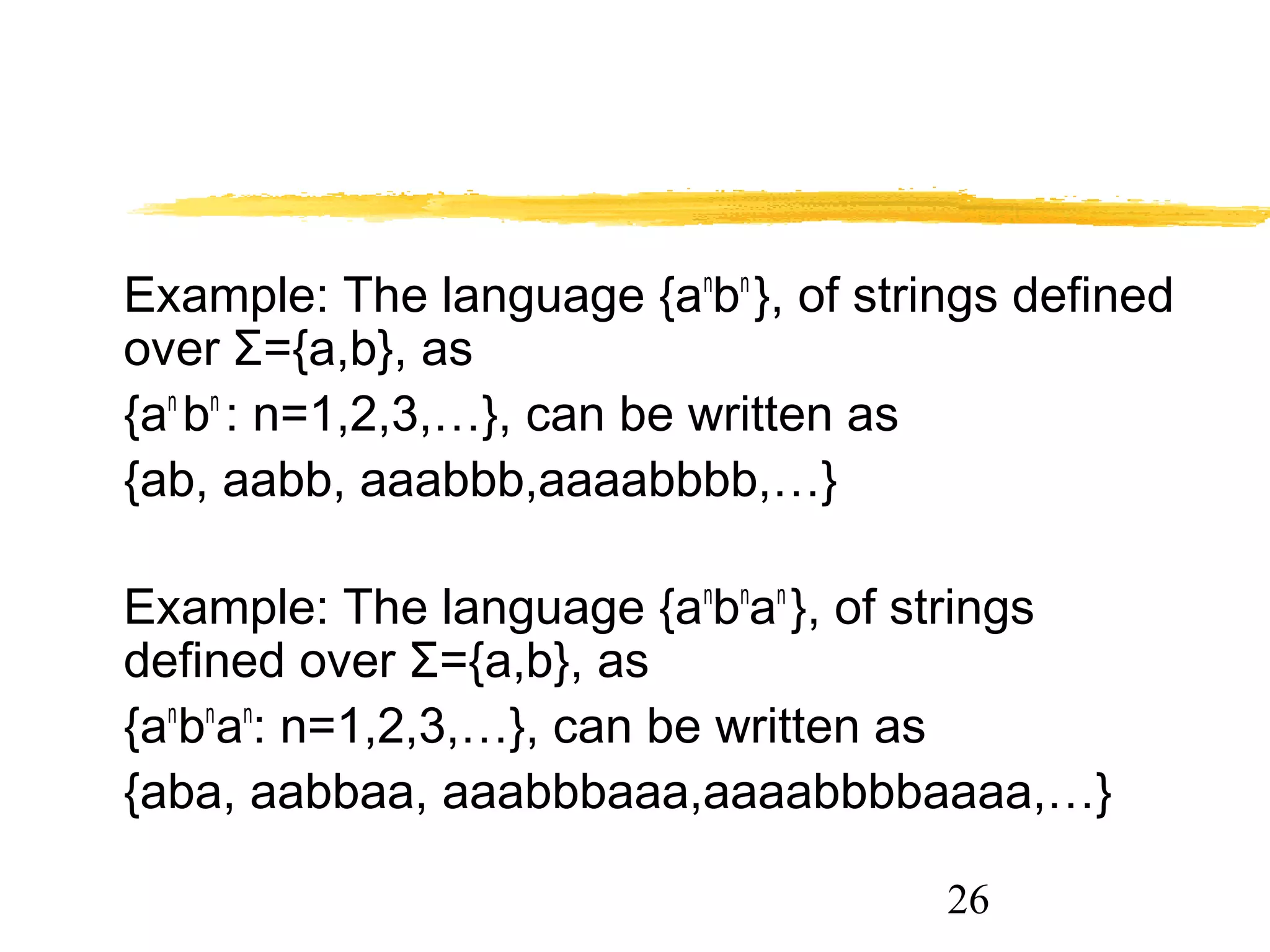
Example: The language {an
bn
}, of strings defined
over Σ={a,b}, as
{an
bn
: n=1,2,3,…}, can be written as
{ab, aabb, aaabbb,aaaabbbb,…}
Example: The language {an
bn
an
}, of strings
defined over Σ={a,b}, as
{an
bn
an
: n=1,2,3,…}, can be written as
{aba, aabbaa, aaabbbaaa,aaaabbbbaaaa,…}
27
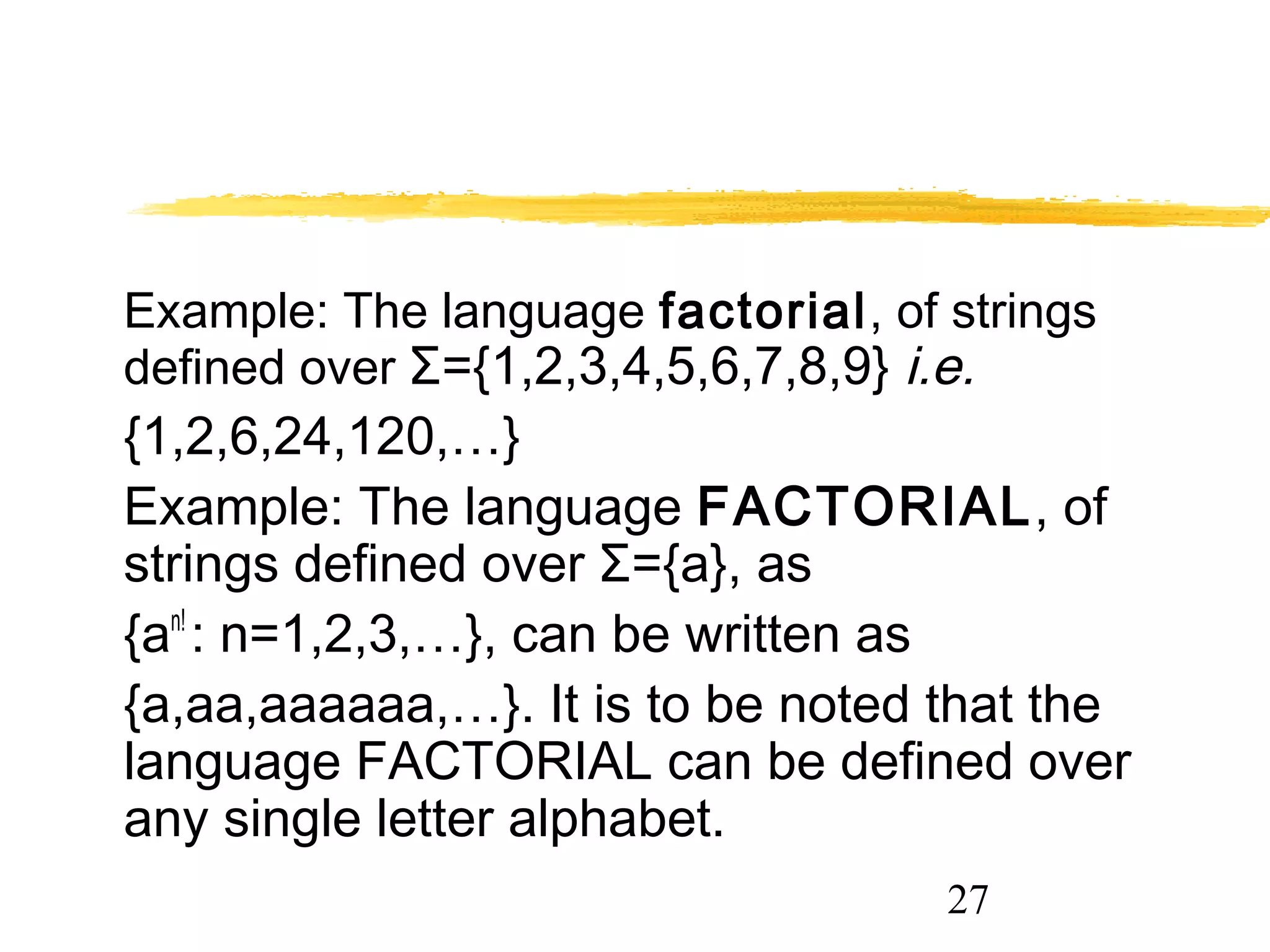
Example: The language factorial, of strings
defined over Σ={1,2,3,4,5,6,7,8,9} i.e.
{1,2,6,24,120,…}
Example: The language FACTORIAL, of
strings defined over Σ={a}, as
{an!
: n=1,2,3,…}, can be written as
{a,aa,aaaaaa,…}. It is to be noted that the
language FACTORIAL can be defined over
any single letter alphabet.
28
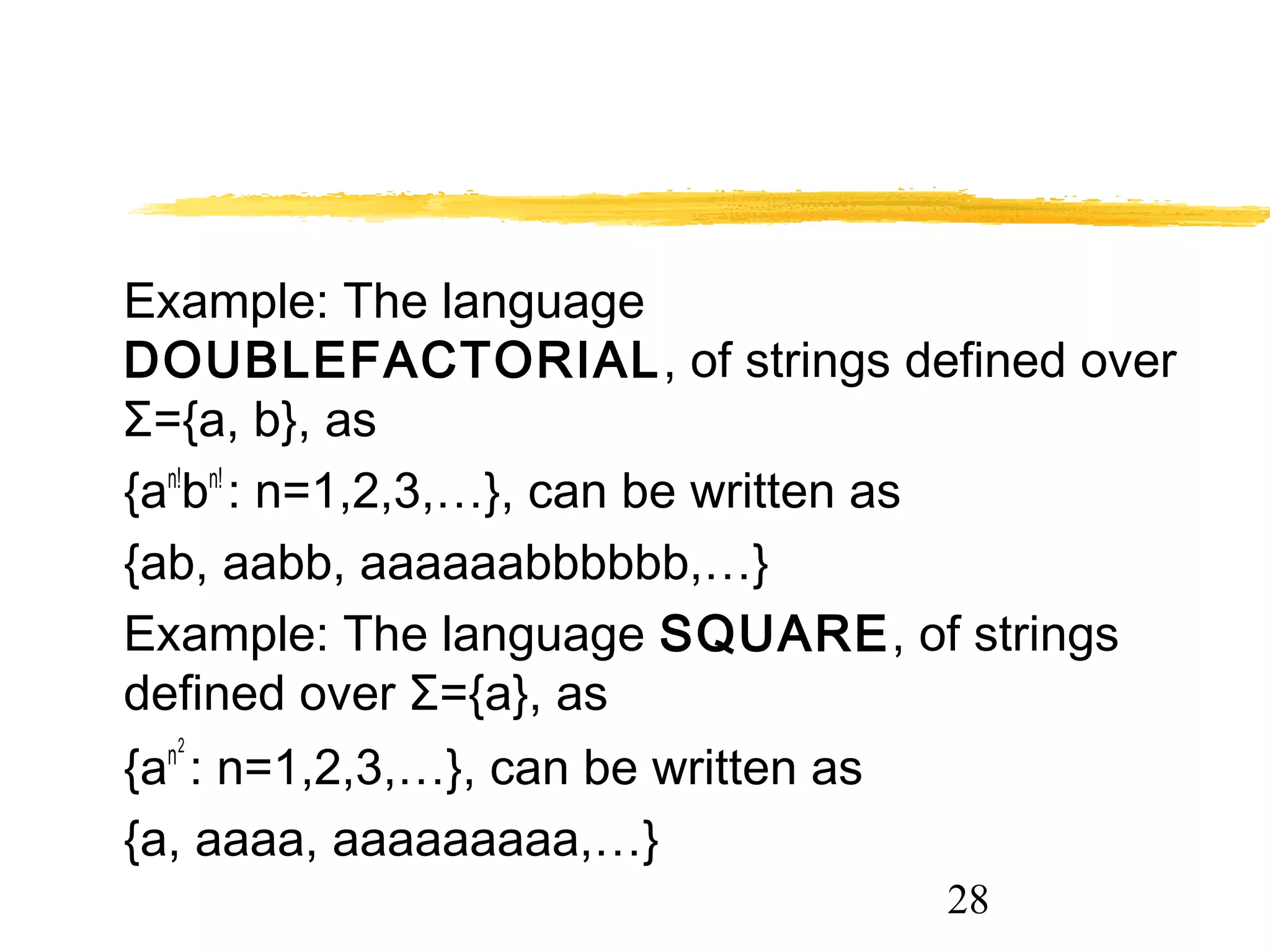
Example: The language
DOUBLEFACTORIAL, of strings defined over
Σ={a, b}, as
{an!
bn!
: n=1,2,3,…}, can be written as
{ab, aabb, aaaaaabbbbbb,…}
Example: The language SQUARE, of strings
defined over Σ={a}, as
{an2
: n=1,2,3,…}, can be written as
{a, aaaa, aaaaaaaaa,…}
29
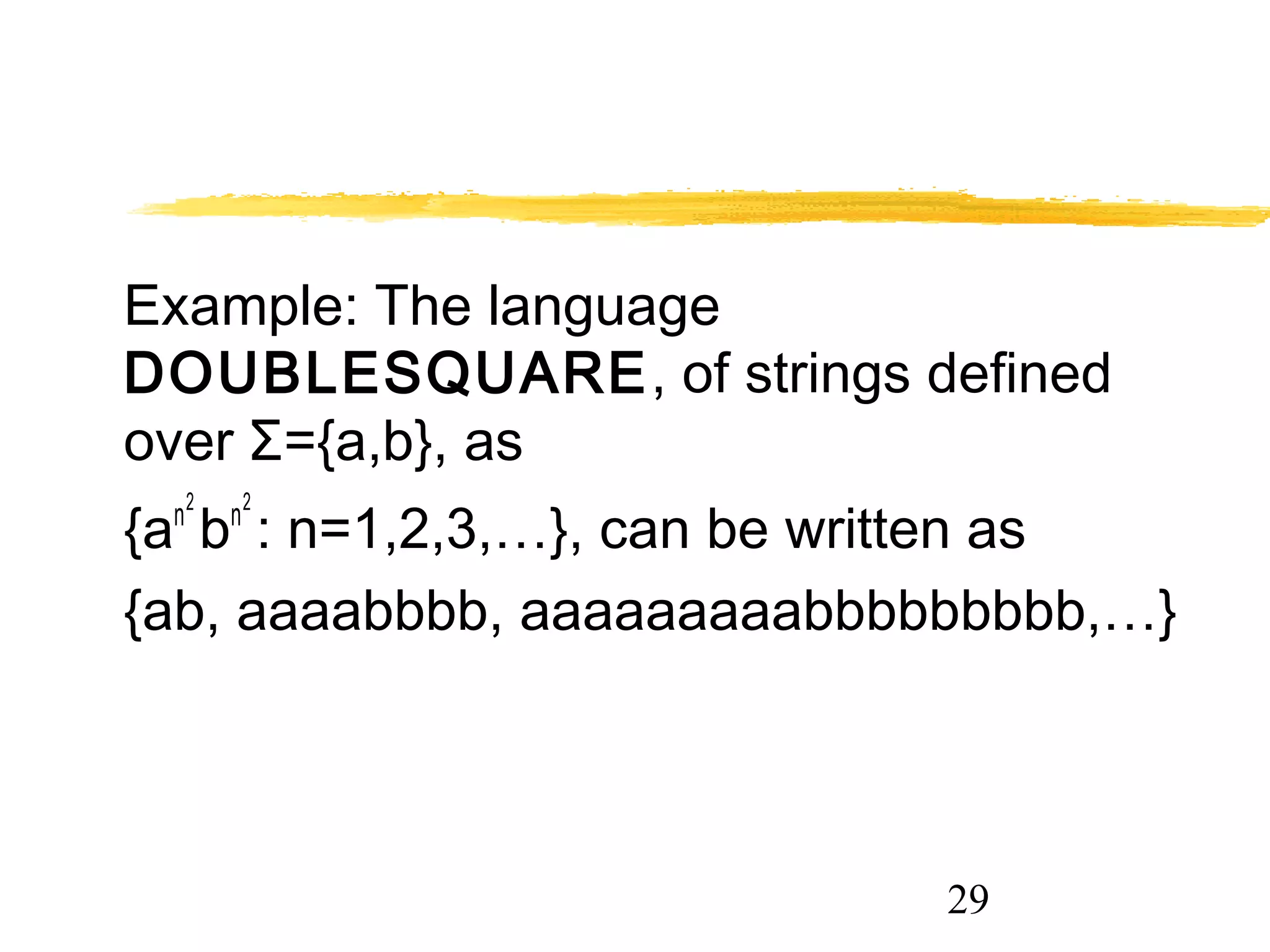
Example: The language
DOUBLESQUARE, of strings defined
over Σ={a,b}, as
{an2
bn2
: n=1,2,3,…}, can be written as
{ab, aaaabbbb, aaaaaaaaabbbbbbbbb,…}
30
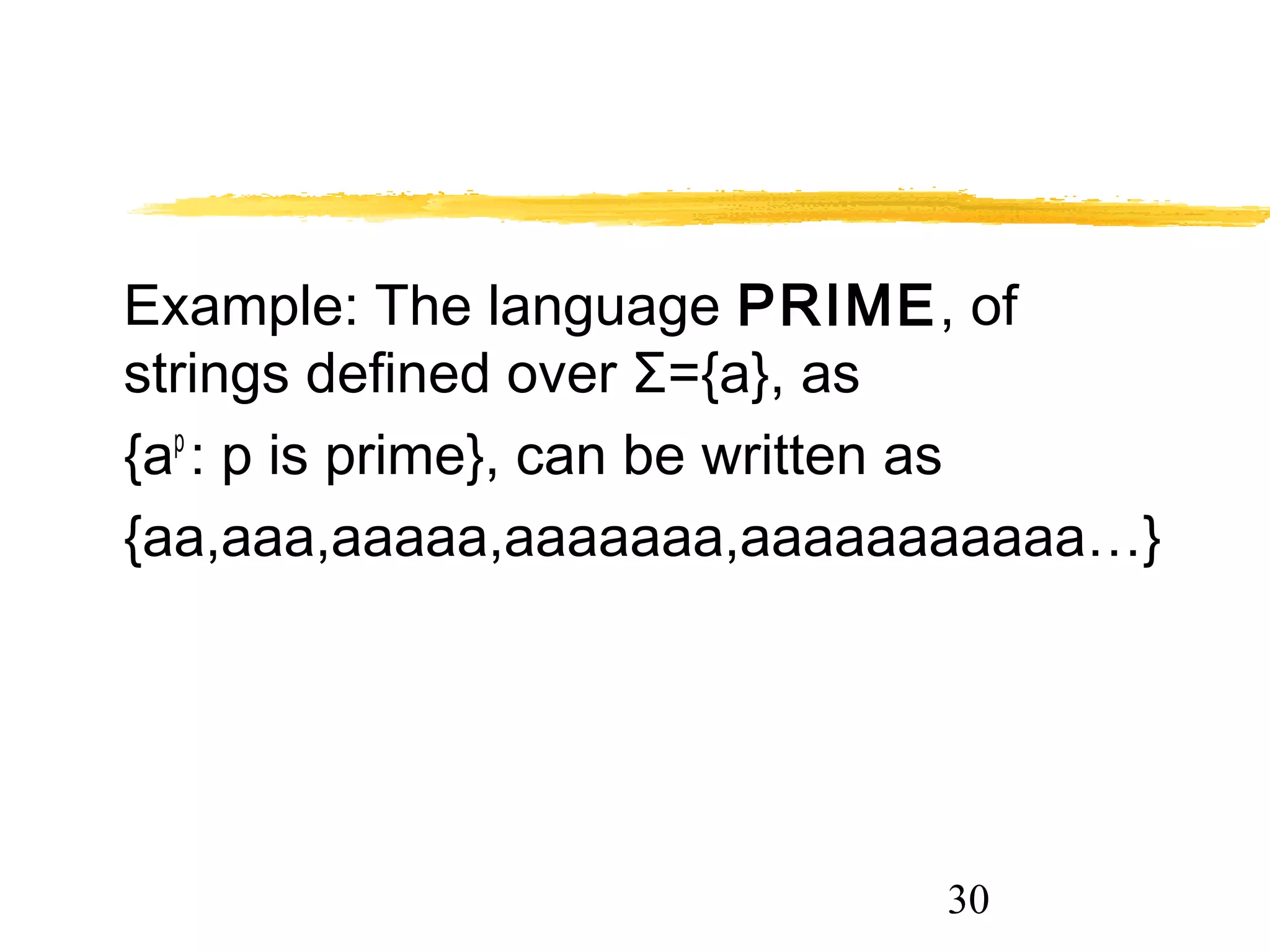
Example: The language PRIME, of
strings defined over Σ={a}, as
{ap
: p is prime}, can be written as
{aa,aaa,aaaaa,aaaaaaa,aaaaaaaaaaa…}
31
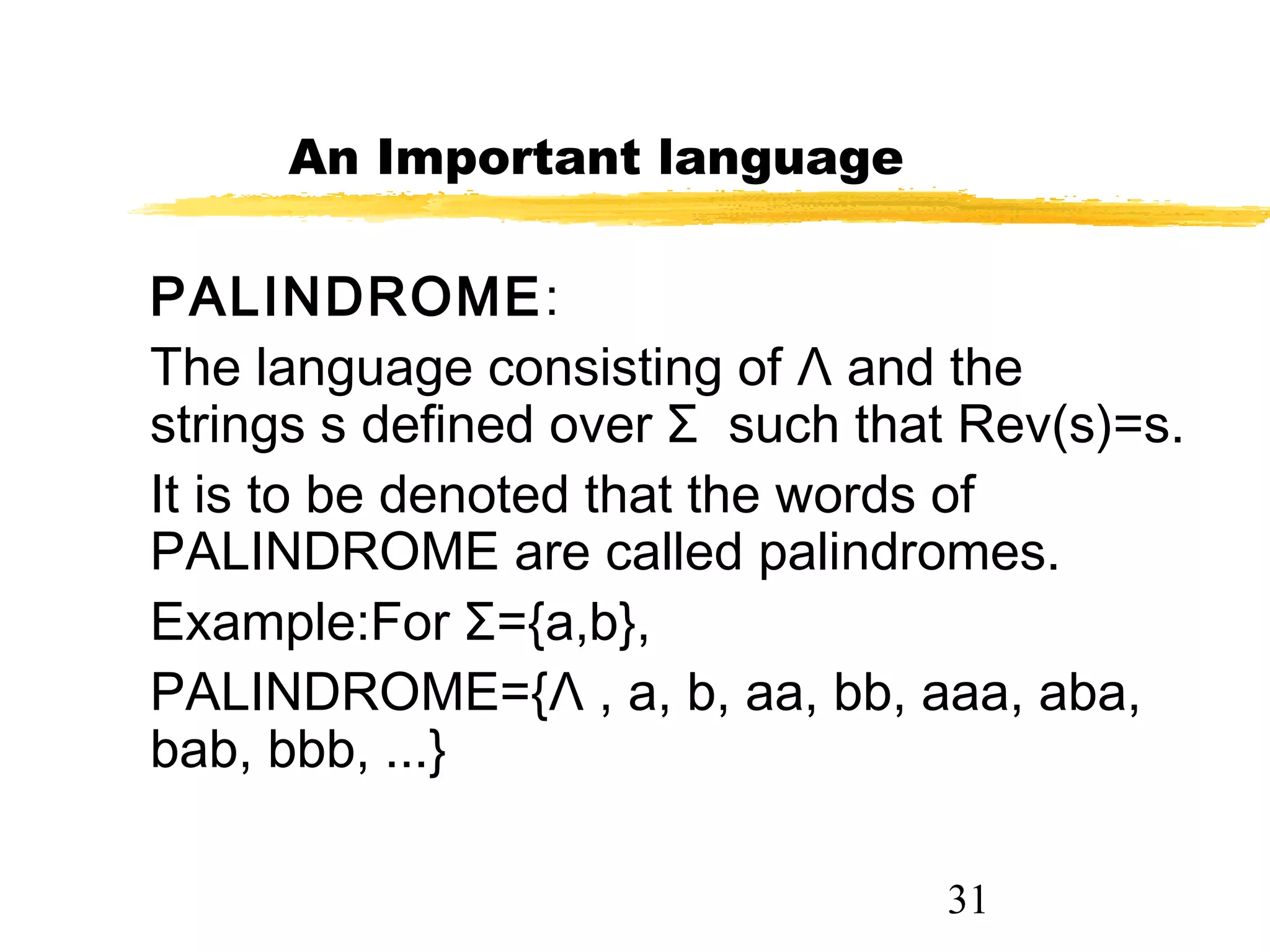
An Important language
PALINDROME:
The language consisting of Λ and the
strings s defined over Σ such that Rev(s)=s.
It is to be denoted that the words of
PALINDROME are called palindromes.
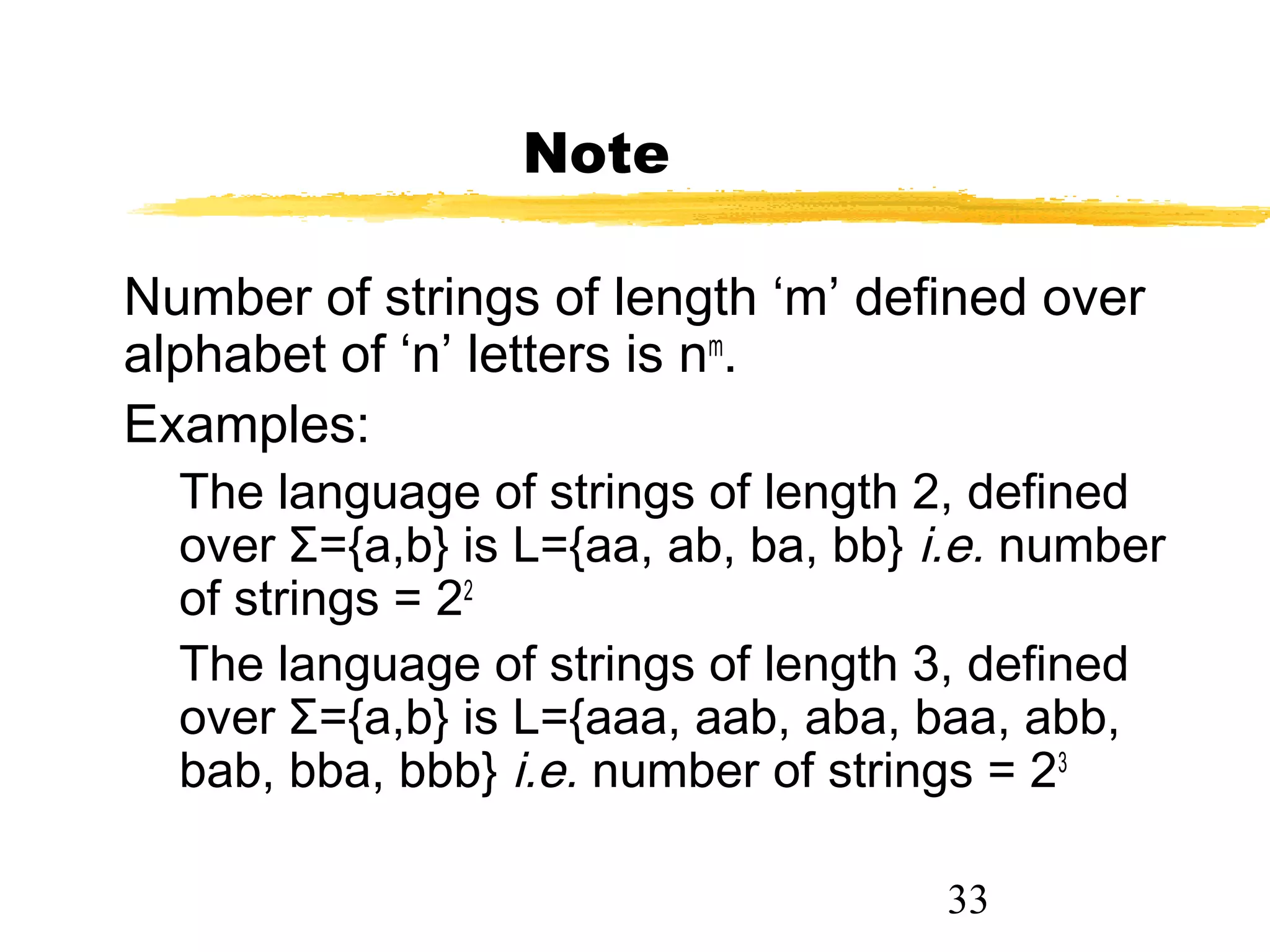
Example:For Σ={a,b},
PALINDROME={Λ , a, b, aa, bb, aaa, aba,
bab, bbb, ...}
32
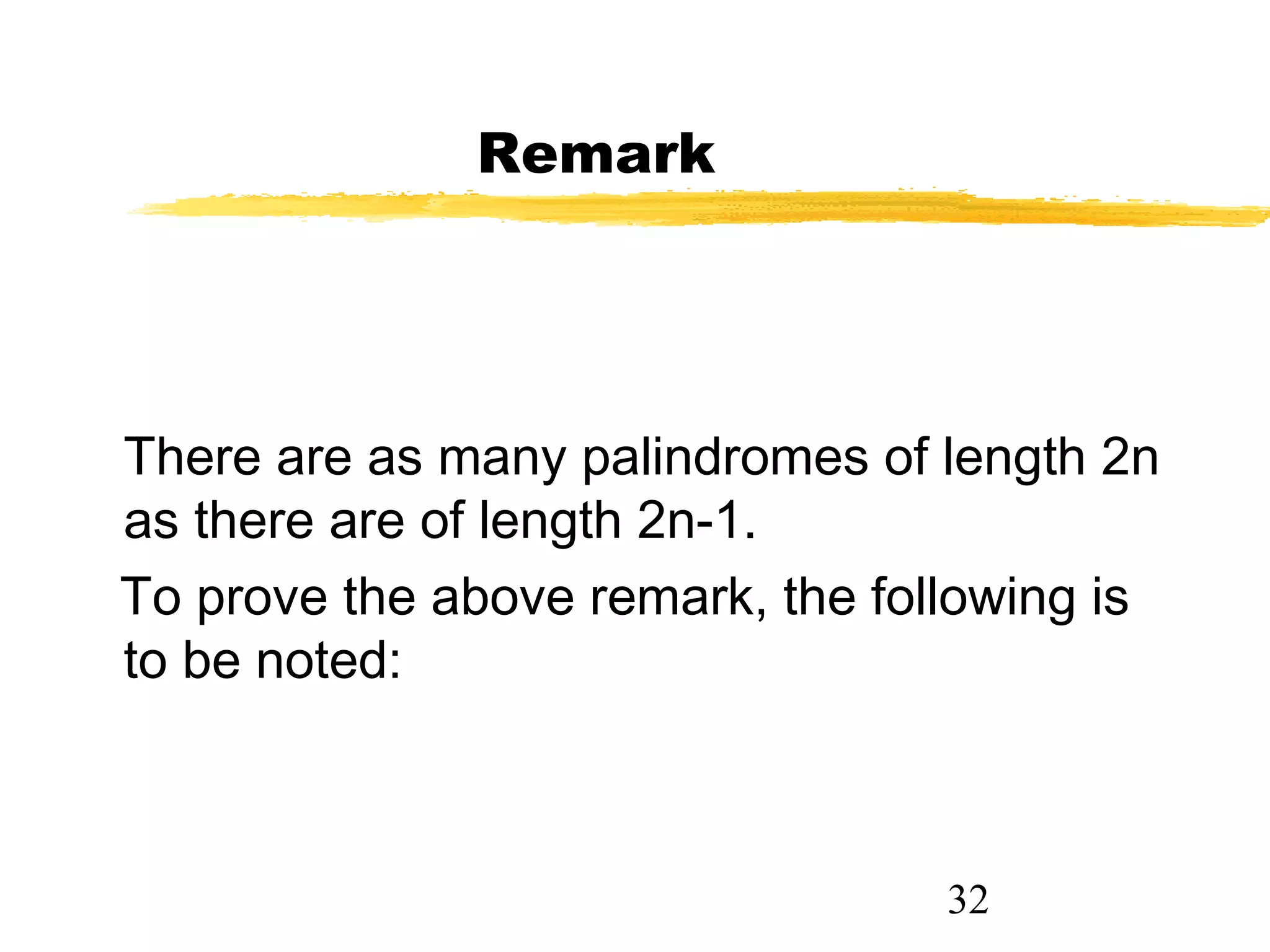
Remark
There are as many palindromes of length 2n
as there are of length 2n-1.
To prove the above remark, the following is
to be noted:
33
Note
Number of strings of length ‘m’ defined over
alphabet of ‘n’ letters is nm
.
Examples:
The language of strings of length 2, defined
over Σ={a,b} is L={aa, ab, ba, bb} i.e. number
of strings = 22
The language of strings of length 3, defined
over Σ={a,b} is L={aaa, aab, aba, baa, abb,
bab, bba, bbb} i.e. number of strings = 23
34
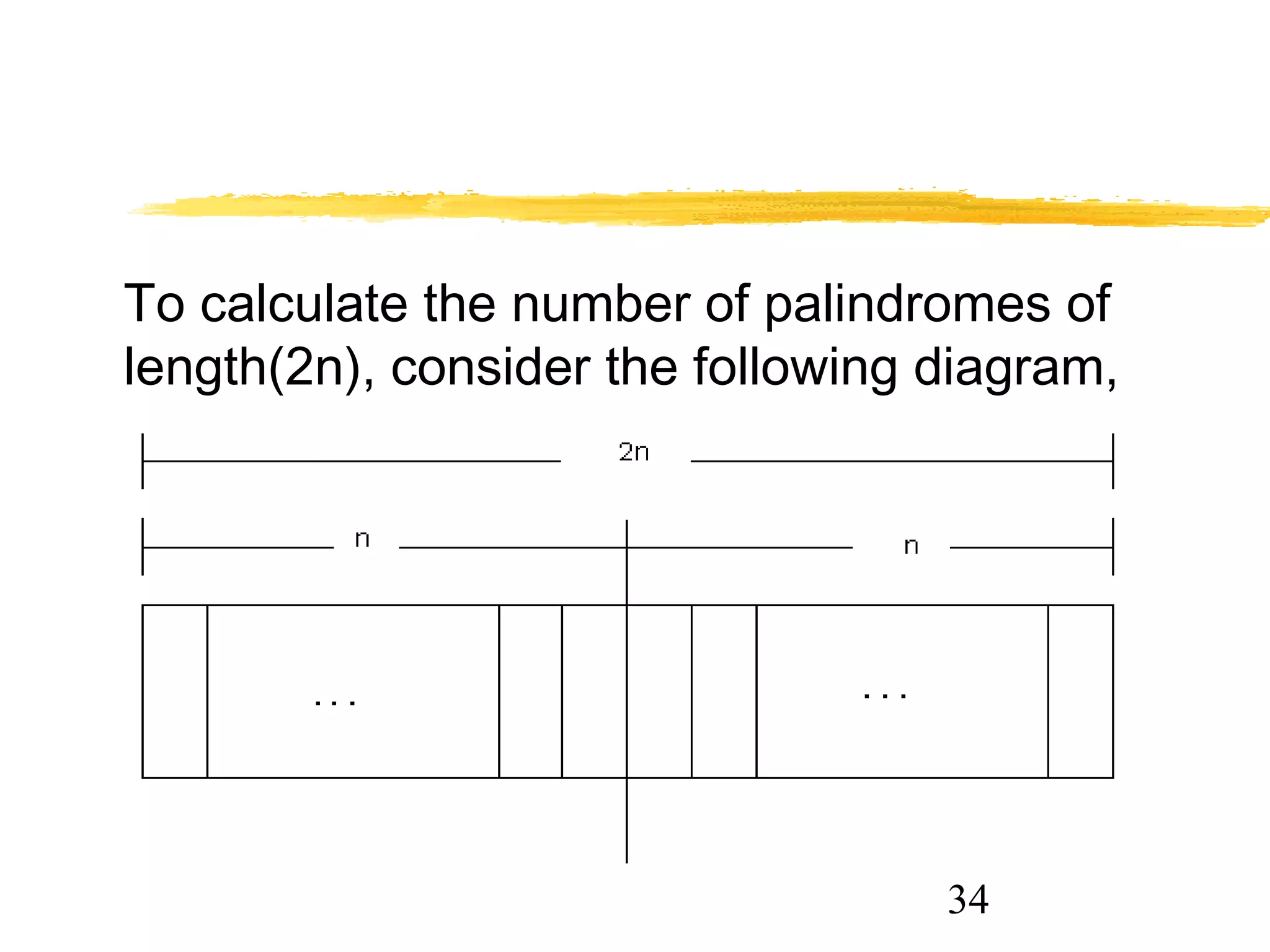
To calculate the number of palindromes of
length(2n), consider the following diagram,
35
which shows that there are as many
palindromes of length 2n as there are the strings
of length n i.e. the required number of
palindromes are 2n
.
36
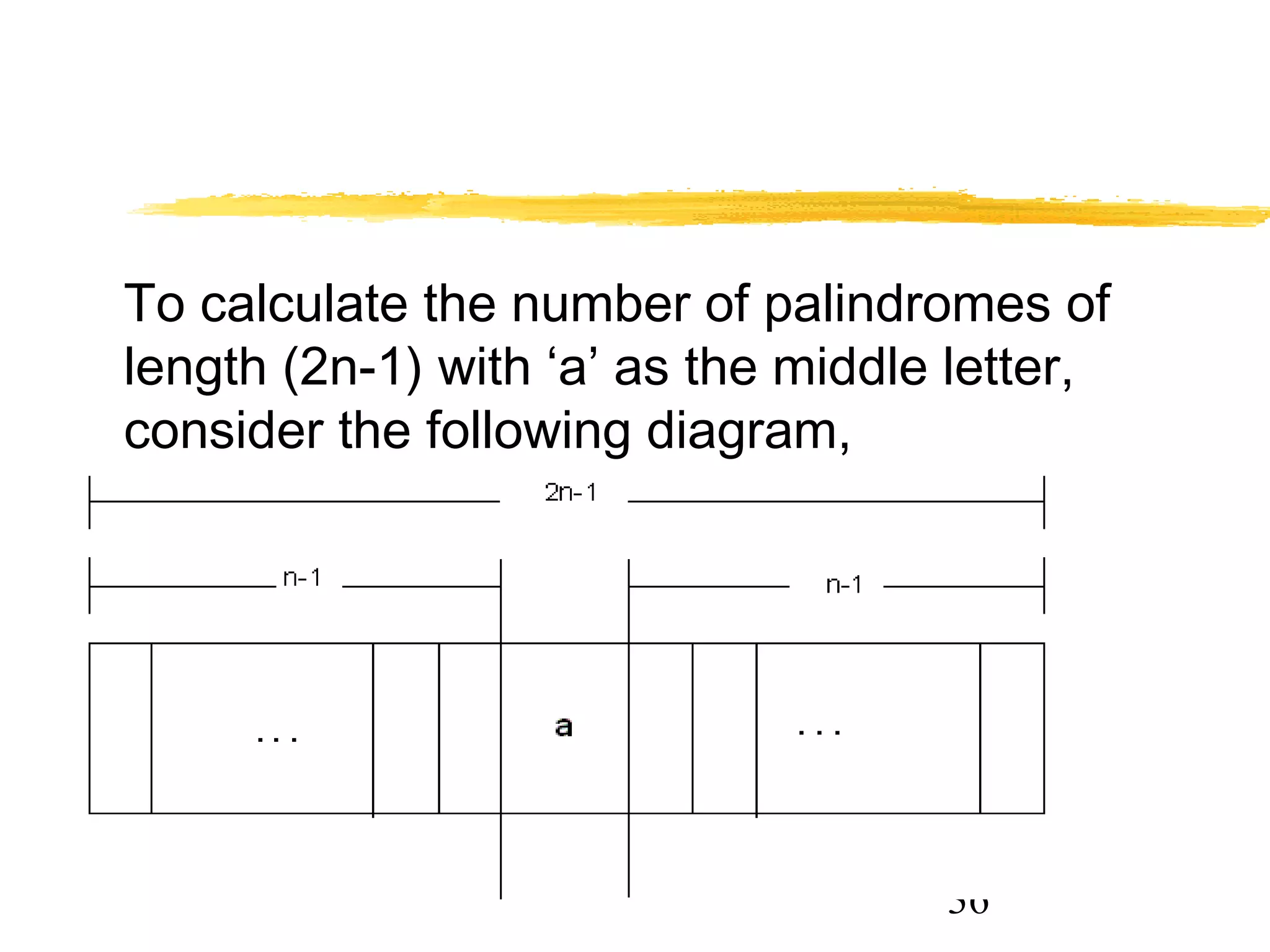
To calculate the number of palindromes of
length (2n-1) with ‘a’ as the middle letter,
consider the following diagram,
37
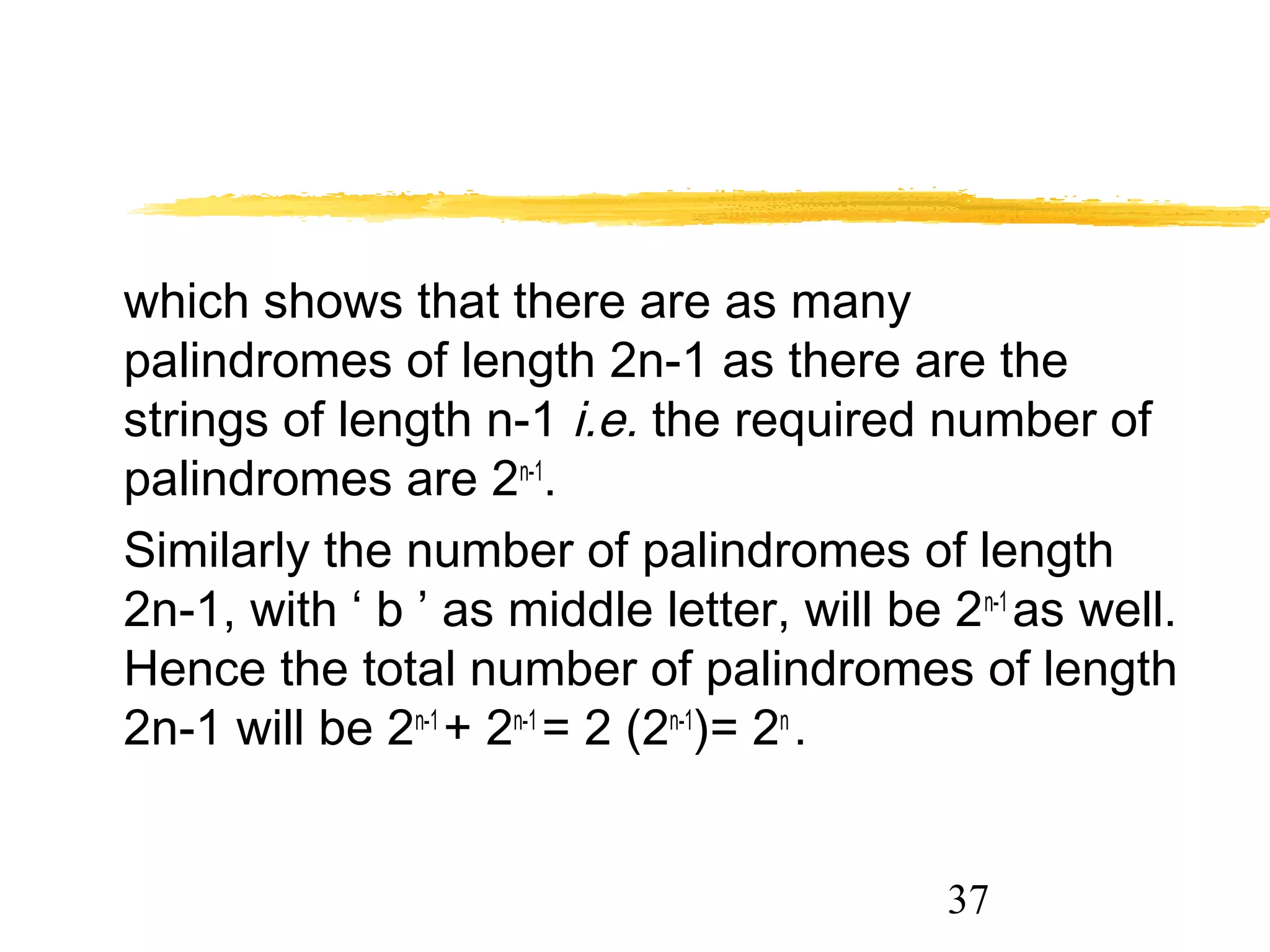
which shows that there are as many
palindromes of length 2n-1 as there are the
strings of length n-1 i.e. the required number of
palindromes are 2n-1
.
Similarly the number of palindromes of length
2n-1, with ‘ b ’ as middle letter, will be 2n-1
as well.
Hence the total number of palindromes of length
2n-1 will be 2n-1
+ 2n-1
= 2 (2n-1
)= 2n
.
38
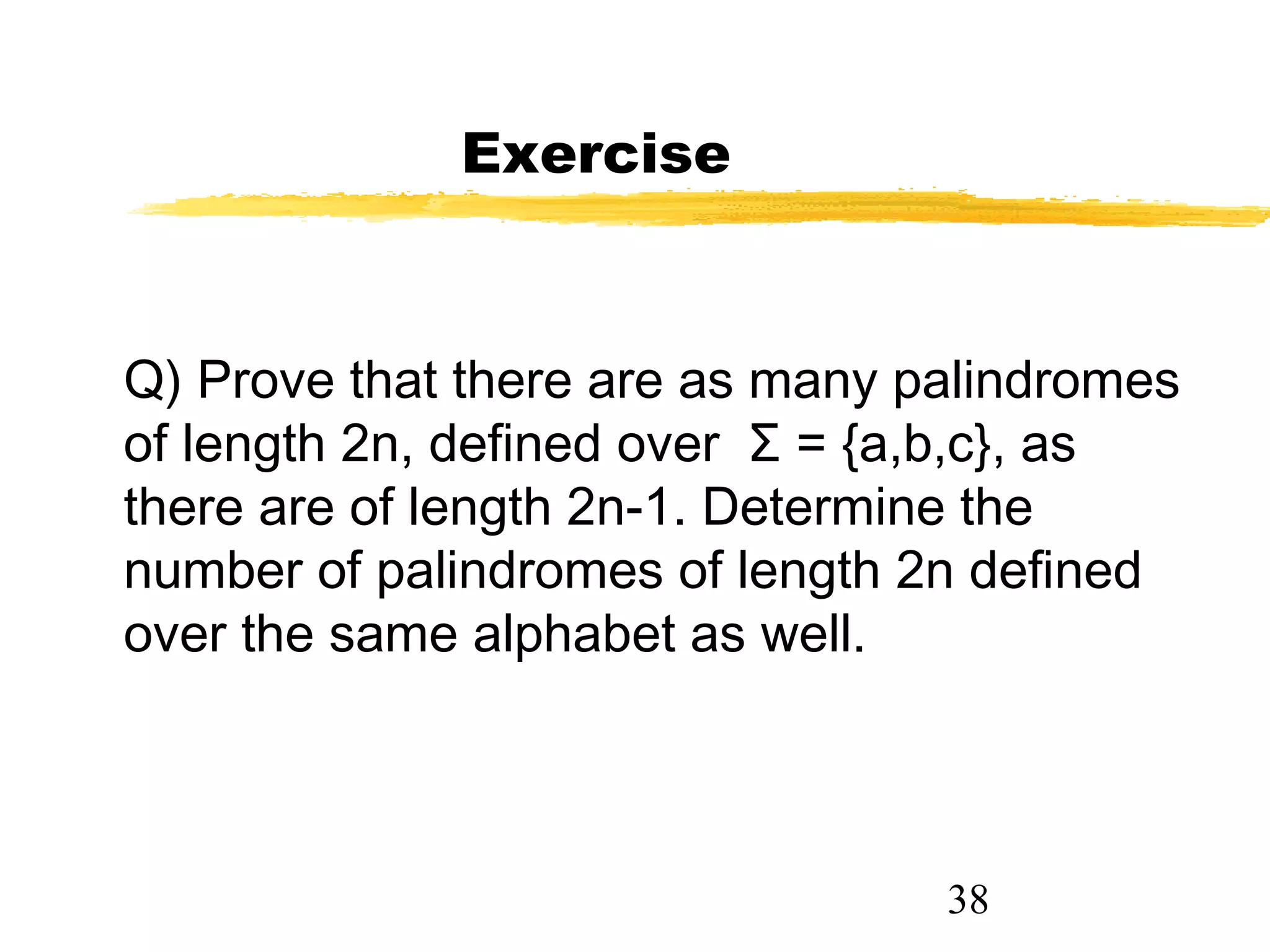
Exercise
Q) Prove that there are as many palindromes
of length 2n, defined over Σ = {a,b,c}, as
there are of length 2n-1. Determine the
number of palindromes of length 2n defined
over the same alphabet as well.
39
SummingUp Lecture-1
Introduction to the course title, Formal and In-
formal languages, Alphabets, Strings, Null string,
Words, Valid and In-valid alphabets, length of a
string, Reverse of a string, Defining languages,
Descriptive definition of languages, EQUAL,
EVEN-EVEN, INTEGER, EVEN, { an
bn
}, { an
bn
an
},
factorial, FACTORIAL, DOUBLEFACTORIAL,
SQUARE, DOUBLESQUARE, PRIME,
PALINDROME.

Theory of Automata

  • 1.
  • 2.
    2 Text and ReferenceMaterial 1. Introduction to Computer Theory, by Daniel I. Cohen, John Wiley and Sons, Inc., 1991, Second Edition 2. Introduction to Languages and Theory of Computation, by J. C. Martin, McGraw Hill Book Co., 1997, Second Edition
  • 3.
    3 Grading There will beOne term exam and one final exam. The final exam will be comprehensive. These will contribute the following percentages to the final grade: Mid-Term Exams. 35% Assignments 15% Final Exams. 50%
  • 4.
    4 What does automatamean? It is the plural of automaton, and it means “something that works automatically”
  • 5.
    5 Introduction to languages Thereare two types of languages Formal Languages (Syntactic languages) Informal Languages (Semantic languages)
  • 6.
    6 Alphabets Definition: A finite non-emptyset of symbols (letters), is called an alphabet. It is denoted by Σ ( Greek letter sigma). Example: Σ={a,b} Σ={0,1} //important as this is the language //which the computer understands. Σ={i,j,k}
  • 7.
    7 NOTE: A certain versionof language ALGOL has 113 letters Σ (alphabet) includes letters, digits and a variety of operators including sequential operators such as GOTO and IF
  • 8.
    8 Strings Definition: Concatenation of finitesymbols from the alphabet is called a string. Example: If Σ= {a,b} then a, abab, aaabb, ababababababababab
  • 9.
    9 NOTE: EMPTY STRING orNULL STRING Sometimes a string with no symbol at all is used, denoted by (Small Greek letter Lambda) λ or (Capital Greek letter Lambda) Λ, is called an empty string or null string. The capital lambda will mostly be used to denote the empty string, in further discussion.
  • 10.
    10 Words Definition: Words are stringsbelonging to some language. Example: If Σ= {x} then a language L can be defined as L={xn : n=1,2,3,…..} or L={x,xx,xxx,….} Here x,xx,… are the words of L
  • 11.
    11 NOTE: All words arestrings, but not all strings are words.
  • 12.
    12 Valid/In-valid alphabets While definingan alphabet, an alphabet may contain letters consisting of group of symbols for example Σ1= {B, aB, bab, d}. Now consider an alphabet Σ2= {B, Ba, bab, d} and a string BababB.
  • 13.
    13 This string canbe tokenized in two different ways (Ba), (bab), (B) (B), (abab), (B) Which shows that the second group cannot be identified as a string, defined over Σ = {a, b}.
  • 14.
    14 As when thisstring is scanned by the compiler (Lexical Analyzer), first symbol B is identified as a letter belonging to Σ, while for the second letter the lexical analyzer would not be able to identify, so while defining an alphabet it should be kept in mind that ambiguity should not be created.
  • 15.
    15 Remarks: While defining analphabet of letters consisting of more than one symbols, no letter should be started with the letter of the same alphabet i.e. one letter should not be the prefix of another. However, a letter may be ended in the letter of same alphabet i.e. one letter may be the suffix of another.
  • 16.
    16 Conclusion Σ1= {B, aB,bab, d} Σ2= {B, Ba, bab, d} Σ1 is a valid alphabet while Σ2 is an in-valid alphabet.
  • 17.
    17 Length of Strings Definition: Thelength of string s, denoted by |s|, is the number of letters in the string. Example: Σ={a,b} s=ababa |s|=5
  • 18.
    18 Example: Σ= {B, aB,bab, d} s=BaBbabBd Tokenizing=(B), (aB), (bab), (d) |s|=4
  • 19.
    19 Reverse of aString Definition: The reverse of a string s denoted by Rev(s) or sr , is obtained by writing the letters of s in reverse order. Example: If s=abc is a string defined over Σ={a,b,c} then Rev(s) or sr = cba
  • 20.
    20 Example: Σ= {B, aB,bab, d} s=BaBbabBd Rev(s)=dBbabaBB
  • 21.
    21 Lecture 2 Defining Languages Thelanguages can be defined in different ways , such as Descriptive definition, Recursive definition, using Regular Expressions(RE) and using Finite Automaton(FA) etc. Descriptive definition of language: The language is defined, describing the conditions imposed on its words.
  • 22.
    22 Example: The language Lof strings of odd length, defined over Σ={a}, can be written as L={a, aaa, aaaaa,…..} Example: The language L of strings that does not start with a, defined over Σ={a,b,c}, can be written as L={b, c, ba, bb, bc, ca, cb, cc, …}
  • 23.
    23 Example: The language Lof strings of length 2, defined over Σ={0,1,2}, can be written as L={00, 01, 02,10, 11,12,20,21,22} Example: The language L of strings ending in 0, defined over Σ ={0,1}, can be written as L={0,00,10,000,010,100,110,…}
  • 24.
    24 Example: The languageEQUAL, of strings with number of a’s equal to number of b’s, defined over Σ={a,b}, can be written as {Λ ,ab,aabb,abab,baba,abba,…} Example: The language EVEN-EVEN, of strings with even number of a’s and even number of b’s, defined over Σ={a,b}, can be written as {Λ, aa, bb, aaaa,aabb,abab, abba, baab, baba, bbaa, bbbb,…}
  • 25.
    25 Example: The languageINTEGER, of strings defined over Σ={-,0,1,2,3,4,5,6,7,8,9}, can be written as INTEGER = {…,-2,-1,0,1,2,…} Example: The language EVEN, of stings defined over Σ={-,0,1,2,3,4,5,6,7,8,9}, can be written as EVEN = { …,-4,-2,0,2,4,…}
  • 26.
    26 Example: The language{an bn }, of strings defined over Σ={a,b}, as {an bn : n=1,2,3,…}, can be written as {ab, aabb, aaabbb,aaaabbbb,…} Example: The language {an bn an }, of strings defined over Σ={a,b}, as {an bn an : n=1,2,3,…}, can be written as {aba, aabbaa, aaabbbaaa,aaaabbbbaaaa,…}
  • 27.
    27 Example: The languagefactorial, of strings defined over Σ={1,2,3,4,5,6,7,8,9} i.e. {1,2,6,24,120,…} Example: The language FACTORIAL, of strings defined over Σ={a}, as {an! : n=1,2,3,…}, can be written as {a,aa,aaaaaa,…}. It is to be noted that the language FACTORIAL can be defined over any single letter alphabet.
  • 28.
    28 Example: The language DOUBLEFACTORIAL,of strings defined over Σ={a, b}, as {an! bn! : n=1,2,3,…}, can be written as {ab, aabb, aaaaaabbbbbb,…} Example: The language SQUARE, of strings defined over Σ={a}, as {an2 : n=1,2,3,…}, can be written as {a, aaaa, aaaaaaaaa,…}
  • 29.
    29 Example: The language DOUBLESQUARE,of strings defined over Σ={a,b}, as {an2 bn2 : n=1,2,3,…}, can be written as {ab, aaaabbbb, aaaaaaaaabbbbbbbbb,…}
  • 30.
    30 Example: The languagePRIME, of strings defined over Σ={a}, as {ap : p is prime}, can be written as {aa,aaa,aaaaa,aaaaaaa,aaaaaaaaaaa…}
  • 31.
    31 An Important language PALINDROME: Thelanguage consisting of Λ and the strings s defined over Σ such that Rev(s)=s. It is to be denoted that the words of PALINDROME are called palindromes. Example:For Σ={a,b}, PALINDROME={Λ , a, b, aa, bb, aaa, aba, bab, bbb, ...}
  • 32.
    32 Remark There are asmany palindromes of length 2n as there are of length 2n-1. To prove the above remark, the following is to be noted:
  • 33.
    33 Note Number of stringsof length ‘m’ defined over alphabet of ‘n’ letters is nm . Examples: The language of strings of length 2, defined over Σ={a,b} is L={aa, ab, ba, bb} i.e. number of strings = 22 The language of strings of length 3, defined over Σ={a,b} is L={aaa, aab, aba, baa, abb, bab, bba, bbb} i.e. number of strings = 23
  • 34.
    34 To calculate thenumber of palindromes of length(2n), consider the following diagram,
  • 35.
    35 which shows thatthere are as many palindromes of length 2n as there are the strings of length n i.e. the required number of palindromes are 2n .
  • 36.
    36 To calculate thenumber of palindromes of length (2n-1) with ‘a’ as the middle letter, consider the following diagram,
  • 37.
    37 which shows thatthere are as many palindromes of length 2n-1 as there are the strings of length n-1 i.e. the required number of palindromes are 2n-1 . Similarly the number of palindromes of length 2n-1, with ‘ b ’ as middle letter, will be 2n-1 as well. Hence the total number of palindromes of length 2n-1 will be 2n-1 + 2n-1 = 2 (2n-1 )= 2n .
  • 38.
    38 Exercise Q) Prove thatthere are as many palindromes of length 2n, defined over Σ = {a,b,c}, as there are of length 2n-1. Determine the number of palindromes of length 2n defined over the same alphabet as well.
  • 39.
    39 SummingUp Lecture-1 Introduction tothe course title, Formal and In- formal languages, Alphabets, Strings, Null string, Words, Valid and In-valid alphabets, length of a string, Reverse of a string, Defining languages, Descriptive definition of languages, EQUAL, EVEN-EVEN, INTEGER, EVEN, { an bn }, { an bn an }, factorial, FACTORIAL, DOUBLEFACTORIAL, SQUARE, DOUBLESQUARE, PRIME, PALINDROME.