CSC218
COMPUTERORGANIZATIONANDFORMALLANGUAGES
Push down automata (PDA).
Nnamene C.C 1
Overview
• Introduction to Push Down Automata (PDA)
• Implementation
• State Operations
2
Push down Automata (PDA)
• This is similar to the FSM, but has additional memory
• This memory uses a stack, which has two operations:
• Push (add a new symbol at the top)
• Pop (read and remove the top symbol)
3
PDA = Finite Automata + Memory (Stack)
a1 a2 a3 .. anInput
FSM
Stack
Used to manipulate the
stacks from the states
Structure of the Push Down Automaton
From left to right 
PDA cntd.
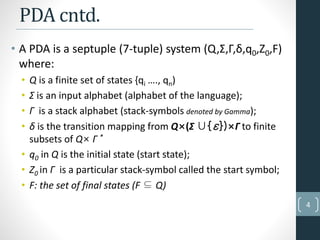
• A PDA is a septuple (7-tuple) system (Q,Σ,Г,δ,q0,Z0,F)
where:
• Q is a finite set of states {qi …., qn)
• Σ is an input alphabet (alphabet of the language);
• Г is a stack alphabet (stack-symbols denoted by Gamma);
• δ is the transition mapping from Q×(Σ ∪{ε})×Г to finite
subsets of Q× Г *
• q0 in Q is the initial state (start state);
• Z0 in Г is a particular stack-symbol called the start symbol;
• F: the set of final states (F ⊆ Q)
4
Conventions used
• Lower cases are used for input symbols eg. a, b, c,…
• e is also allowed as a possible value
• Upper cases are used for stack symbols
• Eg. X, Y, Z, …
• Lower case letters at the end of the alphabets are used
for strings of input symbols eg. x, y, z, …
• The beginning Greek alphabets are used for strings of
stack symbols
• Eg. a, b, …
5
Implementing PDA
• This take into account a transition function with the
following arguments:
1. A state, in Q
2. An input symbol in Σ or e
3. A stack symbol Г
6
For every δ(q, a, z), this will contain (p, a) such that:
p = a state
a = a string of stack symbols
In addition, a PDA having a state ‘q’, and ‘a’ at the front of
the input, and Z at the top of the stack implies:
change the state to p
Remove ‘a’ from the front of input
Replace Z on the top of the stack by ‘a’
Implementing PDA cntd.
Example.
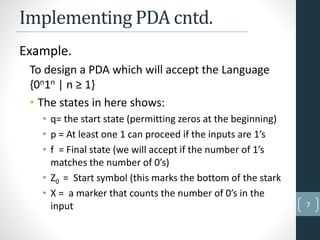
To design a PDA which will accept the Language
{0n1n | n ≥ 1}
• The states in here shows:
• q= the start state (permitting zeros at the beginning)
• p = At least one 1 can proceed if the inputs are 1’s
• f = Final state (we will accept if the number of 1’s
matches the number of 0’s)
• Z0 = Start symbol (this marks the bottom of the stark
• X = a marker that counts the number of 0’s in the
input 7
Implementing PDA
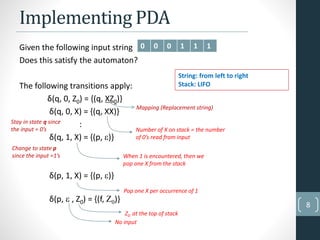
Given the following input string
Does this satisfy the automaton?
The following transitions apply:
δ(q, 0, Z0) = {(q, XZ0)}
δ(q, 0, X) = {(q, XX)}
:
δ(q, 1, X) = {(p, e)}
δ(p, 1, X) = {(p, e)}
δ(p, e , Z0) = {(f, Z0)}
8
Number of X on stack = the number
of 0’s read from input
When 1 is encountered, then we
pop one X from the stack
No input
Z0 at the top of stack
Pop one X per occurrence of 1
0 0 0 1 1 1
String: from left to right
Stack: LIFO
Stay in state q since
the input = 0’s
Change to state p
since the input =1’s
Mapping (Replacement string)
9
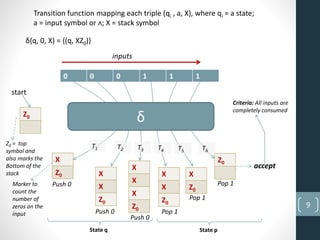
0 0 0 1 1 1
X
X
Z0
X
Z0
X
X
X
Z0
X
X
Z0
X
Z0
δ
Z0
Z0
start
T1 T2 T3 T4 T5
Push 0
Push 0
Push 0
Pop 1
Pop 1
Pop 1
T6
accept
Criteria: All inputs are
completely consumed
inputs
Transition function mapping each triple (qi , a, X), where qi = a state;
a = input symbol or ᴧ; X = stack symbol
δ(q, 0, X) = {(q, XZ0)}
Z0 = top
symbol and
also marks the
Bottom of the
stack
Marker to
count the
number of
zeros on the
input
State q State p
State Operations
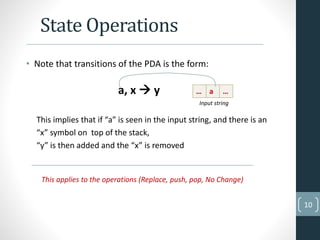
• Note that transitions of the PDA is the form:
a, x  y
This implies that if “a” is seen in the input string, and there is an
“x” symbol on top of the stack,
“y” is then added and the “x” is removed
10
This applies to the operations (Replace, push, pop, No Change)
… a …
Input string
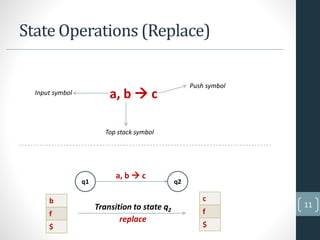
State Operations (Replace)
11
a, b  cInput symbol
Top stack symbol
Push symbol
q1 q2
a, b  c
b
f
$
c
f
$
Transition to state q2
replace
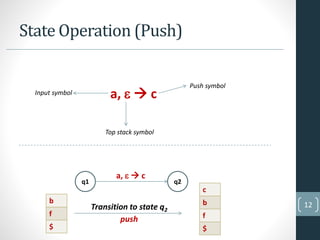
State Operation (Push)
12
a, e  cInput symbol
Top stack symbol
Push symbol
q1 q2
a, e  c
Transition to state q2
b
f
$
push
c
b
f
$
State Operation (Pop)
13
a, b  eInput symbol
Top stack symbol
Push symbol
q1 q2
a, b  e
Transition to state q2
b
f
$
pop
f
$
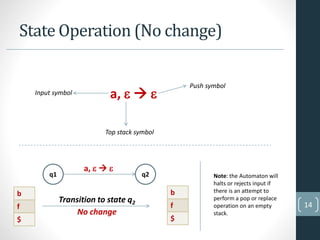
State Operation (No change)
14
a, e  eInput symbol
Top stack symbol
Push symbol
q1 q2
a, e  e
Transition to state q2
b
f
$
No change
b
f
$
Note: the Automaton will
halts or rejects input if
there is an attempt to
perform a pop or replace
operation on an empty
stack.
Condition for PDAacceptanceor rejection
• The PDA accepts if there is a computation such that:
• the computation path ends in an accept state, and
• all the inputs in the string is consumed.
• On the other hand, the PDA rejects if in all paths:
• the computation path ends in the non accepting state, and
• there is an incomplete computation path such that there is no
possible transition in the input and stack symbols.
15
Empty stack indicator ($)
• We place dollar sign ($) or Z0 as the case may be to
help indicate when the stack is empty.
• Discovering the sign again indicates the end of the
stack
16
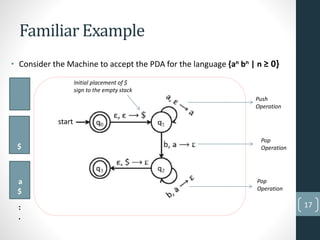
Familiar Example
• Consider the Machine to accept the PDA for the language {an bn | n ≥ 0}
17
start
Initial placement of $
sign to the empty stack
Push
Operation
Pop
Operation
Pop
Operation
$
$
a
:
.
Sequence of moves (Goes to “˫”)
• To describe the sequence of moves of the previous
example, the following holds:
• (q, 000111, Z0) ˫ (q, 00111, XZ0) ˫
• (q,0111, XXZ0) ˫ (q, 111, XXXZ0) ˫
• (p, 11, XXZ0) ˫ (p, 1, Z0) ˫
• (p, e, Z0) ˫ (f, e, Z0 )
• Therefore, (q, 000111, Z0) ˫ (f, e, Z0 )
18
Sequence of moves (Goes to “˫”)
• In a situation where there is an extra 1 eg. 0001111 on
the input, this gives the following sequence:
• (q, 0001111, Z0) ˫ (q, 001111, XZ0) ˫
• (q,01111, XXZ0) ˫ (q, 1111, XXXZ0) ˫
• (p, 111, XXZ0) ˫ (p, 11, XZ0) ˫ (p, 1, Z0) ˫
• (f, 1, Z0)
Therefore, 0001111 is not accepted.
19
THANK YOU!
20

push down automata

  • 1.
  • 2.
    Overview • Introduction toPush Down Automata (PDA) • Implementation • State Operations 2
  • 3.
    Push down Automata(PDA) • This is similar to the FSM, but has additional memory • This memory uses a stack, which has two operations: • Push (add a new symbol at the top) • Pop (read and remove the top symbol) 3 PDA = Finite Automata + Memory (Stack) a1 a2 a3 .. anInput FSM Stack Used to manipulate the stacks from the states Structure of the Push Down Automaton From left to right 
  • 4.
    PDA cntd. • APDA is a septuple (7-tuple) system (Q,Σ,Г,δ,q0,Z0,F) where: • Q is a finite set of states {qi …., qn) • Σ is an input alphabet (alphabet of the language); • Г is a stack alphabet (stack-symbols denoted by Gamma); • δ is the transition mapping from Q×(Σ ∪{ε})×Г to finite subsets of Q× Г * • q0 in Q is the initial state (start state); • Z0 in Г is a particular stack-symbol called the start symbol; • F: the set of final states (F ⊆ Q) 4
  • 5.
    Conventions used • Lowercases are used for input symbols eg. a, b, c,… • e is also allowed as a possible value • Upper cases are used for stack symbols • Eg. X, Y, Z, … • Lower case letters at the end of the alphabets are used for strings of input symbols eg. x, y, z, … • The beginning Greek alphabets are used for strings of stack symbols • Eg. a, b, … 5
  • 6.
    Implementing PDA • Thistake into account a transition function with the following arguments: 1. A state, in Q 2. An input symbol in Σ or e 3. A stack symbol Г 6 For every δ(q, a, z), this will contain (p, a) such that: p = a state a = a string of stack symbols In addition, a PDA having a state ‘q’, and ‘a’ at the front of the input, and Z at the top of the stack implies: change the state to p Remove ‘a’ from the front of input Replace Z on the top of the stack by ‘a’
  • 7.
    Implementing PDA cntd. Example. Todesign a PDA which will accept the Language {0n1n | n ≥ 1} • The states in here shows: • q= the start state (permitting zeros at the beginning) • p = At least one 1 can proceed if the inputs are 1’s • f = Final state (we will accept if the number of 1’s matches the number of 0’s) • Z0 = Start symbol (this marks the bottom of the stark • X = a marker that counts the number of 0’s in the input 7
  • 8.
    Implementing PDA Given thefollowing input string Does this satisfy the automaton? The following transitions apply: δ(q, 0, Z0) = {(q, XZ0)} δ(q, 0, X) = {(q, XX)} : δ(q, 1, X) = {(p, e)} δ(p, 1, X) = {(p, e)} δ(p, e , Z0) = {(f, Z0)} 8 Number of X on stack = the number of 0’s read from input When 1 is encountered, then we pop one X from the stack No input Z0 at the top of stack Pop one X per occurrence of 1 0 0 0 1 1 1 String: from left to right Stack: LIFO Stay in state q since the input = 0’s Change to state p since the input =1’s Mapping (Replacement string)
  • 9.
    9 0 0 01 1 1 X X Z0 X Z0 X X X Z0 X X Z0 X Z0 δ Z0 Z0 start T1 T2 T3 T4 T5 Push 0 Push 0 Push 0 Pop 1 Pop 1 Pop 1 T6 accept Criteria: All inputs are completely consumed inputs Transition function mapping each triple (qi , a, X), where qi = a state; a = input symbol or ᴧ; X = stack symbol δ(q, 0, X) = {(q, XZ0)} Z0 = top symbol and also marks the Bottom of the stack Marker to count the number of zeros on the input State q State p
  • 10.
    State Operations • Notethat transitions of the PDA is the form: a, x  y This implies that if “a” is seen in the input string, and there is an “x” symbol on top of the stack, “y” is then added and the “x” is removed 10 This applies to the operations (Replace, push, pop, No Change) … a … Input string
  • 11.
    State Operations (Replace) 11 a,b  cInput symbol Top stack symbol Push symbol q1 q2 a, b  c b f $ c f $ Transition to state q2 replace
  • 12.
    State Operation (Push) 12 a,e  cInput symbol Top stack symbol Push symbol q1 q2 a, e  c Transition to state q2 b f $ push c b f $
  • 13.
    State Operation (Pop) 13 a,b  eInput symbol Top stack symbol Push symbol q1 q2 a, b  e Transition to state q2 b f $ pop f $
  • 14.
    State Operation (Nochange) 14 a, e  eInput symbol Top stack symbol Push symbol q1 q2 a, e  e Transition to state q2 b f $ No change b f $ Note: the Automaton will halts or rejects input if there is an attempt to perform a pop or replace operation on an empty stack.
  • 15.
    Condition for PDAacceptanceorrejection • The PDA accepts if there is a computation such that: • the computation path ends in an accept state, and • all the inputs in the string is consumed. • On the other hand, the PDA rejects if in all paths: • the computation path ends in the non accepting state, and • there is an incomplete computation path such that there is no possible transition in the input and stack symbols. 15
  • 16.
    Empty stack indicator($) • We place dollar sign ($) or Z0 as the case may be to help indicate when the stack is empty. • Discovering the sign again indicates the end of the stack 16
  • 17.
    Familiar Example • Considerthe Machine to accept the PDA for the language {an bn | n ≥ 0} 17 start Initial placement of $ sign to the empty stack Push Operation Pop Operation Pop Operation $ $ a : .
  • 18.
    Sequence of moves(Goes to “˫”) • To describe the sequence of moves of the previous example, the following holds: • (q, 000111, Z0) ˫ (q, 00111, XZ0) ˫ • (q,0111, XXZ0) ˫ (q, 111, XXXZ0) ˫ • (p, 11, XXZ0) ˫ (p, 1, Z0) ˫ • (p, e, Z0) ˫ (f, e, Z0 ) • Therefore, (q, 000111, Z0) ˫ (f, e, Z0 ) 18
  • 19.
    Sequence of moves(Goes to “˫”) • In a situation where there is an extra 1 eg. 0001111 on the input, this gives the following sequence: • (q, 0001111, Z0) ˫ (q, 001111, XZ0) ˫ • (q,01111, XXZ0) ˫ (q, 1111, XXXZ0) ˫ • (p, 111, XXZ0) ˫ (p, 11, XZ0) ˫ (p, 1, Z0) ˫ • (f, 1, Z0) Therefore, 0001111 is not accepted. 19
  • 20.

Editor's Notes