CFGs: Definition
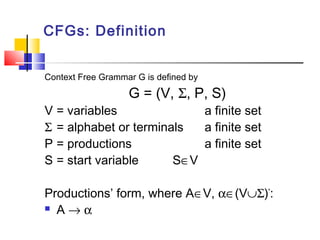
Context Free Grammar G is defined by
G = (V, Σ, P, S)
V = variables a finite set
Σ = alphabet or terminals a finite set
P = productions a finite set
S = start variable S∈V
Productions’ form, where A∈V, α∈(V∪Σ)*
:
 A → α
Derivations
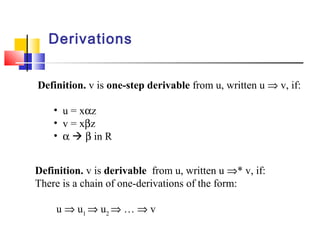
Definition. v is one-step derivable from u, written u ⇒ v, if:
• u = xαz
• v = xβz
• α  β in R
Definition. v is derivable from u, written u ⇒* v, if:
There is a chain of one-derivations of the form:
u ⇒ u1
⇒ u2
⇒ … ⇒ v
Context-Free Languages
Definition. Given a context-free grammar
G = (∑, NT, R, S), the language generated or
derived from G is the set:
L(G) = {w : }S ⇒* w
Definition. A language L is context-free if there is a
context-free grammar G = (∑, NT, R, S), such that L is
generated from G
CFGs & CFLs: Example 1
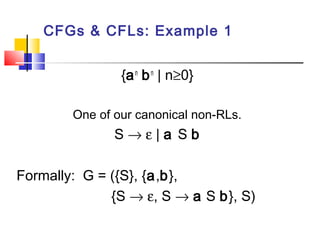
{an
bn
| n≥0}
One of our canonical non-RLs.
S → ε | a S b
Formally: G = ({S}, {a,b},
{S → ε, S → a S b}, S)
CFGs & CFLs: Non-Example
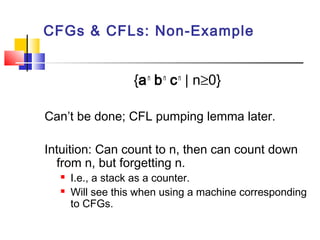
{an
bn
cn
| n≥0}
Can’t be done; CFL pumping lemma later.
Intuition: Can count to n, then can count down
from n, but forgetting n.
 I.e., a stack as a counter.
 Will see this when using a machine corresponding
to CFGs.
Parse Tree
A parse tree of a derivation is a tree in which:
• Each internal node is labeled with a nonterminal
•If a rule A  A1A2…An occurs in the derivation then A is
a parent node of nodes labeled A1, A2, …, AnS
a S
a S
S
e
b
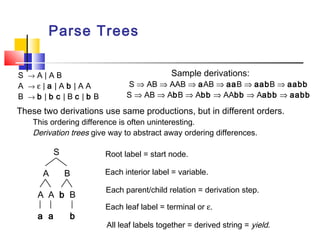
Parse Trees
Sample derivations:
S ⇒ AB ⇒ AAB ⇒ aAB ⇒ aaB ⇒ aabB ⇒ aabb
S ⇒ AB ⇒ AbB ⇒ Abb ⇒ AAbb ⇒ Aabb ⇒ aabb
S → A | A B
A → ε | a | A b | A A
B → b | b c | B c | b B
These two derivations use same productions, but in different orders.
This ordering difference is often uninteresting.
Derivation trees give way to abstract away ordering differences.
Root label = start node.
Each interior label = variable.
Each parent/child relation = derivation step.
Each leaf label = terminal or ε.
All leaf labels together = derived string = yield.
S
A B
AA Bb
a a b
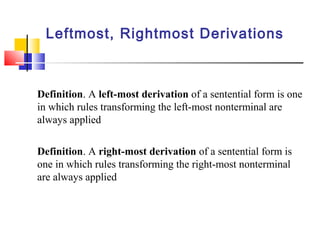
Leftmost, Rightmost Derivations
Definition. A left-most derivation of a sentential form is one
in which rules transforming the left-most nonterminal are
always applied
Definition. A right-most derivation of a sentential form is
one in which rules transforming the right-most nonterminal
are always applied
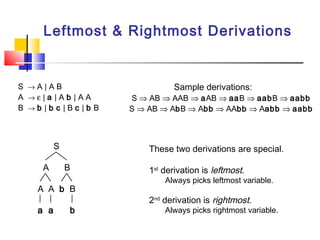
Leftmost & Rightmost Derivations
Sample derivations:
S ⇒ AB ⇒ AAB ⇒ aAB ⇒ aaB ⇒ aabB ⇒ aabb
S ⇒ AB ⇒ AbB ⇒ Abb ⇒ AAbb ⇒ Aabb ⇒ aabb
S → A | A B
A → ε | a | A b | A A
B → b | b c | B c | b B
S
A B
AA Bb
a a b
These two derivations are special.
1st
derivation is leftmost.
Always picks leftmost variable.
2nd
derivation is rightmost.
Always picks rightmost variable.
Left / Rightmost Derivations
 In proofs…
 Restrict attention to left- or rightmost derivations.
 In parsing algorithms…
 Restrict attention to left- or rightmost derivations.
 E.g., recursive descent uses leftmost; yacc uses rightmost.
Derivation Trees
Infinitely
many others
possible.
S
A B
AA b
a
a
bA
S
A
A A
AA bA
a ε
a
bA
S
A B
AA Bb
a a b
S → A | A B
A → ε | a | A b | A A
B → b | b c | B c | b B
w = aabb
Other derivation
trees for this string?
? ?
Ambiguous Grammar
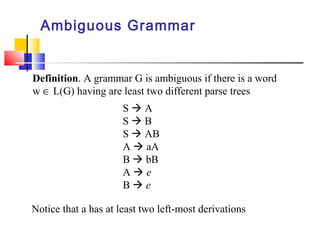
S  A
S  B
S  AB
A  aA
B  bB
A  e
B  e
Definition. A grammar G is ambiguous if there is a word
w ∈ L(G) having are least two different parse trees
Notice that a has at least two left-most derivations
Ambiguity
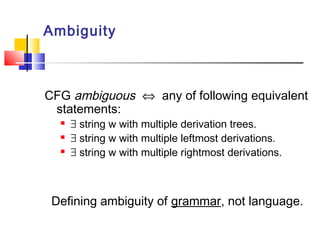
CFG ambiguous ⇔ any of following equivalent
statements:
 ∃ string w with multiple derivation trees.
 ∃ string w with multiple leftmost derivations.
 ∃ string w with multiple rightmost derivations.
Defining ambiguity of grammar, not language.
Ambiguity & Disambiguation
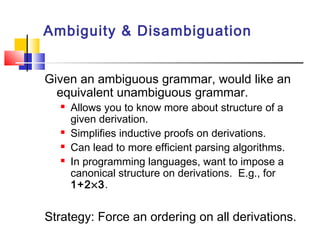
Given an ambiguous grammar, would like an
equivalent unambiguous grammar.
 Allows you to know more about structure of a
given derivation.
 Simplifies inductive proofs on derivations.
 Can lead to more efficient parsing algorithms.
 In programming languages, want to impose a
canonical structure on derivations. E.g., for
1+2×3.
Strategy: Force an ordering on all derivations.
Disambiguation: Example 1
Exp → n
| Exp + Exp
| Exp × Exp
What is an equivalent
unambiguous
grammar?
Exp → Term
| Term + Exp
Term → n
| n × Term
Uses
 operator precedence
 left-associativity
?
?
Disambiguation
What is a general algorithm?
There are CFLs that are inherently ambiguous
Every CFG for this language is ambiguous.
E.g., {an
bn
cm
dm
| n≥1, m≥1} ∪ {an
bm
cm
dn
| n≥1, m≥1}.
So, can’t necessarily eliminate ambiguity!
None exists!
? ?

Context free grammar

  • 1.
    CFGs: Definition Context FreeGrammar G is defined by G = (V, Σ, P, S) V = variables a finite set Σ = alphabet or terminals a finite set P = productions a finite set S = start variable S∈V Productions’ form, where A∈V, α∈(V∪Σ)* :  A → α
  • 2.
    Derivations Definition. v isone-step derivable from u, written u ⇒ v, if: • u = xαz • v = xβz • α  β in R Definition. v is derivable from u, written u ⇒* v, if: There is a chain of one-derivations of the form: u ⇒ u1 ⇒ u2 ⇒ … ⇒ v
  • 3.
    Context-Free Languages Definition. Givena context-free grammar G = (∑, NT, R, S), the language generated or derived from G is the set: L(G) = {w : }S ⇒* w Definition. A language L is context-free if there is a context-free grammar G = (∑, NT, R, S), such that L is generated from G
  • 4.
    CFGs & CFLs:Example 1 {an bn | n≥0} One of our canonical non-RLs. S → ε | a S b Formally: G = ({S}, {a,b}, {S → ε, S → a S b}, S)
  • 5.
    CFGs & CFLs:Non-Example {an bn cn | n≥0} Can’t be done; CFL pumping lemma later. Intuition: Can count to n, then can count down from n, but forgetting n.  I.e., a stack as a counter.  Will see this when using a machine corresponding to CFGs.
  • 6.
    Parse Tree A parsetree of a derivation is a tree in which: • Each internal node is labeled with a nonterminal •If a rule A  A1A2…An occurs in the derivation then A is a parent node of nodes labeled A1, A2, …, AnS a S a S S e b
  • 7.
    Parse Trees Sample derivations: S⇒ AB ⇒ AAB ⇒ aAB ⇒ aaB ⇒ aabB ⇒ aabb S ⇒ AB ⇒ AbB ⇒ Abb ⇒ AAbb ⇒ Aabb ⇒ aabb S → A | A B A → ε | a | A b | A A B → b | b c | B c | b B These two derivations use same productions, but in different orders. This ordering difference is often uninteresting. Derivation trees give way to abstract away ordering differences. Root label = start node. Each interior label = variable. Each parent/child relation = derivation step. Each leaf label = terminal or ε. All leaf labels together = derived string = yield. S A B AA Bb a a b
  • 8.
    Leftmost, Rightmost Derivations Definition.A left-most derivation of a sentential form is one in which rules transforming the left-most nonterminal are always applied Definition. A right-most derivation of a sentential form is one in which rules transforming the right-most nonterminal are always applied
  • 9.
    Leftmost & RightmostDerivations Sample derivations: S ⇒ AB ⇒ AAB ⇒ aAB ⇒ aaB ⇒ aabB ⇒ aabb S ⇒ AB ⇒ AbB ⇒ Abb ⇒ AAbb ⇒ Aabb ⇒ aabb S → A | A B A → ε | a | A b | A A B → b | b c | B c | b B S A B AA Bb a a b These two derivations are special. 1st derivation is leftmost. Always picks leftmost variable. 2nd derivation is rightmost. Always picks rightmost variable.
  • 10.
    Left / RightmostDerivations  In proofs…  Restrict attention to left- or rightmost derivations.  In parsing algorithms…  Restrict attention to left- or rightmost derivations.  E.g., recursive descent uses leftmost; yacc uses rightmost.
  • 11.
    Derivation Trees Infinitely many others possible. S AB AA b a a bA S A A A AA bA a ε a bA S A B AA Bb a a b S → A | A B A → ε | a | A b | A A B → b | b c | B c | b B w = aabb Other derivation trees for this string? ? ?
  • 12.
    Ambiguous Grammar S A S  B S  AB A  aA B  bB A  e B  e Definition. A grammar G is ambiguous if there is a word w ∈ L(G) having are least two different parse trees Notice that a has at least two left-most derivations
  • 13.
    Ambiguity CFG ambiguous ⇔any of following equivalent statements:  ∃ string w with multiple derivation trees.  ∃ string w with multiple leftmost derivations.  ∃ string w with multiple rightmost derivations. Defining ambiguity of grammar, not language.
  • 14.
    Ambiguity & Disambiguation Givenan ambiguous grammar, would like an equivalent unambiguous grammar.  Allows you to know more about structure of a given derivation.  Simplifies inductive proofs on derivations.  Can lead to more efficient parsing algorithms.  In programming languages, want to impose a canonical structure on derivations. E.g., for 1+2×3. Strategy: Force an ordering on all derivations.
  • 15.
    Disambiguation: Example 1 Exp→ n | Exp + Exp | Exp × Exp What is an equivalent unambiguous grammar? Exp → Term | Term + Exp Term → n | n × Term Uses  operator precedence  left-associativity ? ?
  • 16.
    Disambiguation What is ageneral algorithm? There are CFLs that are inherently ambiguous Every CFG for this language is ambiguous. E.g., {an bn cm dm | n≥1, m≥1} ∪ {an bm cm dn | n≥1, m≥1}. So, can’t necessarily eliminate ambiguity! None exists! ? ?