Valuation Methods
Asset based approach
strategyrev.com
Recapitulating the Valuation methods
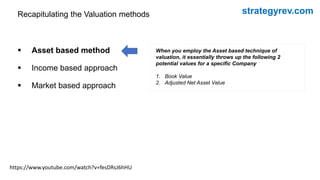
 Asset based method
 Income based approach
 Market based approach
When you employ the Asset based technique of
valuation, it essentially throws up the following 2
potential values for a specific Company
1. Book Value
2. Adjusted Net Asset Value
https://www.youtube.com/watch?v=fesDRsJ6hHU
strategyrev.com
What is a “Balance Sheet”?
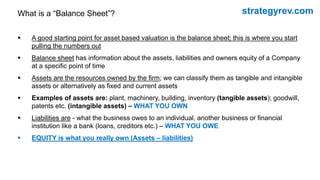
 A good starting point for asset based valuation is the balance sheet; this is where you start
pulling the numbers out
 Balance sheet has information about the assets, liabilities and owners equity of a Company
at a specific point of time
 Assets are the resources owned by the firm; we can classify them as tangible and intangible
assets or alternatively as fixed and current assets
 Examples of assets are: plant, machinery, building, inventory (tangible assets); goodwill,
patents etc. (intangible assets) – WHAT YOU OWN
 Liabilities are - what the business owes to an individual, another business or financial
institution like a bank (loans, creditors etc.) – WHAT YOU OWE
 EQUITY is what you really own (Assets – liabilities)
strategyrev.com
Definition(s) in the asset based approach of valuation
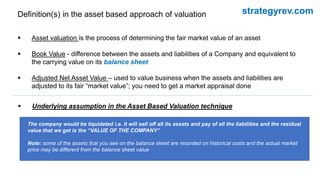
 Asset valuation is the process of determining the fair market value of an asset
 Book Value - difference between the assets and liabilities of a Company and equivalent to
the carrying value on its balance sheet
 Adjusted Net Asset Value – used to value business when the assets and liabilities are
adjusted to its fair “market value”; you need to get a market appraisal done
 Underlying assumption in the Asset Based Valuation technique
The company would be liquidated i.e. it will sell off all its assets and pay of all the liabilities and the residual
value that we get is the “VALUE OF THE COMPANY”
Note: some of the assets that you see on the balance sheet are recorded on historical costs and the actual market
price may be different from the balance sheet value
strategyrev.com
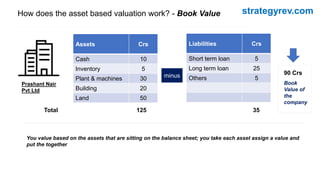
How does the asset based valuation work? - Book Value
Prashant Nair
Pvt Ltd
Assets Crs
Cash 10
Inventory 5
Plant & machines 30
Building 20
Land 50
Liabilities Crs
Short term loan 5
Long term loan 25
Others 5
minus
Total 125 35
90 Crs
Book
Value of
the
company
You value based on the assets that are sitting on the balance sheet; you take each asset assign a value and
put the together
strategyrev.com
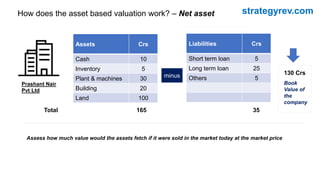
How does the asset based valuation work? – Net asset
Prashant Nair
Pvt Ltd
Assets Crs
Cash 10
Inventory 5
Plant & machines 30
Building 20
Land 100
Liabilities Crs
Short term loan 5
Long term loan 25
Others 5
minus
Total 165 35
130 Crs
Book
Value of
the
company
Assess how much value would the assets fetch if it were sold in the market today at the market price

Asset Based Valuation

  • 1.
  • 2.
    strategyrev.com Recapitulating the Valuationmethods  Asset based method  Income based approach  Market based approach When you employ the Asset based technique of valuation, it essentially throws up the following 2 potential values for a specific Company 1. Book Value 2. Adjusted Net Asset Value https://www.youtube.com/watch?v=fesDRsJ6hHU
  • 3.
    strategyrev.com What is a“Balance Sheet”?  A good starting point for asset based valuation is the balance sheet; this is where you start pulling the numbers out  Balance sheet has information about the assets, liabilities and owners equity of a Company at a specific point of time  Assets are the resources owned by the firm; we can classify them as tangible and intangible assets or alternatively as fixed and current assets  Examples of assets are: plant, machinery, building, inventory (tangible assets); goodwill, patents etc. (intangible assets) – WHAT YOU OWN  Liabilities are - what the business owes to an individual, another business or financial institution like a bank (loans, creditors etc.) – WHAT YOU OWE  EQUITY is what you really own (Assets – liabilities)
  • 4.
    strategyrev.com Definition(s) in theasset based approach of valuation  Asset valuation is the process of determining the fair market value of an asset  Book Value - difference between the assets and liabilities of a Company and equivalent to the carrying value on its balance sheet  Adjusted Net Asset Value – used to value business when the assets and liabilities are adjusted to its fair “market value”; you need to get a market appraisal done  Underlying assumption in the Asset Based Valuation technique The company would be liquidated i.e. it will sell off all its assets and pay of all the liabilities and the residual value that we get is the “VALUE OF THE COMPANY” Note: some of the assets that you see on the balance sheet are recorded on historical costs and the actual market price may be different from the balance sheet value
  • 5.
    strategyrev.com How does theasset based valuation work? - Book Value Prashant Nair Pvt Ltd Assets Crs Cash 10 Inventory 5 Plant & machines 30 Building 20 Land 50 Liabilities Crs Short term loan 5 Long term loan 25 Others 5 minus Total 125 35 90 Crs Book Value of the company You value based on the assets that are sitting on the balance sheet; you take each asset assign a value and put the together
  • 6.
    strategyrev.com How does theasset based valuation work? – Net asset Prashant Nair Pvt Ltd Assets Crs Cash 10 Inventory 5 Plant & machines 30 Building 20 Land 100 Liabilities Crs Short term loan 5 Long term loan 25 Others 5 minus Total 165 35 130 Crs Book Value of the company Assess how much value would the assets fetch if it were sold in the market today at the market price