WEEK 13
MAKING CAPITAL INVESTMENT DECISIONS
RELEVANT CASH FLOWS
• The cash flows that should be included
in a capital budgeting analysis are
those that will only occur (or not occur)
if the project is accepted
• These cash flows are called incremental
cash flows
• The stand-alone principle allows us to
analyze each project in isolation from
the firm simply by focusing on
incremental cash flows
ASKING THE RIGHT QUESTION
• You should always ask yourself “Will this cash
flow occur ONLY if we accept the project?”
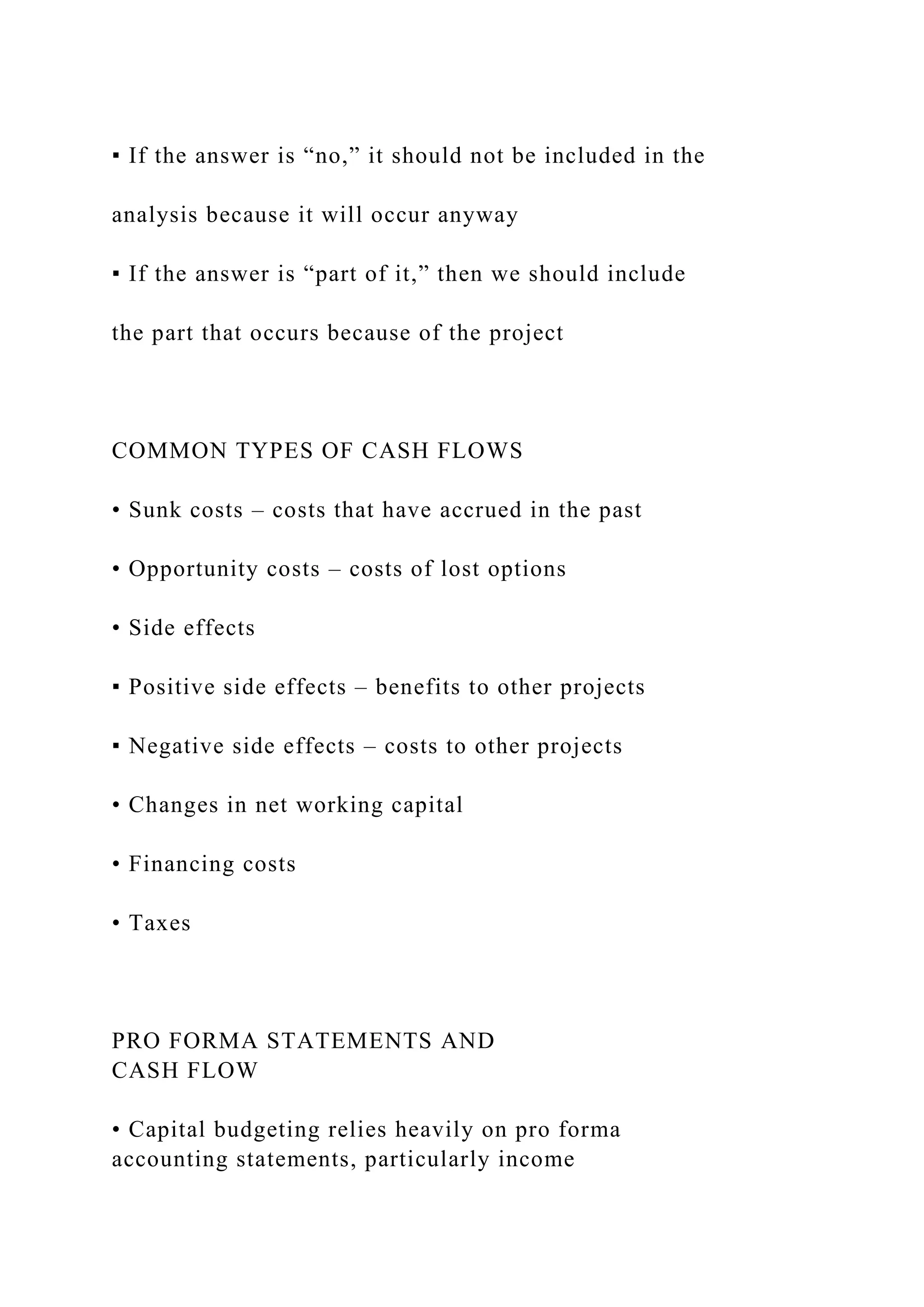
▪ If the answer is “yes,” it should be included in the
analysis because it is incremental
▪ If the answer is “no,” it should not be included in the
analysis because it will occur anyway
▪ If the answer is “part of it,” then we should include
the part that occurs because of the project
COMMON TYPES OF CASH FLOWS
• Sunk costs – costs that have accrued in the past
• Opportunity costs – costs of lost options
• Side effects
▪ Positive side effects – benefits to other projects
▪ Negative side effects – costs to other projects
• Changes in net working capital
• Financing costs
• Taxes
PRO FORMA STATEMENTS AND
CASH FLOW
• Capital budgeting relies heavily on pro forma
accounting statements, particularly income
statements
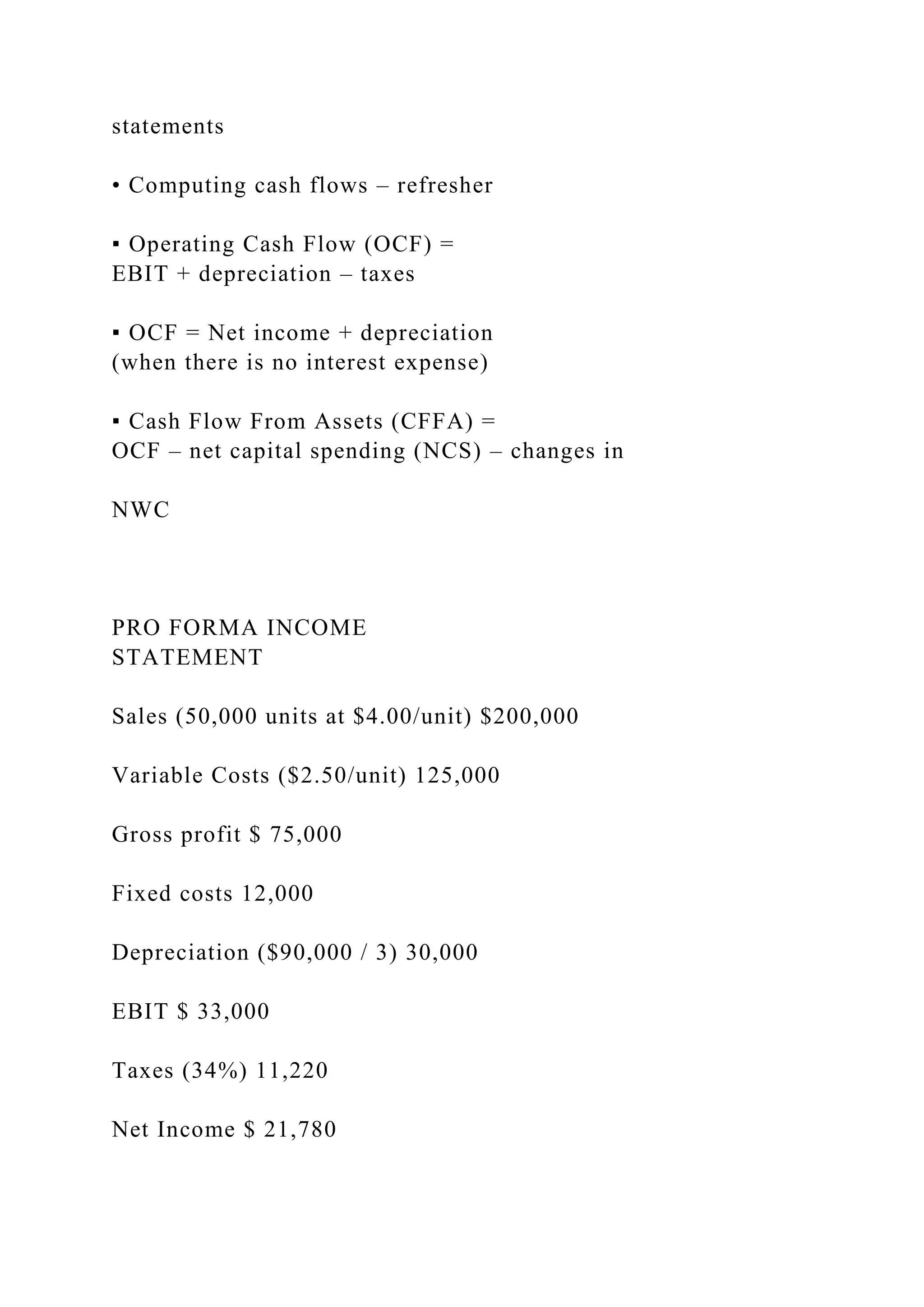
• Computing cash flows – refresher
▪ Operating Cash Flow (OCF) =
EBIT + depreciation – taxes
▪ OCF = Net income + depreciation
(when there is no interest expense)
▪ Cash Flow From Assets (CFFA) =
OCF – net capital spending (NCS) – changes in
NWC
PRO FORMA INCOME
STATEMENT
Sales (50,000 units at $4.00/unit) $200,000
Variable Costs ($2.50/unit) 125,000
Gross profit $ 75,000
Fixed costs 12,000
Depreciation ($90,000 / 3) 30,000
EBIT $ 33,000
Taxes (34%) 11,220
Net Income $ 21,780
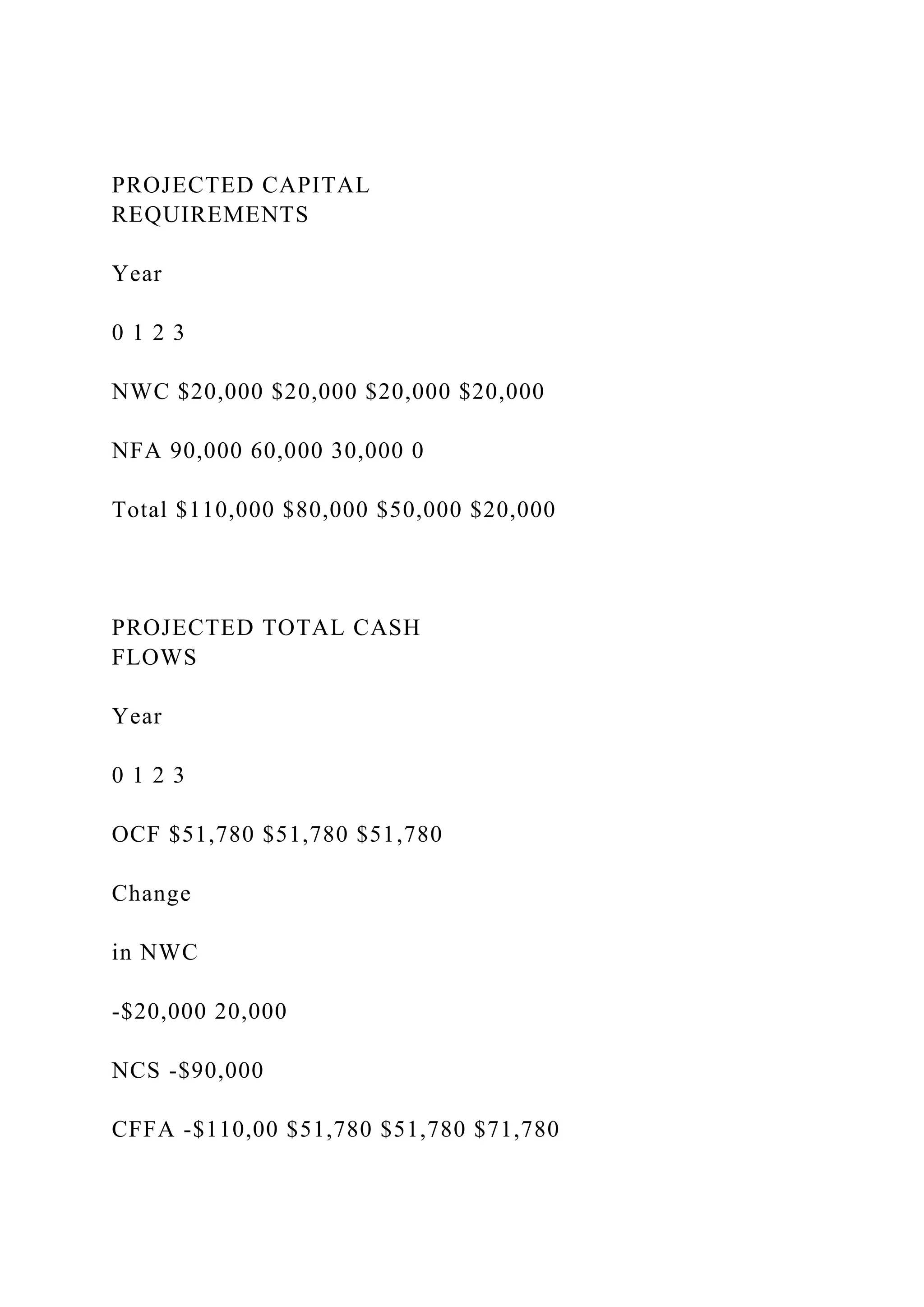
PROJECTED CAPITAL
REQUIREMENTS
Year
0 1 2 3
NWC $20,000 $20,000 $20,000 $20,000
NFA 90,000 60,000 30,000 0
Total $110,000 $80,000 $50,000 $20,000
PROJECTED TOTAL CASH
FLOWS
Year
0 1 2 3
OCF $51,780 $51,780 $51,780
Change
in NWC
-$20,000 20,000
NCS -$90,000
CFFA -$110,00 $51,780 $51,780 $71,780
MORE ON NWC
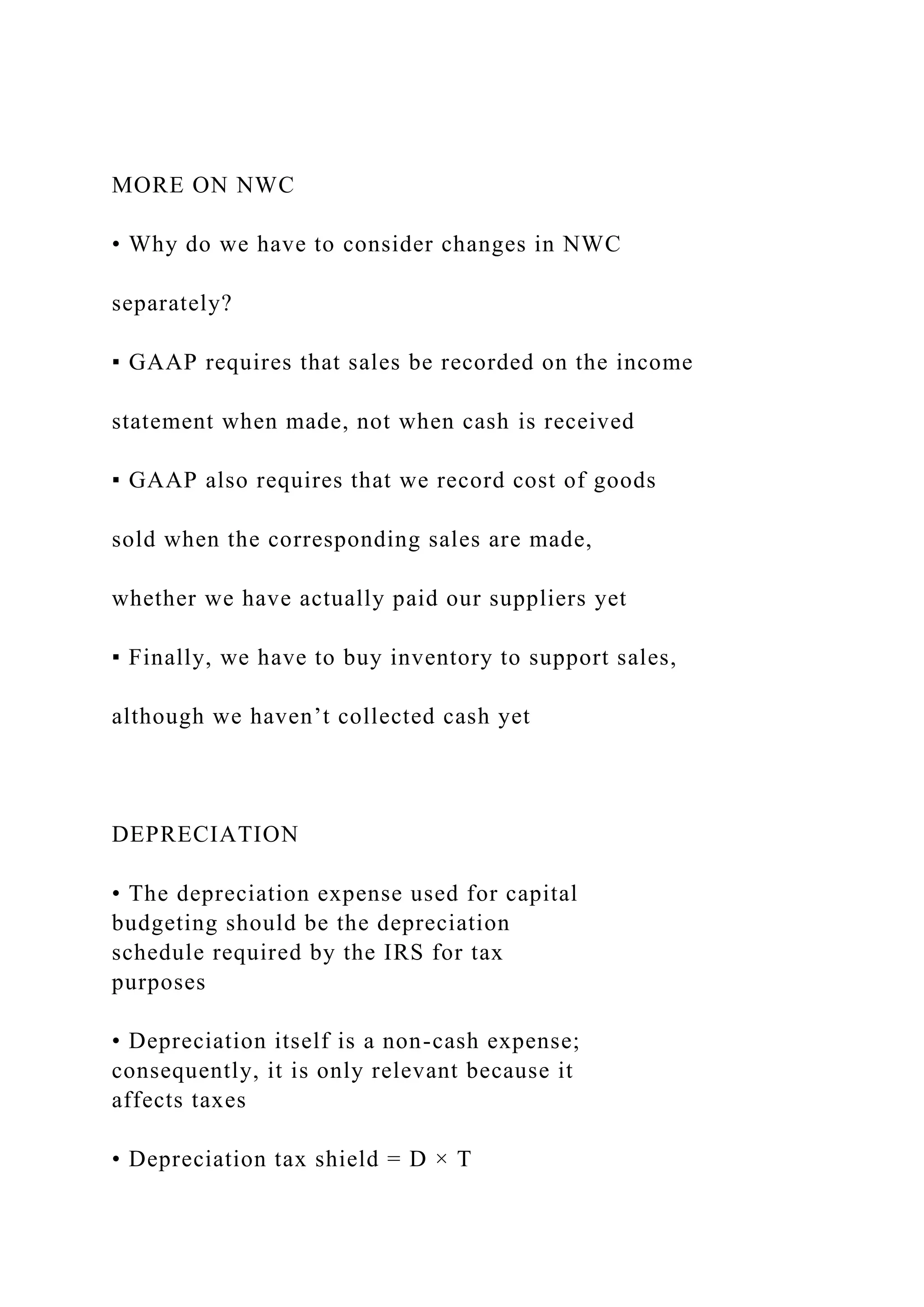
• Why do we have to consider changes in NWC
separately?
▪ GAAP requires that sales be recorded on the income
statement when made, not when cash is received
▪ GAAP also requires that we record cost of goods
sold when the corresponding sales are made,
whether we have actually paid our suppliers yet
▪ Finally, we have to buy inventory to support sales,
although we haven’t collected cash yet
DEPRECIATION
• The depreciation expense used for capital
budgeting should be the depreciation
schedule required by the IRS for tax
purposes
• Depreciation itself is a non-cash expense;
consequently, it is only relevant because it
affects taxes
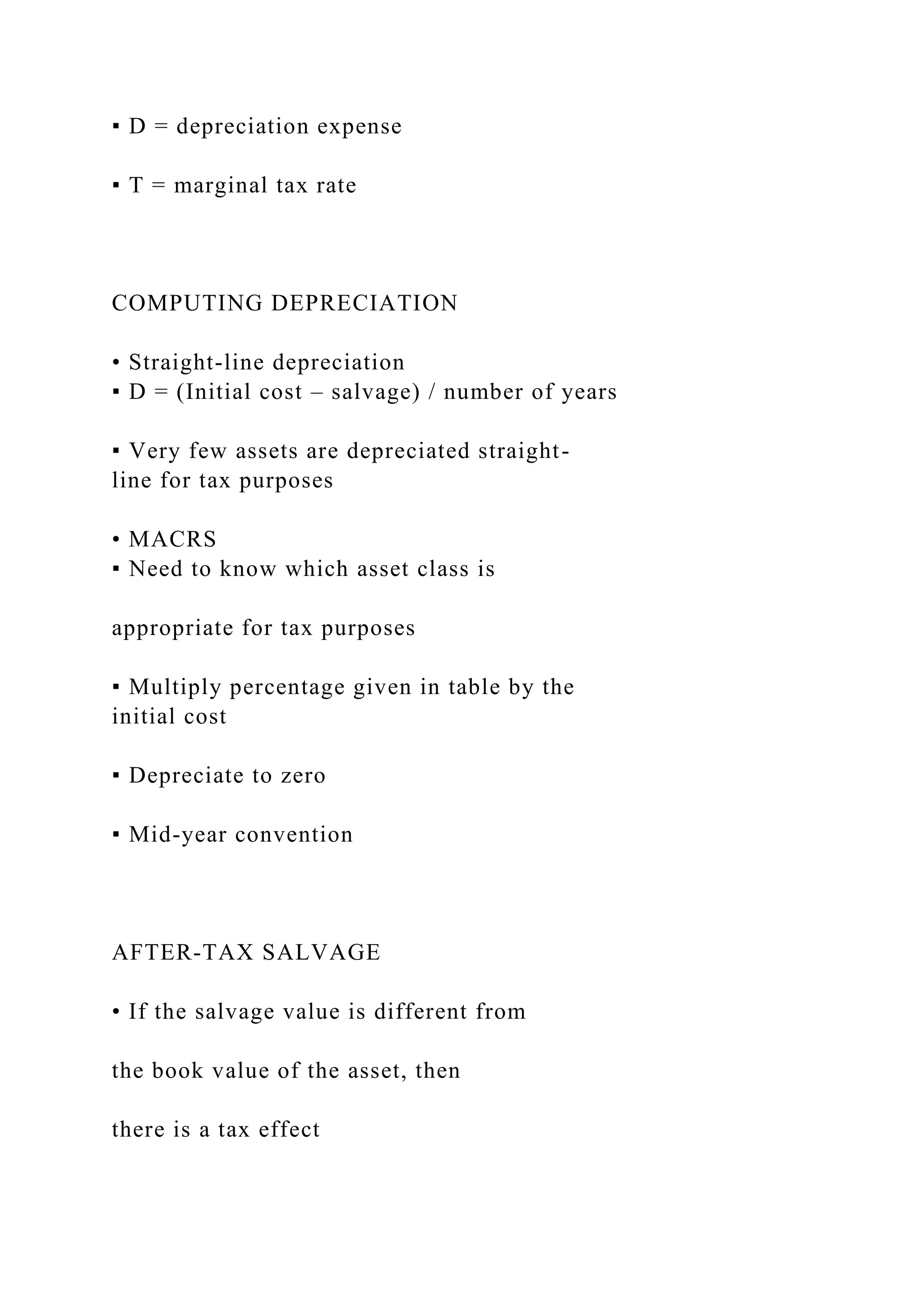
• Depreciation tax shield = D × T
▪ D = depreciation expense
▪ T = marginal tax rate
COMPUTING DEPRECIATION
• Straight-line depreciation
▪ D = (Initial cost – salvage) / number of years
▪ Very few assets are depreciated straight-
line for tax purposes
• MACRS
▪ Need to know which asset class is
appropriate for tax purposes
▪ Multiply percentage given in table by the
initial cost
▪ Depreciate to zero
▪ Mid-year convention
AFTER-TAX SALVAGE
• If the salvage value is different from
the book value of the asset, then
there is a tax effect
• Book value =
initial cost – accumulated
depreciation
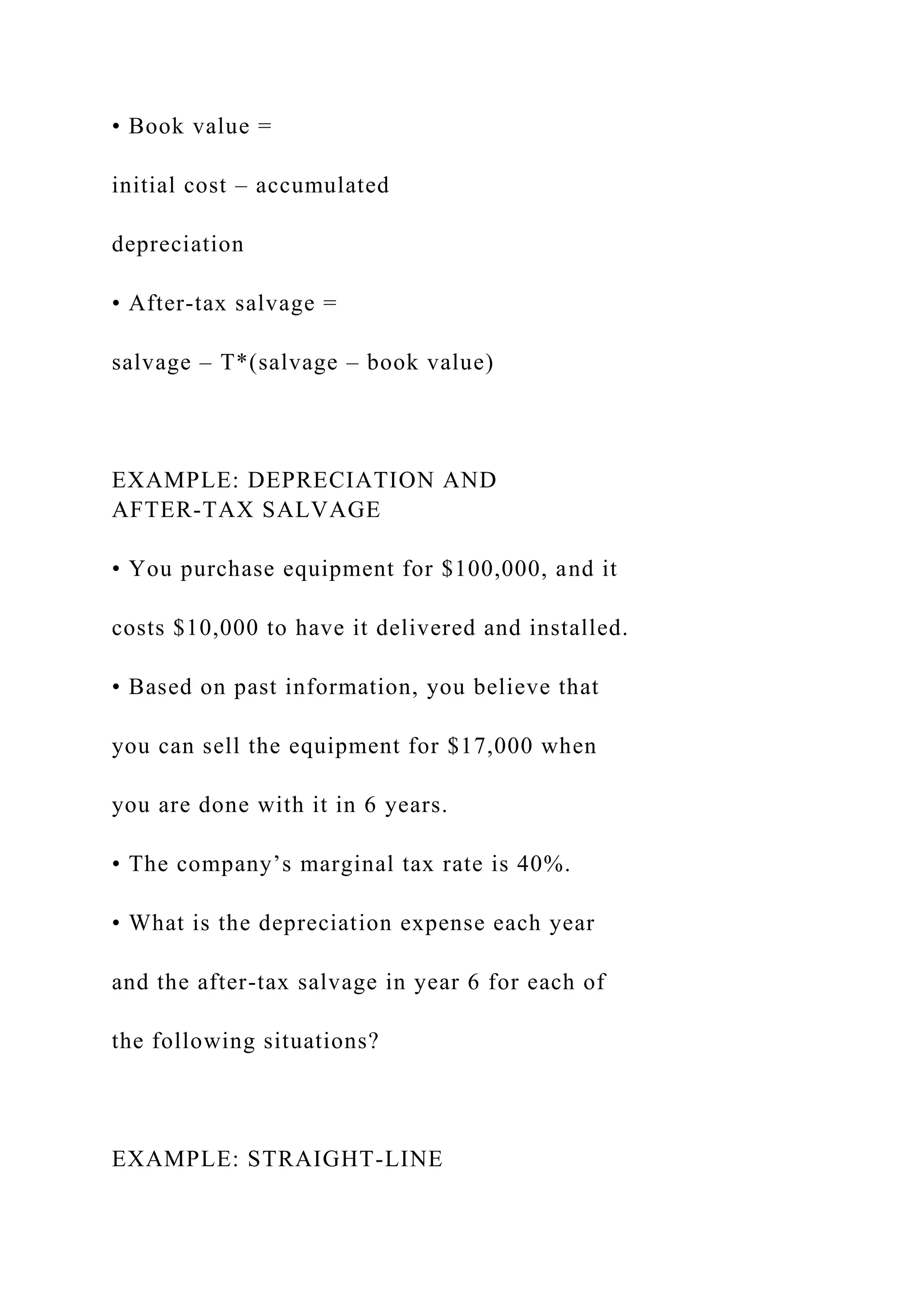
• After-tax salvage =
salvage – T*(salvage – book value)
EXAMPLE: DEPRECIATION AND
AFTER-TAX SALVAGE
• You purchase equipment for $100,000, and it
costs $10,000 to have it delivered and installed.
• Based on past information, you believe that
you can sell the equipment for $17,000 when
you are done with it in 6 years.
• The company’s marginal tax rate is 40%.
• What is the depreciation expense each year
and the after-tax salvage in year 6 for each of
the following situations?
EXAMPLE: STRAIGHT-LINE
• Suppose the appropriate depreciation
schedule is straight-line
▪ D = (110,000 – 17,000) / 6 = 15,500 every year
for 6 years
▪ BV in year 6 = 110,000 – 6(15,500) = 17,000
▪ After-tax salvage =
17,000 - .4(17,000 – 17,000) = 17,000
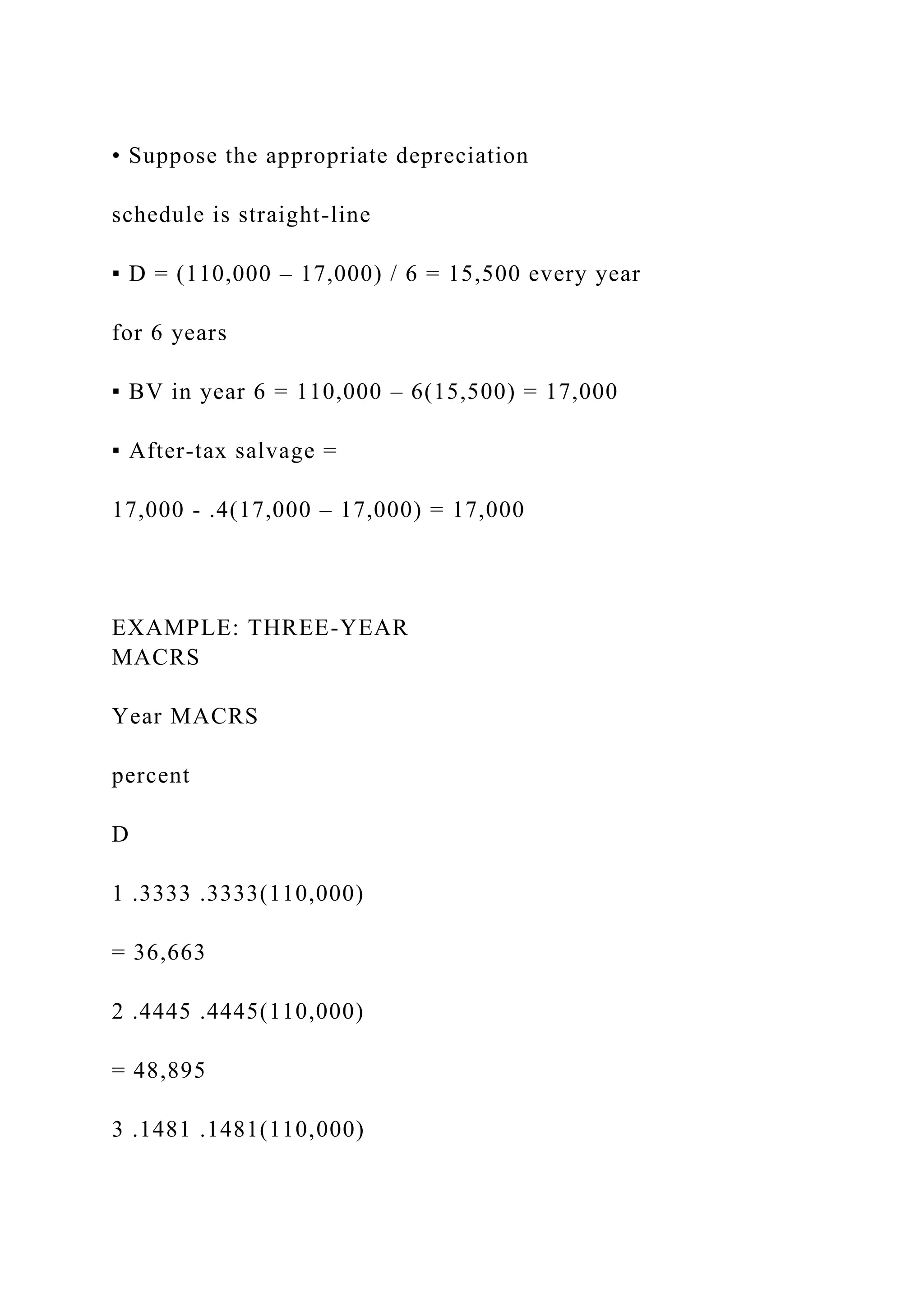
EXAMPLE: THREE-YEAR
MACRS
Year MACRS
percent
D
1 .3333 .3333(110,000)
= 36,663
2 .4445 .4445(110,000)
= 48,895
3 .1481 .1481(110,000)
= 16,291
4 .0741 .0741(110,000)
= 8,151
BV in year 6 =
110,000 – 36,663 –
48,895 – 16,291 –
8,151 = 0
After-tax salvage
= 17,000 -
.4(17,000 – 0) =
$10,200
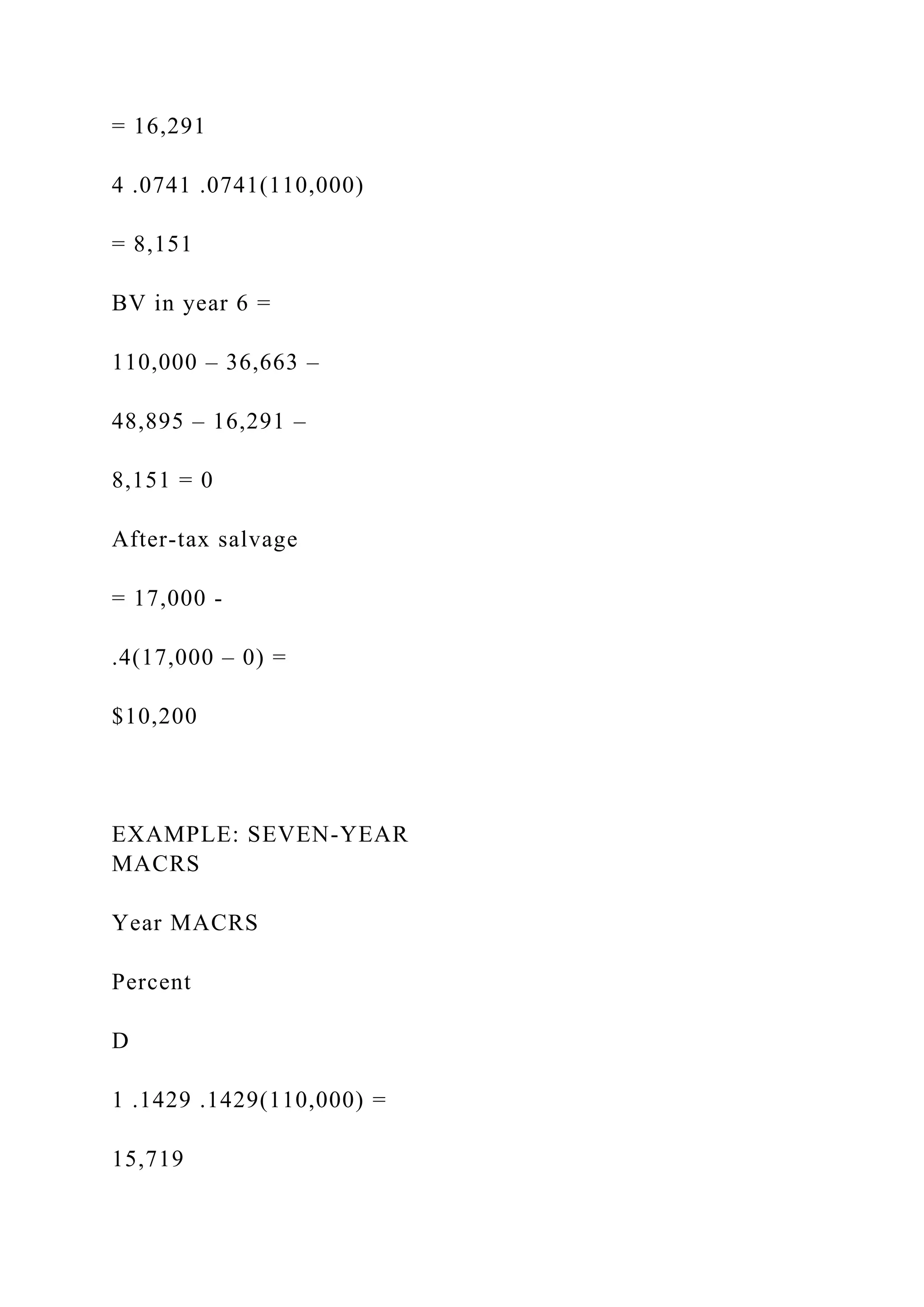
EXAMPLE: SEVEN-YEAR
MACRS
Year MACRS
Percent
D
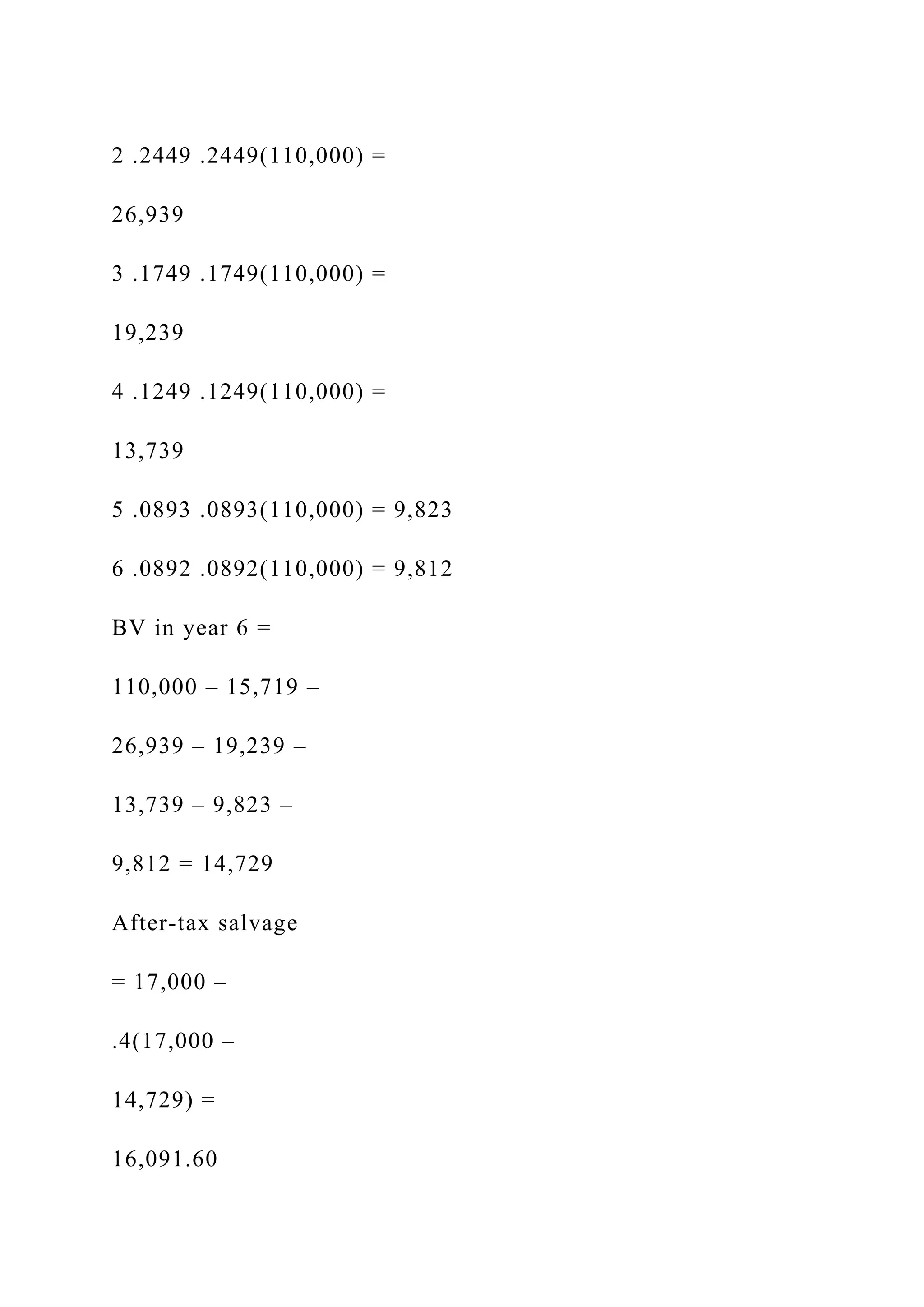
1 .1429 .1429(110,000) =
15,719
2 .2449 .2449(110,000) =
26,939
3 .1749 .1749(110,000) =
19,239
4 .1249 .1249(110,000) =
13,739
5 .0893 .0893(110,000) = 9,823
6 .0892 .0892(110,000) = 9,812
BV in year 6 =
110,000 – 15,719 –
26,939 – 19,239 –
13,739 – 9,823 –
9,812 = 14,729
After-tax salvage
= 17,000 –
.4(17,000 –
14,729) =
16,091.60
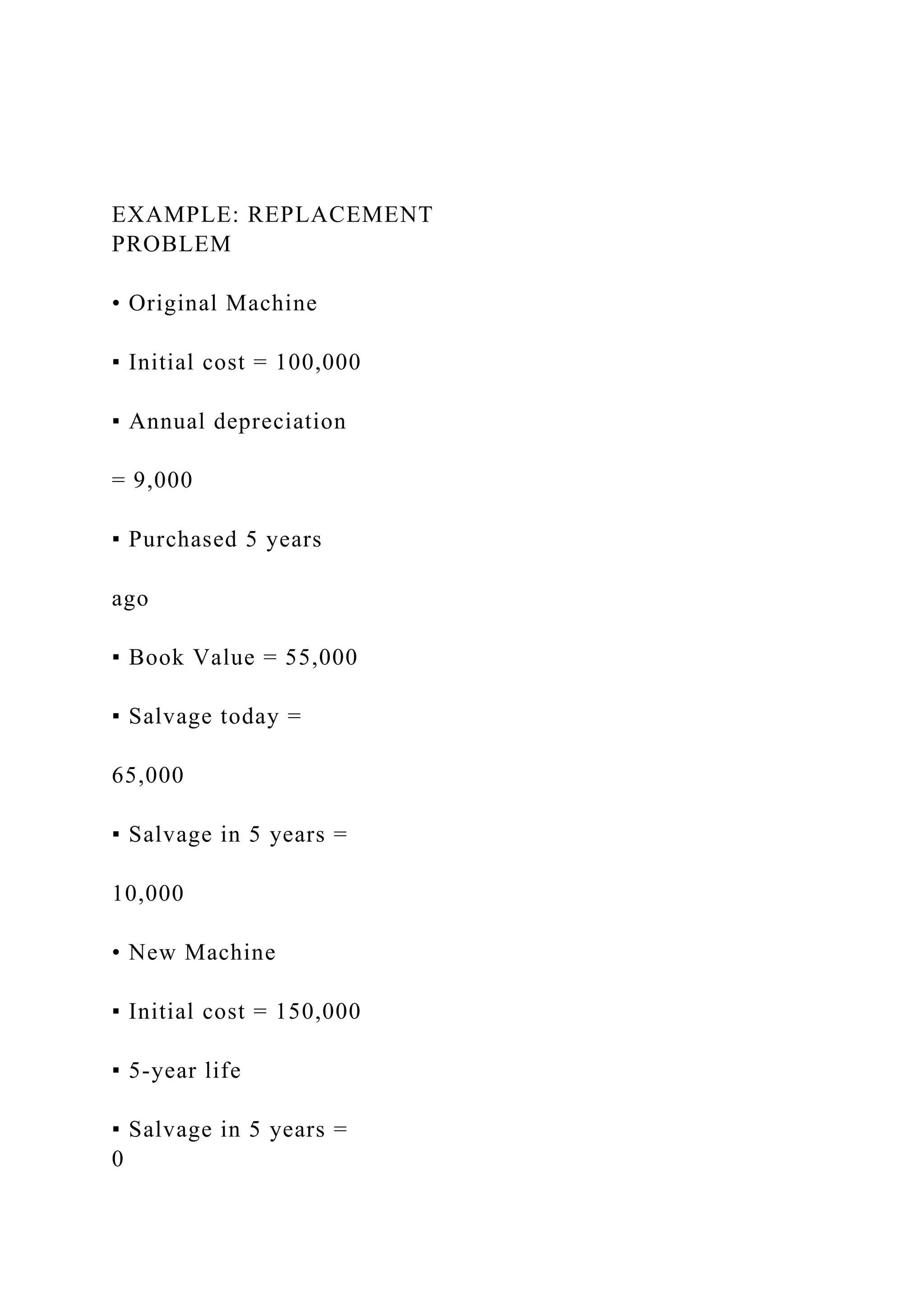
EXAMPLE: REPLACEMENT
PROBLEM
• Original Machine
▪ Initial cost = 100,000
▪ Annual depreciation
= 9,000
▪ Purchased 5 years
ago
▪ Book Value = 55,000
▪ Salvage today =
65,000
▪ Salvage in 5 years =
10,000
• New Machine
▪ Initial cost = 150,000
▪ 5-year life
▪ Salvage in 5 years =
0
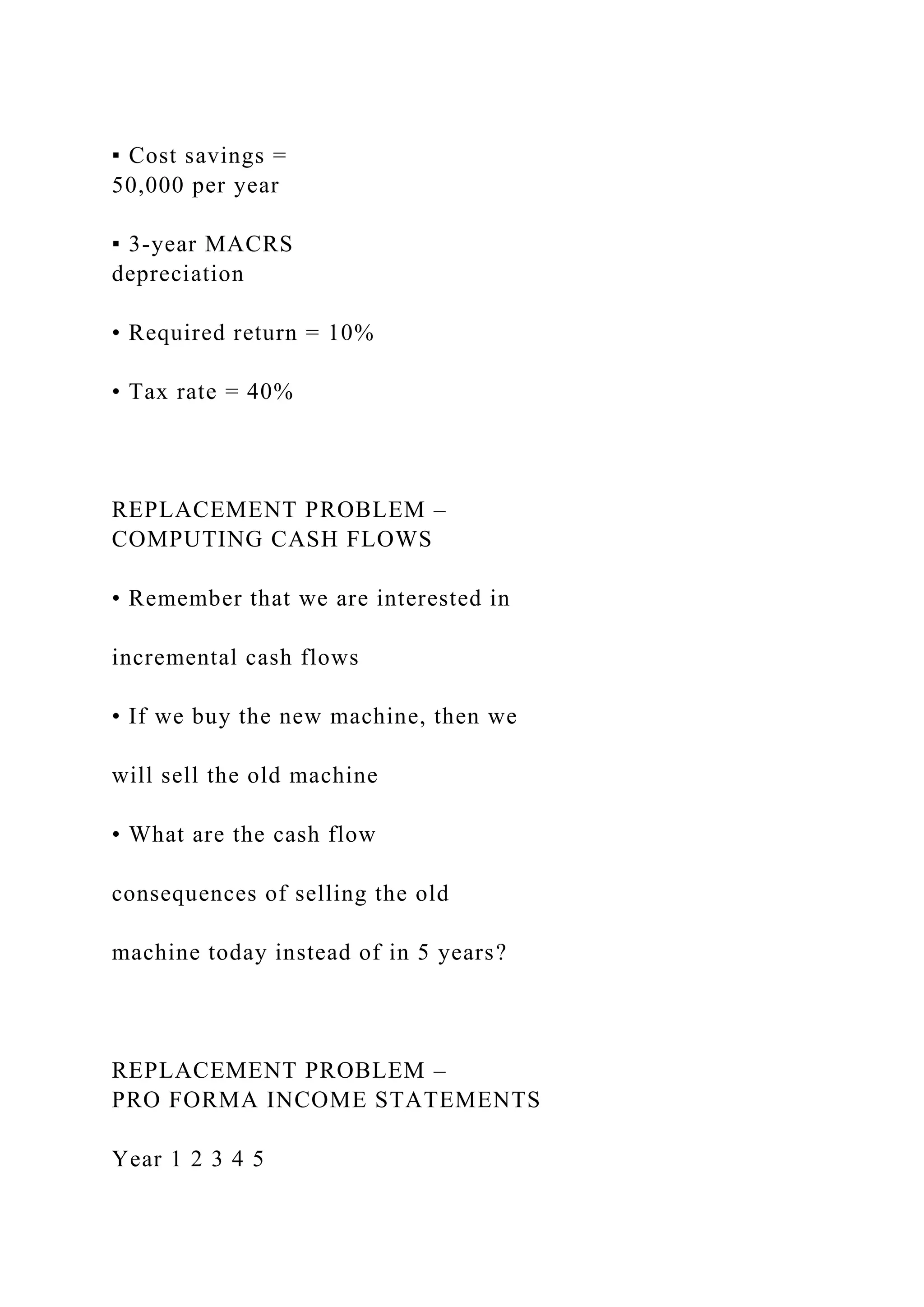
▪ Cost savings =
50,000 per year
▪ 3-year MACRS
depreciation
• Required return = 10%
• Tax rate = 40%
REPLACEMENT PROBLEM –
COMPUTING CASH FLOWS
• Remember that we are interested in
incremental cash flows
• If we buy the new machine, then we
will sell the old machine
• What are the cash flow
consequences of selling the old
machine today instead of in 5 years?
REPLACEMENT PROBLEM –
PRO FORMA INCOME STATEMENTS
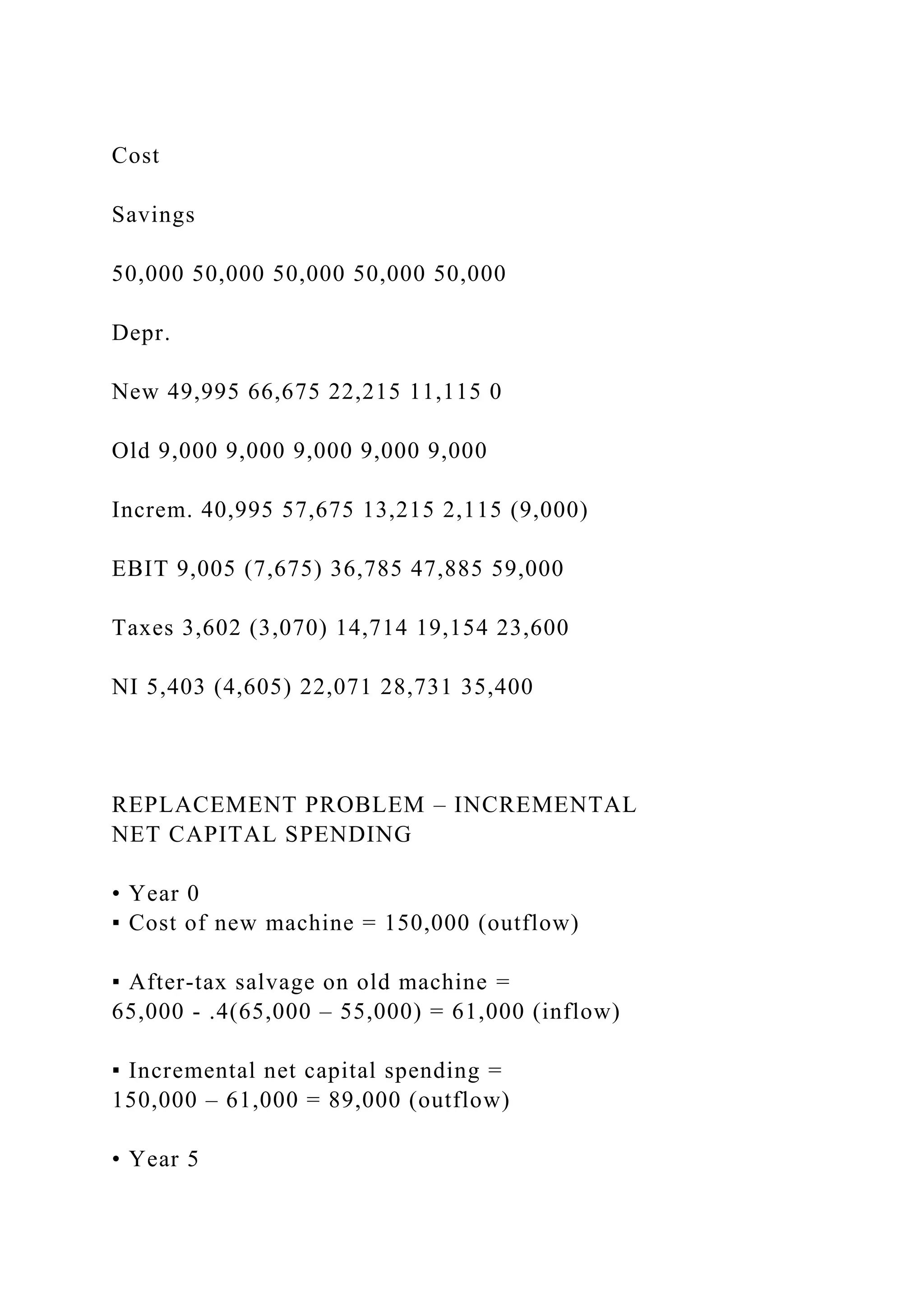
Year 1 2 3 4 5
Cost
Savings
50,000 50,000 50,000 50,000 50,000
Depr.
New 49,995 66,675 22,215 11,115 0
Old 9,000 9,000 9,000 9,000 9,000
Increm. 40,995 57,675 13,215 2,115 (9,000)
EBIT 9,005 (7,675) 36,785 47,885 59,000
Taxes 3,602 (3,070) 14,714 19,154 23,600
NI 5,403 (4,605) 22,071 28,731 35,400
REPLACEMENT PROBLEM – INCREMENTAL
NET CAPITAL SPENDING
• Year 0
▪ Cost of new machine = 150,000 (outflow)
▪ After-tax salvage on old machine =
65,000 - .4(65,000 – 55,000) = 61,000 (inflow)
▪ Incremental net capital spending =
150,000 – 61,000 = 89,000 (outflow)
• Year 5
▪ After-tax salvage on old machine =
10,000 - .4(10,000 – 10,000) = 10,000
(outflow because we no longer receive
this)
REPLACEMENT PROBLEM –
CASH FLOW FROM ASSETS
Year 0 1 2 3 4 5
OCF 46,398 53,070 35,286 30,846 26,400
NCS -89,000 -10,000
NWC
0 0
CFFA -89,000 46,398 53,070 35,286 30,846 16,400
REPLACEMENT PROBLEM –
ANALYZING THE CASH FLOWS
• Now that we have the cash flows, we can
compute the NPV and IRR
• Enter the cash flows
• Compute NPV = 54,801.74
• Compute IRR = 36.28%
• Should the company replace the equipment?
OTHER METHODS FOR
COMPUTING OCF
• Bottom-Up Approach
▪ OCF = NI + depreciation
▪ Works only when there is no interest expense
• Top-Down Approach
▪ OCF = Sales – Costs – Taxes
▪ Don’t subtract non-cash deductions
• Tax Shield Approach
▪ OCF = (Sales – Costs)(1 – T) + Depreciation*T

WEEK 13MAKING CAPITAL INVESTMENT DECISIONSRELEVANT.docx

  • 1.
    WEEK 13 MAKING CAPITALINVESTMENT DECISIONS RELEVANT CASH FLOWS • The cash flows that should be included in a capital budgeting analysis are those that will only occur (or not occur) if the project is accepted • These cash flows are called incremental cash flows • The stand-alone principle allows us to analyze each project in isolation from the firm simply by focusing on incremental cash flows ASKING THE RIGHT QUESTION • You should always ask yourself “Will this cash flow occur ONLY if we accept the project?” ▪ If the answer is “yes,” it should be included in the analysis because it is incremental
  • 2.
    ▪ If theanswer is “no,” it should not be included in the analysis because it will occur anyway ▪ If the answer is “part of it,” then we should include the part that occurs because of the project COMMON TYPES OF CASH FLOWS • Sunk costs – costs that have accrued in the past • Opportunity costs – costs of lost options • Side effects ▪ Positive side effects – benefits to other projects ▪ Negative side effects – costs to other projects • Changes in net working capital • Financing costs • Taxes PRO FORMA STATEMENTS AND CASH FLOW • Capital budgeting relies heavily on pro forma accounting statements, particularly income
  • 3.
    statements • Computing cashflows – refresher ▪ Operating Cash Flow (OCF) = EBIT + depreciation – taxes ▪ OCF = Net income + depreciation (when there is no interest expense) ▪ Cash Flow From Assets (CFFA) = OCF – net capital spending (NCS) – changes in NWC PRO FORMA INCOME STATEMENT Sales (50,000 units at $4.00/unit) $200,000 Variable Costs ($2.50/unit) 125,000 Gross profit $ 75,000 Fixed costs 12,000 Depreciation ($90,000 / 3) 30,000 EBIT $ 33,000 Taxes (34%) 11,220 Net Income $ 21,780
  • 4.
    PROJECTED CAPITAL REQUIREMENTS Year 0 12 3 NWC $20,000 $20,000 $20,000 $20,000 NFA 90,000 60,000 30,000 0 Total $110,000 $80,000 $50,000 $20,000 PROJECTED TOTAL CASH FLOWS Year 0 1 2 3 OCF $51,780 $51,780 $51,780 Change in NWC -$20,000 20,000 NCS -$90,000 CFFA -$110,00 $51,780 $51,780 $71,780
  • 5.
    MORE ON NWC •Why do we have to consider changes in NWC separately? ▪ GAAP requires that sales be recorded on the income statement when made, not when cash is received ▪ GAAP also requires that we record cost of goods sold when the corresponding sales are made, whether we have actually paid our suppliers yet ▪ Finally, we have to buy inventory to support sales, although we haven’t collected cash yet DEPRECIATION • The depreciation expense used for capital budgeting should be the depreciation schedule required by the IRS for tax purposes • Depreciation itself is a non-cash expense; consequently, it is only relevant because it affects taxes • Depreciation tax shield = D × T
  • 6.
    ▪ D =depreciation expense ▪ T = marginal tax rate COMPUTING DEPRECIATION • Straight-line depreciation ▪ D = (Initial cost – salvage) / number of years ▪ Very few assets are depreciated straight- line for tax purposes • MACRS ▪ Need to know which asset class is appropriate for tax purposes ▪ Multiply percentage given in table by the initial cost ▪ Depreciate to zero ▪ Mid-year convention AFTER-TAX SALVAGE • If the salvage value is different from the book value of the asset, then there is a tax effect
  • 7.
    • Book value= initial cost – accumulated depreciation • After-tax salvage = salvage – T*(salvage – book value) EXAMPLE: DEPRECIATION AND AFTER-TAX SALVAGE • You purchase equipment for $100,000, and it costs $10,000 to have it delivered and installed. • Based on past information, you believe that you can sell the equipment for $17,000 when you are done with it in 6 years. • The company’s marginal tax rate is 40%. • What is the depreciation expense each year and the after-tax salvage in year 6 for each of the following situations? EXAMPLE: STRAIGHT-LINE
  • 8.
    • Suppose theappropriate depreciation schedule is straight-line ▪ D = (110,000 – 17,000) / 6 = 15,500 every year for 6 years ▪ BV in year 6 = 110,000 – 6(15,500) = 17,000 ▪ After-tax salvage = 17,000 - .4(17,000 – 17,000) = 17,000 EXAMPLE: THREE-YEAR MACRS Year MACRS percent D 1 .3333 .3333(110,000) = 36,663 2 .4445 .4445(110,000) = 48,895 3 .1481 .1481(110,000)
  • 9.
    = 16,291 4 .0741.0741(110,000) = 8,151 BV in year 6 = 110,000 – 36,663 – 48,895 – 16,291 – 8,151 = 0 After-tax salvage = 17,000 - .4(17,000 – 0) = $10,200 EXAMPLE: SEVEN-YEAR MACRS Year MACRS Percent D 1 .1429 .1429(110,000) = 15,719
  • 10.
    2 .2449 .2449(110,000)= 26,939 3 .1749 .1749(110,000) = 19,239 4 .1249 .1249(110,000) = 13,739 5 .0893 .0893(110,000) = 9,823 6 .0892 .0892(110,000) = 9,812 BV in year 6 = 110,000 – 15,719 – 26,939 – 19,239 – 13,739 – 9,823 – 9,812 = 14,729 After-tax salvage = 17,000 – .4(17,000 – 14,729) = 16,091.60
  • 11.
    EXAMPLE: REPLACEMENT PROBLEM • OriginalMachine ▪ Initial cost = 100,000 ▪ Annual depreciation = 9,000 ▪ Purchased 5 years ago ▪ Book Value = 55,000 ▪ Salvage today = 65,000 ▪ Salvage in 5 years = 10,000 • New Machine ▪ Initial cost = 150,000 ▪ 5-year life ▪ Salvage in 5 years = 0
  • 12.
    ▪ Cost savings= 50,000 per year ▪ 3-year MACRS depreciation • Required return = 10% • Tax rate = 40% REPLACEMENT PROBLEM – COMPUTING CASH FLOWS • Remember that we are interested in incremental cash flows • If we buy the new machine, then we will sell the old machine • What are the cash flow consequences of selling the old machine today instead of in 5 years? REPLACEMENT PROBLEM – PRO FORMA INCOME STATEMENTS Year 1 2 3 4 5
  • 13.
    Cost Savings 50,000 50,000 50,00050,000 50,000 Depr. New 49,995 66,675 22,215 11,115 0 Old 9,000 9,000 9,000 9,000 9,000 Increm. 40,995 57,675 13,215 2,115 (9,000) EBIT 9,005 (7,675) 36,785 47,885 59,000 Taxes 3,602 (3,070) 14,714 19,154 23,600 NI 5,403 (4,605) 22,071 28,731 35,400 REPLACEMENT PROBLEM – INCREMENTAL NET CAPITAL SPENDING • Year 0 ▪ Cost of new machine = 150,000 (outflow) ▪ After-tax salvage on old machine = 65,000 - .4(65,000 – 55,000) = 61,000 (inflow) ▪ Incremental net capital spending = 150,000 – 61,000 = 89,000 (outflow) • Year 5
  • 14.
    ▪ After-tax salvageon old machine = 10,000 - .4(10,000 – 10,000) = 10,000 (outflow because we no longer receive this) REPLACEMENT PROBLEM – CASH FLOW FROM ASSETS Year 0 1 2 3 4 5 OCF 46,398 53,070 35,286 30,846 26,400 NCS -89,000 -10,000 NWC 0 0 CFFA -89,000 46,398 53,070 35,286 30,846 16,400 REPLACEMENT PROBLEM – ANALYZING THE CASH FLOWS • Now that we have the cash flows, we can compute the NPV and IRR • Enter the cash flows
  • 15.
    • Compute NPV= 54,801.74 • Compute IRR = 36.28% • Should the company replace the equipment? OTHER METHODS FOR COMPUTING OCF • Bottom-Up Approach ▪ OCF = NI + depreciation ▪ Works only when there is no interest expense • Top-Down Approach ▪ OCF = Sales – Costs – Taxes ▪ Don’t subtract non-cash deductions • Tax Shield Approach ▪ OCF = (Sales – Costs)(1 – T) + Depreciation*T