Tangible non-current assets
Topics
 Asset (capital) and revenue expenditure
 Property, plant and equipment
 Depreciation
 Revaluations (IFRS)
 Disposals
Asset and revenue expenditure
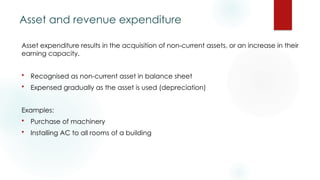
Asset expenditure results in the acquisition of non-current assets, or an increase in their
earning capacity.
 Recognised as non-current asset in balance sheet
 Expensed gradually as the asset is used (depreciation)
Examples:
 Purchase of machinery
 Installing AC to all rooms of a building
Asset and revenue expenditure
Revenue expenditure is incurred for the purpose of trade or to maintain the existing
earning capacity of the non-current assets.
 Expensed in income statement as incurred
Examples:
 Purchase of inventory
 Painting a building
Tangible non-current assets
Tangible resources controlled by an entity
 Held for production, delivery of service, rental, administration etc.
 Expected to be used for more than one period
Tangible non-current assets
Examples:
 Building
 Land
 Machinery
 Equipment
 Plant
 Vehicles
 Furniture
Property, Plant and Equipment
Recognition criteria:
 U.S GAAP: Cost model
 IFRS: Cost model & revaluation (fair value) model
Property, Plant and Equipment
Cost:
 Cash or cash equivalents paid to acquire/construct asset
Fair value:
 Amount at which knowledgeable, willing parties in an arm’s length transaction
Carrying amount:
 Amount at which asset is valued in balance sheet net of depreciation
Components of cost
Cost:
 Cash or cash equivalents paid to acquire/construct asset
Components of cost:
 Purchase price
 Directly attributable costs to get asset ready to be used
Components of cost
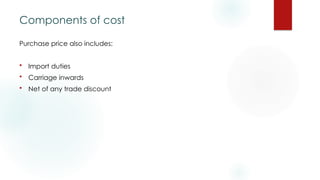
Purchase price also includes:
 Import duties
 Carriage inwards
 Net of any trade discount
Components of cost
Directly attributable costs of bringing the asset to working condition.
 Site preparation costs
 Installation and assembly costs
 Professional fees
 Staff costs for construction or acquisition of assets
Property, plant and equipment
Costs not considered:
 Administration and general overheads
 Initial costs before assets reaches planned efficiency
 Staff training*
 Repair and maintenance
Staff costs
Only staff costs arising directly from the construction or acquisition of the asset can be
capitalised as part of the cost of the asset.
The costs of training staff to use a new asset cannot be capitalised because it is not
probable that economic benefits will be generated from training the staff as we can't
guarantee that those staff will stay and use the asset. The costs of training staff should
be expensed.
Property, plant and equipment
Subsequent expenditure
 Added to carrying amount if improves condition beyond previous performance
Property, plant and equipment
Subsequent expenditure
 Added to carrying amount if improves condition beyond previous performance
Examples:
 Modifications that increases useful life of an asset
 Upgrade of machinery to improve quality of output
Repairs and maintenance costs are expensed.
Property, plant and equipment
When purchased/developed:
 Dr. Asset
 Cr. Cash/Bank/Payable
Depreciation
It is a process of spreading the original cost of a non-current asset over the accounting
periods in which its benefit will be earned.
Depreciation is systematic allocation of the depreciable amount of an asset over its
useful life
 Accruals concept
 Matching concept
 Depreciable amount = Asset value – Residual value
Depreciation
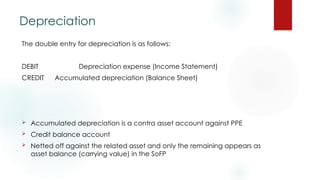
The double entry for depreciation is as follows:
DEBIT Depreciation expense (Income Statement)
CREDIT Accumulated depreciation (Balance Sheet)
 Accumulated depreciation is a contra asset account against PPE
 Credit balance account
 Netted off against the related asset and only the remaining appears as
asset balance (carrying value) in the SoFP
Depreciation
Methods of depreciation:
 Straight line
 Declining (reducing) balance
 Sum-of-the-years'-digits
 Units-of-Production (Output)
 Double declining balance
Note:
At end of useful life, irrespective of the method used, net book value = salvage value
Depreciation
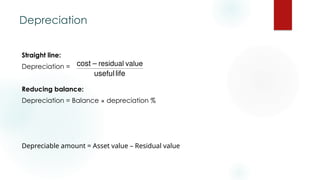
Straight line:
Depreciation =
Reducing balance:
Depreciation = Balance × depreciation %
Depreciable amount = Asset value – Residual value
residual value
cost –
useful life
Depreciation
Double declining balance method:
Depreciation = Balance × double rate of depreciation %
Sum of the years digit method:
Depreciation = (Cost - Salvage value) x Remaining life
Sum of the years digit
Units-of-Production (Output) method:
Depreciation = Output units x Rate/output
Rate/output = Depreciable value/Total output expected
Depreciation
Useful life:
 expected period of usage of an asset
Residual value:
 expected resale value at the end of useful life
 also known as salvage value, scrap value etc.
Change in expected life
Changes in:
 Useful life
 Residual value
Both are estimates; changes will be accounted prospectively.
Updates made in the period when changes occur; no need to revise earlier accounts.
Method of depreciation
 Factors to consider when determining the most appropriate method:
 How will the asset be used by the business?
 Will the benefit be received evenly over the useful life or will the majority of the
benefit be received earlier on?
 Is there a measurable output produced by the company?
Revaluations
IFRS allows a choice between:
 Keeping asset at cost
 Revaluing to fair value
Fair value may give fairer view on business.
Revaluations
 Recording the value of an asset at its market value
 Annually compare the book value with fair value
 Revaluations must be done for all assets in that category (classification)
Revaluations
If fair value > NBV, we will record revaluation gain
 Revaluation gain is added to other comprehensive income (reserve)
 After revaluation entry, carrying value must be equal to fair value
 Revaluation surplus represents an increase in shareholders' wealth
 Revaluation surplus cannot be used for dividends or business operations
Revaluation loss
If revaluation reserve is available:
 Reverse revaluation reserve (other comprehensive income)
If no revaluation reserve:
 Charge to profit or loss as expense
Impairment
Reduction in value of assets. Applicable even if cost model is followed.
Results in:
 Write-off of fixed asset value
 Same accounting treatment as revaluation losses
Non-current asset disposals
 Depreciate the asset until the date of disposal
 Remove all accounts pertaining to the asset and take them to disposal account
 Compare CV and sales proceeds
Non-current asset disposals
Disposal
On disposal of an asset a profit or loss will arise depending on whether
disposal proceeds are greater or less than the carrying value of the asset.
 If proceeds > NBV = profit
 If proceeds < NBV = loss
Component vs composite depreciation
Component depreciation:
 Separate depreciation of each part of an item of property, plant, and
equipment that is significant to the total cost of the fixed asset
 Profit or loss on disposal of each item separately identified
Composite depreciation:
 The process of averaging the economic lives of a number of property units and
depreciating the entire class of assets over a single life
 Simplifying record keeping of assets and depreciation calculations
 Profit or loss on disposal of composite assets are adjusted to accumulated
depreciation
U.S. GAAP vs IFRS
Items U.S. GAAP IFRS
Revaluation method Not applicable Allowed
Depreciation methods Management choice Consistent with usage
Valuation technique Not applicable* Consistent for a class of assets
Component depreciation Management choice Mandatory
*Only one valuation method allowed in U.S. GAAP – Cost method
Thank you!

A4_Tangible non current assets class.pptx

  • 1.
  • 2.
    Topics  Asset (capital)and revenue expenditure  Property, plant and equipment  Depreciation  Revaluations (IFRS)  Disposals
  • 3.
    Asset and revenueexpenditure Asset expenditure results in the acquisition of non-current assets, or an increase in their earning capacity.  Recognised as non-current asset in balance sheet  Expensed gradually as the asset is used (depreciation) Examples:  Purchase of machinery  Installing AC to all rooms of a building
  • 4.
    Asset and revenueexpenditure Revenue expenditure is incurred for the purpose of trade or to maintain the existing earning capacity of the non-current assets.  Expensed in income statement as incurred Examples:  Purchase of inventory  Painting a building
  • 5.
    Tangible non-current assets Tangibleresources controlled by an entity  Held for production, delivery of service, rental, administration etc.  Expected to be used for more than one period
  • 6.
    Tangible non-current assets Examples: Building  Land  Machinery  Equipment  Plant  Vehicles  Furniture
  • 7.
    Property, Plant andEquipment Recognition criteria:  U.S GAAP: Cost model  IFRS: Cost model & revaluation (fair value) model
  • 8.
    Property, Plant andEquipment Cost:  Cash or cash equivalents paid to acquire/construct asset Fair value:  Amount at which knowledgeable, willing parties in an arm’s length transaction Carrying amount:  Amount at which asset is valued in balance sheet net of depreciation
  • 9.
    Components of cost Cost: Cash or cash equivalents paid to acquire/construct asset Components of cost:  Purchase price  Directly attributable costs to get asset ready to be used
  • 10.
    Components of cost Purchaseprice also includes:  Import duties  Carriage inwards  Net of any trade discount
  • 11.
    Components of cost Directlyattributable costs of bringing the asset to working condition.  Site preparation costs  Installation and assembly costs  Professional fees  Staff costs for construction or acquisition of assets
  • 12.
    Property, plant andequipment Costs not considered:  Administration and general overheads  Initial costs before assets reaches planned efficiency  Staff training*  Repair and maintenance
  • 13.
    Staff costs Only staffcosts arising directly from the construction or acquisition of the asset can be capitalised as part of the cost of the asset. The costs of training staff to use a new asset cannot be capitalised because it is not probable that economic benefits will be generated from training the staff as we can't guarantee that those staff will stay and use the asset. The costs of training staff should be expensed.
  • 14.
    Property, plant andequipment Subsequent expenditure  Added to carrying amount if improves condition beyond previous performance
  • 15.
    Property, plant andequipment Subsequent expenditure  Added to carrying amount if improves condition beyond previous performance Examples:  Modifications that increases useful life of an asset  Upgrade of machinery to improve quality of output Repairs and maintenance costs are expensed.
  • 16.
    Property, plant andequipment When purchased/developed:  Dr. Asset  Cr. Cash/Bank/Payable
  • 17.
    Depreciation It is aprocess of spreading the original cost of a non-current asset over the accounting periods in which its benefit will be earned. Depreciation is systematic allocation of the depreciable amount of an asset over its useful life  Accruals concept  Matching concept  Depreciable amount = Asset value – Residual value
  • 18.
    Depreciation The double entryfor depreciation is as follows: DEBIT Depreciation expense (Income Statement) CREDIT Accumulated depreciation (Balance Sheet)  Accumulated depreciation is a contra asset account against PPE  Credit balance account  Netted off against the related asset and only the remaining appears as asset balance (carrying value) in the SoFP
  • 19.
    Depreciation Methods of depreciation: Straight line  Declining (reducing) balance  Sum-of-the-years'-digits  Units-of-Production (Output)  Double declining balance Note: At end of useful life, irrespective of the method used, net book value = salvage value
  • 20.
    Depreciation Straight line: Depreciation = Reducingbalance: Depreciation = Balance × depreciation % Depreciable amount = Asset value – Residual value residual value cost – useful life
  • 21.
    Depreciation Double declining balancemethod: Depreciation = Balance × double rate of depreciation % Sum of the years digit method: Depreciation = (Cost - Salvage value) x Remaining life Sum of the years digit Units-of-Production (Output) method: Depreciation = Output units x Rate/output Rate/output = Depreciable value/Total output expected
  • 22.
    Depreciation Useful life:  expectedperiod of usage of an asset Residual value:  expected resale value at the end of useful life  also known as salvage value, scrap value etc.
  • 23.
    Change in expectedlife Changes in:  Useful life  Residual value Both are estimates; changes will be accounted prospectively. Updates made in the period when changes occur; no need to revise earlier accounts.
  • 24.
    Method of depreciation Factors to consider when determining the most appropriate method:  How will the asset be used by the business?  Will the benefit be received evenly over the useful life or will the majority of the benefit be received earlier on?  Is there a measurable output produced by the company?
  • 25.
    Revaluations IFRS allows achoice between:  Keeping asset at cost  Revaluing to fair value Fair value may give fairer view on business.
  • 26.
    Revaluations  Recording thevalue of an asset at its market value  Annually compare the book value with fair value  Revaluations must be done for all assets in that category (classification)
  • 27.
    Revaluations If fair value> NBV, we will record revaluation gain  Revaluation gain is added to other comprehensive income (reserve)  After revaluation entry, carrying value must be equal to fair value  Revaluation surplus represents an increase in shareholders' wealth  Revaluation surplus cannot be used for dividends or business operations
  • 28.
    Revaluation loss If revaluationreserve is available:  Reverse revaluation reserve (other comprehensive income) If no revaluation reserve:  Charge to profit or loss as expense
  • 29.
    Impairment Reduction in valueof assets. Applicable even if cost model is followed. Results in:  Write-off of fixed asset value  Same accounting treatment as revaluation losses
  • 30.
    Non-current asset disposals Depreciate the asset until the date of disposal  Remove all accounts pertaining to the asset and take them to disposal account  Compare CV and sales proceeds
  • 31.
    Non-current asset disposals Disposal Ondisposal of an asset a profit or loss will arise depending on whether disposal proceeds are greater or less than the carrying value of the asset.  If proceeds > NBV = profit  If proceeds < NBV = loss
  • 32.
    Component vs compositedepreciation Component depreciation:  Separate depreciation of each part of an item of property, plant, and equipment that is significant to the total cost of the fixed asset  Profit or loss on disposal of each item separately identified Composite depreciation:  The process of averaging the economic lives of a number of property units and depreciating the entire class of assets over a single life  Simplifying record keeping of assets and depreciation calculations  Profit or loss on disposal of composite assets are adjusted to accumulated depreciation
  • 33.
    U.S. GAAP vsIFRS Items U.S. GAAP IFRS Revaluation method Not applicable Allowed Depreciation methods Management choice Consistent with usage Valuation technique Not applicable* Consistent for a class of assets Component depreciation Management choice Mandatory *Only one valuation method allowed in U.S. GAAP – Cost method
  • 34.