Money Matters!  “Public Library Budgeting 101” Cheryl Becker Public Library Administration Consultant South Central Library System
The Budget Triangle Planning Preparing  Getting $$
PLANNING “Planning for Results” “Excellence must be defined locally—it results when library services match community needs, interests and priorities.”  Community input Broad community support 1
Stategic Plan Mission Statement Service responses Goals Objectives Activities Resource allocation / Reallocation Budget ramifications
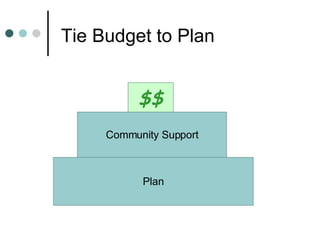
Tie Budget to Plan Plan Community Support $$
PREPARING Resources needed for coming year Estimate expenditures (A) Estimate revenues (B) Amount needed from municipality (C) A – B = C (sort of) 1 2
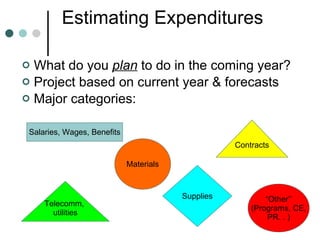
Estimating Expenditures What do you  plan  to do in the coming year? Project based on current year & forecasts Major categories: Salaries, Wages, Benefits Materials Contracts Supplies “ Other’’ (Programs, CE, PR. . ) Telecomm,  utilities
Sources of Info —Personnel Salary & Fringe Benefit Survey of Wisconsin Public Libraries  Public Library Data Service (PLDS) Report Similar positions in municipality State & federal minimum wage Wisconsin Retirement Fund Insurance carriers
Sources of Info — Materials Books: Bowker Annual Periodicals:  Library Journal  (every April) EBSCO  price projections Media:  vendors, stores Electronic resources “ Share” of SCLS resources
Sources of Info —Other Your major vendors LINK  Delivery Telus Continuing education, conference projections Other?
Estimating Revenues County Payments  Own county Adjacent counties System Federal  Funds carried forward Donations / Gifts / Grants Other?
County Reimbursement Wisconsin Statutes 43.12 Formula  70% minimum Doesn’t relieve municipality of responsibility
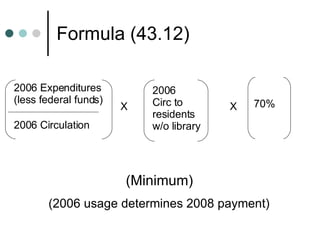
Formula (43.12) 2006 Expenditures (less federal funds) 2006 Circulation X 2006  Circ to residents w/o library X 70% (Minimum) (2006 usage determines 2008 payment)
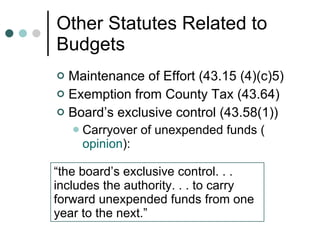
Other Statutes Related to Budgets Maintenance of Effort (43.15 (4)(c)5) Exemption from County Tax (43.64) Board’s exclusive control (43.58(1)) Carryover of unexpended funds ( opinion ): “ the board’s exclusive control. . . includes the authority. . . to carry forward unexpended funds from one year to the next.”
Operating vs. Capital Keep them separate
Operating Recurring, can be anticipated Salaries, wages, benefits Materials Heating, cooling, maintenance, upkeep Contracts
Capital Irregular, major Require fundraising and/or municipal borrowing New or remodeled building, major improvements Expensive  equipment, furnishings Municipality may have separate process for capital requests
Create the Budget Request Types of Budgets Line item Program Municipal format & guidelines Characteristics Clarity Accuracy Consistency Comprehensiveness
Line Item Budget Commonly used Categories (“lines”) of expenditures Personnel Materials (may break down further) Supplies Equipment Etc.  See example
Program Budget Organized around programmatic areas.  For example:  Administration Children’s service Circulation Reference  Public programs May be sub-arranged in line item style
Program Budget Divide salaries, supplies, materials, etc. up and put under each program area Allows director & board to see how much is spent on each area Back up line item budget with program budget Not easy to do, but powerful See example
GETTING Budget documents municipality’s format & guidelines a word about percentages (and levy limits) Documentation simple, understandable, attractive  package Presentation 3 1 2
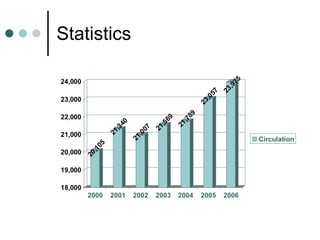
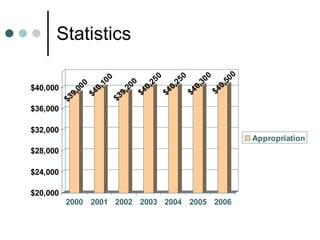
Documentation—Tell your story Statistics Output measures Few Well-chosen Clear and simple Anecdotes / Testimonials Seal the deal Keep a file.
Statistics
Statistics
Statistics “ Last year the average resident checked out 7 items.  The per capita library cost was $27 —   the cost of one hardcover book.  What a good deal!”
“Break it Down”  “ The increase translates to $200 per household, or about 50 ¢ per day —less than the price of a cup of coffee.”
Testimonials “ Last month my husband was diagnosed with a rare health condition.  Library staff members helped me find useful information, and locate a specialist 200 miles away.  I don’t know what we would have done without the library.”
Presentation Know the players Make sure they know you Bring your board Bring your friends/taxpayers Supportive statistics and anecdotes Don’t use jargon / explain acronyms Use humor Be brief
Know the Players —   Do they Know You?  All year round.  Be part of the community (Chamber, other organizations) Support, research on topics of discussion Become useful to individual members What’s going on at the library Invite them in!
Bring your Board, F(f)riends (taxpayers) Educate them about your needs, message Elected officials listen when voters speak (Maybe not the first time)
Three Rules Never assume that others understand what the library does or what it takes to do it.  Use every opportunity to educate them.   #1
Three Rules Ask!  Research shows that even people who don’t use libraries appreciate them and support them.  #2
Three Rules Don’t do this alone.  Your message is most powerful when others speak up for you.   #3
Successful Speaking Be sincere.  Be brief. Be seated.   — Franklin D. Roosevelt
Post-Appropriation Did we get what we asked for?  Why or why not?  What will we do differently next time?  If not:  reallocate budget lines (Board, not municipality) No matter what:  Say  “Thank you!” $$
Municipal vs. Library Accounting Municipality makes payments from library fund (authorized by library board) Municipal accounting should be available to director & board upon request Advisable to also keep library’s own records timely access double-check
Typical Budget Calendar After discussion with board, director drafts preliminary budget Summer Review current year revenue & expenditures  Municipality sets budget calendar & process Mid-Year Review plan and service responses.  Progress.  Spring Review annual report. Trends. February-March
Typical Budget Calendar Budget reviewed by municipality May request additional info Budget hearing Fall Submit board-approved budget request to municipality Prepare documentation for budget hearing Late Summer/ Early Fall Board approves or revises budget Late Summer/ Early Fall
Typical Budget Calendar Soon it will be time to do it all again! Final approval Fall Monitor expenditures Ongoing Thank-you’s Reallocate budget lines if necessary Evaluate, notes for next year Post- approval
Questions, Discussion?  Thank you! Cheryl Becker Public Library Administration Consultant South Central Library System [email_address]

Money Matters!

  • 1.
    Money Matters! “Public Library Budgeting 101” Cheryl Becker Public Library Administration Consultant South Central Library System
  • 2.
    The Budget TrianglePlanning Preparing Getting $$
  • 3.
    PLANNING “Planning forResults” “Excellence must be defined locally—it results when library services match community needs, interests and priorities.” Community input Broad community support 1
  • 4.
    Stategic Plan MissionStatement Service responses Goals Objectives Activities Resource allocation / Reallocation Budget ramifications
  • 5.
    Tie Budget toPlan Plan Community Support $$
  • 6.
    PREPARING Resources neededfor coming year Estimate expenditures (A) Estimate revenues (B) Amount needed from municipality (C) A – B = C (sort of) 1 2
  • 7.
    Estimating Expenditures Whatdo you plan to do in the coming year? Project based on current year & forecasts Major categories: Salaries, Wages, Benefits Materials Contracts Supplies “ Other’’ (Programs, CE, PR. . ) Telecomm, utilities
  • 8.
    Sources of Info—Personnel Salary & Fringe Benefit Survey of Wisconsin Public Libraries Public Library Data Service (PLDS) Report Similar positions in municipality State & federal minimum wage Wisconsin Retirement Fund Insurance carriers
  • 9.
    Sources of Info— Materials Books: Bowker Annual Periodicals: Library Journal (every April) EBSCO price projections Media: vendors, stores Electronic resources “ Share” of SCLS resources
  • 10.
    Sources of Info—Other Your major vendors LINK Delivery Telus Continuing education, conference projections Other?
  • 11.
    Estimating Revenues CountyPayments Own county Adjacent counties System Federal Funds carried forward Donations / Gifts / Grants Other?
  • 12.
    County Reimbursement WisconsinStatutes 43.12 Formula 70% minimum Doesn’t relieve municipality of responsibility
  • 13.
    Formula (43.12) 2006Expenditures (less federal funds) 2006 Circulation X 2006 Circ to residents w/o library X 70% (Minimum) (2006 usage determines 2008 payment)
  • 14.
    Other Statutes Relatedto Budgets Maintenance of Effort (43.15 (4)(c)5) Exemption from County Tax (43.64) Board’s exclusive control (43.58(1)) Carryover of unexpended funds ( opinion ): “ the board’s exclusive control. . . includes the authority. . . to carry forward unexpended funds from one year to the next.”
  • 15.
    Operating vs. CapitalKeep them separate
  • 16.
    Operating Recurring, canbe anticipated Salaries, wages, benefits Materials Heating, cooling, maintenance, upkeep Contracts
  • 17.
    Capital Irregular, majorRequire fundraising and/or municipal borrowing New or remodeled building, major improvements Expensive equipment, furnishings Municipality may have separate process for capital requests
  • 18.
    Create the BudgetRequest Types of Budgets Line item Program Municipal format & guidelines Characteristics Clarity Accuracy Consistency Comprehensiveness
  • 19.
    Line Item BudgetCommonly used Categories (“lines”) of expenditures Personnel Materials (may break down further) Supplies Equipment Etc. See example
  • 20.
    Program Budget Organizedaround programmatic areas. For example: Administration Children’s service Circulation Reference Public programs May be sub-arranged in line item style
  • 21.
    Program Budget Dividesalaries, supplies, materials, etc. up and put under each program area Allows director & board to see how much is spent on each area Back up line item budget with program budget Not easy to do, but powerful See example
  • 22.
    GETTING Budget documentsmunicipality’s format & guidelines a word about percentages (and levy limits) Documentation simple, understandable, attractive package Presentation 3 1 2
  • 23.
    Documentation—Tell your storyStatistics Output measures Few Well-chosen Clear and simple Anecdotes / Testimonials Seal the deal Keep a file.
  • 24.
  • 25.
  • 26.
    Statistics “ Lastyear the average resident checked out 7 items. The per capita library cost was $27 — the cost of one hardcover book. What a good deal!”
  • 27.
    “Break it Down” “ The increase translates to $200 per household, or about 50 ¢ per day —less than the price of a cup of coffee.”
  • 28.
    Testimonials “ Lastmonth my husband was diagnosed with a rare health condition. Library staff members helped me find useful information, and locate a specialist 200 miles away. I don’t know what we would have done without the library.”
  • 29.
    Presentation Know theplayers Make sure they know you Bring your board Bring your friends/taxpayers Supportive statistics and anecdotes Don’t use jargon / explain acronyms Use humor Be brief
  • 30.
    Know the Players— Do they Know You? All year round. Be part of the community (Chamber, other organizations) Support, research on topics of discussion Become useful to individual members What’s going on at the library Invite them in!
  • 31.
    Bring your Board,F(f)riends (taxpayers) Educate them about your needs, message Elected officials listen when voters speak (Maybe not the first time)
  • 32.
    Three Rules Neverassume that others understand what the library does or what it takes to do it. Use every opportunity to educate them. #1
  • 33.
    Three Rules Ask! Research shows that even people who don’t use libraries appreciate them and support them. #2
  • 34.
    Three Rules Don’tdo this alone. Your message is most powerful when others speak up for you. #3
  • 35.
    Successful Speaking Besincere. Be brief. Be seated. — Franklin D. Roosevelt
  • 36.
    Post-Appropriation Did weget what we asked for? Why or why not? What will we do differently next time? If not: reallocate budget lines (Board, not municipality) No matter what: Say “Thank you!” $$
  • 37.
    Municipal vs. LibraryAccounting Municipality makes payments from library fund (authorized by library board) Municipal accounting should be available to director & board upon request Advisable to also keep library’s own records timely access double-check
  • 38.
    Typical Budget CalendarAfter discussion with board, director drafts preliminary budget Summer Review current year revenue & expenditures Municipality sets budget calendar & process Mid-Year Review plan and service responses. Progress. Spring Review annual report. Trends. February-March
  • 39.
    Typical Budget CalendarBudget reviewed by municipality May request additional info Budget hearing Fall Submit board-approved budget request to municipality Prepare documentation for budget hearing Late Summer/ Early Fall Board approves or revises budget Late Summer/ Early Fall
  • 40.
    Typical Budget CalendarSoon it will be time to do it all again! Final approval Fall Monitor expenditures Ongoing Thank-you’s Reallocate budget lines if necessary Evaluate, notes for next year Post- approval
  • 41.
    Questions, Discussion? Thank you! Cheryl Becker Public Library Administration Consultant South Central Library System [email_address]