By
Yelisetty Sai Manish
2100550023
WHAT IS A BUDGET?
“The master financial plan of your municipality”
WHY HAVE A BUDGET?
• ACCOUNTABILITY - legitimatize public
expenditures and account for control and usage.
• PLANNING - planning, coordinating and scheduling
programs.
• EVALUATION - source for review of project
effectiveness.
• INFORMATION - useful management and
communication documents.
WHAT SHOULD A BUDGET
SHOW?
•The proposed cost for each
function of government.
(Expenses)
•The proposed means for
financing these activities.
(Revenues)
DIFFERENT BUDGET TYPES
• Line Item Budget
• Program Budget
• Lump Sum Budget
• Multi-Year Budget
“The basic law of budgets: You can
only spend it once.”
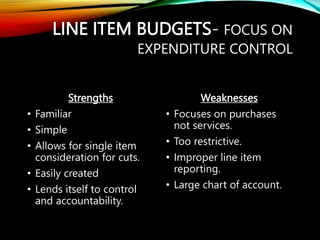
LINE ITEM BUDGETS- FOCUS ON
EXPENDITURE CONTROL
Strengths
• Familiar
• Simple
• Allows for single item
consideration for cuts.
• Easily created
• Lends itself to control
and accountability.
Weaknesses
• Focuses on purchases
not services.
• Too restrictive.
• Improper line item
reporting.
• Large chart of account.
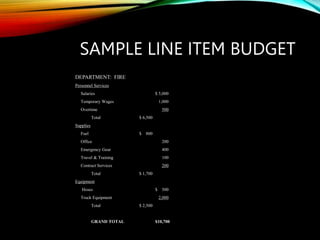
SAMPLE LINE ITEM BUDGET
DEPARTMENT: FIRE
Personnel Services
Salaries $ 5,000
Temporary Wages 1,000
Overtime 500
Total $ 6,500
Supplies
Fuel $ 800
Office 200
Emergency Gear 400
Travel & Training 100
Contract Services 200
Total $ 1,700
Equipment
Hoses $ 500
Truck Equipment 2,000
Total $ 2,500
GRAND TOTAL $10,700
PROGRAM BUDGETS- FOCUS ON THE
PRODUCT OF THE BUDGETING EFFORT NOT
WHAT GOES INTO IT.
Strengths
• Budget focus shifts to
accomplishments not
individual purchases
• Total program and
activity cost easily
identified.
• Links to objectives and
performance.
•Weaknesses
• Too complex and detailed
if many variables are
used.
• Harder for elected
officials to learn.
• Increases internal record
keeping and accounting
burdens.
SAMPLE PROGRAM
BUDGET
PROGRAM: PUBLIC SAFETY
•Police $ 8,000
•Investigation 1,000
•Traffic Enforcement 3,000
•Fire Suppression 5,400
•Fire Training 500
•Fire Prevention 1,800
•Rescue 2,000
•Fire Administration 1,000
•Building Inspection 1,000
•Animal Control 1,500
•Traffic Engineering 500
•Street Lights 2,000
GRAND TOTAL $10,700
LUMP BUDGETS- BASED ON TRUST
BETWEEN ELECTED OFFICIALS AND STAFF.
Strengths
• Allows elected officials to set
goals and policy without being
weighed down by line item
detail.
• Gives department heads a high
degree of freedom in managing
their department.
• Budget funds not spent can be
carried forward to next year-
encourages saving.
Weaknesses
• See Strengths.
“If the police chief gets a budget. If he
wants to use it to buy police cars or to
hire people, that’s his business. What I
care about is that the city gets good
police protection and he’s got money
left over at the end of the year.”
Gale Wilson, Fairfield City Manager
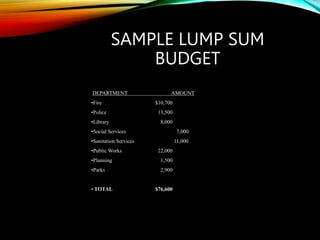
SAMPLE LUMP SUM
BUDGET
DEPARTMENT AMOUNT
•Fire $10,700
•Police 13,500
•Library 8,000
•Social Services 7,000
•Sanitation Services 11,000
•Public Works 22,000
•Planning 1,500
•Parks 2,900
• TOTAL $76,600
MULTI-YEAR BUDGETS- SAVES
STAFF TIME AND MONEY.
Strengths
• Flexibility in using resources
because of the two year time
frame.
• Less work in the second year.
• Provides long range planning.
• Can result in significant cost
savings.
Weaknesses
• Difficult to estimate second
year budget revenues.
• Newly elected officials may not
want to accept budget.
• May not be practical if the state
has an impact on local funding.
• Costly accounting, reporting
modifications.
BI-ANNUAL BUDGETING
W.S. 16-4-104(h) allows cities and town to employ a two (2)
year budget cycle and adopt a two (2) year budget under the
following conditions:
• The two (2) year period shall begin with the city’s or
town’s first fiscal year following a budget session of the
legislature;
• For the second year of the budget cycle, the budget
officer shall prepare a budget adjustment that includes the
original budget and any proposed changes, to be adopted
by the governing body in the same procedure as a budget.
BUDGET PROCESSES
• Preparation - the budget officer (YOU) collects financial
data and provides program expense projections and
funding needs to council for review.
• Adoption - must pass a budget ordinance during the last
quarter of the fiscal year for the upcoming year.
• Execution - governing body must adopt the budget
within 24 hours of their budget hearings, which must
be held between the 2nd and 3rd Tuesday in June.
BUDGET DEVELOPMENT FILE
• Complaints about service.
• Census Data
• New program ideas, history, revenue trends, and new funding
options.
• Newspaper/Magazine Articles
• Performance data (i.e.. Workload, service demands.)
• Audit recommendations
• New technology information.
• Letters of commendation
PROGRAM CONSIDERATIONS
• Is it Mandated?
• Will productivity be increased?
• Will legal exposure be lessened?
• Will it cause an increased workload?
• Will it result in higher prices?
• Can the additional cost be offset by revenues?
• What new challenges are developing that will require resources?
• Is this something the elected officials want to see?
• What are the organizational goals set by the elected body?
BEGINNER’S MISTAKES
• Failure to follow instructions or meet deadlines.
• Mathematical errors.
• Not asking for enough money to meet expense needs.
• Asking for too much money without justified need.
• Not recognizing the difference between controversial and routine
proposals.
• Not asking “stupid” questions.
• Failing to research revenue trends.
• Not considering dedicated funding sources and knowing which
can and cannot be used for other projects.
ERRORS COUNCILS NEVER MISS
• Spelling errors anywhere in the material.
• Columns that do not add correctly.
• Negative balance shown as a positive.
• Decimal in the wrong place.
• Inconsistent narrative in different parts of the budget.
“Big budgets, small budgets, they are all the
same - just add or subtract a few sets of
zero’s.”
Budget Director, New York City
BUDGET QUESTIONS
• Why is this needed?
• When is this item required and
why?
• What are the total direct and
indirect costs?
• What are the objectives?
• What are the personnel
requirements?
• Can this item be phased?
• What is the program life-span?
• Who will benefit and what are
the political impacts?
You should be able to answer these questions for any program or
capital project.
• What additional training and
equipment will be needed?
• What problems will it create?
• How much revenue will be
generated?
• Can the cost be recovered?
• Where will we get the money to
pay for it?
• Can it be financed through a
grant?
• What will happen if it is not
funded?
BUDGET EVALUATION
• Did we meet our objectives?
• What adjustments were made?
• What was accomplished?
• What did we do wrong?
• What did we do right?
“A government which robs Peter to pay
Paul can always depend on the support of
Paul”
George Bernard Shaw
PRESENTING BUDGETS TO
COUNCIL AND THE PUBLIC
• Summarize the main issues up front.
• Be prepared to answer questions.
• Cite statistics, measures and sources.
• Humanize responses with specific examples.
• Provide an overall perspective. What does this mean?
• Utilize simple but meaningful graphics and visuals.
• Anticipate the critical issues and address them.
• Budget needs to be clear to the public.
PRESENTING BAD NEWS
• Explain the issue in plain English.
• Get to the point.
• Present bad news promptly, don’t keep them guessing.
• Outline consequences.
• Show emotion.
• Focus on what is being done to deal with the issue.
• Articulate the assumptions being made.
• Express your best professional judgment.
• Leave them with the feeling they are in charge.
CITIES/TOWNS UNDER
4,000
• Must prepare its budget in a format that complies
with W.S. 16-4-104(f).
• Shall be prepared in a timely fashion allowing the
governing body to meet the hearing date and notice
requirements.
• Publish at least one week before the public hearing.
• Hearing held between 2nd and third Tuesday of June.
• The proposed budget shall set forth:
• Actual revenue and expense in the last completed year.
• Estimated total revenues and expenses for current year.
• Estimated available revenue and expense for upcoming year.
• Must pass an appropriations ordinance during
the last quarter of the year to take effect at the
beginning of the new fiscal year. This will be
May 1st unless otherwise provided by
ordinance.
• Each budget shall be accompanied by a budget
message outlining the proposed financial
policies for the budget year, describing
important features of the budgetary plan and
reason for changes from previous years.
• Prior to adoption, the governing body must
determine the amount of general taxes needed
to provide for expenses and the amount of any
special tax or levy needed.
• The budget officer must certify the amount to
the county clerk:
• by the 4th Monday in May if the fiscal year begins on May
1; or
• by July 31st if the fiscal year begins on July 1.
CITIES AND TOWNS OVER
4,000
• Unless changed by charter, all incorporated first
class cities or town with a population over 4,000
and all city manager cities must comply with
the provisions of the Uniform Municipal Fiscal
Procedures Act (W.S. 16-4-101 - 16-4-124).
• Fiscal years run from July 1 to the following
June 30 (W.S. 16-4-102 (a)(x)).
UNIFORM FISCAL
PROCEDURES ACT
• Department officials must submit budget
requests to the budget officer by May 1st.
• Budget Officer must then prepare tentative
budget and file with governing body by May
15th.
• Hearings scheduled between 2nd and 3rd
Tuesday in June. At a time chosen by the
governing body.
• Must be in a format that best serves the needs
of the municipality.
• No later than 30 days after adoption of the
budget the governing body shall provide the
following information to the Legislative Service
Office (W.S. 16-1-104(j)):
• report the budget’s actual revenue/expense in the
last completed year.
• Estimate total revenue/expense for current year
• Estimated available revenue/expense for upcoming
budget year.
• Budget must contain estimates with specific
work programs and other supportive data
requested by the governing body.
• Budget must be accompanied by a budget
message outlining the proposed financial
policies and explain any changes from previous
years.
• A summary of the budget proposed for
adoption must be entered in the minutes.
• The budget summary must be published at
least one week before the date of the public
hearing in a newspaper having general
circulation or by posting the notice in three
conspicuous places.
• A copy of the publication of the hearing must
be sent to the state examiner.
• No appropriation in the final budget can be in
excess of the estimated expendable revenue of
the fund (W.S. 16-4-110).
• Within 24 hours of the public hearing, the
governing body must, by resolution or
ordinance, make the necessary appropriations
and adopt the budget.
• Copy of certified budget must be furnished to
the county commissioners on or before July
31st. (W.S. 39-2-401) and certified copies of the
adopted budget must be on file in the budget
office for public inspection.
BUDGET AMENDMENTS
• Budgets can be amended by the governing
body adopting a resolution (W.S. 16-4-112 and
W.S. 16-4-113).
• If an emergency exists, the governing body can
make the expenditure from accumulated
revenues upon notice of declaration of
emergency published in the paper. (W.S. 16-4-
114).
BUDGET MYTHS &
LEGENDS
• You have to have a balanced budget.
• You can’t budget for grants until you receive
confirmation of award.
• You have to budget reserves as a revenue source.
Our budget is balanced. 50% of our numbers
are real, and 50% are made up.”
BROWN’S BUDGET BELIEFS
• Managers and supervisors are paid
to manage, not be managed.
• Managers can find ways to do
things more efficiently and with less
money if given the freedom to
innovate and control their
resources.
• Self-imposed goals and deadlines
are power motivators
• Interdepartmental competition is
healthy.
• Managers should concentrate on
the bottom line.
• Budgeting is a means to an end,
not an end in itself.
• Given the freedom and the trust,
people will do what’s right.
• Decisions about the best way to get
things done are best made by those
who are assigned to do them.
• If given an incentive to save money,
and operate more efficiently, people
will do so.
• Department managers or supervisors
know more about their needs and
priorities that the City Manager’s
office or the Budget officer.
Don Brown, City Manager, distributed these budget beliefs to his staff.
RESOURCES
• Wyoming Department of Audit – Municipal
Accounting Handbook. --
http://audit.state.wy.us/PFUNDS/MANUALS%20and%20RFP%20form/Wy
oming_Municipal_Accounting_Handbook_2003.pdf
• GFOA Recommended Budgeting Practices --
http://www.gfoa.org/index.php?option=com_content&task=view&id=12
0&Itemid=134
• ICMA – www.icma.org
• APTUS&C - http://www.aptusc.org/
• State of Wyoming – www.state.wy.us
ACKNOWLEDGEMENTS
This presentation was based on information provided in
the following text resources:
• “Little Budget Book” A Portable Budgeting Guide for Local
Governments, By Len Wood, Copyright 1993 & 2000 by Len Wood
& Associates.
• WAMCAT Handbook
• Department of Audit Municipal Accounting Handbook
• Wyoming State Statutes

Budget (1).ppt

  • 1.
  • 2.
    WHAT IS ABUDGET? “The master financial plan of your municipality”
  • 3.
    WHY HAVE ABUDGET? • ACCOUNTABILITY - legitimatize public expenditures and account for control and usage. • PLANNING - planning, coordinating and scheduling programs. • EVALUATION - source for review of project effectiveness. • INFORMATION - useful management and communication documents.
  • 4.
    WHAT SHOULD ABUDGET SHOW? •The proposed cost for each function of government. (Expenses) •The proposed means for financing these activities. (Revenues)
  • 5.
    DIFFERENT BUDGET TYPES •Line Item Budget • Program Budget • Lump Sum Budget • Multi-Year Budget “The basic law of budgets: You can only spend it once.”
  • 6.
    LINE ITEM BUDGETS-FOCUS ON EXPENDITURE CONTROL Strengths • Familiar • Simple • Allows for single item consideration for cuts. • Easily created • Lends itself to control and accountability. Weaknesses • Focuses on purchases not services. • Too restrictive. • Improper line item reporting. • Large chart of account.
  • 7.
    SAMPLE LINE ITEMBUDGET DEPARTMENT: FIRE Personnel Services Salaries $ 5,000 Temporary Wages 1,000 Overtime 500 Total $ 6,500 Supplies Fuel $ 800 Office 200 Emergency Gear 400 Travel & Training 100 Contract Services 200 Total $ 1,700 Equipment Hoses $ 500 Truck Equipment 2,000 Total $ 2,500 GRAND TOTAL $10,700
  • 8.
    PROGRAM BUDGETS- FOCUSON THE PRODUCT OF THE BUDGETING EFFORT NOT WHAT GOES INTO IT. Strengths • Budget focus shifts to accomplishments not individual purchases • Total program and activity cost easily identified. • Links to objectives and performance. •Weaknesses • Too complex and detailed if many variables are used. • Harder for elected officials to learn. • Increases internal record keeping and accounting burdens.
  • 9.
    SAMPLE PROGRAM BUDGET PROGRAM: PUBLICSAFETY •Police $ 8,000 •Investigation 1,000 •Traffic Enforcement 3,000 •Fire Suppression 5,400 •Fire Training 500 •Fire Prevention 1,800 •Rescue 2,000 •Fire Administration 1,000 •Building Inspection 1,000 •Animal Control 1,500 •Traffic Engineering 500 •Street Lights 2,000 GRAND TOTAL $10,700
  • 10.
    LUMP BUDGETS- BASEDON TRUST BETWEEN ELECTED OFFICIALS AND STAFF. Strengths • Allows elected officials to set goals and policy without being weighed down by line item detail. • Gives department heads a high degree of freedom in managing their department. • Budget funds not spent can be carried forward to next year- encourages saving. Weaknesses • See Strengths. “If the police chief gets a budget. If he wants to use it to buy police cars or to hire people, that’s his business. What I care about is that the city gets good police protection and he’s got money left over at the end of the year.” Gale Wilson, Fairfield City Manager
  • 11.
    SAMPLE LUMP SUM BUDGET DEPARTMENTAMOUNT •Fire $10,700 •Police 13,500 •Library 8,000 •Social Services 7,000 •Sanitation Services 11,000 •Public Works 22,000 •Planning 1,500 •Parks 2,900 • TOTAL $76,600
  • 12.
    MULTI-YEAR BUDGETS- SAVES STAFFTIME AND MONEY. Strengths • Flexibility in using resources because of the two year time frame. • Less work in the second year. • Provides long range planning. • Can result in significant cost savings. Weaknesses • Difficult to estimate second year budget revenues. • Newly elected officials may not want to accept budget. • May not be practical if the state has an impact on local funding. • Costly accounting, reporting modifications.
  • 13.
    BI-ANNUAL BUDGETING W.S. 16-4-104(h)allows cities and town to employ a two (2) year budget cycle and adopt a two (2) year budget under the following conditions: • The two (2) year period shall begin with the city’s or town’s first fiscal year following a budget session of the legislature; • For the second year of the budget cycle, the budget officer shall prepare a budget adjustment that includes the original budget and any proposed changes, to be adopted by the governing body in the same procedure as a budget.
  • 14.
    BUDGET PROCESSES • Preparation- the budget officer (YOU) collects financial data and provides program expense projections and funding needs to council for review. • Adoption - must pass a budget ordinance during the last quarter of the fiscal year for the upcoming year. • Execution - governing body must adopt the budget within 24 hours of their budget hearings, which must be held between the 2nd and 3rd Tuesday in June.
  • 15.
    BUDGET DEVELOPMENT FILE •Complaints about service. • Census Data • New program ideas, history, revenue trends, and new funding options. • Newspaper/Magazine Articles • Performance data (i.e.. Workload, service demands.) • Audit recommendations • New technology information. • Letters of commendation
  • 16.
    PROGRAM CONSIDERATIONS • Isit Mandated? • Will productivity be increased? • Will legal exposure be lessened? • Will it cause an increased workload? • Will it result in higher prices? • Can the additional cost be offset by revenues? • What new challenges are developing that will require resources? • Is this something the elected officials want to see? • What are the organizational goals set by the elected body?
  • 17.
    BEGINNER’S MISTAKES • Failureto follow instructions or meet deadlines. • Mathematical errors. • Not asking for enough money to meet expense needs. • Asking for too much money without justified need. • Not recognizing the difference between controversial and routine proposals. • Not asking “stupid” questions. • Failing to research revenue trends. • Not considering dedicated funding sources and knowing which can and cannot be used for other projects.
  • 18.
    ERRORS COUNCILS NEVERMISS • Spelling errors anywhere in the material. • Columns that do not add correctly. • Negative balance shown as a positive. • Decimal in the wrong place. • Inconsistent narrative in different parts of the budget. “Big budgets, small budgets, they are all the same - just add or subtract a few sets of zero’s.” Budget Director, New York City
  • 19.
    BUDGET QUESTIONS • Whyis this needed? • When is this item required and why? • What are the total direct and indirect costs? • What are the objectives? • What are the personnel requirements? • Can this item be phased? • What is the program life-span? • Who will benefit and what are the political impacts? You should be able to answer these questions for any program or capital project. • What additional training and equipment will be needed? • What problems will it create? • How much revenue will be generated? • Can the cost be recovered? • Where will we get the money to pay for it? • Can it be financed through a grant? • What will happen if it is not funded?
  • 20.
    BUDGET EVALUATION • Didwe meet our objectives? • What adjustments were made? • What was accomplished? • What did we do wrong? • What did we do right? “A government which robs Peter to pay Paul can always depend on the support of Paul” George Bernard Shaw
  • 21.
    PRESENTING BUDGETS TO COUNCILAND THE PUBLIC • Summarize the main issues up front. • Be prepared to answer questions. • Cite statistics, measures and sources. • Humanize responses with specific examples. • Provide an overall perspective. What does this mean? • Utilize simple but meaningful graphics and visuals. • Anticipate the critical issues and address them. • Budget needs to be clear to the public.
  • 22.
    PRESENTING BAD NEWS •Explain the issue in plain English. • Get to the point. • Present bad news promptly, don’t keep them guessing. • Outline consequences. • Show emotion. • Focus on what is being done to deal with the issue. • Articulate the assumptions being made. • Express your best professional judgment. • Leave them with the feeling they are in charge.
  • 23.
    CITIES/TOWNS UNDER 4,000 • Mustprepare its budget in a format that complies with W.S. 16-4-104(f). • Shall be prepared in a timely fashion allowing the governing body to meet the hearing date and notice requirements. • Publish at least one week before the public hearing. • Hearing held between 2nd and third Tuesday of June. • The proposed budget shall set forth: • Actual revenue and expense in the last completed year. • Estimated total revenues and expenses for current year. • Estimated available revenue and expense for upcoming year.
  • 24.
    • Must passan appropriations ordinance during the last quarter of the year to take effect at the beginning of the new fiscal year. This will be May 1st unless otherwise provided by ordinance. • Each budget shall be accompanied by a budget message outlining the proposed financial policies for the budget year, describing important features of the budgetary plan and reason for changes from previous years.
  • 25.
    • Prior toadoption, the governing body must determine the amount of general taxes needed to provide for expenses and the amount of any special tax or levy needed. • The budget officer must certify the amount to the county clerk: • by the 4th Monday in May if the fiscal year begins on May 1; or • by July 31st if the fiscal year begins on July 1.
  • 26.
    CITIES AND TOWNSOVER 4,000 • Unless changed by charter, all incorporated first class cities or town with a population over 4,000 and all city manager cities must comply with the provisions of the Uniform Municipal Fiscal Procedures Act (W.S. 16-4-101 - 16-4-124). • Fiscal years run from July 1 to the following June 30 (W.S. 16-4-102 (a)(x)).
  • 27.
    UNIFORM FISCAL PROCEDURES ACT •Department officials must submit budget requests to the budget officer by May 1st. • Budget Officer must then prepare tentative budget and file with governing body by May 15th. • Hearings scheduled between 2nd and 3rd Tuesday in June. At a time chosen by the governing body. • Must be in a format that best serves the needs of the municipality.
  • 28.
    • No laterthan 30 days after adoption of the budget the governing body shall provide the following information to the Legislative Service Office (W.S. 16-1-104(j)): • report the budget’s actual revenue/expense in the last completed year. • Estimate total revenue/expense for current year • Estimated available revenue/expense for upcoming budget year.
  • 29.
    • Budget mustcontain estimates with specific work programs and other supportive data requested by the governing body. • Budget must be accompanied by a budget message outlining the proposed financial policies and explain any changes from previous years. • A summary of the budget proposed for adoption must be entered in the minutes.
  • 30.
    • The budgetsummary must be published at least one week before the date of the public hearing in a newspaper having general circulation or by posting the notice in three conspicuous places. • A copy of the publication of the hearing must be sent to the state examiner. • No appropriation in the final budget can be in excess of the estimated expendable revenue of the fund (W.S. 16-4-110).
  • 31.
    • Within 24hours of the public hearing, the governing body must, by resolution or ordinance, make the necessary appropriations and adopt the budget. • Copy of certified budget must be furnished to the county commissioners on or before July 31st. (W.S. 39-2-401) and certified copies of the adopted budget must be on file in the budget office for public inspection.
  • 32.
    BUDGET AMENDMENTS • Budgetscan be amended by the governing body adopting a resolution (W.S. 16-4-112 and W.S. 16-4-113). • If an emergency exists, the governing body can make the expenditure from accumulated revenues upon notice of declaration of emergency published in the paper. (W.S. 16-4- 114).
  • 33.
    BUDGET MYTHS & LEGENDS •You have to have a balanced budget. • You can’t budget for grants until you receive confirmation of award. • You have to budget reserves as a revenue source. Our budget is balanced. 50% of our numbers are real, and 50% are made up.”
  • 34.
    BROWN’S BUDGET BELIEFS •Managers and supervisors are paid to manage, not be managed. • Managers can find ways to do things more efficiently and with less money if given the freedom to innovate and control their resources. • Self-imposed goals and deadlines are power motivators • Interdepartmental competition is healthy. • Managers should concentrate on the bottom line. • Budgeting is a means to an end, not an end in itself. • Given the freedom and the trust, people will do what’s right. • Decisions about the best way to get things done are best made by those who are assigned to do them. • If given an incentive to save money, and operate more efficiently, people will do so. • Department managers or supervisors know more about their needs and priorities that the City Manager’s office or the Budget officer. Don Brown, City Manager, distributed these budget beliefs to his staff.
  • 35.
    RESOURCES • Wyoming Departmentof Audit – Municipal Accounting Handbook. -- http://audit.state.wy.us/PFUNDS/MANUALS%20and%20RFP%20form/Wy oming_Municipal_Accounting_Handbook_2003.pdf • GFOA Recommended Budgeting Practices -- http://www.gfoa.org/index.php?option=com_content&task=view&id=12 0&Itemid=134 • ICMA – www.icma.org • APTUS&C - http://www.aptusc.org/ • State of Wyoming – www.state.wy.us
  • 36.
    ACKNOWLEDGEMENTS This presentation wasbased on information provided in the following text resources: • “Little Budget Book” A Portable Budgeting Guide for Local Governments, By Len Wood, Copyright 1993 & 2000 by Len Wood & Associates. • WAMCAT Handbook • Department of Audit Municipal Accounting Handbook • Wyoming State Statutes