Financial Management of
Academic Libraries
Presented To Presented By
Prof. M.P. Singh Rajiv Ranjan Mishra
DLIS BBAU MLIS 2nd Sem.
Table of Contents
 Financial Management – Definition
 Components
 Sources of Finance
 Characteristics
 Principles of financial management
 Financial estimation
 Method of financial estimation
 Benefits
 Drawbacks
 Conclusion
 References
Introduction
 Financial management means planning , organizing , directing and controlling of financial
activities ( e.g. procurement and utilization of funds) of the enterprises.
 The word finance is used to comparison of income with expenditure.
 It is use for effective functioning .
 Financial management is the study of principles and
practice involved in financial operation in a library .
 Financial management deals with problem in acquisition,
distribution and utilization of funds , balancing of revenue
and expenditure.
Financial Management
• According to Dr. S. N. Maheshwari
“ Financial management is concerned with raising financial resources and their
effective utilization towards achieving the organization goals.
• According to Richard A. Brealey
“ Financial management is the process of putting the available funds to the best
advantage from the long term point of view of business objectives.”
Components of Financial Management
Financial planning
Forecasting of receipts and disbursements
Realization of funds and revenues
Allocation of funds
Utilization of funds
Financial accounting
Financial control
Financial auditing
Source of Finance
 School Libraries –
 The library fund of school should preferably comprise of fee collected from
pupils , equal contribution from the management , matching contribution
from the government and local body , other gift or special grant that may at
any time be received specifically for the library and donations from public.
The state government or any education authority administrating the school
meet the initial expenditure on setting up school library including cost of
new library buildings and initial expenditure on fittings and book covering .
Continue....
 College Libraries –
There are three main sources of funds for college libraries.
 The first source is the allocation from the current operating funds of the college .
Whether the college is public ( Gov.) or private controlled matters less the amount
of additional money the library need during one budgetary year. ‘ Amalgamated
fund collection ‘ is given to college library for purchase of reading materials .
 The second source of fund for college libraries is Grants , Individual gifts , and
endowments. A large number of college libraries throughout the country receive
grants from UGC.
 The third source of fund college libraries are subscription / membership fee
charged from the students , and annual recurring and non-recurring grants from the
state governments or the governing bodies of the institution .
 University Libraries -
University libraries receive funds from the following sources :
 Grants allocated from University Budget
 Grants from the University Grants Commission
 Grants from Central and State Government
 Endowments and Gifts
Library Fee ( such as development fee , security etc. ) and Caution Money
 Fines and Miscellaneous sources
Characteristics of Library Finance
 Spending Institution
 Growing Institutions
Recurring Financial Demands
 Price-rise
Devaluation of money
Principles of Financial Management
 Effective Control
 Simple Procedures
Regularity and Farsightedness
Economy
Flexibility
Financial Estimation
• Estimate always made for coming year .
• The financial requirement of any library depends on following factors –
 Quantity and Quality of reading material
 Number of Readers
 Seating Capacity
 Number of Research Scholars
 Jurisdiction
 Staff
 Service provide by the Library
Methods of Financial Estimation
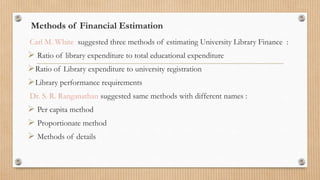
Carl M. White suggested three methods of estimating University Library Finance :
 Ratio of library expenditure to total educational expenditure
Ratio of Library expenditure to university registration
Library performance requirements
Dr. S. R. Ranganathan suggested same methods with different names :
 Per capita method
 Proportionate method
 Methods of details
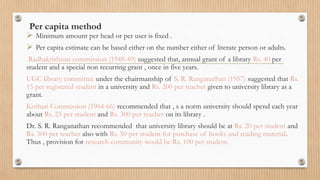
Per capita method
 Minimum amount per head or per user is fixed .
 Per capita estimate can be based either on the number either of literate person or adults.
Radhakrishnan commission (1948-49) suggested that, annual grant of a library Rs. 40 per
student and a special non recurring grant , once in five years.
UGC library committee under the chairmanship of S. R. Ranganathan (1957) suggested that Rs.
15 per registered student in a university and Rs. 200 per teacher given to university library as a
grant.
Kothari Commission (1964-66) recommended that , s a norm university should spend each year
about Rs. 25 per student and Rs. 300 per teacher on its library .
Dr. S. R. Ranganathan recommended that university library should be at Rs. 20 per student and
Rs. 300 per teacher also with Rs. 50 per student for purchase of books and reading material.
Thus , provision for research community would be Rs. 100 per student.
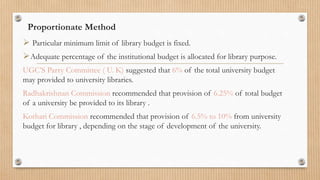
Proportionate Method
 Particular minimum limit of library budget is fixed.
Adequate percentage of the institutional budget is allocated for library purpose.
UGC’S Parry Committee ( U. K) suggested that 6% of the total university budget
may provided to university libraries.
Radhakrishnan Commission recommended that provision of 6.25% of total budget
of a university be provided to its library .
Kothari Commission recommended that provision of 6.5% to 10% from university
budget for library , depending on the stage of development of the university.
Methods of Details
• In this method all the items of expenditure are accounted for preparing financial estimates
for a library.
• It includes-
 Salary/ Wages
Reading Materials
 Books , Periodicals
 Binding and Repair heading
Cooling and Lighting
 Telegrams , Telephones and Stationary etc.
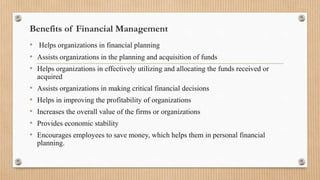
Benefits of Financial Management
• Helps organizations in financial planning
• Assists organizations in the planning and acquisition of funds
• Helps organizations in effectively utilizing and allocating the funds received or
acquired
• Assists organizations in making critical financial decisions
• Helps in improving the profitability of organizations
• Increases the overall value of the firms or organizations
• Provides economic stability
• Encourages employees to save money, which helps them in personal financial
planning.
Drawbacks
 Costly
 Rigidity
 Determination of Standards
 Difficulty in applying control measures
Conclusion
 Today , all libraries are facing the problem of financial crunch due to the rising
subscription cost of periodicals and resources. For Research based sustainability a
consortium is the most suitable approach. Collaboration is an essential facet of
modern library management . To sum up , consortia is the backbone of library co-
operation. And through the availability financial problems may be resolve .
References
 Finance Management / Content by Trishanjit Kaur
 sources of finance and resource mobilisation
http://www.egyankosh.ac.in/bitstream/123456789/35888/5/Unit-10.pdf
 content provided on finance management in university libraries By Prof. M. P.
Singh.
 slide share on financial management by Pichand Kikon ,Ph.D. Scholar
https://www.slideshare.net/pichanokikon9/financial-management-100664957
Finance management in academic library

Finance management in academic library

  • 1.
    Financial Management of AcademicLibraries Presented To Presented By Prof. M.P. Singh Rajiv Ranjan Mishra DLIS BBAU MLIS 2nd Sem.
  • 2.
    Table of Contents Financial Management – Definition  Components  Sources of Finance  Characteristics  Principles of financial management  Financial estimation  Method of financial estimation  Benefits  Drawbacks  Conclusion  References
  • 3.
    Introduction  Financial managementmeans planning , organizing , directing and controlling of financial activities ( e.g. procurement and utilization of funds) of the enterprises.  The word finance is used to comparison of income with expenditure.  It is use for effective functioning .  Financial management is the study of principles and practice involved in financial operation in a library .  Financial management deals with problem in acquisition, distribution and utilization of funds , balancing of revenue and expenditure.
  • 4.
    Financial Management • Accordingto Dr. S. N. Maheshwari “ Financial management is concerned with raising financial resources and their effective utilization towards achieving the organization goals. • According to Richard A. Brealey “ Financial management is the process of putting the available funds to the best advantage from the long term point of view of business objectives.”
  • 5.
    Components of FinancialManagement Financial planning Forecasting of receipts and disbursements Realization of funds and revenues Allocation of funds Utilization of funds Financial accounting Financial control Financial auditing
  • 6.
    Source of Finance School Libraries –  The library fund of school should preferably comprise of fee collected from pupils , equal contribution from the management , matching contribution from the government and local body , other gift or special grant that may at any time be received specifically for the library and donations from public. The state government or any education authority administrating the school meet the initial expenditure on setting up school library including cost of new library buildings and initial expenditure on fittings and book covering .
  • 7.
    Continue....  College Libraries– There are three main sources of funds for college libraries.  The first source is the allocation from the current operating funds of the college . Whether the college is public ( Gov.) or private controlled matters less the amount of additional money the library need during one budgetary year. ‘ Amalgamated fund collection ‘ is given to college library for purchase of reading materials .  The second source of fund for college libraries is Grants , Individual gifts , and endowments. A large number of college libraries throughout the country receive grants from UGC.  The third source of fund college libraries are subscription / membership fee charged from the students , and annual recurring and non-recurring grants from the state governments or the governing bodies of the institution .
  • 8.
     University Libraries- University libraries receive funds from the following sources :  Grants allocated from University Budget  Grants from the University Grants Commission  Grants from Central and State Government  Endowments and Gifts Library Fee ( such as development fee , security etc. ) and Caution Money  Fines and Miscellaneous sources
  • 9.
    Characteristics of LibraryFinance  Spending Institution  Growing Institutions Recurring Financial Demands  Price-rise Devaluation of money
  • 10.
    Principles of FinancialManagement  Effective Control  Simple Procedures Regularity and Farsightedness Economy Flexibility
  • 11.
    Financial Estimation • Estimatealways made for coming year . • The financial requirement of any library depends on following factors –  Quantity and Quality of reading material  Number of Readers  Seating Capacity  Number of Research Scholars  Jurisdiction  Staff  Service provide by the Library
  • 12.
    Methods of FinancialEstimation Carl M. White suggested three methods of estimating University Library Finance :  Ratio of library expenditure to total educational expenditure Ratio of Library expenditure to university registration Library performance requirements Dr. S. R. Ranganathan suggested same methods with different names :  Per capita method  Proportionate method  Methods of details
  • 13.
    Per capita method Minimum amount per head or per user is fixed .  Per capita estimate can be based either on the number either of literate person or adults. Radhakrishnan commission (1948-49) suggested that, annual grant of a library Rs. 40 per student and a special non recurring grant , once in five years. UGC library committee under the chairmanship of S. R. Ranganathan (1957) suggested that Rs. 15 per registered student in a university and Rs. 200 per teacher given to university library as a grant. Kothari Commission (1964-66) recommended that , s a norm university should spend each year about Rs. 25 per student and Rs. 300 per teacher on its library . Dr. S. R. Ranganathan recommended that university library should be at Rs. 20 per student and Rs. 300 per teacher also with Rs. 50 per student for purchase of books and reading material. Thus , provision for research community would be Rs. 100 per student.
  • 14.
    Proportionate Method  Particularminimum limit of library budget is fixed. Adequate percentage of the institutional budget is allocated for library purpose. UGC’S Parry Committee ( U. K) suggested that 6% of the total university budget may provided to university libraries. Radhakrishnan Commission recommended that provision of 6.25% of total budget of a university be provided to its library . Kothari Commission recommended that provision of 6.5% to 10% from university budget for library , depending on the stage of development of the university.
  • 15.
    Methods of Details •In this method all the items of expenditure are accounted for preparing financial estimates for a library. • It includes-  Salary/ Wages Reading Materials  Books , Periodicals  Binding and Repair heading Cooling and Lighting  Telegrams , Telephones and Stationary etc.
  • 16.
    Benefits of FinancialManagement • Helps organizations in financial planning • Assists organizations in the planning and acquisition of funds • Helps organizations in effectively utilizing and allocating the funds received or acquired • Assists organizations in making critical financial decisions • Helps in improving the profitability of organizations • Increases the overall value of the firms or organizations • Provides economic stability • Encourages employees to save money, which helps them in personal financial planning.
  • 17.
    Drawbacks  Costly  Rigidity Determination of Standards  Difficulty in applying control measures
  • 18.
    Conclusion  Today ,all libraries are facing the problem of financial crunch due to the rising subscription cost of periodicals and resources. For Research based sustainability a consortium is the most suitable approach. Collaboration is an essential facet of modern library management . To sum up , consortia is the backbone of library co- operation. And through the availability financial problems may be resolve .
  • 19.
    References  Finance Management/ Content by Trishanjit Kaur  sources of finance and resource mobilisation http://www.egyankosh.ac.in/bitstream/123456789/35888/5/Unit-10.pdf  content provided on finance management in university libraries By Prof. M. P. Singh.  slide share on financial management by Pichand Kikon ,Ph.D. Scholar https://www.slideshare.net/pichanokikon9/financial-management-100664957