BUDGETING
Presented by - Tilak Chauhan
FY BFM – 105
DEFINITION:
Budgeting is an operational plan, for a definite period
usually a year. Expressed in financial terms and based
on the expected income and expenditure.
Or
Budgeting is a concrete precise picture of the total
operation of an enterprise in monetary terms.
By: H.M. Donovan
PURPOSE OF BUDGETING:
Mechanism for translating fiscal objectives into
projected monthly spending pattern.
Enhances fiscal planning and decision making.
Clearly recognizes controllable and uncontrollable cost
areas.
Offers a useful format for communicating fiscal
objectives.
Allows feedback of utilization of budget.
Helps to identify problem areas and facilitates effective
solution.
Provides means for measuring and recording financial
success with objectives of organization.
PERQUISITES OF BUDGETING:
 ORGANIZATIONAL STRUCTURE: Need a sound
organizational structure with clear line of authority
and responsibility.
 NON-MONETARY STATISTICAL DATA: Such as
number of admissions, average length of stay,
percentage of occupancy and number of patient’s days.
Used for planning and budgetary process.
 CHARTS OF ACCOUNTS: Designed to be consistent
with the organizational plans. Revenues and expenses
are reported by responsibilities areas, thus providing
historical data that are valuable for planning and
providing budgetary control for evaluation as
performance can be compared to plans.
 MANAGERIAL SUPPORT: Essential for the
budgetary programme. Budgeting is done at the
departmental level, it must be valued by top
administration. Managers must be willing to devote
their time and energy to the budgeting process.
 FORMAL BUDGETING PROCESS AND
PROCEDURES: Should be available in budget
manual, in which objectives are clarified and
instructions for budget development are discussed.
Calendar of budgeting activities with the schedule for
each stage of programme is presented.
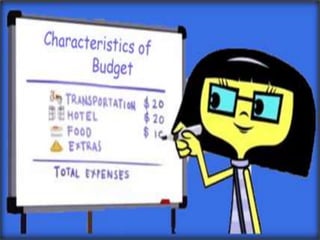
CHARACTERISTICS OF BUDGETING:
 Should be flexible.
 Should be synthesis of past, present and future.
 Should be product of joint venture and cooperation of
executive/department head at different level of
management.
 Should be in the form of statistical standard laid down
in the specific numerical terms.
 Should have support of top management throughout
the period of its planning and implementation.
IMPORTANCE OF BUDGETING:
 Needed for planning future course of action and
control over all activities in the organization.
 Facilitates coordinating operation of various
departments and sectors.
 Helps to weigh values and make decision when
necessary.
TYPES OF BUDGETING:
 OPERATING BUDGET (Revenues and Expenses):
Provides an overview of agency function by projecting
the planned operation for upcoming year. Deals with
salaries, medical-surgical supplies, office supplies,
laundry services, books periodicals, recreation and
contractual services.
 CAPITAL EXPENDITURE BUDGET: Related to long
range planning. Includes physical changes
(replacement and expansion of plant, major
equipments and inventories). They are major
investment and reduce flexibility in budgeting.
 CASH BUDGET: Planned to make adequate funds
available and to use extra funds profitably. Should not
have too much cash on hand during budgetary period.
 LABOR OR PERSONNEL BUDGET: Estimate cost of
direct labor necessary to meet agency objectives.
Determine the recruitment, hiring, assignment, layoff,
discharge of personnel. Nurse Manager has to decide
number of aids, orderlies required during a shift
months and areas.
 FLEXIBLE BUDGET: Some costs are fixed, others
changes with volume of business. Some expenses are
unpredictable and can be determined only after
change has begun. Periodic reviews required to
compensate for changes.
 STRATEGIC PLANNING BUDGET: Long range
budget for long range planning. Projected for 3-5 years.
Programme budget is a part of this budget.
BUDGETING PROCESS:
 STEP 1: Establishment of operational goals and
objectives and policies.
 STEP 2: Goals must be translated into quantifiable
management objectives for organizational units.
Departmental goals are made.
 STEP 3: Formal plan for budget preparation and
review including assignment of responsibilities and
timetable is prepared.
 STEP 4: Departmental budget are revised and master
budget is prepared.
 STEP5: Financial feasibility of master budget is tested
and final document is approved and distributed to all
parties involved.
 STEP 6: Every head of the office required to prepare
budget estimate in respect of salaries of establishment,
contingent expenditure and others. Example-
Telephone, office expenses, rent of building etc.
ADVANTAGES OF BUDGETING:
 Fixes accountability, assignment of responsibility and
authority.
 Encourages managers to make careful analysis of
operation.
 Weakness is revealed, corrective measures taken.
 Financial matters can be handled in orderly fashion.
Activities are balanced.
DISADVANTAGES OF BUDGETING:
 Converts all aspects of organizational performance in
monetary values. Only easy aspects can be considered
and equally important facts such as organizational
development may be ignored.
 May become an end in itself instead of means to end.
Budgetary goals may supersede agency goals.
 Skills and experiences are required for successful
budgetary control.
 Time consuming and expensive.
budgeting-180116052926.pptx

budgeting-180116052926.pptx

  • 1.
    BUDGETING Presented by -Tilak Chauhan FY BFM – 105
  • 2.
    DEFINITION: Budgeting is anoperational plan, for a definite period usually a year. Expressed in financial terms and based on the expected income and expenditure. Or Budgeting is a concrete precise picture of the total operation of an enterprise in monetary terms. By: H.M. Donovan
  • 4.
    PURPOSE OF BUDGETING: Mechanismfor translating fiscal objectives into projected monthly spending pattern. Enhances fiscal planning and decision making. Clearly recognizes controllable and uncontrollable cost areas.
  • 5.
    Offers a usefulformat for communicating fiscal objectives. Allows feedback of utilization of budget. Helps to identify problem areas and facilitates effective solution. Provides means for measuring and recording financial success with objectives of organization.
  • 6.
    PERQUISITES OF BUDGETING: ORGANIZATIONAL STRUCTURE: Need a sound organizational structure with clear line of authority and responsibility.  NON-MONETARY STATISTICAL DATA: Such as number of admissions, average length of stay, percentage of occupancy and number of patient’s days. Used for planning and budgetary process.
  • 7.
     CHARTS OFACCOUNTS: Designed to be consistent with the organizational plans. Revenues and expenses are reported by responsibilities areas, thus providing historical data that are valuable for planning and providing budgetary control for evaluation as performance can be compared to plans.  MANAGERIAL SUPPORT: Essential for the budgetary programme. Budgeting is done at the departmental level, it must be valued by top administration. Managers must be willing to devote their time and energy to the budgeting process.
  • 8.
     FORMAL BUDGETINGPROCESS AND PROCEDURES: Should be available in budget manual, in which objectives are clarified and instructions for budget development are discussed. Calendar of budgeting activities with the schedule for each stage of programme is presented.
  • 10.
    CHARACTERISTICS OF BUDGETING: Should be flexible.  Should be synthesis of past, present and future.  Should be product of joint venture and cooperation of executive/department head at different level of management.  Should be in the form of statistical standard laid down in the specific numerical terms.  Should have support of top management throughout the period of its planning and implementation.
  • 12.
    IMPORTANCE OF BUDGETING: Needed for planning future course of action and control over all activities in the organization.  Facilitates coordinating operation of various departments and sectors.  Helps to weigh values and make decision when necessary.
  • 13.
    TYPES OF BUDGETING: OPERATING BUDGET (Revenues and Expenses): Provides an overview of agency function by projecting the planned operation for upcoming year. Deals with salaries, medical-surgical supplies, office supplies, laundry services, books periodicals, recreation and contractual services.  CAPITAL EXPENDITURE BUDGET: Related to long range planning. Includes physical changes (replacement and expansion of plant, major equipments and inventories). They are major investment and reduce flexibility in budgeting.
  • 14.
     CASH BUDGET:Planned to make adequate funds available and to use extra funds profitably. Should not have too much cash on hand during budgetary period.  LABOR OR PERSONNEL BUDGET: Estimate cost of direct labor necessary to meet agency objectives. Determine the recruitment, hiring, assignment, layoff, discharge of personnel. Nurse Manager has to decide number of aids, orderlies required during a shift months and areas.
  • 15.
     FLEXIBLE BUDGET:Some costs are fixed, others changes with volume of business. Some expenses are unpredictable and can be determined only after change has begun. Periodic reviews required to compensate for changes.  STRATEGIC PLANNING BUDGET: Long range budget for long range planning. Projected for 3-5 years. Programme budget is a part of this budget.
  • 17.
    BUDGETING PROCESS:  STEP1: Establishment of operational goals and objectives and policies.  STEP 2: Goals must be translated into quantifiable management objectives for organizational units. Departmental goals are made.  STEP 3: Formal plan for budget preparation and review including assignment of responsibilities and timetable is prepared.
  • 18.
     STEP 4:Departmental budget are revised and master budget is prepared.  STEP5: Financial feasibility of master budget is tested and final document is approved and distributed to all parties involved.  STEP 6: Every head of the office required to prepare budget estimate in respect of salaries of establishment, contingent expenditure and others. Example- Telephone, office expenses, rent of building etc.
  • 20.
    ADVANTAGES OF BUDGETING: Fixes accountability, assignment of responsibility and authority.  Encourages managers to make careful analysis of operation.  Weakness is revealed, corrective measures taken.  Financial matters can be handled in orderly fashion. Activities are balanced.
  • 21.
    DISADVANTAGES OF BUDGETING: Converts all aspects of organizational performance in monetary values. Only easy aspects can be considered and equally important facts such as organizational development may be ignored.  May become an end in itself instead of means to end. Budgetary goals may supersede agency goals.  Skills and experiences are required for successful budgetary control.  Time consuming and expensive.