Dr. N.Sundar
Librarian
Thiagarajar College of Preceptors, Madurai.
Library Management &
Organizational Structure
Objectives
 Describe the administration and its functions.
 Discuss the basic principles of management.
 Illustrate the departments and its individual
operations.
Library Administration
 Library Administration
 Lib authority and
committees
 Human Resources (Library
Staffing, Job Analysis &
Evaluation, etc.)
 Library Finance (Budgeting,
Accounting, etc.)
 Acquisition, Circulation,
other sections.
 Library Rules &
Maintenance.
 Records, Reports and
Statistics.
Some Definitions
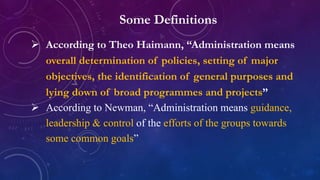
 According to Theo Haimann, “Administration means
overall determination of policies, setting of major
objectives, the identification of general purposes and
lying down of broad programmes and projects”
 According to Newman, “Administration means guidance,
leadership & control of the efforts of the groups towards
some common goals”
Levels of Management
Top Level of Management
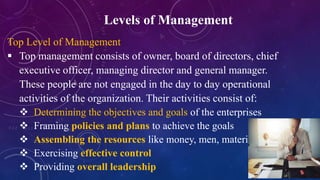
 Top management consists of owner, board of directors, chief
executive officer, managing director and general manager.
These people are not engaged in the day to day operational
activities of the organization. Their activities consist of:
 Determining the objectives and goals of the enterprises
 Framing policies and plans to achieve the goals
 Assembling the resources like money, men, material
 Exercising effective control
 Providing overall leadership
Levels of Management
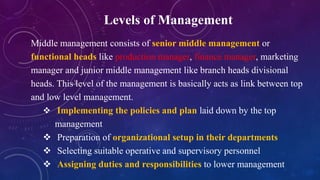
Middle management consists of senior middle management or
functional heads like production manager, finance manager, marketing
manager and junior middle management like branch heads divisional
heads. This level of the management is basically acts as link between top
and low level management.
 Implementing the policies and plan laid down by the top
management
 Preparation of organizational setup in their departments
 Selecting suitable operative and supervisory personnel
 Assigning duties and responsibilities to lower management
Levels of Management
Lower Level of Management
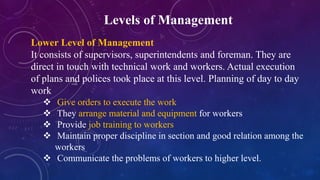
It consists of supervisors, superintendents and foreman. They are
direct in touch with technical work and workers. Actual execution
of plans and polices took place at this level. Planning of day to day
work
 Give orders to execute the work
 They arrange material and equipment for workers
 Provide job training to workers
 Maintain proper discipline in section and good relation among the
workers
 Communicate the problems of workers to higher level.
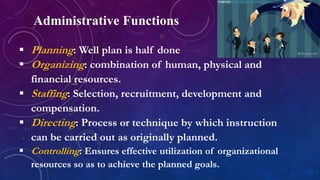
Administrative Functions
 Planning: Well plan is half done
 Organizing: combination of human, physical and
financial resources.
 Staffing: Selection, recruitment, development and
compensation.
 Directing: Process or technique by which instruction
can be carried out as originally planned.
 Controlling: Ensures effective utilization of organizational
resources so as to achieve the planned goals.
Strategic Planning
 Strategic visioning: A proactive view, leading to a plan to
anticipate the future of the library organization.
 Strategic acting: A process of strategically analyzing the
organization’s efforts.
 Strategic planning: A systematic method used by
organizations to adapt to expected changes.
 Core values: A set of common beliefs held by the
organization.
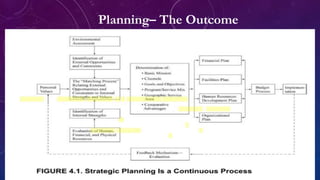
Planning– The Outcome
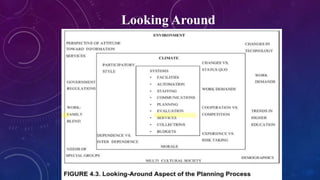
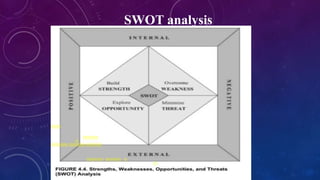
Looking Around
SWOT analysis
Vision
 A vision statement, as an act of foresight, outlines
what the organization wants to be. It is inspirational;
set within a context of the future, it is timeless, and it
provides clear decision-making criteria.
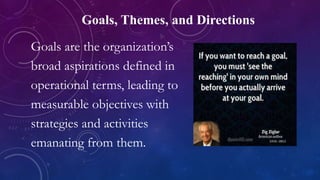
Goals, Themes, and Directions
Goals are the organization’s
broad aspirations defined in
operational terms, leading to
measurable objectives with
strategies and activities
emanating from them.
Objectives, Initiatives, Pathways, and Strategies
Primary elements are involved in objectives formulation include:
 Clients: Who they are and who they are not (with the potential of converting those who are
not).
 Services: What new services are needed, which existing ones should be retained, and which
should be deleted.
 Personnel resources: What professional support skills are needed to provide identified
services.
 Technological resources: What resources can be assessed and what technology is required.
 Financial resources: What the objectives cost.
 Community responsibilities: The library’s obligations as a social institution.
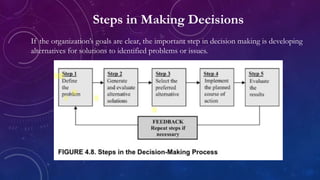
Steps in Making Decisions
If the organization’s goals are clear, the important step in decision making is developing
alternatives for solutions to identified problems or issues.
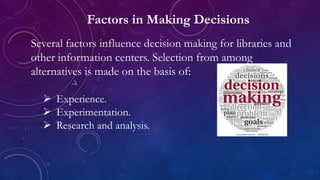
Factors in Making Decisions
Several factors influence decision making for libraries and
other information centers. Selection from among
alternatives is made on the basis of:
 Experience.
 Experimentation.
 Research and analysis.
Understanding the Strategic plan failure & Success
According to Germano, M. A., & Stretch-Stephenson, S. (2012)
 Poor employee engagement;
 Poor communication;
 Lack of clarity in terms of goals and expected outcomes;
 Inadequate leadership development within organizations;
 Speed and adaptability when refinements are required;
 Slow decision-making;
 Resource inadequacy;
 Little attention to customer needs; and
 Non-alignment across functional areas.
Understanding the Strategic plan failure & Success
This requires libraries to address huge questions like:
 Who is (not) using my library?
 What are they (not) using?
 What moments of truth prevent patrons from using the library again?
 What are they using instead?
 How do they get information when the library is unavailable?
 How much do they value information?
 How has the library improved patrons’ lives in quantifiable ways?
 Is my library capable of providing the information patrons need?
 What do my patrons need from a library? Want?
 What or who is my competition?
Functions of Administration Departments
 Process of paper work & information for internal &
external support.
 Proper communication to make all the staff to aware
what’s going on.
 Facilities & maintenance of the overall library
functions.
Functions of Administration Departments
 Process of paper work & information for internal &
external support.
 Proper communication to make all the staff to aware
what’s going on.
 Facilities & maintenance of the overall library
functions.
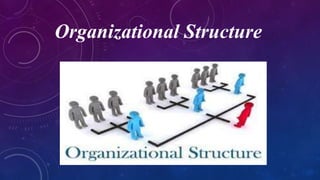
Organizational Structure
Library and its departments
 Circulation
 Reference Services
 Technical Services
 Periodical (or) Serials control
 Acquisition Unit
 Copyright Services
 Research Sections
 Information Services
 Digital Resources
 Audio Visual Sections
 Back-Volumes/Newspaper
 Communication & Outreach
 Quality Assurance
 etc.
Overview
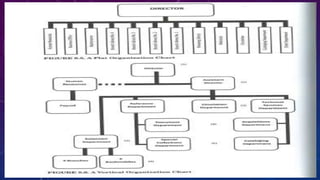
All organizations require some sort of structure.
Organizational Structure is a mechanism to divide all the
necessary tasks among the workers, and to guarantee that
workers perform those tasks in the right order and at the
right time.
Overview
• Consider, for example, US Library of Congress, largest library in the world.
• Established in 1800 with an appropriation of $5,000. Library’s first
collection consisted of 740 books and 3maps; its first librarian did double
duty as clerk of the House of Representatives.
• Today’s Library of Congress, by contrast, has a collection of more than
147 million items occupying approximately 838 miles of bookshelves
and adds more than 22,000 items each day with more than 3,500
permanent full-time employees, the library requires an elaborated
organizational frame-work.
• http://www.loc.gov/static/portals/about/documents/OrgChart-
all_93018.pdf
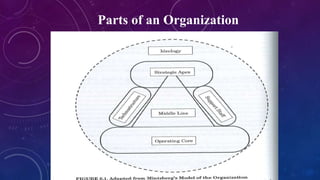
Parts of an Organization
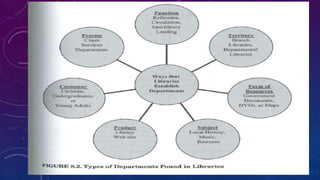
Methods of Departmentalization
Organizations have traditionally established their departments using
five methods: by function, by territory, by product, by customer
and by process.
One example
Function: In business, most common organizational design is the
functional structure. In libraries too, this methods of
departmentalization is widespread, with subunits handling the
functions of circulation, reference, acquisition, cataloguing,
management, and etc.
LIS 602 Resource Management in Library & Information Centers
The Hierarchy
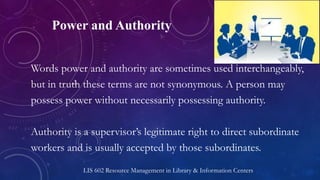
Power and Authority
Words power and authority are sometimes used interchangeably,
but in truth these terms are not synonymous. A person may
possess power without necessarily possessing authority.
Authority is a supervisor’s legitimate right to direct subordinate
workers and is usually accepted by those subordinates.
LIS 602 Resource Management in Library & Information Centers
Power and Authority
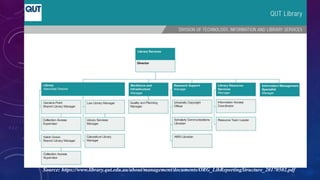
Source: https://www.library.qut.edu.au/about/management/documents/ORG_LibReportingStructure_20170502.pdf
Reference
 Moran, BB, Stueart, RD, & Morner, C (2013). Library and Information
Center Management, 8th ed. ISBN: 9781598849899
 Germano, M. A., & Stretch-Stephenson, S. (2012). Strategic value
planning for libraries. The Bottom Line, 25(2), 71-88.
doi:http://dx.doi.org/10.1108/08880451211256405
 Lovely Professional University:
http://ebooks.lpude.in/library_and_info_sciences/DLIS/Year_1/DLI
S003_LIBRARY_ADMINISTRATION_AND_MANAGEMENT.pdf

Library Administration and Organizational Structure

  • 1.
    Dr. N.Sundar Librarian Thiagarajar Collegeof Preceptors, Madurai. Library Management & Organizational Structure
  • 2.
    Objectives  Describe theadministration and its functions.  Discuss the basic principles of management.  Illustrate the departments and its individual operations.
  • 3.
    Library Administration  LibraryAdministration  Lib authority and committees  Human Resources (Library Staffing, Job Analysis & Evaluation, etc.)  Library Finance (Budgeting, Accounting, etc.)  Acquisition, Circulation, other sections.  Library Rules & Maintenance.  Records, Reports and Statistics.
  • 4.
    Some Definitions  Accordingto Theo Haimann, “Administration means overall determination of policies, setting of major objectives, the identification of general purposes and lying down of broad programmes and projects”  According to Newman, “Administration means guidance, leadership & control of the efforts of the groups towards some common goals”
  • 5.
    Levels of Management TopLevel of Management  Top management consists of owner, board of directors, chief executive officer, managing director and general manager. These people are not engaged in the day to day operational activities of the organization. Their activities consist of:  Determining the objectives and goals of the enterprises  Framing policies and plans to achieve the goals  Assembling the resources like money, men, material  Exercising effective control  Providing overall leadership
  • 6.
    Levels of Management Middlemanagement consists of senior middle management or functional heads like production manager, finance manager, marketing manager and junior middle management like branch heads divisional heads. This level of the management is basically acts as link between top and low level management.  Implementing the policies and plan laid down by the top management  Preparation of organizational setup in their departments  Selecting suitable operative and supervisory personnel  Assigning duties and responsibilities to lower management
  • 7.
    Levels of Management LowerLevel of Management It consists of supervisors, superintendents and foreman. They are direct in touch with technical work and workers. Actual execution of plans and polices took place at this level. Planning of day to day work  Give orders to execute the work  They arrange material and equipment for workers  Provide job training to workers  Maintain proper discipline in section and good relation among the workers  Communicate the problems of workers to higher level.
  • 8.
    Administrative Functions  Planning:Well plan is half done  Organizing: combination of human, physical and financial resources.  Staffing: Selection, recruitment, development and compensation.  Directing: Process or technique by which instruction can be carried out as originally planned.  Controlling: Ensures effective utilization of organizational resources so as to achieve the planned goals.
  • 9.
    Strategic Planning  Strategicvisioning: A proactive view, leading to a plan to anticipate the future of the library organization.  Strategic acting: A process of strategically analyzing the organization’s efforts.  Strategic planning: A systematic method used by organizations to adapt to expected changes.  Core values: A set of common beliefs held by the organization.
  • 10.
  • 11.
  • 12.
  • 13.
    Vision  A visionstatement, as an act of foresight, outlines what the organization wants to be. It is inspirational; set within a context of the future, it is timeless, and it provides clear decision-making criteria.
  • 14.
    Goals, Themes, andDirections Goals are the organization’s broad aspirations defined in operational terms, leading to measurable objectives with strategies and activities emanating from them.
  • 15.
    Objectives, Initiatives, Pathways,and Strategies Primary elements are involved in objectives formulation include:  Clients: Who they are and who they are not (with the potential of converting those who are not).  Services: What new services are needed, which existing ones should be retained, and which should be deleted.  Personnel resources: What professional support skills are needed to provide identified services.  Technological resources: What resources can be assessed and what technology is required.  Financial resources: What the objectives cost.  Community responsibilities: The library’s obligations as a social institution.
  • 16.
    Steps in MakingDecisions If the organization’s goals are clear, the important step in decision making is developing alternatives for solutions to identified problems or issues.
  • 17.
    Factors in MakingDecisions Several factors influence decision making for libraries and other information centers. Selection from among alternatives is made on the basis of:  Experience.  Experimentation.  Research and analysis.
  • 18.
    Understanding the Strategicplan failure & Success According to Germano, M. A., & Stretch-Stephenson, S. (2012)  Poor employee engagement;  Poor communication;  Lack of clarity in terms of goals and expected outcomes;  Inadequate leadership development within organizations;  Speed and adaptability when refinements are required;  Slow decision-making;  Resource inadequacy;  Little attention to customer needs; and  Non-alignment across functional areas.
  • 19.
    Understanding the Strategicplan failure & Success This requires libraries to address huge questions like:  Who is (not) using my library?  What are they (not) using?  What moments of truth prevent patrons from using the library again?  What are they using instead?  How do they get information when the library is unavailable?  How much do they value information?  How has the library improved patrons’ lives in quantifiable ways?  Is my library capable of providing the information patrons need?  What do my patrons need from a library? Want?  What or who is my competition?
  • 20.
    Functions of AdministrationDepartments  Process of paper work & information for internal & external support.  Proper communication to make all the staff to aware what’s going on.  Facilities & maintenance of the overall library functions.
  • 21.
    Functions of AdministrationDepartments  Process of paper work & information for internal & external support.  Proper communication to make all the staff to aware what’s going on.  Facilities & maintenance of the overall library functions.
  • 22.
  • 23.
    Library and itsdepartments  Circulation  Reference Services  Technical Services  Periodical (or) Serials control  Acquisition Unit  Copyright Services  Research Sections  Information Services  Digital Resources  Audio Visual Sections  Back-Volumes/Newspaper  Communication & Outreach  Quality Assurance  etc.
  • 24.
    Overview All organizations requiresome sort of structure. Organizational Structure is a mechanism to divide all the necessary tasks among the workers, and to guarantee that workers perform those tasks in the right order and at the right time.
  • 25.
    Overview • Consider, forexample, US Library of Congress, largest library in the world. • Established in 1800 with an appropriation of $5,000. Library’s first collection consisted of 740 books and 3maps; its first librarian did double duty as clerk of the House of Representatives. • Today’s Library of Congress, by contrast, has a collection of more than 147 million items occupying approximately 838 miles of bookshelves and adds more than 22,000 items each day with more than 3,500 permanent full-time employees, the library requires an elaborated organizational frame-work. • http://www.loc.gov/static/portals/about/documents/OrgChart- all_93018.pdf
  • 26.
    Parts of anOrganization
  • 27.
    Methods of Departmentalization Organizationshave traditionally established their departments using five methods: by function, by territory, by product, by customer and by process. One example Function: In business, most common organizational design is the functional structure. In libraries too, this methods of departmentalization is widespread, with subunits handling the functions of circulation, reference, acquisition, cataloguing, management, and etc. LIS 602 Resource Management in Library & Information Centers
  • 28.
  • 29.
    Power and Authority Wordspower and authority are sometimes used interchangeably, but in truth these terms are not synonymous. A person may possess power without necessarily possessing authority. Authority is a supervisor’s legitimate right to direct subordinate workers and is usually accepted by those subordinates. LIS 602 Resource Management in Library & Information Centers
  • 30.
  • 31.
  • 32.
    Reference  Moran, BB,Stueart, RD, & Morner, C (2013). Library and Information Center Management, 8th ed. ISBN: 9781598849899  Germano, M. A., & Stretch-Stephenson, S. (2012). Strategic value planning for libraries. The Bottom Line, 25(2), 71-88. doi:http://dx.doi.org/10.1108/08880451211256405  Lovely Professional University: http://ebooks.lpude.in/library_and_info_sciences/DLIS/Year_1/DLI S003_LIBRARY_ADMINISTRATION_AND_MANAGEMENT.pdf