
by Ana Maria B. Fresnido, DLSU Libraries
ana.fresnido@dlsu.edu.ph
 The DLSU Libraries:
 regularly conducts collection assessment
 makes use of varied assessment techniques
 but no attempt has been made to determine
the appropriate collecting level
 Collecting activity is based on the qualitative
condition of the book collection
1. To find out the current collection level of printed
books in the different subject areas.
2. To accurately capture the qualitative condition
of the book collection.
3. To objectively determine the appropriate
collecting activity level.
4. To assess how the book collection is responding
to the program offerings of the university.
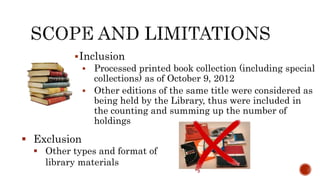
Inclusion
 Processed printed book collection (including special
collections) as of October 9, 2012
 Other editions of the same title were considered as
being held by the Library, thus were included in
the counting and summing up the number of
holdings
 Exclusion
 Other types and format of
library materials
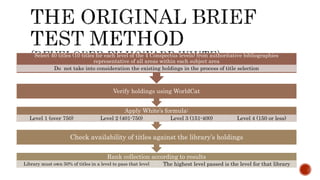
Rank collection according to results
Library must own 50% of titles in a level to pass that level The highest level passed is the level for that library
Check availability of titles against the library’s holdings
Apply White’s formula:
Level 1 (over 750) Level 2 (401-750) Level 3 (151-400) Level 4 (150 or less)
Verify holdings using WorldCat
Select 40 titles (10 titles for each level of the 4 Conspectus levels) from authoritative bibliographies
representative of all areas within each subject area
Do not take into consideration the existing holdings in the process of title selection
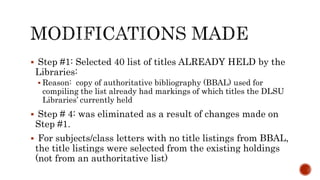
 Step #1: Selected 40 list of titles ALREADY HELD by the
Libraries:
 Reason: copy of authoritative bibliography (BBAL) used for
compiling the list already had markings of which titles the DLSU
Libraries’ currently held
 Step # 4: was eliminated as a result of changes made on
Step #1.
 For subjects/class letters with no title listings from BBAL,
the title listings were selected from the existing holdings
(not from an authoritative list)
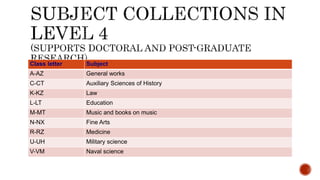
Class letter Subject
A-AZ General works
C-CT Auxiliary Sciences of History
K-KZ Law
L-LT Education
M-MT Music and books on music
N-NX Fine Arts
R-RZ Medicine
U-UH Military science
V-VM Naval science
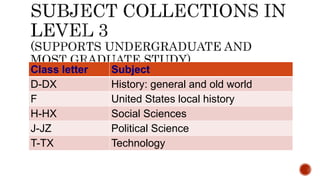
Class letter Subject
D-DX History: general and old world
F United States local history
H-HX Social Sciences
J-JZ Political Science
T-TX Technology
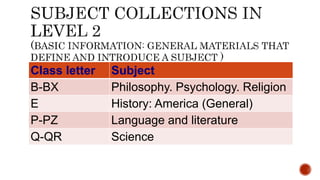
Class letter Subject
B-BX Philosophy. Psychology. Religion
E History: America (General)
P-PZ Language and literature
Q-QR Science
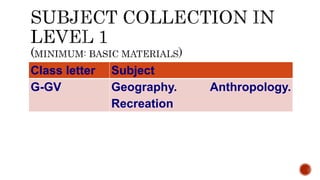
Class letter Subject
G-GV Geography. Anthropology.
Recreation
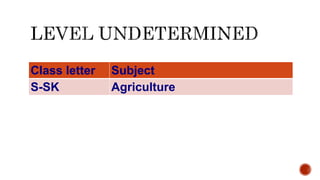
Class letter Subject
S-SK Agriculture
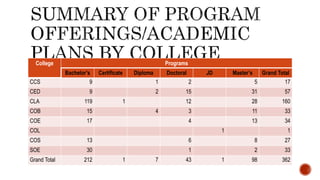
College Programs
Bachelor’s Certificate Diploma Doctoral JD Master’s Grand Total
CCS 9 1 2 5 17
CED 9 2 15 31 57
CLA 119 1 12 28 160
COB 15 4 3 11 33
COE 17 4 13 34
COL 1 1
COS 13 6 8 27
SOE 30 1 2 33
Grand Total 212 1 7 43 1 98 362
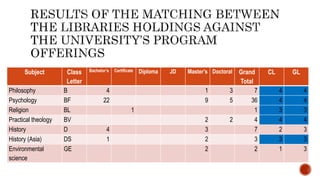
Subject Class
Letter
Bachelor’s Certificate Diploma JD Master’s Doctoral Grand
Total
CL GL
Philosophy B 4 1 3 7 4 4
Psychology BF 22 9 5 36 4 4
Religion BL 1 1 3 3
Practical theology BV 2 2 4 4 4
History D 4 3 7 2 3
History (Asia) DS 1 2 3 3 3
Environmental
science
GE 2 2 1 3
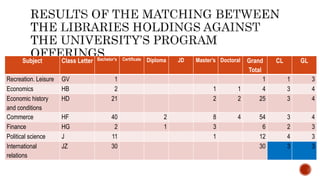
Subject Class Letter Bachelor’s Certificate Diploma JD Master’s Doctoral Grand
Total
CL GL
Recreation. Leisure GV 1 1 1 3
Economics HB 2 1 1 4 3 4
Economic history
and conditions
HD 21 2 2 25 3 4
Commerce HF 40 2 8 4 54 3 4
Finance HG 2 1 3 6 2 3
Political science J 11 1 12 4 3
International
relations
JZ 30 30 3 3
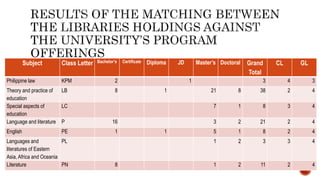
Subject Class Letter Bachelor’s Certificate Diploma JD Master’s Doctoral Grand
Total
CL GL
Philippine law KPM 2 1 3 4 3
Theory and practice of
education
LB 8 1 21 8 38 2 4
Special aspects of
education
LC 7 1 8 3 4
Language and literature P 16 3 2 21 2 4
English PE 1 1 5 1 8 2 4
Languages and
literatures of Eastern
Asia, Africa and Oceania
PL 1 2 3 3 4
Literature PN 8 1 2 11 2 4
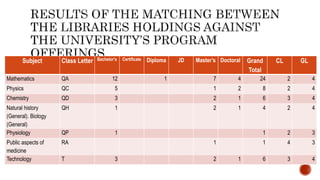
Subject Class Letter Bachelor’s Certificate Diploma JD Master’s Doctoral Grand
Total
CL GL
Mathematics QA 12 1 7 4 24 2 4
Physics QC 5 1 2 8 2 4
Chemistry QD 3 2 1 6 3 4
Natural history
(General). Biology
(General)
QH 1 2 1 4 2 4
Physiology QP 1 1 2 3
Public aspects of
medicine
RA 1 1 4 3
Technology T 3 2 1 6 3 4
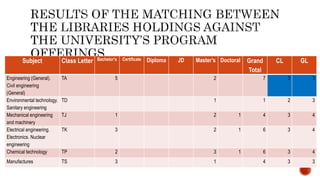
Subject Class Letter Bachelor’s Certificate Diploma JD Master’s Doctoral Grand
Total
CL GL
Engineering (General).
Civil engineering
(General)
TA 5 2 7 3 3
Environmental technology.
Sanitary engineering
TD 1 1 2 3
Mechanical engineering
and machinery
TJ 1 2 1 4 3 4
Electrical engineering.
Electronics. Nuclear
engineering
TK 3 2 1 6 3 4
Chemical technology TP 2 3 1 6 3 4
Manufactures TS 3 1 4 3 3
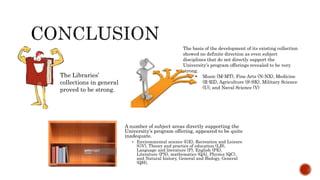
A number of subject areas directly supporting the
University’s program offering, appeared to be quite
inadequate.
 Environmental science (GE), Recreation and Leisure
(GV), Theory and practice of education (LB),
Language and literature (P), English (PE),
Literature (PN), mathematics (QA), Physics (QC),
and Natural history, General and Biology, General
(QH),
The Libraries’
collections in general
proved to be strong.
The basis of the development of its existing collection
showed no definite direction as even subject
disciplines that do not directly support the
University’s program offerings revealed to be very
strong.
 Music (M-MT), Fine Arts (N-NX), Medicine
(R-RZ), Agriculture (S-SK), Military Science
(U), and Naval Science (V)
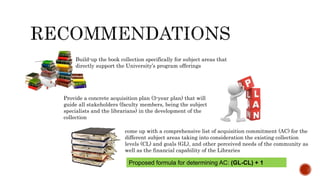
Build-up the book collection specifically for subject areas that
directly support the University’s program offerings
Provide a concrete acquisition plan (3-year plan) that will
guide all stakeholders (faculty members, being the subject
specialists and the librarians) in the development of the
collection
come up with a comprehensive list of acquisition commitment (AC) for the
different subject areas taking into consideration the existing collection
levels (CL) and goals (GL), and other perceived needs of the community as
well as the financial capability of the Libraries
Proposed formula for determining AC: (GL-CL) + 1
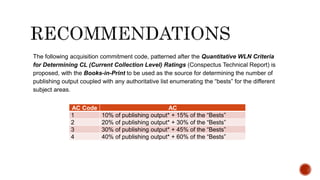
The following acquisition commitment code, patterned after the Quantitative WLN Criteria
for Determining CL (Current Collection Level) Ratings (Conspectus Technical Report) is
proposed, with the Books-in-Print to be used as the source for determining the number of
publishing output coupled with any authoritative list enumerating the “bests” for the different
subject areas.
AC Code AC
1 10% of publishing output* + 15% of the “Bests”
2 20% of publishing output* + 30% of the “Bests”
3 30% of publishing output* + 45% of the “Bests”
4 40% of publishing output* + 60% of the “Bests”
Collection assessment using modified brief test method

Collection assessment using modified brief test method

  • 1.
    by Ana MariaB. Fresnido, DLSU Libraries ana.fresnido@dlsu.edu.ph
  • 2.
     The DLSULibraries:  regularly conducts collection assessment  makes use of varied assessment techniques  but no attempt has been made to determine the appropriate collecting level  Collecting activity is based on the qualitative condition of the book collection
  • 3.
    1. To findout the current collection level of printed books in the different subject areas. 2. To accurately capture the qualitative condition of the book collection. 3. To objectively determine the appropriate collecting activity level. 4. To assess how the book collection is responding to the program offerings of the university.
  • 4.
    Inclusion  Processed printedbook collection (including special collections) as of October 9, 2012  Other editions of the same title were considered as being held by the Library, thus were included in the counting and summing up the number of holdings  Exclusion  Other types and format of library materials
  • 6.
    Rank collection accordingto results Library must own 50% of titles in a level to pass that level The highest level passed is the level for that library Check availability of titles against the library’s holdings Apply White’s formula: Level 1 (over 750) Level 2 (401-750) Level 3 (151-400) Level 4 (150 or less) Verify holdings using WorldCat Select 40 titles (10 titles for each level of the 4 Conspectus levels) from authoritative bibliographies representative of all areas within each subject area Do not take into consideration the existing holdings in the process of title selection
  • 7.
     Step #1:Selected 40 list of titles ALREADY HELD by the Libraries:  Reason: copy of authoritative bibliography (BBAL) used for compiling the list already had markings of which titles the DLSU Libraries’ currently held  Step # 4: was eliminated as a result of changes made on Step #1.  For subjects/class letters with no title listings from BBAL, the title listings were selected from the existing holdings (not from an authoritative list)
  • 10.
    Class letter Subject A-AZGeneral works C-CT Auxiliary Sciences of History K-KZ Law L-LT Education M-MT Music and books on music N-NX Fine Arts R-RZ Medicine U-UH Military science V-VM Naval science
  • 11.
    Class letter Subject D-DXHistory: general and old world F United States local history H-HX Social Sciences J-JZ Political Science T-TX Technology
  • 12.
    Class letter Subject B-BXPhilosophy. Psychology. Religion E History: America (General) P-PZ Language and literature Q-QR Science
  • 13.
    Class letter Subject G-GVGeography. Anthropology. Recreation
  • 14.
  • 16.
    College Programs Bachelor’s CertificateDiploma Doctoral JD Master’s Grand Total CCS 9 1 2 5 17 CED 9 2 15 31 57 CLA 119 1 12 28 160 COB 15 4 3 11 33 COE 17 4 13 34 COL 1 1 COS 13 6 8 27 SOE 30 1 2 33 Grand Total 212 1 7 43 1 98 362
  • 17.
    Subject Class Letter Bachelor’s CertificateDiploma JD Master’s Doctoral Grand Total CL GL Philosophy B 4 1 3 7 4 4 Psychology BF 22 9 5 36 4 4 Religion BL 1 1 3 3 Practical theology BV 2 2 4 4 4 History D 4 3 7 2 3 History (Asia) DS 1 2 3 3 3 Environmental science GE 2 2 1 3
  • 18.
    Subject Class LetterBachelor’s Certificate Diploma JD Master’s Doctoral Grand Total CL GL Recreation. Leisure GV 1 1 1 3 Economics HB 2 1 1 4 3 4 Economic history and conditions HD 21 2 2 25 3 4 Commerce HF 40 2 8 4 54 3 4 Finance HG 2 1 3 6 2 3 Political science J 11 1 12 4 3 International relations JZ 30 30 3 3
  • 19.
    Subject Class LetterBachelor’s Certificate Diploma JD Master’s Doctoral Grand Total CL GL Philippine law KPM 2 1 3 4 3 Theory and practice of education LB 8 1 21 8 38 2 4 Special aspects of education LC 7 1 8 3 4 Language and literature P 16 3 2 21 2 4 English PE 1 1 5 1 8 2 4 Languages and literatures of Eastern Asia, Africa and Oceania PL 1 2 3 3 4 Literature PN 8 1 2 11 2 4
  • 20.
    Subject Class LetterBachelor’s Certificate Diploma JD Master’s Doctoral Grand Total CL GL Mathematics QA 12 1 7 4 24 2 4 Physics QC 5 1 2 8 2 4 Chemistry QD 3 2 1 6 3 4 Natural history (General). Biology (General) QH 1 2 1 4 2 4 Physiology QP 1 1 2 3 Public aspects of medicine RA 1 1 4 3 Technology T 3 2 1 6 3 4
  • 21.
    Subject Class LetterBachelor’s Certificate Diploma JD Master’s Doctoral Grand Total CL GL Engineering (General). Civil engineering (General) TA 5 2 7 3 3 Environmental technology. Sanitary engineering TD 1 1 2 3 Mechanical engineering and machinery TJ 1 2 1 4 3 4 Electrical engineering. Electronics. Nuclear engineering TK 3 2 1 6 3 4 Chemical technology TP 2 3 1 6 3 4 Manufactures TS 3 1 4 3 3
  • 23.
    A number ofsubject areas directly supporting the University’s program offering, appeared to be quite inadequate.  Environmental science (GE), Recreation and Leisure (GV), Theory and practice of education (LB), Language and literature (P), English (PE), Literature (PN), mathematics (QA), Physics (QC), and Natural history, General and Biology, General (QH), The Libraries’ collections in general proved to be strong. The basis of the development of its existing collection showed no definite direction as even subject disciplines that do not directly support the University’s program offerings revealed to be very strong.  Music (M-MT), Fine Arts (N-NX), Medicine (R-RZ), Agriculture (S-SK), Military Science (U), and Naval Science (V)
  • 24.
    Build-up the bookcollection specifically for subject areas that directly support the University’s program offerings Provide a concrete acquisition plan (3-year plan) that will guide all stakeholders (faculty members, being the subject specialists and the librarians) in the development of the collection come up with a comprehensive list of acquisition commitment (AC) for the different subject areas taking into consideration the existing collection levels (CL) and goals (GL), and other perceived needs of the community as well as the financial capability of the Libraries Proposed formula for determining AC: (GL-CL) + 1
  • 25.
    The following acquisitioncommitment code, patterned after the Quantitative WLN Criteria for Determining CL (Current Collection Level) Ratings (Conspectus Technical Report) is proposed, with the Books-in-Print to be used as the source for determining the number of publishing output coupled with any authoritative list enumerating the “bests” for the different subject areas. AC Code AC 1 10% of publishing output* + 15% of the “Bests” 2 20% of publishing output* + 30% of the “Bests” 3 30% of publishing output* + 45% of the “Bests” 4 40% of publishing output* + 60% of the “Bests”