BUDGETING BASICS
PDPM | A. HILLOCK & B. FISCHER
BASIC PRINCIPLES
         

    • A budget should
     • Directly reflect organization’s mission
       & priorities
     • Chart a direction for allocating and
       maximizing use of resources
     • Tend to history of finances and future
       projections
       • Futurity through rolling budgets
     • Be tailored according to the scope &
       size of program/project
     • Be compared to actual performance
       of projects
       • Allows staff to isolate gaps/misdirected
         funds
EFFECTIVE BUDGETING
                          

An effective budget is


  • Realistic
  • Consistent
  • Flexible
  • Measurable


• Should plan for Short vs. Long Term Investments
PREPARING A BUDGET
                              

• Determine programs & activities for the
  budget period
• Budget expenses and revenues
  • Based on historical data, forecasts &
    economic climate
• Develop a draft budget
  • Include previous yr budget, current yr and
    cash flow
• Review/modify your draft
• Have board review and approve
  • Revise if necessary
• Monitor and record budget activity
CASH FLOW VS. PROGRAM BUDGET
                                         

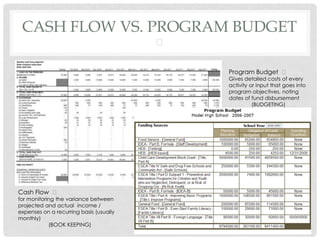
                                             Program Budget 
                                             Gives detailed costs of every
                                             activity or input that goes into
                                             program objectives, noting
                                             dates of fund disbursement
                                                       (BUDGETING)


Cash Flow 
for monitoring the variance between
projected and actual income /
expenses on a recurring basis (usually
monthly)
            (BOOK KEEPING)
CASH FLOW PLANNING
                                 


• Difficulties
  • Volatility, Unpredictability (esp. with Disaster Relief)


• How to
  • Account for cyclical and seasonal fluctuations in cash
    inflow / outflow
    • Adjustments made when cash inflow less than outflow
    • May call for postponing expenditures/accelerating client billings
  • Plan for lags between invoicing/billing for services and
    actual receipt of cash
  • Chart expenditures according to payment deadline
  • Factor in debt repayments
WHERE TO START
                    WITH A CASH FLOW


       Zero-Based                  Incremental
• Starts from 0, assuming    • Assumption is programs
  no program is                and depts. are pre-
  necessary and no             approved
  money spent                • Only increases and
                               decreases in resources
• Orderly evaluation of
                               allocated
  all revenues and
                             • Focus on changes since
  expenses
                               previous FY numbers
• Aim is for quantitative    • Less focus on rigid
  measurability                calculations
ADDITIONAL BUDGET REPORTS
                                

• Annual, quarterly or monthly projects of income
  and expenses
  • For entire organization, its divisions and depts.
• Revenue projections by type
  • Donations, gifts, grants, etc.
• Individual project and dept. projections
• Service delivery costs
  • ie. cost per patient/beneficiary
• Cash flow – short and long term
• Historic and project fund-raising revenue & expense
• Staffing models
NON-PROFITS
                                 

• Flexibility!
  • Contingency plans

• Lead-time for grant requests
  • multi-year programs, etc.

• Unpredictable cash flows & contribution
  revenue
  • Can be dealt with by postponing expenditures,
    accelerating constituent billings

• Money allocated appropriately*
  • Under common law, non-profits have a duty to
    donors/grantors to use gifts for the purpose the
    funds were given
LEAN, ADAPTABLE & ETHICAL

• Transparency & sustainability
• Priorities in balance reflect priorities of the
  organization
  • Bear in mind the needs of the beneficiaries and
    stakeholders
  • Reporting mechanisms built in to alert management of
    cause for change
• Budget inherently a “push mechanism,” but should
  also be “pulled” by beneficiaries/stakeholders
• Should not only set ceiling prices, but also floor
  prices
OTHER CONSIDERATIONS
                              

• As much money as possible in federally insured,
  interest bearing accounts
• Once cash reserves exceed operating costs,
  consider longer-term investments
  • Staff increases, technological investments
• Budget spreadsheets often, requested by third-
  party stakeholders / [potential] donors
• Tracking of expenditures enhances ability to report
  accomplishments

PDPM Budgeting Presentation

  • 1.
    BUDGETING BASICS PDPM |A. HILLOCK & B. FISCHER
  • 2.
    BASIC PRINCIPLES  • A budget should • Directly reflect organization’s mission & priorities • Chart a direction for allocating and maximizing use of resources • Tend to history of finances and future projections • Futurity through rolling budgets • Be tailored according to the scope & size of program/project • Be compared to actual performance of projects • Allows staff to isolate gaps/misdirected funds
  • 3.
    EFFECTIVE BUDGETING  An effective budget is • Realistic • Consistent • Flexible • Measurable • Should plan for Short vs. Long Term Investments
  • 4.
    PREPARING A BUDGET  • Determine programs & activities for the budget period • Budget expenses and revenues • Based on historical data, forecasts & economic climate • Develop a draft budget • Include previous yr budget, current yr and cash flow • Review/modify your draft • Have board review and approve • Revise if necessary • Monitor and record budget activity
  • 5.
    CASH FLOW VS.PROGRAM BUDGET  Program Budget  Gives detailed costs of every activity or input that goes into program objectives, noting dates of fund disbursement (BUDGETING) Cash Flow  for monitoring the variance between projected and actual income / expenses on a recurring basis (usually monthly) (BOOK KEEPING)
  • 6.
    CASH FLOW PLANNING  • Difficulties • Volatility, Unpredictability (esp. with Disaster Relief) • How to • Account for cyclical and seasonal fluctuations in cash inflow / outflow • Adjustments made when cash inflow less than outflow • May call for postponing expenditures/accelerating client billings • Plan for lags between invoicing/billing for services and actual receipt of cash • Chart expenditures according to payment deadline • Factor in debt repayments
  • 7.
    WHERE TO START WITH A CASH FLOW Zero-Based Incremental • Starts from 0, assuming • Assumption is programs no program is and depts. are pre- necessary and no approved money spent • Only increases and decreases in resources • Orderly evaluation of allocated all revenues and • Focus on changes since expenses previous FY numbers • Aim is for quantitative • Less focus on rigid measurability calculations
  • 8.
    ADDITIONAL BUDGET REPORTS  • Annual, quarterly or monthly projects of income and expenses • For entire organization, its divisions and depts. • Revenue projections by type • Donations, gifts, grants, etc. • Individual project and dept. projections • Service delivery costs • ie. cost per patient/beneficiary • Cash flow – short and long term • Historic and project fund-raising revenue & expense • Staffing models
  • 9.
    NON-PROFITS  • Flexibility! • Contingency plans • Lead-time for grant requests • multi-year programs, etc. • Unpredictable cash flows & contribution revenue • Can be dealt with by postponing expenditures, accelerating constituent billings • Money allocated appropriately* • Under common law, non-profits have a duty to donors/grantors to use gifts for the purpose the funds were given
  • 10.
    LEAN, ADAPTABLE &ETHICAL • Transparency & sustainability • Priorities in balance reflect priorities of the organization • Bear in mind the needs of the beneficiaries and stakeholders • Reporting mechanisms built in to alert management of cause for change • Budget inherently a “push mechanism,” but should also be “pulled” by beneficiaries/stakeholders • Should not only set ceiling prices, but also floor prices
  • 11.
    OTHER CONSIDERATIONS  • As much money as possible in federally insured, interest bearing accounts • Once cash reserves exceed operating costs, consider longer-term investments • Staff increases, technological investments • Budget spreadsheets often, requested by third- party stakeholders / [potential] donors • Tracking of expenditures enhances ability to report accomplishments