
UNIVERSITY OF MYSORE
MANASAGANGOTHRI
THIRD SEMESTER
Paper : Marketing of information products and services
Seminar on : Marketing concept
Presented to,
Dr. Khaiser Nikam
DOS in Library and Information Science
Manasagangothri, Mysore
Presented by,
Kumar,B
2nd year M.LISc
DOS in LIS.
Contents
 Introduction
 Definition
 Core Marketing Concepts
 Application of marketing in libraries
 Conclusion
 References
Introduction
Librarians and Information specialists have debated the idea of
marketing for the information sector. Several things have compelled us to
learn about marketing and begin doing it. Librarianship is experiencing
rapid change. Information technology has created a new gateway for
information services. Information products and services in a multiplicity of
formats have made libraries and information centers more competitive and
alert. Libraries are being subjected to significant pressures from the
information revolution. The challenges of budget cuts, increased user base,
the rapid growth of material, rising costs, networking demands, competition
by database vendors, and complexity in information requirements are
forcing the professionals to adopt marketing to improve the management of
library and information centers.
What is marketing?
 Philip Kotler:
Marketing is human activity directed at satisfying
needs and wants through exchange processes. The essence of
marketing is transaction–exchange of values between two
parties.
-That marketing is the process of planning and
executing the conception, pricing, promotion and distribution
of goods, services and ideas to create exchanges with target
groups that satisfy customers and organizational objectives.
 Christian Grönroos:
Marketing is to establish, maintain and enhance long-
term customer relationships at a profit, so that the objectives of the
parties involved are met. This is done by mutual exchange and
fulfillment of promises.
Why Marketing is essential to Your Library?
Marketing is the process that successful businesses
and organizations use to ensure continuing success.
Following a complete marketing process may result in:
•Greater use of the library by your customers.
•Better decisions about what to offer at your library.
•Better partnerships with faculty and administration.
•Maintenance of the central position of library in the
institution.
•Adequate funding.
•Better informed and more supportive legislators.
Early concepts/ models :
Some of the early theories, concepts, models, and
methods in marketing preoccupy marketing professionals
and students until the present day.
Among them are
 McCarthy’s 4p’s(1964),
 Borden’s marketing mix(1965),
 Fishbein’s measurement of mental attitudes(1967),
 The Boston Consulting Group’s portfolio matrix(ca
1970), Porter’s 5-forces (1979), and
 SWOT Analysis(ca 1978).
Key concepts of marketing:
1. Market segmentation.
2. Market positioning.
3. Market analysis.
4. Market program.
5. Market audit.
1. Market Segmentation
Market segmentation is “the categorization of potential users
into groups based on common characteristics such as age,
gender, income, and geography or other attributes relating to
purchase or consumption behavior.” Market segmentation
helps organizations find new customers, gain insights,
improve service delivery, and become customer-centric.
Market segmentation is the segmentation of the clients /
users on the basic of individual differences and group
similarities. Segmentation can be by subject/ institute / value
of users / age group like (adult, young, children etc.). Special
group such as faculty , students, research scholars .
Cont…
Market segmentation involves the
identifications of actual and potential and their
needs assessment followed by analyzing market
segment to determine what they need and how to
delivery library services.
2. Market Positioning
 Market positioning is the manipulation of a brand or
family of brands to create a positive perception in the
eyes of the public. If a product is well positioned, it will
have strong sales, and it may become the go-to brand
for people who need that particular product.
 When developing a market position you need to select
the most persuasive, meaningful and unique points of
difference that will allow you to compete for the largest
number of potential customers.
Objectives of Market positioning in
library
 Prioritizing the library users.
 Put all primary clients and steps of users.
 List important users in the library.
 Cost of establishing.
 Keep all users in mind.
 Put goal of the library expenditure.
 Prioritizing the work.
 Make best use of money and materials.
3.Market Analysis
A market analysis studies the attractiveness and the dynamics
of a special market within a special industry. It is part of the industry
analysis and thus in turn of the global environmental analysis.
The goal of a market analysis is to determine the
attractiveness of a market and to understand its evolving
opportunities and threats as they relate to the strengths and
weaknesses of the firm.
Market analysis in library
 Is measuring requirements of the users.
 Processing, measuring , needs of users.
 Types of information products give to the users.
 Analyze the consumers
Dimensions of a market analysis :
Market size (current and future)
Market growth rate
Market profitability
Industry cost structure
Distribution channels
Market trends
Key success factors
4.Marketing mix in Libraries
 Marketing mix in libraries requires a critical analysis of the
marketing mix (the 7 Ps of Marketing mix - product, place, price,
promotion, Participants, Physical Evidence and Process) to identify
the nature, features, benefits, and value of the products to the
customer.
 The development of an effective marketing strategy requires the
specification of the marketing mix. These concepts are utilized in the
for-profit sector, but a good library-marketing plan will also profit by
examining products offered and assessing the value of the products
to the users.
 Market research helps to determine what library users are looking
for in the way of product features such as variety, quality, and design,
and what benefits such as good performance, quality, reliability and
durability users demand in services, systems, programs, and
resources.
5.Marketing Audit
 The marketing audit is a fundamental part of the market
planning process. It is conducted not only at the beginning
of the process, but also at a series of points during the
implementation of the plan. The marketing audit considers
both internal and external influences on market planning,
as well as a review of the plan itself.
 Marketing audit covers both the assessment of customer
needs and the attempt to understand community systems.
 Kotler defines the marketing audit as a “comprehensive,
systematic, independent, and periodic examination of the
library’s total environment, objectives, strategies, activities,
and resources in order to determine problem areas and
opportunities and to recommend a plan of action.”
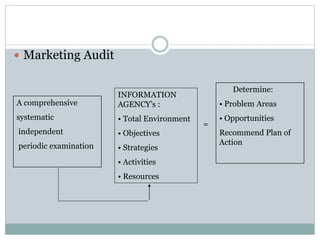
 Marketing Audit
A comprehensive
systematic
independent
periodic examination
INFORMATION
AGENCY’s :
• Total Environment
• Objectives
• Strategies
• Activities
• Resources
Determine:
• Problem Areas
• Opportunities
Recommend Plan of
Action
=
The marketing audit analyzes the internal
environment of the library—identifying strengths,
limitations, and present practice—thereby including the
entire environment in its examination. Furthermore, the
audit develops an “environmental scan” that identifies
trends and projections in both external and internal
environments to develop contingency plans that will
relate to alternative future scenarios.
Information Marketing in University Libraries
Libraries and other non-profit organizations have
only recently become aware of the need to market their
products and services. Library and information products
and services are now being recognized as commodities
that can be sold, exchanged, lent, and transmitted.
University libraries rely on their host organizations for
operational costs. To gain some self-sufficiency,
university libraries think seriously about not only
recovering the costs incurred but also making a profit
through their services.
Information marketing by university libraries in
India is essential in order to:
 Promotion of the use of information resources;
 Create perception of need and there by create demand;
 Ensure the optimum use of information.
 Improve the image and status of the libraries and library professionals.
 Tackle the problems of rising costs of reading materials, journals, and
databases;
 Cope with the information explosion;
 Introduce cutting-edge information technology systems in library
services;
 Balance shrinking funds;
 Save libraries from devaluation
 Save libraries from declining reader-support;
 Uphold the dictum that information is power.
Conclusion
 In summary, information professionals must understand that it is
essential to actively market their services. Library marketing is
critical for any information professional in order to spread the word
about their library. It doesn’t matter what library type, it doesn’t
matter how large or small the library is you need to call attention to
your library, your services, your worth to your community, your
administration, your staff, and your users!
 It is important to understand the organization’s mission to produce
effective marketing material that builds the library’s brand and
image, drives traffic to your web site, and differentiates your library
from its competitors. That’s why in this highly competitive industry
marketing plays a very important role.
References
 http://www.nmstatelibrary.org/docs/development/
planning/Marketing_Plan_Workbook.pdf
 http://www.ala.org/acrl/sites/ala.org.acrl/files/cont
ent/issues/marketing/ParticipantManual.pdf
 http://www.boldhorizon.co.nz/market-
positioning.php
 http://www.ala.org/offices/sites/ala.org.offices/files
/content/publishing/editions/samplers/wein_future
.pdf
marketing concepts in libraries

marketing concepts in libraries

  • 1.
    UNIVERSITY OF MYSORE MANASAGANGOTHRI THIRDSEMESTER Paper : Marketing of information products and services Seminar on : Marketing concept Presented to, Dr. Khaiser Nikam DOS in Library and Information Science Manasagangothri, Mysore Presented by, Kumar,B 2nd year M.LISc DOS in LIS.
  • 3.
    Contents  Introduction  Definition Core Marketing Concepts  Application of marketing in libraries  Conclusion  References
  • 4.
    Introduction Librarians and Informationspecialists have debated the idea of marketing for the information sector. Several things have compelled us to learn about marketing and begin doing it. Librarianship is experiencing rapid change. Information technology has created a new gateway for information services. Information products and services in a multiplicity of formats have made libraries and information centers more competitive and alert. Libraries are being subjected to significant pressures from the information revolution. The challenges of budget cuts, increased user base, the rapid growth of material, rising costs, networking demands, competition by database vendors, and complexity in information requirements are forcing the professionals to adopt marketing to improve the management of library and information centers.
  • 5.
    What is marketing? Philip Kotler: Marketing is human activity directed at satisfying needs and wants through exchange processes. The essence of marketing is transaction–exchange of values between two parties. -That marketing is the process of planning and executing the conception, pricing, promotion and distribution of goods, services and ideas to create exchanges with target groups that satisfy customers and organizational objectives.  Christian Grönroos: Marketing is to establish, maintain and enhance long- term customer relationships at a profit, so that the objectives of the parties involved are met. This is done by mutual exchange and fulfillment of promises.
  • 6.
    Why Marketing isessential to Your Library? Marketing is the process that successful businesses and organizations use to ensure continuing success. Following a complete marketing process may result in: •Greater use of the library by your customers. •Better decisions about what to offer at your library. •Better partnerships with faculty and administration. •Maintenance of the central position of library in the institution. •Adequate funding. •Better informed and more supportive legislators.
  • 7.
    Early concepts/ models: Some of the early theories, concepts, models, and methods in marketing preoccupy marketing professionals and students until the present day. Among them are  McCarthy’s 4p’s(1964),  Borden’s marketing mix(1965),  Fishbein’s measurement of mental attitudes(1967),  The Boston Consulting Group’s portfolio matrix(ca 1970), Porter’s 5-forces (1979), and  SWOT Analysis(ca 1978).
  • 8.
    Key concepts ofmarketing: 1. Market segmentation. 2. Market positioning. 3. Market analysis. 4. Market program. 5. Market audit.
  • 9.
    1. Market Segmentation Marketsegmentation is “the categorization of potential users into groups based on common characteristics such as age, gender, income, and geography or other attributes relating to purchase or consumption behavior.” Market segmentation helps organizations find new customers, gain insights, improve service delivery, and become customer-centric. Market segmentation is the segmentation of the clients / users on the basic of individual differences and group similarities. Segmentation can be by subject/ institute / value of users / age group like (adult, young, children etc.). Special group such as faculty , students, research scholars .
  • 10.
    Cont… Market segmentation involvesthe identifications of actual and potential and their needs assessment followed by analyzing market segment to determine what they need and how to delivery library services.
  • 11.
    2. Market Positioning Market positioning is the manipulation of a brand or family of brands to create a positive perception in the eyes of the public. If a product is well positioned, it will have strong sales, and it may become the go-to brand for people who need that particular product.  When developing a market position you need to select the most persuasive, meaningful and unique points of difference that will allow you to compete for the largest number of potential customers.
  • 12.
    Objectives of Marketpositioning in library  Prioritizing the library users.  Put all primary clients and steps of users.  List important users in the library.  Cost of establishing.  Keep all users in mind.  Put goal of the library expenditure.  Prioritizing the work.  Make best use of money and materials.
  • 13.
    3.Market Analysis A marketanalysis studies the attractiveness and the dynamics of a special market within a special industry. It is part of the industry analysis and thus in turn of the global environmental analysis. The goal of a market analysis is to determine the attractiveness of a market and to understand its evolving opportunities and threats as they relate to the strengths and weaknesses of the firm. Market analysis in library  Is measuring requirements of the users.  Processing, measuring , needs of users.  Types of information products give to the users.  Analyze the consumers
  • 14.
    Dimensions of amarket analysis : Market size (current and future) Market growth rate Market profitability Industry cost structure Distribution channels Market trends Key success factors
  • 15.
    4.Marketing mix inLibraries  Marketing mix in libraries requires a critical analysis of the marketing mix (the 7 Ps of Marketing mix - product, place, price, promotion, Participants, Physical Evidence and Process) to identify the nature, features, benefits, and value of the products to the customer.  The development of an effective marketing strategy requires the specification of the marketing mix. These concepts are utilized in the for-profit sector, but a good library-marketing plan will also profit by examining products offered and assessing the value of the products to the users.  Market research helps to determine what library users are looking for in the way of product features such as variety, quality, and design, and what benefits such as good performance, quality, reliability and durability users demand in services, systems, programs, and resources.
  • 16.
    5.Marketing Audit  Themarketing audit is a fundamental part of the market planning process. It is conducted not only at the beginning of the process, but also at a series of points during the implementation of the plan. The marketing audit considers both internal and external influences on market planning, as well as a review of the plan itself.  Marketing audit covers both the assessment of customer needs and the attempt to understand community systems.  Kotler defines the marketing audit as a “comprehensive, systematic, independent, and periodic examination of the library’s total environment, objectives, strategies, activities, and resources in order to determine problem areas and opportunities and to recommend a plan of action.”
  • 17.
     Marketing Audit Acomprehensive systematic independent periodic examination INFORMATION AGENCY’s : • Total Environment • Objectives • Strategies • Activities • Resources Determine: • Problem Areas • Opportunities Recommend Plan of Action =
  • 18.
    The marketing auditanalyzes the internal environment of the library—identifying strengths, limitations, and present practice—thereby including the entire environment in its examination. Furthermore, the audit develops an “environmental scan” that identifies trends and projections in both external and internal environments to develop contingency plans that will relate to alternative future scenarios.
  • 20.
    Information Marketing inUniversity Libraries Libraries and other non-profit organizations have only recently become aware of the need to market their products and services. Library and information products and services are now being recognized as commodities that can be sold, exchanged, lent, and transmitted. University libraries rely on their host organizations for operational costs. To gain some self-sufficiency, university libraries think seriously about not only recovering the costs incurred but also making a profit through their services.
  • 21.
    Information marketing byuniversity libraries in India is essential in order to:  Promotion of the use of information resources;  Create perception of need and there by create demand;  Ensure the optimum use of information.  Improve the image and status of the libraries and library professionals.  Tackle the problems of rising costs of reading materials, journals, and databases;  Cope with the information explosion;  Introduce cutting-edge information technology systems in library services;  Balance shrinking funds;  Save libraries from devaluation  Save libraries from declining reader-support;  Uphold the dictum that information is power.
  • 22.
    Conclusion  In summary,information professionals must understand that it is essential to actively market their services. Library marketing is critical for any information professional in order to spread the word about their library. It doesn’t matter what library type, it doesn’t matter how large or small the library is you need to call attention to your library, your services, your worth to your community, your administration, your staff, and your users!  It is important to understand the organization’s mission to produce effective marketing material that builds the library’s brand and image, drives traffic to your web site, and differentiates your library from its competitors. That’s why in this highly competitive industry marketing plays a very important role.
  • 23.
    References  http://www.nmstatelibrary.org/docs/development/ planning/Marketing_Plan_Workbook.pdf  http://www.ala.org/acrl/sites/ala.org.acrl/files/cont ent/issues/marketing/ParticipantManual.pdf http://www.boldhorizon.co.nz/market- positioning.php  http://www.ala.org/offices/sites/ala.org.offices/files /content/publishing/editions/samplers/wein_future .pdf