ALTERNATE VIEW OF LIBRARY BUDGETS:
A LIVING DOCUMENT
Janice E. Henderson, Esq., M.L.S.
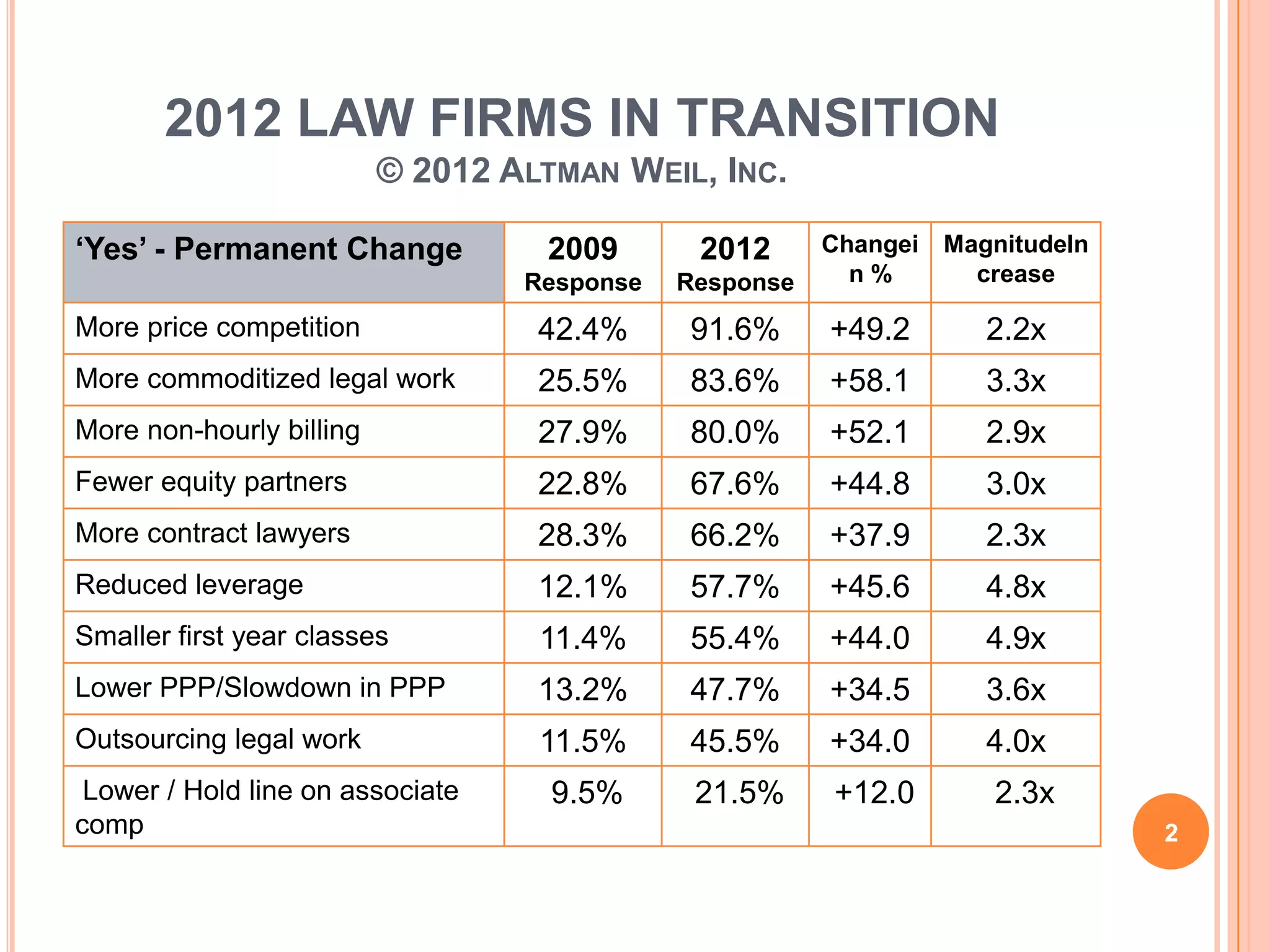
2012 LAW FIRMS IN TRANSITION
© 2012 ALTMAN WEIL, INC.
„Yes‟ - Permanent Change 2009
Response
2012
Response
Changei
n %
MagnitudeIn
crease
More price competition 42.4% 91.6% +49.2 2.2x
More commoditized legal work 25.5% 83.6% +58.1 3.3x
More non-hourly billing 27.9% 80.0% +52.1 2.9x
Fewer equity partners 22.8% 67.6% +44.8 3.0x
More contract lawyers 28.3% 66.2% +37.9 2.3x
Reduced leverage 12.1% 57.7% +45.6 4.8x
Smaller first year classes 11.4% 55.4% +44.0 4.9x
Lower PPP/Slowdown in PPP 13.2% 47.7% +34.5 3.6x
Outsourcing legal work 11.5% 45.5% +34.0 4.0x
Lower / Hold line on associate
comp
9.5% 21.5% +12.0 2.3x
2
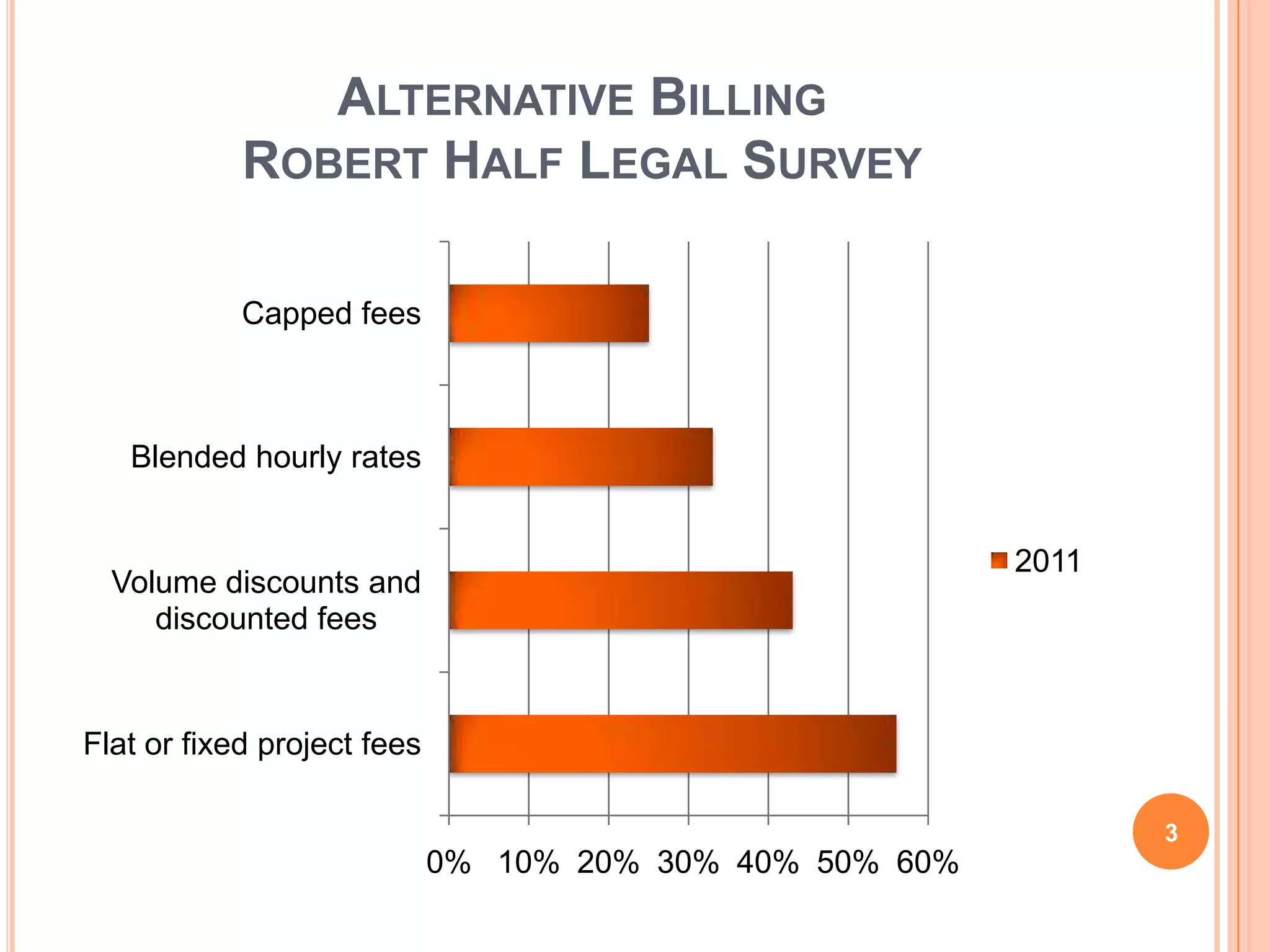
ALTERNATIVE BILLING
ROBERT HALF LEGAL SURVEY
3
0% 10% 20% 30% 40% 50% 60%
Flat or fixed project fees
Volume discounts and
discounted fees
Blended hourly rates
Capped fees
2011
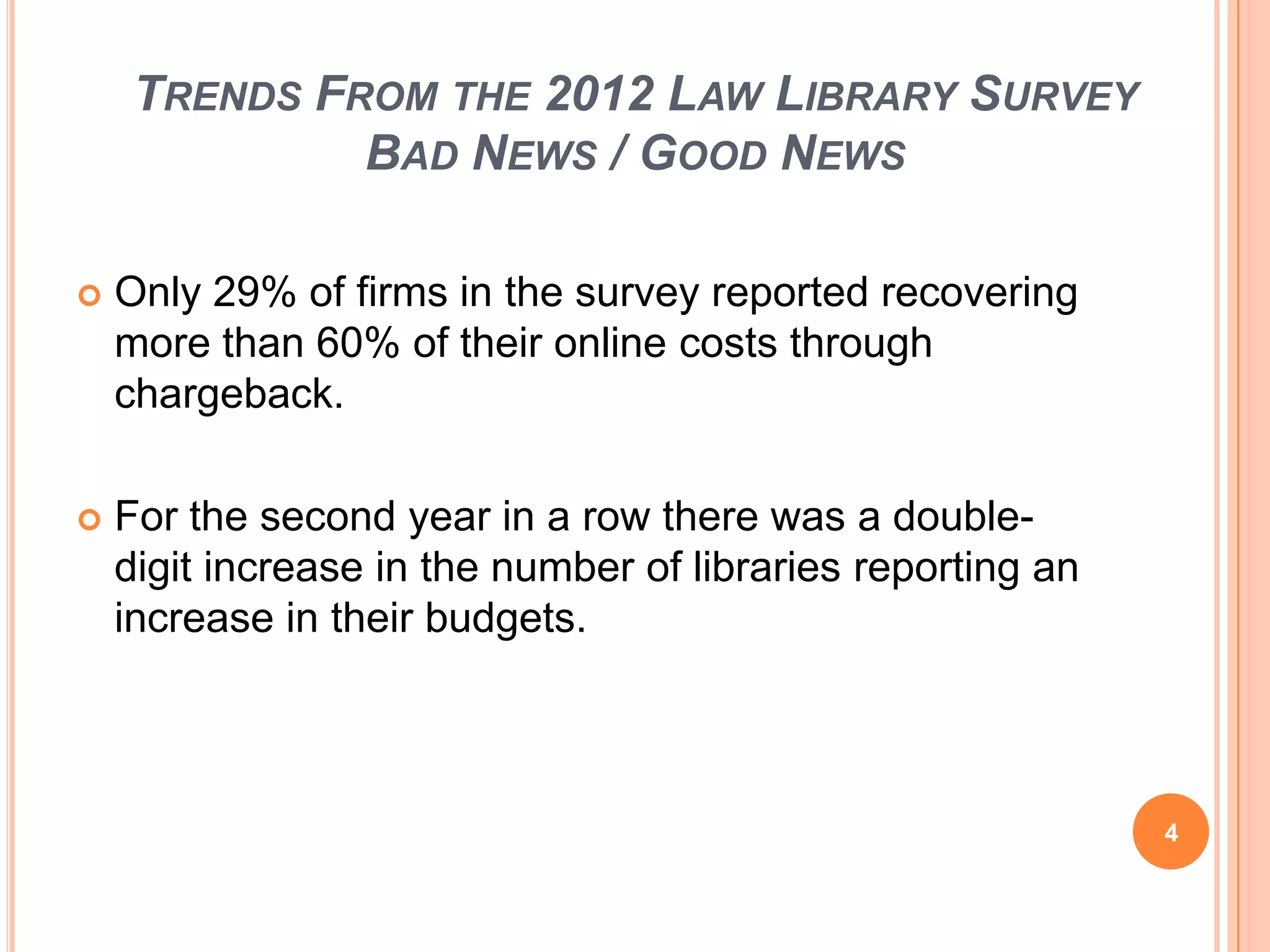
TRENDS FROM THE 2012 LAW LIBRARY SURVEY
BAD NEWS / GOOD NEWS
 Only 29% of firms in the survey reported recovering
more than 60% of their online costs through
chargeback.
 For the second year in a row there was a double-
digit increase in the number of libraries reporting an
increase in their budgets.
4
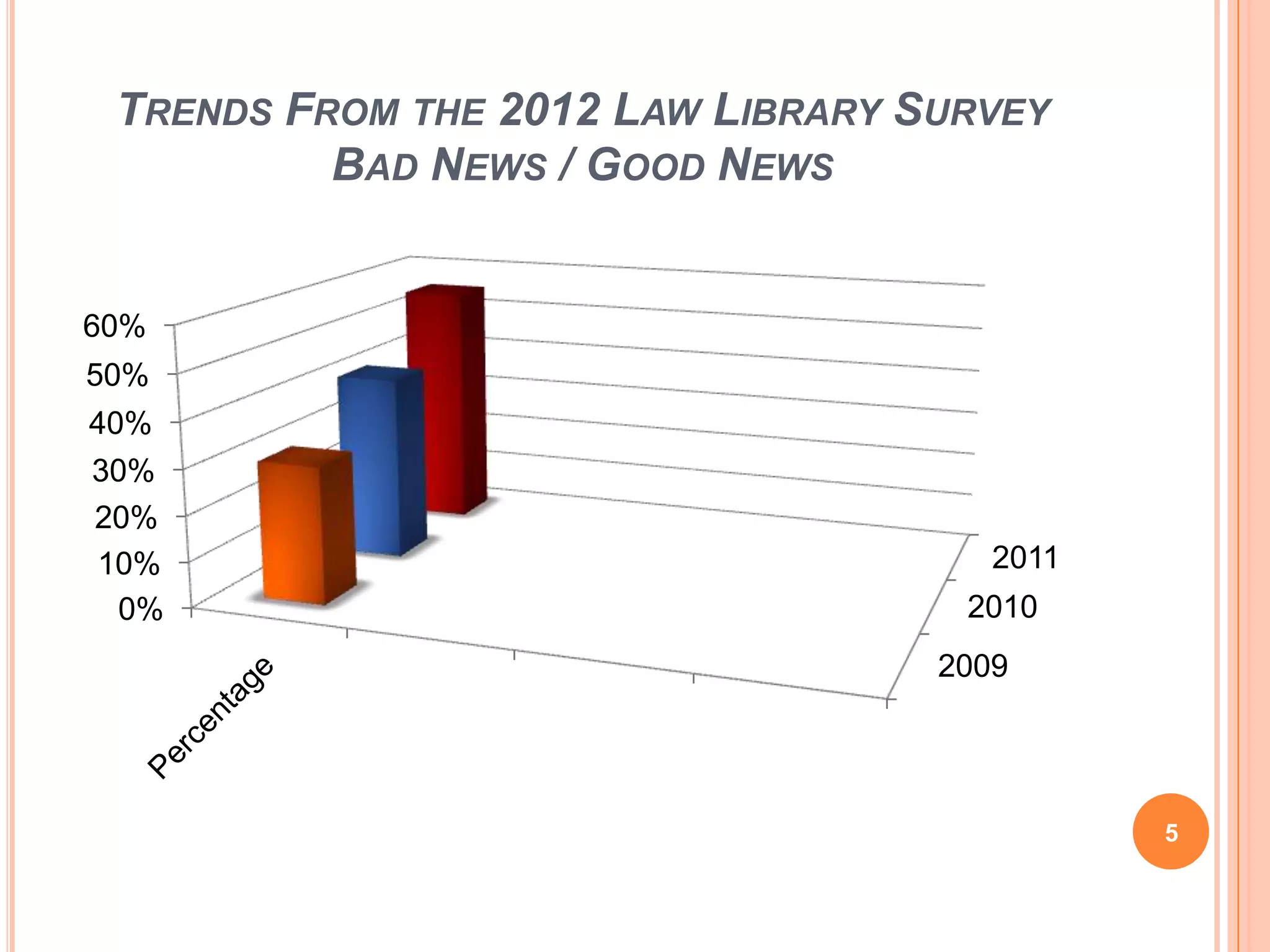
TRENDS FROM THE 2012 LAW LIBRARY SURVEY
BAD NEWS / GOOD NEWS
2009
2010
2011
0%
10%
20%
30%
40%
50%
60%
5
BLOOMBERG LAW 2012 LAW FIRM COST
RECOVERY RESEARCH SURVEY FINDINGS
 Law firms are recovering less of the research costs
they incurred two years ago.
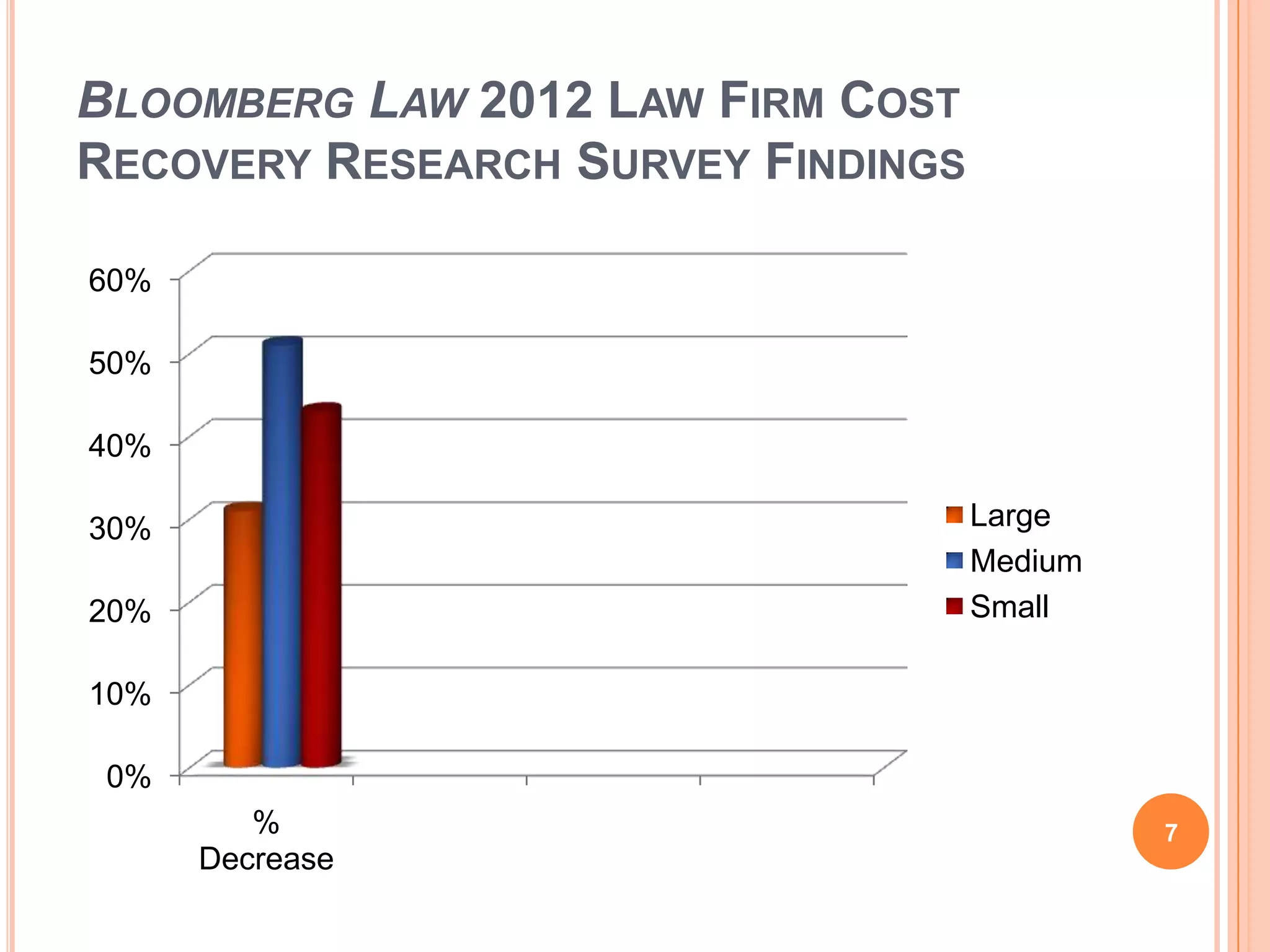
 The downward trend in the amount of research
costs is most dramatic at medium and small law
firms.
 The cost of legal research and client
expectation/demand is what typically drives cost
recovery policies, regardless of law firm size.
6
BLOOMBERG LAW 2012 LAW FIRM COST
RECOVERY RESEARCH SURVEY FINDINGS
0%
10%
20%
30%
40%
50%
60%
%
Decrease
Large
Medium
Small
7
POLL
Have you ever done a business plan for your library?
8
PREPARING THE BUSINESS PLAN & BUDGET
“…budgets are prepared annually and not reviewed
until the next budget cycle. This annual look at the
budget is very ineffective in helping you reach your
financial goals.”
Budgeting
Strategieshttp://www.entrepreneurship.org/en/resource-
center/budgeting-strategies.aspx
9
BUSINESS PLAN AND BUDGET PREPARATION
Business Plan and Budget Preparation
 Analysis of current year financial results
 SWOT Analysis - strengths, weaknesses, opportunities
and threats
 Balanced scorecard - analysis of the impact of
achieving objectives from a financial perspective, a
customer perspective and an internal perspective, and
on innovation and learning, together with identification of
critical success factors and performance measures
 Brainstorming - for alternative
scenarios, opportunities, strategies
10
“THE DIFFERENCE BETWEEN A TRADITIONAL BUDGET AND A STRATEGIC ONE IS THE
PROCESS SURROUNDING HOW THESE PROJECTIONS ARE DERIVED”. STRATEGIC
BUDGETING FOR LAW FIRMS,HTTP://WWW.RBZ.COM/NEWS-CATEGORY/THE-BOTTOM-
LINE/STRATEGIC-BUDGETING-FOR-LAW-FIRMS/
Strategic Budgeting
 Projected Revenue
 Projected Expenses
 Salaries
 Bonuses
 Marketing
 Capital Expenditures
 library automation systems
 Operating Expenditures
 Library Collection
 Fee-based Databases
 Projected Profit and Cash Flow 11
“MANAGING IN A TIME OF CHANGE REQUIRES THAT LIBRARY DIRECTORS THINK
STRATEGICALLY AND CHALLENGE ASSUMPTIONS ABOUT TRADITIONAL ROLES LIBRARIES
HAVE PLAYED IN THE PAST.” STRATEGIC PLANNING AND PROGRAM BUDGETING FOR
LIBRARIES, LIBRARY TRENDS, VOL. 42, NO. 3, PP. 420-47 (1994)
 Library Collections
 Technology
 Library Services
 Training
Strategic Budgeting Questions
12
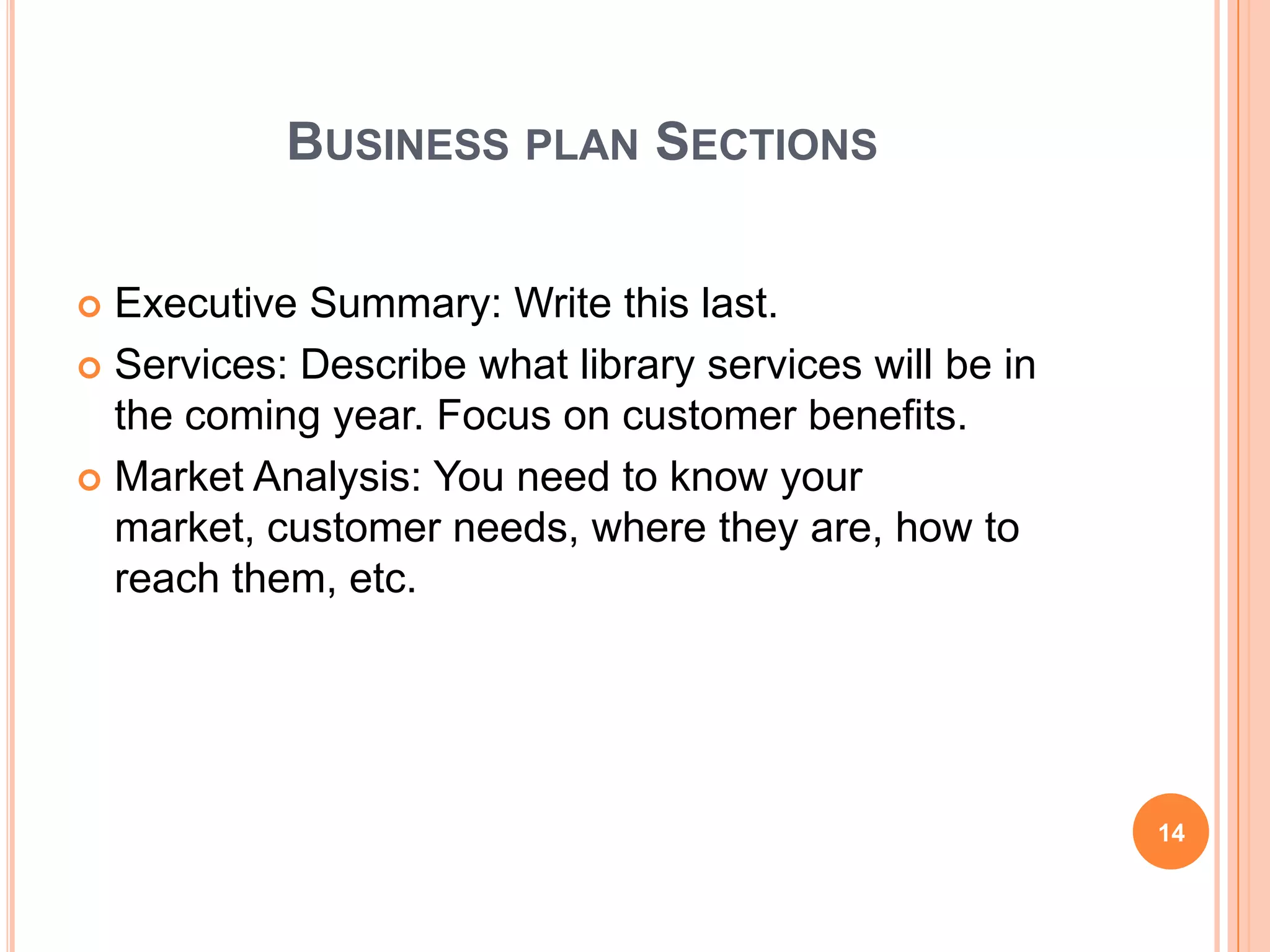
SUPPORTING LIBRARY SERVICES
13
BUSINESS PLAN SECTIONS
 Executive Summary: Write this last.
 Services: Describe what library services will be in
the coming year. Focus on customer benefits.
 Market Analysis: You need to know your
market, customer needs, where they are, how to
reach them, etc.
14
BUSINESS PLAN SECTIONS
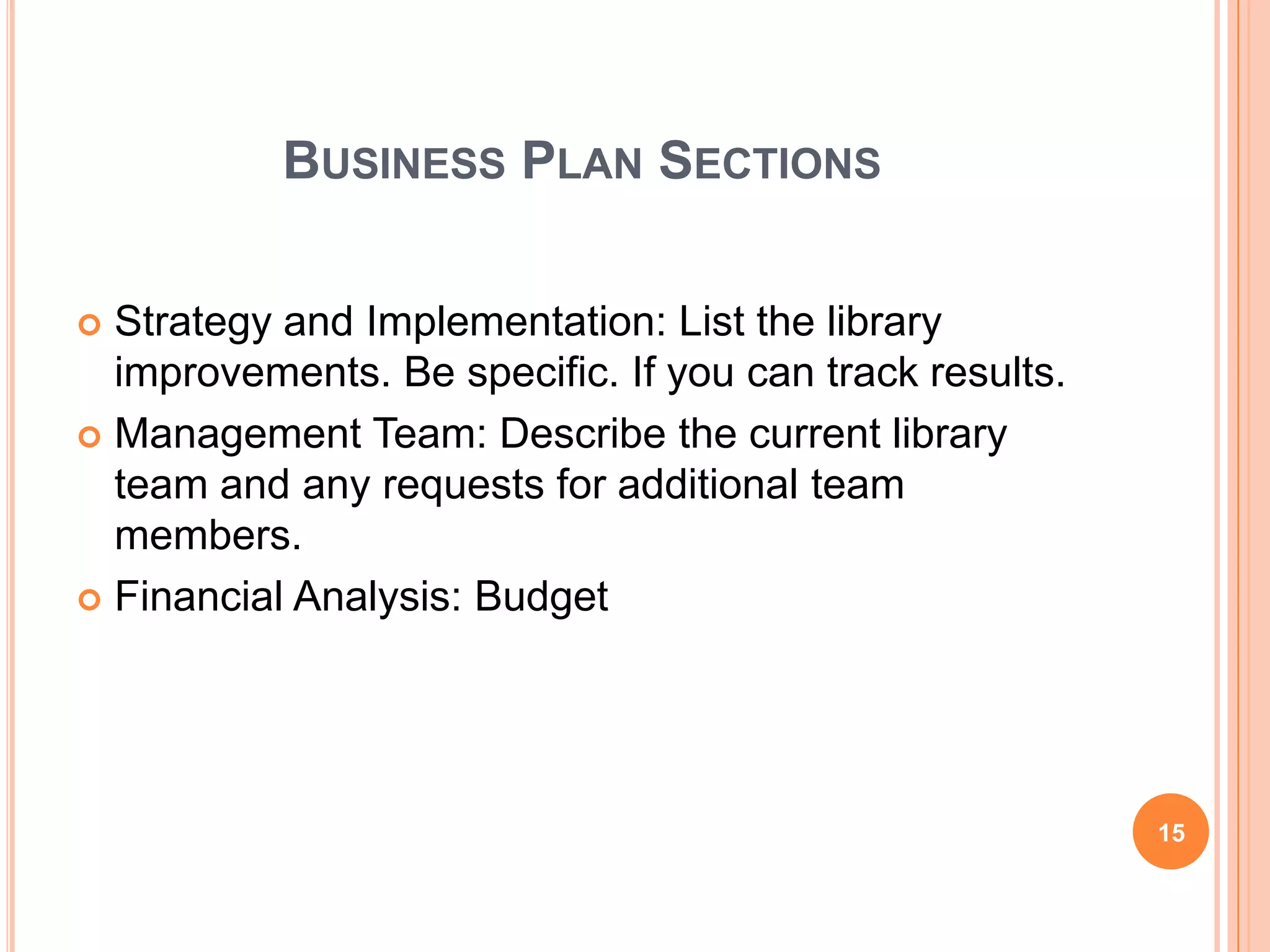
 Strategy and Implementation: List the library
improvements. Be specific. If you can track results.
 Management Team: Describe the current library
team and any requests for additional team
members.
 Financial Analysis: Budget
15
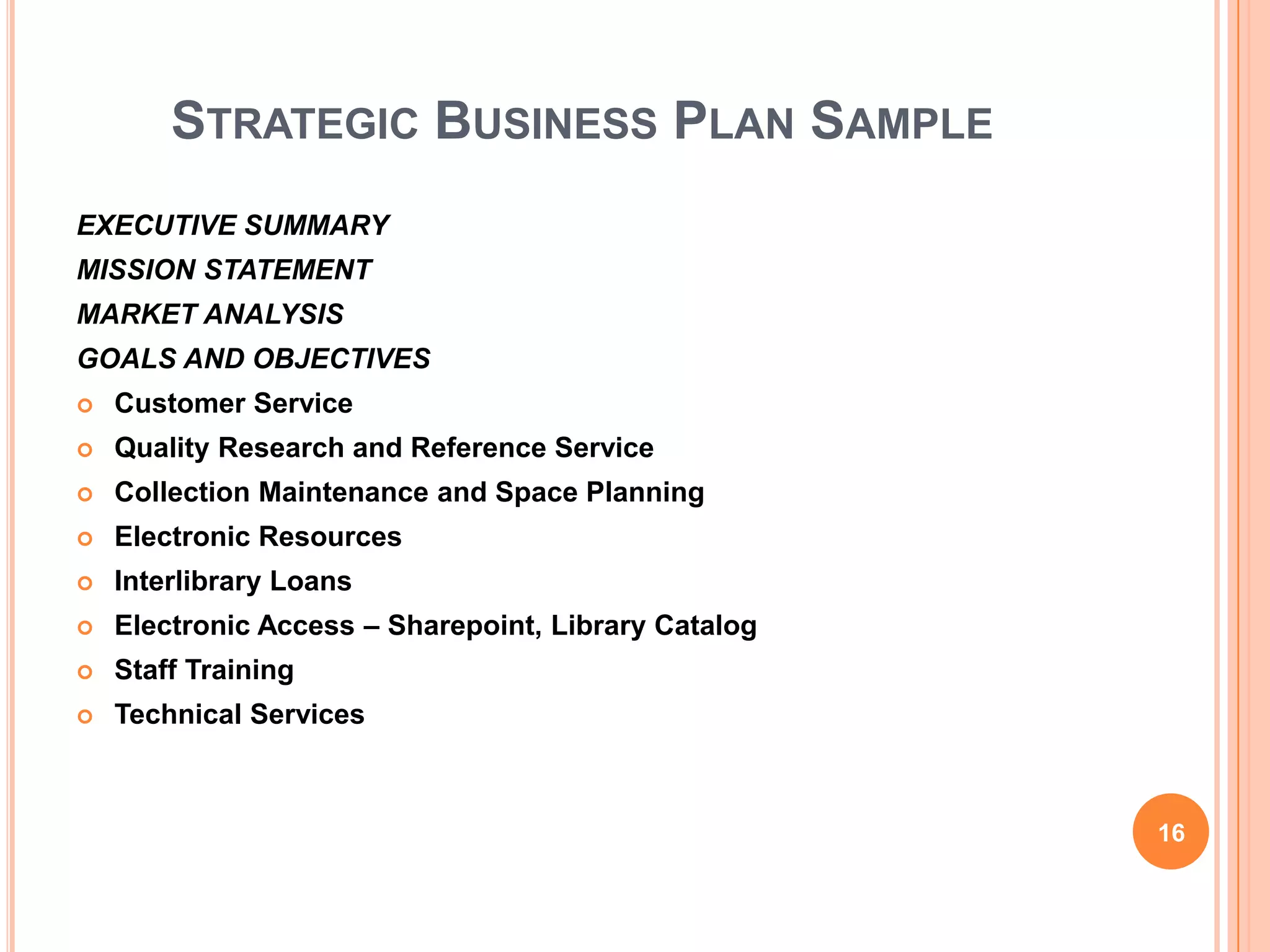
STRATEGIC BUSINESS PLAN SAMPLE
EXECUTIVE SUMMARY
MISSION STATEMENT
MARKET ANALYSIS
GOALS AND OBJECTIVES
 Customer Service
 Quality Research and Reference Service
 Collection Maintenance and Space Planning
 Electronic Resources
 Interlibrary Loans
 Electronic Access – Sharepoint, Library Catalog
 Staff Training
 Technical Services
16
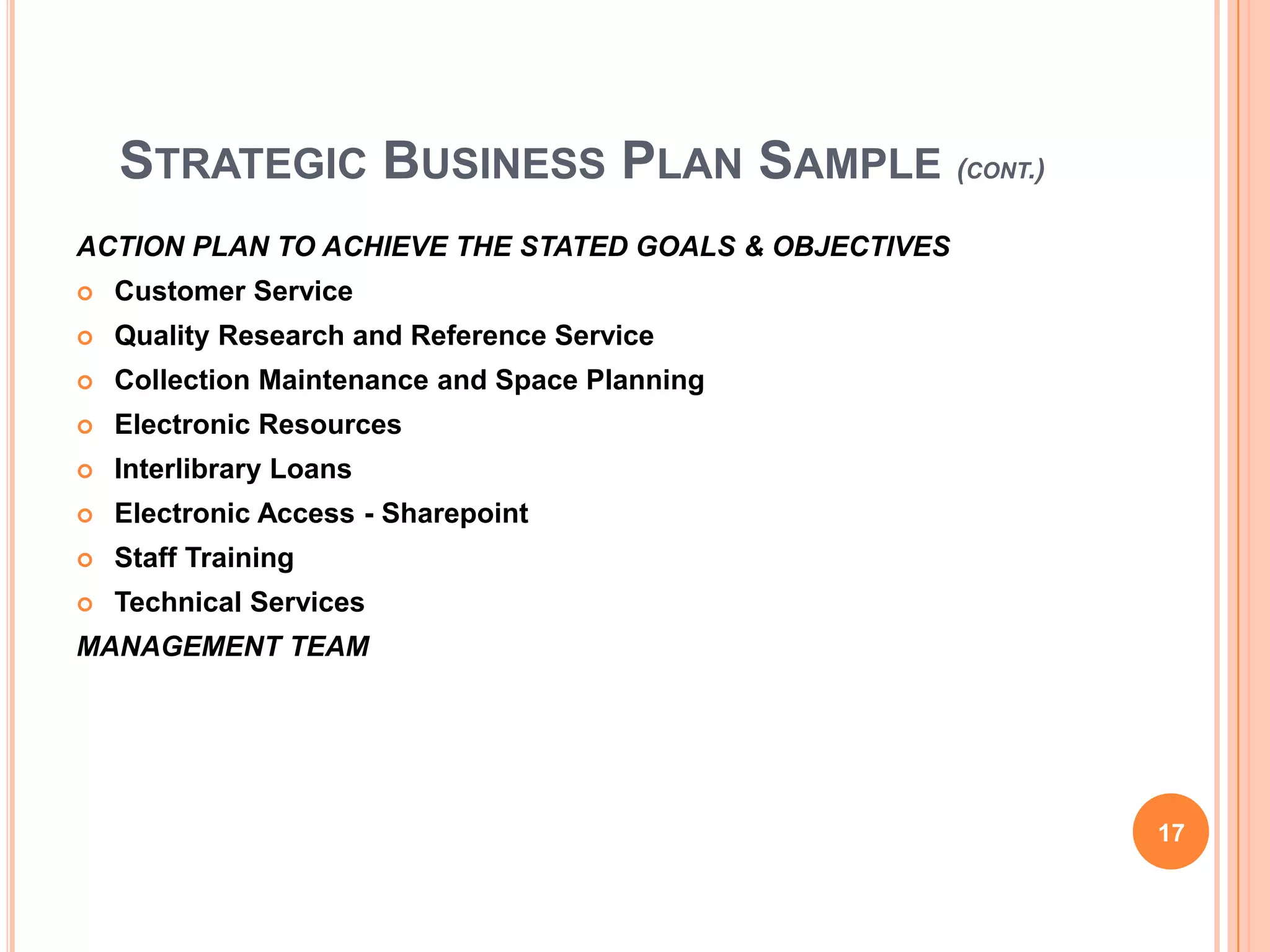
STRATEGIC BUSINESS PLAN SAMPLE (CONT.)
ACTION PLAN TO ACHIEVE THE STATED GOALS & OBJECTIVES
 Customer Service
 Quality Research and Reference Service
 Collection Maintenance and Space Planning
 Electronic Resources
 Interlibrary Loans
 Electronic Access - Sharepoint
 Staff Training
 Technical Services
MANAGEMENT TEAM
17
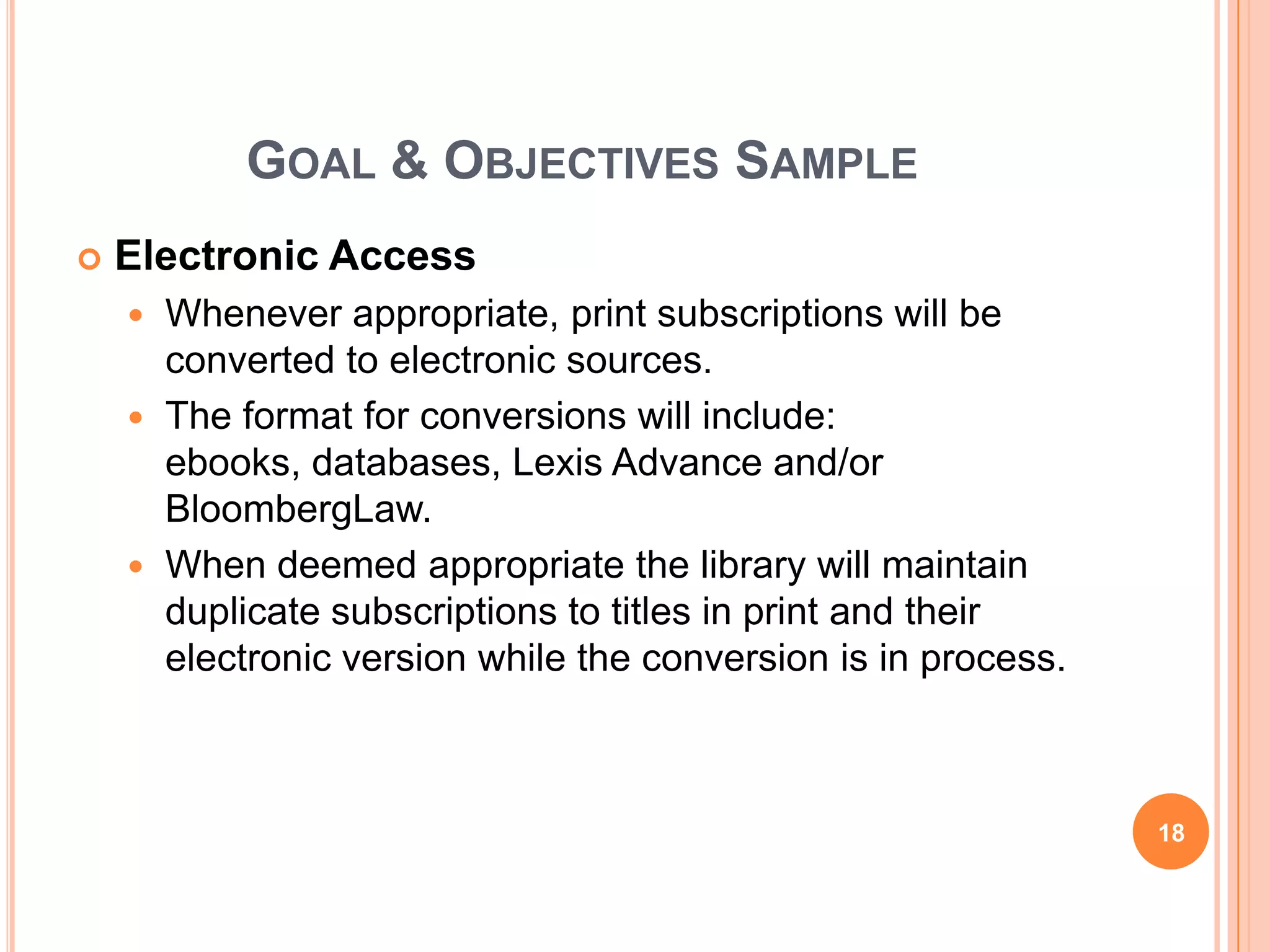
GOAL & OBJECTIVES SAMPLE
 Electronic Access
 Whenever appropriate, print subscriptions will be
converted to electronic sources.
 The format for conversions will include:
ebooks, databases, Lexis Advance and/or
BloombergLaw.
 When deemed appropriate the library will maintain
duplicate subscriptions to titles in print and their
electronic version while the conversion is in process.
18
ACTION PLAN TO ACHIEVE THE STATED GOALS &
OBJECTIVES SAMPLE
 Electronic Resources
 In substituting an electronic source for a print
subscription, the Director of the Library will make the
decision with impute from the attorneys and the department
head.
 When making decisions the following parameters should
be taken into account:
 Ease of use of the electronic version.
 Is the coverage the same as the print?
 What is the demand of the print? Is the print continually off the
shelf because of high usage?
 Will it be more convenient to the practitioner to have access to
an electronic version vs. the print?
 In conversion discussions with the vendors, LexisNexis and
BloombergLaw, a „free‟ period of use for the titles will be
included in the contract or a print discount will be
negotiated for the remaining period of the print
subscription. 19
WHEN AND HOW DO CORPORATIONS
PLAN THEIR BUDGETS?
 Budget discussions begin in August.
 Every budget must start at zero (Zero-based
budgeting).
 Each and every cost is added until the total budget
needed is identified.
 Last, paring down begins.
 Budget is signed off in November.
20
POLL
Have you ever used zero-based budgeting?
21
REASONS FOR ZERO BASED BUDGETING VS.
TRADITIONAL BUDGETING
 Zero based budgeting allows resources to be used
based on needs rather than the traditional model.
 Managers will become more efficient and search for
ways to improve their operating procedures instead
of relying on funding based on previous
performance.
 It can aid in finding areas that are expensive and
indicate more cost effective ways of dealing with
the problem.
22
USE OF ZERO BASED BUDGETING VS.
TRADITIONAL BUDGETING
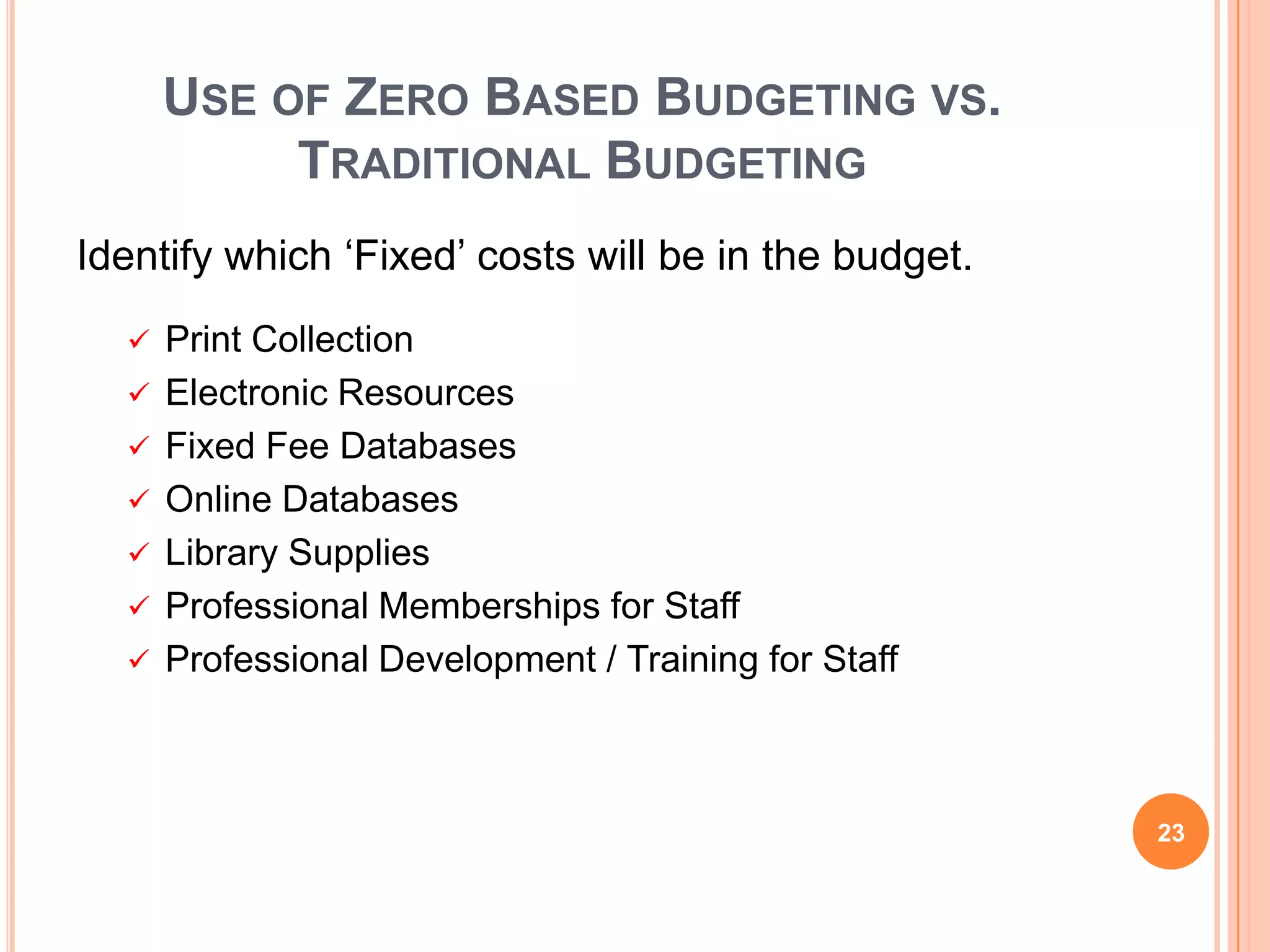
Identify which „Fixed‟ costs will be in the budget.
 Print Collection
 Electronic Resources
 Fixed Fee Databases
 Online Databases
 Library Supplies
 Professional Memberships for Staff
 Professional Development / Training for Staff
23
USE OF ZERO BASED BUDGETING:
BREAKDOWN
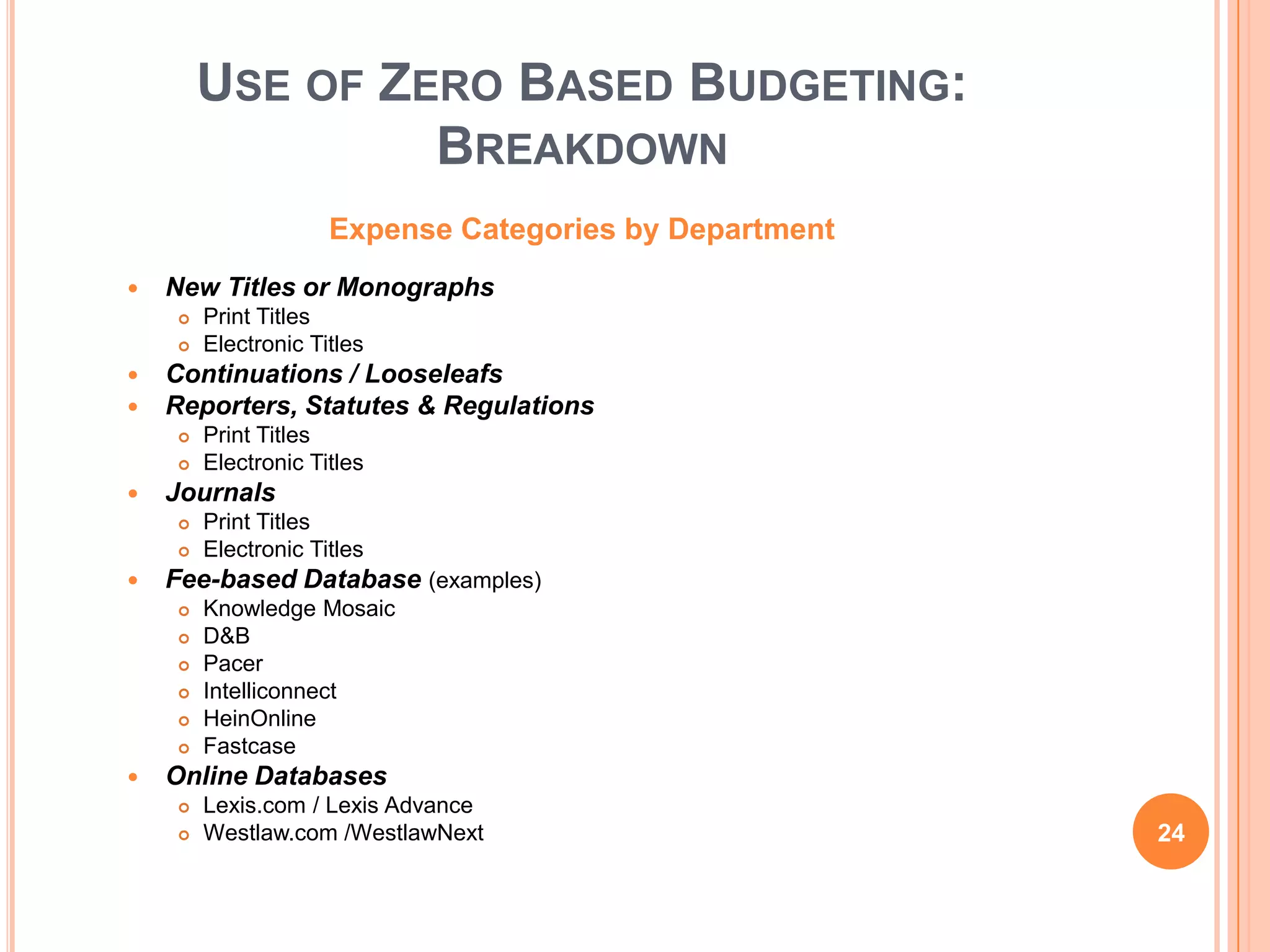
Expense Categories by Department
 New Titles or Monographs
 Print Titles
 Electronic Titles
 Continuations / Looseleafs
 Reporters, Statutes & Regulations
 Print Titles
 Electronic Titles
 Journals
 Print Titles
 Electronic Titles
 Fee-based Database (examples)
 Knowledge Mosaic
 D&B
 Pacer
 Intelliconnect
 HeinOnline
 Fastcase
 Online Databases
 Lexis.com / Lexis Advance
 Westlaw.com /WestlawNext 24
ACCOUNTING
PARENT / CHILD CATEGORIES
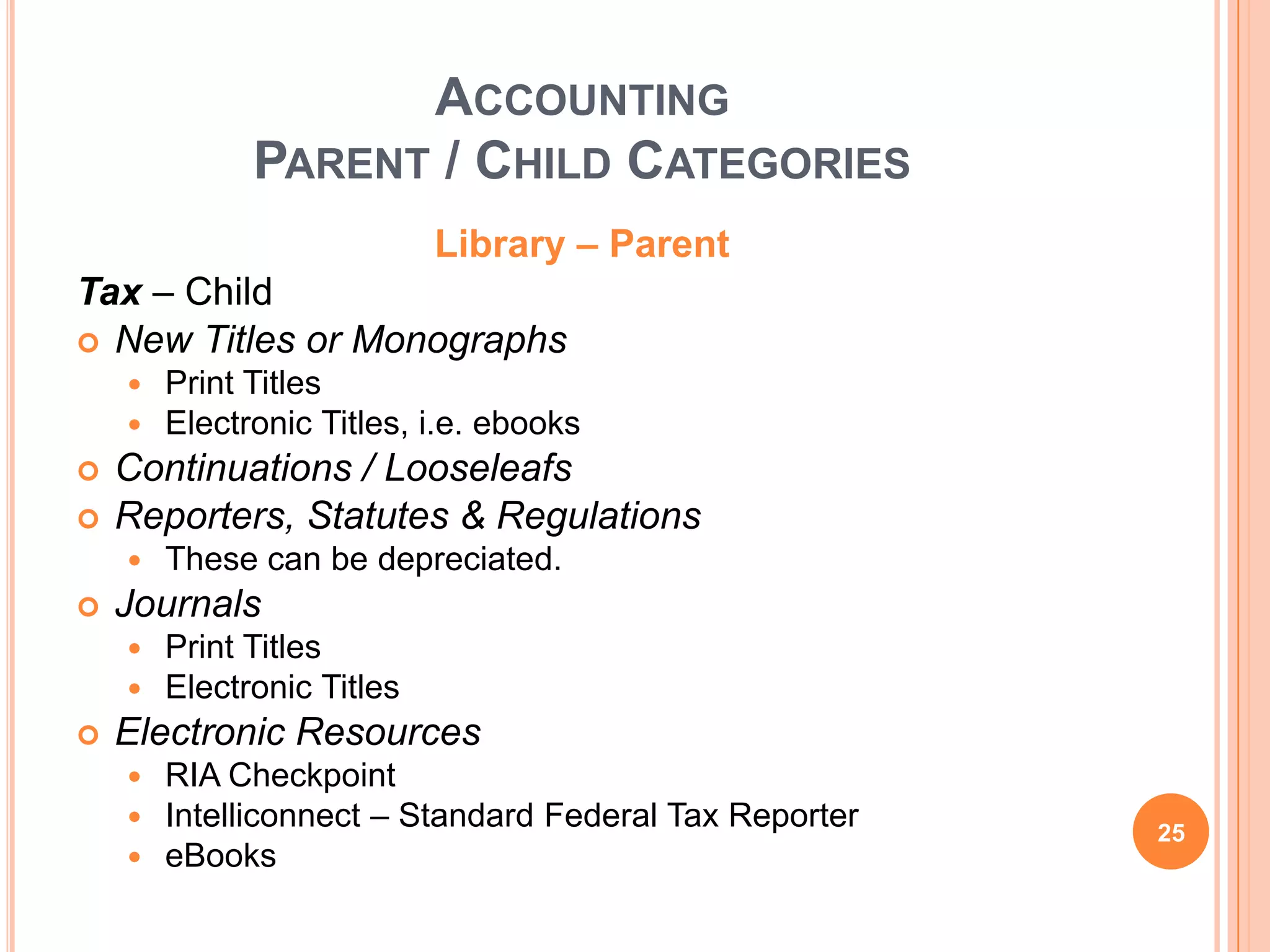
Library – Parent
Tax – Child
 New Titles or Monographs
 Print Titles
 Electronic Titles, i.e. ebooks
 Continuations / Looseleafs
 Reporters, Statutes & Regulations
 These can be depreciated.
 Journals
 Print Titles
 Electronic Titles
 Electronic Resources
 RIA Checkpoint
 Intelliconnect – Standard Federal Tax Reporter
 eBooks
25
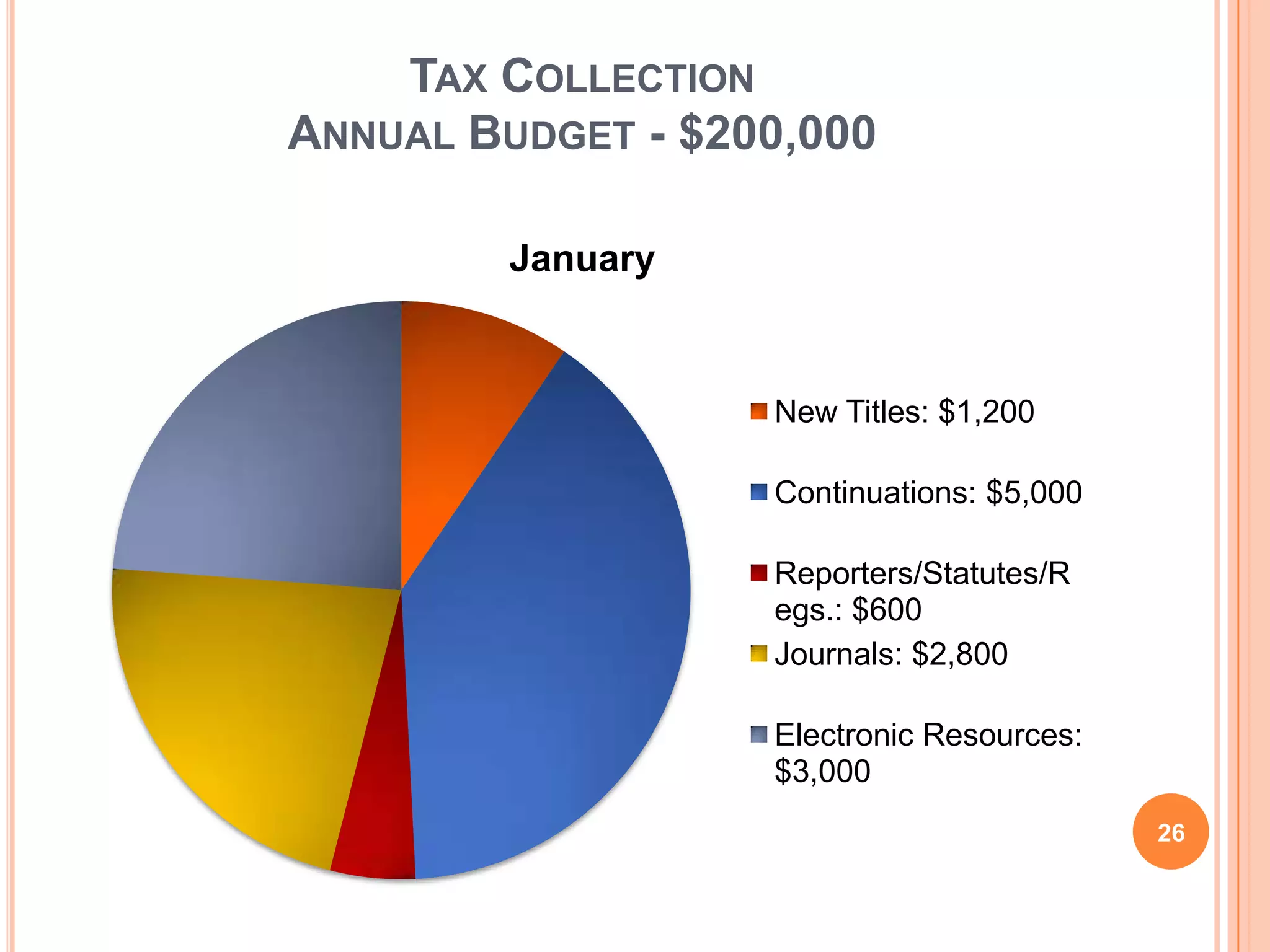
TAX COLLECTION
ANNUAL BUDGET - $200,000
January
New Titles: $1,200
Continuations: $5,000
Reporters/Statutes/R
egs.: $600
Journals: $2,800
Electronic Resources:
$3,000
26
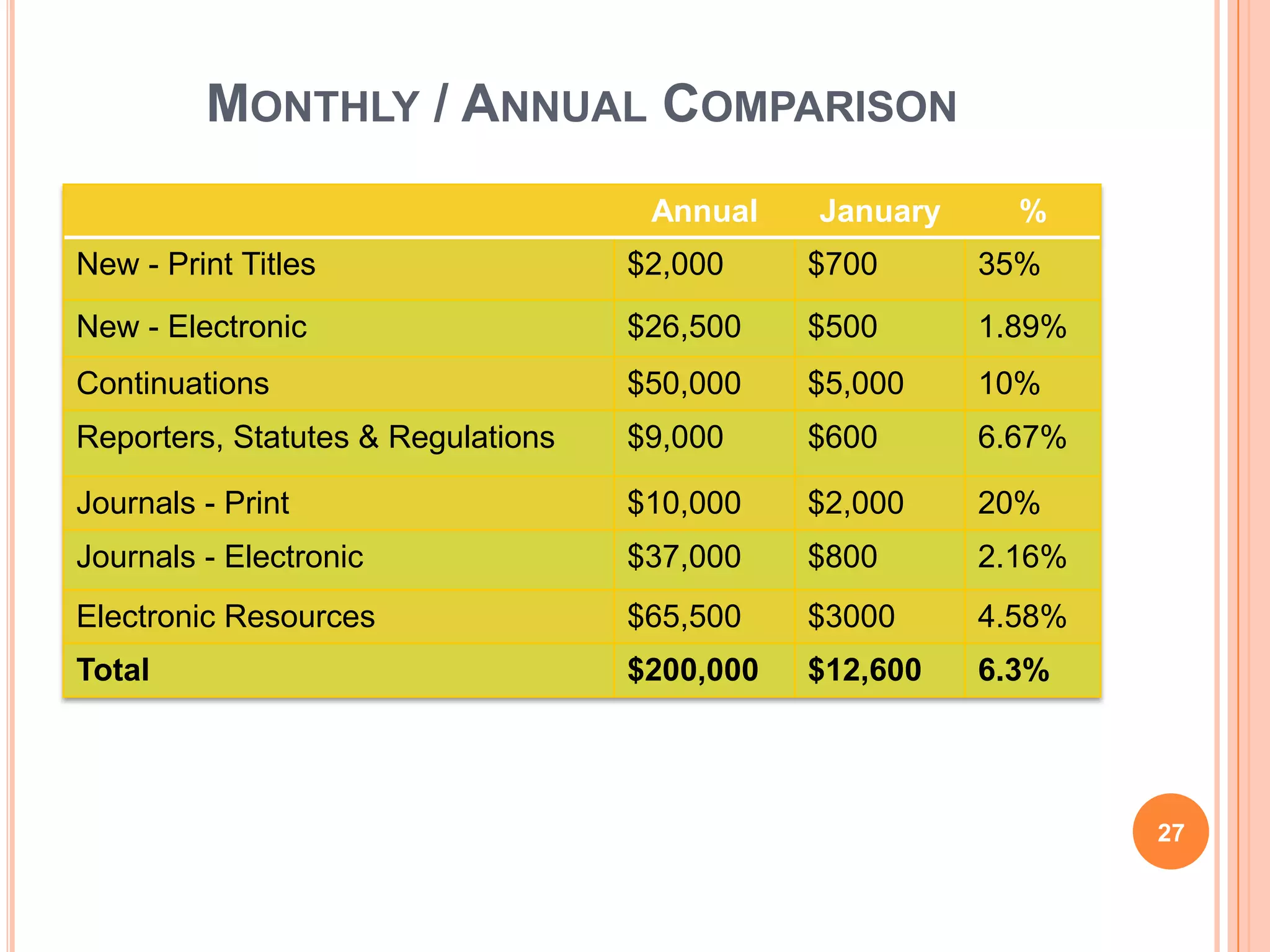
MONTHLY / ANNUAL COMPARISON
Annual January %
New - Print Titles $2,000 $700 35%
New - Electronic $26,500 $500 1.89%
Continuations $50,000 $5,000 10%
Reporters, Statutes & Regulations $9,000 $600 6.67%
Journals - Print $10,000 $2,000 20%
Journals - Electronic $37,000 $800 2.16%
Electronic Resources $65,500 $3000 4.58%
Total $200,000 $12,600 6.3%
27
USING A PROJECT MANAGEMENT APPROACH, LAW FIRMS ARE BEING MORE TRANSPARENT ABOUT
THEIR COSTS WITH CLIENTS. AT THE SAME TIME, BY ORGANIZING ALL THE COMPONENTS OF A
SINGLE CASE INTO ONE PLACE, LAW FIRMS SAY THE STRATEGY IS HELPING THEM BECOME MORE
EFFICIENT. NASHVILLE BUSINESS JOURNAL
HTTPS://MARKETCENTER.BAKERDONELSON.COM/FILES/UPLOADS/DOCUMENTS/NBJ%20BAKER%
20MANAGE%2009-28-12.PDF
Project Management results in:
 more effective planning,
 cost control,
 resource allocation and
 appropriate risk management throughout the duration of
a case/project, giving project team members the
structured tools to make deliberate, fact-based
decisions.
[ACC PRIMER – Legal Project Management
http://www.acc.com/advocacy/valuechallenge/toolkit/loader.cfm?csModu
le=security/getfile&pageid=1293786&page=/index.cfm&qstring=&title=A
CC%20Legal%20Project%20Management%20Primer]
28
 Start the budget process early.
 Seek out those individuals who know the direction
the organization will take in the coming year.
 Review and track the budget monthly.
 Develop month‐by‐month charts of expenditures (%
for total) for each category.
 Track expenditures at a finer level.
29
ALTERNATE VIEW OF LIBRARY BUDGETS:
A LIVING DOCUMENT
30

Alternate View of Library Budgets, A Living Document

  • 1.
    ALTERNATE VIEW OFLIBRARY BUDGETS: A LIVING DOCUMENT Janice E. Henderson, Esq., M.L.S.
  • 2.
    2012 LAW FIRMSIN TRANSITION © 2012 ALTMAN WEIL, INC. „Yes‟ - Permanent Change 2009 Response 2012 Response Changei n % MagnitudeIn crease More price competition 42.4% 91.6% +49.2 2.2x More commoditized legal work 25.5% 83.6% +58.1 3.3x More non-hourly billing 27.9% 80.0% +52.1 2.9x Fewer equity partners 22.8% 67.6% +44.8 3.0x More contract lawyers 28.3% 66.2% +37.9 2.3x Reduced leverage 12.1% 57.7% +45.6 4.8x Smaller first year classes 11.4% 55.4% +44.0 4.9x Lower PPP/Slowdown in PPP 13.2% 47.7% +34.5 3.6x Outsourcing legal work 11.5% 45.5% +34.0 4.0x Lower / Hold line on associate comp 9.5% 21.5% +12.0 2.3x 2
  • 3.
    ALTERNATIVE BILLING ROBERT HALFLEGAL SURVEY 3 0% 10% 20% 30% 40% 50% 60% Flat or fixed project fees Volume discounts and discounted fees Blended hourly rates Capped fees 2011
  • 4.
    TRENDS FROM THE2012 LAW LIBRARY SURVEY BAD NEWS / GOOD NEWS  Only 29% of firms in the survey reported recovering more than 60% of their online costs through chargeback.  For the second year in a row there was a double- digit increase in the number of libraries reporting an increase in their budgets. 4
  • 5.
    TRENDS FROM THE2012 LAW LIBRARY SURVEY BAD NEWS / GOOD NEWS 2009 2010 2011 0% 10% 20% 30% 40% 50% 60% 5
  • 6.
    BLOOMBERG LAW 2012LAW FIRM COST RECOVERY RESEARCH SURVEY FINDINGS  Law firms are recovering less of the research costs they incurred two years ago.  The downward trend in the amount of research costs is most dramatic at medium and small law firms.  The cost of legal research and client expectation/demand is what typically drives cost recovery policies, regardless of law firm size. 6
  • 7.
    BLOOMBERG LAW 2012LAW FIRM COST RECOVERY RESEARCH SURVEY FINDINGS 0% 10% 20% 30% 40% 50% 60% % Decrease Large Medium Small 7
  • 8.
    POLL Have you everdone a business plan for your library? 8
  • 9.
    PREPARING THE BUSINESSPLAN & BUDGET “…budgets are prepared annually and not reviewed until the next budget cycle. This annual look at the budget is very ineffective in helping you reach your financial goals.” Budgeting Strategieshttp://www.entrepreneurship.org/en/resource- center/budgeting-strategies.aspx 9
  • 10.
    BUSINESS PLAN ANDBUDGET PREPARATION Business Plan and Budget Preparation  Analysis of current year financial results  SWOT Analysis - strengths, weaknesses, opportunities and threats  Balanced scorecard - analysis of the impact of achieving objectives from a financial perspective, a customer perspective and an internal perspective, and on innovation and learning, together with identification of critical success factors and performance measures  Brainstorming - for alternative scenarios, opportunities, strategies 10
  • 11.
    “THE DIFFERENCE BETWEENA TRADITIONAL BUDGET AND A STRATEGIC ONE IS THE PROCESS SURROUNDING HOW THESE PROJECTIONS ARE DERIVED”. STRATEGIC BUDGETING FOR LAW FIRMS,HTTP://WWW.RBZ.COM/NEWS-CATEGORY/THE-BOTTOM- LINE/STRATEGIC-BUDGETING-FOR-LAW-FIRMS/ Strategic Budgeting  Projected Revenue  Projected Expenses  Salaries  Bonuses  Marketing  Capital Expenditures  library automation systems  Operating Expenditures  Library Collection  Fee-based Databases  Projected Profit and Cash Flow 11
  • 12.
    “MANAGING IN ATIME OF CHANGE REQUIRES THAT LIBRARY DIRECTORS THINK STRATEGICALLY AND CHALLENGE ASSUMPTIONS ABOUT TRADITIONAL ROLES LIBRARIES HAVE PLAYED IN THE PAST.” STRATEGIC PLANNING AND PROGRAM BUDGETING FOR LIBRARIES, LIBRARY TRENDS, VOL. 42, NO. 3, PP. 420-47 (1994)  Library Collections  Technology  Library Services  Training Strategic Budgeting Questions 12
  • 13.
  • 14.
    BUSINESS PLAN SECTIONS Executive Summary: Write this last.  Services: Describe what library services will be in the coming year. Focus on customer benefits.  Market Analysis: You need to know your market, customer needs, where they are, how to reach them, etc. 14
  • 15.
    BUSINESS PLAN SECTIONS Strategy and Implementation: List the library improvements. Be specific. If you can track results.  Management Team: Describe the current library team and any requests for additional team members.  Financial Analysis: Budget 15
  • 16.
    STRATEGIC BUSINESS PLANSAMPLE EXECUTIVE SUMMARY MISSION STATEMENT MARKET ANALYSIS GOALS AND OBJECTIVES  Customer Service  Quality Research and Reference Service  Collection Maintenance and Space Planning  Electronic Resources  Interlibrary Loans  Electronic Access – Sharepoint, Library Catalog  Staff Training  Technical Services 16
  • 17.
    STRATEGIC BUSINESS PLANSAMPLE (CONT.) ACTION PLAN TO ACHIEVE THE STATED GOALS & OBJECTIVES  Customer Service  Quality Research and Reference Service  Collection Maintenance and Space Planning  Electronic Resources  Interlibrary Loans  Electronic Access - Sharepoint  Staff Training  Technical Services MANAGEMENT TEAM 17
  • 18.
    GOAL & OBJECTIVESSAMPLE  Electronic Access  Whenever appropriate, print subscriptions will be converted to electronic sources.  The format for conversions will include: ebooks, databases, Lexis Advance and/or BloombergLaw.  When deemed appropriate the library will maintain duplicate subscriptions to titles in print and their electronic version while the conversion is in process. 18
  • 19.
    ACTION PLAN TOACHIEVE THE STATED GOALS & OBJECTIVES SAMPLE  Electronic Resources  In substituting an electronic source for a print subscription, the Director of the Library will make the decision with impute from the attorneys and the department head.  When making decisions the following parameters should be taken into account:  Ease of use of the electronic version.  Is the coverage the same as the print?  What is the demand of the print? Is the print continually off the shelf because of high usage?  Will it be more convenient to the practitioner to have access to an electronic version vs. the print?  In conversion discussions with the vendors, LexisNexis and BloombergLaw, a „free‟ period of use for the titles will be included in the contract or a print discount will be negotiated for the remaining period of the print subscription. 19
  • 20.
    WHEN AND HOWDO CORPORATIONS PLAN THEIR BUDGETS?  Budget discussions begin in August.  Every budget must start at zero (Zero-based budgeting).  Each and every cost is added until the total budget needed is identified.  Last, paring down begins.  Budget is signed off in November. 20
  • 21.
    POLL Have you everused zero-based budgeting? 21
  • 22.
    REASONS FOR ZEROBASED BUDGETING VS. TRADITIONAL BUDGETING  Zero based budgeting allows resources to be used based on needs rather than the traditional model.  Managers will become more efficient and search for ways to improve their operating procedures instead of relying on funding based on previous performance.  It can aid in finding areas that are expensive and indicate more cost effective ways of dealing with the problem. 22
  • 23.
    USE OF ZEROBASED BUDGETING VS. TRADITIONAL BUDGETING Identify which „Fixed‟ costs will be in the budget.  Print Collection  Electronic Resources  Fixed Fee Databases  Online Databases  Library Supplies  Professional Memberships for Staff  Professional Development / Training for Staff 23
  • 24.
    USE OF ZEROBASED BUDGETING: BREAKDOWN Expense Categories by Department  New Titles or Monographs  Print Titles  Electronic Titles  Continuations / Looseleafs  Reporters, Statutes & Regulations  Print Titles  Electronic Titles  Journals  Print Titles  Electronic Titles  Fee-based Database (examples)  Knowledge Mosaic  D&B  Pacer  Intelliconnect  HeinOnline  Fastcase  Online Databases  Lexis.com / Lexis Advance  Westlaw.com /WestlawNext 24
  • 25.
    ACCOUNTING PARENT / CHILDCATEGORIES Library – Parent Tax – Child  New Titles or Monographs  Print Titles  Electronic Titles, i.e. ebooks  Continuations / Looseleafs  Reporters, Statutes & Regulations  These can be depreciated.  Journals  Print Titles  Electronic Titles  Electronic Resources  RIA Checkpoint  Intelliconnect – Standard Federal Tax Reporter  eBooks 25
  • 26.
    TAX COLLECTION ANNUAL BUDGET- $200,000 January New Titles: $1,200 Continuations: $5,000 Reporters/Statutes/R egs.: $600 Journals: $2,800 Electronic Resources: $3,000 26
  • 27.
    MONTHLY / ANNUALCOMPARISON Annual January % New - Print Titles $2,000 $700 35% New - Electronic $26,500 $500 1.89% Continuations $50,000 $5,000 10% Reporters, Statutes & Regulations $9,000 $600 6.67% Journals - Print $10,000 $2,000 20% Journals - Electronic $37,000 $800 2.16% Electronic Resources $65,500 $3000 4.58% Total $200,000 $12,600 6.3% 27
  • 28.
    USING A PROJECTMANAGEMENT APPROACH, LAW FIRMS ARE BEING MORE TRANSPARENT ABOUT THEIR COSTS WITH CLIENTS. AT THE SAME TIME, BY ORGANIZING ALL THE COMPONENTS OF A SINGLE CASE INTO ONE PLACE, LAW FIRMS SAY THE STRATEGY IS HELPING THEM BECOME MORE EFFICIENT. NASHVILLE BUSINESS JOURNAL HTTPS://MARKETCENTER.BAKERDONELSON.COM/FILES/UPLOADS/DOCUMENTS/NBJ%20BAKER% 20MANAGE%2009-28-12.PDF Project Management results in:  more effective planning,  cost control,  resource allocation and  appropriate risk management throughout the duration of a case/project, giving project team members the structured tools to make deliberate, fact-based decisions. [ACC PRIMER – Legal Project Management http://www.acc.com/advocacy/valuechallenge/toolkit/loader.cfm?csModu le=security/getfile&pageid=1293786&page=/index.cfm&qstring=&title=A CC%20Legal%20Project%20Management%20Primer] 28
  • 29.
     Start thebudget process early.  Seek out those individuals who know the direction the organization will take in the coming year.  Review and track the budget monthly.  Develop month‐by‐month charts of expenditures (% for total) for each category.  Track expenditures at a finer level. 29
  • 30.
    ALTERNATE VIEW OFLIBRARY BUDGETS: A LIVING DOCUMENT 30