Sustainable Stormwater
Management
BUILDING SERVICES 1
Group Members:
ANDY CHIN
WEE HIONG KIET
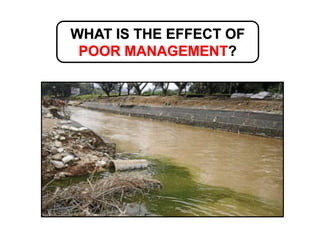
WONG SHER SHENG
WONG TIAN YI
TEO CHIANG LOONG
INTRODUCTION
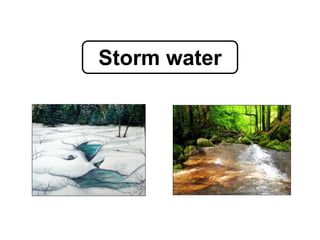
Storm water
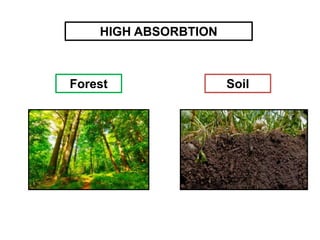
Forest Soil
HIGH ABSORBTION
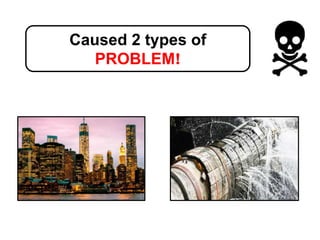
Caused 2 types of
PROBLEM!
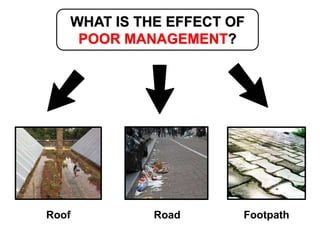
WHAT IS THE EFFECT OF
POOR MANAGEMENT?
Roof Road Footpath
WHAT IS THE EFFECT OF
POOR MANAGEMENT?
WHAT IS THE EFFECT OF
POOR MANAGEMENT?
WHAT IS THE EFFECT OF
POOR MANAGEMENT?
WHAT IS THE EFFECT OF
POOR MANAGEMENT?
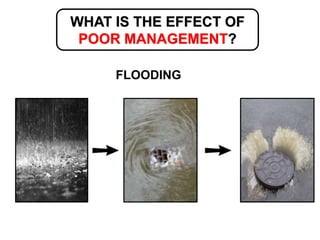
FLOODING
WHAT IS THE EFFECT OF
POOR MANAGEMENT?
WHAT IS THE EFFECT OF
POOR MANAGEMENT?
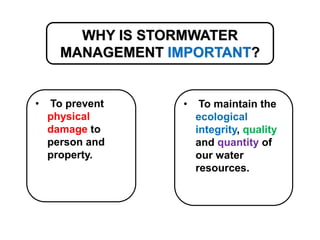
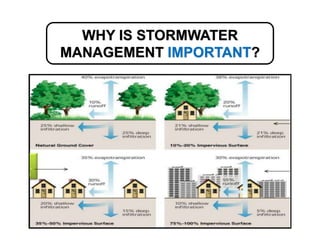
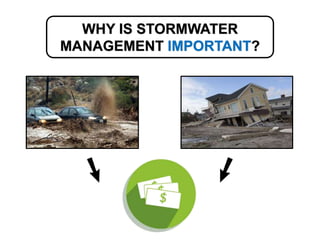
WHY IS STORMWATER
MANAGEMENT IMPORTANT?
• To maintain the
ecological
integrity, quality
and quantity of
our water
resources.
• To prevent
physical
damage to
person and
property.
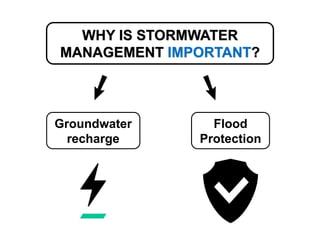
WHY IS STORMWATER
MANAGEMENT IMPORTANT?
Groundwater
recharge
Flood
Protection
WHY IS STORMWATER
MANAGEMENT IMPORTANT?
STORM WATER MANAGEMENT
Assists with the reduction
&
Prevention of many different source of pollution
WHY IS STORMWATER
MANAGEMENT IMPORTANT?
WHY IS STORMWATER
MANAGEMENT IMPORTANT?
What is Sustainable Stormwater
Management?
Sustainable Stormwater
Management
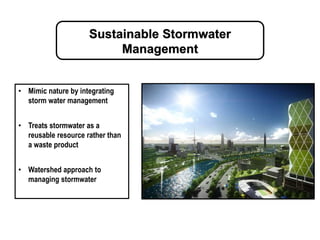
• Mimic nature by integrating
storm water management
• Treats stormwater as a
reusable resource rather than
a waste product
• Watershed approach to
managing stormwater
Two types of Sustainable
Stormwater Management System
Best Management Practice(BMPs)
• Structural BMP’s are specific practices or
structures that are designed and
engineered to integrate stormwater
• Structural or Nonstructural
• Non-structural BMP’s are land use
planning and design approaches that
have the ability to lessen and prevent
stormwater
Low Impact Development(LIDs)
• Stormwater management approach that
seeks to manage runoff using distributed
and decentralized micro-scale controls
• Mimic a site’s predevelopment hydrology
by using design techniques that infiltrate,
filter, store, evaporate, and detain runoff
close to its source
Best Management Practice (BMPs)
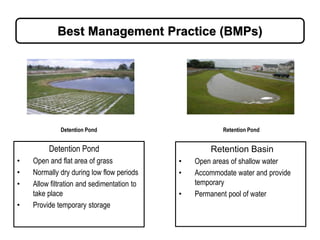
Detention Pond
• Open and flat area of grass
• Normally dry during low flow periods
• Allow filtration and sedimentation to
take place
• Provide temporary storage
Retention Basin
• Open areas of shallow water
• Accommodate water and provide
temporary
• Permanent pool of water
Detention Pond Retention Pond
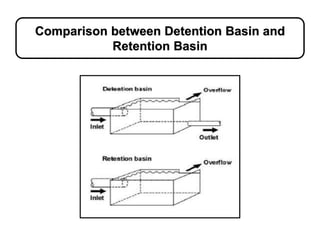
Comparison between Detention Basin and
Retention Basin
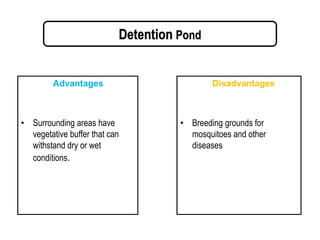
Detention Pond
Advantages
• Surrounding areas have
vegetative buffer that can
withstand dry or wet
conditions.
Disadvantages
• Breeding grounds for
mosquitoes and other
diseases
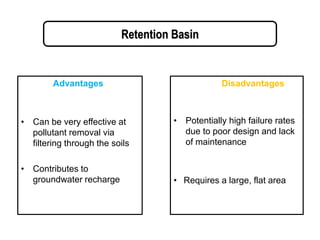
Disadvantages
• Potentially high failure rates
due to poor design and lack
of maintenance
• Requires a large, flat area
Retention Basin
Advantages
• Can be very effective at
pollutant removal via
filtering through the soils
• Contributes to
groundwater recharge
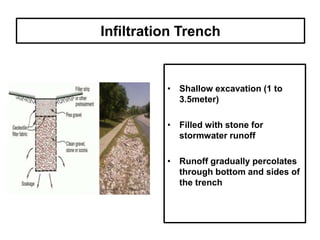
Infiltration Trench
• Shallow excavation (1 to
3.5meter)
• Filled with stone for
stormwater runoff
• Runoff gradually percolates
through bottom and sides of
the trench
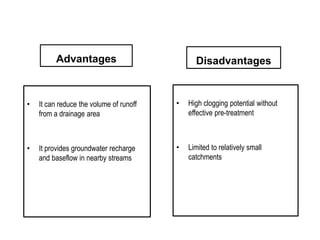
Advantages
• It can reduce the volume of runoff
from a drainage area
• It provides groundwater recharge
and baseflow in nearby streams
Disadvantages
• High clogging potential without
effective pre-treatment
• Limited to relatively small
catchments
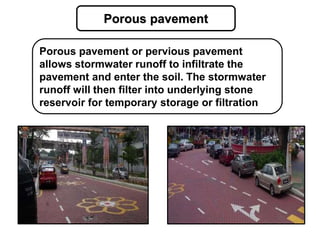
Porous pavement
Porous pavement or pervious pavement
allows stormwater runoff to infiltrate the
pavement and enter the soil. The stormwater
runoff will then filter into underlying stone
reservoir for temporary storage or filtration
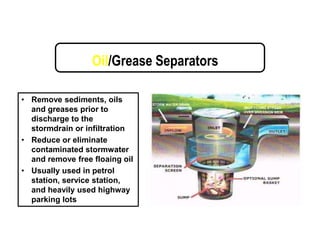
Oil/Grease Separators
• Remove sediments, oils
and greases prior to
discharge to the
stormdrain or infiltration
• Reduce or eliminate
contaminated stormwater
and remove free floaing oil
• Usually used in petrol
station, service station,
and heavily used highway
parking lots
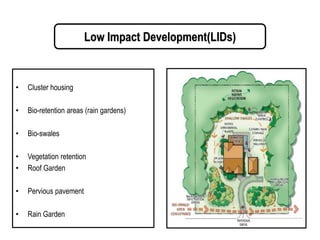
Low Impact Development(LIDs)
• Cluster housing
• Bio-retention areas (rain gardens)
• Bio-swales
• Vegetation retention
• Roof Garden
• Pervious pavement
• Rain Garden
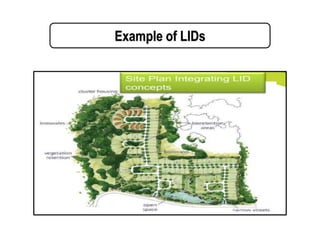
Example of LIDs
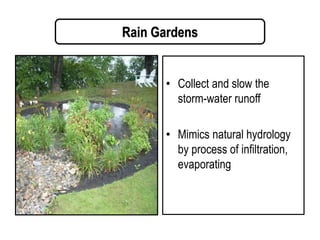
Rain Gardens
• Collect and slow the
storm-water runoff
• Mimics natural hydrology
by process of infiltration,
evaporating
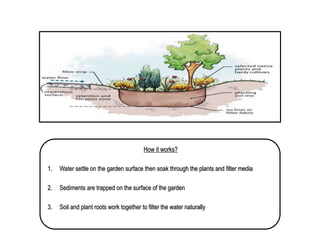
How it works?
1. Water settle on the garden surface then soak through the plants and filter media
2. Sediments are trapped on the surface of the garden
3. Soil and plant roots work together to filter the water naturally
Advantages
• Filter pollutants from runoff
• Recharge groundwater
• Enhance property value
Disadvantages
• As they are often small, their impact
on volume reduction can be limited
• Requires landscaping and
management
• Not suitable for areas with steep
slopes
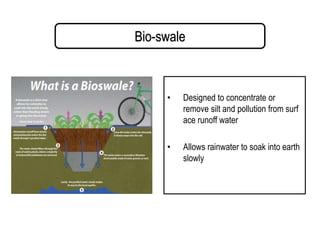
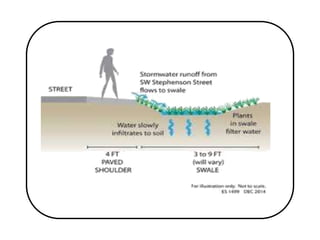
Bio-swale
• Designed to concentrate or
remove silt and pollution from surf
ace runoff water
• Allows rainwater to soak into earth
slowly
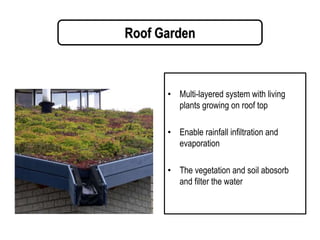
Roof Garden
• Multi-layered system with living
plants growing on roof top
• Enable rainfall infiltration and
evaporation
• The vegetation and soil abosorb
and filter the water
Advantages
• Expand roof life 2x3 times (up to
60 years)
• Improve aesthetic value
• Reduce stormwater runoff
• Neutralize acid rain effect
Disadvantages
• Increase the weight load of the roof
• Require regular management
CASE STUDY
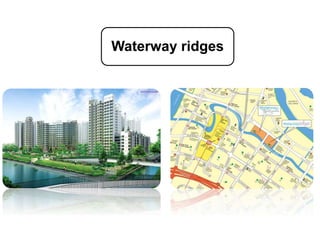
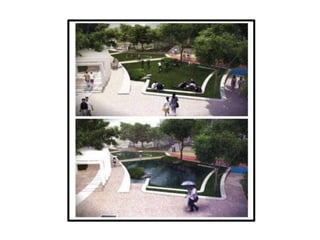
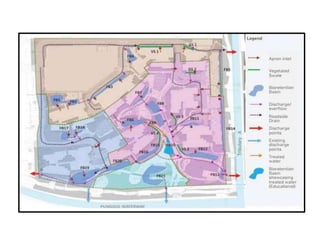
Waterway ridges
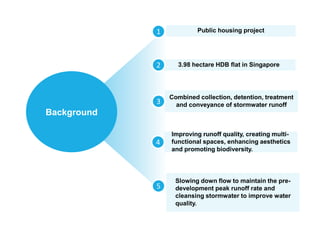
Background
Public housing project1
3.98 hectare HDB flat in Singapore2
Combined collection, detention, treatment
and conveyance of stormwater runoff3
Improving runoff quality, creating multi-
functional spaces, enhancing aesthetics
and promoting biodiversity.
4
Slowing down flow to maintain the pre-
development peak runoff rate and
cleansing stormwater to improve water
quality.
5
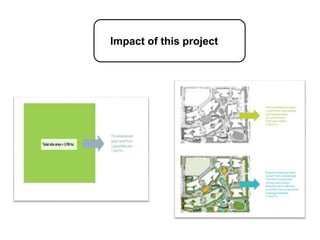
Impact of this project
Process of the system
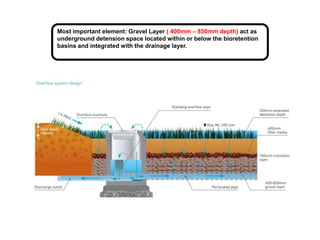
Most important element: Gravel Layer ( 400mm – 850mm depth) act as
underground detension space located within or below the bioretention
basins and integrated with the drainage layer.
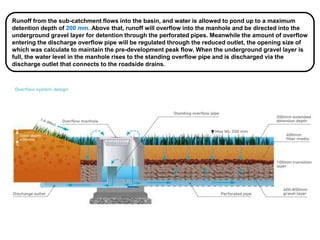
Runoff from the sub-catchment flows into the basin, and water is allowed to pond up to a maximum
detention depth of 200 mm. Above that, runoff will overflow into the manhole and be directed into the
underground gravel layer for detention through the perforated pipes. Meanwhile the amount of overflow
entering the discharge overflow pipe will be regulated through the reduced outlet, the opening size of
which was calculate to maintain the pre-development peak flow. When the underground gravel layer is
full, the water level in the manhole rises to the standing overflow pipe and is discharged via the
discharge outlet that connects to the roadside drains.
How to regulate the
runoff rate from the
precinct as well as
improve runoff
water quality?
01
03
02
04
05
06
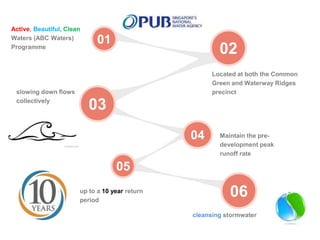
Active, Beautiful, Clean
Waters (ABC Waters)
Programme​
slowing down flows
collectively
up to a 10 year return
period
Located at both the Common
Green and Waterway Ridges
precinct
Maintain the pre-
development peak
runoff rate
cleansing stormwater
What's the solution
for stormwater
runoff?
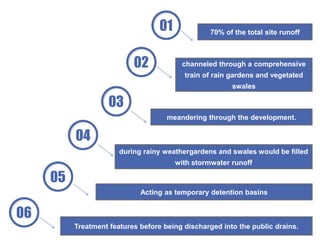
01 70% of the total site runoff
02 channeled through a comprehensive
train of rain gardens and vegetated
swales
03
meandering through the development.
04
during rainy weathergardens and swales would be filled
with stormwater runoff
05
Acting as temporary detention basins
06
Treatment features before being discharged into the public drains.
THANK YOU

Final presentation

  • 1.
    Sustainable Stormwater Management BUILDING SERVICES1 Group Members: ANDY CHIN WEE HIONG KIET WONG SHER SHENG WONG TIAN YI TEO CHIANG LOONG
  • 2.
  • 3.
  • 4.
  • 5.
    Caused 2 typesof PROBLEM!
  • 6.
    WHAT IS THEEFFECT OF POOR MANAGEMENT? Roof Road Footpath
  • 7.
    WHAT IS THEEFFECT OF POOR MANAGEMENT?
  • 8.
    WHAT IS THEEFFECT OF POOR MANAGEMENT?
  • 9.
    WHAT IS THEEFFECT OF POOR MANAGEMENT?
  • 10.
    WHAT IS THEEFFECT OF POOR MANAGEMENT? FLOODING
  • 11.
    WHAT IS THEEFFECT OF POOR MANAGEMENT?
  • 12.
    WHAT IS THEEFFECT OF POOR MANAGEMENT?
  • 13.
    WHY IS STORMWATER MANAGEMENTIMPORTANT? • To maintain the ecological integrity, quality and quantity of our water resources. • To prevent physical damage to person and property.
  • 14.
  • 15.
  • 16.
    STORM WATER MANAGEMENT Assistswith the reduction & Prevention of many different source of pollution WHY IS STORMWATER MANAGEMENT IMPORTANT?
  • 17.
  • 18.
    What is SustainableStormwater Management?
  • 19.
    Sustainable Stormwater Management • Mimicnature by integrating storm water management • Treats stormwater as a reusable resource rather than a waste product • Watershed approach to managing stormwater
  • 20.
    Two types ofSustainable Stormwater Management System Best Management Practice(BMPs) • Structural BMP’s are specific practices or structures that are designed and engineered to integrate stormwater • Structural or Nonstructural • Non-structural BMP’s are land use planning and design approaches that have the ability to lessen and prevent stormwater Low Impact Development(LIDs) • Stormwater management approach that seeks to manage runoff using distributed and decentralized micro-scale controls • Mimic a site’s predevelopment hydrology by using design techniques that infiltrate, filter, store, evaporate, and detain runoff close to its source
  • 21.
    Best Management Practice(BMPs) Detention Pond • Open and flat area of grass • Normally dry during low flow periods • Allow filtration and sedimentation to take place • Provide temporary storage Retention Basin • Open areas of shallow water • Accommodate water and provide temporary • Permanent pool of water Detention Pond Retention Pond
  • 22.
    Comparison between DetentionBasin and Retention Basin
  • 23.
    Detention Pond Advantages • Surroundingareas have vegetative buffer that can withstand dry or wet conditions. Disadvantages • Breeding grounds for mosquitoes and other diseases
  • 24.
    Disadvantages • Potentially highfailure rates due to poor design and lack of maintenance • Requires a large, flat area Retention Basin Advantages • Can be very effective at pollutant removal via filtering through the soils • Contributes to groundwater recharge
  • 25.
    Infiltration Trench • Shallowexcavation (1 to 3.5meter) • Filled with stone for stormwater runoff • Runoff gradually percolates through bottom and sides of the trench
  • 26.
    Advantages • It canreduce the volume of runoff from a drainage area • It provides groundwater recharge and baseflow in nearby streams Disadvantages • High clogging potential without effective pre-treatment • Limited to relatively small catchments
  • 27.
    Porous pavement Porous pavementor pervious pavement allows stormwater runoff to infiltrate the pavement and enter the soil. The stormwater runoff will then filter into underlying stone reservoir for temporary storage or filtration
  • 28.
    Oil/Grease Separators • Removesediments, oils and greases prior to discharge to the stormdrain or infiltration • Reduce or eliminate contaminated stormwater and remove free floaing oil • Usually used in petrol station, service station, and heavily used highway parking lots
  • 29.
    Low Impact Development(LIDs) •Cluster housing • Bio-retention areas (rain gardens) • Bio-swales • Vegetation retention • Roof Garden • Pervious pavement • Rain Garden
  • 30.
  • 31.
    Rain Gardens • Collectand slow the storm-water runoff • Mimics natural hydrology by process of infiltration, evaporating
  • 32.
    How it works? 1.Water settle on the garden surface then soak through the plants and filter media 2. Sediments are trapped on the surface of the garden 3. Soil and plant roots work together to filter the water naturally
  • 33.
    Advantages • Filter pollutantsfrom runoff • Recharge groundwater • Enhance property value Disadvantages • As they are often small, their impact on volume reduction can be limited • Requires landscaping and management • Not suitable for areas with steep slopes
  • 34.
    Bio-swale • Designed toconcentrate or remove silt and pollution from surf ace runoff water • Allows rainwater to soak into earth slowly
  • 35.
    Roof Garden • Multi-layeredsystem with living plants growing on roof top • Enable rainfall infiltration and evaporation • The vegetation and soil abosorb and filter the water
  • 36.
    Advantages • Expand rooflife 2x3 times (up to 60 years) • Improve aesthetic value • Reduce stormwater runoff • Neutralize acid rain effect Disadvantages • Increase the weight load of the roof • Require regular management
  • 37.
  • 38.
  • 39.
    Background Public housing project1 3.98hectare HDB flat in Singapore2 Combined collection, detention, treatment and conveyance of stormwater runoff3 Improving runoff quality, creating multi- functional spaces, enhancing aesthetics and promoting biodiversity. 4 Slowing down flow to maintain the pre- development peak runoff rate and cleansing stormwater to improve water quality. 5
  • 40.
  • 41.
  • 42.
    Most important element:Gravel Layer ( 400mm – 850mm depth) act as underground detension space located within or below the bioretention basins and integrated with the drainage layer.
  • 43.
    Runoff from thesub-catchment flows into the basin, and water is allowed to pond up to a maximum detention depth of 200 mm. Above that, runoff will overflow into the manhole and be directed into the underground gravel layer for detention through the perforated pipes. Meanwhile the amount of overflow entering the discharge overflow pipe will be regulated through the reduced outlet, the opening size of which was calculate to maintain the pre-development peak flow. When the underground gravel layer is full, the water level in the manhole rises to the standing overflow pipe and is discharged via the discharge outlet that connects to the roadside drains.
  • 47.
    How to regulatethe runoff rate from the precinct as well as improve runoff water quality?
  • 48.
    01 03 02 04 05 06 Active, Beautiful, Clean Waters(ABC Waters) Programme​ slowing down flows collectively up to a 10 year return period Located at both the Common Green and Waterway Ridges precinct Maintain the pre- development peak runoff rate cleansing stormwater
  • 49.
    What's the solution forstormwater runoff?
  • 50.
    01 70% ofthe total site runoff 02 channeled through a comprehensive train of rain gardens and vegetated swales 03 meandering through the development. 04 during rainy weathergardens and swales would be filled with stormwater runoff 05 Acting as temporary detention basins 06 Treatment features before being discharged into the public drains.
  • 52.

Editor's Notes

  • #2 Good morning to my lecturer,Today we are going to present the sustainable stormwater management.
  • #4 So first, let me explain to you guys THE BASIC OF STORMWATER MANAGEMENT. Storm water basically water from snow or from nearby stream river or runoff surface.
  • #5 Other than that, Natural sentiment such as forest and the soil absorbs much of the storm water.
  • #6 In developed place such as cities, unmanaged stormwater can create 2 types of problem. First problem would be water pollution.
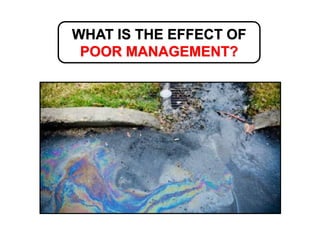
  • #7 When water comes in contact with urban surfaces such as roof, foorpaths, it becomes contaminated with oil, metals, litter and other pollutants.
  • #8 Definitely looks like this
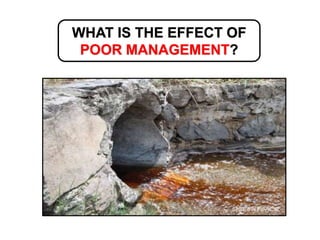
  • #11 The second problem is Flooding. During heavy rainfall events, large volumes of stormwater collect on sealed surfaces and flow into the stormwater drainage network.
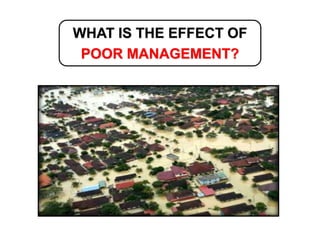
  • #12 This is the example of poor stormwater management. This situated in Kota kuantan, Pahang
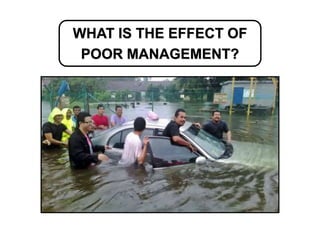
  • #13 This was happened in Kuala berang, Terengganu.
  • #14 Stormwater management is important to prevent physical damage to persons and property from flooding and to maintain the ecological integrity, quality and quantity of our water resources.
  • #15 This graph shows that the urbanization impact of the natural water cycle As you can see before urbanization, the evaporate rate is higer than after urbanization. As you can see from this graph, it can drop 5-10% it depending the scale on how high is the scale of the urbanization. As urbanization increase, the urban surface run off increase. During urbanization the impervious surface also increases, this simultaneously decrease the infiltration .
  • #16 In addiction, Stormwater can also considered a resource that provides benefits such as groundwater recharge and flood protection.
  • #17 Stormwater management also assists with reduction and prevention of many different sources of pollution which enter local waterways.
  • #18 Stormwater management can provide economic benefits to local communities as well. Proper management can reduce the percentage of flash flood, property damage and loss of life created by increased stormwater runoff. Therefore, it reduced cost and or fees for remediation.
  • #20 Sustainable stormwater management is to mimic nature by integrating storm water management into building and site developments to reduce the impacts that urbanization has on our natural resources. Sustainable stormwater management treats stormwater as a reusable resource rather than a waste product, and seeks to incorporate flood prevention, good drainage, and efficient conveyance into a site specific LID BMP, while simultaneously reducing pollution and providing other amenities such as landscaping and habitat. It also takes a watershed approach to managing stormwater, meaning that it looks at stormwater as part of the larger hydrologic system.
  • #39 Now I am going to talk about the case study of our sustainable stormwater management. We have used the Waterway Ridges in Singapore as our case study.

  • #41 The picture on the left shows pre development peak runoff from a greenfield site. Before the land is developed, the peak runoff rate is 1.04 m3/s. After the development, the peak runoff rate is 1.85m3/s. With the use of onsite stormwater detention and retention along with the conventional drainage system, there is about 37% reduction in the peak runoff rate. Thus, the impact of the project is significant