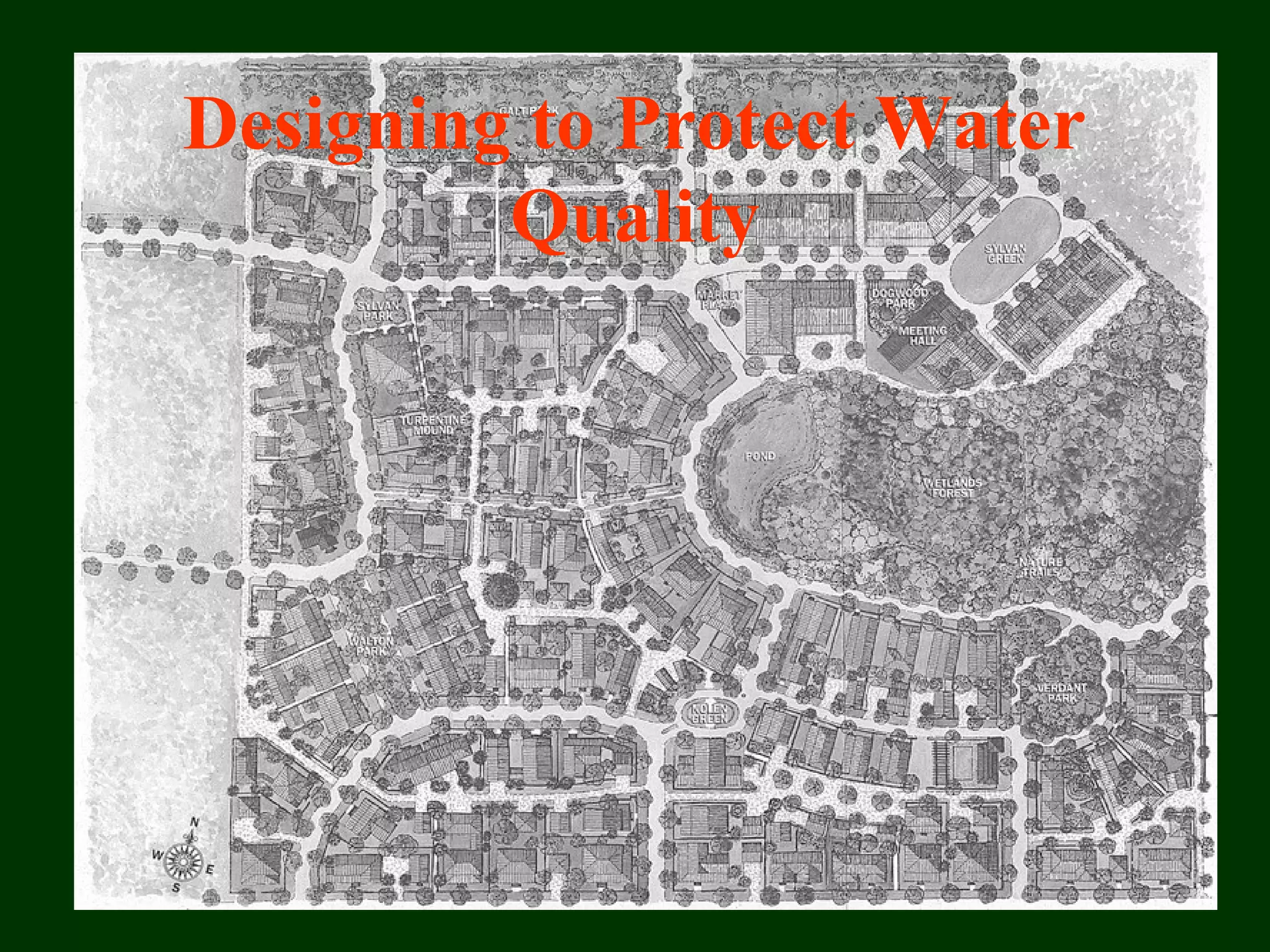
Designing to Protect Water
Quality
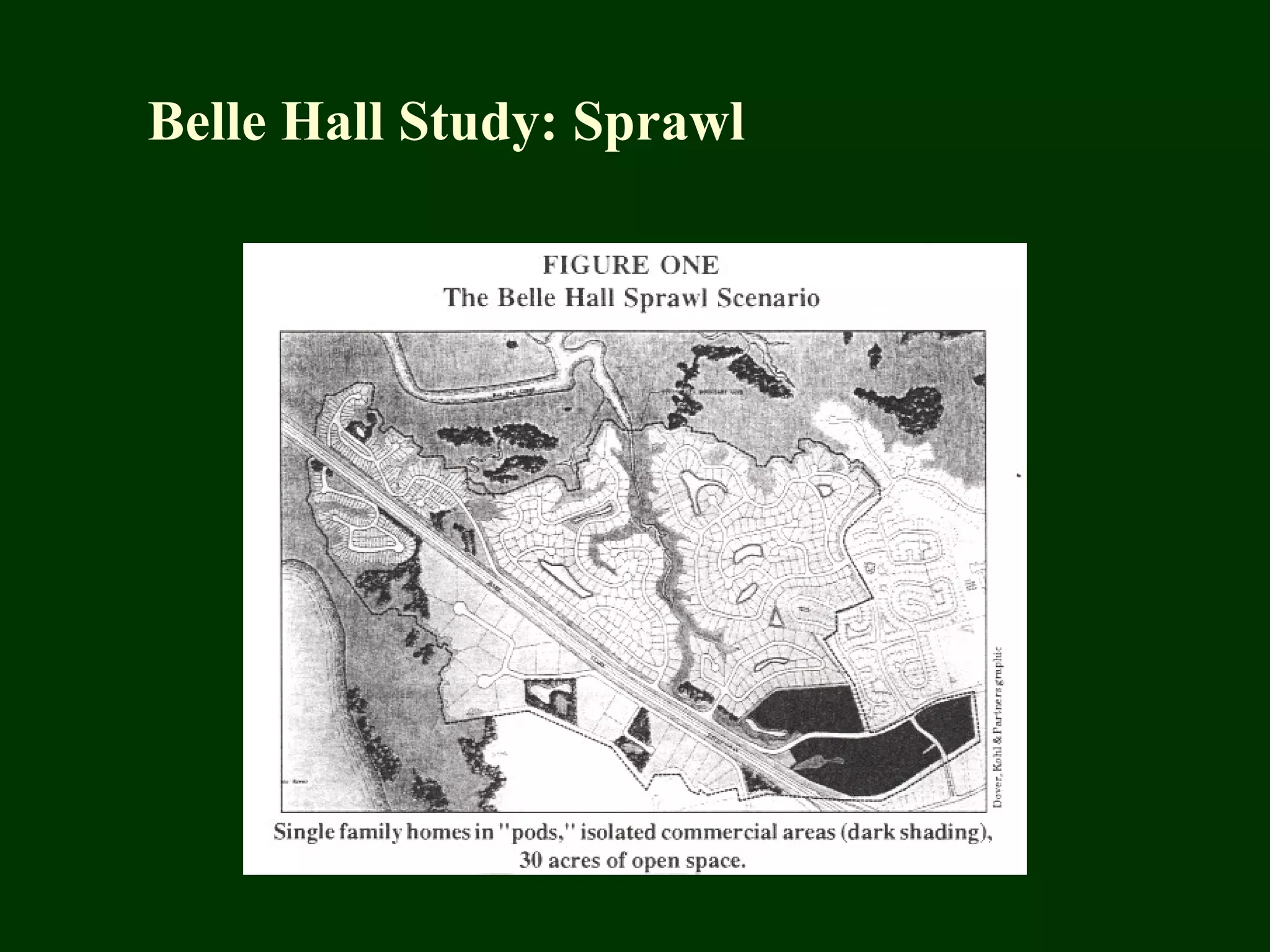
Belle Hall Study: Sprawl
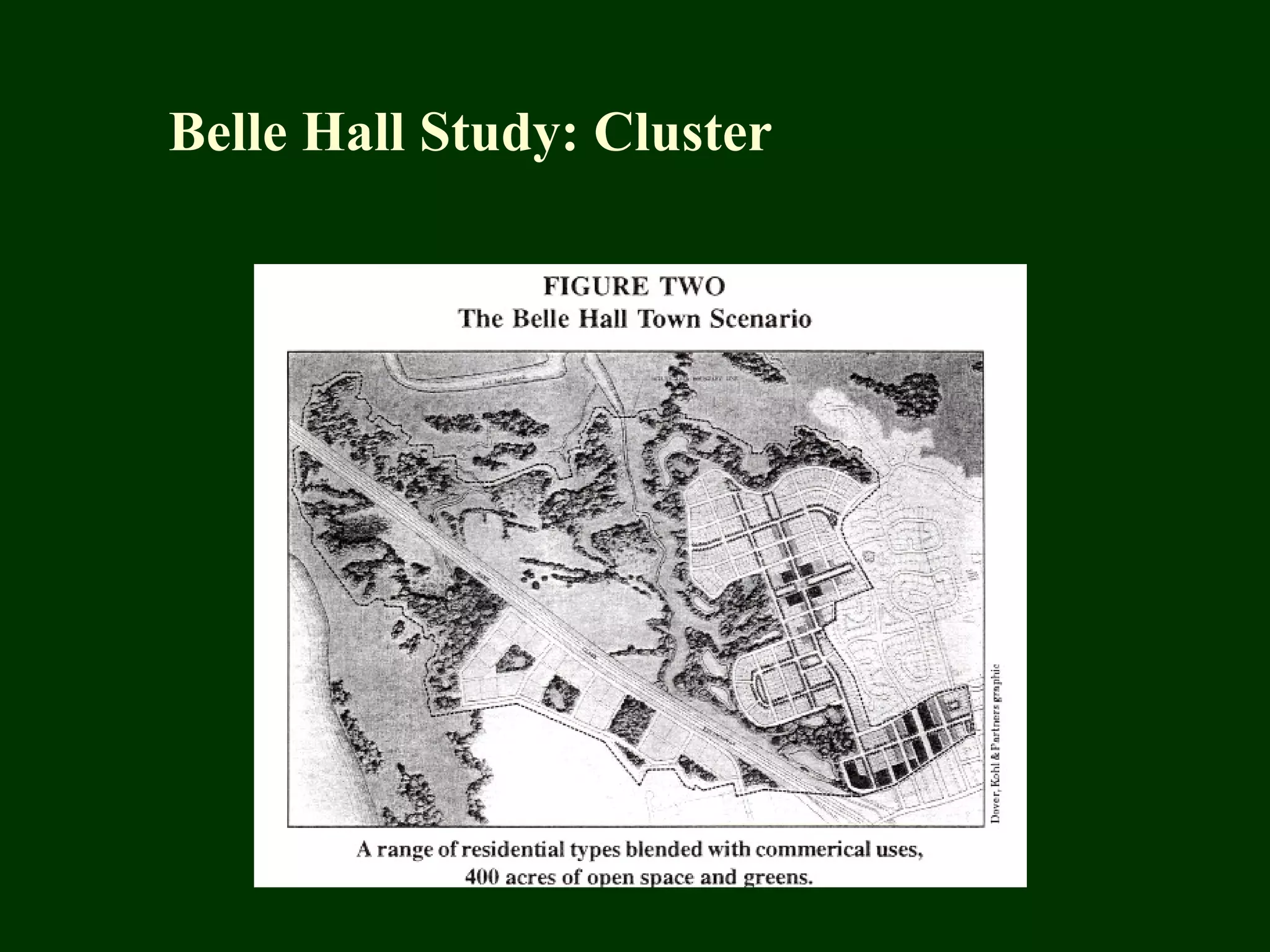
Belle Hall Study: Cluster
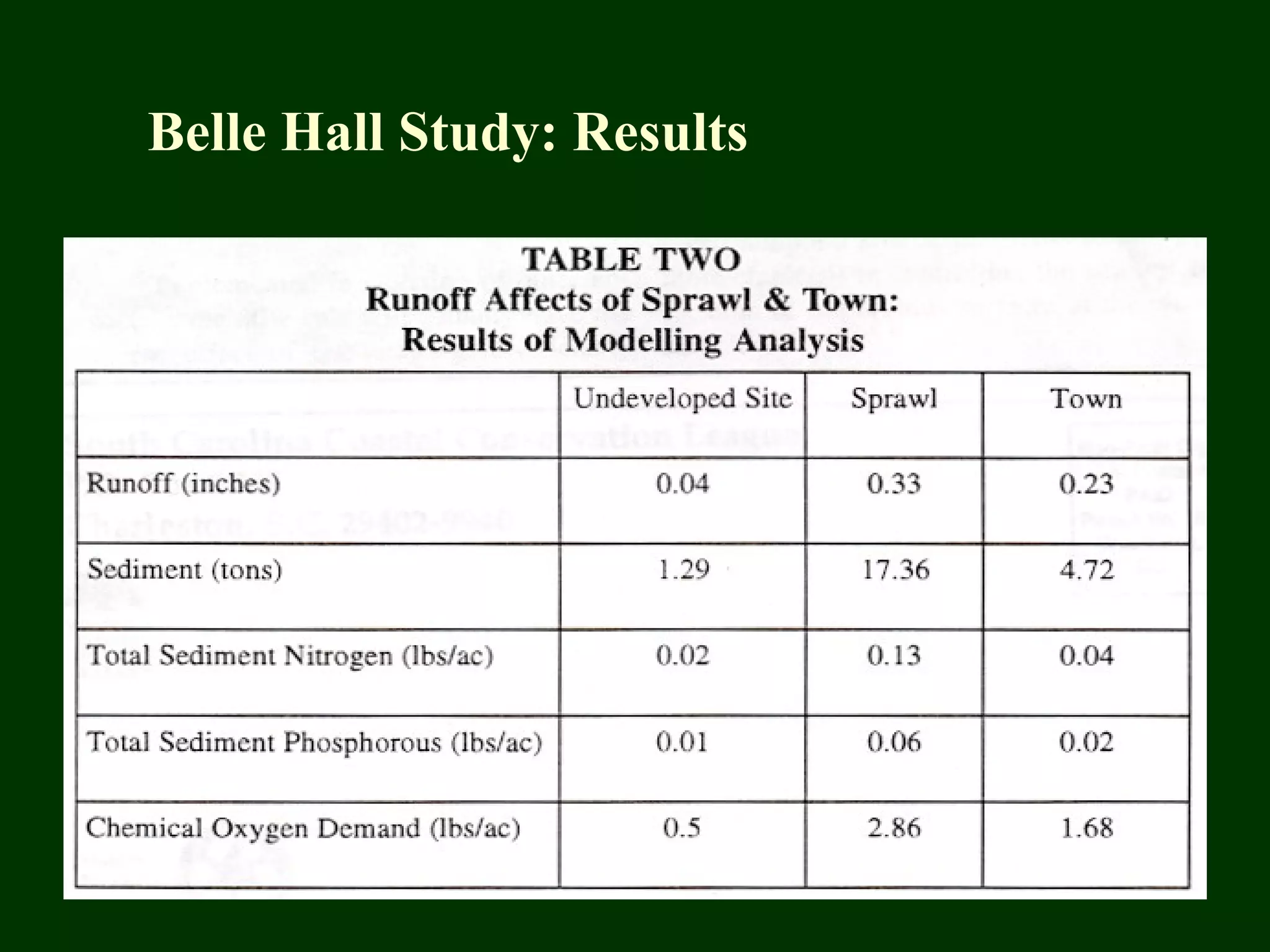
Belle Hall Study: Results
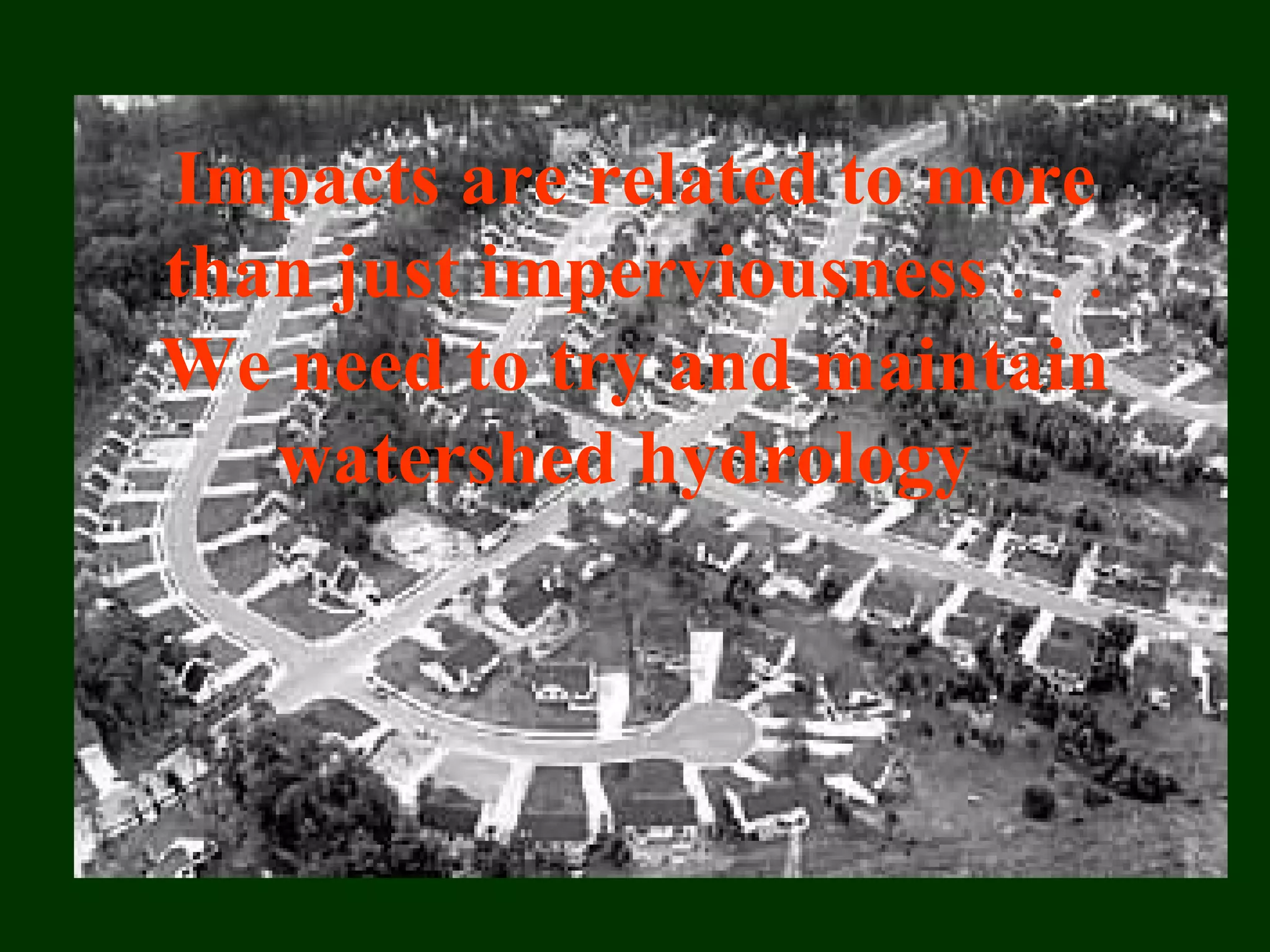
Impacts are related to more
than just imperviousness . . .
We need to try and maintain
watershed hydrology
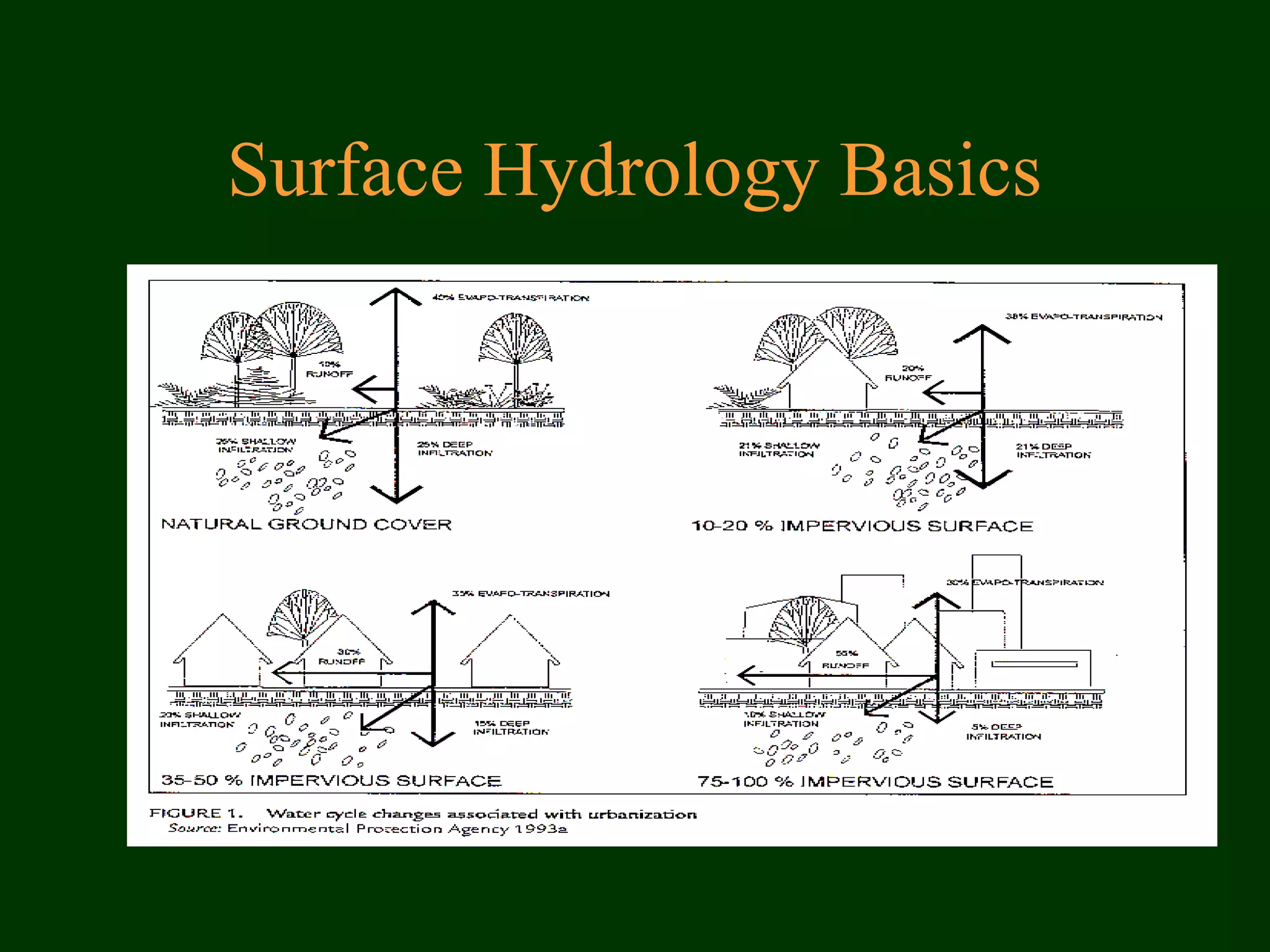
Surface Hydrology Basics
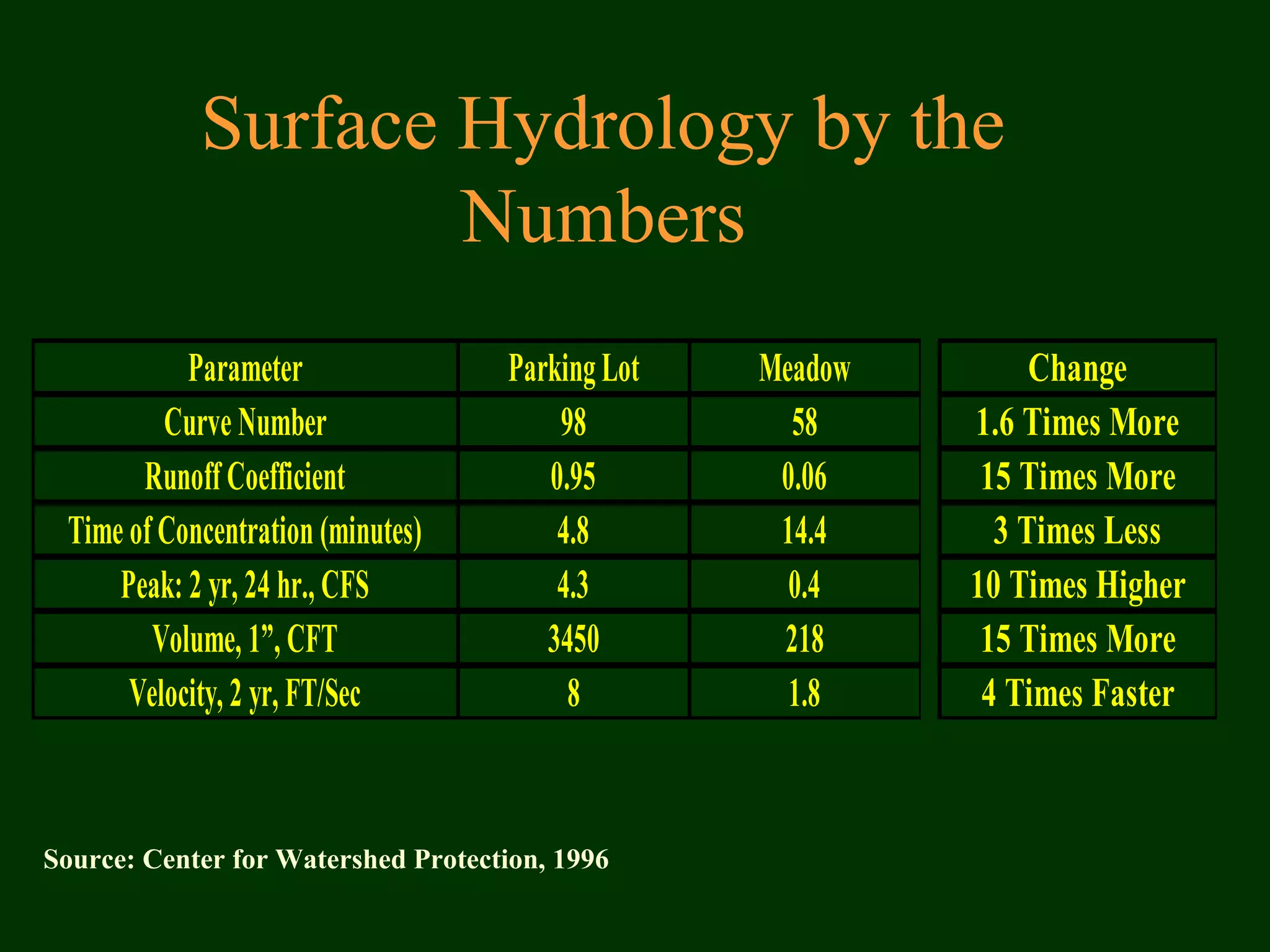
Surface Hydrology by the
Numbers
Source: Center for Watershed Protection, 1996
Parameter ParkingLot Meadow
Curve Number 98 58
Runoff Coefficient 0.95 0.06
Time of Concentration (minutes) 4.8 14.4
Peak: 2 yr, 24 hr., CFS 4.3 0.4
Volume, 1”, CFT 3450 218
Velocity, 2 yr, FT/Sec 8 1.8
Change
1.6 Times More
15 Times More
3 Times Less
10 Times Higher
15 Times More
4 Times Faster
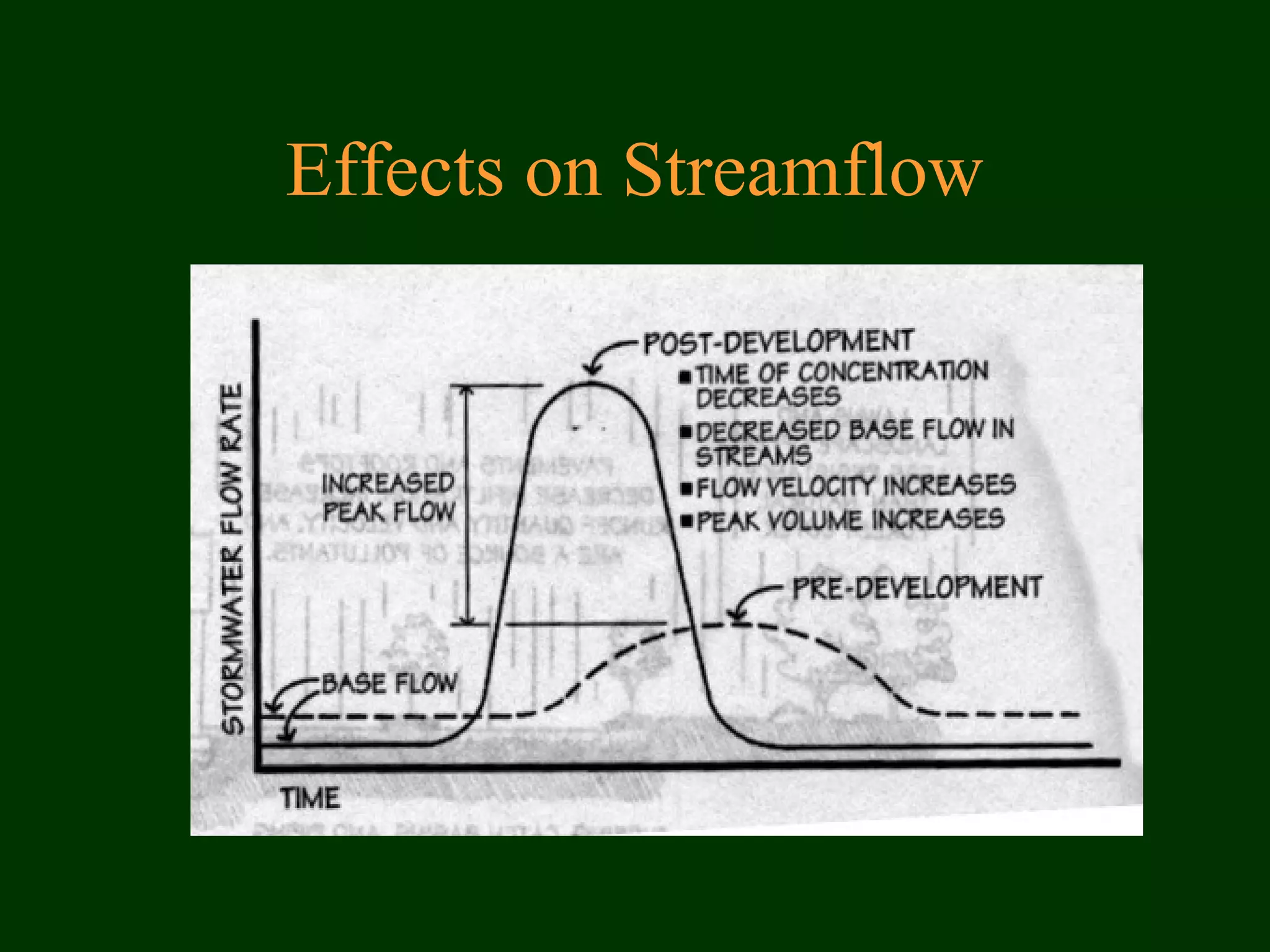
Effects on Streamflow
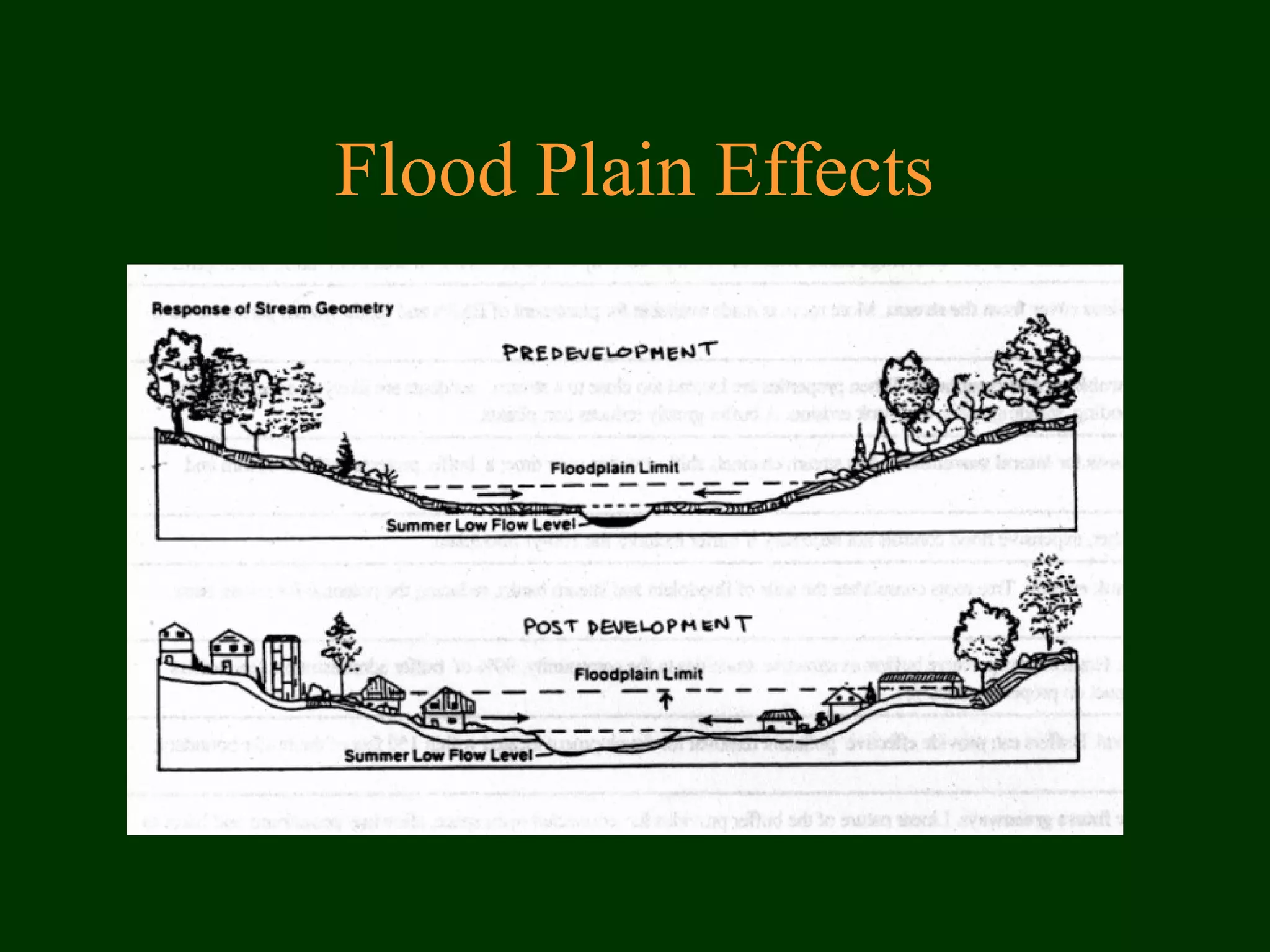
Flood Plain Effects
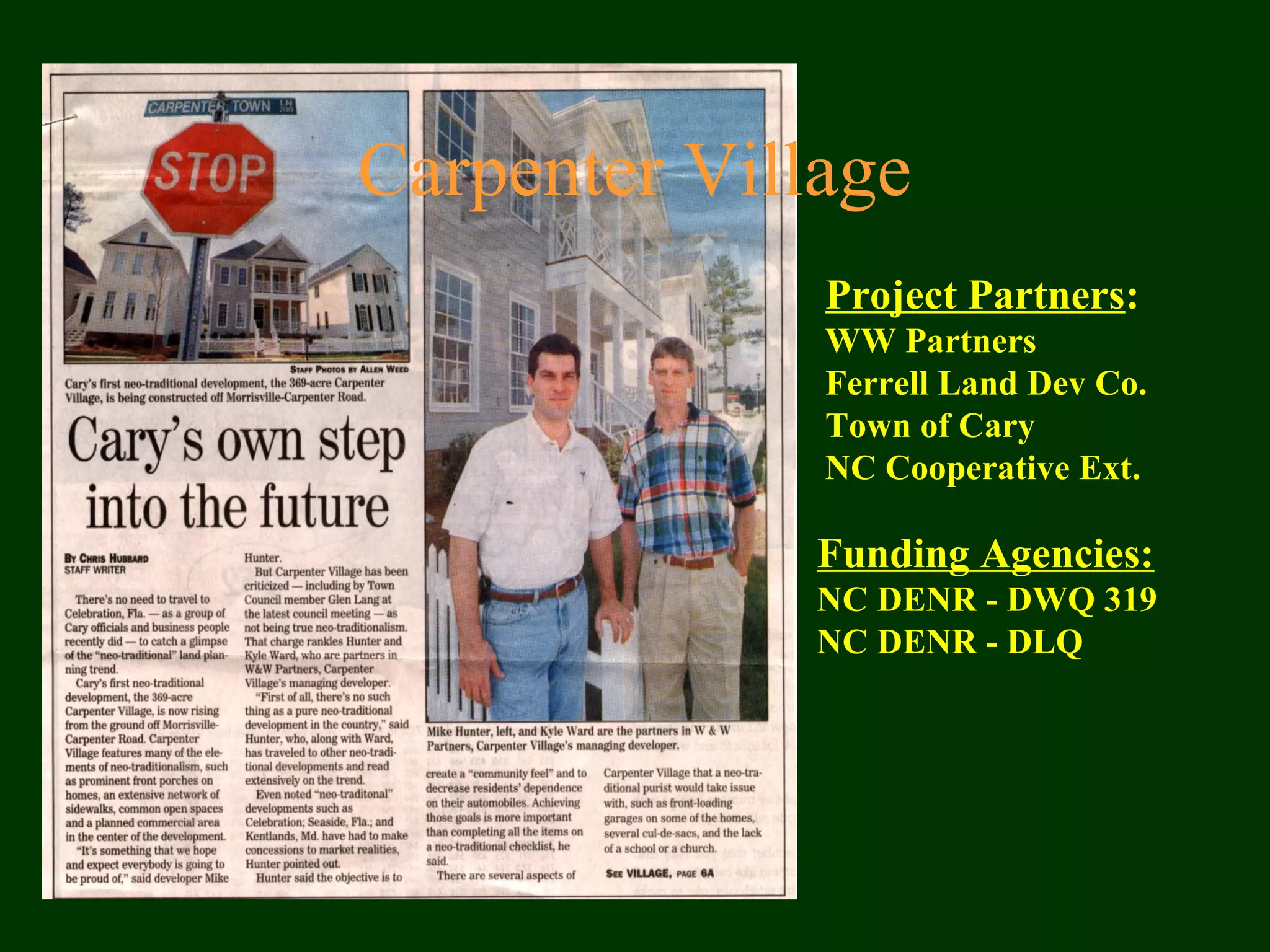
Carpenter Village
Project Partners:
WW Partners
Ferrell Land Dev Co.
Town of Cary
NC Cooperative Ext.
Funding Agencies:
NC DENR - DWQ 319
NC DENR - DLQ
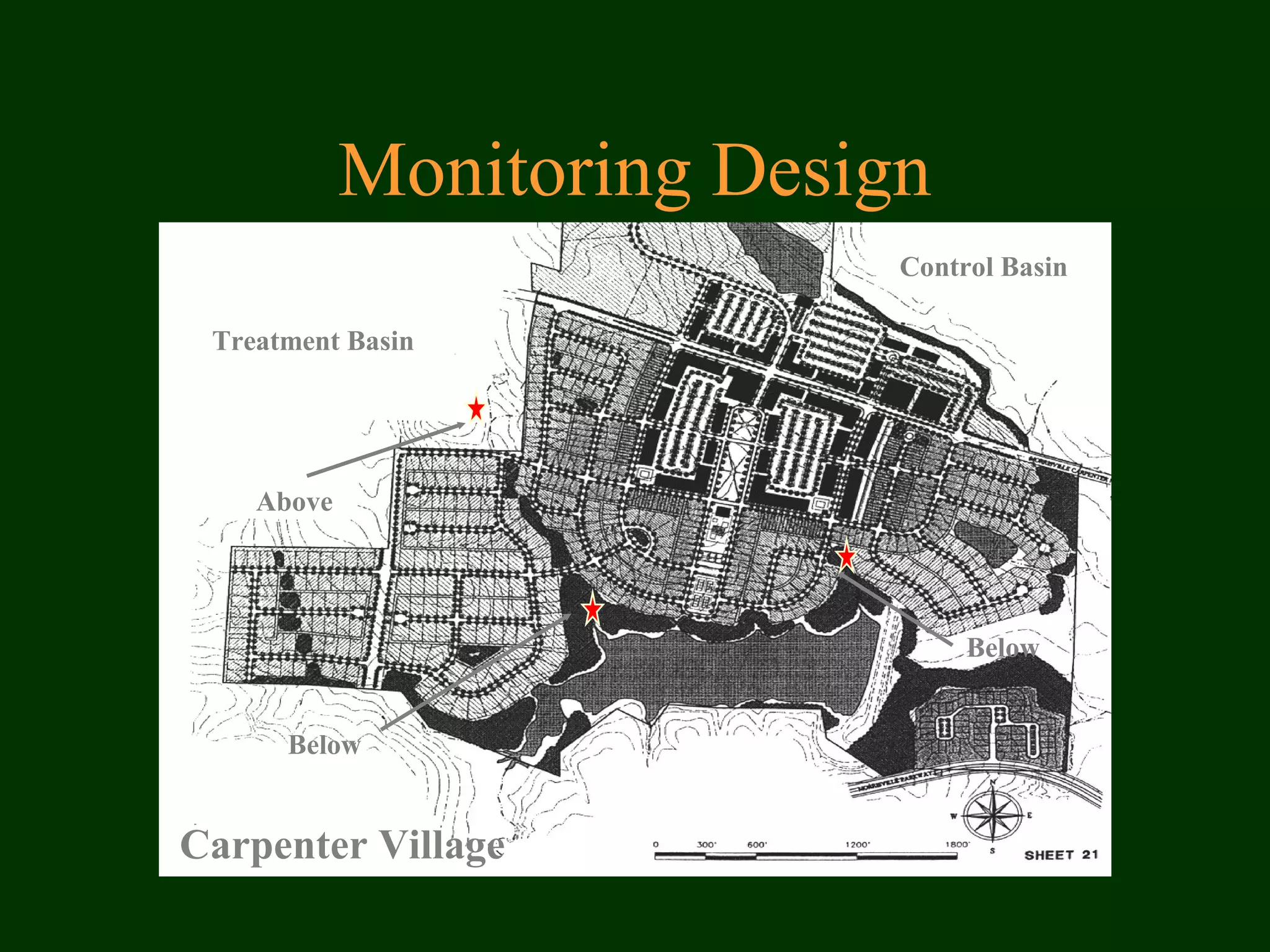
Monitoring Design
Below
Treatment Basin
Above
Control Basin
Below
Carpenter Village
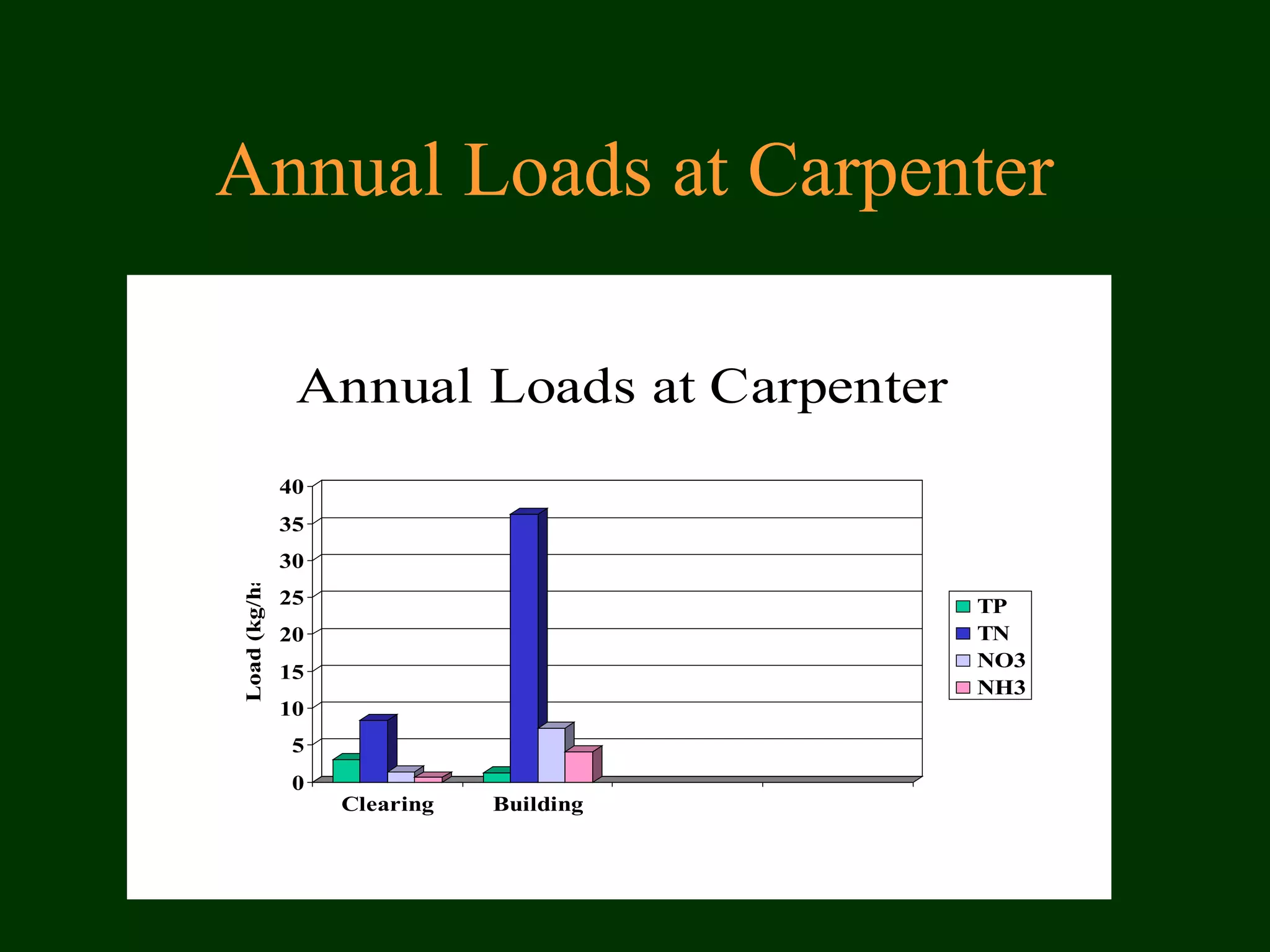
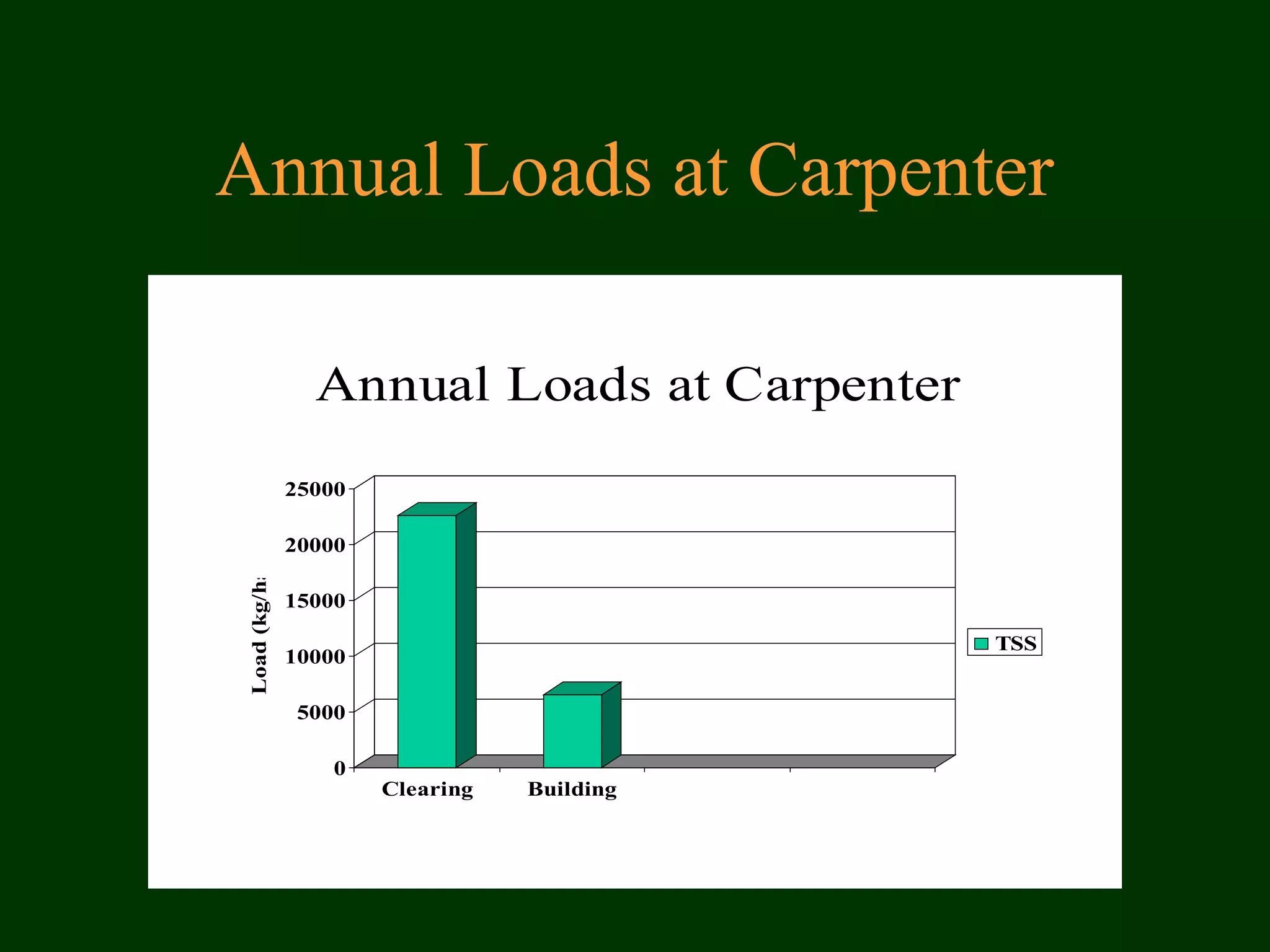
Annual Loads at Carpenter
0
5
10
15
20
25
30
35
40
Load(kg/ha)
Clearing Building
TP
TN
NO3
NH3
Annual Loads at Carpenter
0
5000
10000
15000
20000
25000
Load(kg/ha)
Clearing Building
TSS
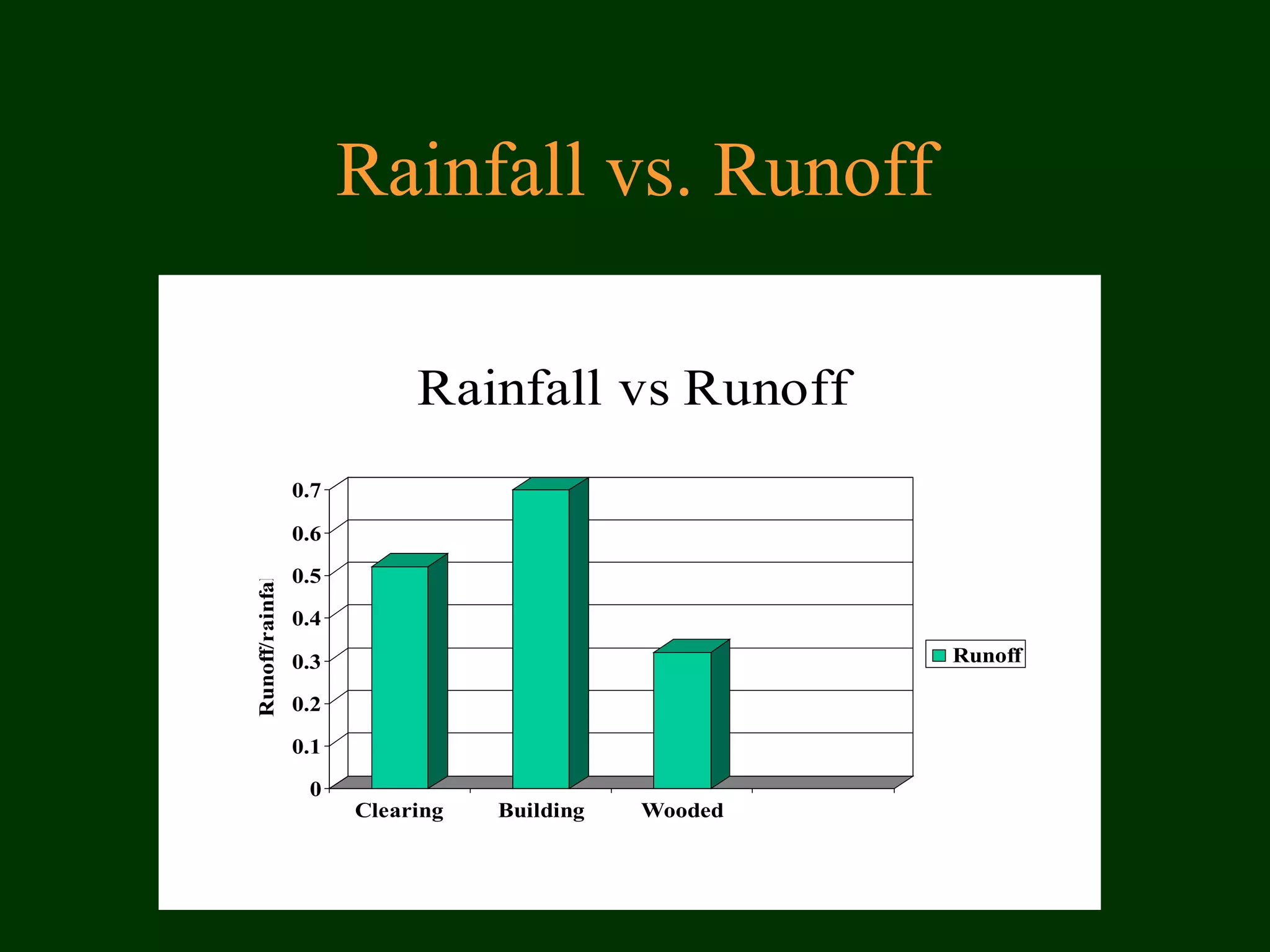
Rainfall vs. Runoff
Rainfall vs Runoff
0
0.1
0.2
0.3
0.4
0.5
0.6
0.7
Runoff/rainfall
Clearing Building Wooded
Runoff
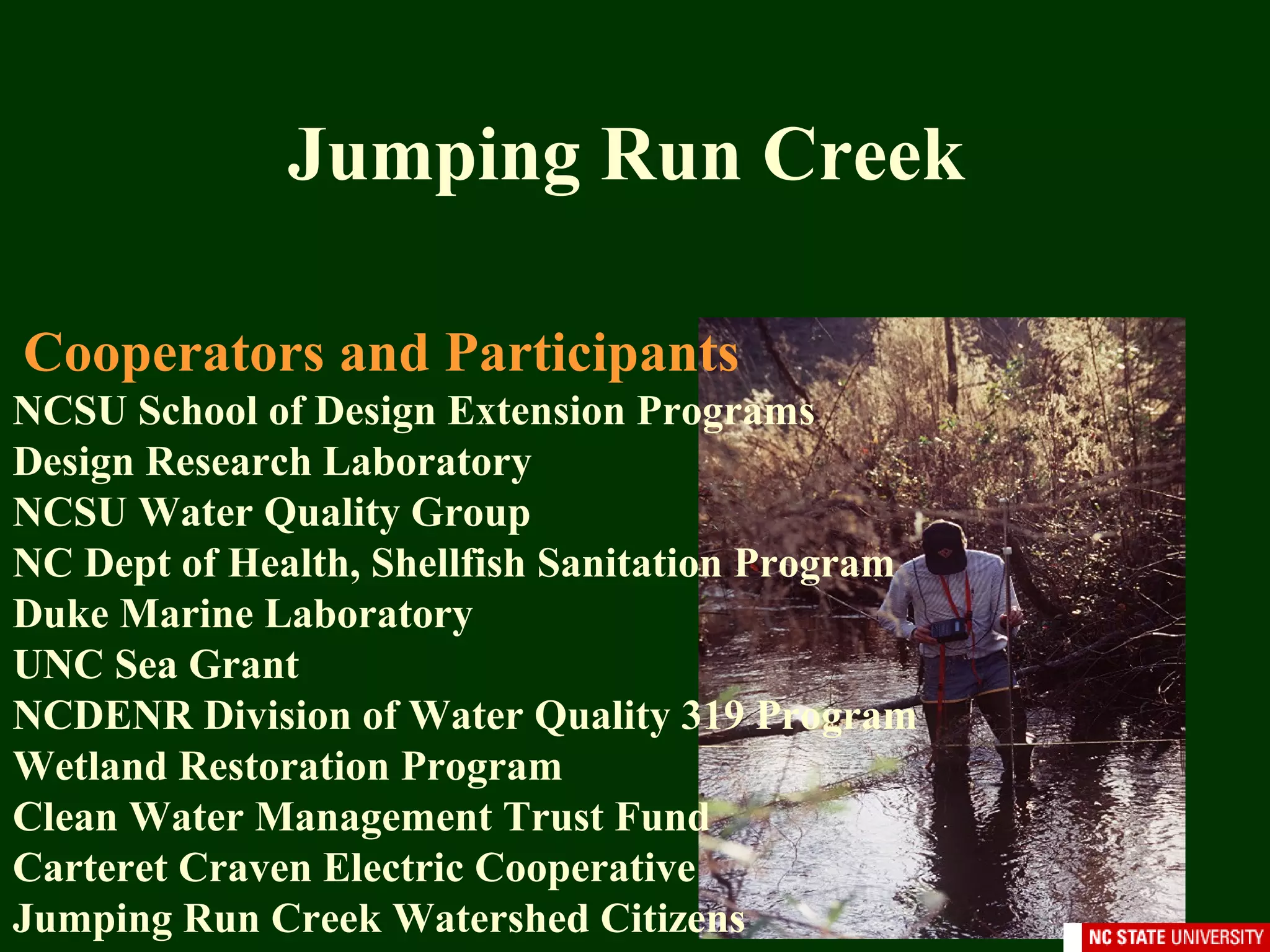
Cooperators and Participants
NCSU School of Design Extension Programs
Design Research Laboratory
NCSU Water Quality Group
NC Dept of Health, Shellfish Sanitation Program
Duke Marine Laboratory
UNC Sea Grant
NCDENR Division of Water Quality 319 Program
Wetland Restoration Program
Clean Water Management Trust Fund
Carteret Craven Electric Cooperative
Jumping Run Creek Watershed Citizens
Jumping Run Creek
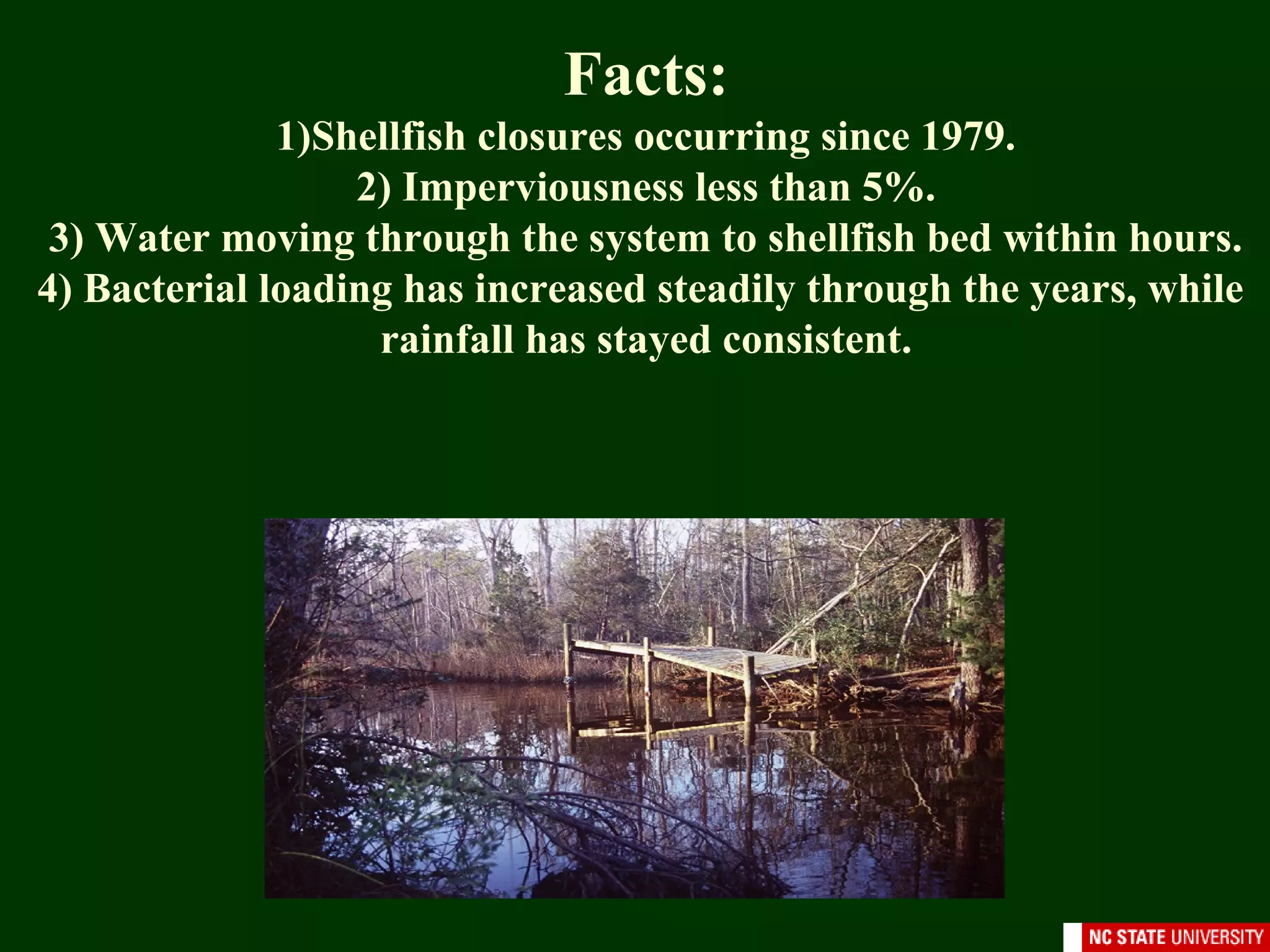
Facts:
1)Shellfish closures occurring since 1979.
2) Imperviousness less than 5%.
3) Water moving through the system to shellfish bed within hours.
4) Bacterial loading has increased steadily through the years, while
rainfall has stayed consistent.
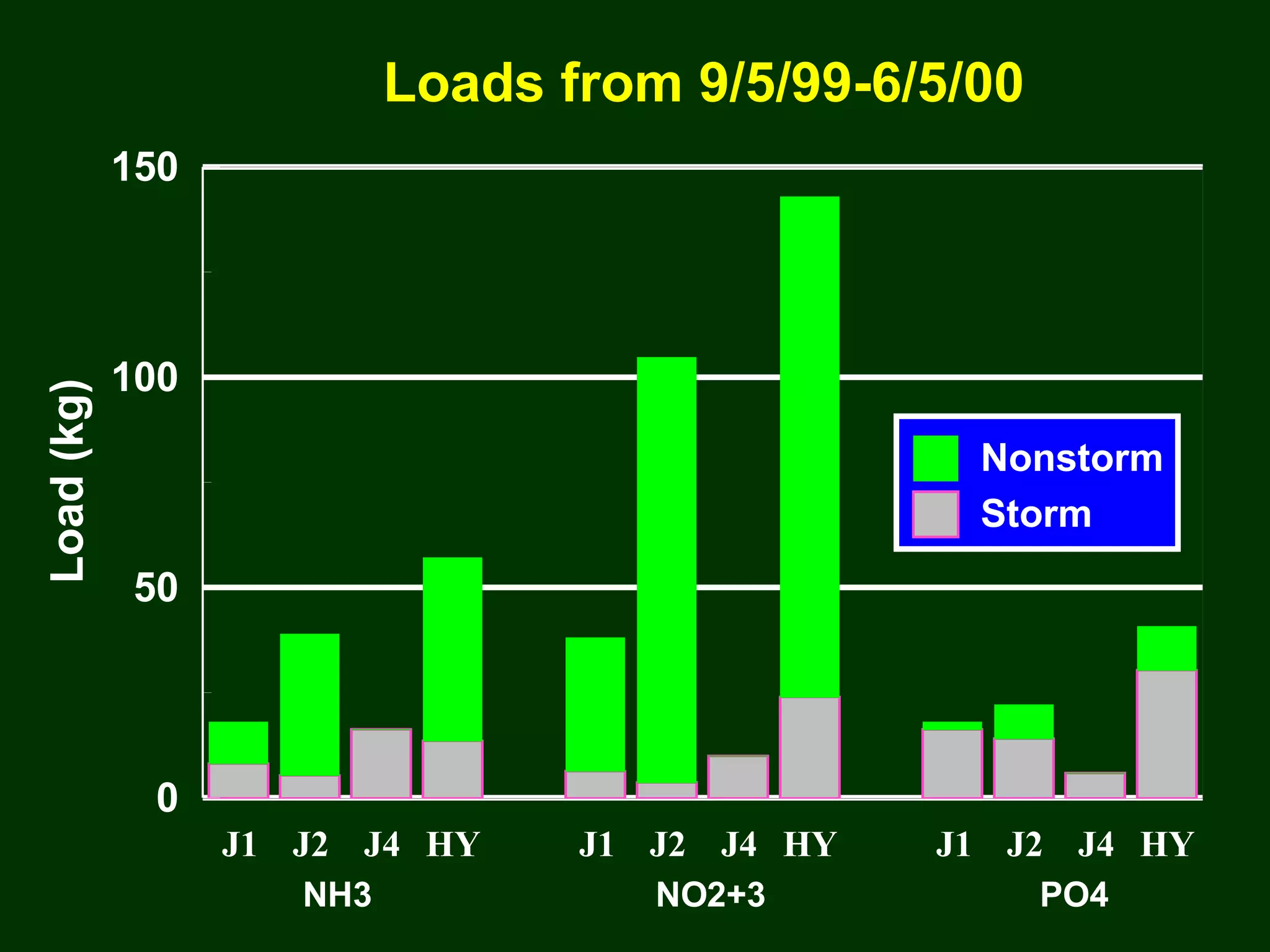
J1 J2 J4 HY J1 J2 J4 HY J1 J2 J4 HY
0
50
100
150
Load(kg)
Nonstorm
Storm
Loads from 9/5/99-6/5/00
NH3 NO2+3 PO4
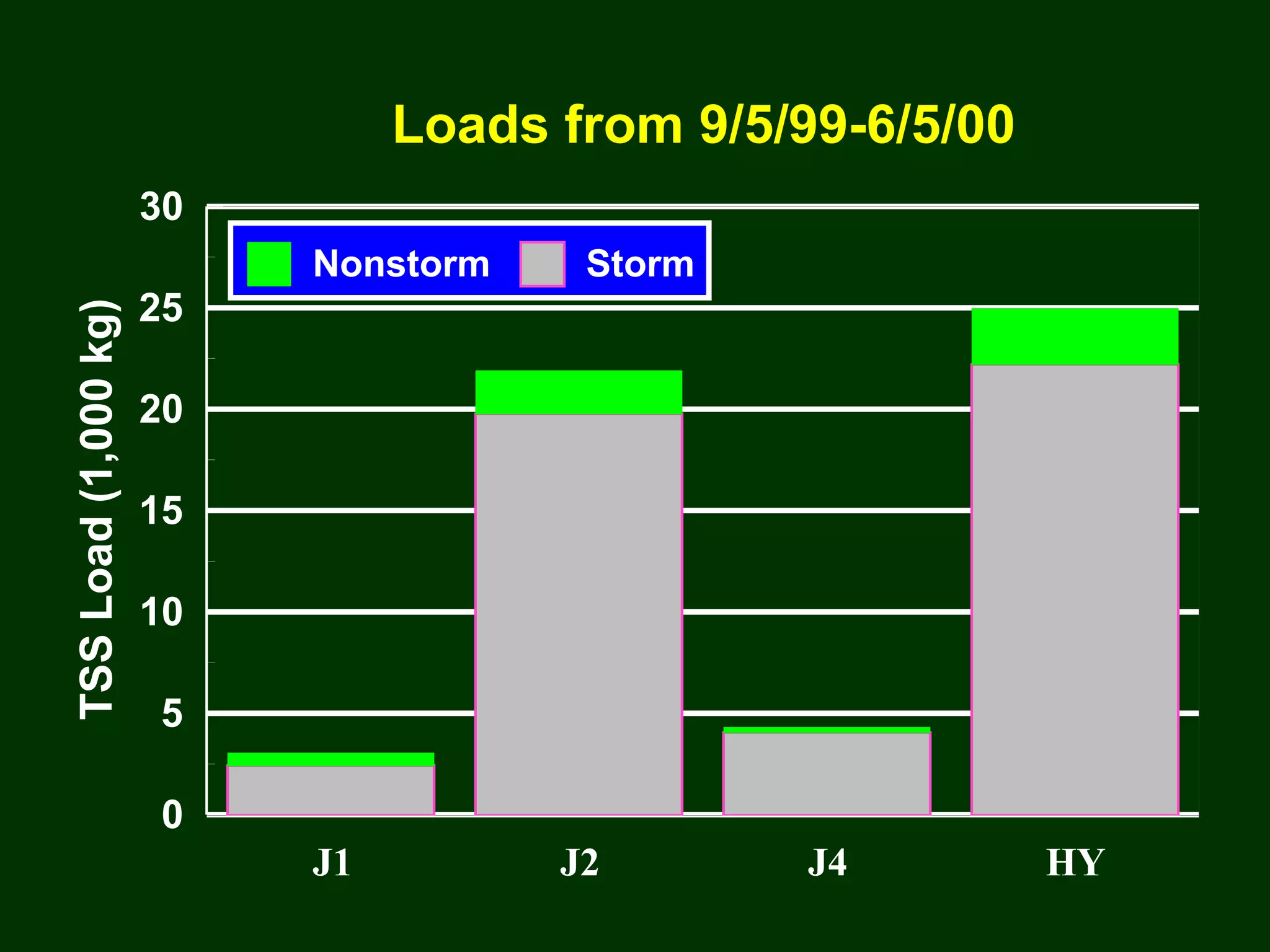
J1 J2 J4 HY
0
5
10
15
20
25
30
TSSLoad(1,000kg)
Nonstorm Storm
Loads from 9/5/99-6/5/00
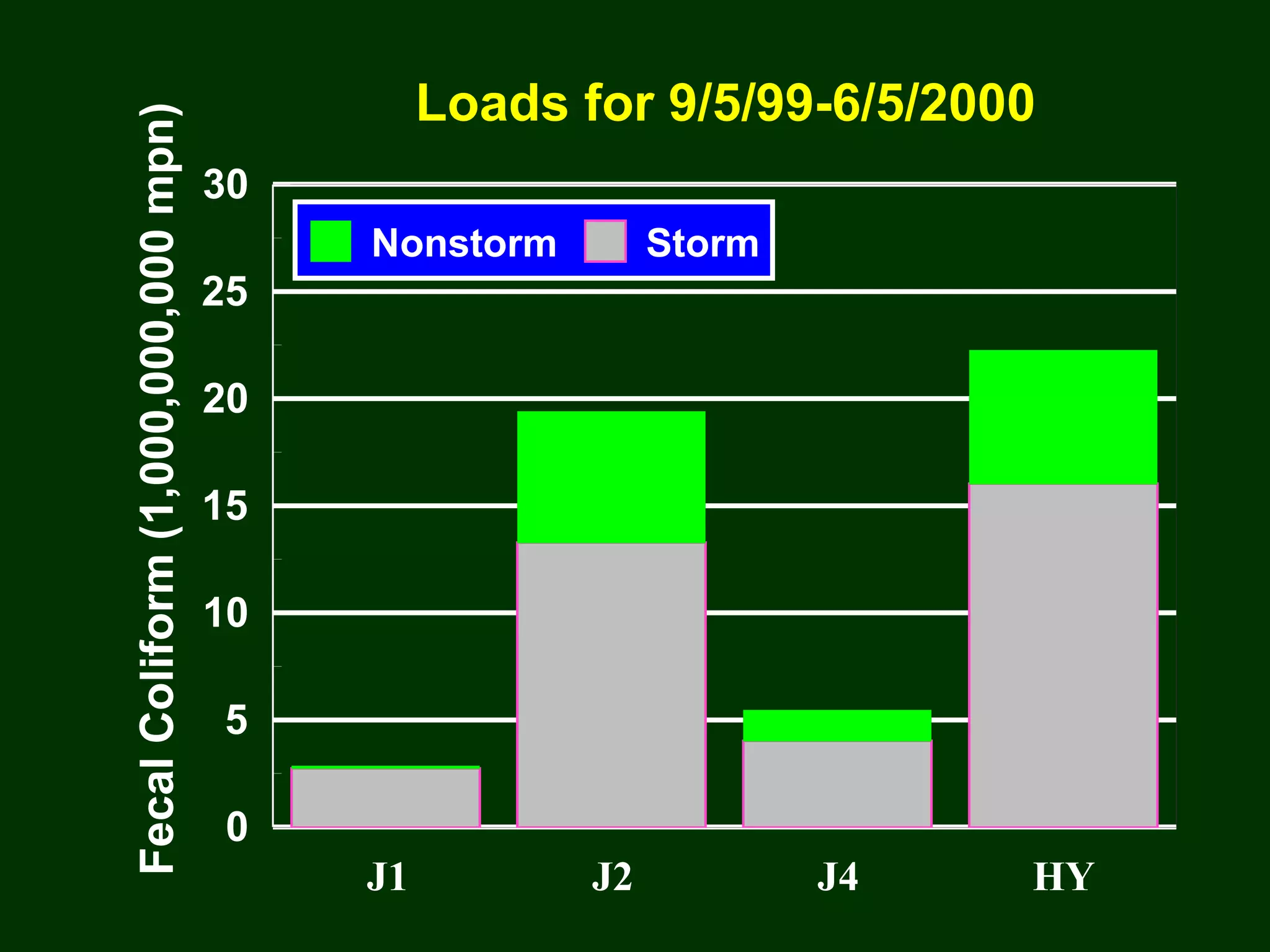
J1 J2 J4 HY
0
5
10
15
20
25
30
FecalColiform(1,000,000,000mpn)
Nonstorm Storm
Loads for 9/5/99-6/5/2000
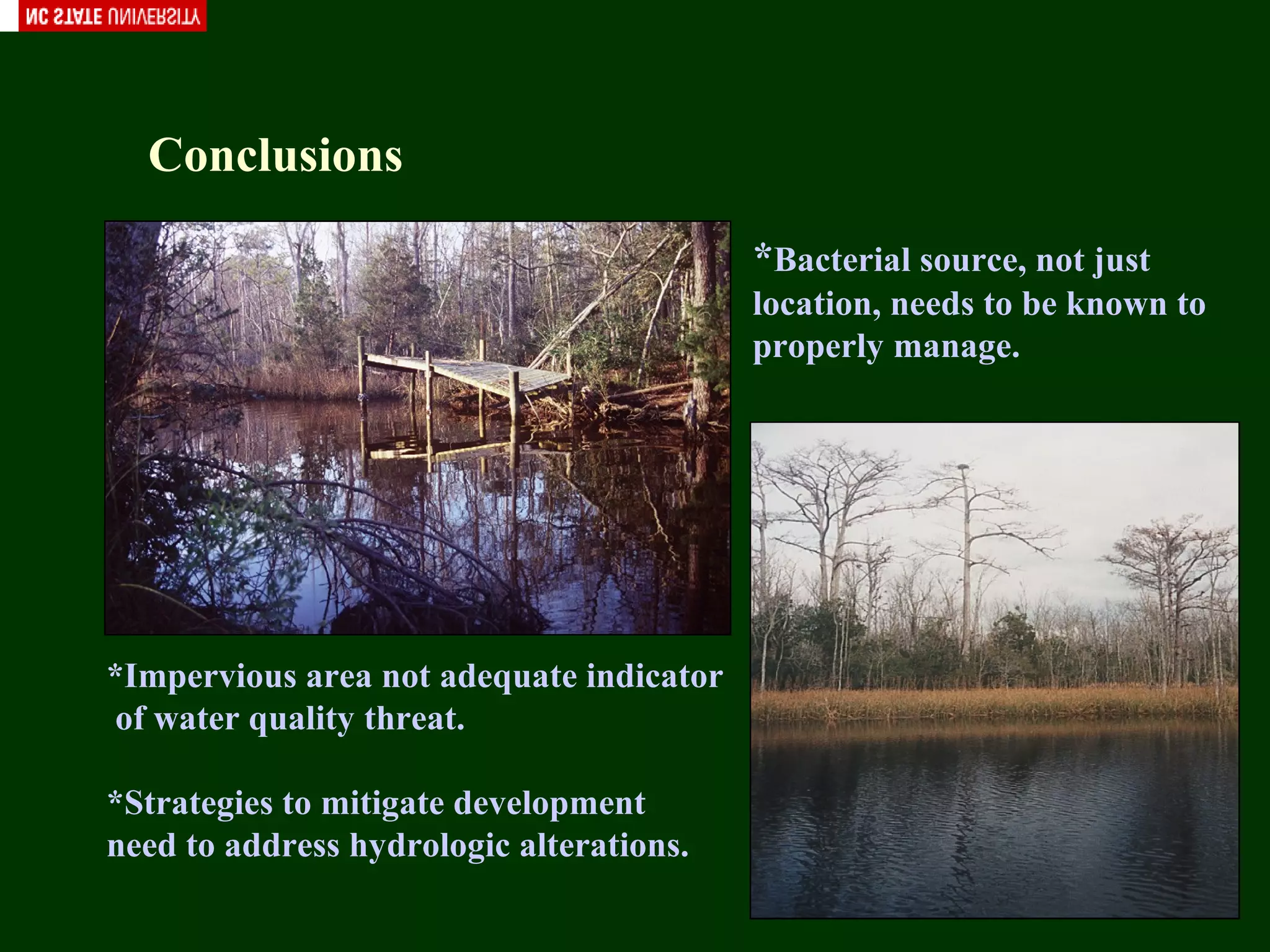
Conclusions
*Impervious area not adequate indicator
of water quality threat.
*Strategies to mitigate development
need to address hydrologic alterations.
*Bacterial source, not just
location, needs to be known to
properly manage.
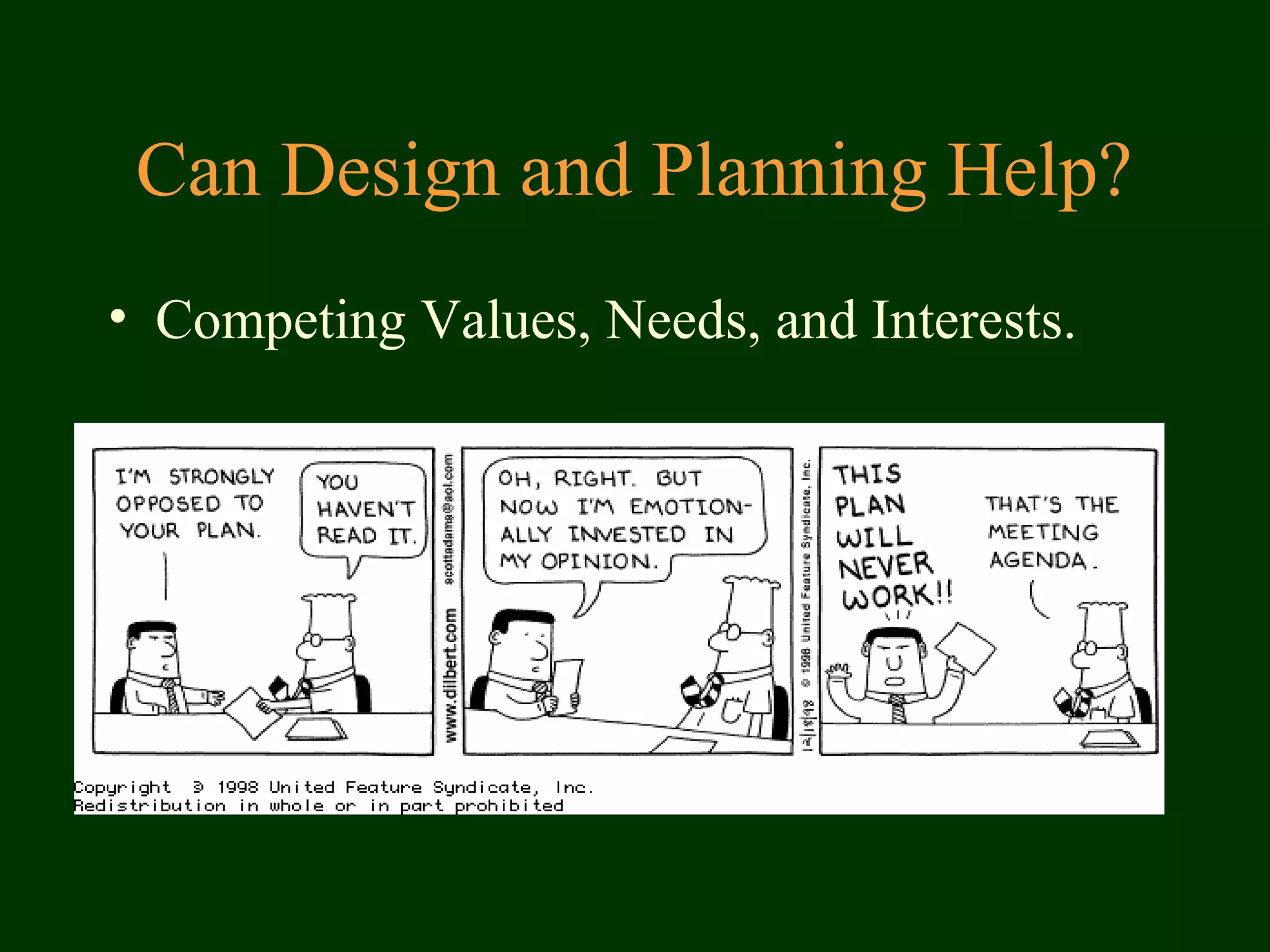
Can Design and Planning Help?
• Competing Values, Needs, and Interests.
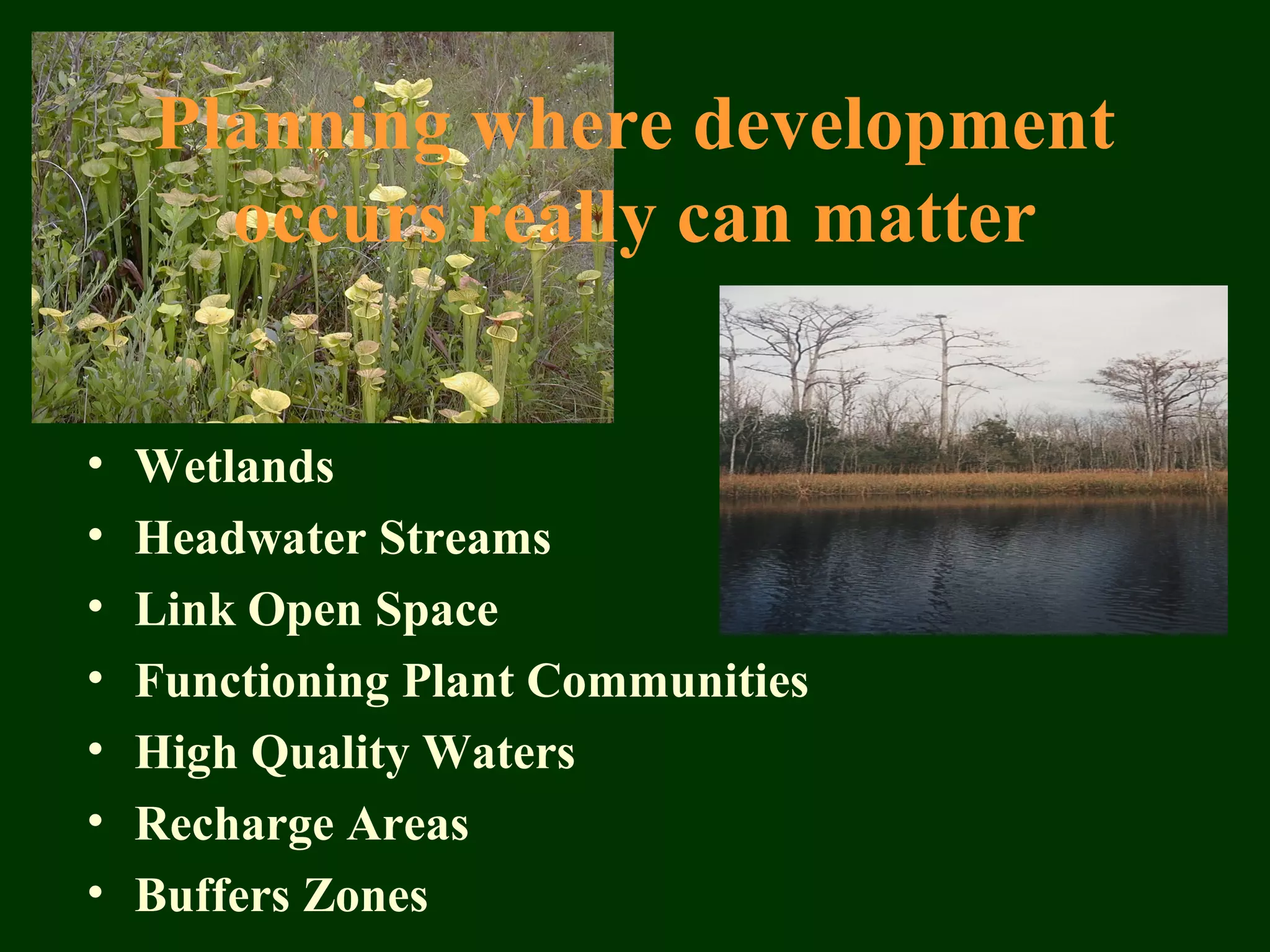
Planning where development
occurs really can matter
• Wetlands
• Headwater Streams
• Link Open Space
• Functioning Plant Communities
• High Quality Waters
• Recharge Areas
• Buffers Zones
Need to plan and design development
on a watershed basis
• Reliance on end-of-pipe BMP technology will not achieve the 30%
reduction standard for Nitrogen.
• Development based on imperviousness alone can encourage
sprawl.
• New urban scenarios while providing opportunities to implement
a variety of urban land use and sensitive area protection features
are high density and can be high impact.
• Source reduction approaches need to be assessed using watershed
- based planning and design techniques to get the right uses in the
right place.
Reduce Impervious Area:
Reduce Road Widths -- Use one way streets, pull-off zones, back
alleyways for utility infrastructure and parking, alternative
materials.
Reduce Parking Area -- Angled parking, narrower slots, lower
allocation.
Share Driveways -- Put more houses on each drive access.
Reduce Paved Sidewalk Area -- Use one side only and alternative
materials.
Contain Stormwater On-Site
Use Inverted Streets as Stormwater Collectors -- Direct to bio-filters.
Invert Parking Islands to Collect Water.
Direct Runoff from house gutters onto pervious areas.
Reduce use of street curbing -- Use grassed or vegetative swales.
Use Bioretention Areas and Rain Gardens
Use Green Building Techniques
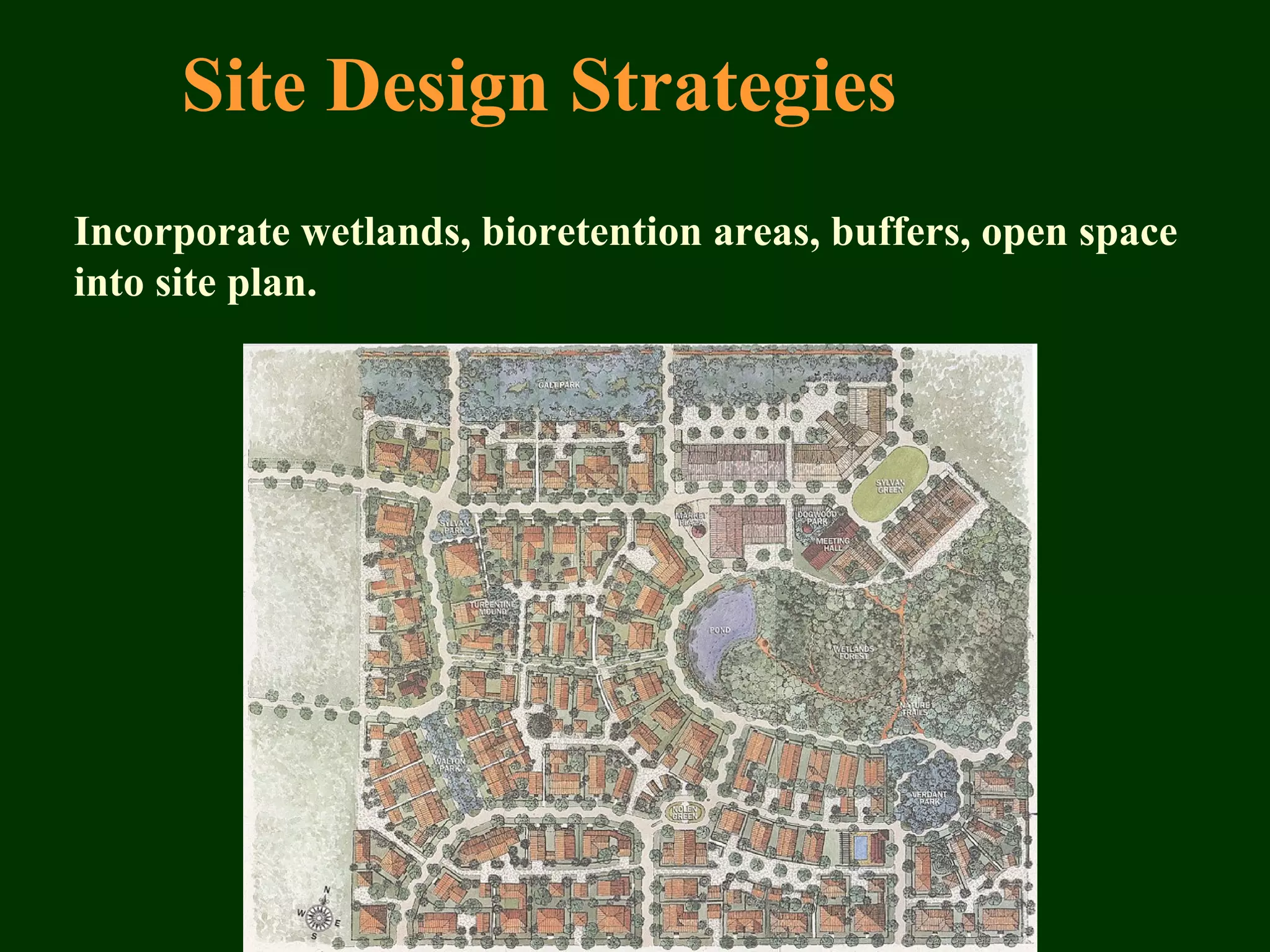
Site Design Strategies
Incorporate wetlands, bioretention areas, buffers, open space
into site plan.
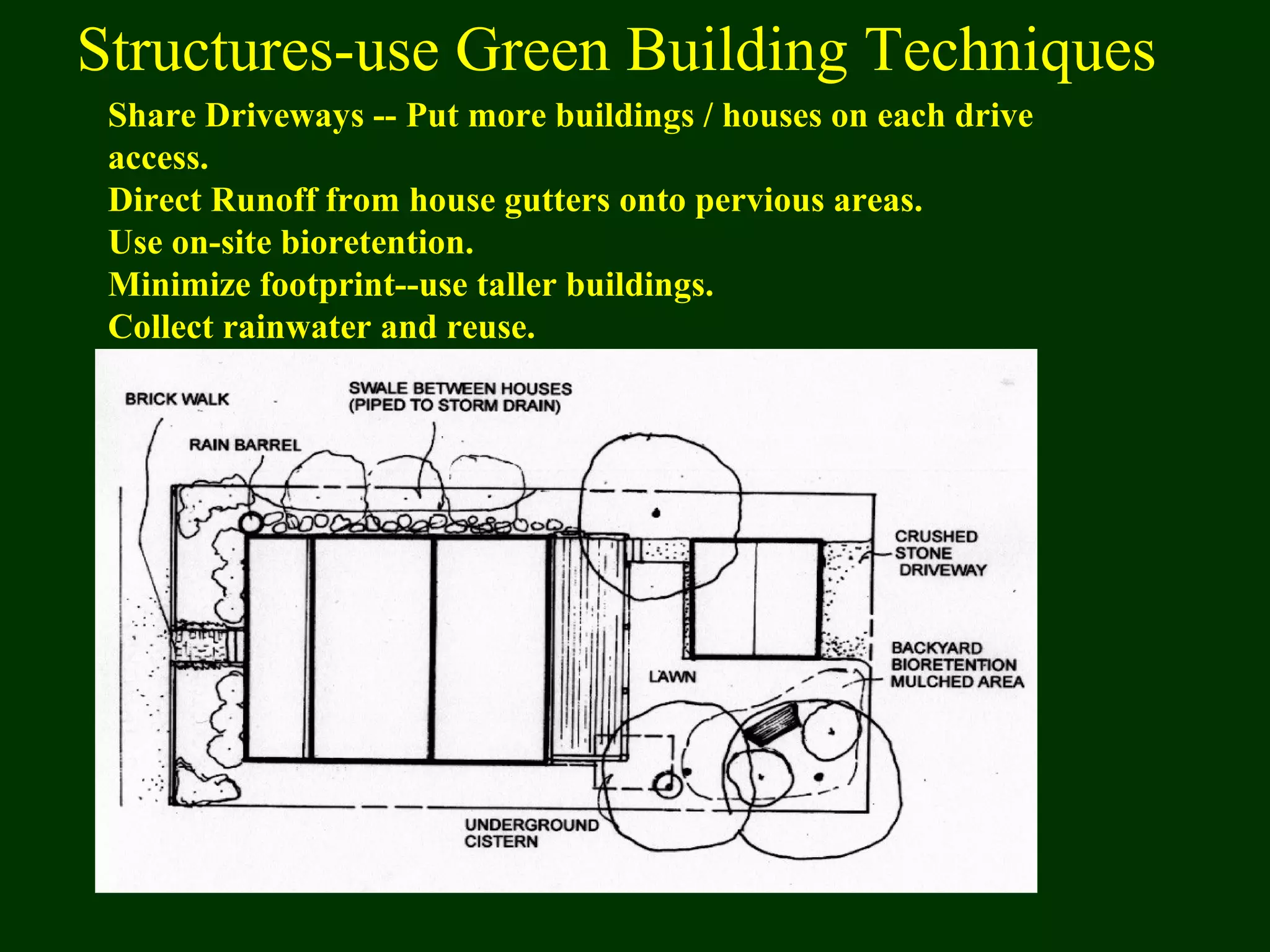
Share Driveways -- Put more buildings / houses on each drive
access.
Direct Runoff from house gutters onto pervious areas.
Use on-site bioretention.
Minimize footprint--use taller buildings.
Collect rainwater and reuse.
Use pervious materials whenever possible.
Structures-use Green Building Techniques
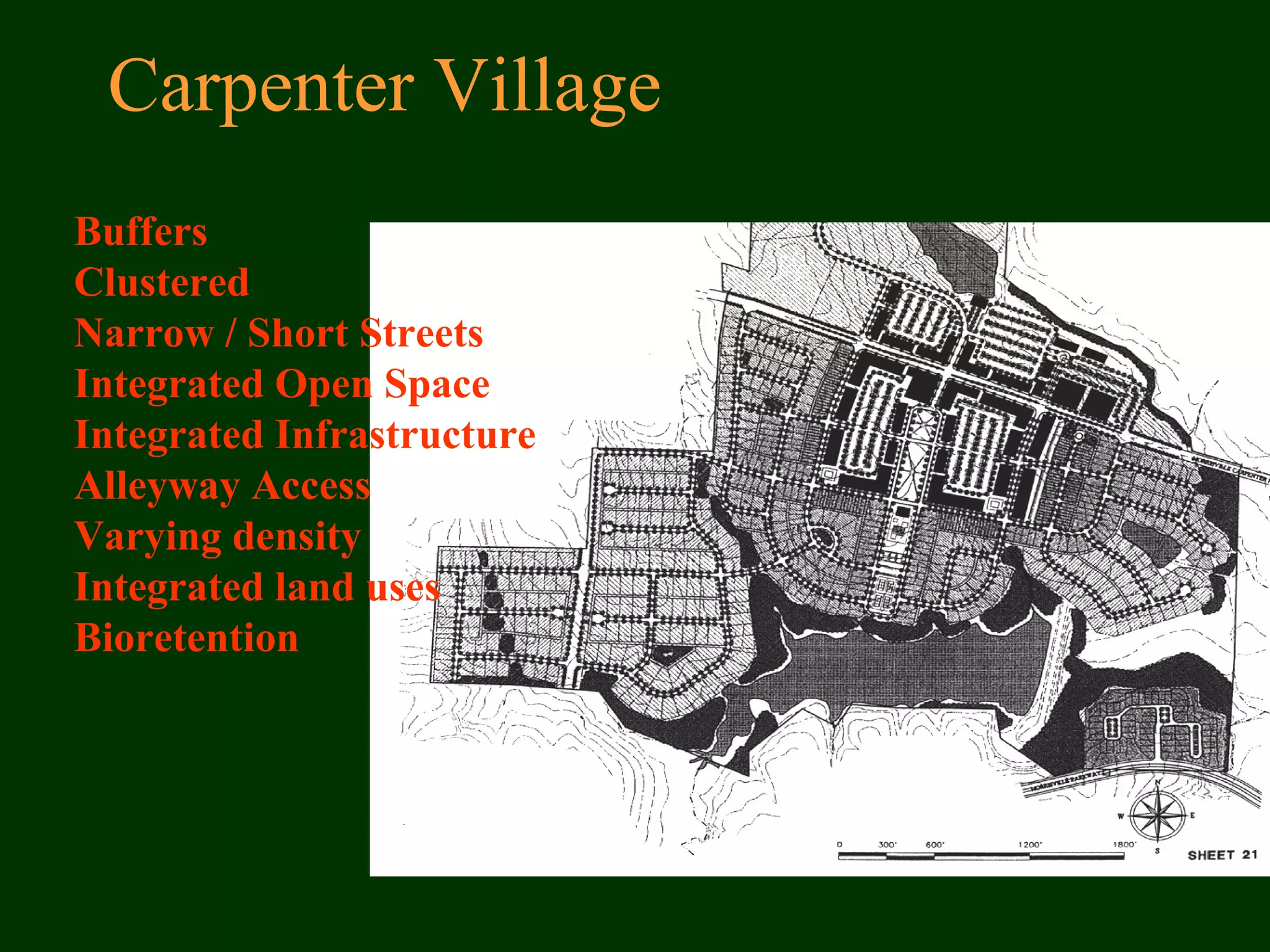
Carpenter Village
Buffers
Clustered
Narrow / Short Streets
Integrated Open Space
Integrated Infrastructure
Alleyway Access
Varying density
Integrated land uses
Bioretention
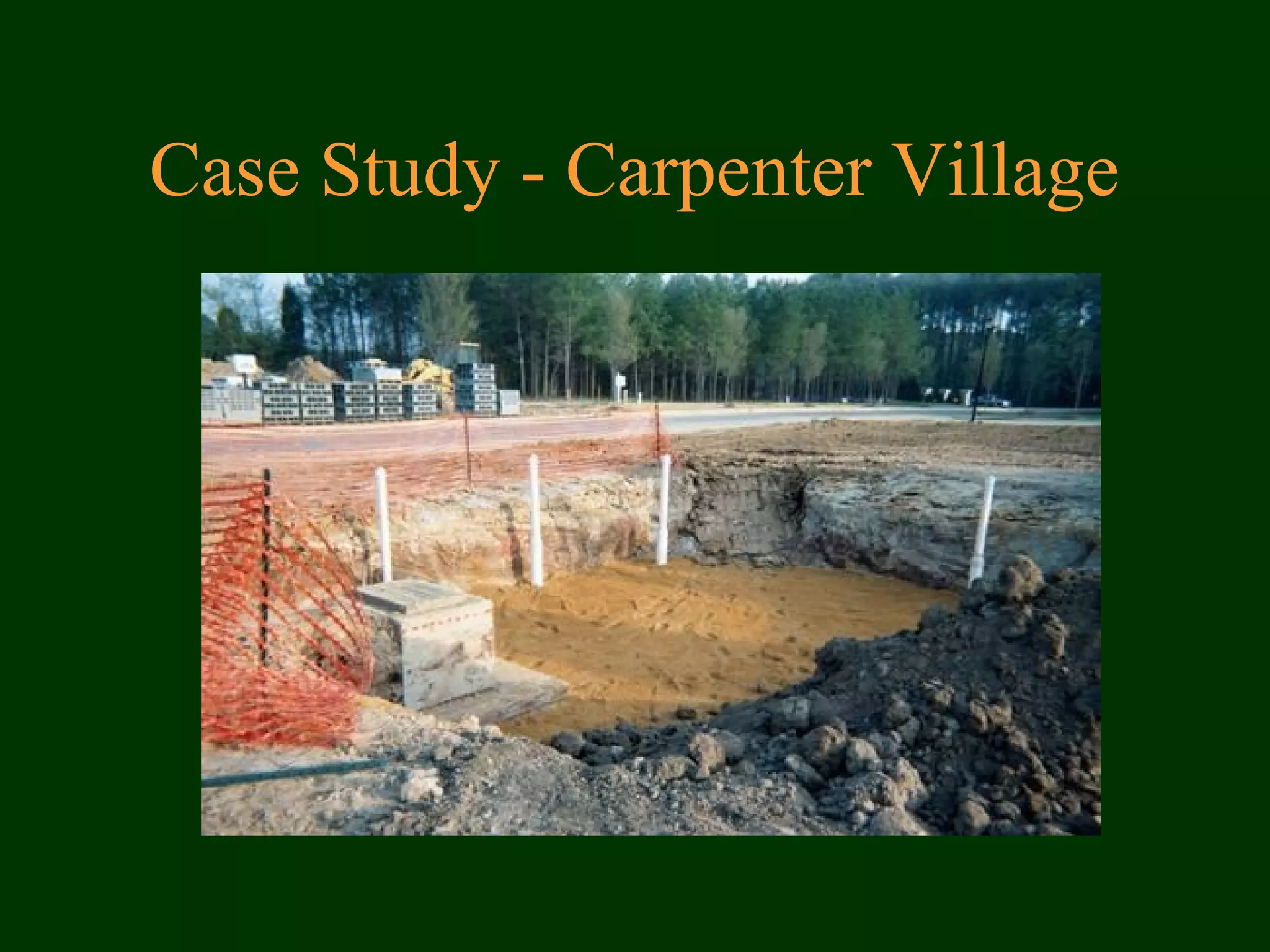
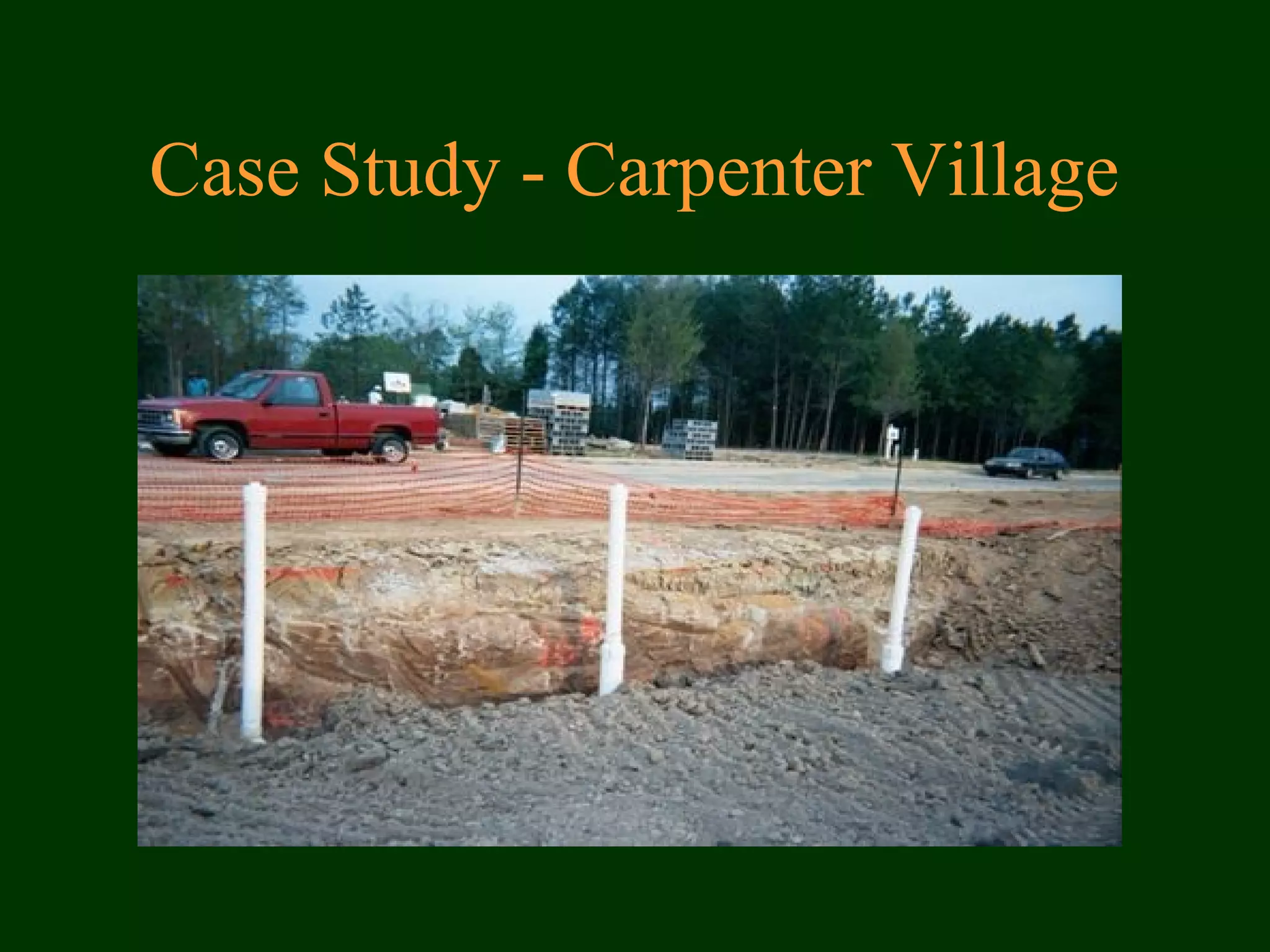
Bioretention Case Study -
Carpenter Village
• Work with Developers and Town to identify
suitable locations.
– Ideal -- low area, good soils, water gathering
slope form, dispersed in the watershed, part of
city infrastructure.
– Reality -- got existing open space, high grades,
poor soils, only two locations in the watershed,
located on private property (Developers
responsibility).
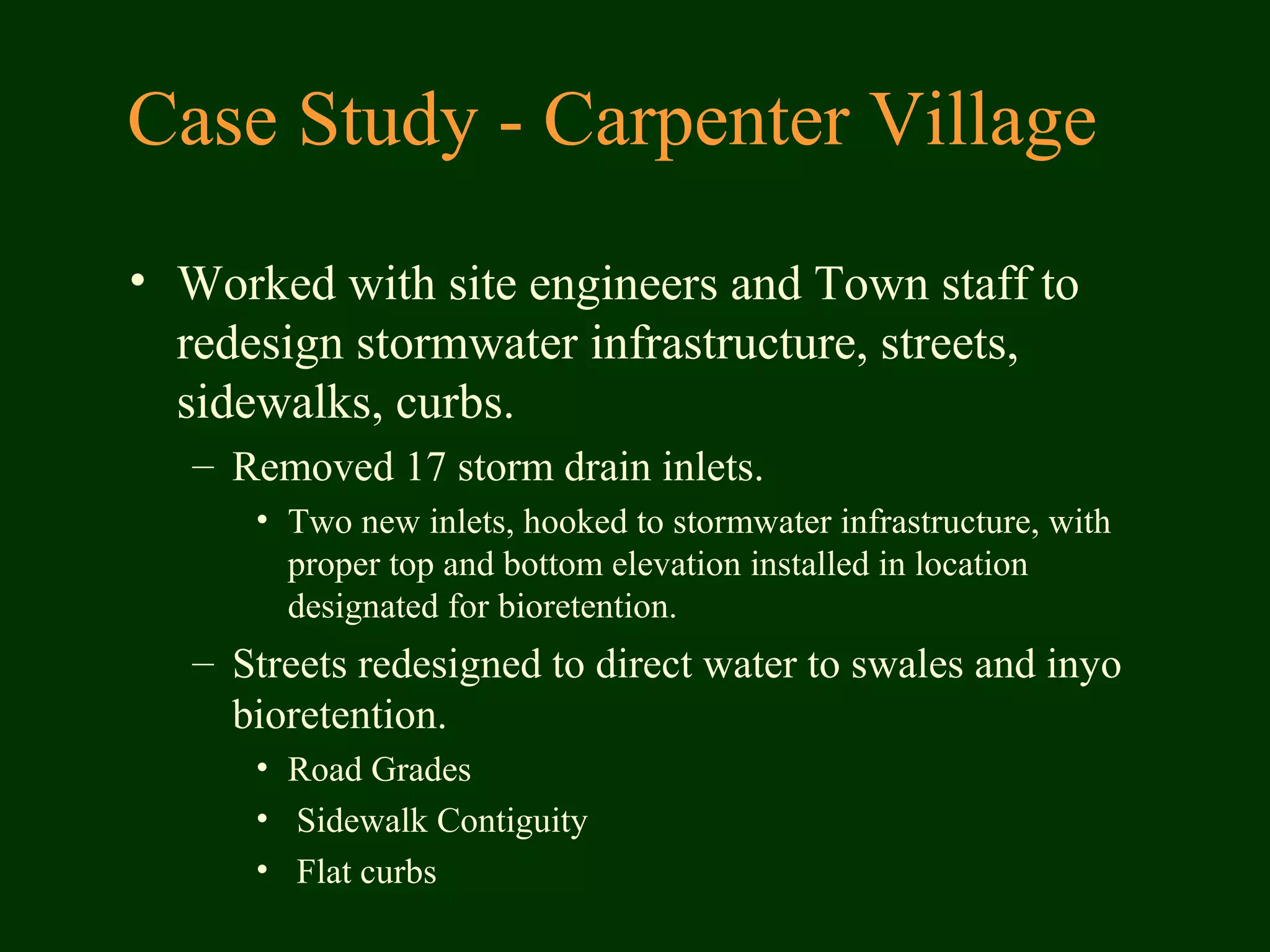
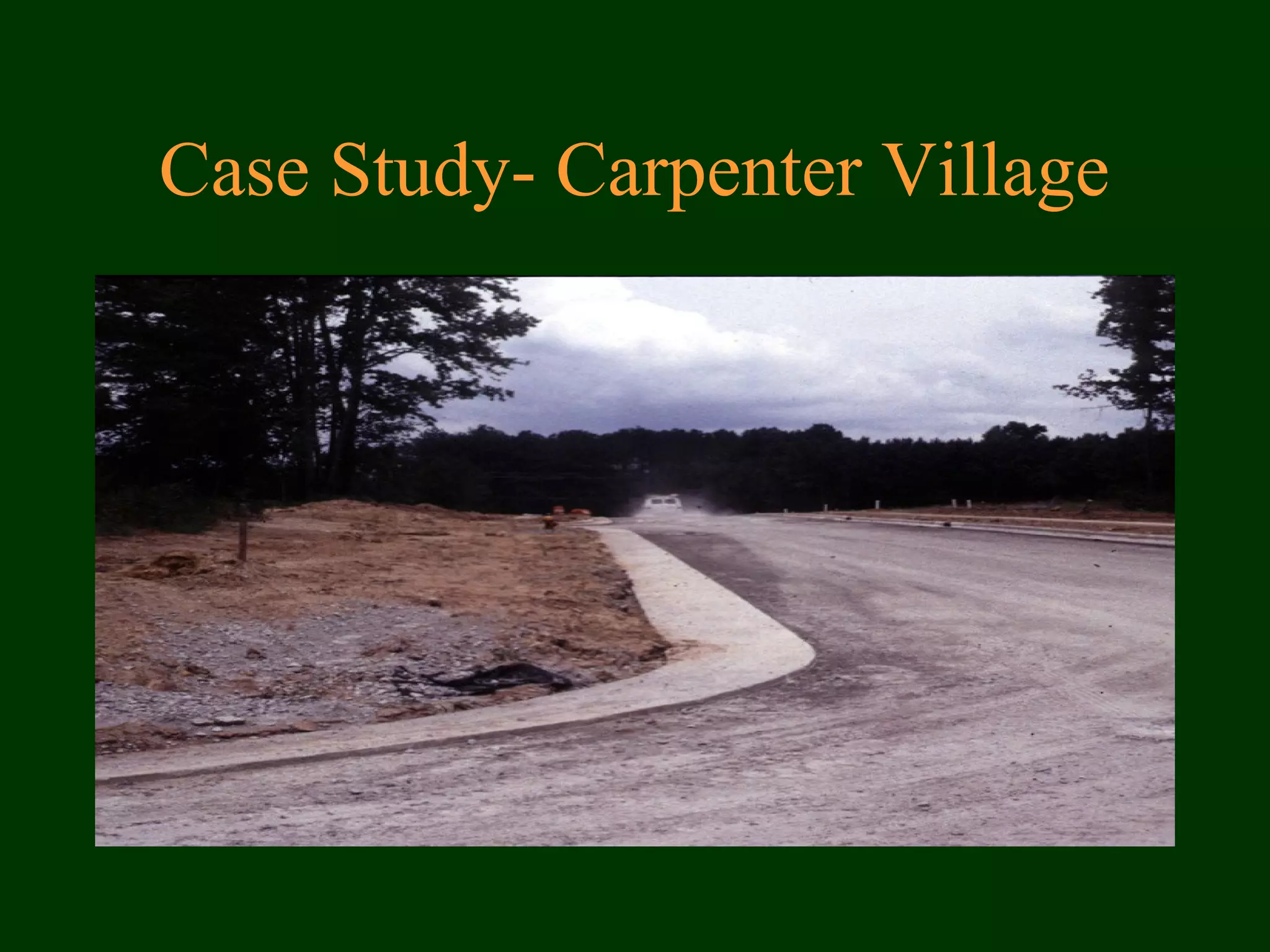
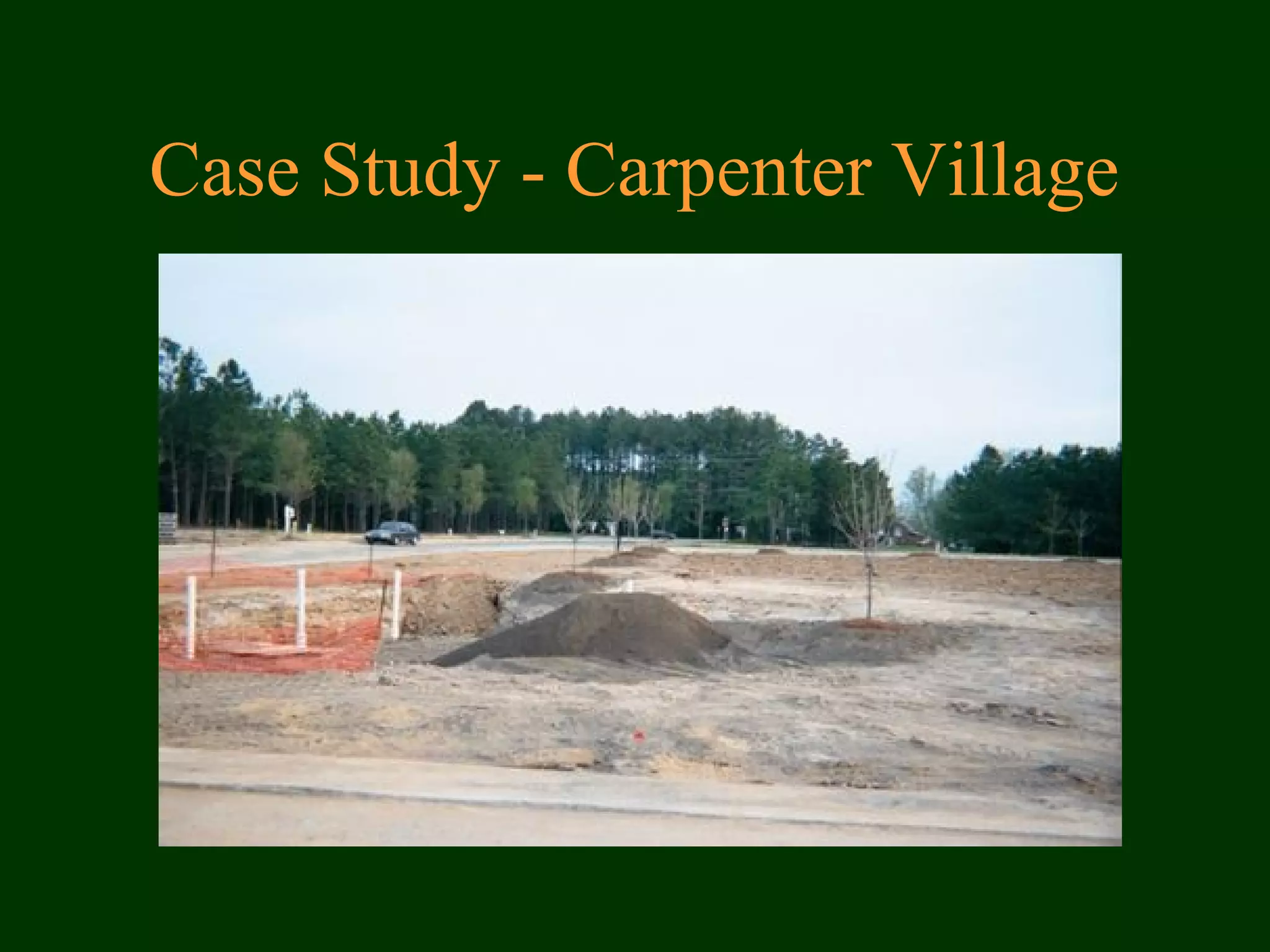
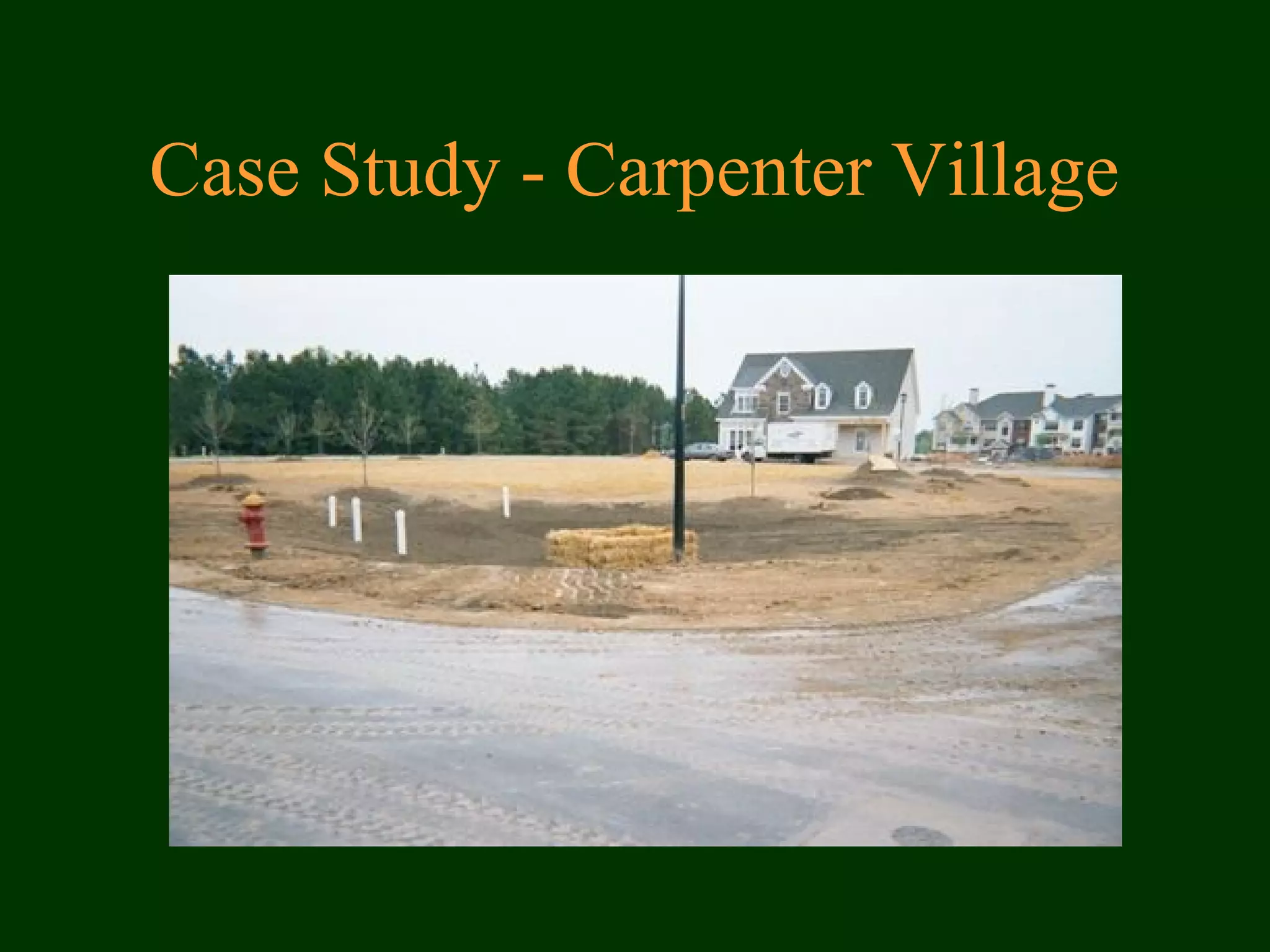
Case Study - Carpenter Village
• Worked with site engineers and Town staff to
redesign stormwater infrastructure, streets,
sidewalks, curbs.
– Removed 17 storm drain inlets.
• Two new inlets, hooked to stormwater infrastructure, with
proper top and bottom elevation installed in location
designated for bioretention.
– Streets redesigned to direct water to swales and inyo
bioretention.
• Road Grades
• Sidewalk Contiguity
• Flat curbs
Case Study- Carpenter Village
Case Study - Carpenter Village
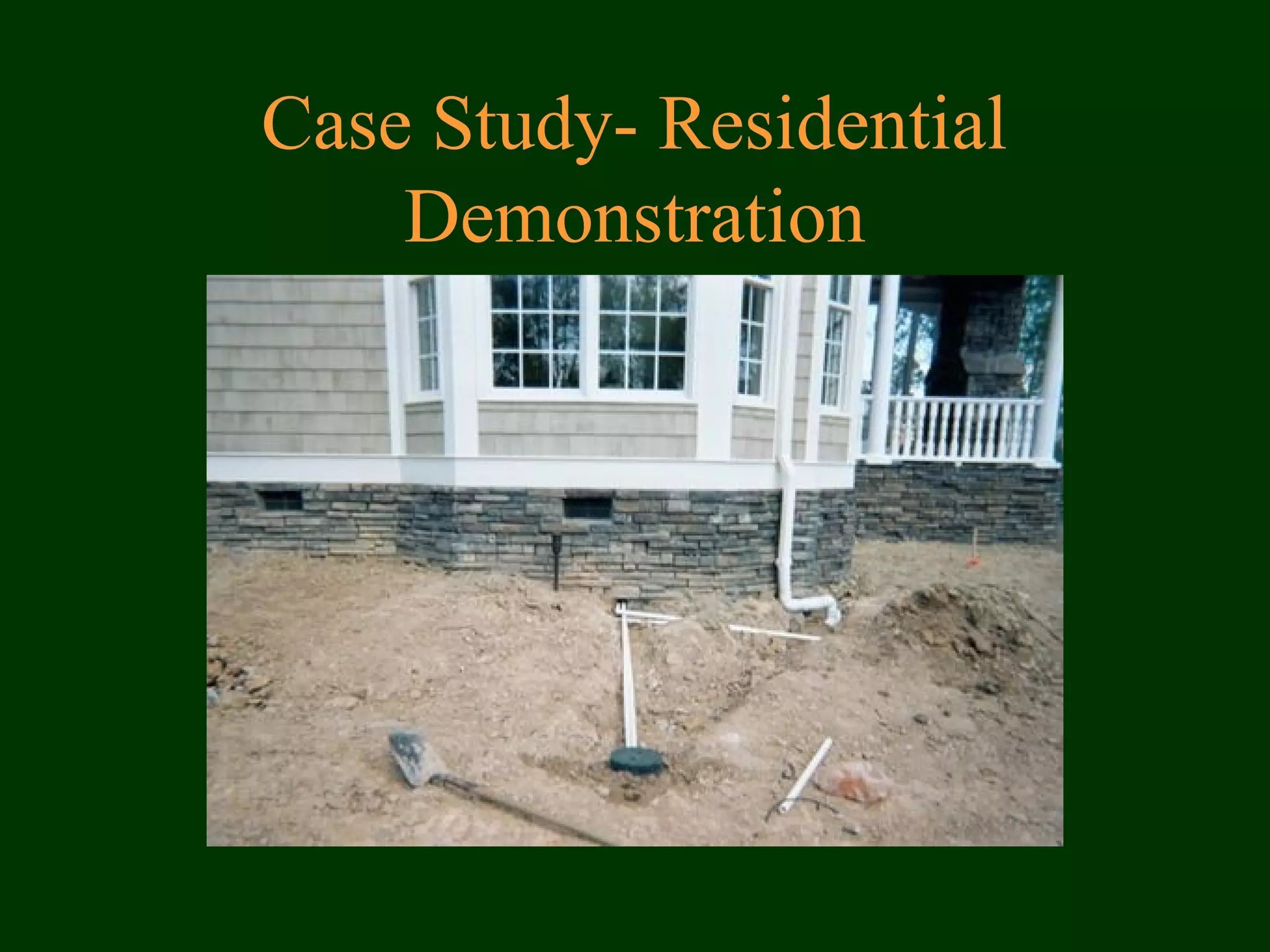
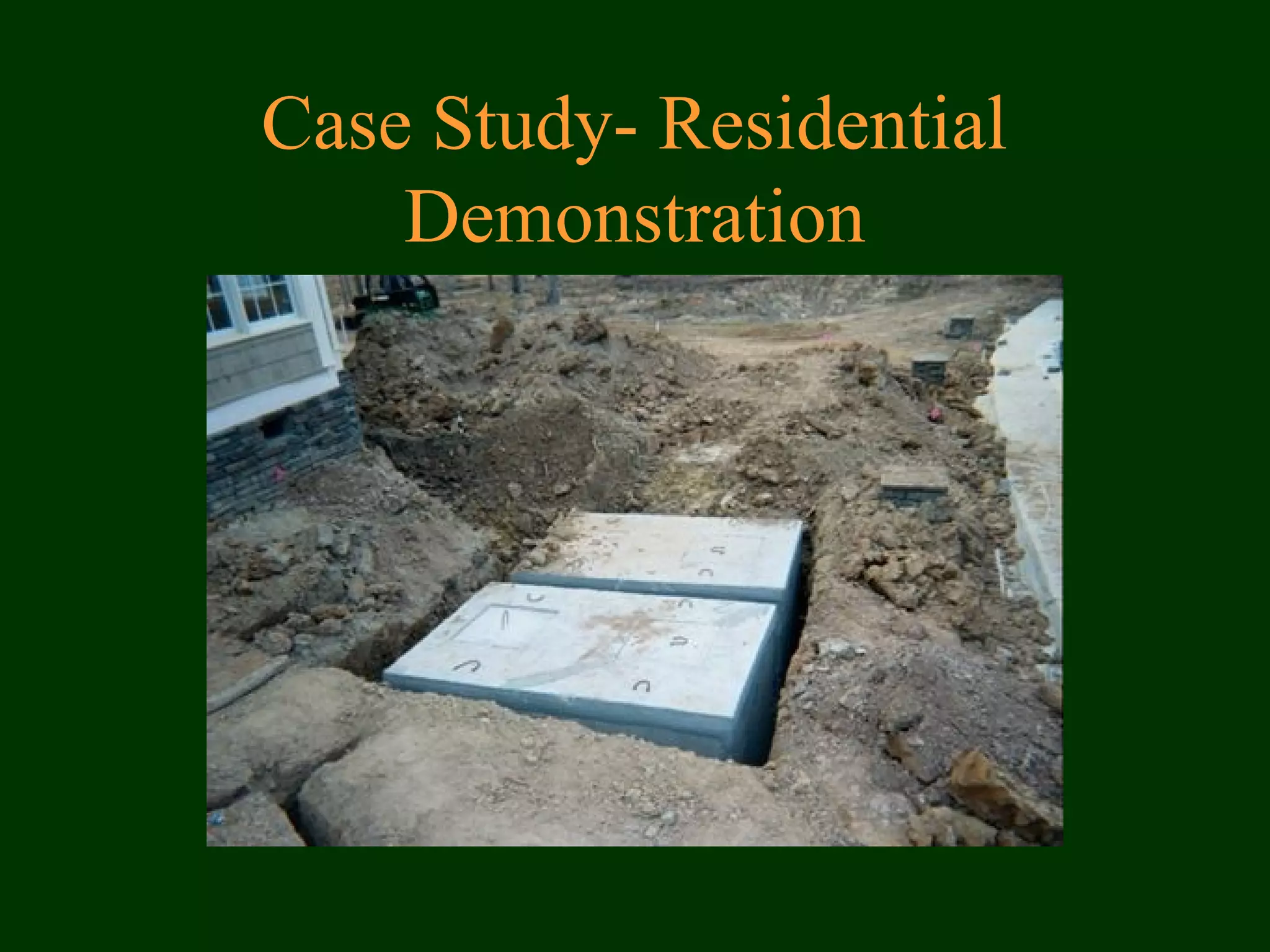
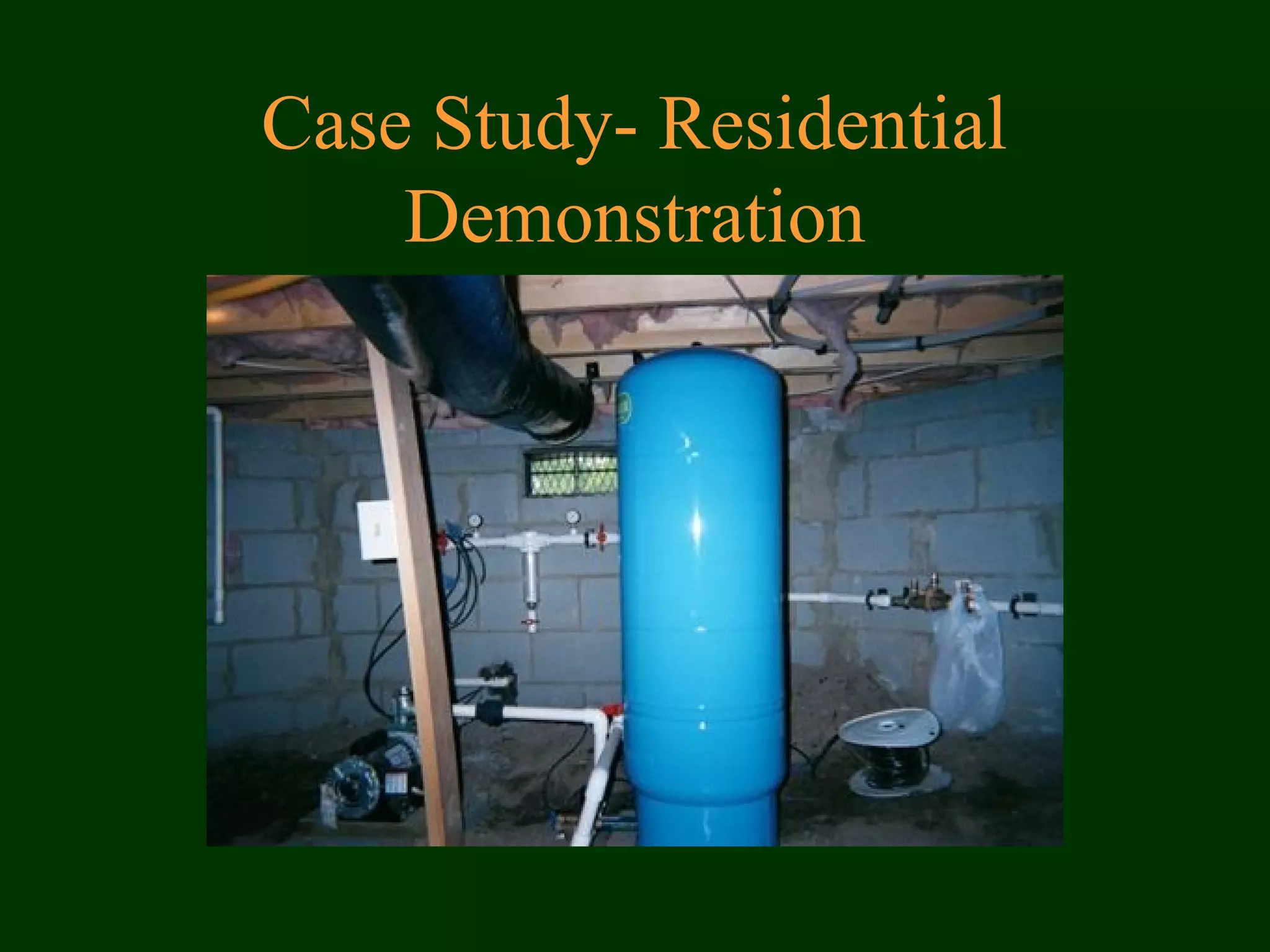
• Rainwater Harvesting - the collection and
reuse of rainwater for non-potable
applications.
– Reduction in storm water runoff.
– Increased opportunities for re-infiltration.
– Conserve potable water.
– Save money.
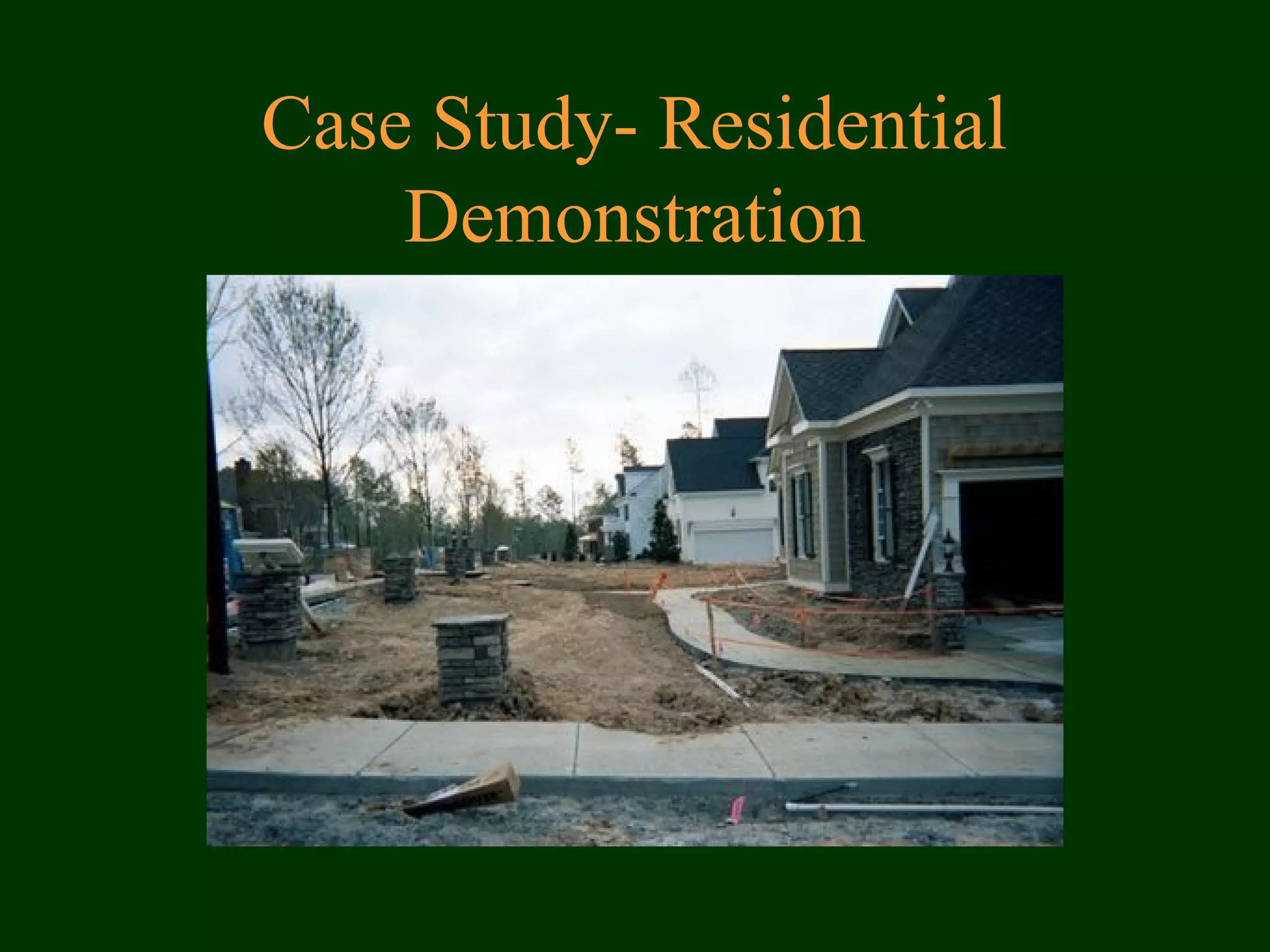
Case Study- Residential
Demonstration
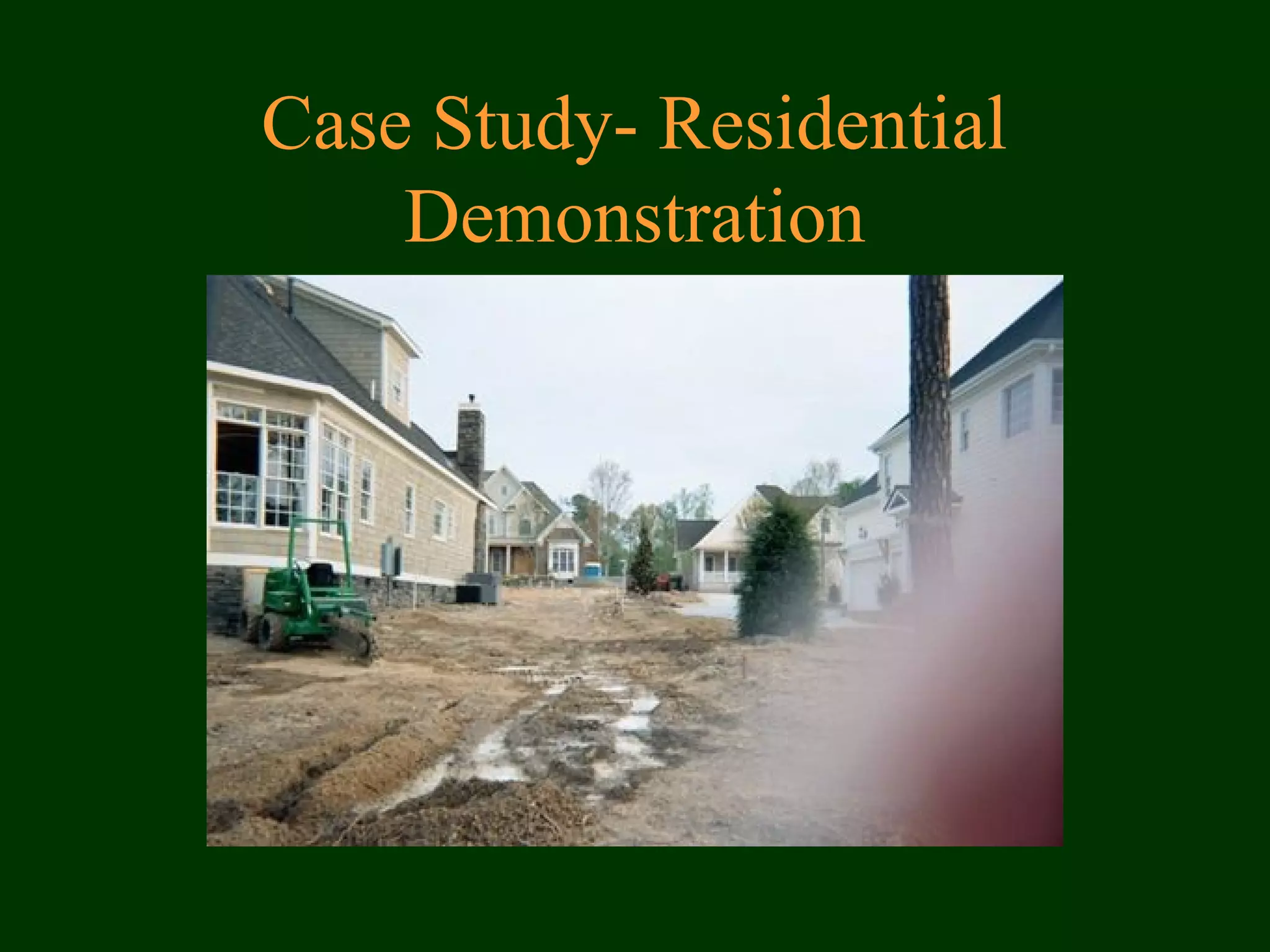
Case Study- Residential
Demonstration
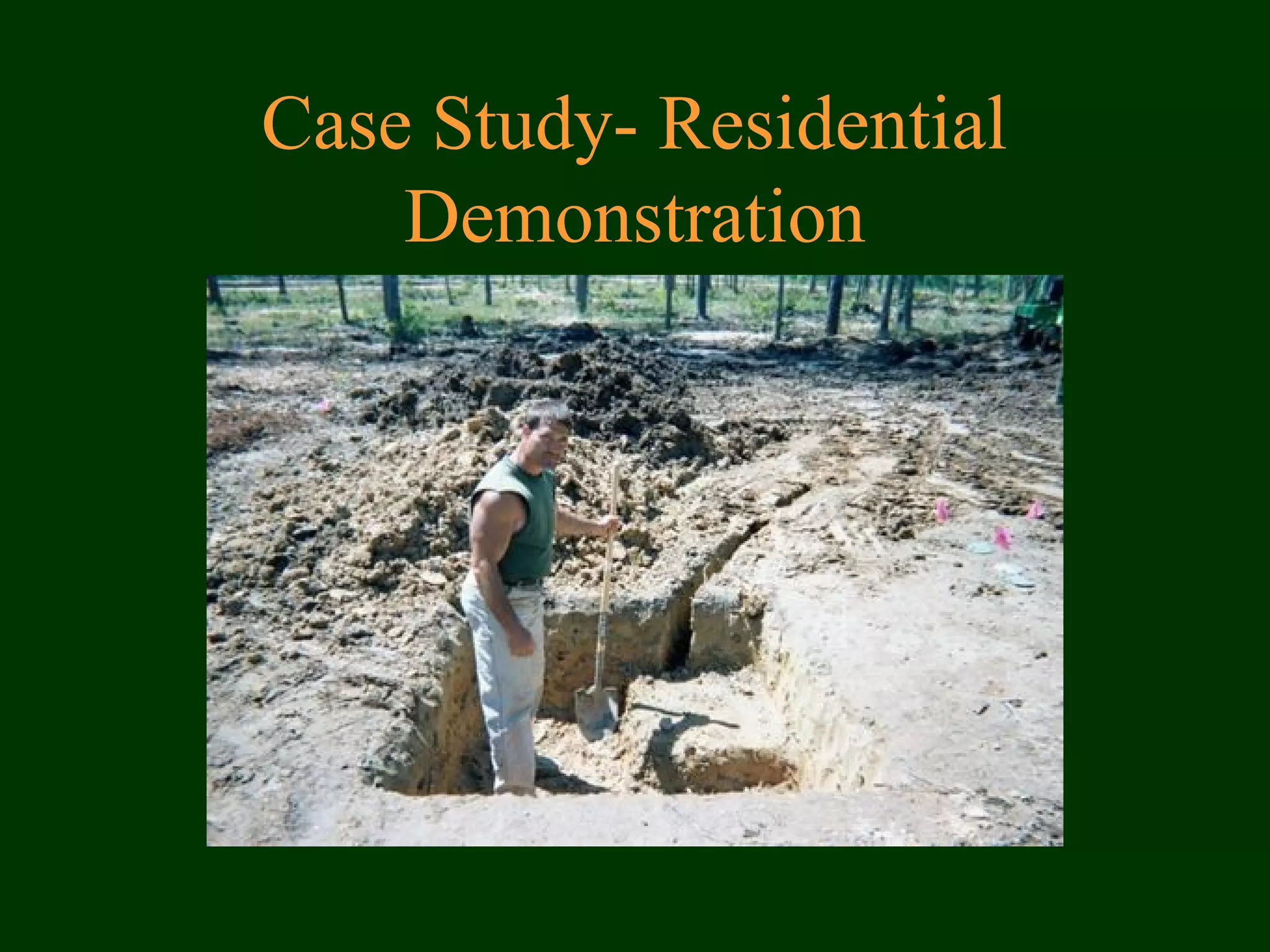
Case Study- Residential
Demonstration
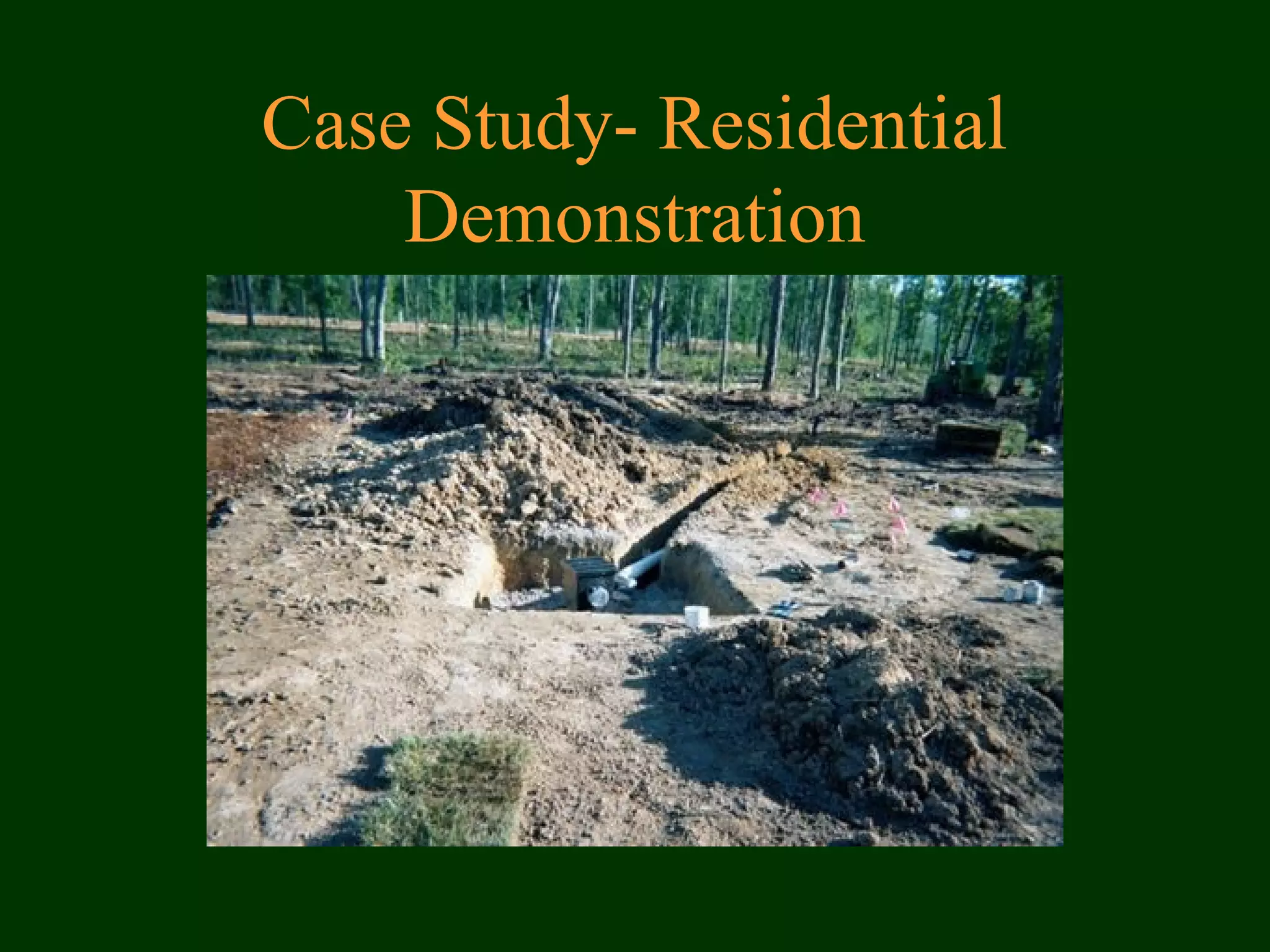
Case Study- Residential
Demonstration
Case Study- Residential
Demonstration
• If linked to city water and irrigation system
(which increases ease of use).
– Requires programmable timer.
– Labeled non-potable lines.
• If not, only normal plumbing and electrical
codes apply.
Case Study- Residential
Demonstration
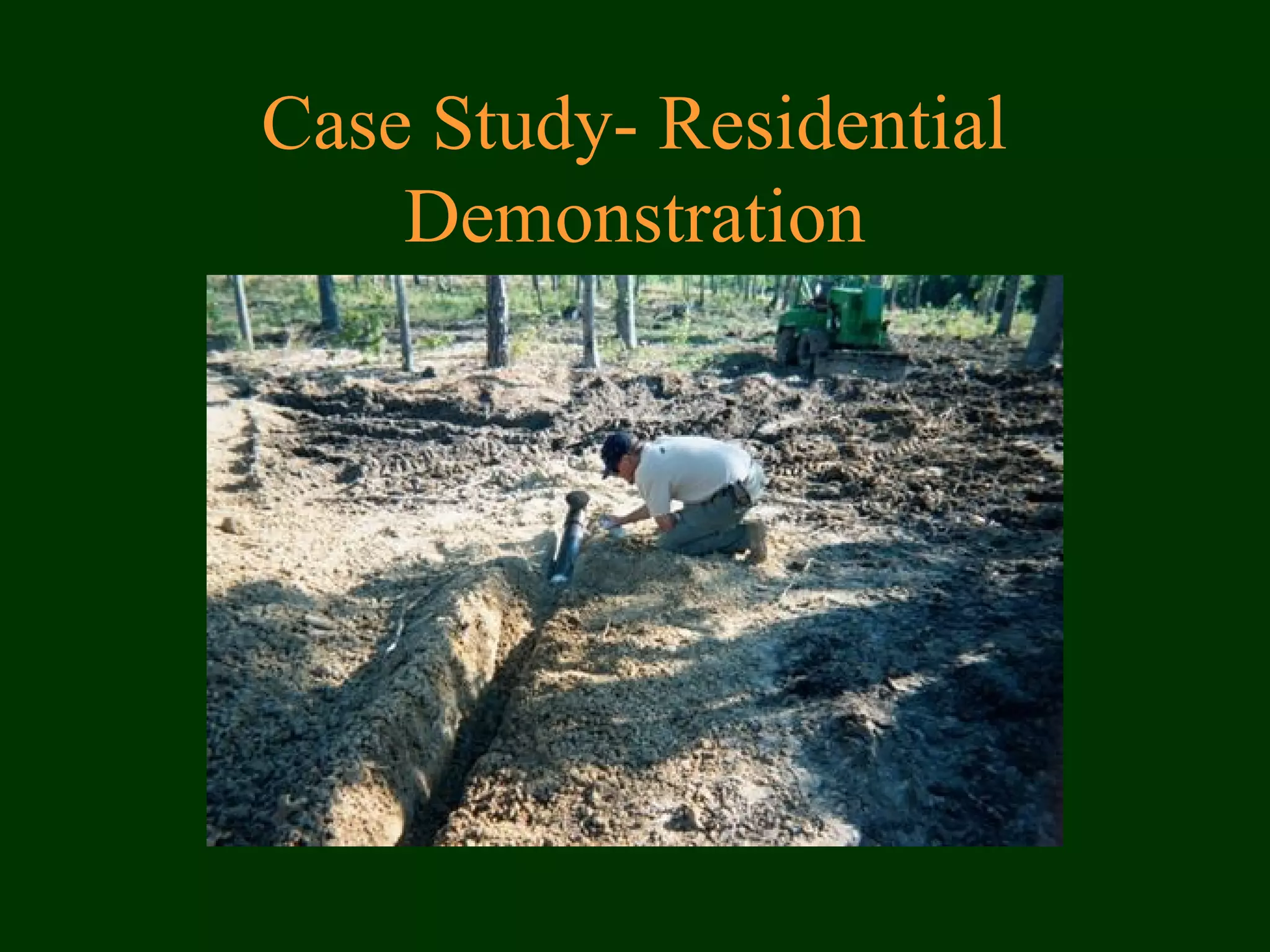
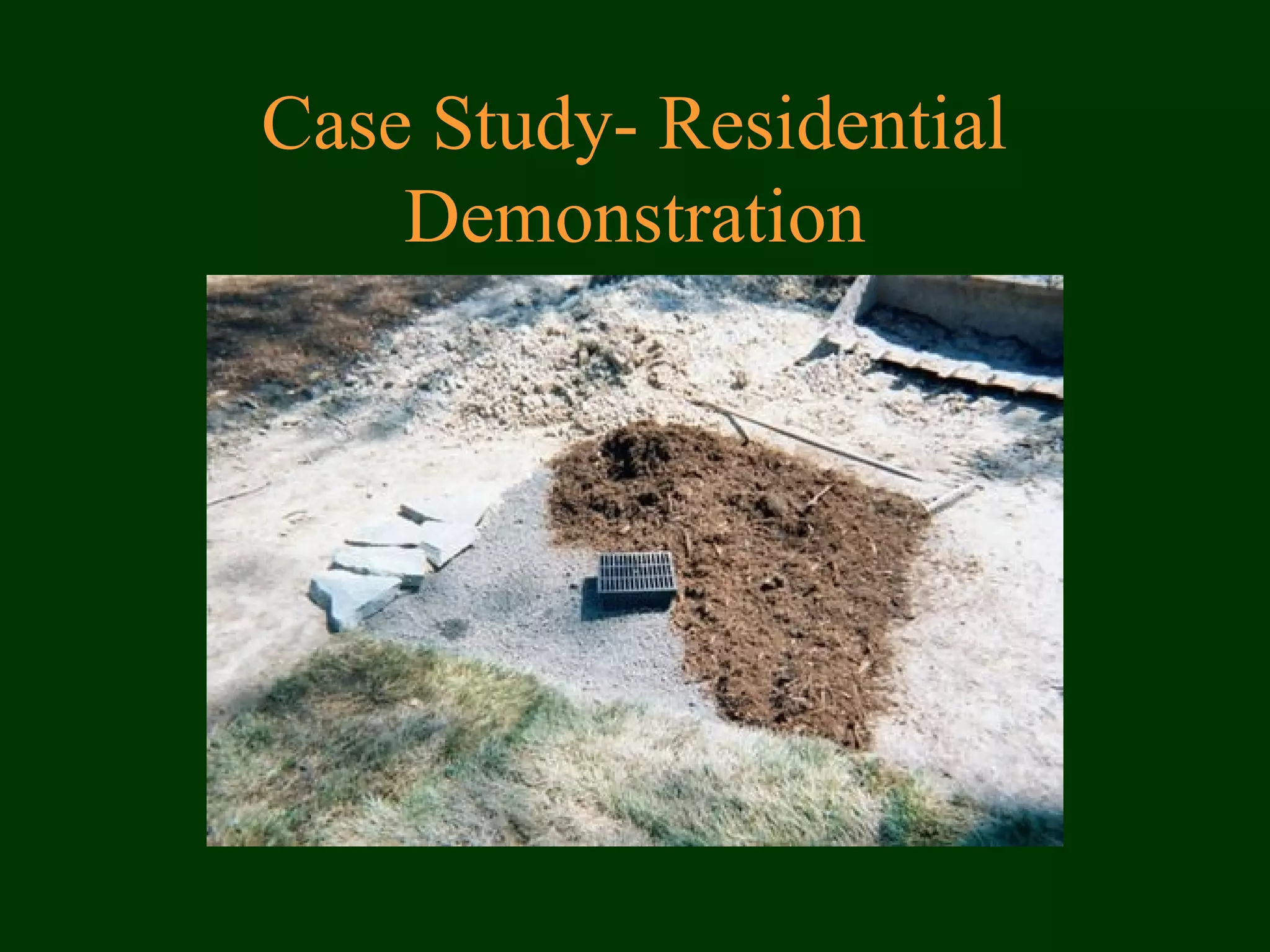
• Rain Garden as part of the landscape
– Locate in low point of the landscape.
– Grade remainder of landscape to drain to rain
garden.
– Use simple plastic inlet system.
– Provide overflow outlet.
– Plant with facultative vegetation.
Case Study- Residential
Demonstration
Case Study- Residential
Demonstration
Case Study- Residential
Demonstration
Case Study- Residential
Demonstration
Case Study- Residential
Demonstration
Case Study- Residential
Demonstration
Conclusions:
•Effective solutions need a “Toolbox” approach using watershed
based planning, low impact design, and green building
implementation techniques.
•Wetlands and riparian buffers are essential for habitat and
water quality.
•Recharge rates must be addressed by capturing storm water
utilizing infiltration techniques, reapplication, and the
preservation of recharge areas, open space.
Water quality protection can happen when hydrologic functionality
of the watershed is maintained, pollutant load (including storm
hydrology) is minimized.
More Conclusions!
• Positive results can be achieved when there cooperation
between towns to develop management strategies on a
watershed basis.
• Within that context, the good development work can be
done if designed using multi-disciplinary teams that
include architects, landscape architects, biologists, soil
scientists, ecologists, botanists, and, yes, even engineers.

Urban Planning Design Considerations for Better Water Quality, Bill Hunt NC State University

  • 1.
    Designing to ProtectWater Quality
  • 2.
  • 3.
  • 4.
  • 5.
    Impacts are relatedto more than just imperviousness . . . We need to try and maintain watershed hydrology
  • 6.
  • 7.
    Surface Hydrology bythe Numbers Source: Center for Watershed Protection, 1996 Parameter ParkingLot Meadow Curve Number 98 58 Runoff Coefficient 0.95 0.06 Time of Concentration (minutes) 4.8 14.4 Peak: 2 yr, 24 hr., CFS 4.3 0.4 Volume, 1”, CFT 3450 218 Velocity, 2 yr, FT/Sec 8 1.8 Change 1.6 Times More 15 Times More 3 Times Less 10 Times Higher 15 Times More 4 Times Faster
  • 8.
  • 9.
  • 10.
    Carpenter Village Project Partners: WWPartners Ferrell Land Dev Co. Town of Cary NC Cooperative Ext. Funding Agencies: NC DENR - DWQ 319 NC DENR - DLQ
  • 11.
  • 12.
    Annual Loads atCarpenter Annual Loads at Carpenter 0 5 10 15 20 25 30 35 40 Load(kg/ha) Clearing Building TP TN NO3 NH3
  • 13.
    Annual Loads atCarpenter Annual Loads at Carpenter 0 5000 10000 15000 20000 25000 Load(kg/ha) Clearing Building TSS
  • 14.
    Rainfall vs. Runoff Rainfallvs Runoff 0 0.1 0.2 0.3 0.4 0.5 0.6 0.7 Runoff/rainfall Clearing Building Wooded Runoff
  • 15.
    Cooperators and Participants NCSUSchool of Design Extension Programs Design Research Laboratory NCSU Water Quality Group NC Dept of Health, Shellfish Sanitation Program Duke Marine Laboratory UNC Sea Grant NCDENR Division of Water Quality 319 Program Wetland Restoration Program Clean Water Management Trust Fund Carteret Craven Electric Cooperative Jumping Run Creek Watershed Citizens Jumping Run Creek
  • 16.
    Facts: 1)Shellfish closures occurringsince 1979. 2) Imperviousness less than 5%. 3) Water moving through the system to shellfish bed within hours. 4) Bacterial loading has increased steadily through the years, while rainfall has stayed consistent.
  • 17.
    J1 J2 J4HY J1 J2 J4 HY J1 J2 J4 HY 0 50 100 150 Load(kg) Nonstorm Storm Loads from 9/5/99-6/5/00 NH3 NO2+3 PO4
  • 18.
    J1 J2 J4HY 0 5 10 15 20 25 30 TSSLoad(1,000kg) Nonstorm Storm Loads from 9/5/99-6/5/00
  • 19.
    J1 J2 J4HY 0 5 10 15 20 25 30 FecalColiform(1,000,000,000mpn) Nonstorm Storm Loads for 9/5/99-6/5/2000
  • 20.
    Conclusions *Impervious area notadequate indicator of water quality threat. *Strategies to mitigate development need to address hydrologic alterations. *Bacterial source, not just location, needs to be known to properly manage.
  • 21.
    Can Design andPlanning Help? • Competing Values, Needs, and Interests.
  • 22.
    Planning where development occursreally can matter • Wetlands • Headwater Streams • Link Open Space • Functioning Plant Communities • High Quality Waters • Recharge Areas • Buffers Zones
  • 23.
    Need to planand design development on a watershed basis • Reliance on end-of-pipe BMP technology will not achieve the 30% reduction standard for Nitrogen. • Development based on imperviousness alone can encourage sprawl. • New urban scenarios while providing opportunities to implement a variety of urban land use and sensitive area protection features are high density and can be high impact. • Source reduction approaches need to be assessed using watershed - based planning and design techniques to get the right uses in the right place.
  • 24.
    Reduce Impervious Area: ReduceRoad Widths -- Use one way streets, pull-off zones, back alleyways for utility infrastructure and parking, alternative materials. Reduce Parking Area -- Angled parking, narrower slots, lower allocation. Share Driveways -- Put more houses on each drive access. Reduce Paved Sidewalk Area -- Use one side only and alternative materials. Contain Stormwater On-Site Use Inverted Streets as Stormwater Collectors -- Direct to bio-filters. Invert Parking Islands to Collect Water. Direct Runoff from house gutters onto pervious areas. Reduce use of street curbing -- Use grassed or vegetative swales. Use Bioretention Areas and Rain Gardens Use Green Building Techniques Site Design Strategies
  • 25.
    Site Design Strategies Incorporatewetlands, bioretention areas, buffers, open space into site plan.
  • 26.
    Share Driveways --Put more buildings / houses on each drive access. Direct Runoff from house gutters onto pervious areas. Use on-site bioretention. Minimize footprint--use taller buildings. Collect rainwater and reuse. Use pervious materials whenever possible. Structures-use Green Building Techniques
  • 27.
    Carpenter Village Buffers Clustered Narrow /Short Streets Integrated Open Space Integrated Infrastructure Alleyway Access Varying density Integrated land uses Bioretention
  • 28.
    Bioretention Case Study- Carpenter Village • Work with Developers and Town to identify suitable locations. – Ideal -- low area, good soils, water gathering slope form, dispersed in the watershed, part of city infrastructure. – Reality -- got existing open space, high grades, poor soils, only two locations in the watershed, located on private property (Developers responsibility).
  • 29.
    Case Study -Carpenter Village • Worked with site engineers and Town staff to redesign stormwater infrastructure, streets, sidewalks, curbs. – Removed 17 storm drain inlets. • Two new inlets, hooked to stormwater infrastructure, with proper top and bottom elevation installed in location designated for bioretention. – Streets redesigned to direct water to swales and inyo bioretention. • Road Grades • Sidewalk Contiguity • Flat curbs
  • 30.
  • 31.
    Case Study -Carpenter Village
  • 32.
    Case Study -Carpenter Village
  • 33.
    Case Study -Carpenter Village
  • 34.
    Case Study -Carpenter Village
  • 35.
    • Rainwater Harvesting- the collection and reuse of rainwater for non-potable applications. – Reduction in storm water runoff. – Increased opportunities for re-infiltration. – Conserve potable water. – Save money. Case Study- Residential Demonstration
  • 36.
  • 37.
  • 38.
  • 39.
    Case Study- Residential Demonstration •If linked to city water and irrigation system (which increases ease of use). – Requires programmable timer. – Labeled non-potable lines. • If not, only normal plumbing and electrical codes apply.
  • 40.
    Case Study- Residential Demonstration •Rain Garden as part of the landscape – Locate in low point of the landscape. – Grade remainder of landscape to drain to rain garden. – Use simple plastic inlet system. – Provide overflow outlet. – Plant with facultative vegetation.
  • 41.
  • 42.
  • 43.
  • 44.
  • 45.
  • 46.
  • 47.
    Conclusions: •Effective solutions needa “Toolbox” approach using watershed based planning, low impact design, and green building implementation techniques. •Wetlands and riparian buffers are essential for habitat and water quality. •Recharge rates must be addressed by capturing storm water utilizing infiltration techniques, reapplication, and the preservation of recharge areas, open space. Water quality protection can happen when hydrologic functionality of the watershed is maintained, pollutant load (including storm hydrology) is minimized.
  • 48.
    More Conclusions! • Positiveresults can be achieved when there cooperation between towns to develop management strategies on a watershed basis. • Within that context, the good development work can be done if designed using multi-disciplinary teams that include architects, landscape architects, biologists, soil scientists, ecologists, botanists, and, yes, even engineers.