FIELD STUDY 4
Exploring the Curriculum
DIOSDADO P. MACAPAGAL
ELEMENTARY SCHOOl
The School Plan and
Organizaton
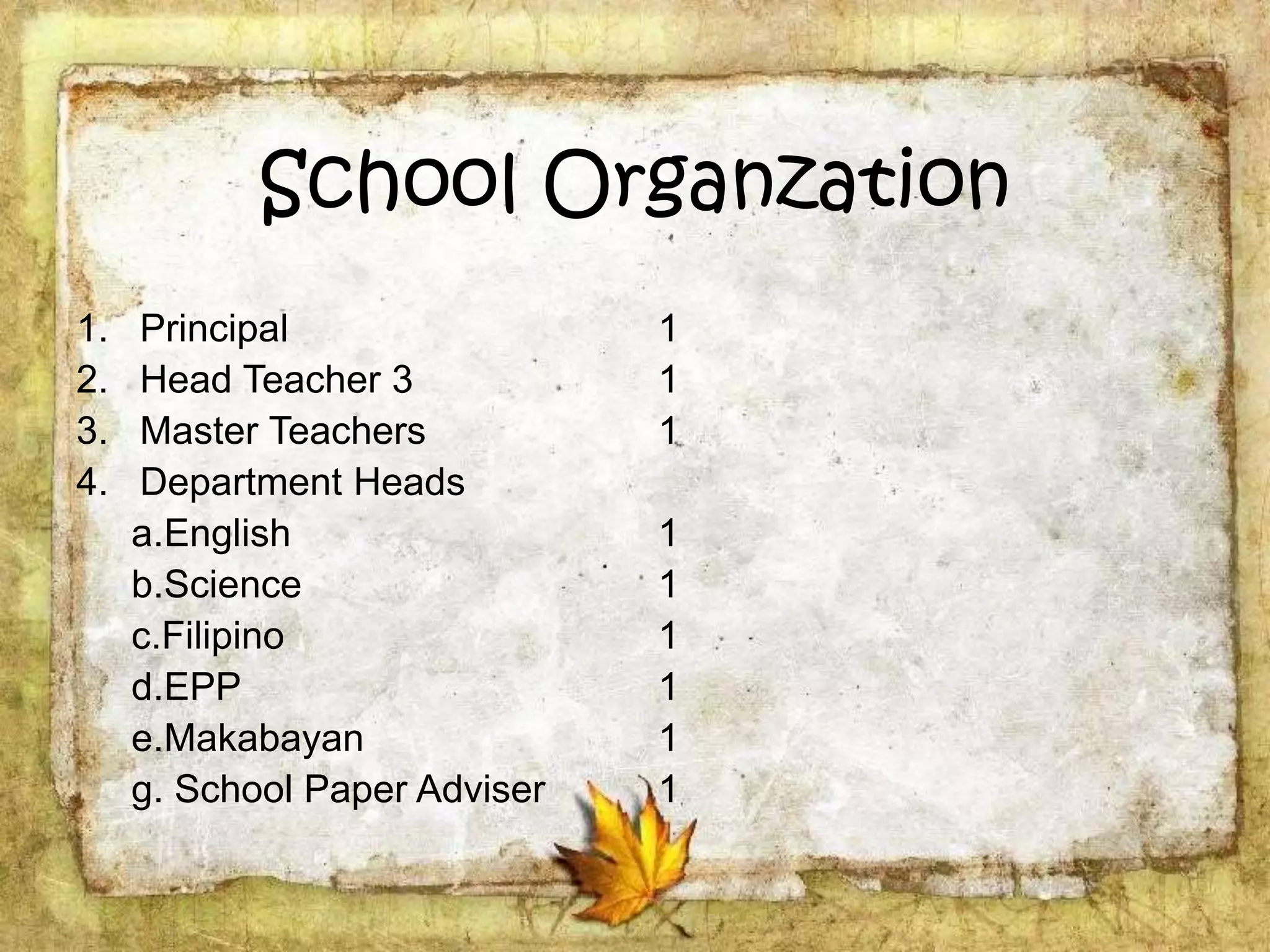
School Organzation
1. Principal
2. Head Teacher 3
3. Master Teachers
4. Department Heads
a.English
b.Science
c.Filipino
d.EPP
e.Makabayan
g. School Paper Adviser
1
1
1
1
1
1
1
1
1
School Organzation
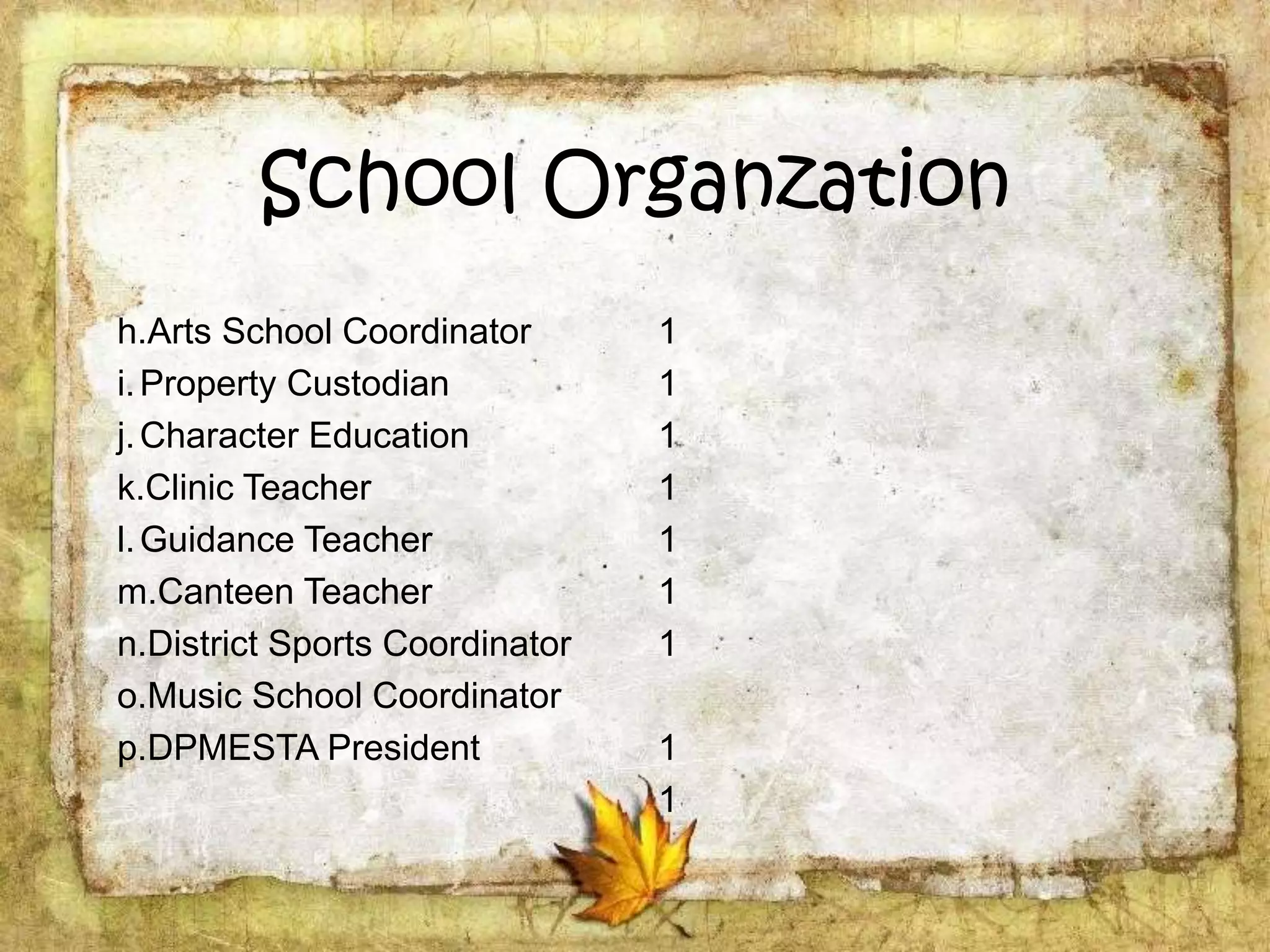
h.Arts School Coordinator
i.Property Custodian
j.Character Education
k.Clinic Teacher
l.Guidance Teacher
m.Canteen Teacher
n.District Sports Coordinator
o.Music School Coordinator
p.DPMESTA President
1
1
1
1
1
1
1
1
1
School Organzation
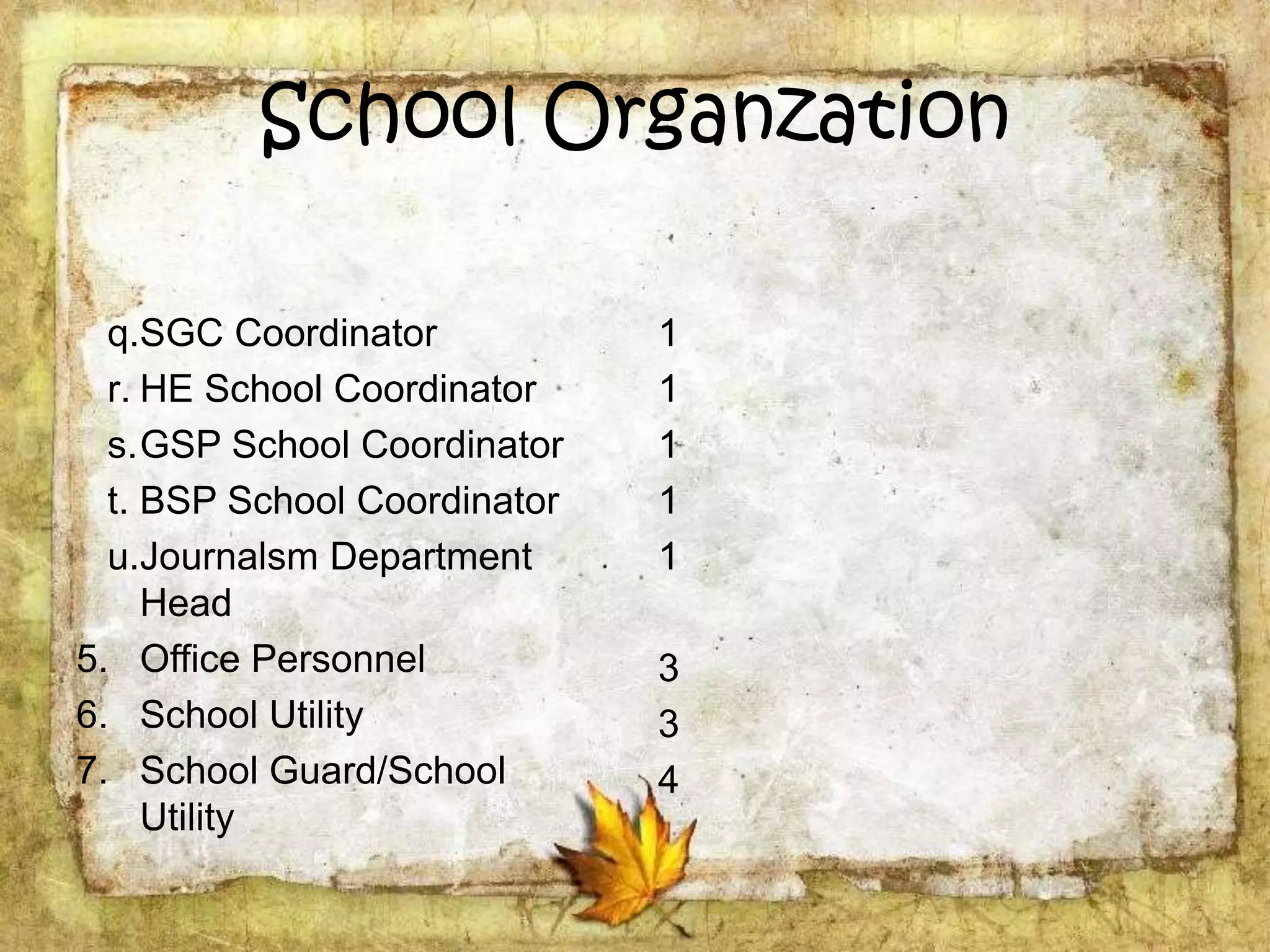
q.SGC Coordinator
r. HE School Coordinator
s.GSP School Coordinator
t. BSP School Coordinator
u.Journalsm Department
Head
5. Office Personnel
6. School Utility
7. School Guard/School
Utility
1
1
1
1
1
3
3
4
School Organzation
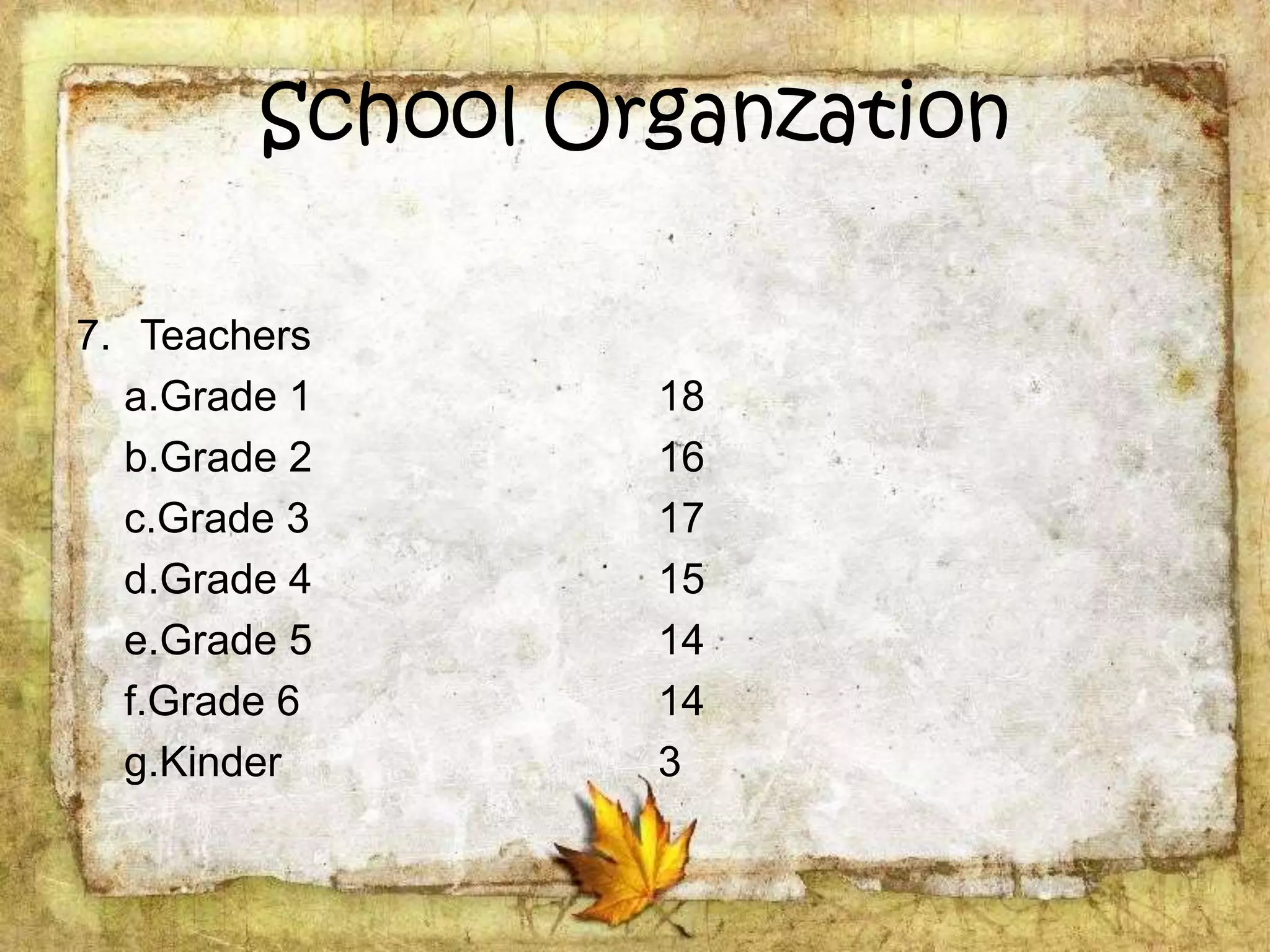
7. Teachers
a.Grade 1
b.Grade 2
c.Grade 3
d.Grade 4
e.Grade 5
f.Grade 6
g.Kinder
18
16
17
15
14
14
3
School Organzation
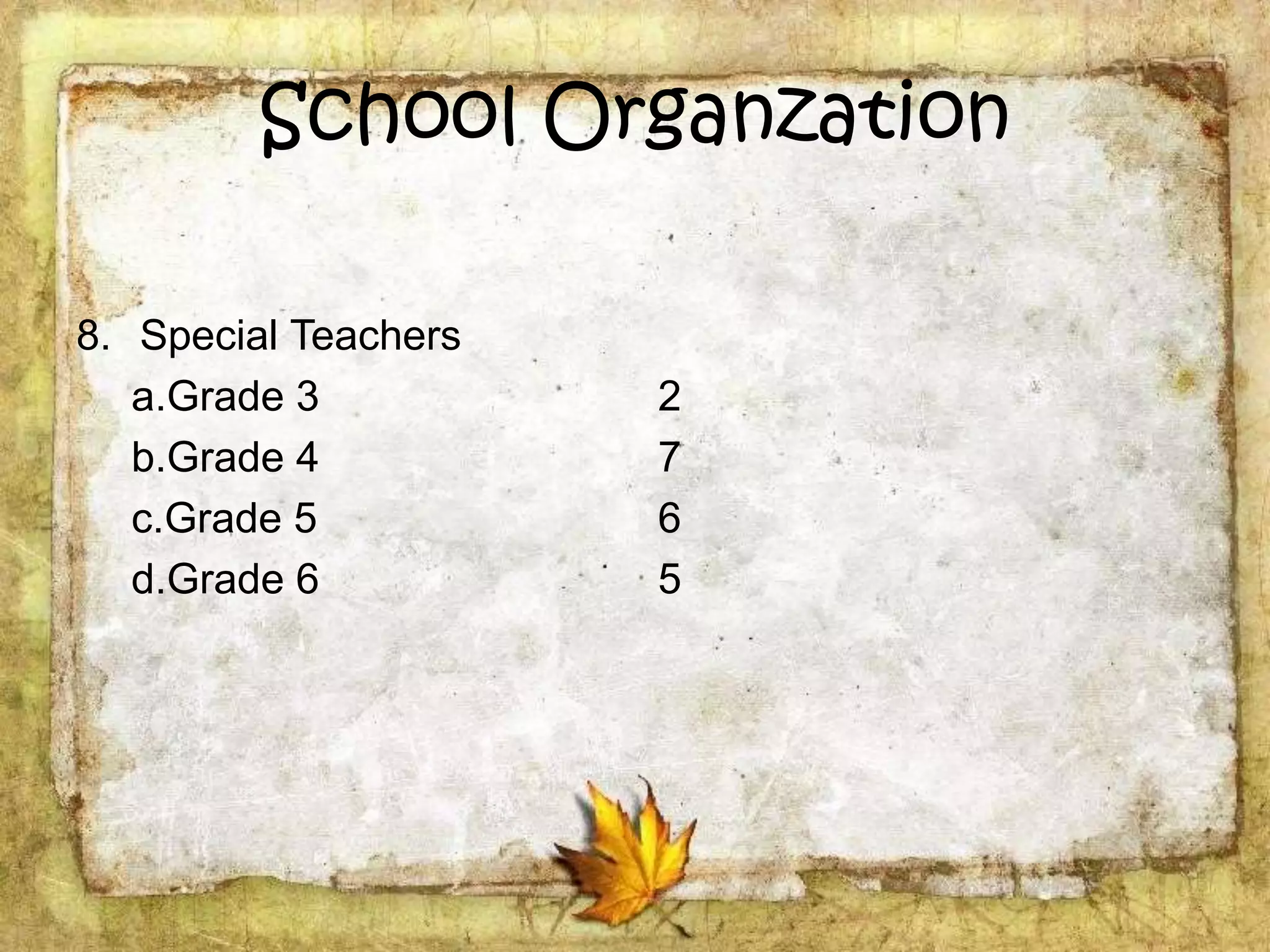
8. Special Teachers
a.Grade 3
b.Grade 4
c.Grade 5
d.Grade 6
2
7
6
5
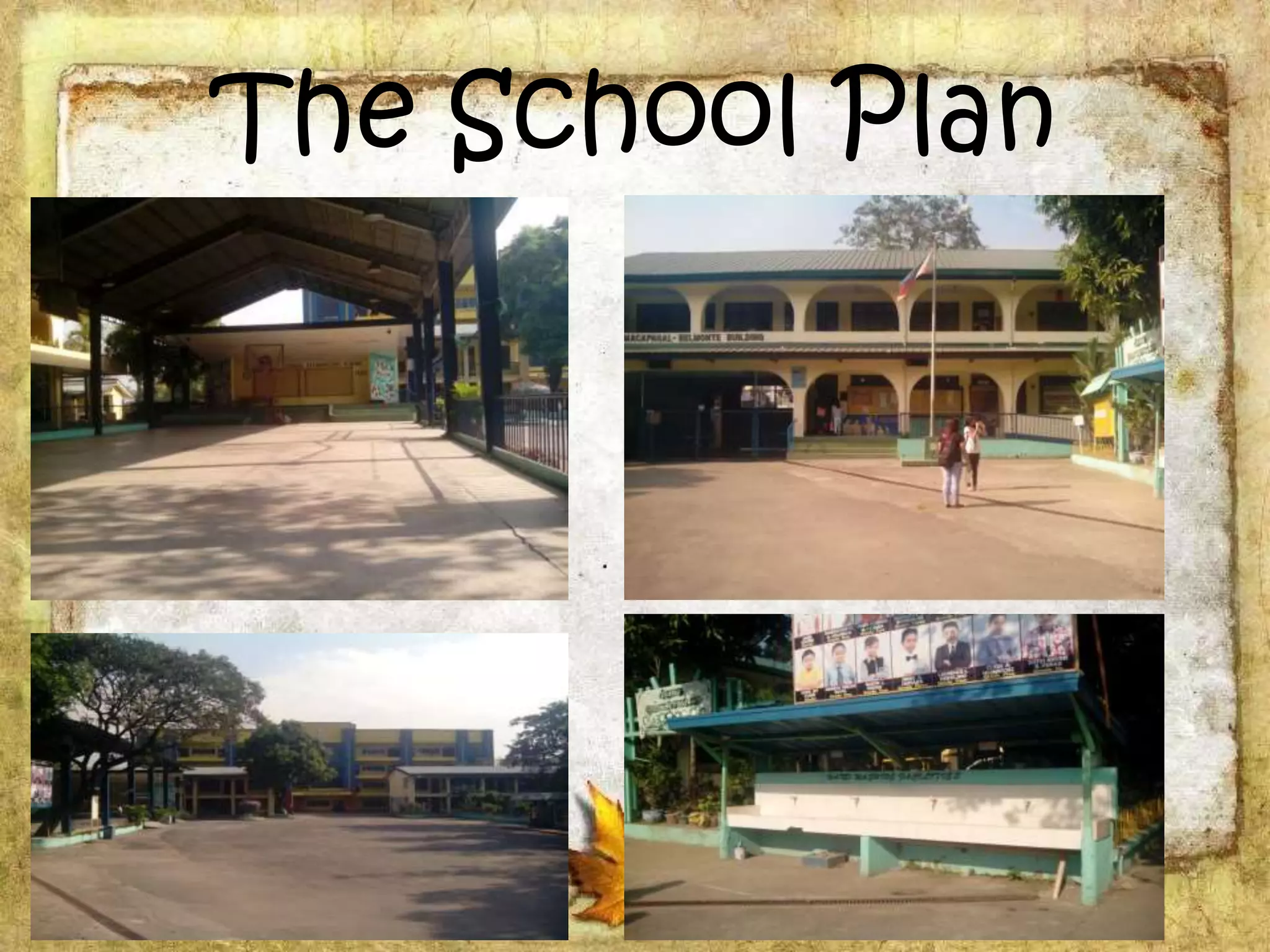
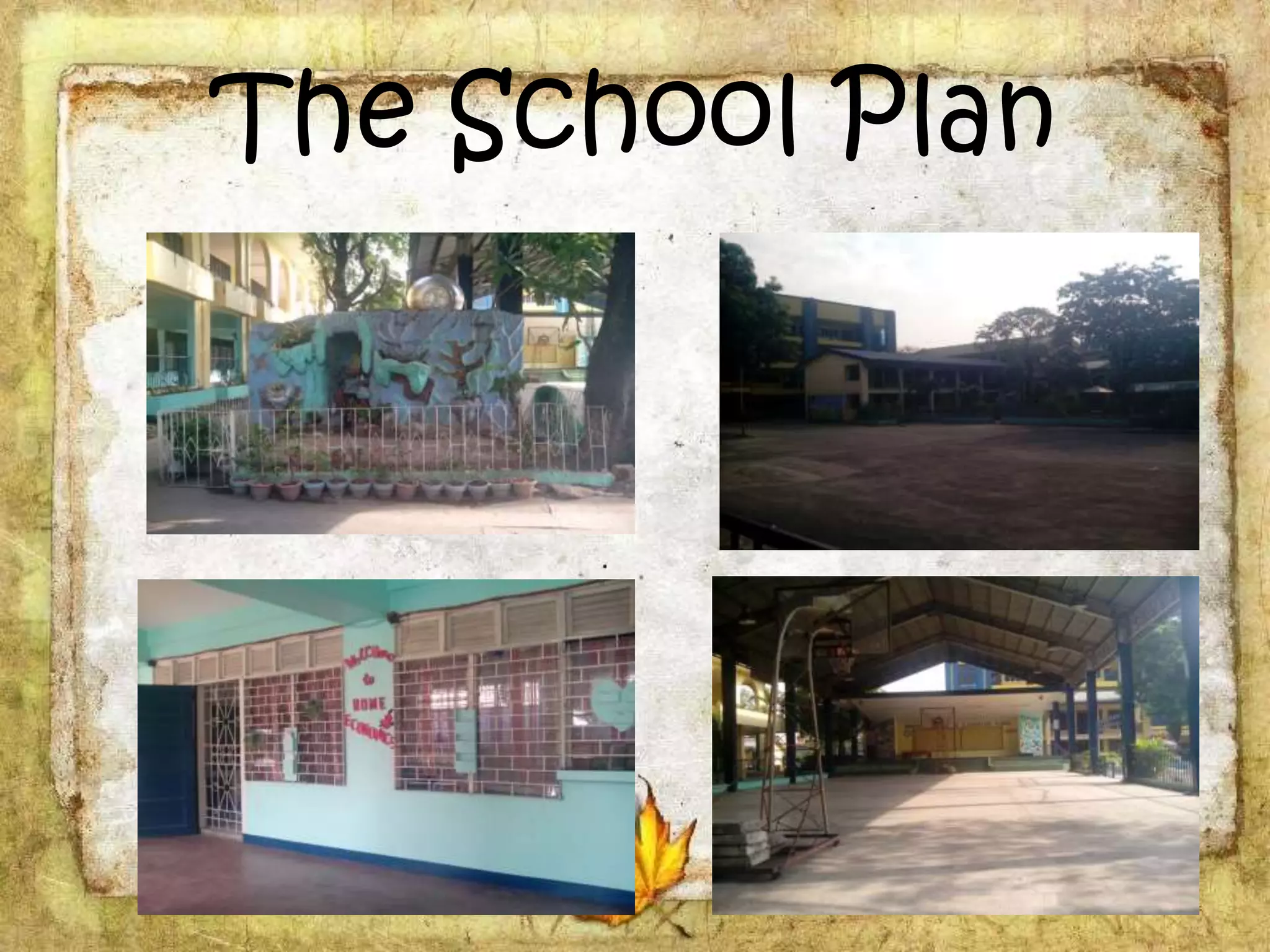
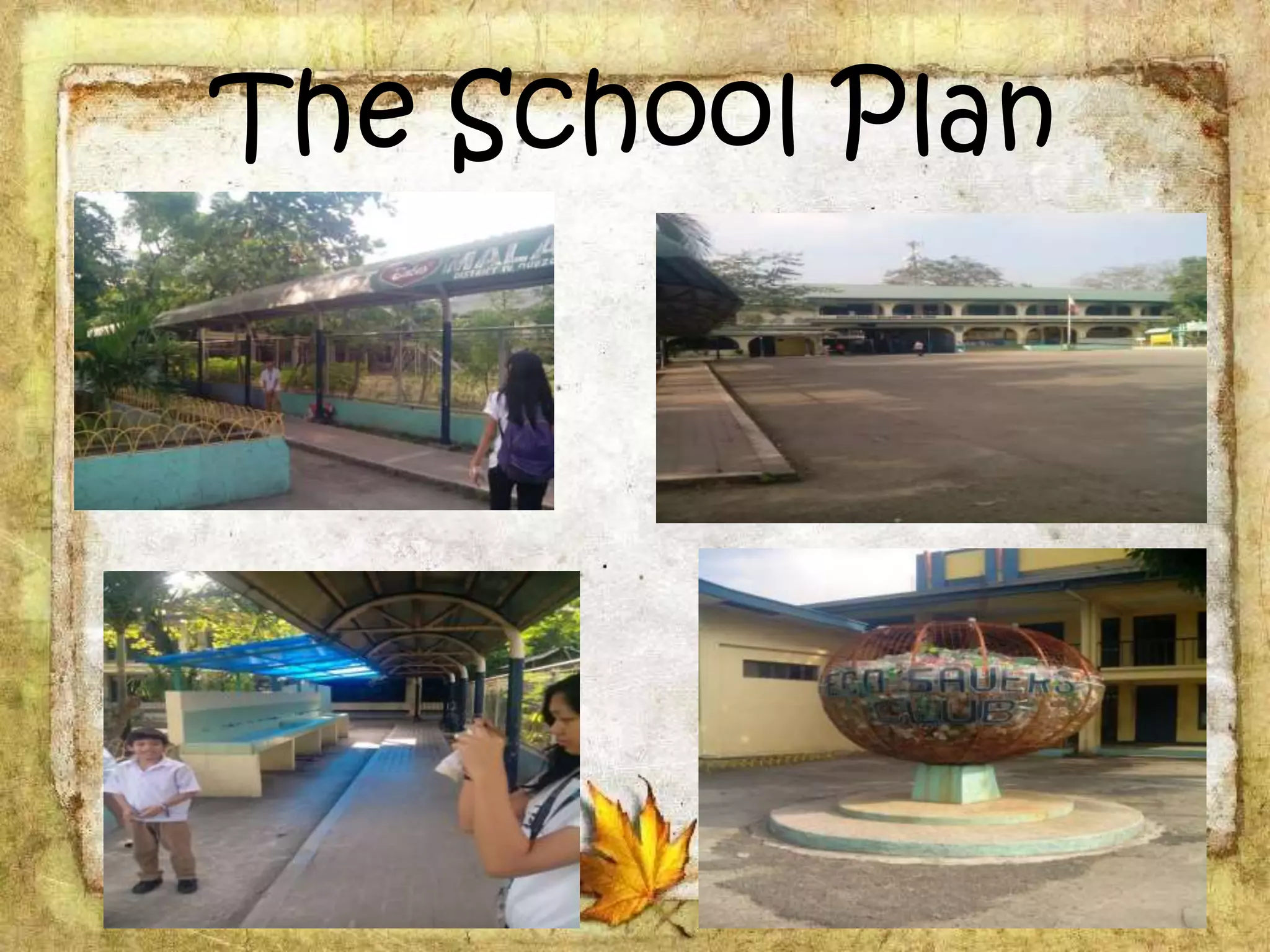
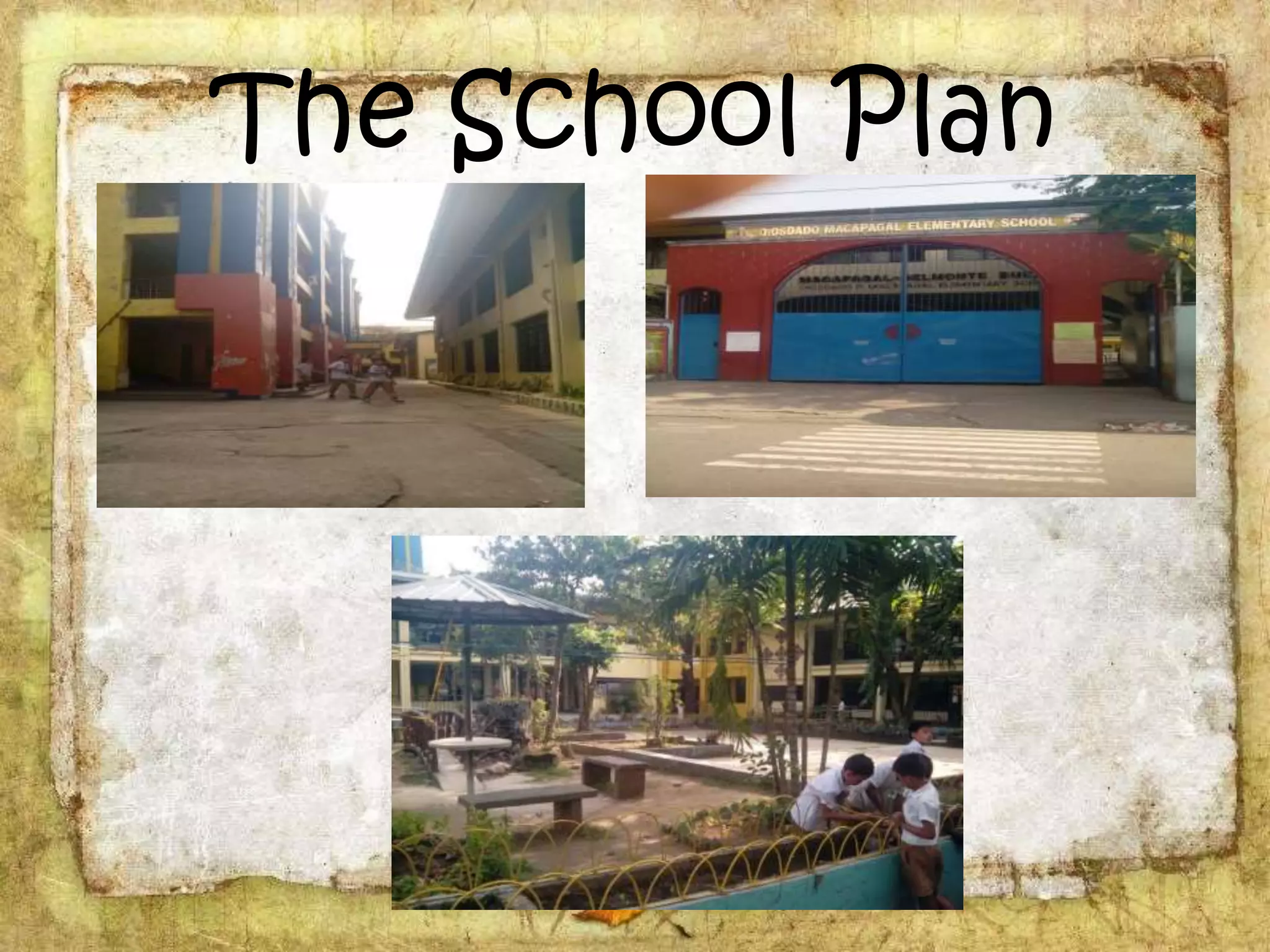
The School Plan
The School Plan
The School Plan
The School Plan
Episode 1
LOOK DEEPER INTO THE
CONCEPTS, NATURE AND
PURPOSES OF THE
CURRICULUM
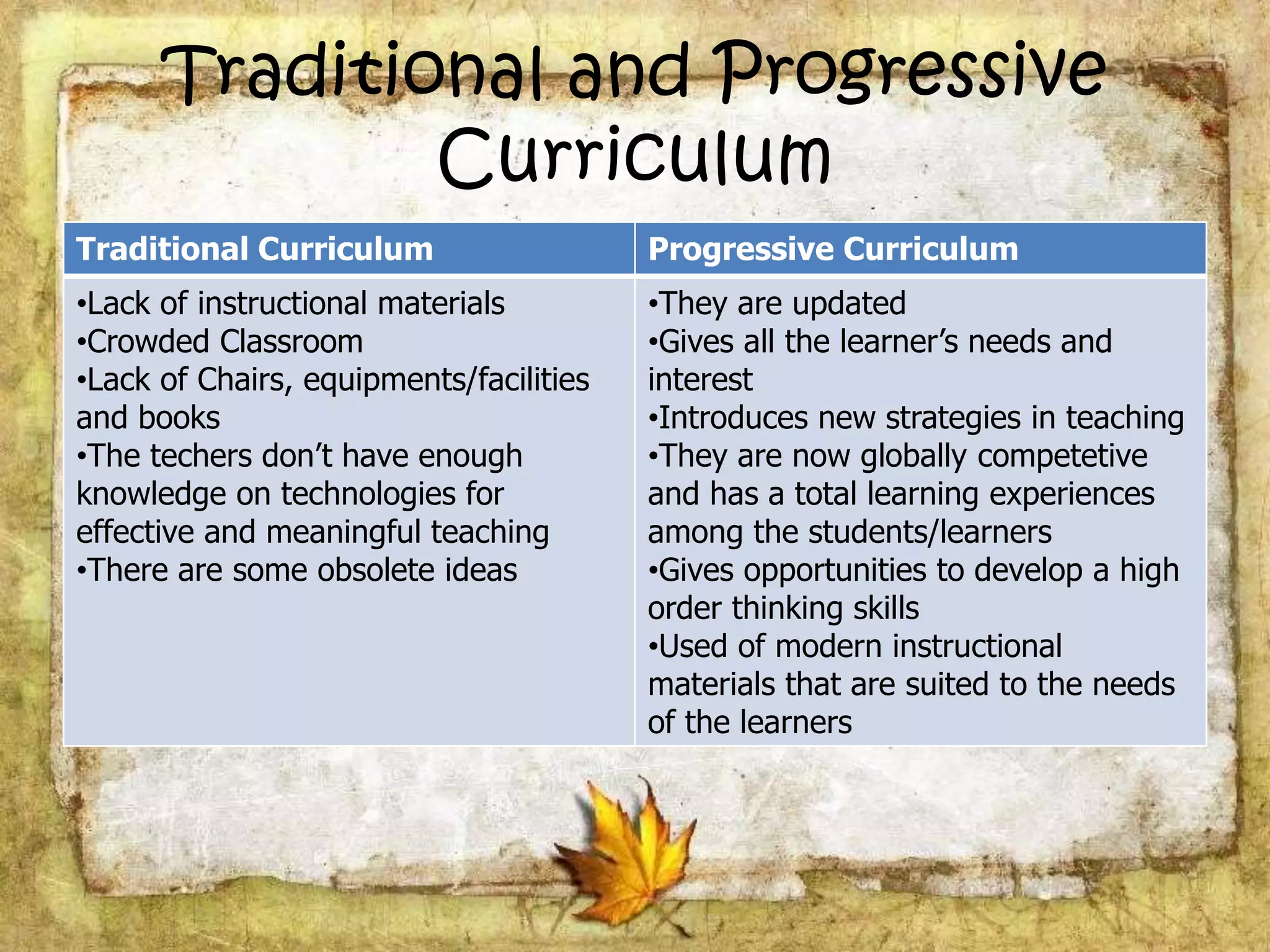
Traditional and Progressive
Curriculum
Traditional Curriculum Progressive Curriculum
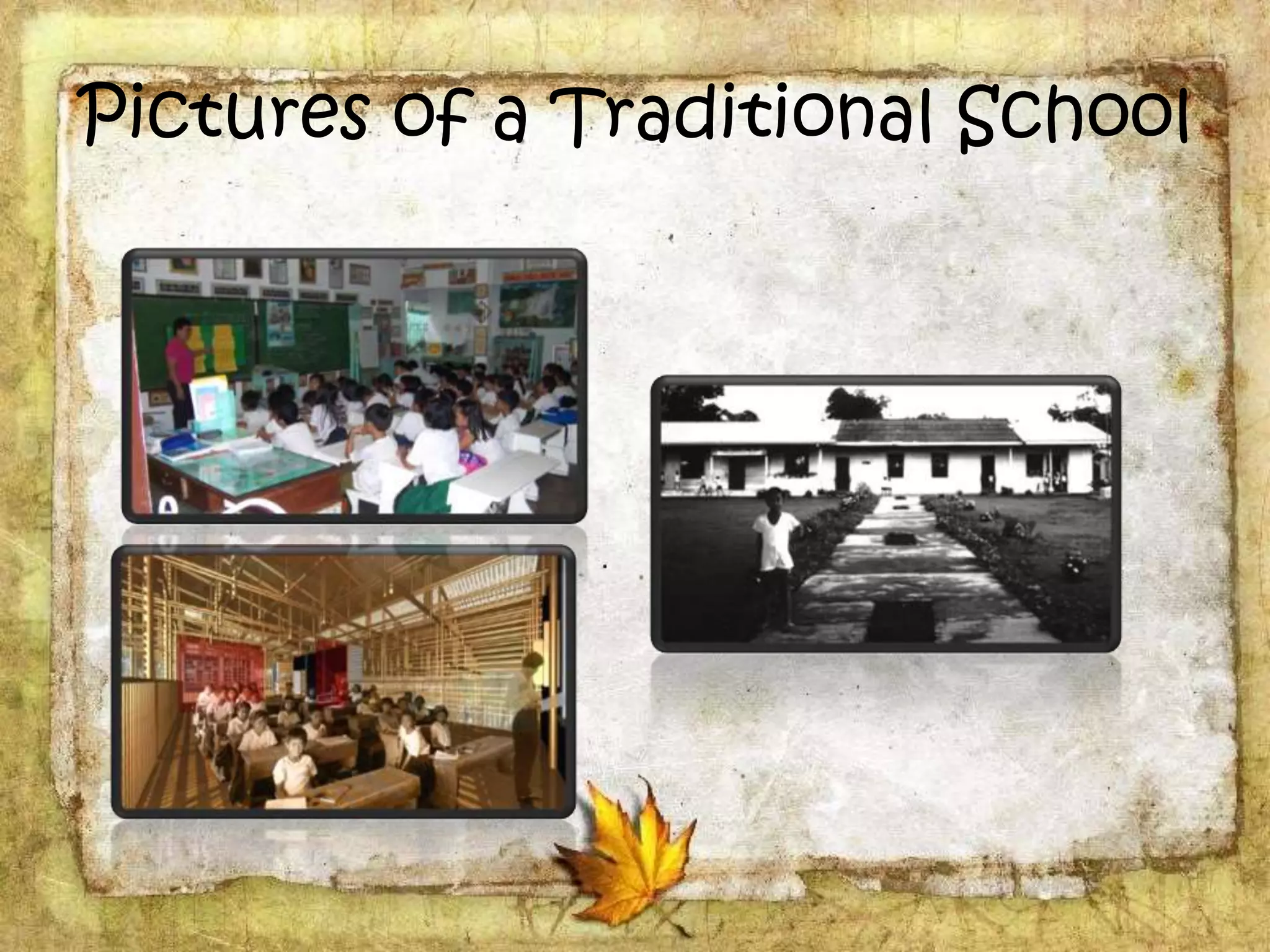
•Lack of instructional materials
•Crowded Classroom
•Lack of Chairs, equipments/facilities
and books
•The techers don’t have enough
knowledge on technologies for
effective and meaningful teaching
•There are some obsolete ideas
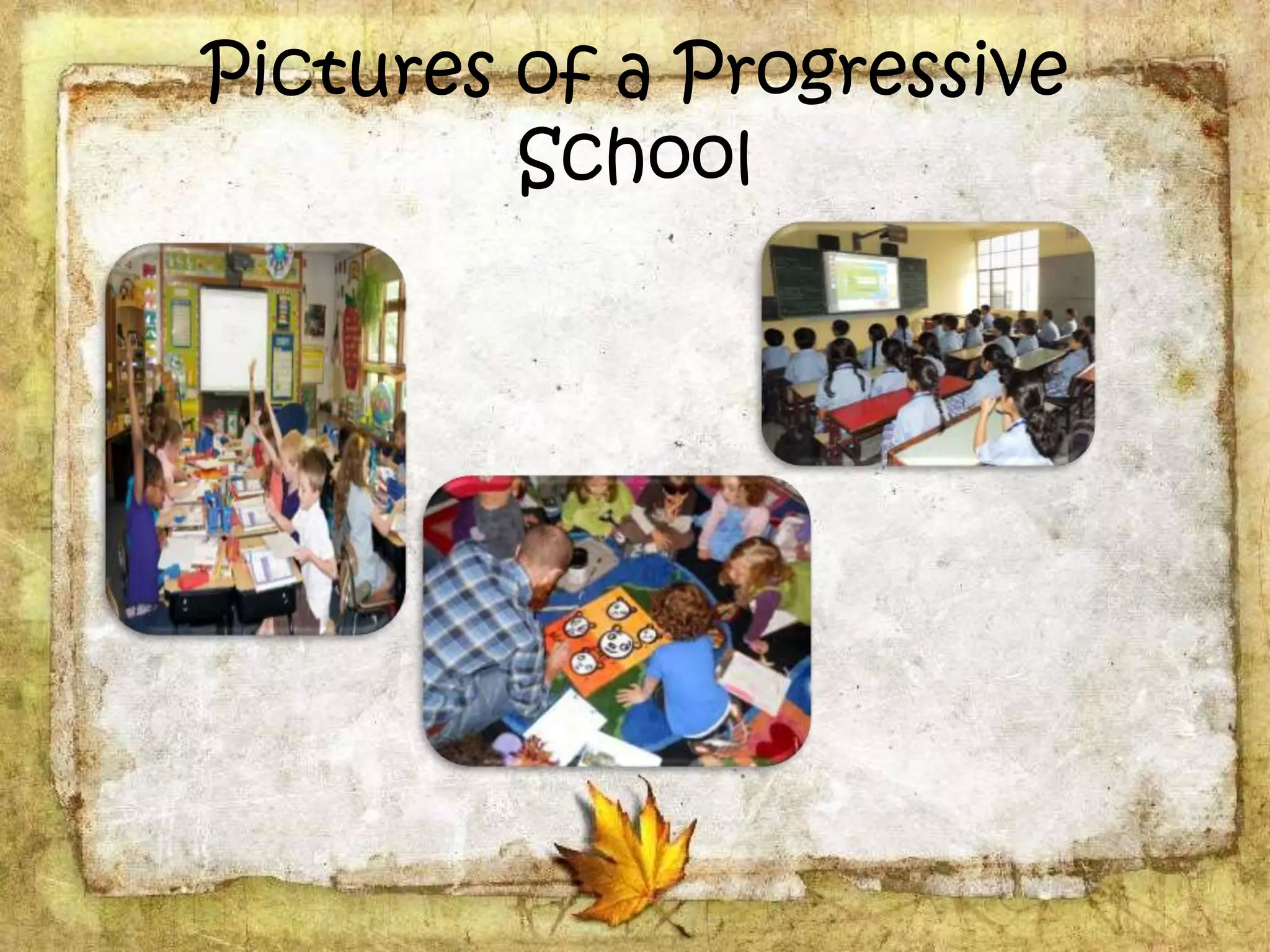
•They are updated
•Gives all the learner’s needs and
interest
•Introduces new strategies in teaching
•They are now globally competetive
and has a total learning experiences
among the students/learners
•Gives opportunities to develop a high
order thinking skills
•Used of modern instructional
materials that are suited to the needs
of the learners
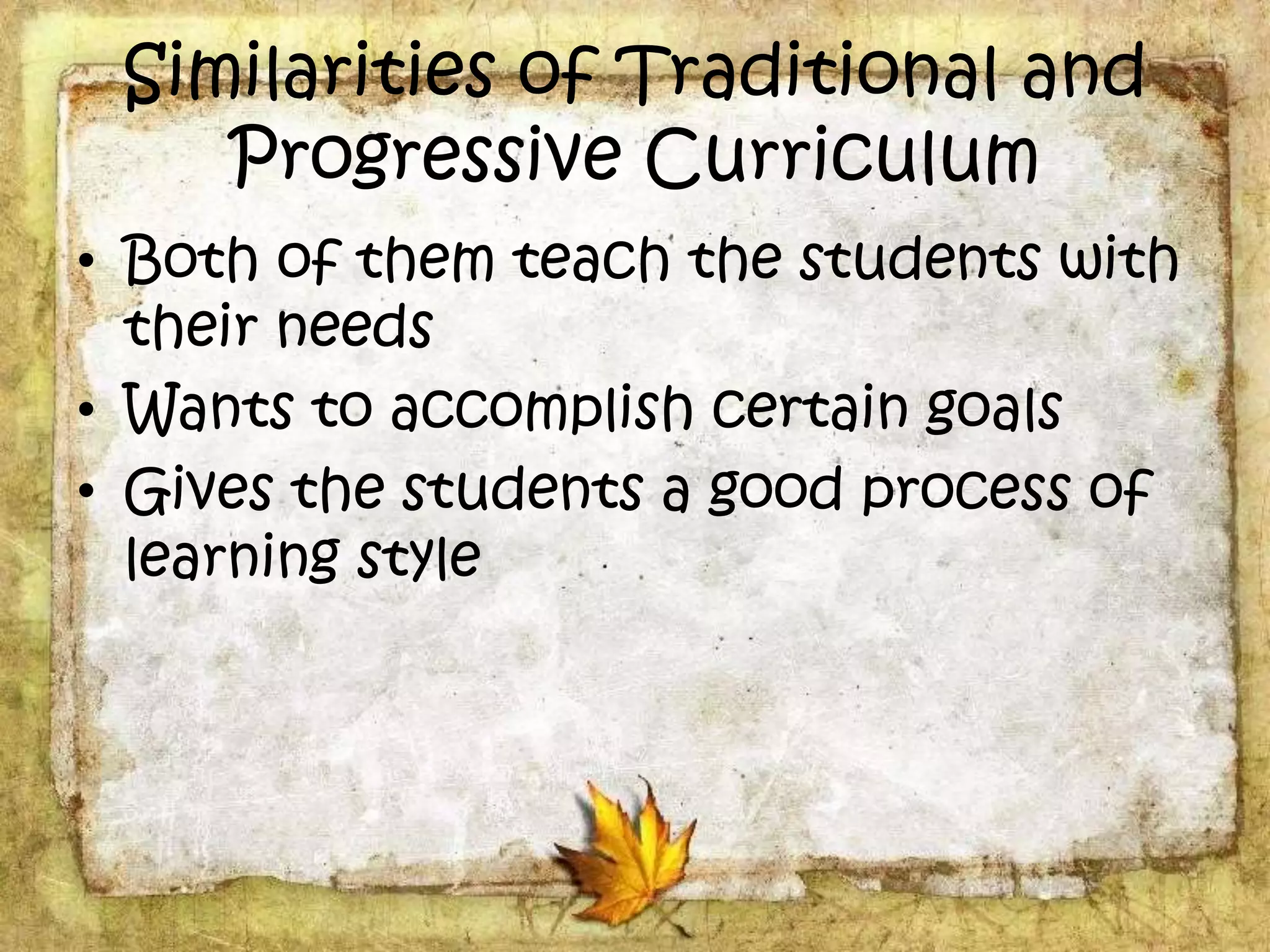
Similarities of Traditional and
Progressive Curriculum
• Both of them teach the students with
their needs
• Wants to accomplish certain goals
• Gives the students a good process of
learning style
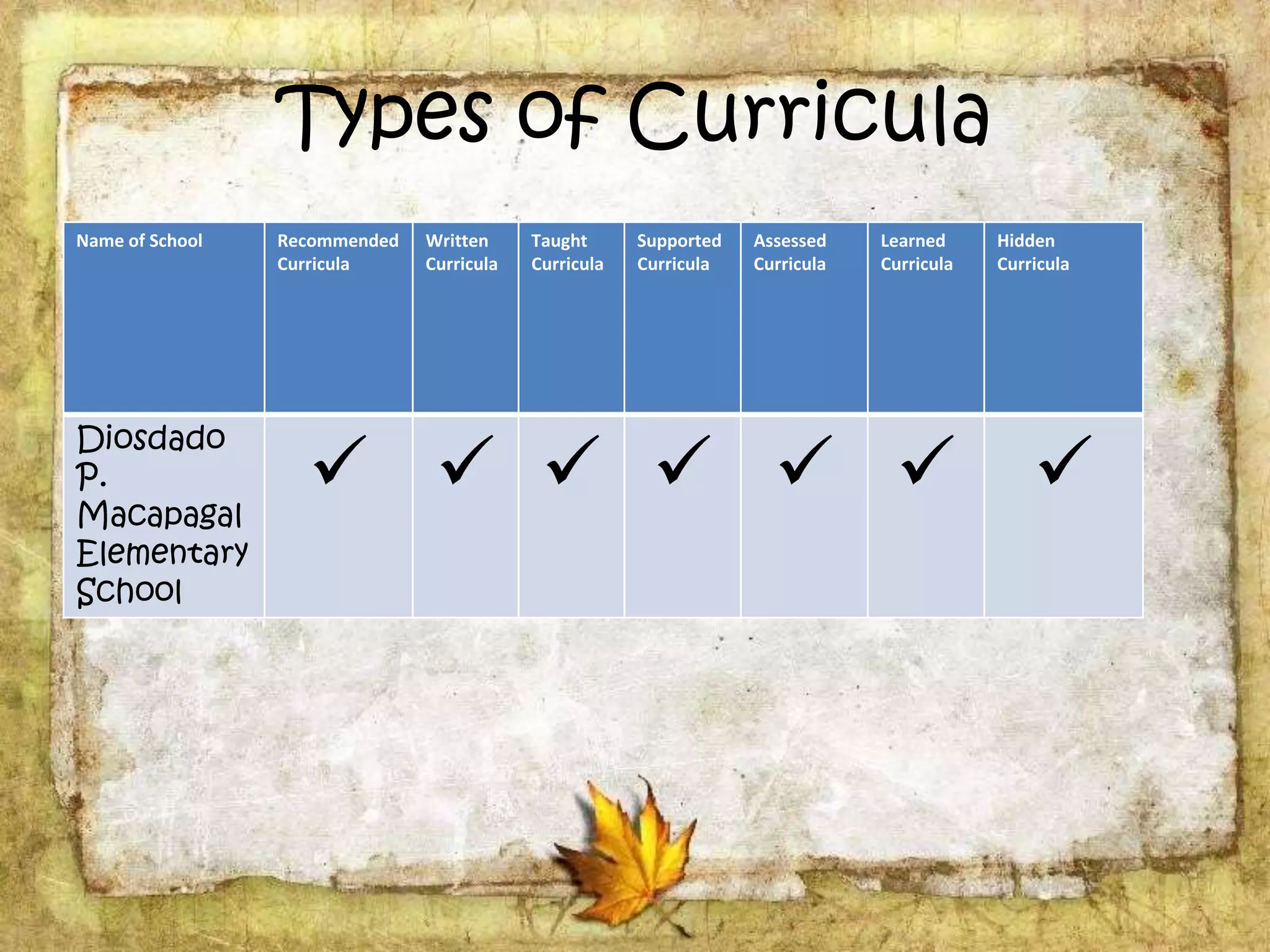
Types of Curricula
Name of School Recommended
Curricula
Written
Curricula
Taught
Curricula
Supported
Curricula
Assessed
Curricula
Learned
Curricula
Hidden
Curricula
Diosdado
P.
Macapagal
Elementary
School
      
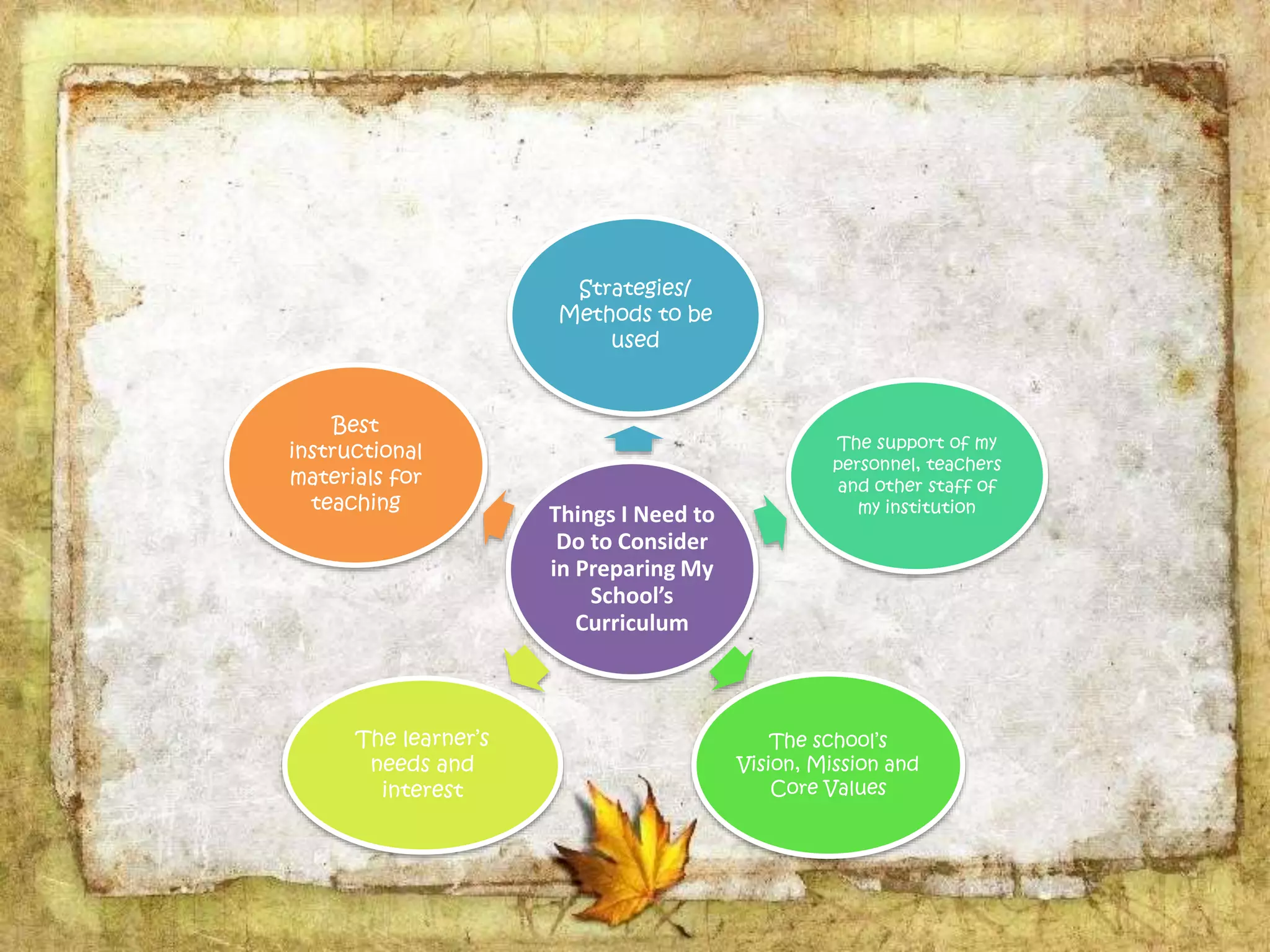
Things I Need to
Do to Consider
in Preparing My
School’s
Curriculum
Strategies/
Methods to be
used
The support of my
personnel, teachers
and other staff of
my institution
The school’s
Vision, Mission and
Core Values
The learner’s
needs and
interest
Best
instructional
materials for
teaching
Pictures of a Traditional School
Pictures of a Progressive
School
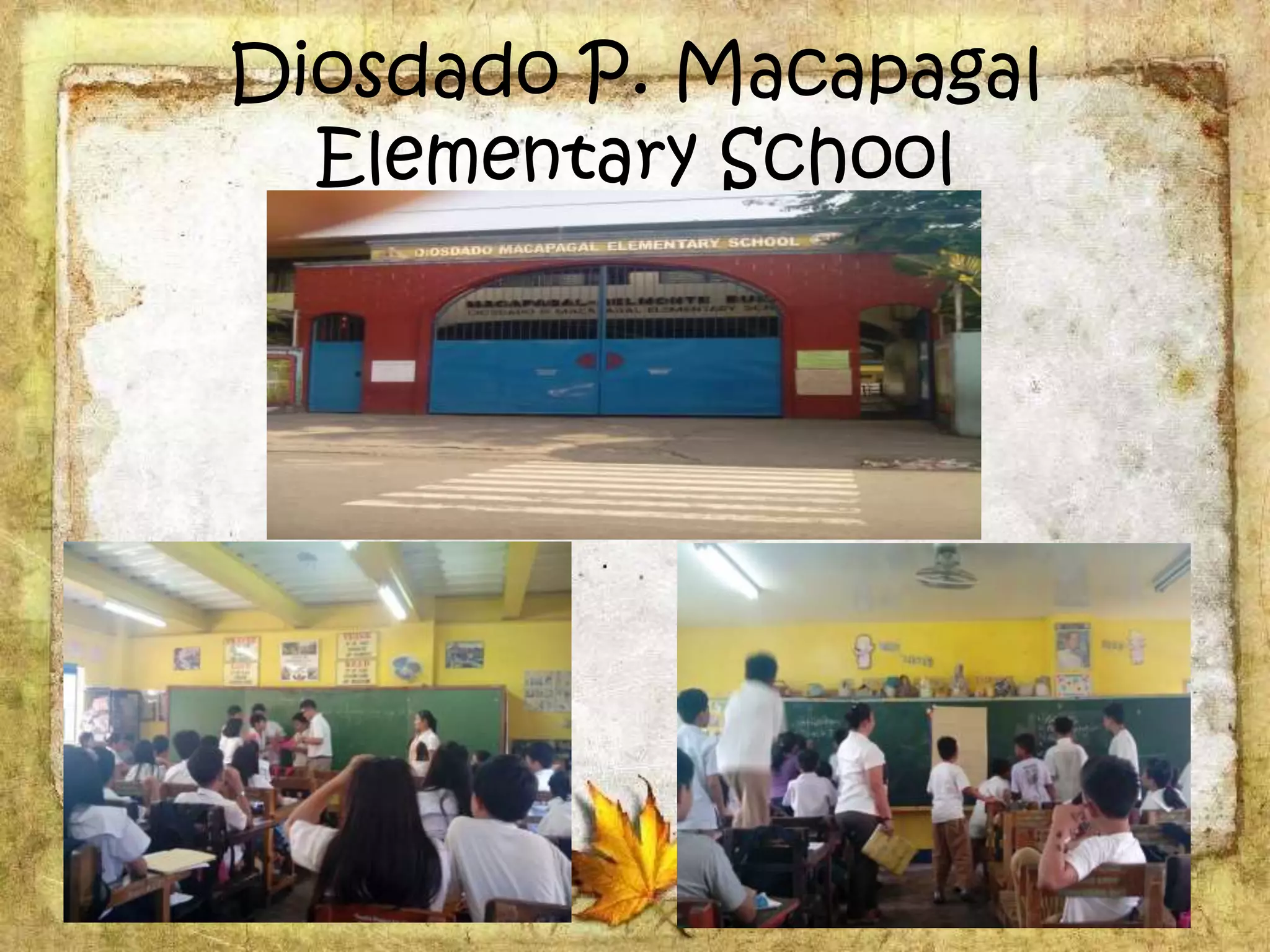
Diosdado P. Macapagal
Elementary School
Episode 2
WHAT’S THE CURRICULUM
MADE OF?
DIOSDADO P. MACAPAGAL
ELEMENTARY SCHOOL
MISSION AND VISION
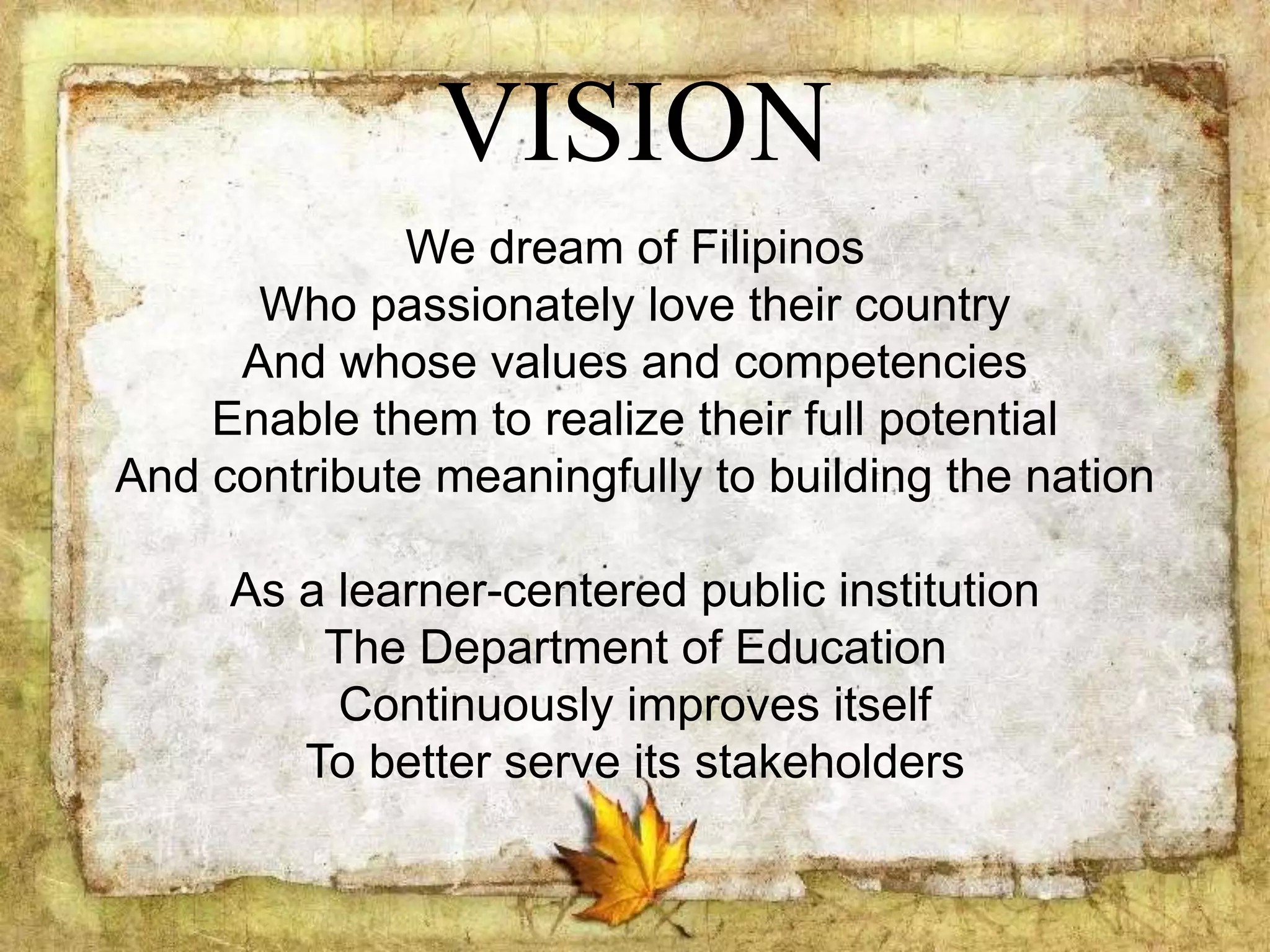
VISION
We dream of Filipinos
Who passionately love their country
And whose values and competencies
Enable them to realize their full potential
And contribute meaningfully to building the nation
As a learner-centered public institution
The Department of Education
Continuously improves itself
To better serve its stakeholders
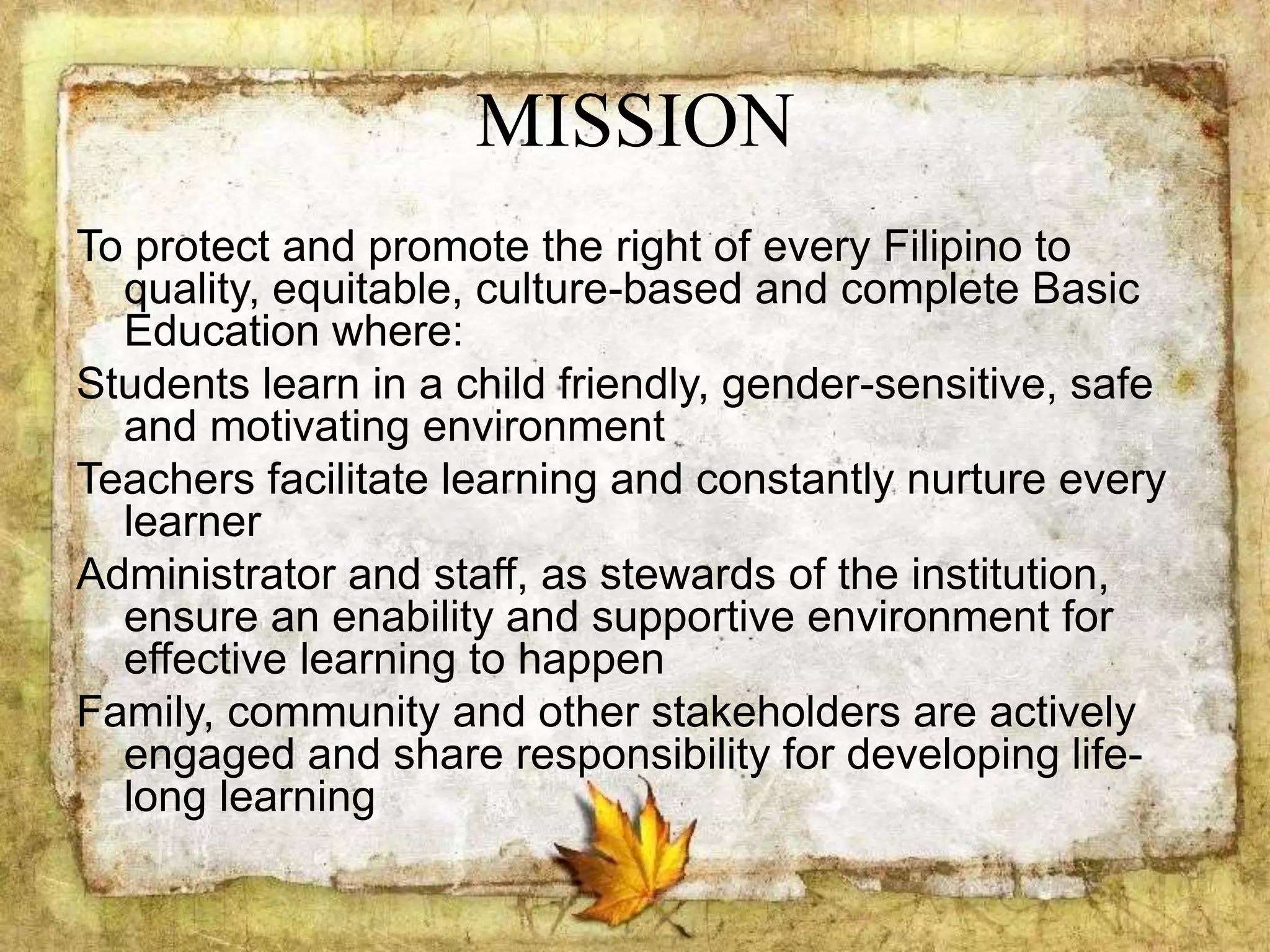
MISSION
To protect and promote the right of every Filipino to
quality, equitable, culture-based and complete Basic
Education where:
Students learn in a child friendly, gender-sensitive, safe
and motivating environment
Teachers facilitate learning and constantly nurture every
learner
Administrator and staff, as stewards of the institution,
ensure an enability and supportive environment for
effective learning to happen
Family, community and other stakeholders are actively
engaged and share responsibility for developing life-
long learning
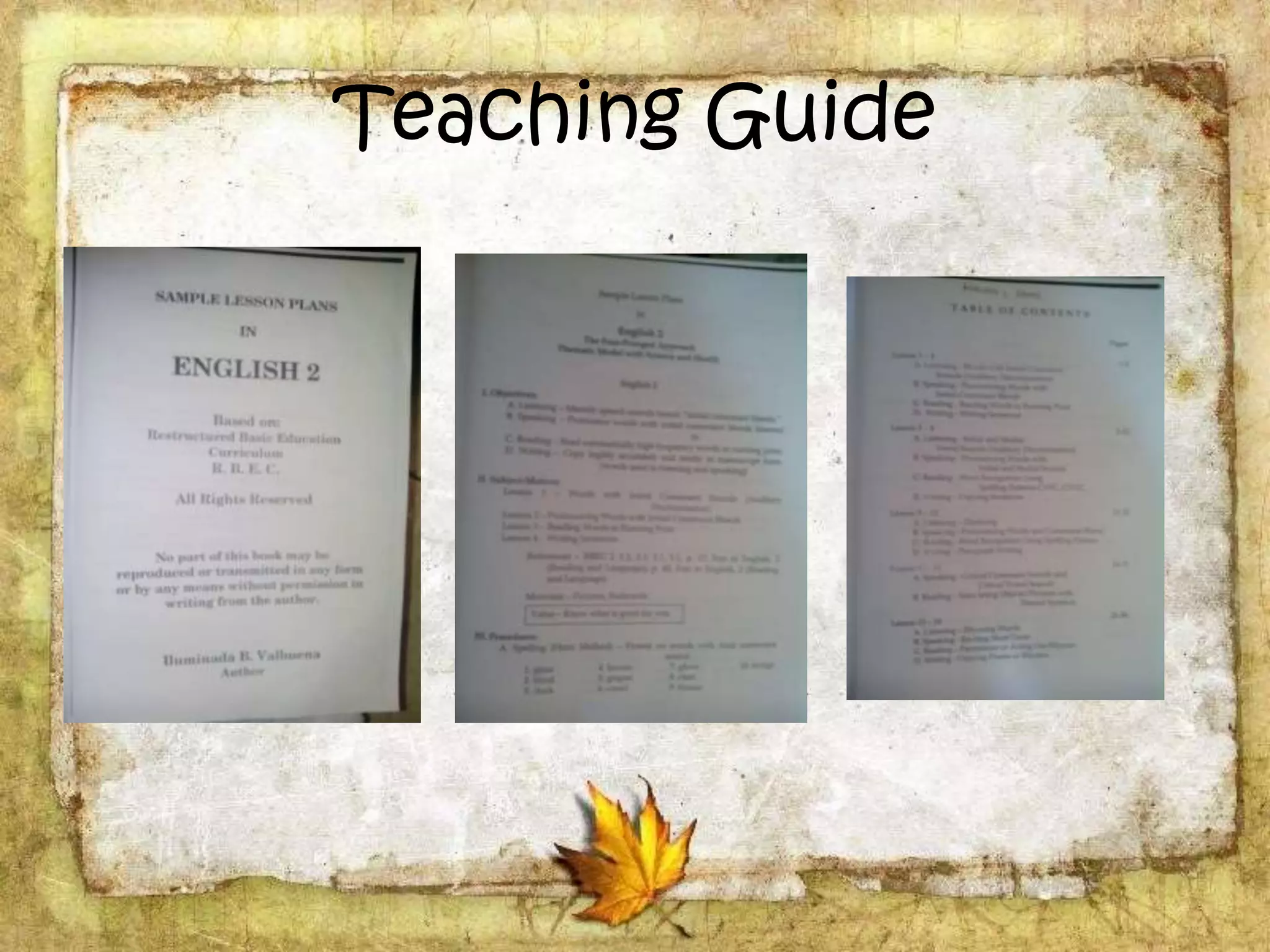
Teaching Guide
Episode 3
WHAT’S NEW IN TEACHING
AND LEARNING
SERIES OF ACTIONS IN THE
TEACHING PROCESS
PLAN
IMPLEMENT
EVALUATE
PLAN
• LESSON PLAN
• ACTION PLAN (Activites for the
whole year)
• PTA MEETING
IMPLEMENT
• TEACHING MATERIALS (not
enough)
• SUPPORT OF THE PRINCIPAL
• DepED MEMOS
• USE OF GUIDE
• PTA MEETING
EVALUATE
• QUIZZES
• PERIODICAL EXAMS
• BEHAVIORAL OBSERVATIONS
• NAT (National Achievement Test)
• PHIL-IRI INVENTORY (Reading
Capacity)
LEARNING THEORIES
BEHAVIORAL LEARNING THEORIES
COGNITIVE LEARNING THEORIES
DISCOVERY LEARNING
RECEPTION LEARNING
BEHAVIORAL LEARNING
THEORIES
• It happens during group activities and P.E
• Art activities
COGNITIVE LEARNING
THEORIES
• Activities and quizzes in Mathematics and
Science
DISCOVERY LEARNING
• EPP activities also like planting and cooking
RECEPTION LEARNING
• EPP practical work like cooking, stitching, and
cross stitch.
TEACHING-
LEARNING PROCESS
Episode 4
LET’S CRAFT THE
CURRICULUM
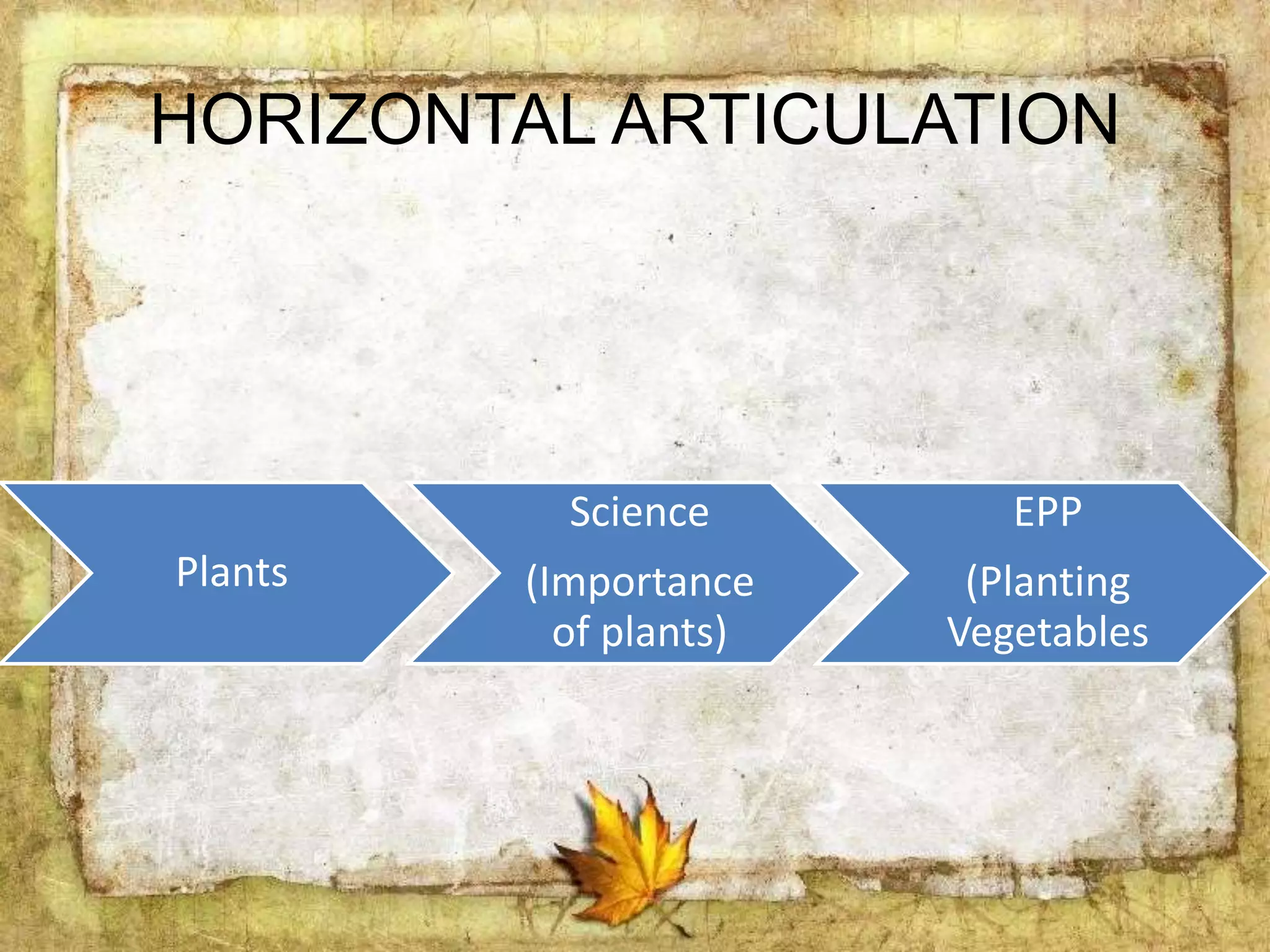
HORIZONTAL ARTICULATION
Plants
Science
(Importance
of plants)
EPP
(Planting
Vegetables
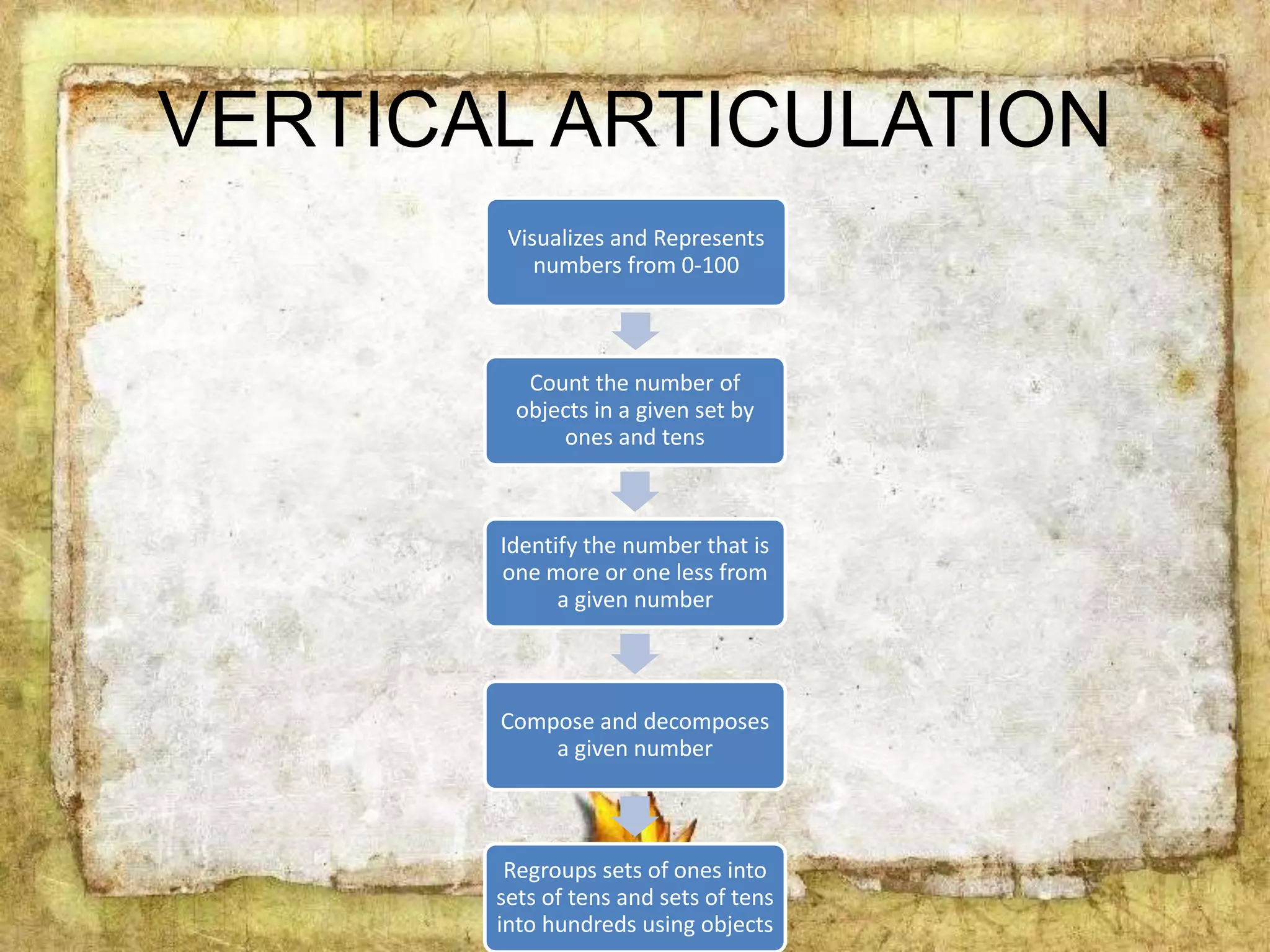
VERTICAL ARTICULATION
Visualizes and Represents
numbers from 0-100
Count the number of
objects in a given set by
ones and tens
Identify the number that is
one more or one less from
a given number
Compose and decomposes
a given number
Regroups sets of ones into
sets of tens and sets of tens
into hundreds using objects
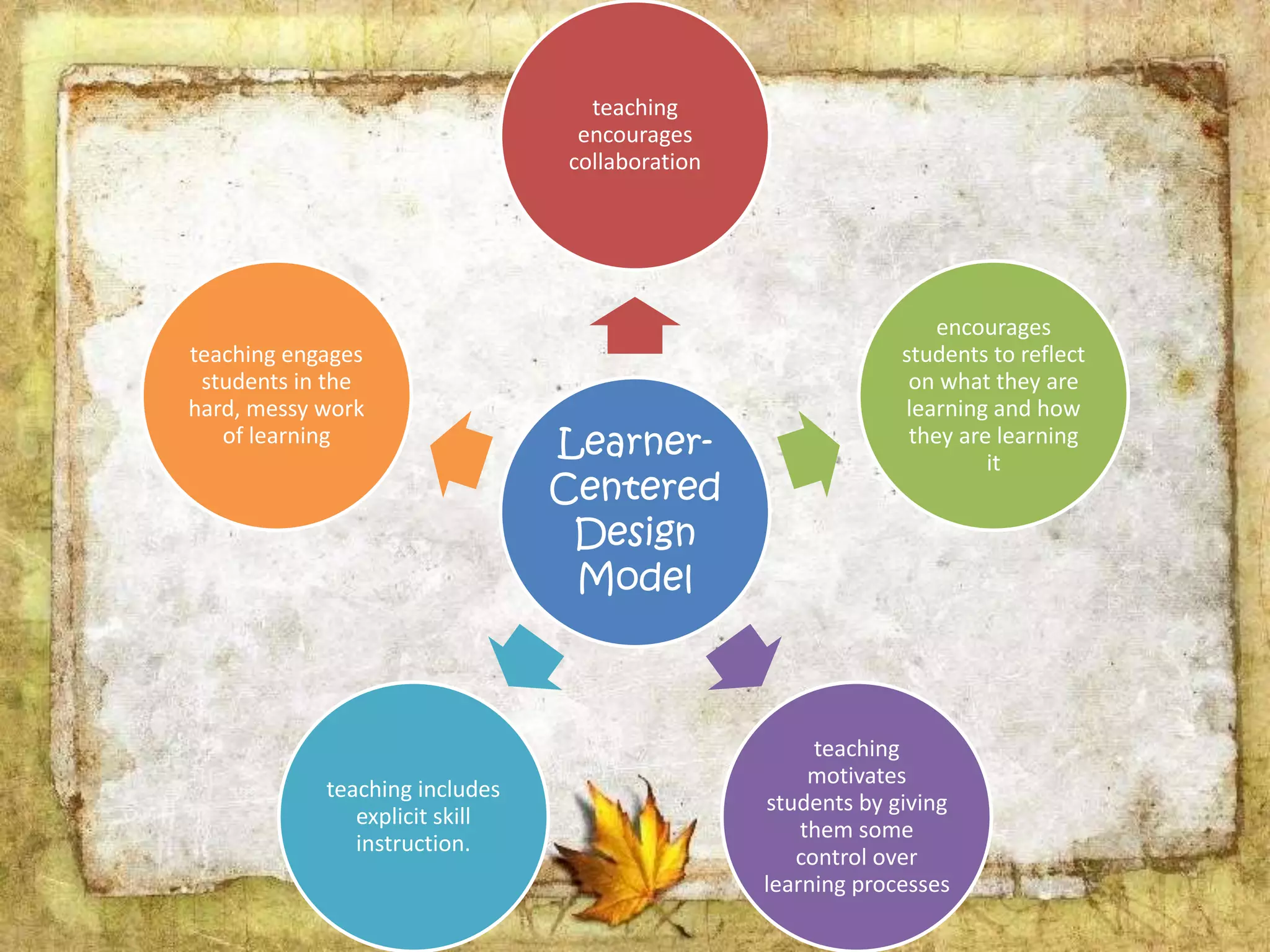
Learner-
Centered
Design
Model
teaching
encourages
collaboration
encourages
students to reflect
on what they are
learning and how
they are learning
it
teaching
motivates
students by giving
them some
control over
learning processes
teaching includes
explicit skill
instruction.
teaching engages
students in the
hard, messy work
of learning
Episode 5
WHAT’S THE BASIC OF THE
CURRICULUM
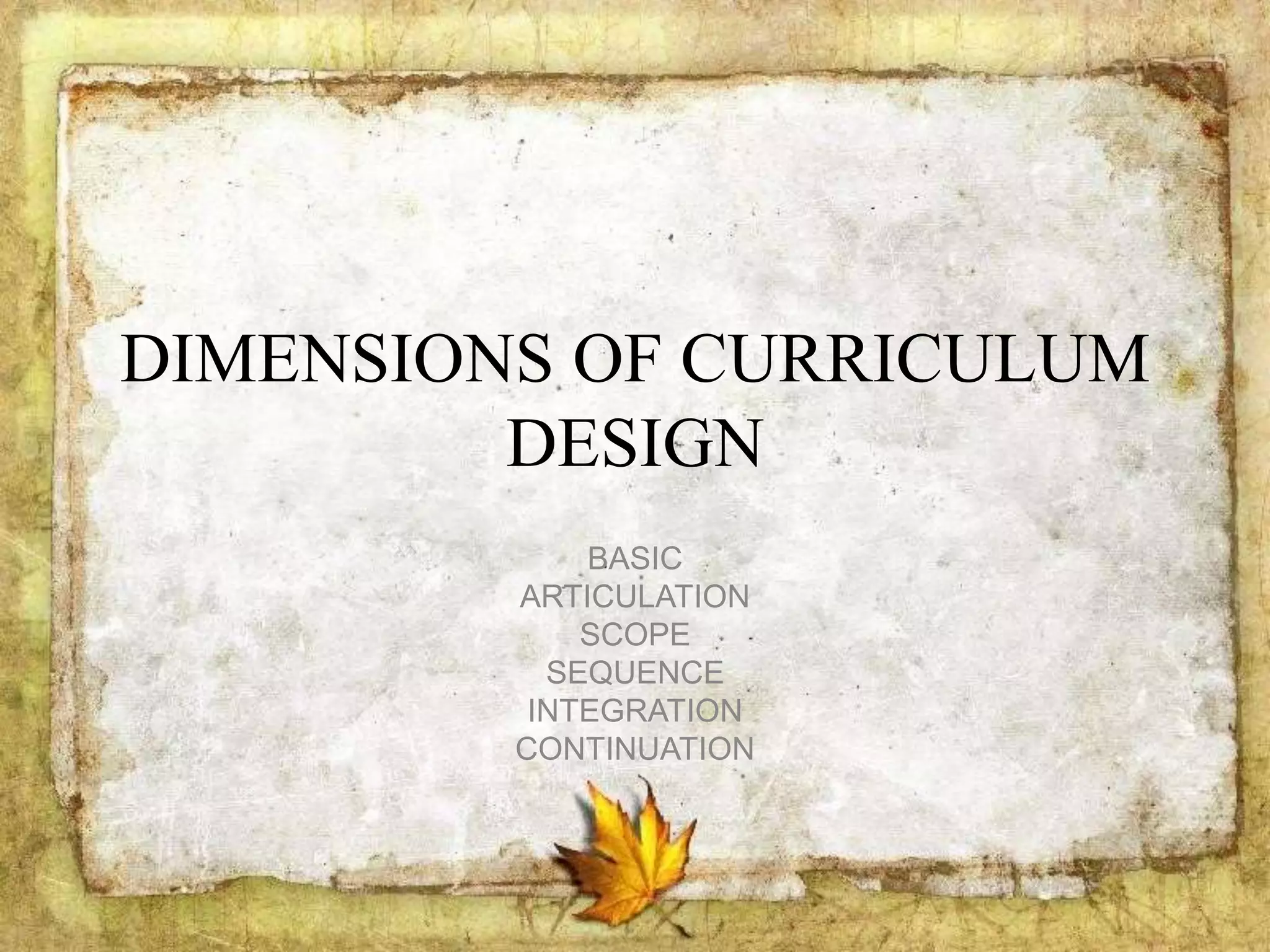
DIMENSIONS OF CURRICULUM
DESIGN
BASIC
ARTICULATION
SCOPE
SEQUENCE
INTEGRATION
CONTINUATION
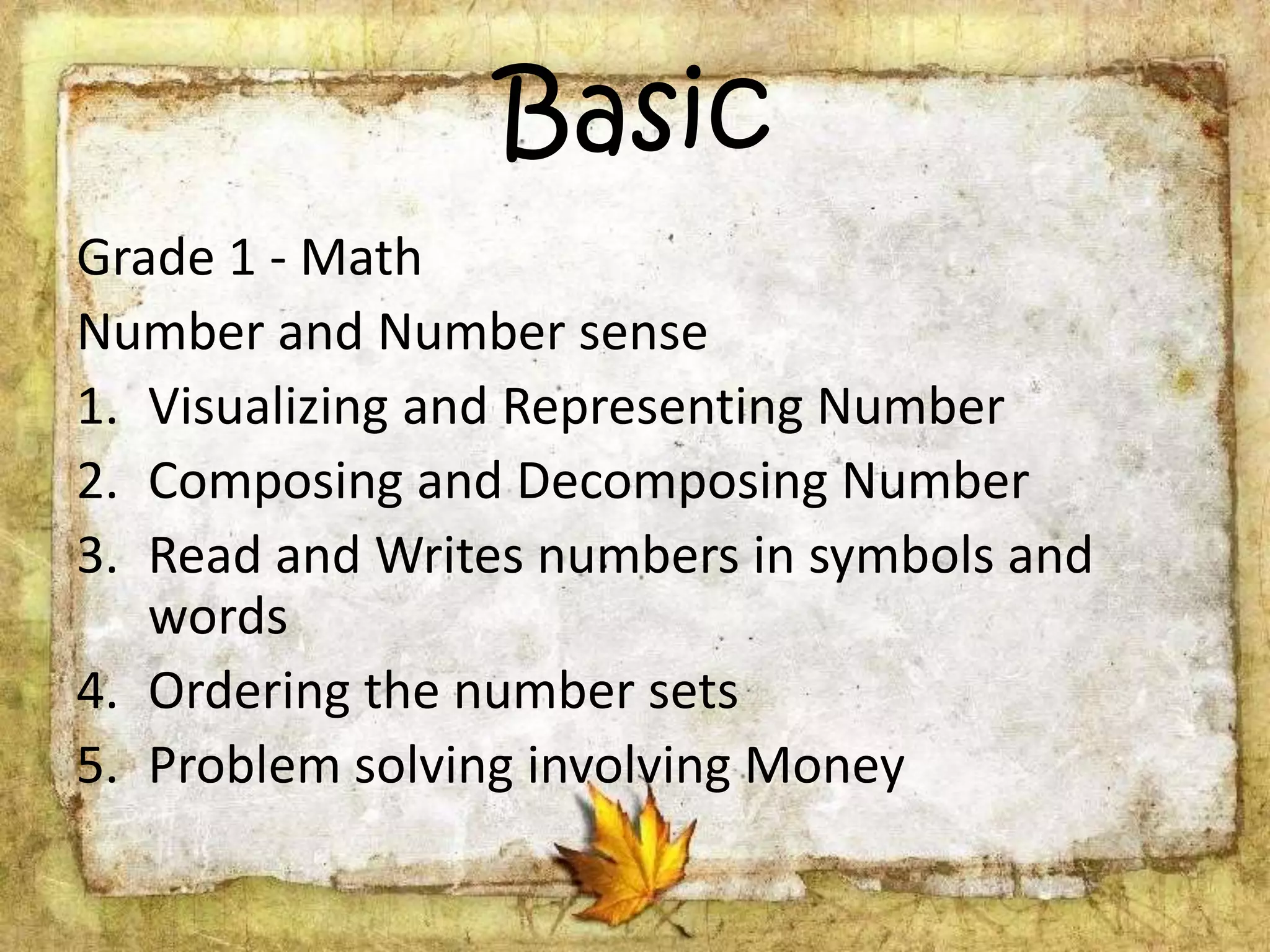
Basic
Grade 1 - Math
Number and Number sense
1. Visualizing and Representing Number
2. Composing and Decomposing Number
3. Read and Writes numbers in symbols and
words
4. Ordering the number sets
5. Problem solving involving Money
Articulation
Horizontal
Vertical
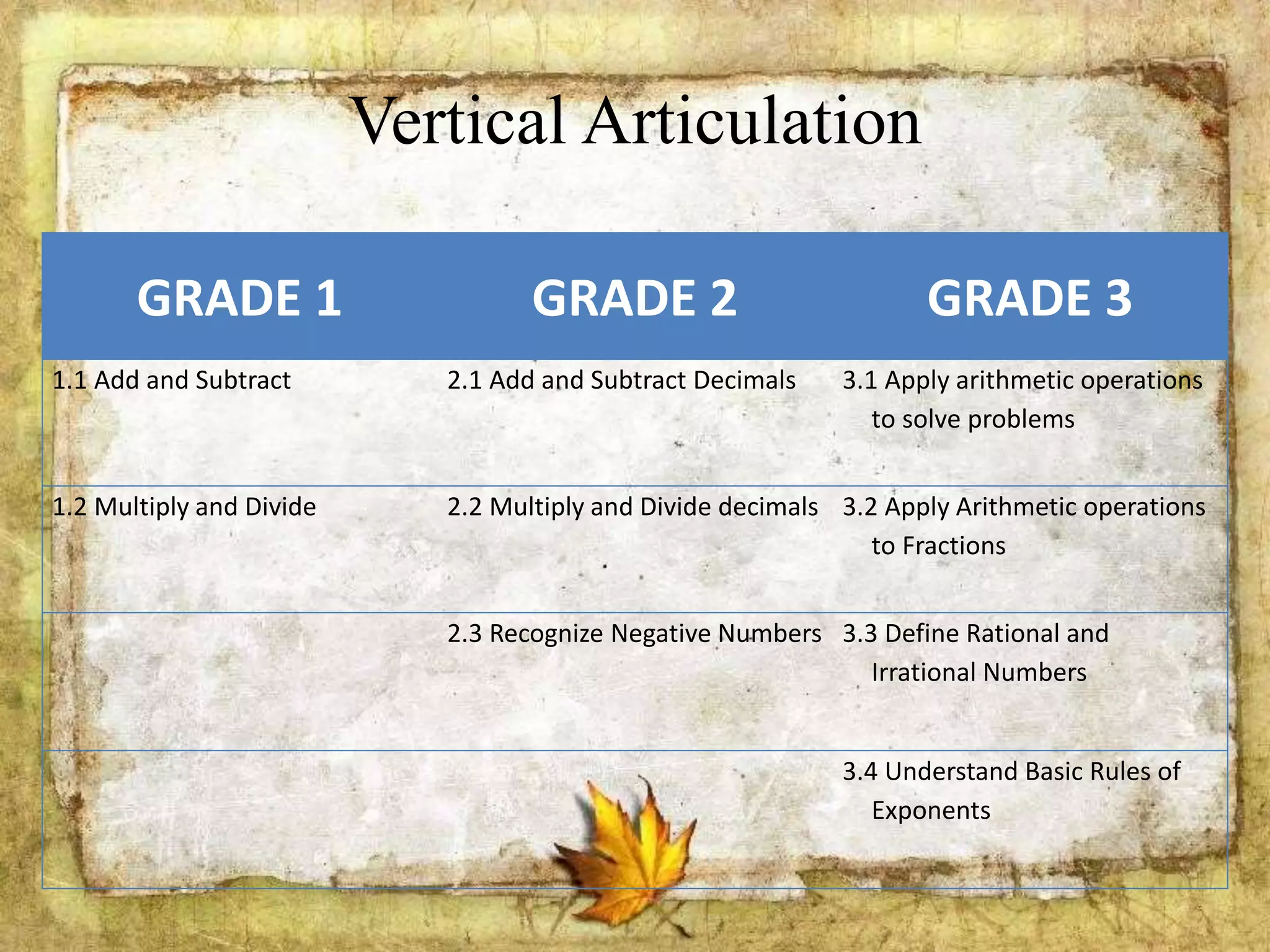
Vertical Articulation
GRADE 1 GRADE 2 GRADE 3
1.1 Add and Subtract 2.1 Add and Subtract Decimals 3.1 Apply arithmetic operations
to solve problems
1.2 Multiply and Divide 2.2 Multiply and Divide decimals 3.2 Apply Arithmetic operations
to Fractions
2.3 Recognize Negative Numbers 3.3 Define Rational and
Irrational Numbers
3.4 Understand Basic Rules of
Exponents
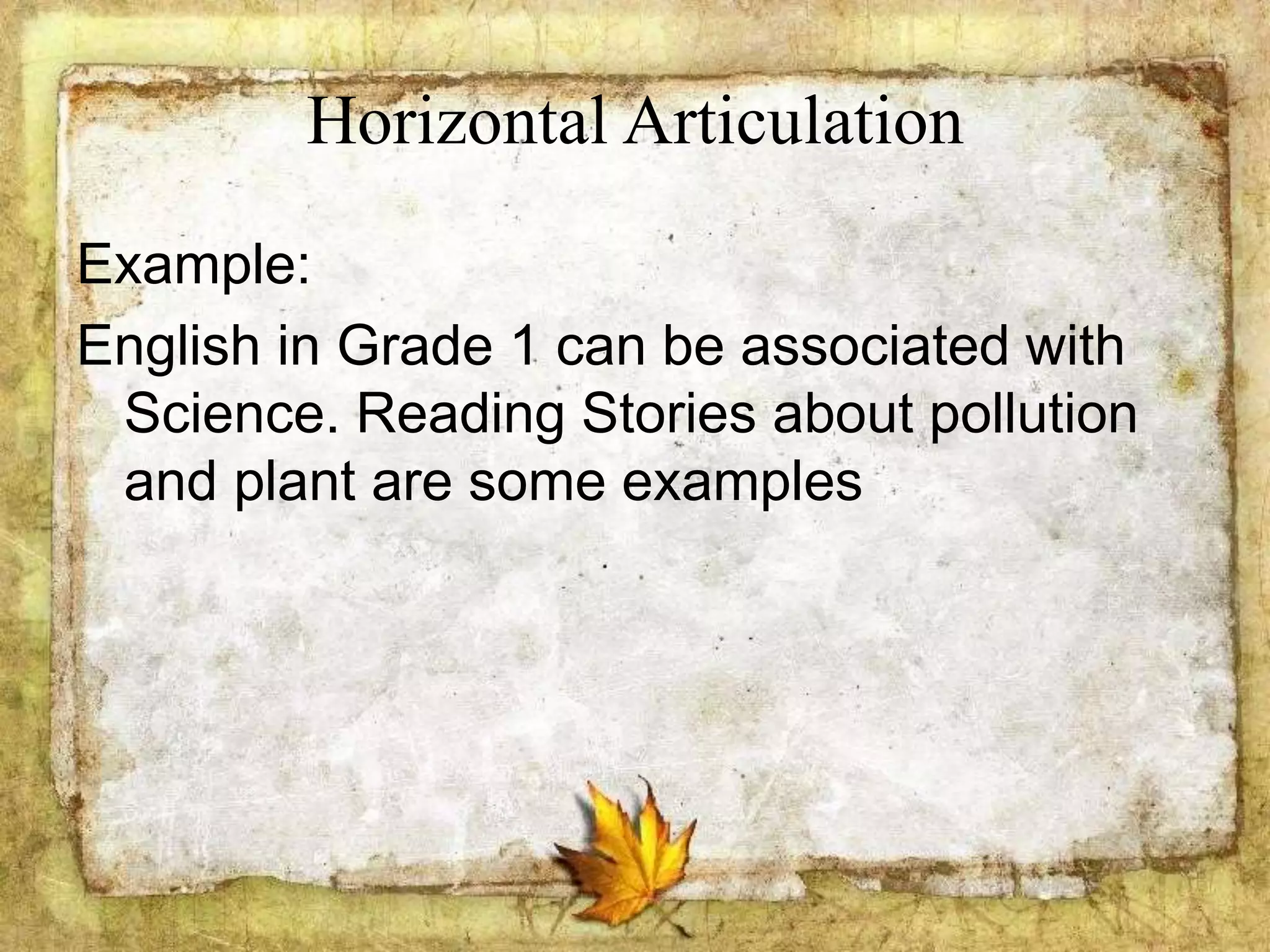
Horizontal Articulation
Example:
English in Grade 1 can be associated with
Science. Reading Stories about pollution
and plant are some examples
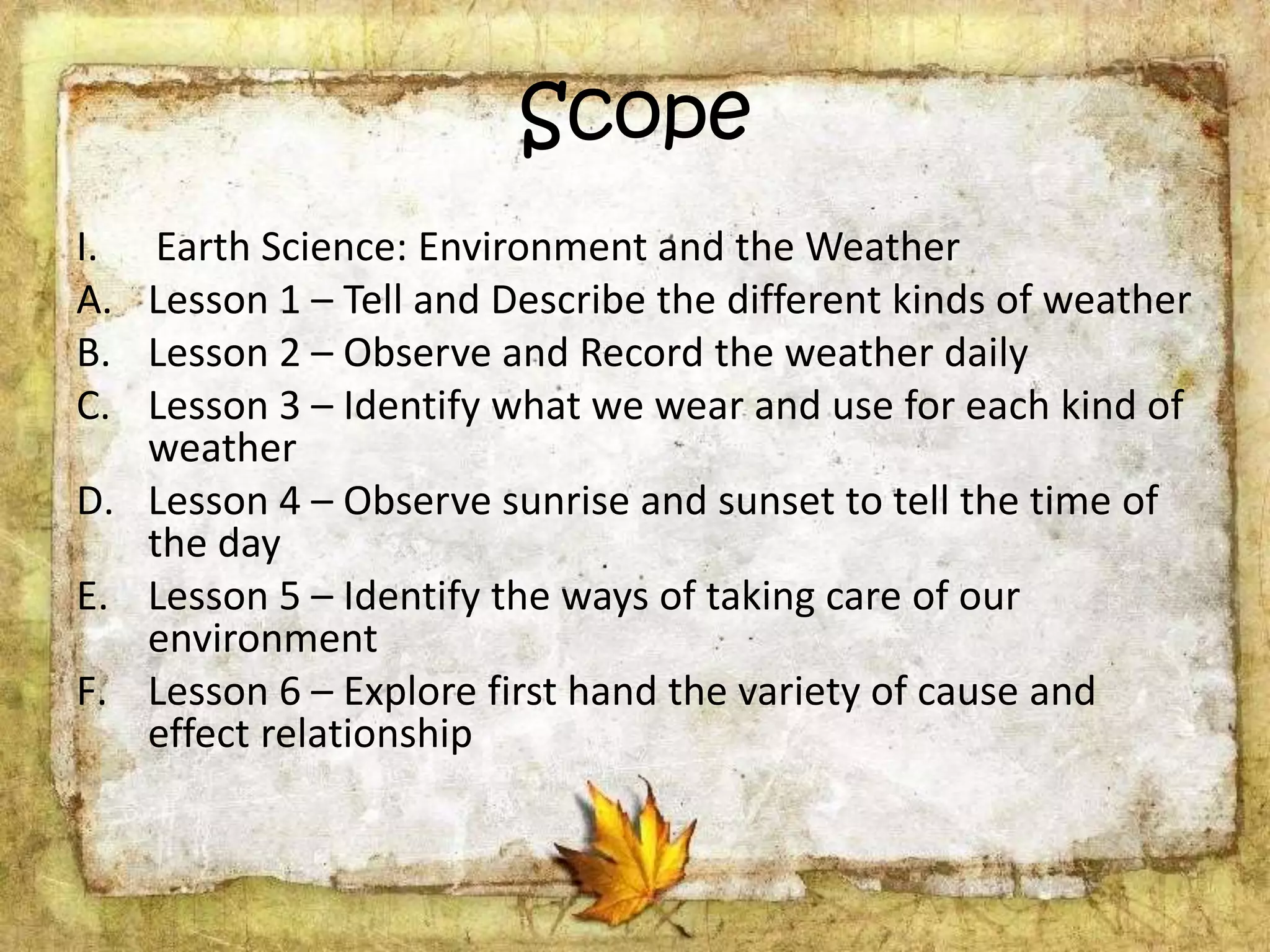
Scope
I. Earth Science: Environment and the Weather
A. Lesson 1 – Tell and Describe the different kinds of weather
B. Lesson 2 – Observe and Record the weather daily
C. Lesson 3 – Identify what we wear and use for each kind of
weather
D. Lesson 4 – Observe sunrise and sunset to tell the time of
the day
E. Lesson 5 – Identify the ways of taking care of our
environment
F. Lesson 6 – Explore first hand the variety of cause and
effect relationship
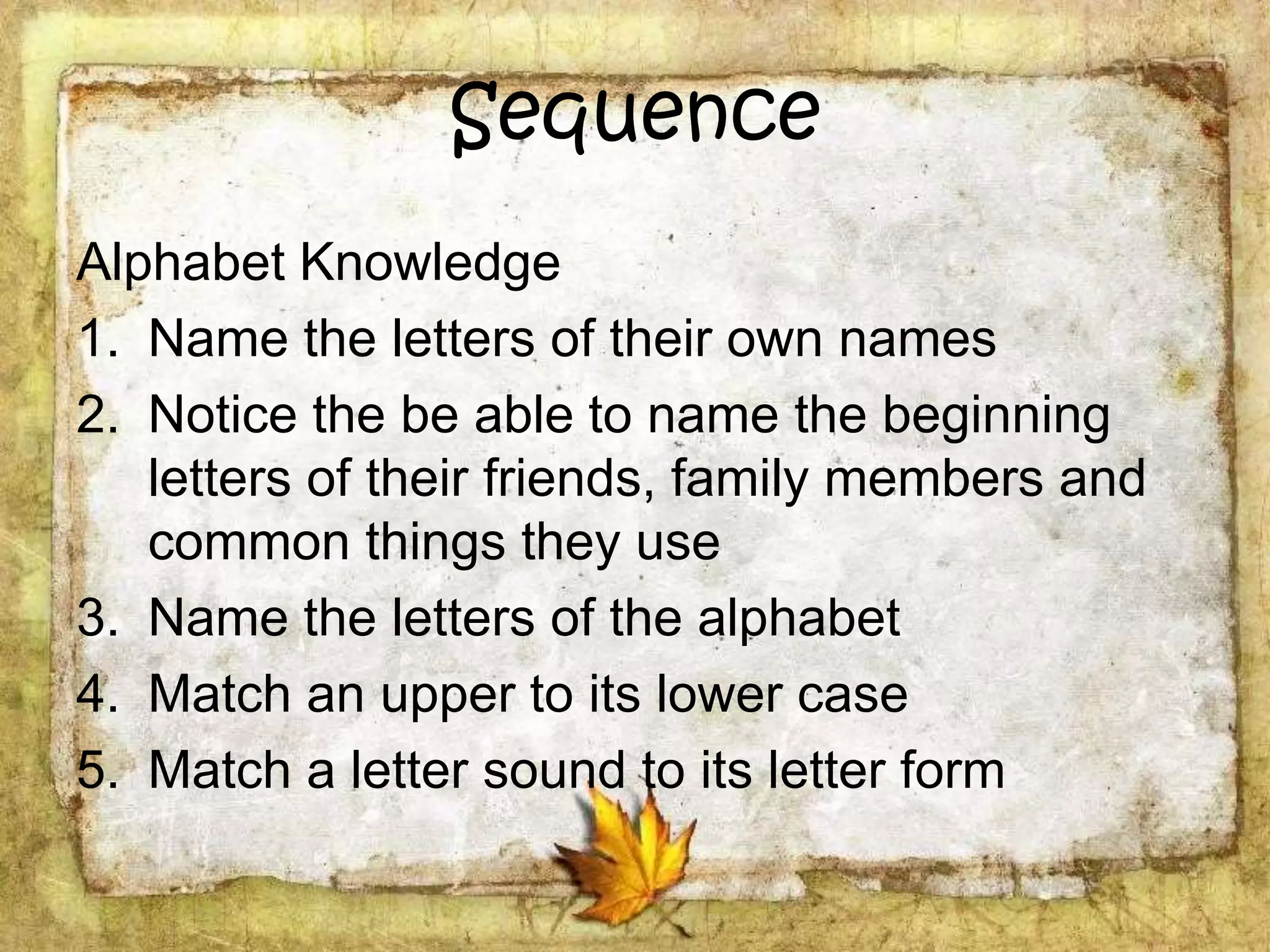
Sequence
Alphabet Knowledge
1. Name the letters of their own names
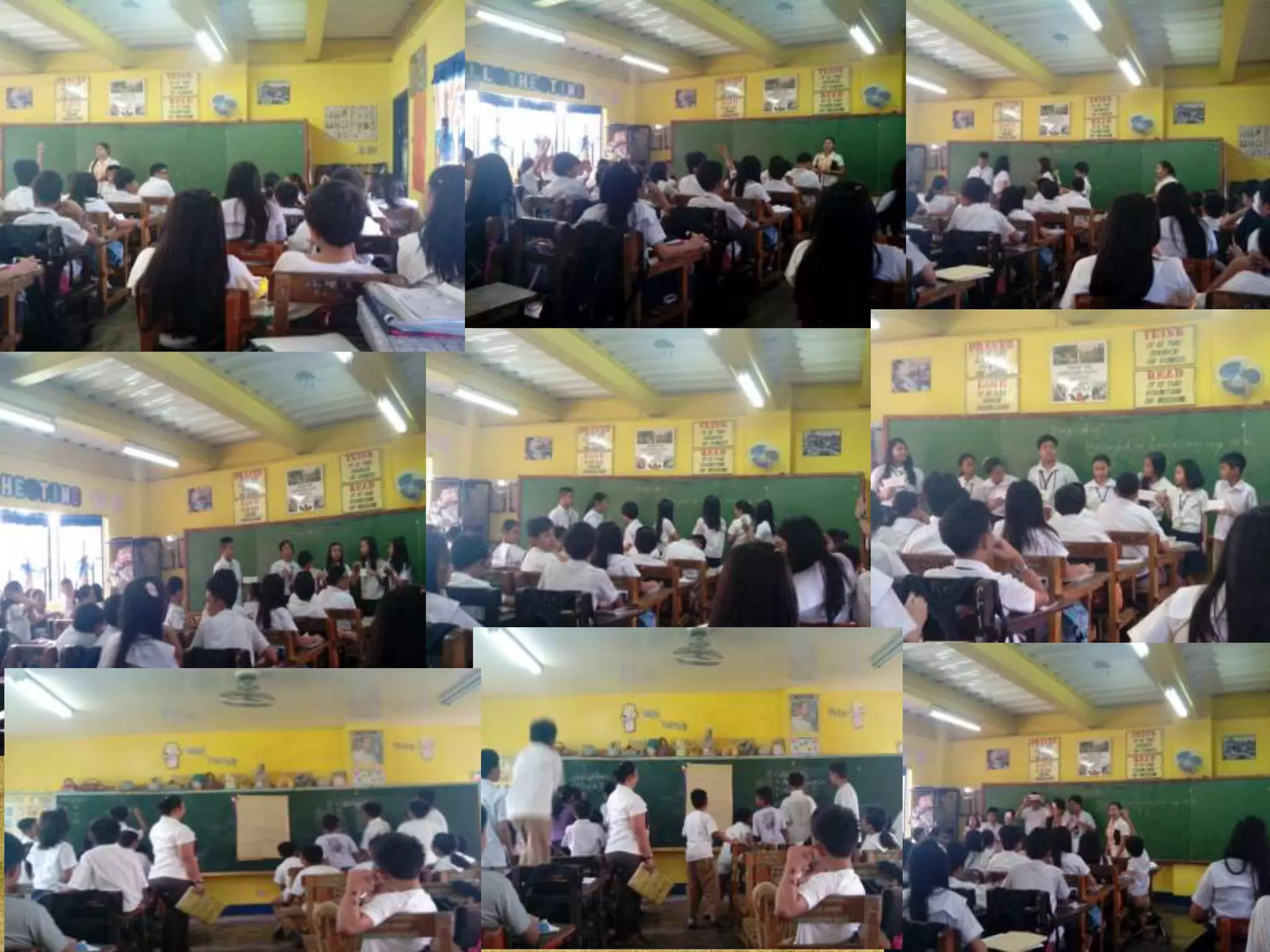
2. Notice the be able to name the beginning
letters of their friends, family members and
common things they use
3. Name the letters of the alphabet
4. Match an upper to its lower case
5. Match a letter sound to its letter form
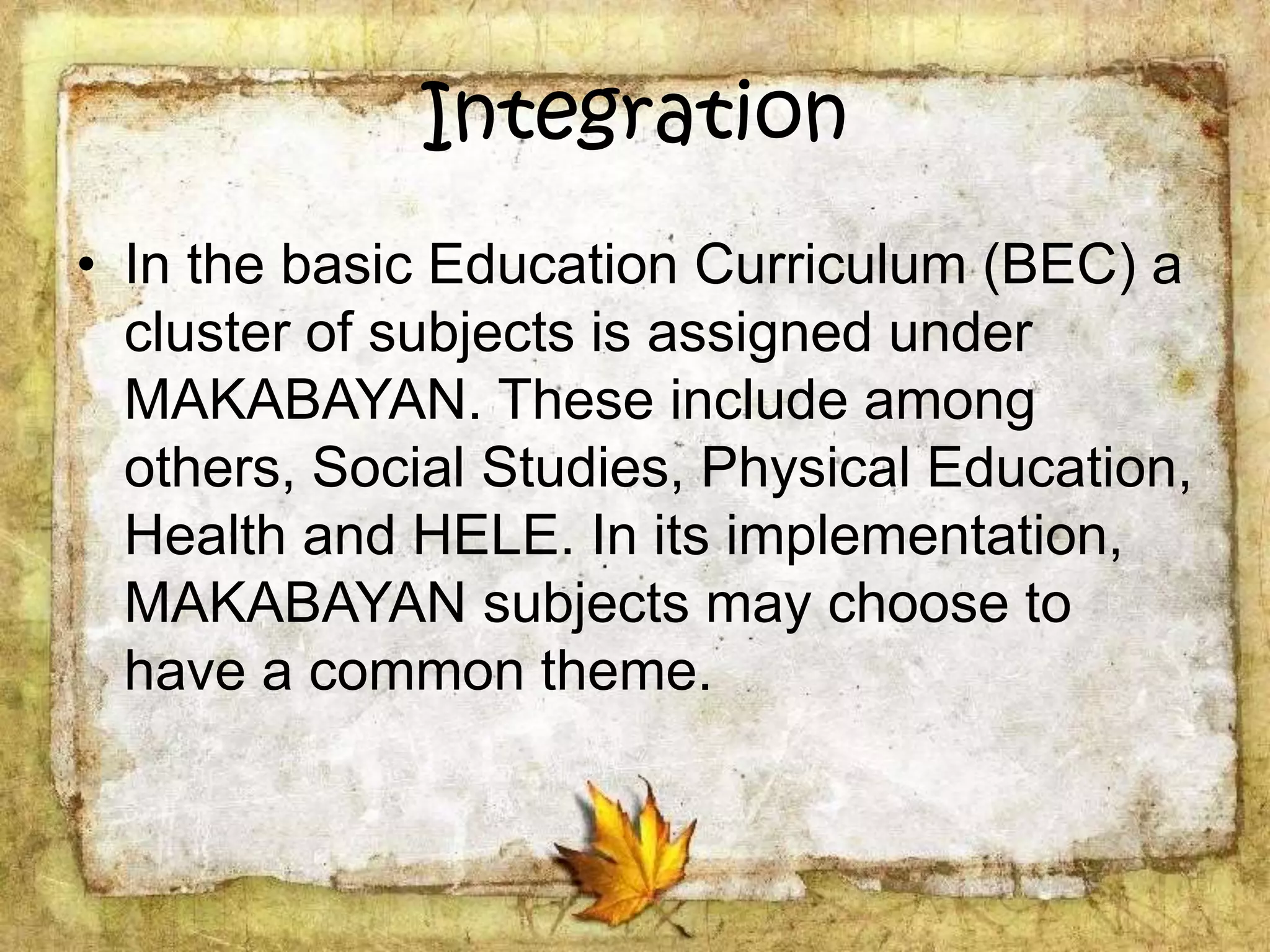
Integration
• In the basic Education Curriculum (BEC) a
cluster of subjects is assigned under
MAKABAYAN. These include among
others, Social Studies, Physical Education,
Health and HELE. In its implementation,
MAKABAYAN subjects may choose to
have a common theme.
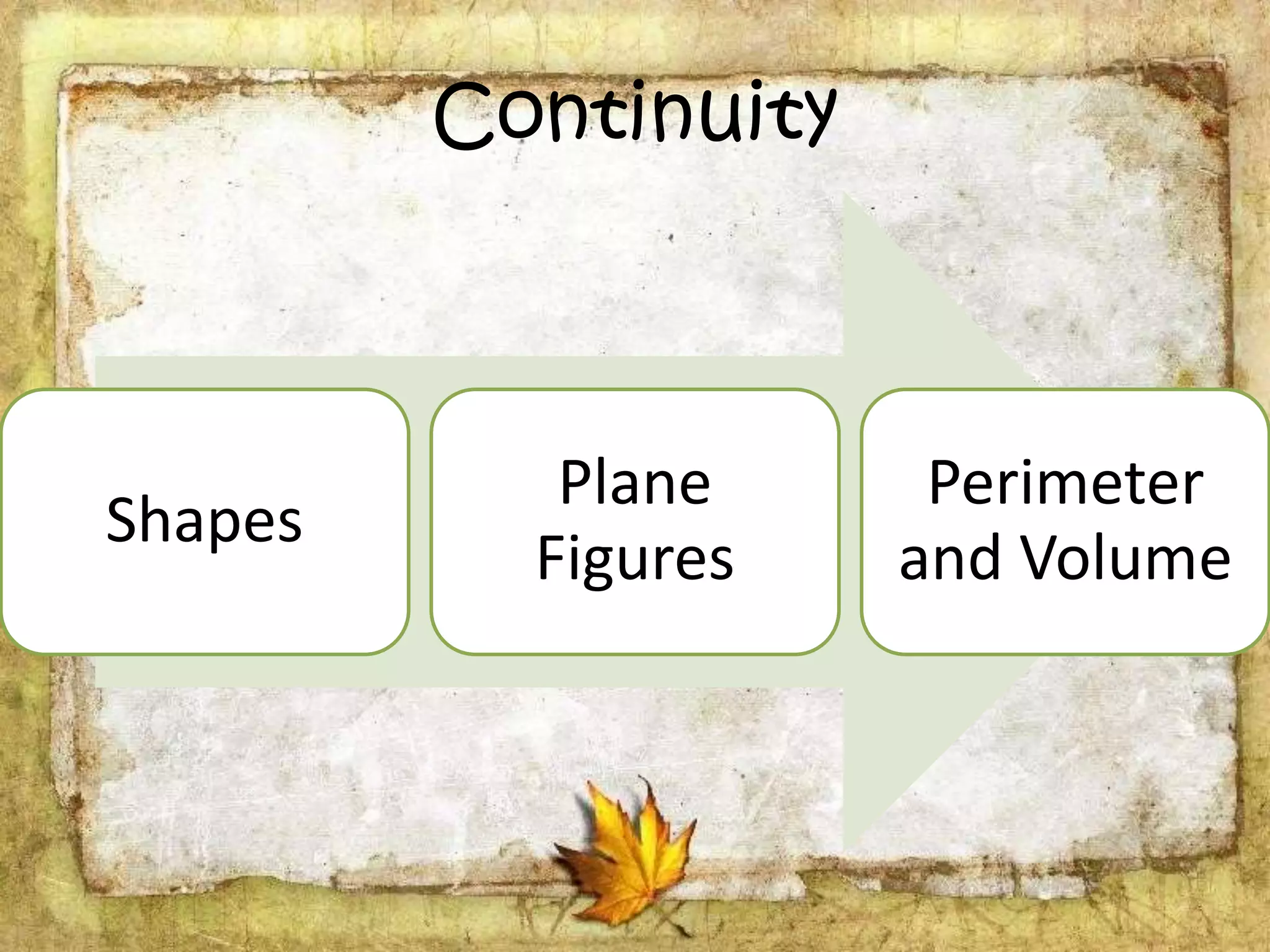
Continuity
Shapes
Plane
Figures
Perimeter
and Volume
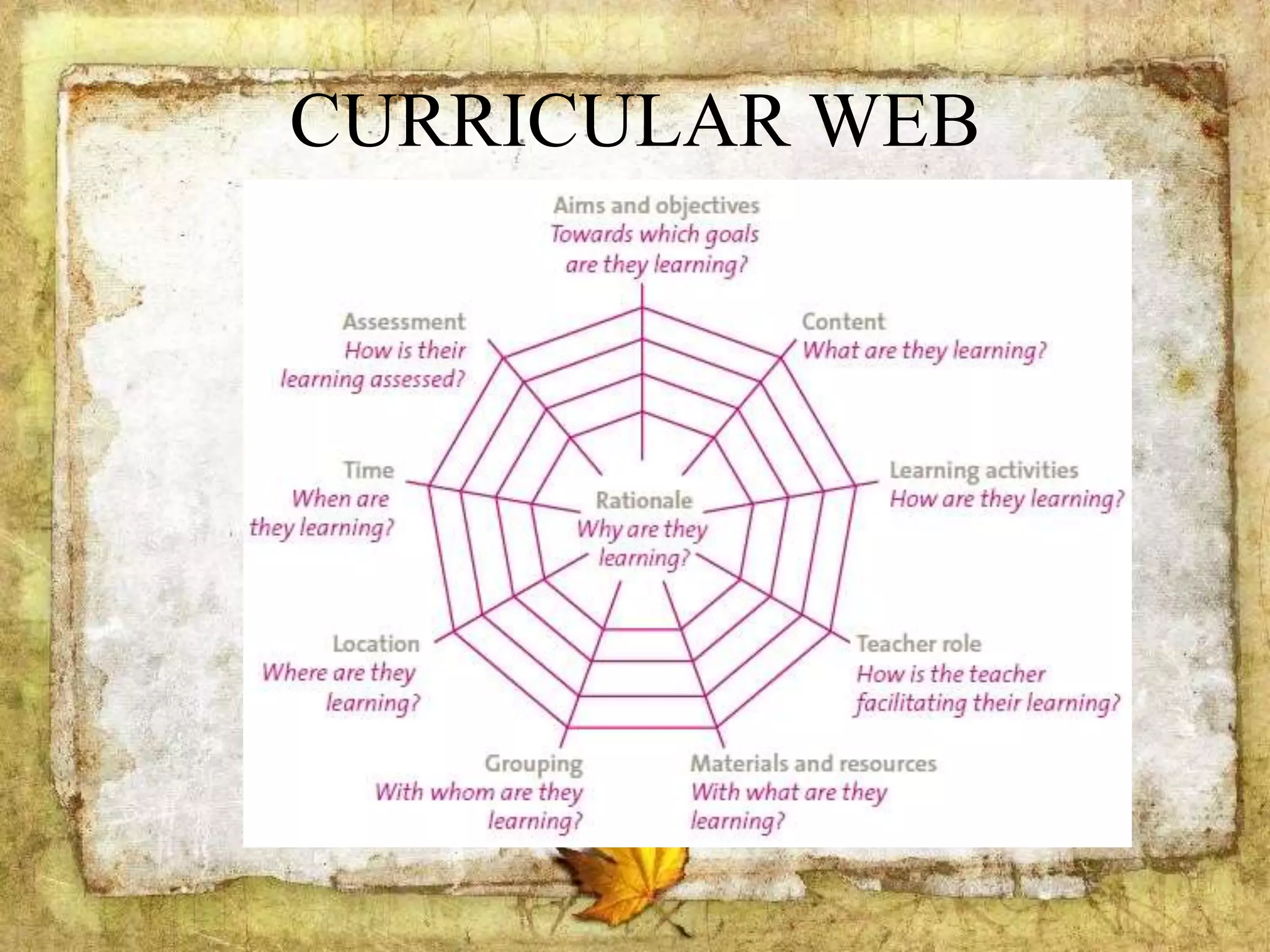
CURRICULAR WEB
Episode 6
TELL ME YOUR FEATURES
UTILIZATION OF PARENTS
AS THEIR SCHOOL
PARTNER
PTA
Brigada Eskwela
School Competition
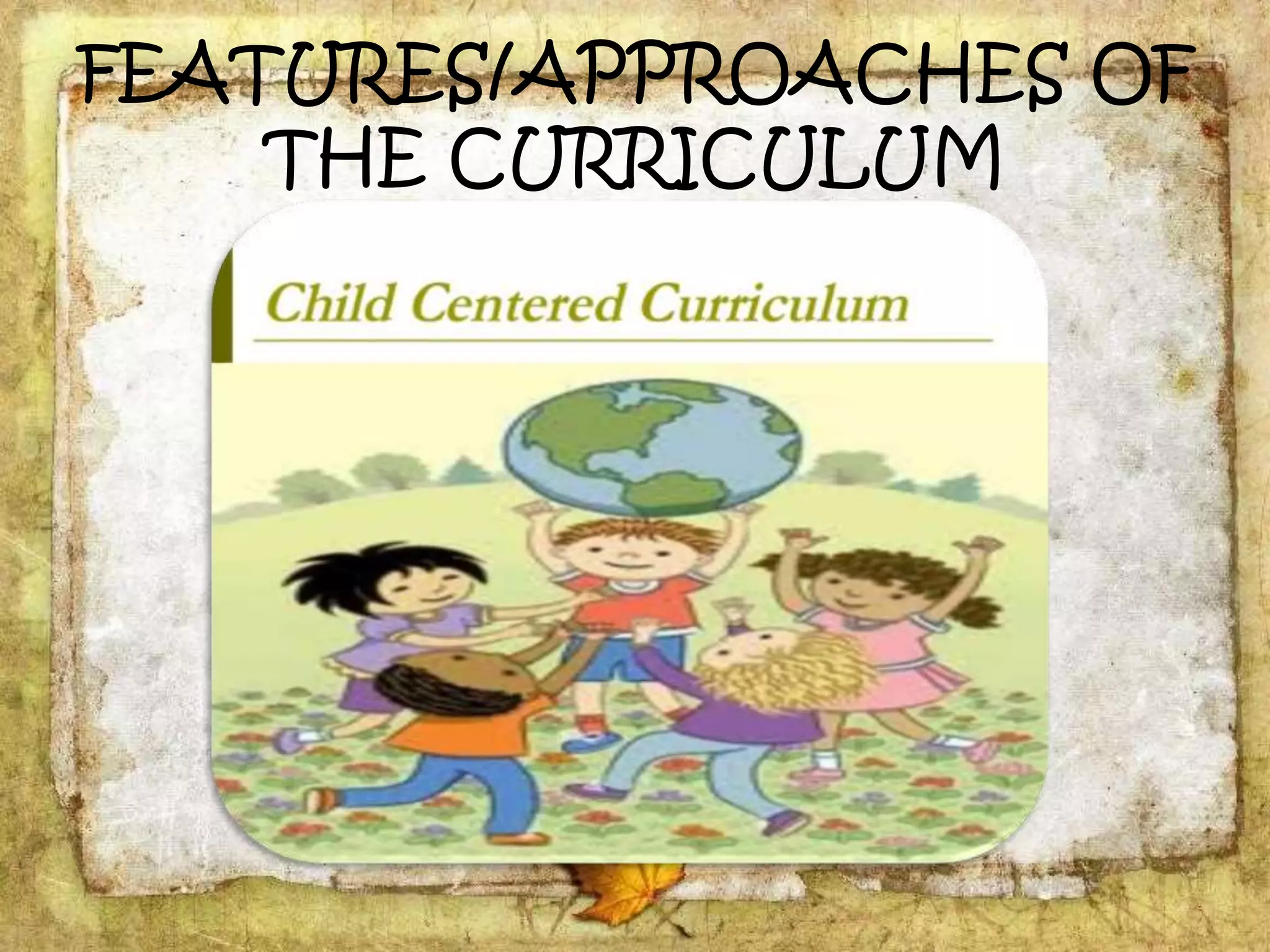
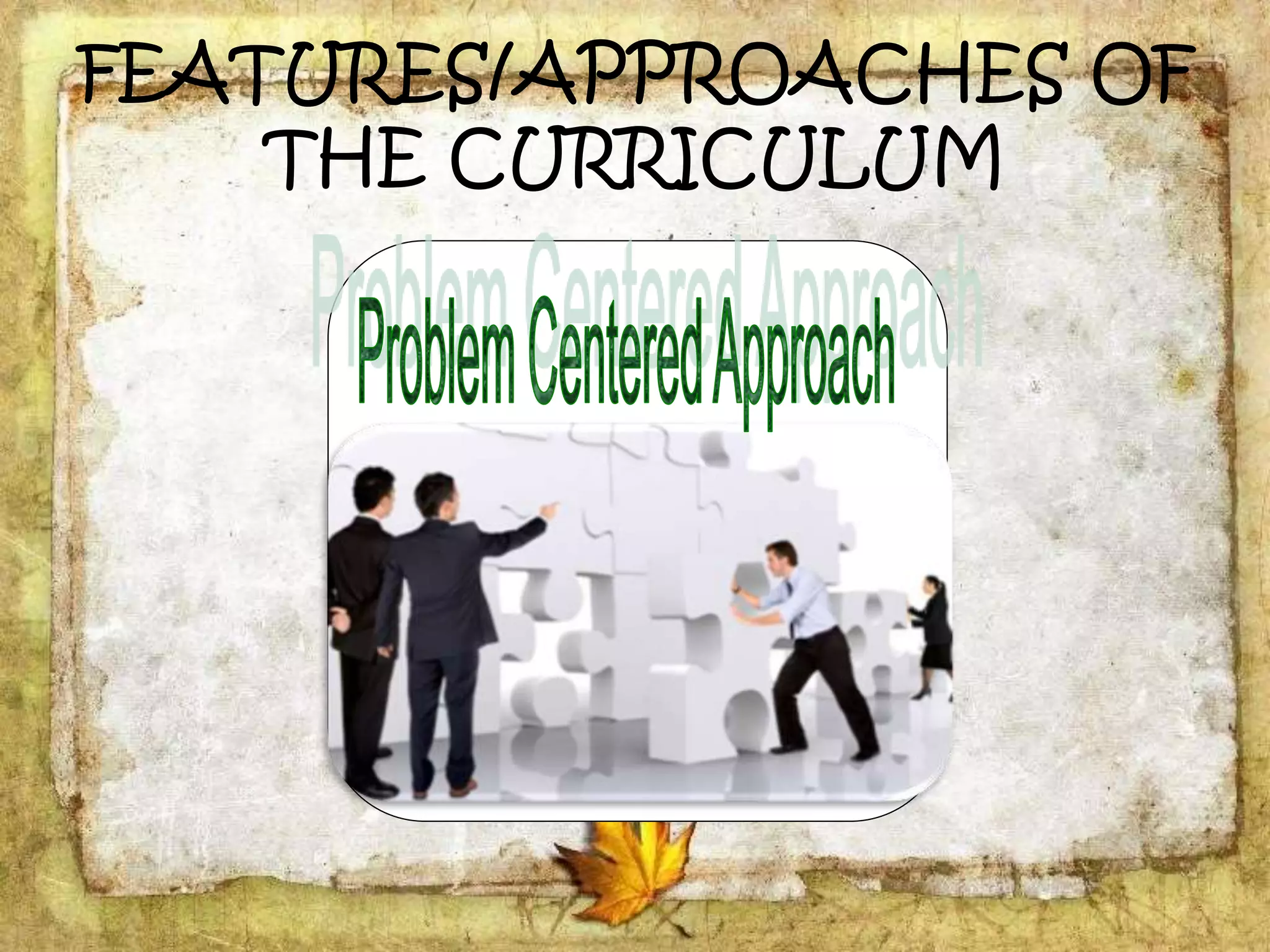
FEATURES/APPROACHES OF
THE CURRICULUM
FEATURES/APPROACHES OF
THE CURRICULUM
EPISODE 7
THE Wh- OF THE
CURRICULUM
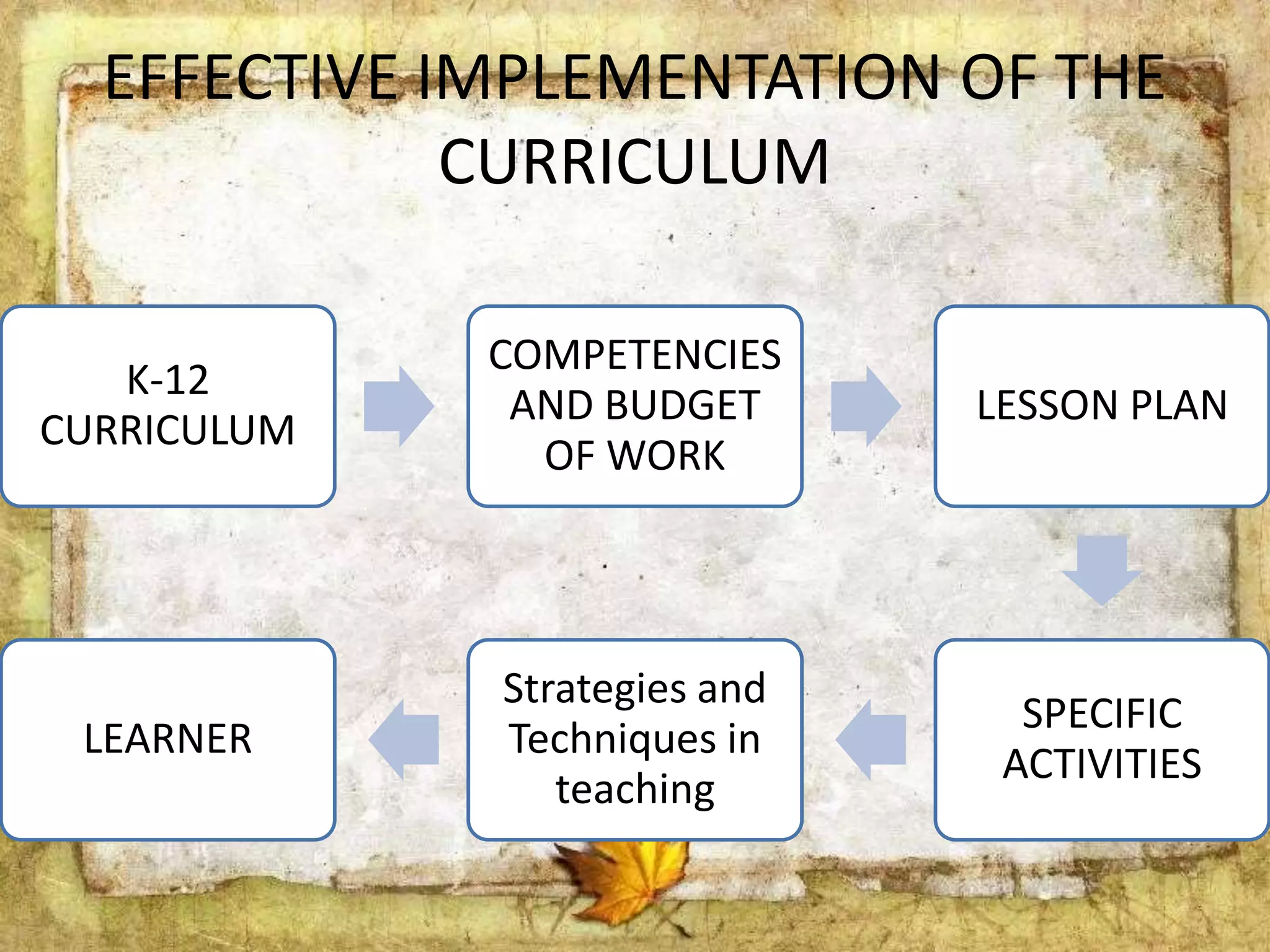
EFFECTIVE IMPLEMENTATION OF THE
CURRICULUM
K-12
CURRICULUM
COMPETENCIES
AND BUDGET
OF WORK
LESSON PLAN
SPECIFIC
ACTIVITIES
Strategies and
Techniques in
teaching
LEARNER
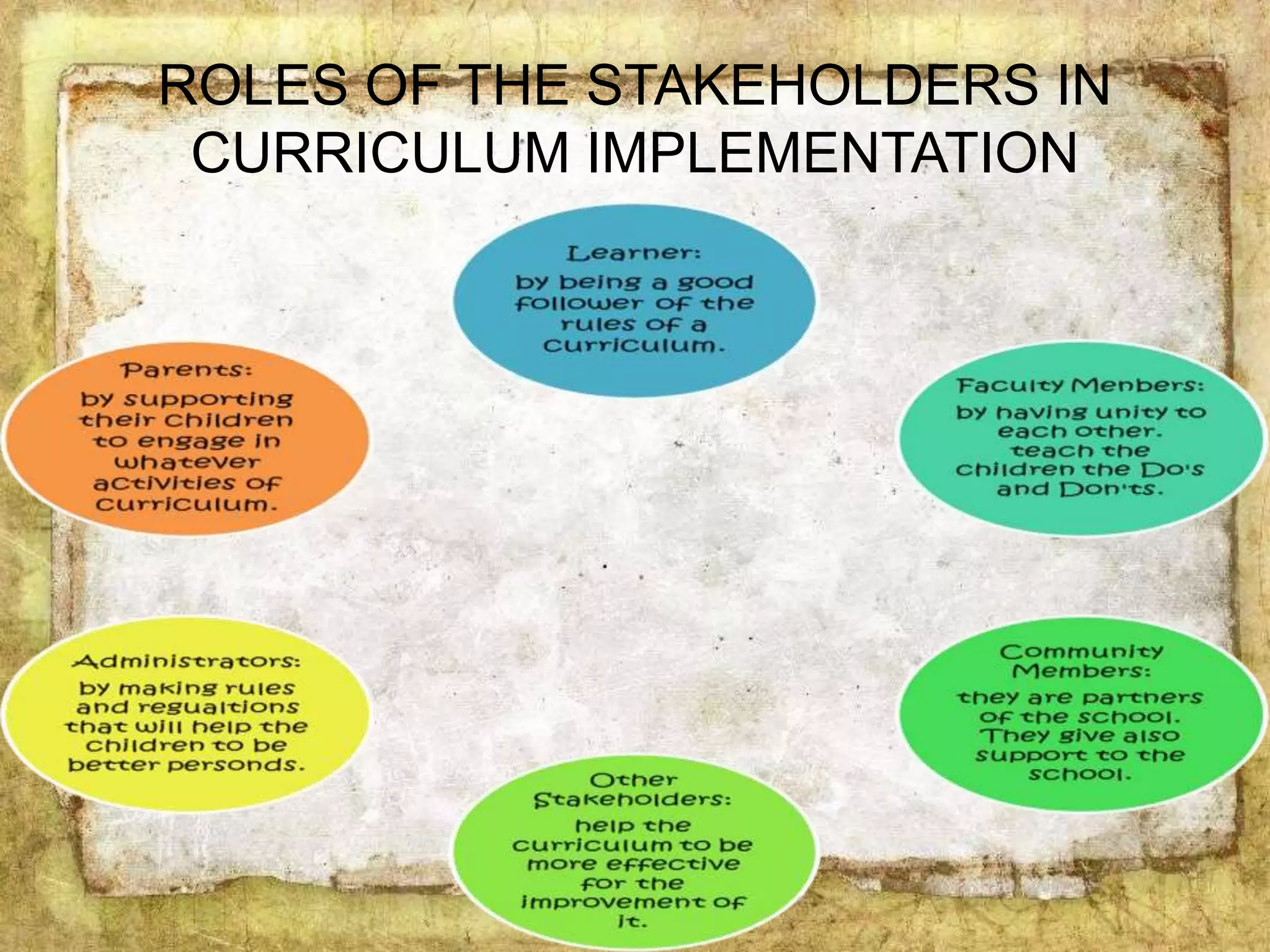
ROLES OF THE STAKEHOLDERS IN
CURRICULUM IMPLEMENTATION
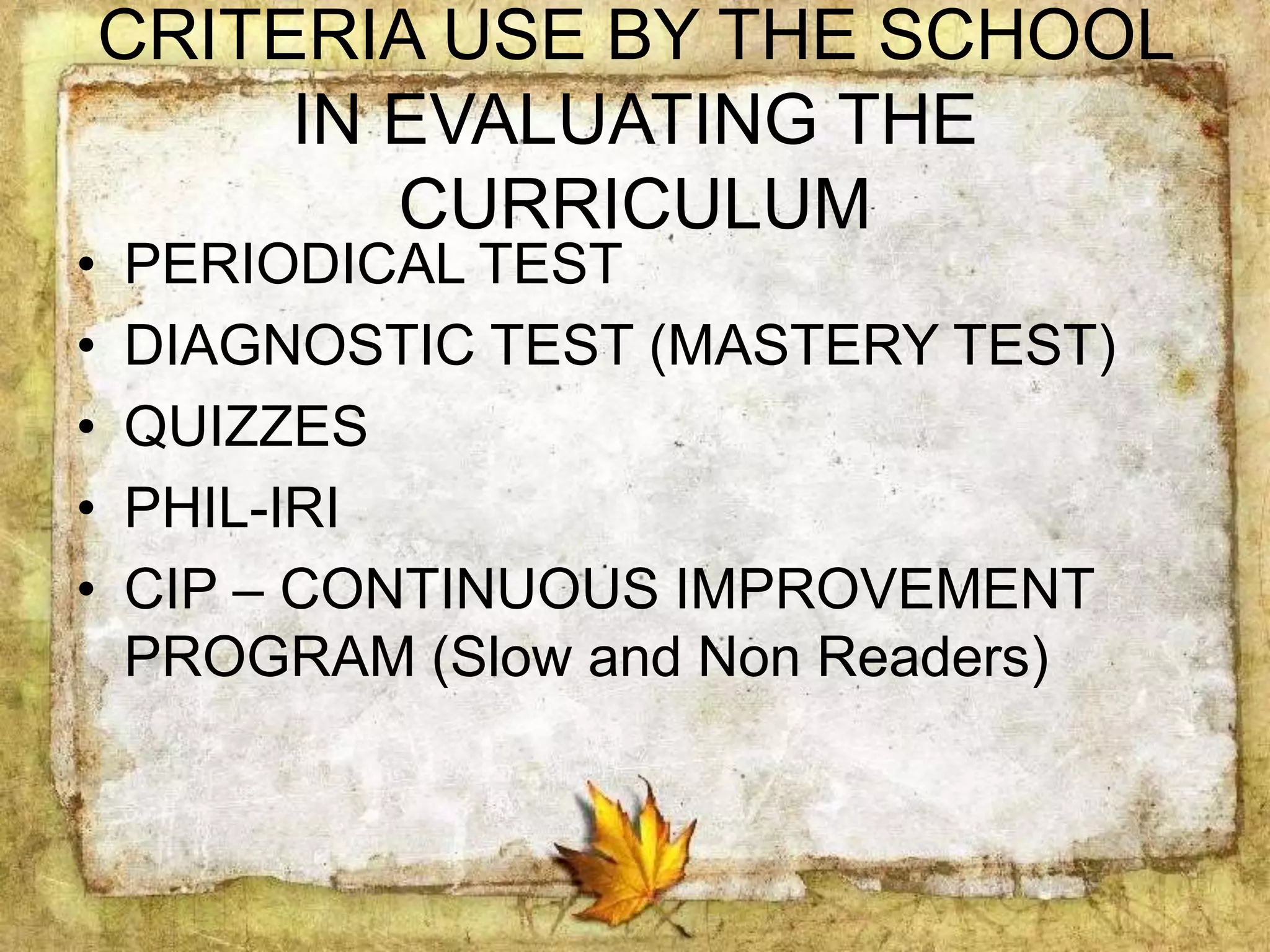
CRITERIA USE BY THE SCHOOL
IN EVALUATING THE
CURRICULUM
• PERIODICAL TEST
• DIAGNOSTIC TEST (MASTERY TEST)
• QUIZZES
• PHIL-IRI
• CIP – CONTINUOUS IMPROVEMENT
PROGRAM (Slow and Non Readers)
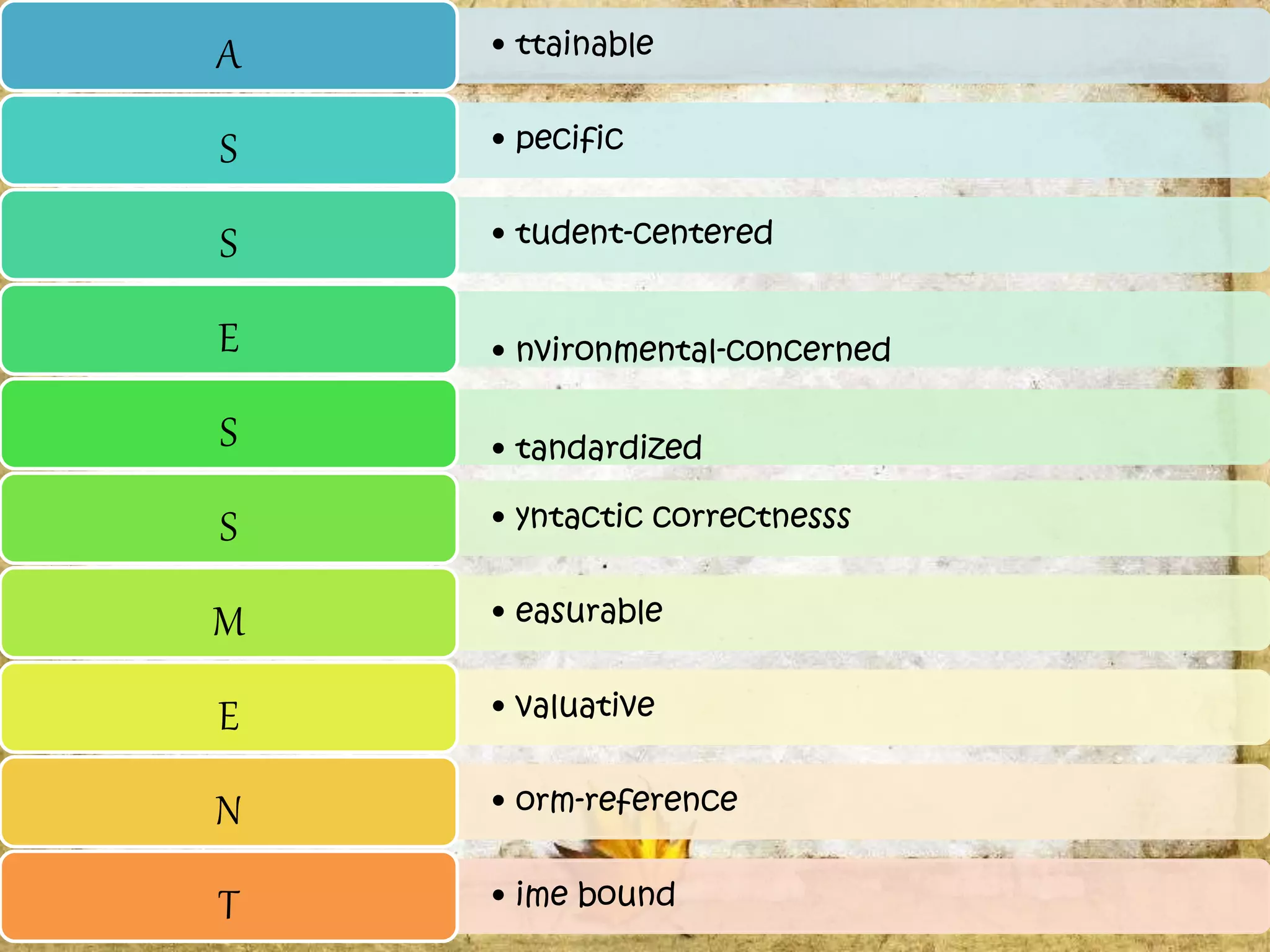
• ttainableA
• pecificS
• tudent-centeredS
• nvironmental-concernedE
• tandardizedS
• yntactic correctnesssS
• easurableM
• valuativeE
• orm-referenceN
• ime boundT
Episode 8
WHAT’S NEW IN THE
CURRICULUM
CURRICULAR INNOVATIONS
K-12 CURRICULUM
MOTHER TONGUE BASED
INSTRUCTION
TEAM TEACHING
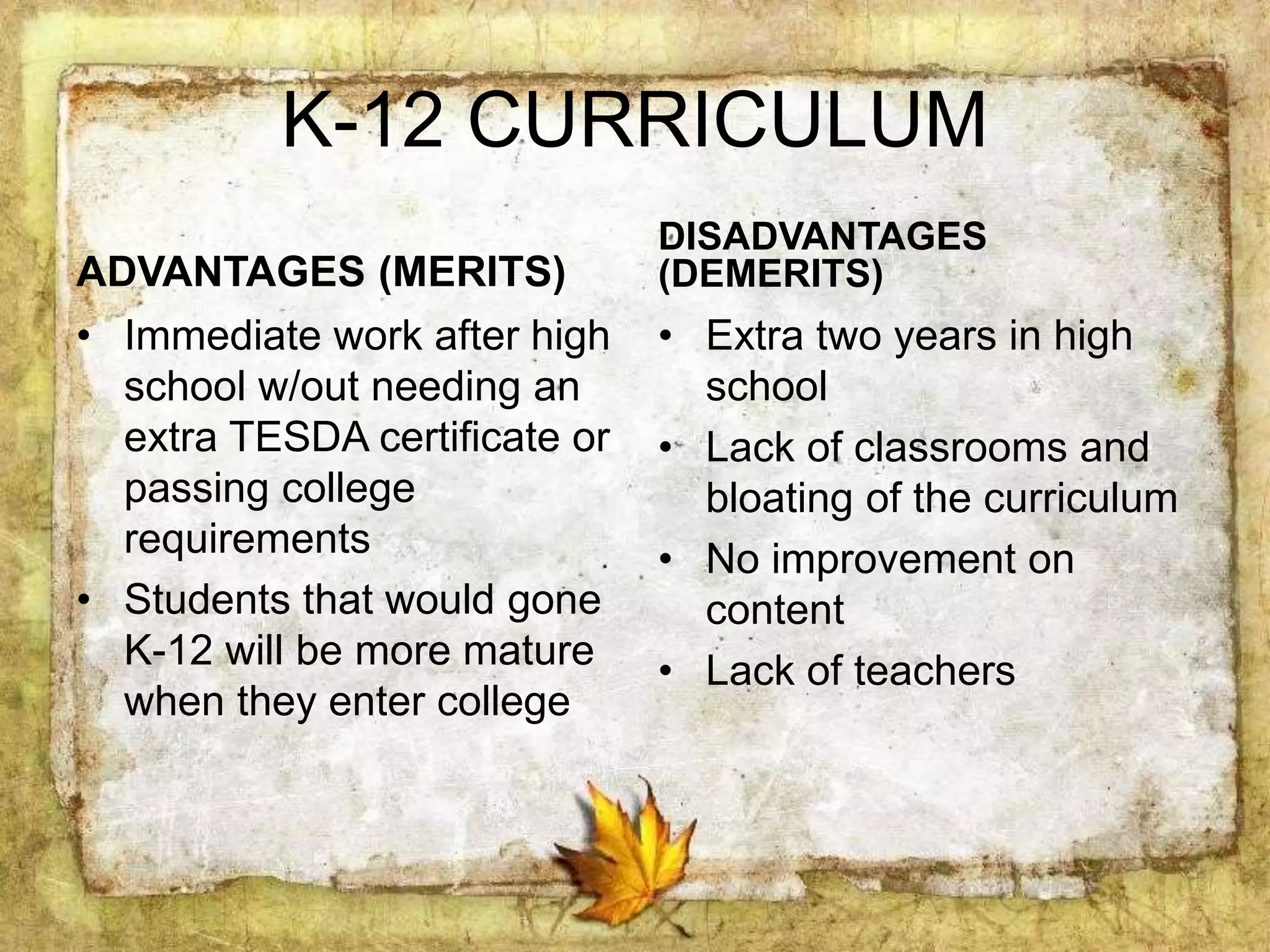
K-12 CURRICULUM
ADVANTAGES (MERITS)
• Immediate work after high
school w/out needing an
extra TESDA certificate or
passing college
requirements
• Students that would gone
K-12 will be more mature
when they enter college
DISADVANTAGES
(DEMERITS)
• Extra two years in high
school
• Lack of classrooms and
bloating of the curriculum
• No improvement on
content
• Lack of teachers
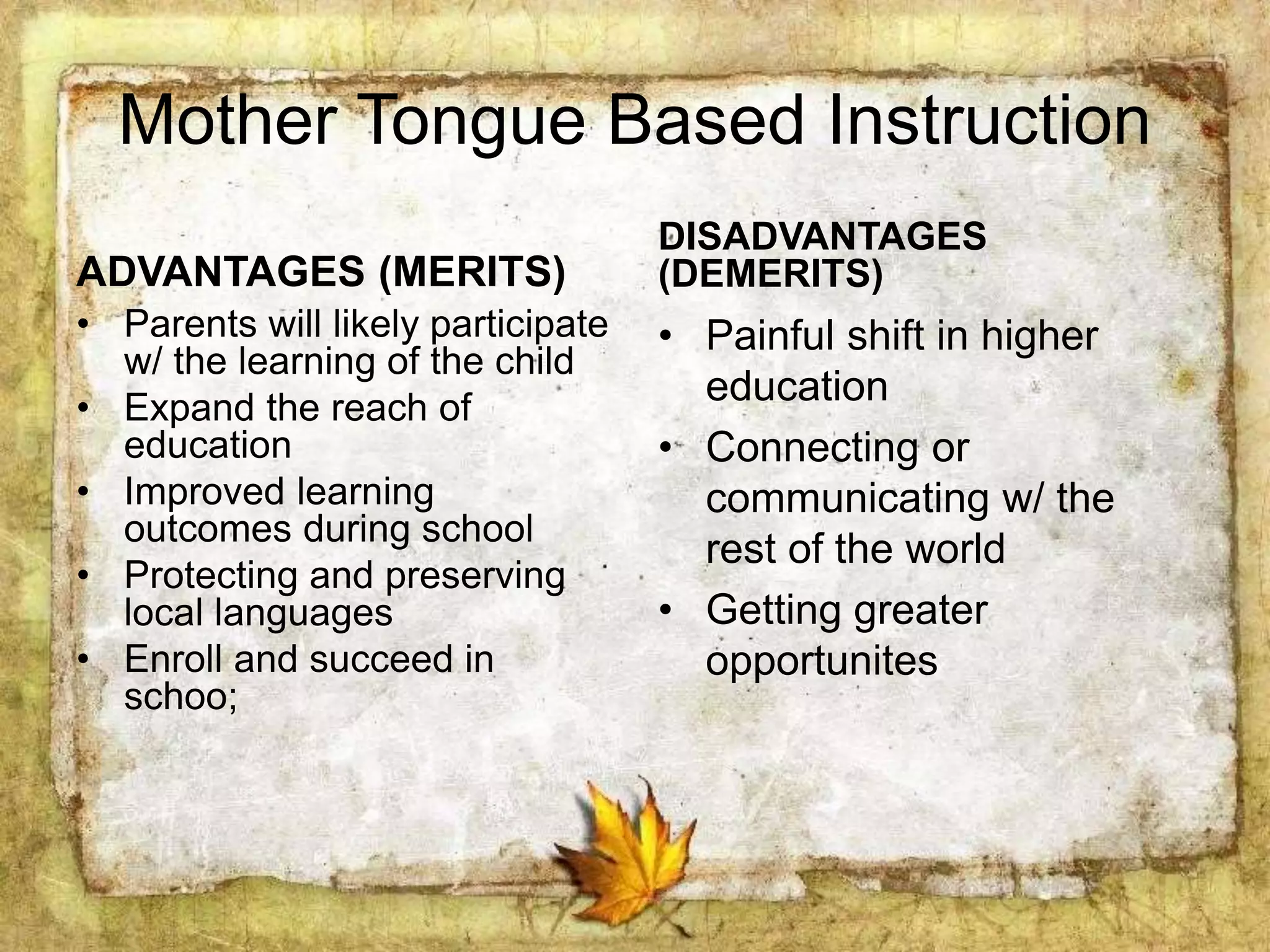
Mother Tongue Based Instruction
ADVANTAGES (MERITS)
• Parents will likely participate
w/ the learning of the child
• Expand the reach of
education
• Improved learning
outcomes during school
• Protecting and preserving
local languages
• Enroll and succeed in
schoo;
DISADVANTAGES
(DEMERITS)
• Painful shift in higher
education
• Connecting or
communicating w/ the
rest of the world
• Getting greater
opportunites
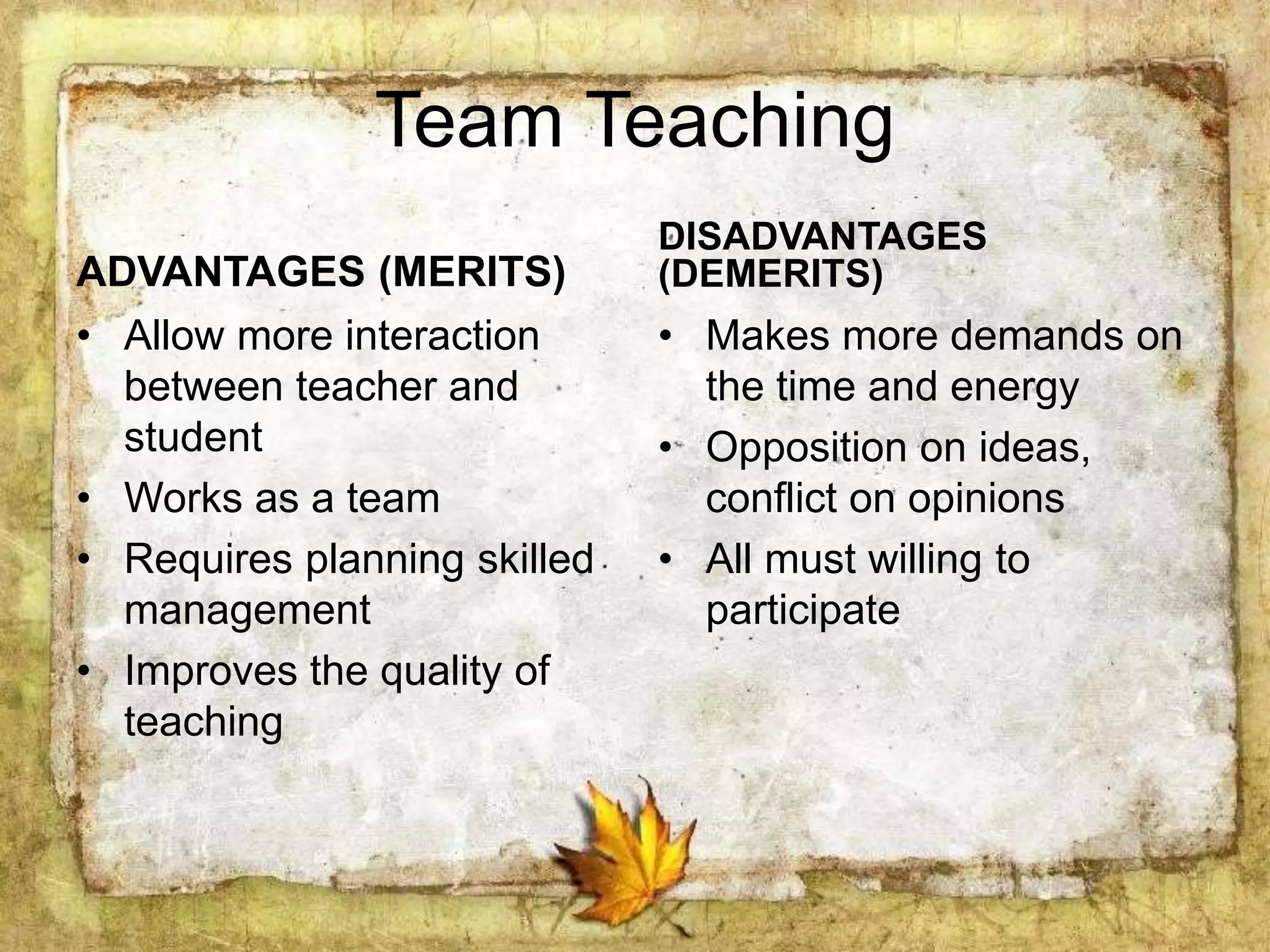
Team Teaching
ADVANTAGES (MERITS)
• Allow more interaction
between teacher and
student
• Works as a team
• Requires planning skilled
management
• Improves the quality of
teaching
DISADVANTAGES
(DEMERITS)
• Makes more demands on
the time and energy
• Opposition on ideas,
conflict on opinions
• All must willing to
participate
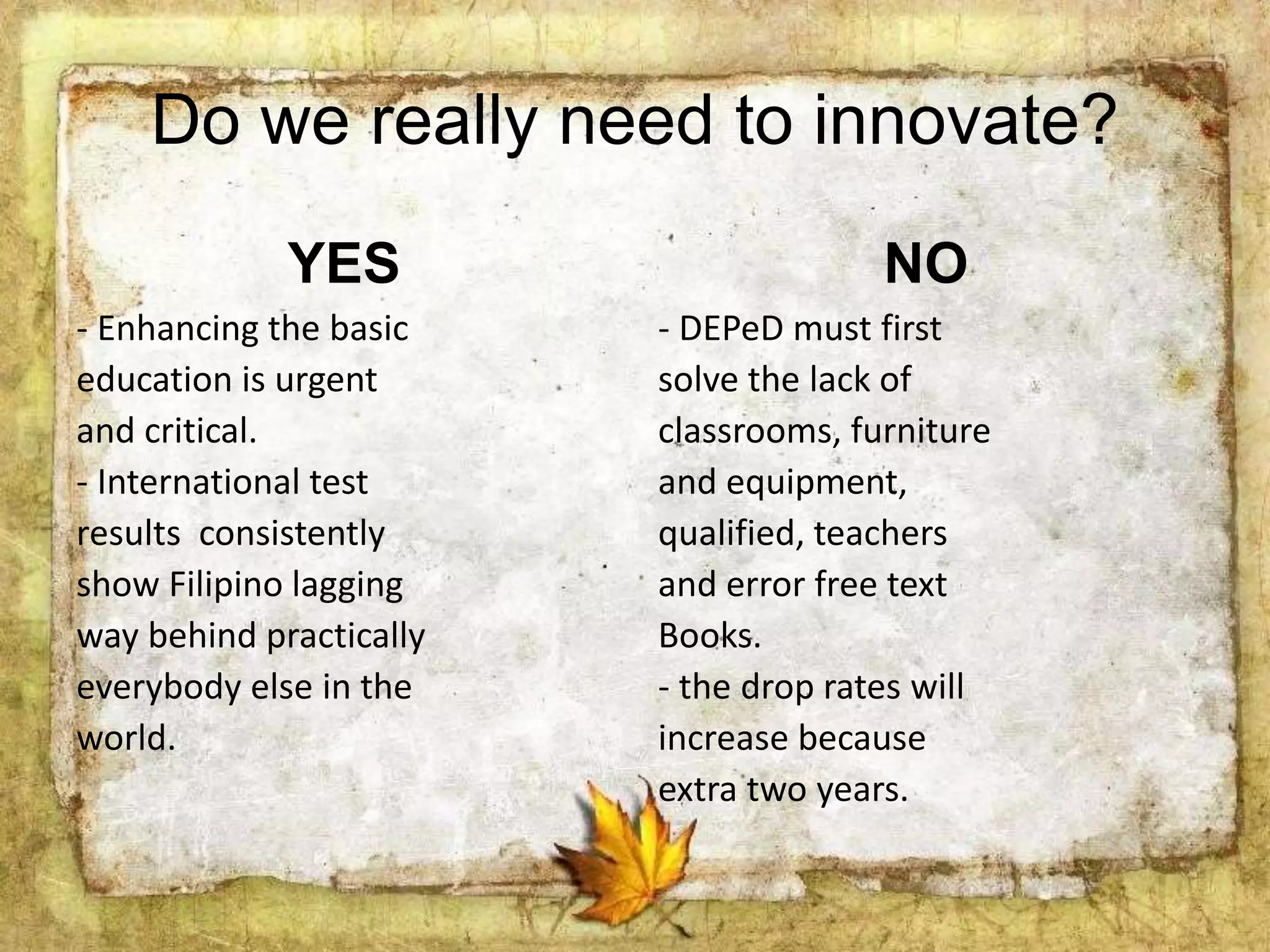
Do we really need to innovate?
YES
- Enhancing the basic
education is urgent
and critical.
- International test
results consistently
show Filipino lagging
way behind practically
everybody else in the
world.
NO
- DEPeD must first
solve the lack of
classrooms, furniture
and equipment,
qualified, teachers
and error free text
Books.
- the drop rates will
increase because
extra two years.
END OF PRESENTATION

Fieldstudy4 150301020105-conversion-gate01

  • 1.
  • 2.
  • 3.
    The School Planand Organizaton
  • 4.
    School Organzation 1. Principal 2.Head Teacher 3 3. Master Teachers 4. Department Heads a.English b.Science c.Filipino d.EPP e.Makabayan g. School Paper Adviser 1 1 1 1 1 1 1 1 1
  • 5.
    School Organzation h.Arts SchoolCoordinator i.Property Custodian j.Character Education k.Clinic Teacher l.Guidance Teacher m.Canteen Teacher n.District Sports Coordinator o.Music School Coordinator p.DPMESTA President 1 1 1 1 1 1 1 1 1
  • 6.
    School Organzation q.SGC Coordinator r.HE School Coordinator s.GSP School Coordinator t. BSP School Coordinator u.Journalsm Department Head 5. Office Personnel 6. School Utility 7. School Guard/School Utility 1 1 1 1 1 3 3 4
  • 7.
    School Organzation 7. Teachers a.Grade1 b.Grade 2 c.Grade 3 d.Grade 4 e.Grade 5 f.Grade 6 g.Kinder 18 16 17 15 14 14 3
  • 8.
    School Organzation 8. SpecialTeachers a.Grade 3 b.Grade 4 c.Grade 5 d.Grade 6 2 7 6 5
  • 9.
  • 10.
  • 11.
  • 12.
  • 13.
    Episode 1 LOOK DEEPERINTO THE CONCEPTS, NATURE AND PURPOSES OF THE CURRICULUM
  • 14.
    Traditional and Progressive Curriculum TraditionalCurriculum Progressive Curriculum •Lack of instructional materials •Crowded Classroom •Lack of Chairs, equipments/facilities and books •The techers don’t have enough knowledge on technologies for effective and meaningful teaching •There are some obsolete ideas •They are updated •Gives all the learner’s needs and interest •Introduces new strategies in teaching •They are now globally competetive and has a total learning experiences among the students/learners •Gives opportunities to develop a high order thinking skills •Used of modern instructional materials that are suited to the needs of the learners
  • 15.
    Similarities of Traditionaland Progressive Curriculum • Both of them teach the students with their needs • Wants to accomplish certain goals • Gives the students a good process of learning style
  • 16.
    Types of Curricula Nameof School Recommended Curricula Written Curricula Taught Curricula Supported Curricula Assessed Curricula Learned Curricula Hidden Curricula Diosdado P. Macapagal Elementary School       
  • 17.
    Things I Needto Do to Consider in Preparing My School’s Curriculum Strategies/ Methods to be used The support of my personnel, teachers and other staff of my institution The school’s Vision, Mission and Core Values The learner’s needs and interest Best instructional materials for teaching
  • 18.
    Pictures of aTraditional School
  • 19.
    Pictures of aProgressive School
  • 20.
  • 21.
    Episode 2 WHAT’S THECURRICULUM MADE OF?
  • 22.
    DIOSDADO P. MACAPAGAL ELEMENTARYSCHOOL MISSION AND VISION
  • 23.
    VISION We dream ofFilipinos Who passionately love their country And whose values and competencies Enable them to realize their full potential And contribute meaningfully to building the nation As a learner-centered public institution The Department of Education Continuously improves itself To better serve its stakeholders
  • 24.
    MISSION To protect andpromote the right of every Filipino to quality, equitable, culture-based and complete Basic Education where: Students learn in a child friendly, gender-sensitive, safe and motivating environment Teachers facilitate learning and constantly nurture every learner Administrator and staff, as stewards of the institution, ensure an enability and supportive environment for effective learning to happen Family, community and other stakeholders are actively engaged and share responsibility for developing life- long learning
  • 25.
  • 26.
    Episode 3 WHAT’S NEWIN TEACHING AND LEARNING
  • 27.
    SERIES OF ACTIONSIN THE TEACHING PROCESS PLAN IMPLEMENT EVALUATE
  • 28.
    PLAN • LESSON PLAN •ACTION PLAN (Activites for the whole year) • PTA MEETING
  • 29.
    IMPLEMENT • TEACHING MATERIALS(not enough) • SUPPORT OF THE PRINCIPAL • DepED MEMOS • USE OF GUIDE • PTA MEETING
  • 30.
    EVALUATE • QUIZZES • PERIODICALEXAMS • BEHAVIORAL OBSERVATIONS • NAT (National Achievement Test) • PHIL-IRI INVENTORY (Reading Capacity)
  • 31.
    LEARNING THEORIES BEHAVIORAL LEARNINGTHEORIES COGNITIVE LEARNING THEORIES DISCOVERY LEARNING RECEPTION LEARNING
  • 32.
    BEHAVIORAL LEARNING THEORIES • Ithappens during group activities and P.E • Art activities
  • 33.
    COGNITIVE LEARNING THEORIES • Activitiesand quizzes in Mathematics and Science
  • 34.
    DISCOVERY LEARNING • EPPactivities also like planting and cooking
  • 35.
    RECEPTION LEARNING • EPPpractical work like cooking, stitching, and cross stitch.
  • 36.
  • 38.
  • 39.
  • 40.
    VERTICAL ARTICULATION Visualizes andRepresents numbers from 0-100 Count the number of objects in a given set by ones and tens Identify the number that is one more or one less from a given number Compose and decomposes a given number Regroups sets of ones into sets of tens and sets of tens into hundreds using objects
  • 41.
    Learner- Centered Design Model teaching encourages collaboration encourages students to reflect onwhat they are learning and how they are learning it teaching motivates students by giving them some control over learning processes teaching includes explicit skill instruction. teaching engages students in the hard, messy work of learning
  • 42.
    Episode 5 WHAT’S THEBASIC OF THE CURRICULUM
  • 43.
  • 44.
    Basic Grade 1 -Math Number and Number sense 1. Visualizing and Representing Number 2. Composing and Decomposing Number 3. Read and Writes numbers in symbols and words 4. Ordering the number sets 5. Problem solving involving Money
  • 45.
  • 46.
    Vertical Articulation GRADE 1GRADE 2 GRADE 3 1.1 Add and Subtract 2.1 Add and Subtract Decimals 3.1 Apply arithmetic operations to solve problems 1.2 Multiply and Divide 2.2 Multiply and Divide decimals 3.2 Apply Arithmetic operations to Fractions 2.3 Recognize Negative Numbers 3.3 Define Rational and Irrational Numbers 3.4 Understand Basic Rules of Exponents
  • 47.
    Horizontal Articulation Example: English inGrade 1 can be associated with Science. Reading Stories about pollution and plant are some examples
  • 48.
    Scope I. Earth Science:Environment and the Weather A. Lesson 1 – Tell and Describe the different kinds of weather B. Lesson 2 – Observe and Record the weather daily C. Lesson 3 – Identify what we wear and use for each kind of weather D. Lesson 4 – Observe sunrise and sunset to tell the time of the day E. Lesson 5 – Identify the ways of taking care of our environment F. Lesson 6 – Explore first hand the variety of cause and effect relationship
  • 49.
    Sequence Alphabet Knowledge 1. Namethe letters of their own names 2. Notice the be able to name the beginning letters of their friends, family members and common things they use 3. Name the letters of the alphabet 4. Match an upper to its lower case 5. Match a letter sound to its letter form
  • 50.
    Integration • In thebasic Education Curriculum (BEC) a cluster of subjects is assigned under MAKABAYAN. These include among others, Social Studies, Physical Education, Health and HELE. In its implementation, MAKABAYAN subjects may choose to have a common theme.
  • 51.
  • 52.
  • 53.
    Episode 6 TELL MEYOUR FEATURES
  • 54.
    UTILIZATION OF PARENTS ASTHEIR SCHOOL PARTNER PTA Brigada Eskwela School Competition
  • 55.
  • 56.
  • 57.
    EPISODE 7 THE Wh-OF THE CURRICULUM
  • 58.
    EFFECTIVE IMPLEMENTATION OFTHE CURRICULUM K-12 CURRICULUM COMPETENCIES AND BUDGET OF WORK LESSON PLAN SPECIFIC ACTIVITIES Strategies and Techniques in teaching LEARNER
  • 59.
    ROLES OF THESTAKEHOLDERS IN CURRICULUM IMPLEMENTATION
  • 60.
    CRITERIA USE BYTHE SCHOOL IN EVALUATING THE CURRICULUM • PERIODICAL TEST • DIAGNOSTIC TEST (MASTERY TEST) • QUIZZES • PHIL-IRI • CIP – CONTINUOUS IMPROVEMENT PROGRAM (Slow and Non Readers)
  • 61.
    • ttainableA • pecificS •tudent-centeredS • nvironmental-concernedE • tandardizedS • yntactic correctnesssS • easurableM • valuativeE • orm-referenceN • ime boundT
  • 62.
    Episode 8 WHAT’S NEWIN THE CURRICULUM
  • 63.
    CURRICULAR INNOVATIONS K-12 CURRICULUM MOTHERTONGUE BASED INSTRUCTION TEAM TEACHING
  • 64.
    K-12 CURRICULUM ADVANTAGES (MERITS) •Immediate work after high school w/out needing an extra TESDA certificate or passing college requirements • Students that would gone K-12 will be more mature when they enter college DISADVANTAGES (DEMERITS) • Extra two years in high school • Lack of classrooms and bloating of the curriculum • No improvement on content • Lack of teachers
  • 65.
    Mother Tongue BasedInstruction ADVANTAGES (MERITS) • Parents will likely participate w/ the learning of the child • Expand the reach of education • Improved learning outcomes during school • Protecting and preserving local languages • Enroll and succeed in schoo; DISADVANTAGES (DEMERITS) • Painful shift in higher education • Connecting or communicating w/ the rest of the world • Getting greater opportunites
  • 66.
    Team Teaching ADVANTAGES (MERITS) •Allow more interaction between teacher and student • Works as a team • Requires planning skilled management • Improves the quality of teaching DISADVANTAGES (DEMERITS) • Makes more demands on the time and energy • Opposition on ideas, conflict on opinions • All must willing to participate
  • 67.
    Do we reallyneed to innovate? YES - Enhancing the basic education is urgent and critical. - International test results consistently show Filipino lagging way behind practically everybody else in the world. NO - DEPeD must first solve the lack of classrooms, furniture and equipment, qualified, teachers and error free text Books. - the drop rates will increase because extra two years.
  • 68.