EDUC6776 | WEEK 1
Understanding Curriculum
Associate Professor
Robert Parkes
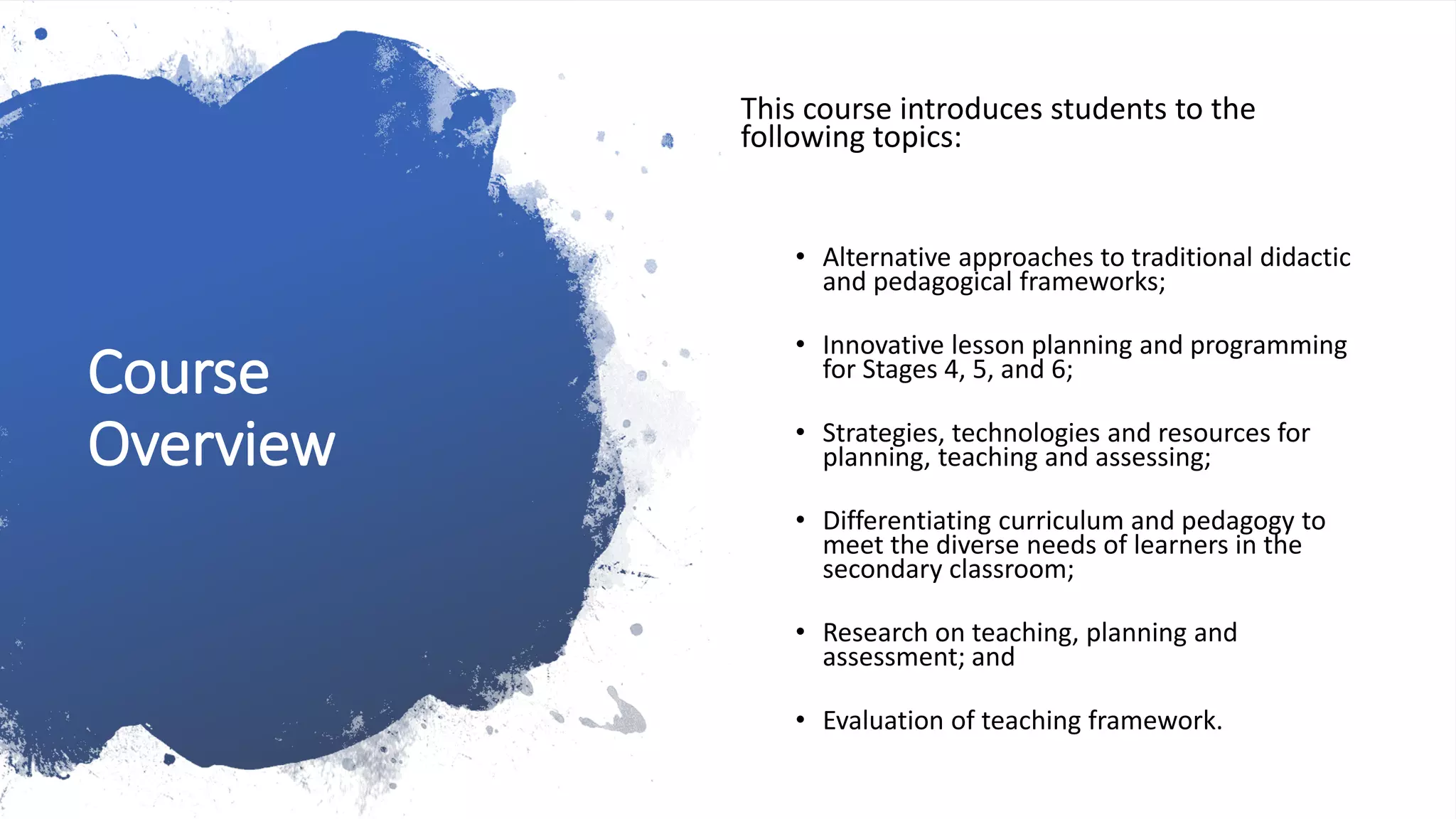
Course
Overview
This course introduces students to the
following topics:
• Alternative approaches to traditional didactic
and pedagogical frameworks;
• Innovative lesson planning and programming
for Stages 4, 5, and 6;
• Strategies, technologies and resources for
planning, teaching and assessing;
• Differentiating curriculum and pedagogy to
meet the diverse needs of learners in the
secondary classroom;
• Research on teaching, planning and
assessment; and
• Evaluation of teaching framework.
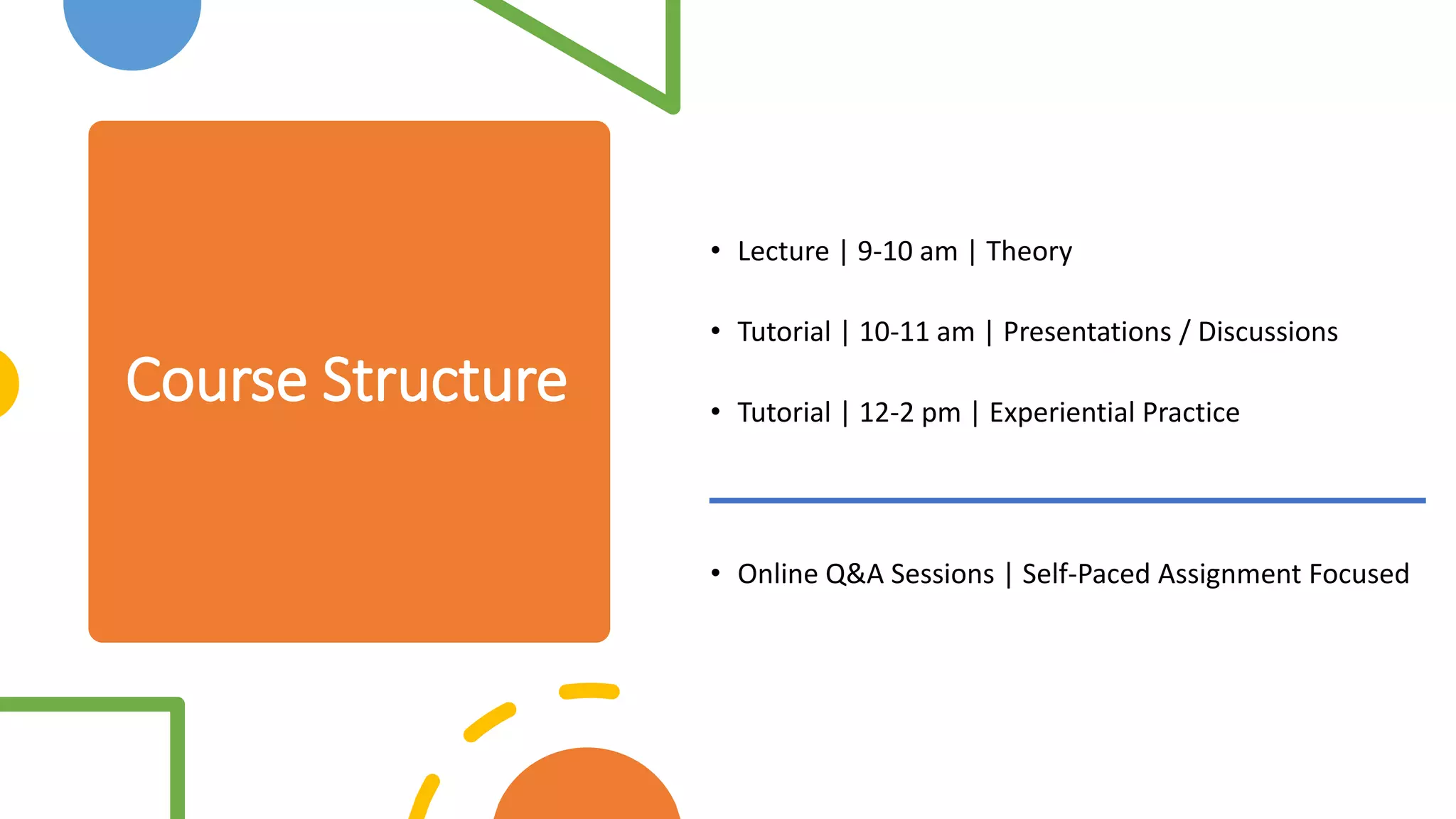
Course Structure
• Lecture | 9-10 am | Theory
• Tutorial | 10-11 am | Presentations / Discussions
• Tutorial | 12-2 pm | Experiential Practice
• Online Q&A Sessions | Self-Paced Assignment Focused
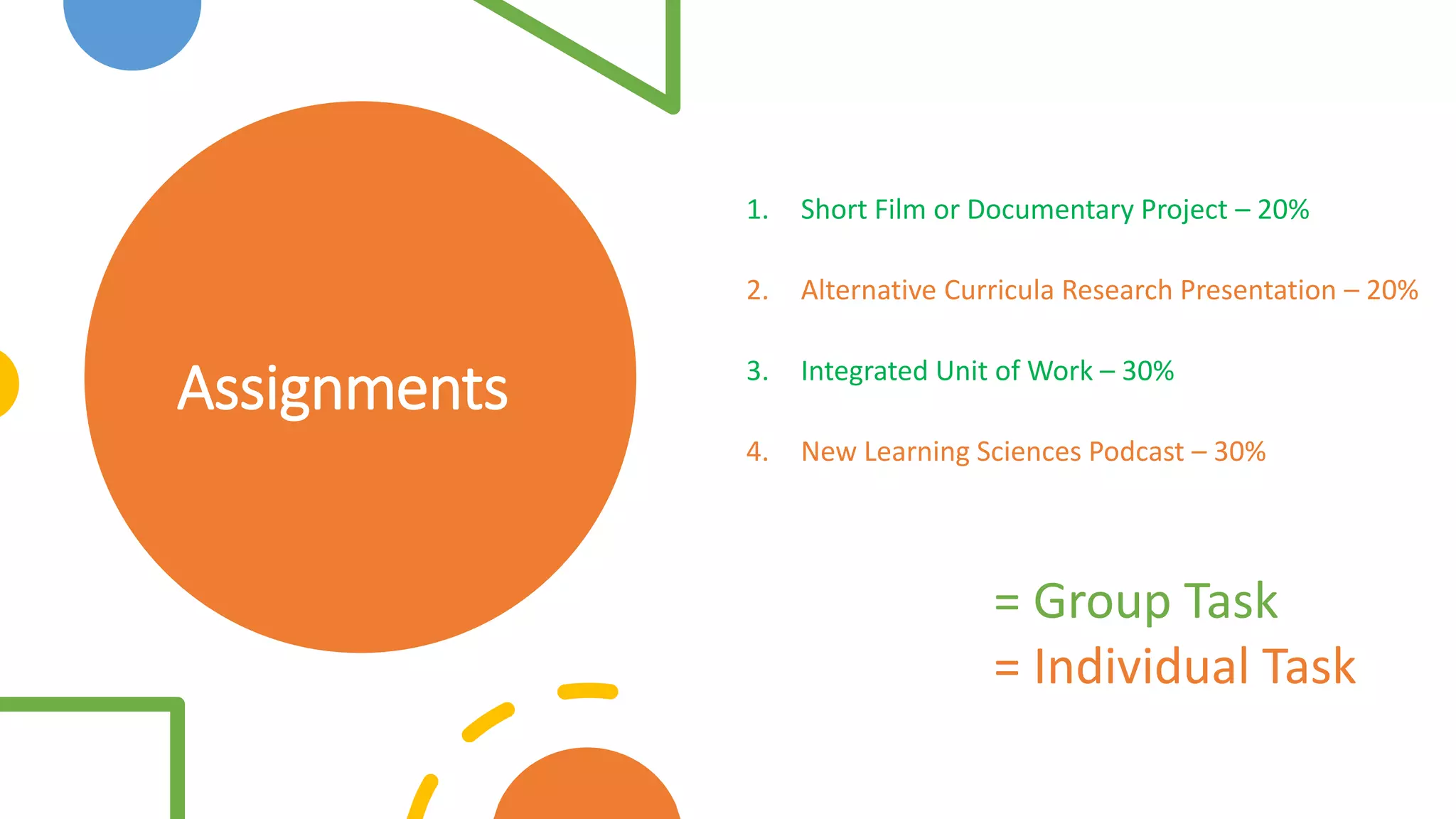
Assignments
1. Short Film or Documentary Project – 20%
2. Alternative Curricula Research Presentation – 20%
3. Integrated Unit of Work – 30%
4. New Learning Sciences Podcast – 30%
= Group Task
= Individual Task
Understanding
Curriculum
Theory
• “Curriculum theory is a distinctive field of
study, with a unique history, a complex
present, an uncertain future . . . [that] has its
origin in and owes its loyalty to the discipline
and experience of education” (p. 2).1
• The practice of curriculum theorizing and
design is not singular or uniform but
multiple, fractured and contested;2 and
conceptions and cultures of curriculum vary,
sometimes dramatically.3
1. Pinar, W. F. (2004). What is curriculum
theory? Mahwah, NJ: Lawrence Erlbaum
Associates, Publishers.
2. Wright, H. K. (2000). Nailing jell-o to the
wall: Pinpointing aspects of state-of-the-art
curriculum theorizing. Educational
Researcher, 29(5), 4-13.
3. Joseph, P., Bravmann, S., Windschitl, M.,
Mikel, E., & Green, N. (2000). Cultures of
curriculum. Mahwah, NJ: Lawrence Erlbaum
Associates.
What is
curriculum?
Take a minute to write down
your own definition of
curriculum in the chat.
Origins of curriculum?
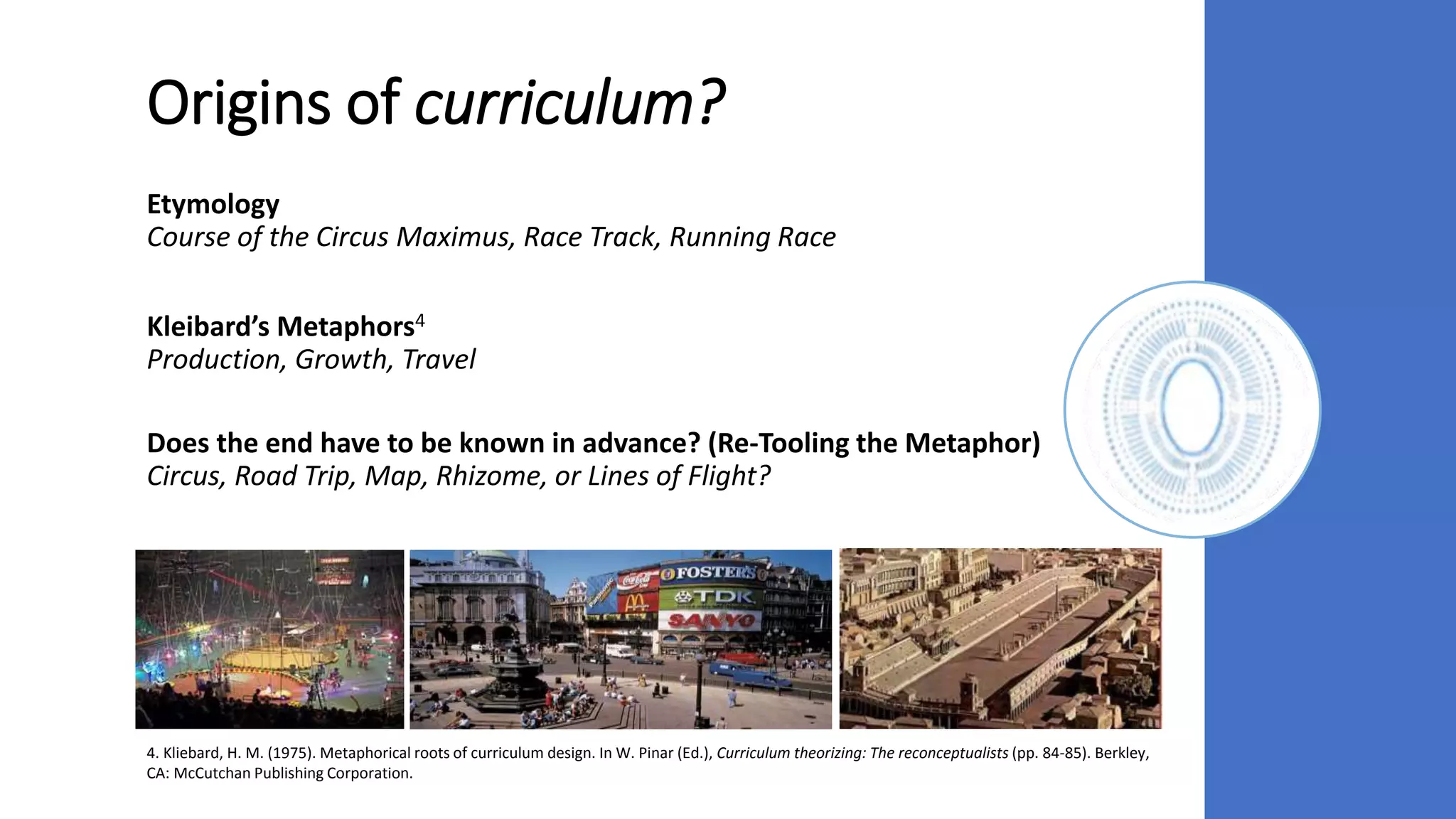
Etymology
Course of the Circus Maximus, Race Track, Running Race
Kleibard’s Metaphors4
Production, Growth, Travel
Does the end have to be known in advance? (Re-Tooling the Metaphor)
Circus, Road Trip, Map, Rhizome, or Lines of Flight?
4. Kliebard, H. M. (1975). Metaphorical roots of curriculum design. In W. Pinar (Ed.), Curriculum theorizing: The reconceptualists (pp. 84-85). Berkley,
CA: McCutchan Publishing Corporation.
What is curriculum?
• All of the learning planned and directed by
the school to attain its educational goals.5
• Refers to the learning experience of
students, as expressed or anticipated in
goals and objectives, plans and designs, and
their implementation.6
5. Tyler, R. W. (1949). Basic principles of curriculum and instruction. Chicago: The University of
Chicago Press. Or see: Tyler, R. W. (2004). Basic principles of curriculum and instruction. In D. J.
Flinders & S. J. Thornton (Eds.), The curriculum studies reader (pp. 51-60). New York: Routledge.
6. Skilbeck, M. (1984). School based curriculum development. London: Harper & Row Ltd.
The Syllabus as a set of educational prescriptions
[ Usually a set of official Aims, Knowledge, Skills, & Values ]
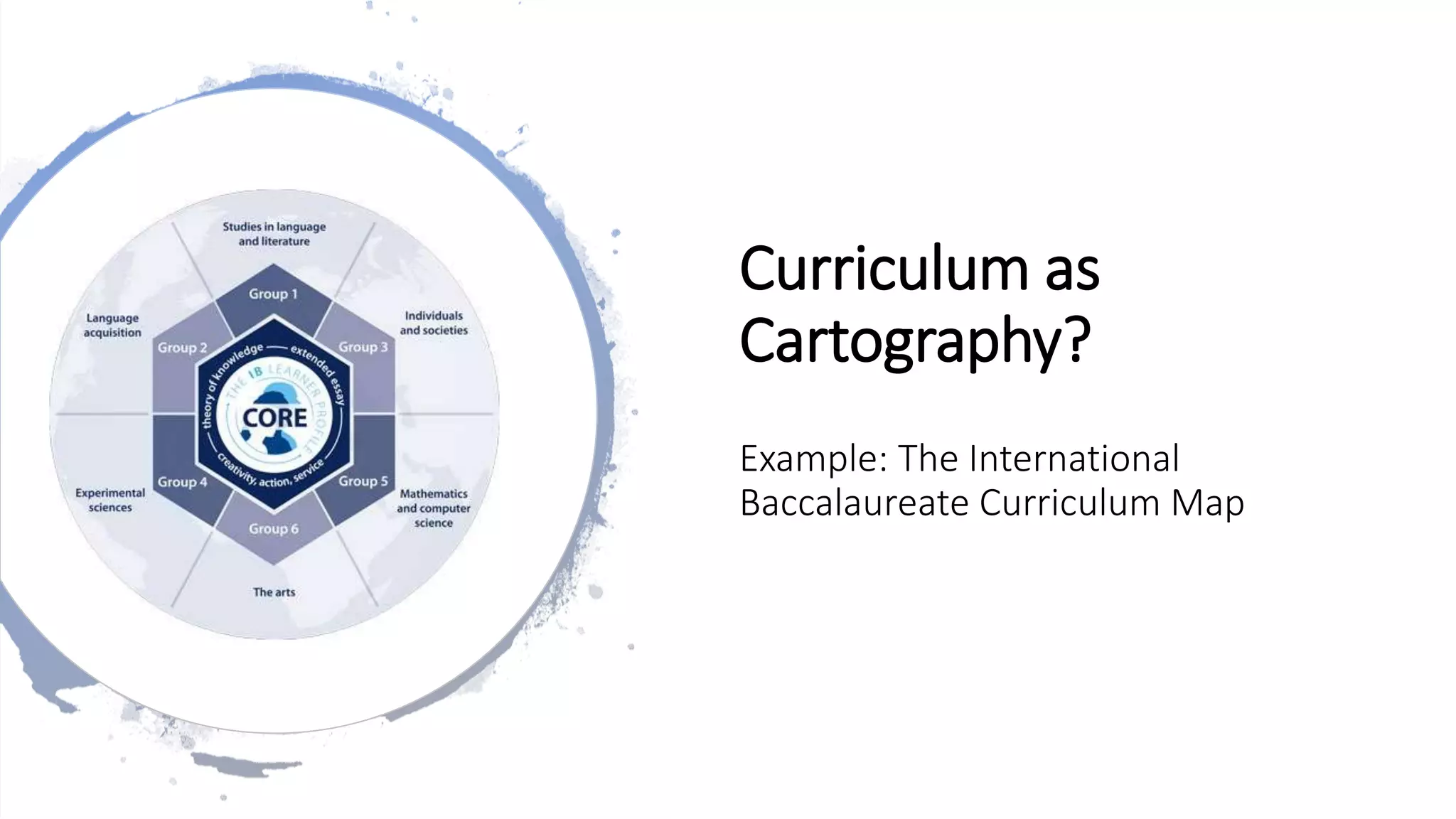
Curriculum as
Cartography?
Example: The International
Baccalaureate Curriculum Map
So what is the
curriculum?
• the collection of all school subjects?
• the Syllabus for a specific school
subject or Key Learning Area?
• a Scope and sequence that maps how
the syllabus prescriptions will be met in
an individual school?
• a Unit of Work that outlines the
teaching and learning strategies and
goals for a specific set of syllabus
topics?
• Lesson Plans for individual lessons that
work towards the achievement of unit
goals?
The Explicit, Planned,
or Official Curriculum
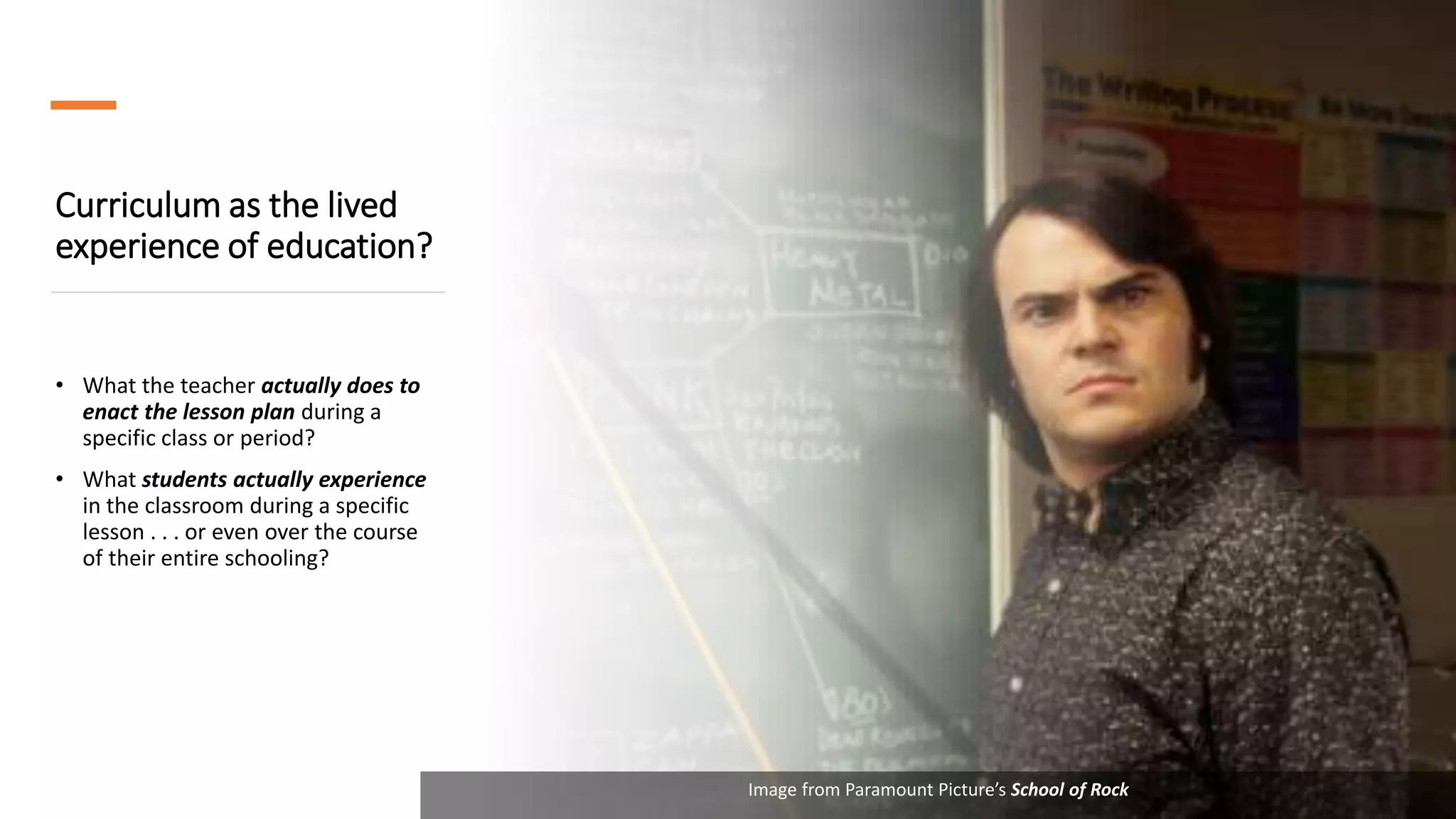
Curriculum as the lived
experience of education?
• What the teacher actually does to
enact the lesson plan during a
specific class or period?
• What students actually experience
in the classroom during a specific
lesson . . . or even over the course
of their entire schooling?
Image from Paramount Picture’s School of Rock
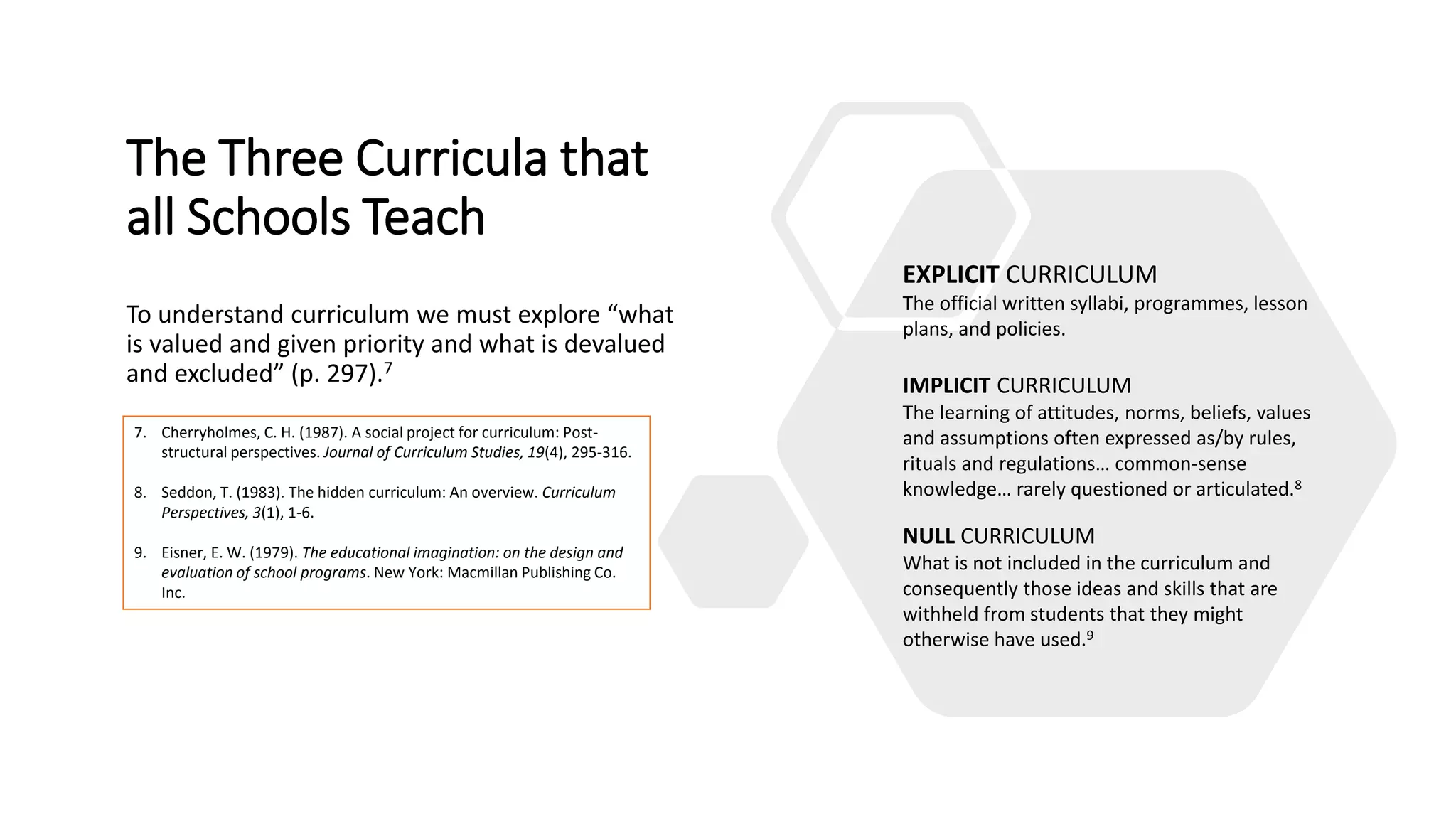
The Three Curricula that
all Schools Teach
To understand curriculum we must explore “what
is valued and given priority and what is devalued
and excluded” (p. 297).7
EXPLICIT CURRICULUM
The official written syllabi, programmes, lesson
plans, and policies.
IMPLICIT CURRICULUM
The learning of attitudes, norms, beliefs, values
and assumptions often expressed as/by rules,
rituals and regulations… common-sense
knowledge… rarely questioned or articulated.8
NULL CURRICULUM
What is not included in the curriculum and
consequently those ideas and skills that are
withheld from students that they might
otherwise have used.9
7. Cherryholmes, C. H. (1987). A social project for curriculum: Post-
structural perspectives. Journal of Curriculum Studies, 19(4), 295-316.
8. Seddon, T. (1983). The hidden curriculum: An overview. Curriculum
Perspectives, 3(1), 1-6.
9. Eisner, E. W. (1979). The educational imagination: on the design and
evaluation of school programs. New York: Macmillan Publishing Co.
Inc.
Curriculum constitutes
particular rationalities at the
expense of others
• “Curricula are historically formed within systems of
ideas that inscribe styles of reasoning, standards, and
conceptual distinctions in school practices” (p. 151).
[Offering] “an ensemble of methods and strategies that
inscribe principles for action” (p. 163). . . [and
particular] “styles of reasoning” (p. 151). Curriculum
must therefore be understood as “a practice of
governing and an effect of power” (p. 151).10
• Curriculum forms our ways of reasoning about the self
and the world, and the rationalities that emerge from
this process are constituted not only by what it
includes, but by what it implies and neglects.11
10. Popkewitz, T. S. (2001). The production of reason and power: Curriculum
history and intellectual traditions. In T. S. Popkewitz, B. M. Franklin & M. A.
Pereyra (Eds.), Cultural history and education: Critical essays on knowledge
and schooling (pp. 151-183). New York: Routledge Falmer.
11. Parkes, R. J. (2011). Interrupting history: Rethinking history curriculum after
'the end of history'. New York: Peter Lang.
The Levels of
Curriculum
Development
in Australia
• Australian CurriculumACARA
• NSW SyllabusNESA
• Scope and SequenceSchool Department
• Unit of WorkTeacher/s
• Lesson PlanIndividual Teacher
MayNotBeWrittenWrittenText
The Key
Curriculum
Question/s
• Anglo-American Curriculum Tradition:
What knowledge is of most worth?
Whose knowledge is being taught?
[What should be taught?]
• European Bildung-Influenced Didaktik Tradition:12
What will the student become?
[What should the student become?]
12. Gundem, B. B., & Hopmann, S. (Eds.).
(2002). Didaktik and/or curriculum: An
international dialogue. New York: Peter
Lang.
What is the function of curriculum?
• The double problem13 of the relationship
between:
• theory and practice
[curriculum provides a set of
representations of a ‘world outside’]
• education and society
[curriculum operates as a site of cultural
reproduction]
• Re-examing the work of Ulf Lundgren and the
Deakin School, Green14 refers to this as the
unresolved problem of representation and
reproduction.
13. Kemmis, S., & Fitzclarence, L. (1986). Curriculum theorizing: Beyond reproduction
theory. Geelong, Victoria: Deakin University.
14. Green, B. (2010). Rethinking the representation problem in curriculum inquiry. Journal
of Curriculum Studies, 42(4), 451-469.
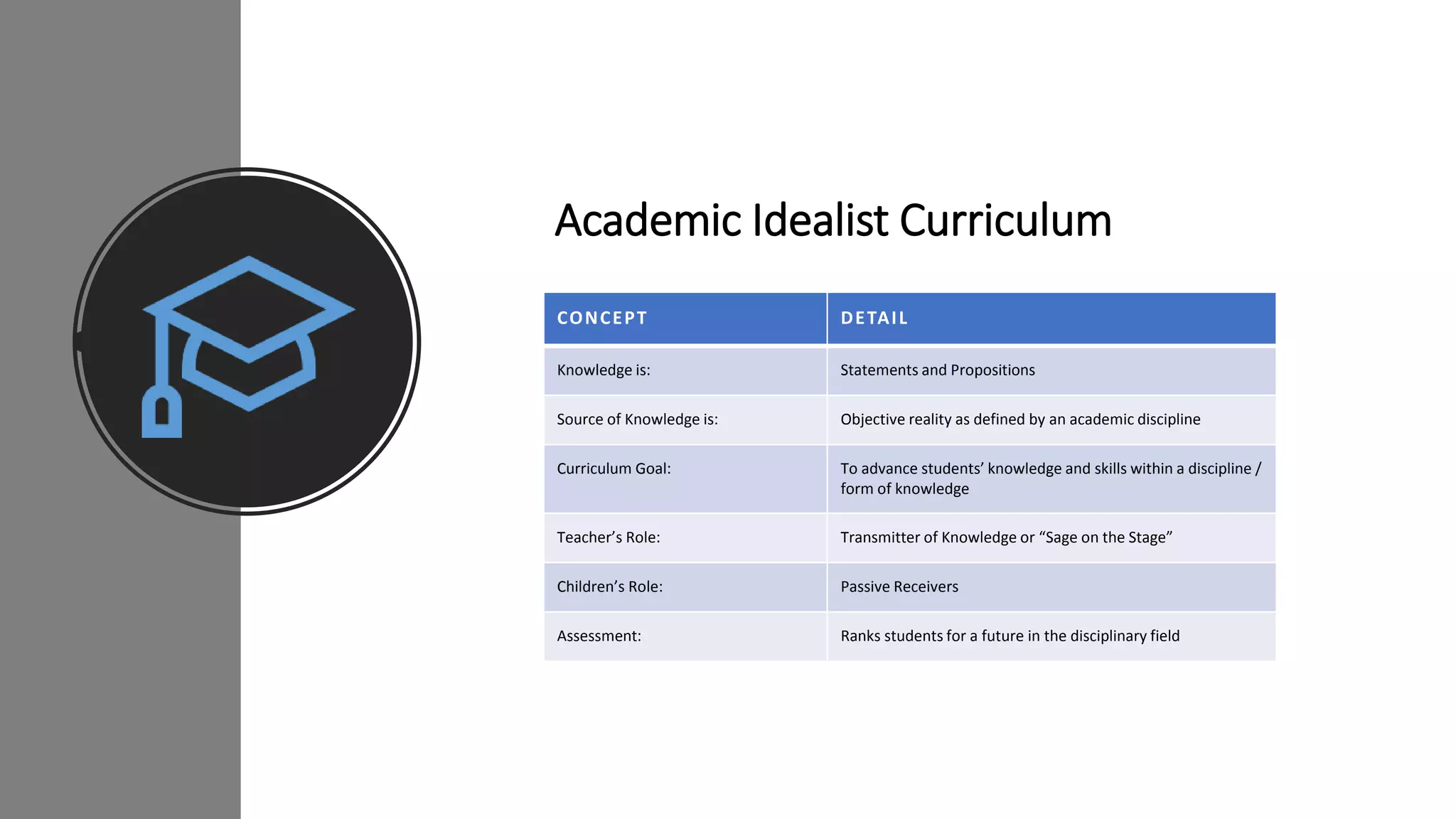
CONCEPT DETAIL
Knowledge is: Statements and Propositions
Source of Knowledge is: Objective reality as defined by an academic discipline
Curriculum Goal: To advance students’ knowledge and skills within a discipline /
form of knowledge
Teacher’s Role: Transmitter of Knowledge or “Sage on the Stage”
Children’s Role: Passive Receivers
Assessment: Ranks students for a future in the disciplinary field
Academic Idealist Curriculum
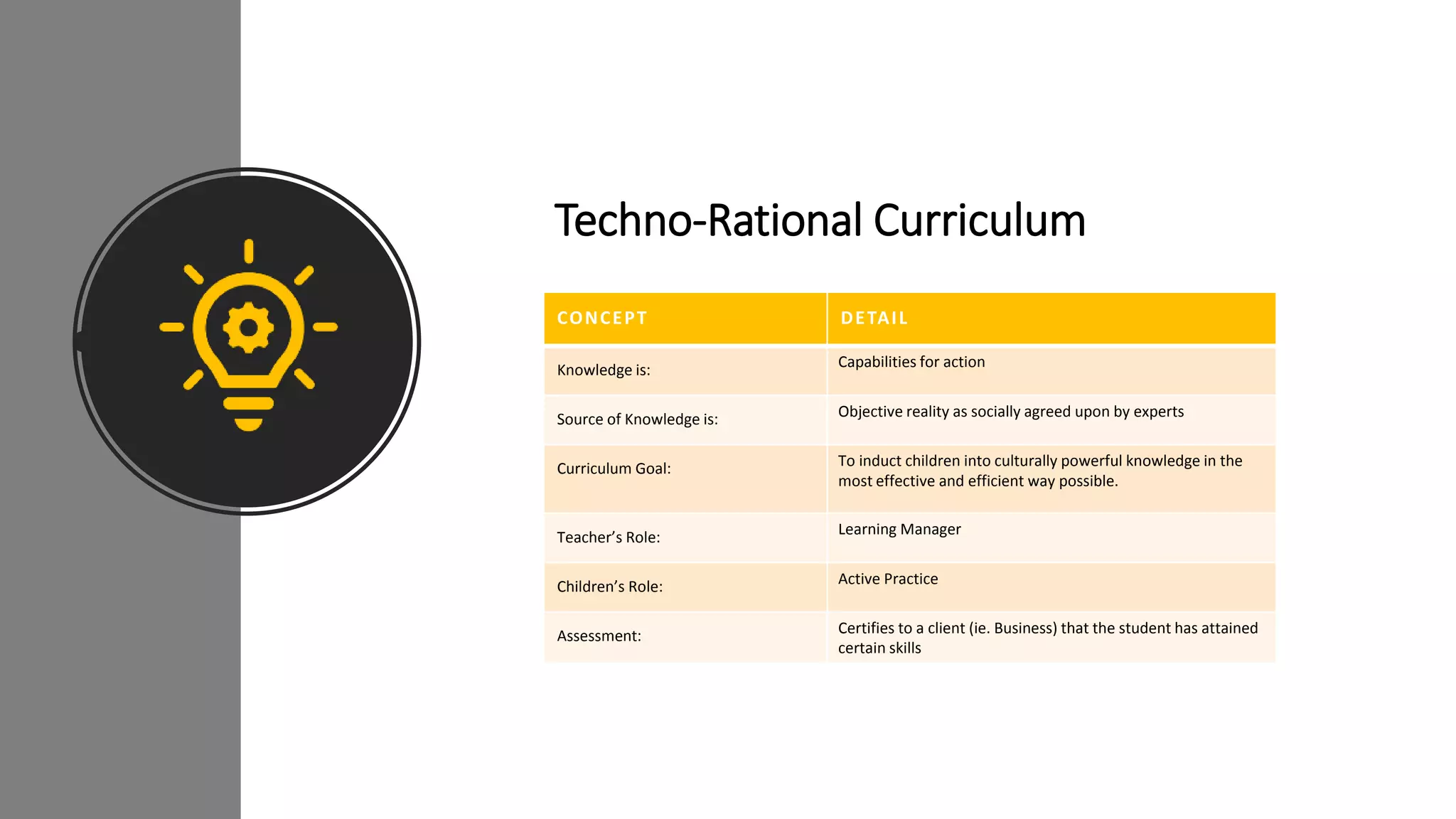
CONCEPT DETAIL
Knowledge is: Capabilities for action
Source of Knowledge is: Objective reality as socially agreed upon by experts
Curriculum Goal: To induct children into culturally powerful knowledge in the
most effective and efficient way possible.
Teacher’s Role: Learning Manager
Children’s Role: Active Practice
Assessment: Certifies to a client (ie. Business) that the student has attained
certain skills
Techno-Rational Curriculum
CONCEPT DETAIL
Knowledge is: Personal Meanings
Source of Knowledge is: Individual’s personal creative response to experience
Curriculum Goal: To stimulate individual growth and assist students’ to realise
their full potential
Teacher’s Role: Facilitator or “Guide on the Side”
Children’s Role: Active Participants
Assessment: Diagnoses students’ abilities to inform future lesson planning
to best support children’s learning
Learner-Centred Curriculum
CONCEPT DETAIL
Knowledge is: Critical Intelligence & Moral Clarity
Source of Knowledge is: Individual’s interpretation of society’s past, present, and future
Curriculum Goal: To liberate, emancipate and empower students’ to critique
culture and transform society towards a more just and fair
world
Teacher’s Role: Transformative Intellectual and Colleague
Children’s Role: Active Participants & Leaders
Assessment: Measures progress with respect to a student’s perceived
capacities and abilities
Social Reconstructionist Curriculum
Academic Idealist
Learner Centred
Social
Reconstructionist
Techno-Rational
Tensions Between
the Four Major
Curriculum Discourses
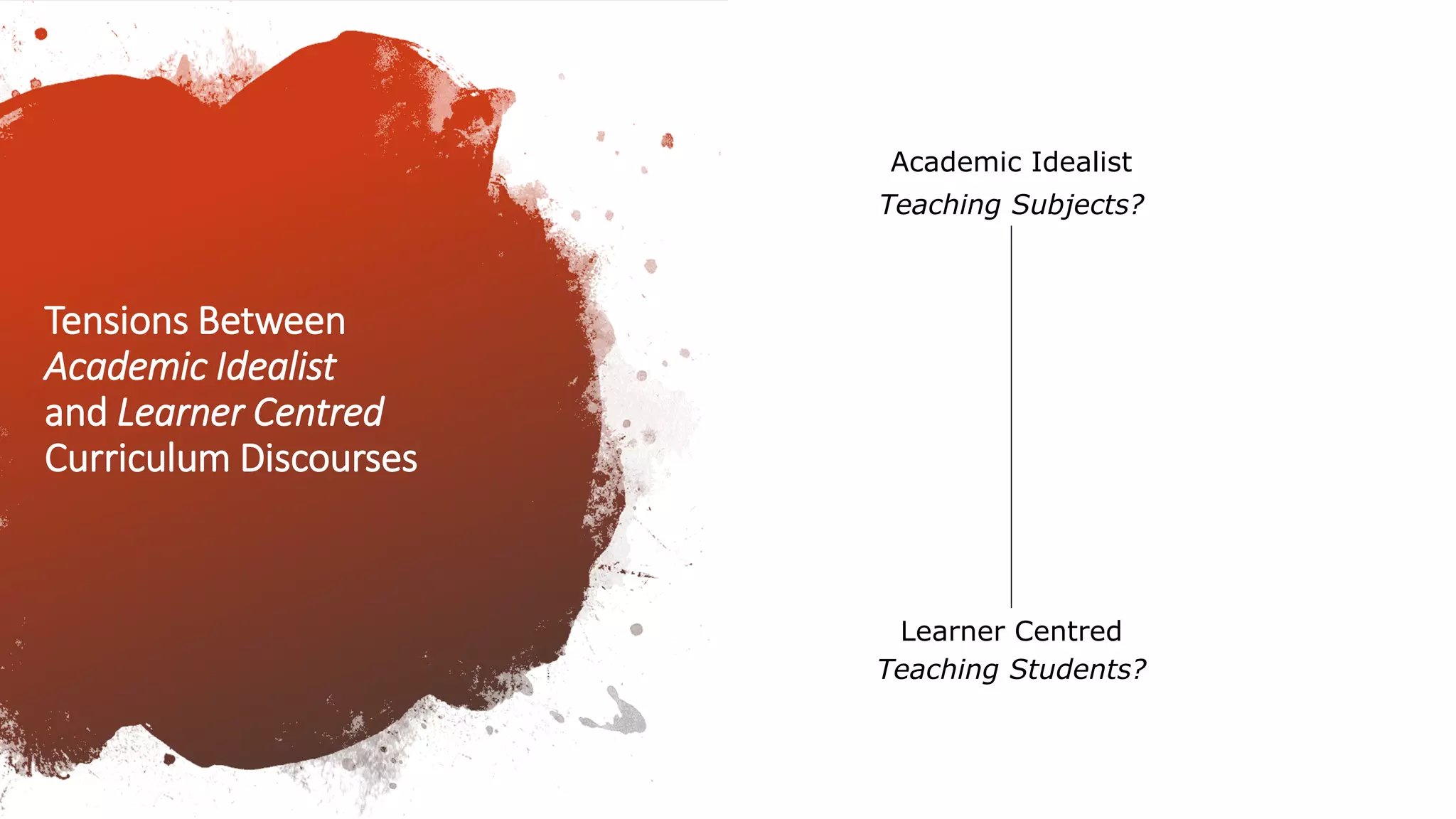
Tensions Between
Academic Idealist
and Learner Centred
Curriculum Discourses
Academic Idealist
Learner Centred
Teaching Subjects?
Teaching Students?
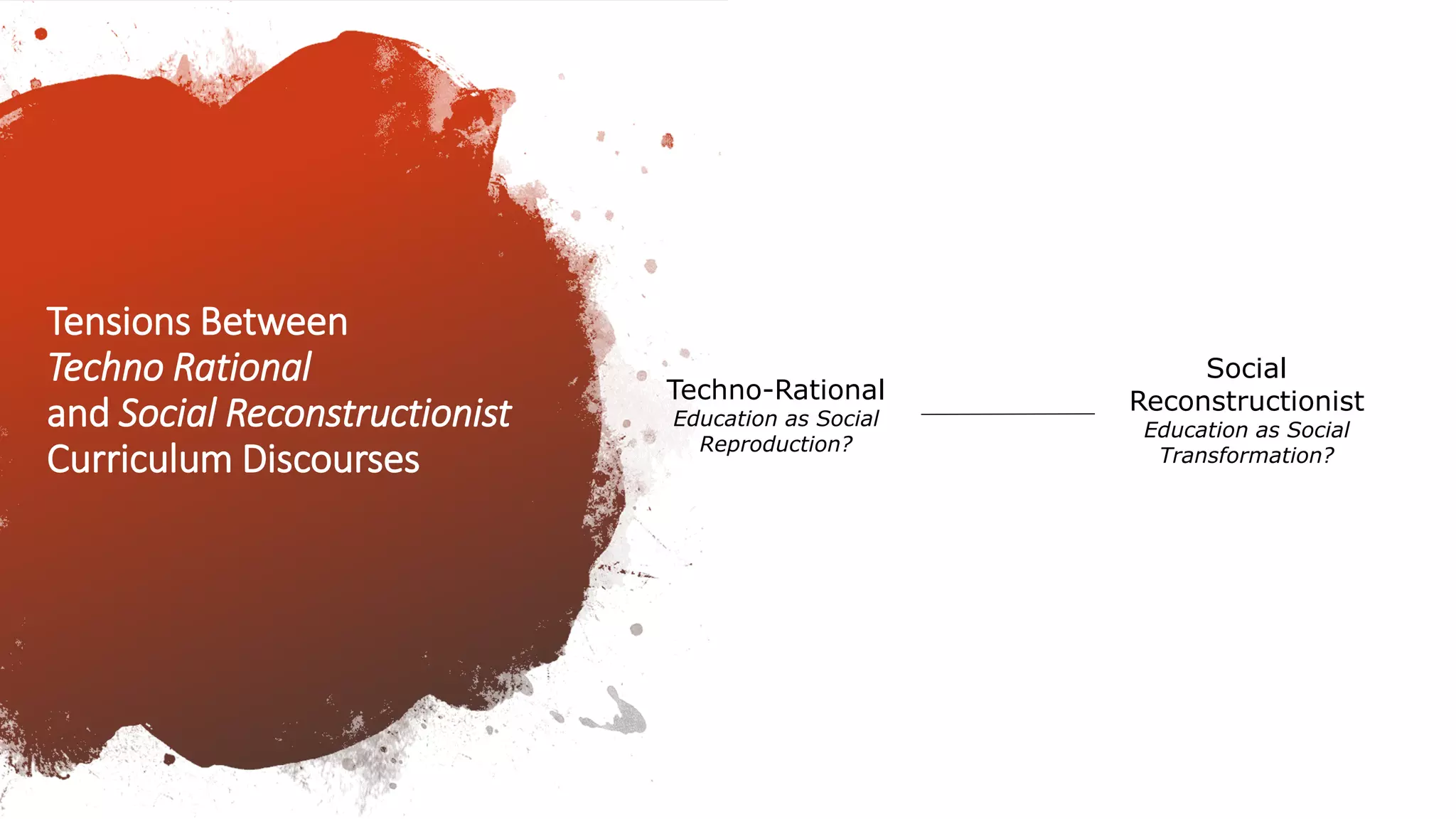
Social
Reconstructionist
Education as Social
Transformation?
Techno-Rational
Education as Social
Reproduction?
Tensions Between
Techno Rational
and Social Reconstructionist
Curriculum Discourses
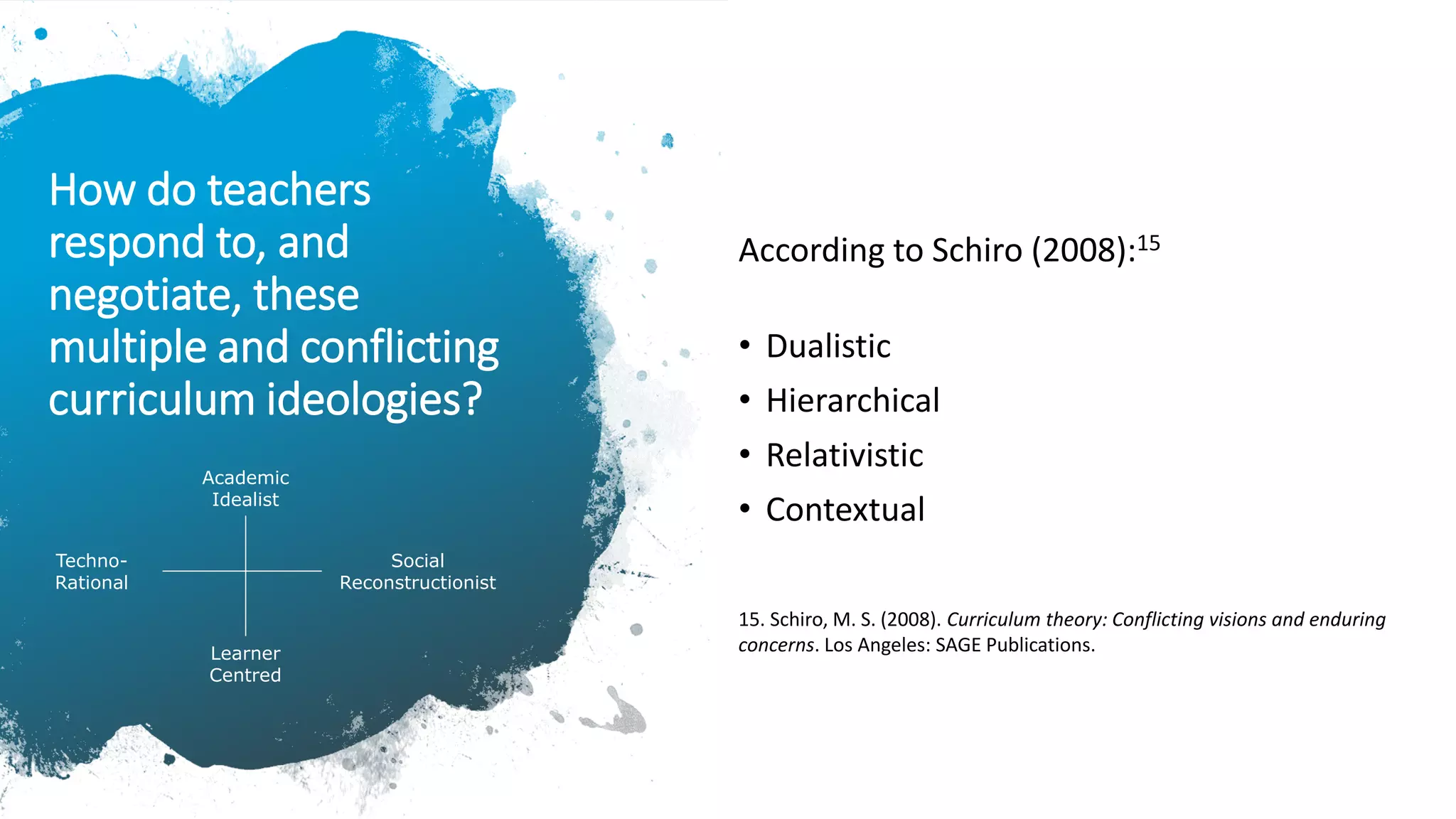
How do teachers
respond to, and
negotiate, these
multiple and conflicting
curriculum ideologies?
According to Schiro (2008):15
• Dualistic
• Hierarchical
• Relativistic
• Contextual
15. Schiro, M. S. (2008). Curriculum theory: Conflicting visions and enduring
concerns. Los Angeles: SAGE Publications.
Social
Reconstructionist
Academic
Idealist
Learner
Centred
Techno-
Rational
Recent
Curriculum
Reforms
through the
Lens of
Curriculum
Theory
• What type of curriculum
discourse underpins Queensland’s
New Basics and Rich Tasks?
• What type of curriculum
discourse underpins the
structures of the new Australian
Curriculum?
• What type of curriculum
discourse underpins NAPLAN and
other forms of national testing?
• What type of curriculum
discourse underpins the NSW
Quality Teaching model?
• What are the dominant
curriculum discourses
circulating in
contemporary Australia?
• Whose interests do these
discourses serve?
• If other discourses were
dominant, what might the
construction of
contemporary curriculum
look like?
Curriculum needs to be
understood as a Complicated
Conversation16
• “Curriculum discourse should be
marked by richness, diversity,
discordant voices, fecundity,
multiple rationalities, and
theories, and should be touched
by humanity and practicality in a
hundred thousand contexts.”
(p. 487)16
16. Pinar, W. F. (2004). What is curriculum theory?
Mahwah, NJ: Lawrence Erlbaum Associates, Publishers.
QUESTIO
NS

EDUC6776 | Understanding Curriculum

  • 1.
    EDUC6776 | WEEK1 Understanding Curriculum Associate Professor Robert Parkes
  • 2.
    Course Overview This course introducesstudents to the following topics: • Alternative approaches to traditional didactic and pedagogical frameworks; • Innovative lesson planning and programming for Stages 4, 5, and 6; • Strategies, technologies and resources for planning, teaching and assessing; • Differentiating curriculum and pedagogy to meet the diverse needs of learners in the secondary classroom; • Research on teaching, planning and assessment; and • Evaluation of teaching framework.
  • 3.
    Course Structure • Lecture| 9-10 am | Theory • Tutorial | 10-11 am | Presentations / Discussions • Tutorial | 12-2 pm | Experiential Practice • Online Q&A Sessions | Self-Paced Assignment Focused
  • 4.
    Assignments 1. Short Filmor Documentary Project – 20% 2. Alternative Curricula Research Presentation – 20% 3. Integrated Unit of Work – 30% 4. New Learning Sciences Podcast – 30% = Group Task = Individual Task
  • 5.
    Understanding Curriculum Theory • “Curriculum theoryis a distinctive field of study, with a unique history, a complex present, an uncertain future . . . [that] has its origin in and owes its loyalty to the discipline and experience of education” (p. 2).1 • The practice of curriculum theorizing and design is not singular or uniform but multiple, fractured and contested;2 and conceptions and cultures of curriculum vary, sometimes dramatically.3 1. Pinar, W. F. (2004). What is curriculum theory? Mahwah, NJ: Lawrence Erlbaum Associates, Publishers. 2. Wright, H. K. (2000). Nailing jell-o to the wall: Pinpointing aspects of state-of-the-art curriculum theorizing. Educational Researcher, 29(5), 4-13. 3. Joseph, P., Bravmann, S., Windschitl, M., Mikel, E., & Green, N. (2000). Cultures of curriculum. Mahwah, NJ: Lawrence Erlbaum Associates.
  • 6.
    What is curriculum? Take aminute to write down your own definition of curriculum in the chat.
  • 7.
    Origins of curriculum? Etymology Courseof the Circus Maximus, Race Track, Running Race Kleibard’s Metaphors4 Production, Growth, Travel Does the end have to be known in advance? (Re-Tooling the Metaphor) Circus, Road Trip, Map, Rhizome, or Lines of Flight? 4. Kliebard, H. M. (1975). Metaphorical roots of curriculum design. In W. Pinar (Ed.), Curriculum theorizing: The reconceptualists (pp. 84-85). Berkley, CA: McCutchan Publishing Corporation.
  • 8.
    What is curriculum? •All of the learning planned and directed by the school to attain its educational goals.5 • Refers to the learning experience of students, as expressed or anticipated in goals and objectives, plans and designs, and their implementation.6 5. Tyler, R. W. (1949). Basic principles of curriculum and instruction. Chicago: The University of Chicago Press. Or see: Tyler, R. W. (2004). Basic principles of curriculum and instruction. In D. J. Flinders & S. J. Thornton (Eds.), The curriculum studies reader (pp. 51-60). New York: Routledge. 6. Skilbeck, M. (1984). School based curriculum development. London: Harper & Row Ltd. The Syllabus as a set of educational prescriptions [ Usually a set of official Aims, Knowledge, Skills, & Values ]
  • 9.
    Curriculum as Cartography? Example: TheInternational Baccalaureate Curriculum Map
  • 10.
    So what isthe curriculum? • the collection of all school subjects? • the Syllabus for a specific school subject or Key Learning Area? • a Scope and sequence that maps how the syllabus prescriptions will be met in an individual school? • a Unit of Work that outlines the teaching and learning strategies and goals for a specific set of syllabus topics? • Lesson Plans for individual lessons that work towards the achievement of unit goals? The Explicit, Planned, or Official Curriculum
  • 11.
    Curriculum as thelived experience of education? • What the teacher actually does to enact the lesson plan during a specific class or period? • What students actually experience in the classroom during a specific lesson . . . or even over the course of their entire schooling? Image from Paramount Picture’s School of Rock
  • 12.
    The Three Curriculathat all Schools Teach To understand curriculum we must explore “what is valued and given priority and what is devalued and excluded” (p. 297).7 EXPLICIT CURRICULUM The official written syllabi, programmes, lesson plans, and policies. IMPLICIT CURRICULUM The learning of attitudes, norms, beliefs, values and assumptions often expressed as/by rules, rituals and regulations… common-sense knowledge… rarely questioned or articulated.8 NULL CURRICULUM What is not included in the curriculum and consequently those ideas and skills that are withheld from students that they might otherwise have used.9 7. Cherryholmes, C. H. (1987). A social project for curriculum: Post- structural perspectives. Journal of Curriculum Studies, 19(4), 295-316. 8. Seddon, T. (1983). The hidden curriculum: An overview. Curriculum Perspectives, 3(1), 1-6. 9. Eisner, E. W. (1979). The educational imagination: on the design and evaluation of school programs. New York: Macmillan Publishing Co. Inc.
  • 13.
    Curriculum constitutes particular rationalitiesat the expense of others • “Curricula are historically formed within systems of ideas that inscribe styles of reasoning, standards, and conceptual distinctions in school practices” (p. 151). [Offering] “an ensemble of methods and strategies that inscribe principles for action” (p. 163). . . [and particular] “styles of reasoning” (p. 151). Curriculum must therefore be understood as “a practice of governing and an effect of power” (p. 151).10 • Curriculum forms our ways of reasoning about the self and the world, and the rationalities that emerge from this process are constituted not only by what it includes, but by what it implies and neglects.11 10. Popkewitz, T. S. (2001). The production of reason and power: Curriculum history and intellectual traditions. In T. S. Popkewitz, B. M. Franklin & M. A. Pereyra (Eds.), Cultural history and education: Critical essays on knowledge and schooling (pp. 151-183). New York: Routledge Falmer. 11. Parkes, R. J. (2011). Interrupting history: Rethinking history curriculum after 'the end of history'. New York: Peter Lang.
  • 14.
    The Levels of Curriculum Development inAustralia • Australian CurriculumACARA • NSW SyllabusNESA • Scope and SequenceSchool Department • Unit of WorkTeacher/s • Lesson PlanIndividual Teacher MayNotBeWrittenWrittenText
  • 15.
    The Key Curriculum Question/s • Anglo-AmericanCurriculum Tradition: What knowledge is of most worth? Whose knowledge is being taught? [What should be taught?] • European Bildung-Influenced Didaktik Tradition:12 What will the student become? [What should the student become?] 12. Gundem, B. B., & Hopmann, S. (Eds.). (2002). Didaktik and/or curriculum: An international dialogue. New York: Peter Lang.
  • 16.
    What is thefunction of curriculum? • The double problem13 of the relationship between: • theory and practice [curriculum provides a set of representations of a ‘world outside’] • education and society [curriculum operates as a site of cultural reproduction] • Re-examing the work of Ulf Lundgren and the Deakin School, Green14 refers to this as the unresolved problem of representation and reproduction. 13. Kemmis, S., & Fitzclarence, L. (1986). Curriculum theorizing: Beyond reproduction theory. Geelong, Victoria: Deakin University. 14. Green, B. (2010). Rethinking the representation problem in curriculum inquiry. Journal of Curriculum Studies, 42(4), 451-469.
  • 17.
    CONCEPT DETAIL Knowledge is:Statements and Propositions Source of Knowledge is: Objective reality as defined by an academic discipline Curriculum Goal: To advance students’ knowledge and skills within a discipline / form of knowledge Teacher’s Role: Transmitter of Knowledge or “Sage on the Stage” Children’s Role: Passive Receivers Assessment: Ranks students for a future in the disciplinary field Academic Idealist Curriculum
  • 18.
    CONCEPT DETAIL Knowledge is:Capabilities for action Source of Knowledge is: Objective reality as socially agreed upon by experts Curriculum Goal: To induct children into culturally powerful knowledge in the most effective and efficient way possible. Teacher’s Role: Learning Manager Children’s Role: Active Practice Assessment: Certifies to a client (ie. Business) that the student has attained certain skills Techno-Rational Curriculum
  • 19.
    CONCEPT DETAIL Knowledge is:Personal Meanings Source of Knowledge is: Individual’s personal creative response to experience Curriculum Goal: To stimulate individual growth and assist students’ to realise their full potential Teacher’s Role: Facilitator or “Guide on the Side” Children’s Role: Active Participants Assessment: Diagnoses students’ abilities to inform future lesson planning to best support children’s learning Learner-Centred Curriculum
  • 20.
    CONCEPT DETAIL Knowledge is:Critical Intelligence & Moral Clarity Source of Knowledge is: Individual’s interpretation of society’s past, present, and future Curriculum Goal: To liberate, emancipate and empower students’ to critique culture and transform society towards a more just and fair world Teacher’s Role: Transformative Intellectual and Colleague Children’s Role: Active Participants & Leaders Assessment: Measures progress with respect to a student’s perceived capacities and abilities Social Reconstructionist Curriculum
  • 21.
  • 22.
    Tensions Between Academic Idealist andLearner Centred Curriculum Discourses Academic Idealist Learner Centred Teaching Subjects? Teaching Students?
  • 23.
    Social Reconstructionist Education as Social Transformation? Techno-Rational Educationas Social Reproduction? Tensions Between Techno Rational and Social Reconstructionist Curriculum Discourses
  • 24.
    How do teachers respondto, and negotiate, these multiple and conflicting curriculum ideologies? According to Schiro (2008):15 • Dualistic • Hierarchical • Relativistic • Contextual 15. Schiro, M. S. (2008). Curriculum theory: Conflicting visions and enduring concerns. Los Angeles: SAGE Publications. Social Reconstructionist Academic Idealist Learner Centred Techno- Rational
  • 25.
    Recent Curriculum Reforms through the Lens of Curriculum Theory •What type of curriculum discourse underpins Queensland’s New Basics and Rich Tasks? • What type of curriculum discourse underpins the structures of the new Australian Curriculum? • What type of curriculum discourse underpins NAPLAN and other forms of national testing? • What type of curriculum discourse underpins the NSW Quality Teaching model? • What are the dominant curriculum discourses circulating in contemporary Australia? • Whose interests do these discourses serve? • If other discourses were dominant, what might the construction of contemporary curriculum look like?
  • 26.
    Curriculum needs tobe understood as a Complicated Conversation16 • “Curriculum discourse should be marked by richness, diversity, discordant voices, fecundity, multiple rationalities, and theories, and should be touched by humanity and practicality in a hundred thousand contexts.” (p. 487)16 16. Pinar, W. F. (2004). What is curriculum theory? Mahwah, NJ: Lawrence Erlbaum Associates, Publishers. QUESTIO NS