EPISODE 1: PRINCIPLES OF LEARNING 
My Tool 
As I observe a class, I will use the Observation sheet for a more focused observation 
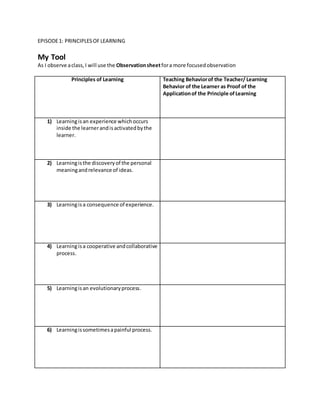
Principles of Learning Teaching Behavior of the Teacher/ Learning 
Behavior of the Learner as Proof of the 
Application of the Principle of Learning 
1) Learning is an experience which occurs 
inside the learner and is activated by the 
learner. 
2) Learning is the discovery of the personal 
meaning and relevance of ideas. 
3) Learning is a consequence of experience. 
4) Learning is a cooperative and collaborative 
process. 
5) Learning is an evolutionary process. 
6) Learning is sometimes a painful process.
7) One of the richest resources for the 
learning is the learner himself. 
8) The process of learning is emotional as 
well as intellectual. 
9) The process of problem solving and 
learning is highly unique and individual. 
My Analysis 
1) What is the impact of the resource Teacher’s observance of these principles on the teaching - 
learning process and on the learners? 
2) Which learning principle was applied most? 
3) Which learning principle was applied least or not at all applied? 
4) Do you agree with these principles of learning? Or have you discovered that the are not always 
correct?
My Reflections 
1) My reflections on my observation of my Resource Teacher’s observance of these principles. Did 
my Resource Teachers adhere to these principles? 
2) Lessons I have learned from my observations on the classroom application of the principles of 
learning.
My Portfolio 
Principles of Learning in My Own Words
EPISODE 2: LESSON OBJECTIVES AS MY GUIDING STAR 
My Tool 
1) As I observe a class, I will use the Observation Sheet for a more focused observation. 
Guiding Principles in Determining and 
Formulating Learning Objectives 
Teaching Behavior/s which Prove/s Observance 
of the Guiding Principle 
1) Begin with the end of mind. 
2) Share lesson objective with students 
3) Lesson Objectives must be in the 2 or 3 
domains- cognitive, skill and affective or 
cognitive and affective or skill and 
affective. 
4) Work on significant and relevant lesson 
objectives. 
5) Lesson objectives must lead to the 
development of critical and creative 
thinking.
2) After observing your Resource Teacher teaches, write down what you think was/were her lesson 
objective. 
3) Ask permission from your Resource Teacher for you to copy her lesson objective for the day’s 
lesson. Copy it here then compare it with your answer in #2. Are they the same? Different? 
My Analysis 
1) If answer in #3 above is different, what is your conclusion regarding written lesson objective and 
actual lesson development? Are lesson objectives in the lesson plan always followed? Do they 
really serve as guiding star? 
2) Why did you find it easy/difficult to write down the Resource Teacher’s lesson objectives for the 
day? Did she mention it at the beginning of his/her lesson?
3) Did you find the lesson objective SMART? Why? Why not? 
4) Was the lesson objective in the cognitive or psychomotor or affective domain? Or was it in the 
two or three domains? Support your answer.. 
My Reflections 
Any lesson learned or insights gained from your observation focused on objectives? Write them 
down here. Are lesson objectives truly the guiding star in the development of a lesson? Or are 
lesson objectives sometimes forgotten as the lesson develops? 
My Portfolio 
My research quotations that state the significance of goals and objectives (don’t forget to 
state your answer)
EPISODE 3: ORGANIZING CONTENT FOR MEANINGFUL LEARNING 
My Tools 
A. For the Cognitive Lesson 
1) What is the lesson about? 
2) What are the examples of facts mentioned in the lesson? 
3) Did the lesson end with facts? Or did these facts lead to misunderstanding of concepts? 
Prove your answer. 
4) Write down instances of treating the topic in depth (giving examples, examining cause-effect 
relationships, relating ideas or concepts to one another.)
5) Cite instance/instances when students were encouraged to ask questions, to talk about 
and reflect on what they learned. 
B. For the Skill Lesson 
1) What was the skill lesson about? Which skills was/were target? Manipulative skill or 
thinking skill? 
2) Write evidence of the teacher’s encouragement of divergent thinking by the students. 
3) Which are proofs that the Resource Teacher promoted convergent thinking?
4) If there was problem solving in lesson, were the pupils taught to solve problem using 
algorithm or heuristic strategy? 
5) What are proofs that the students were encourage to do critical thinking? 
C. Value/Affective Lesson 
1) What was the value lesson about? 
2) Was the value taught alone or was it integrated with cognitive or skill lesson? 
3) How was the value lesson developed?
My Analysis 
For the Cognitive Lesson 
How did my Resource Teacher teach the cognitive content meaningfully and 
interestingly? 
For the Skill Lesson 
How was the skill taught meaningfully and interestingly? 
For the Affective Lesson 
1) Is it possible to teach a value lesson without any cognitive basis at all? Explain your 
answer.
2) A cognitive or a skill lesson is a vehicle for value education. Do you agree? 
My Reflection 
1) Someone once said: “There are dull teachers, dull textbooks, dull films but no dull subjects”. Do 
you agree? Write down your reflections here! 
2) How should you organize subject matter (be it cognitive skill or value lesson) so that your 
teaching will always be fresh and interesting? 
My Portfolio 
Research on/or come up with a lesson plan (cognitive or skill) that integrates a value or values. 
Paste it here! (You want to refer to “Integrating Values with Subject Matter”, in Principles of 
Teaching 2, 2006 by Corpuz B., G. Salandanan and D. Rigor, pp. 91-92.)An outline of the lesson 
development will do. 
My Lesson Plan
EPISODE 4: GUIDING PRINCIPLES IN THE SELECTION AND USE OF TTEACHING STRATEGIES 
My Tools 
Guiding Principles in the selection and Use of 
Strategies 
Teaching Behavior of the Resource Teacher that 
Applies the Principles 
1) Learning is an active process. 
2) The more senses that are involved, the 
more and the better the learning. 
3) A non-threatening atmosphere enhances 
learning.
4) Emotion has the power to increase 
retention and learning. 
5) Good teaching goes beyond recall of 
information 
6) Learning is meaningful when it is 
connected to students’ everyday life 
7) An integrated teaching approach is afr 
more effective than teaching isolated bits 
of information.
My Analysis 
Are these principles in accordance with brain-based teaching and learning? 
My Reflections 
What is the best method of teaching? Is there such a thing? 
My Portfolio 
Illustrate your reflection on the best method of teaching creatively on this page.
EPISODE 5: ON TEACHING APPROACHES AND METHODS 
My Tools 
Approach/Method Description of Teaching Behavior that Proves Use 
of the Teaching Approach/Method (What did my 
Resource Teacher do as she used this 
approach/method?) 
1) Deductive Method 
2) Inductive Method 
3) Demonstration Method 
4) Problem Solving
5) Discovery Method 
6) Problem Solving Method 
7) Project Method 
8) Constructivist Approach 
9) Metacognitive Approach
10) Integrative Approach 
My Analysis 
1) Which approaches/methods will be grouped together? Why? 
E.g. Direct method and deductive method 
2) Which approaches/methods are more interactive? Less interactive? 
3) When should the direct method be used?
4) When should the indirect method be used? 
5) Which approaches/methods promote “learning to live together”? 
My Reflections 
If I decided on my teaching approach/method, I will consider___________________ (Continue 
the sentence. Begin writing NOW!)
My Portfolio 
1) By means of graphic organizer show the characteristics of a constructivist and a metacognitive 
approach. 
CONTRUCTIVIST 
APPROACH
METACOGNITIVE 
APPROACH
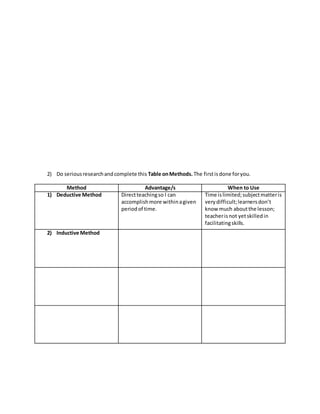
2) Do serious research and complete this Table on Methods. The first is done for you. 
Method Advantage/s When to Use 
1) Deductive Method Direct teaching so I can 
accomplish more within a given 
period of time. 
Time is limited; subject matter is 
very difficult; learners don’t 
know much about the lesson; 
teacher is not yet skilled in 
facilitating skills. 
2) Inductive Method
EPISODE 6: ON LESSON DEVELOPMENT 
My Tools 
1) Describe hoe the teacher began his/her lesson. Why do you think did she/he do that? 
2) What activity/es did the Resource Teacher ask the learners to do after she/he introduced the 
lesson? Why do you think she/he did such? 
3) How did she end his/her lesson? Why do you think she/he did that?
4) Did you notice an assessment of learning in the process of teaching? If yes, how was it done? 
5) Did you observe if Resource Teacher checked learning at the end of her lesson? 
6) Checklist-Of the following, which did you observe? Please check if you observed the item. 
Teaching Behavior Check here! 
1) Connecting lesson to past lesson 
2) Introducing the lesson for the day 
3) Sharing the lesson objective for the day 
4) Motivating the students 
5) Students doing learning activity 
6) Teacher giving Lecture 
7) Teacher checking for understanding 
8) Teacher/ Students Summarizing 
My Analysis 
1) How should a lesson begin and end? 
2) Did you observe any part of the lesson development to have been out of place? Explain your 
answer.
My Reflections 
“Tell them what you want to tell them; tell them what you told them.” Relate this statement to 
lesson development. 
My Portfolio 
1) Re-construct your Resource Teacher’s Lesson Plan. Your lesson plan must have the parts of a 
lesson plan. A lesson plan outline may do, provided all parts of a lesson are covered.
EPISODE 7: EFFECTIVE QUESTIONING AND REACTING TECHNIQUES 
My Tools 
Score the Resource teacher every time she/he demonstrates any of the following questioning behaviors. 
Simple is shown in item #1. 
Questioning Behavior Tally of Use Frequency 
1) Varying types of questions 
2) Asking non-directed 
questions 
3) Calling on non-volunteers 
4) Rephrasing 
5) Sequencing Logically 
6) Requiring abstract thinking
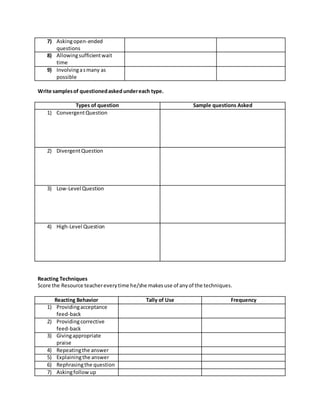
7) Asking open-ended 
questions 
8) Allowing sufficient wait 
time 
9) Involving a s many as 
possible 
Write samples of questioned asked under each type. 
Types of question Sample questions Asked 
1) Convergent Question 
2) Divergent Question 
3) Low-Level Question 
4) High-Level Question 
Reacting Techniques 
Score the Resource teacher every time he/she makes use of any of the techniques. 
Reacting Behavior Tally of Use Frequency 
1) Providing acceptance 
feed-back 
2) Providing corrective 
feed-back 
3) Giving appropriate 
praise 
4) Repeating the answer 
5) Explaining the answer 
6) Rephrasing the question 
7) Asking follow up
questions 
8) Redirecting questions to 
other pupils 
9) Soliciting students 
questions 
10) Encouraging through 
non-verbal behavior 
11) Criticizing responding 
student for his/her 
answer 
12) Scolding for misbehavior 
or not listening 
13) Overusing expressions 
such as “Okay”, “Right”, 
etc.? 
My Analysis 
1) Which questioning and reacting techniques encouraged teacher-student interaction? Which 
ones did not? 
2) What did Neil Postman mean when he said: “Children go to school as question marks and leave 
school as periods”? Does this have something to do with a teacher’s questioning and reacting 
techniques? 
My Reflections 
What do I resolve to do and NOT do in my questioning and reacting techniques so as to 
encourage teacher-student interaction?
My Portfolio 
I promote higher-order-thinking skills (HOTS) and interaction for learning by the kind of questions 
that I ask. 
Here are learning objectives. Formulate at least two examples of questions that promote divergent 
thinking and HOTS. 
Elementary 
1) At the end of the lesson, the pupil is able to identify the functions of the organs of the digestive 
system. 
Write you two divergent questions here! 
ELEMENTARY 
I promote class interaction by my favorite remarks. Here are five examples of expressions I must 
use (Product of my research) to inspire my students to be involved in class interaction. 
1) e.g. “You are on the right track!” 
2) 
3) 
4)

Field Study 2

  • 1.
    EPISODE 1: PRINCIPLESOF LEARNING My Tool As I observe a class, I will use the Observation sheet for a more focused observation Principles of Learning Teaching Behavior of the Teacher/ Learning Behavior of the Learner as Proof of the Application of the Principle of Learning 1) Learning is an experience which occurs inside the learner and is activated by the learner. 2) Learning is the discovery of the personal meaning and relevance of ideas. 3) Learning is a consequence of experience. 4) Learning is a cooperative and collaborative process. 5) Learning is an evolutionary process. 6) Learning is sometimes a painful process.
  • 2.
    7) One ofthe richest resources for the learning is the learner himself. 8) The process of learning is emotional as well as intellectual. 9) The process of problem solving and learning is highly unique and individual. My Analysis 1) What is the impact of the resource Teacher’s observance of these principles on the teaching - learning process and on the learners? 2) Which learning principle was applied most? 3) Which learning principle was applied least or not at all applied? 4) Do you agree with these principles of learning? Or have you discovered that the are not always correct?
  • 3.
    My Reflections 1)My reflections on my observation of my Resource Teacher’s observance of these principles. Did my Resource Teachers adhere to these principles? 2) Lessons I have learned from my observations on the classroom application of the principles of learning.
  • 4.
    My Portfolio Principlesof Learning in My Own Words
  • 5.
    EPISODE 2: LESSONOBJECTIVES AS MY GUIDING STAR My Tool 1) As I observe a class, I will use the Observation Sheet for a more focused observation. Guiding Principles in Determining and Formulating Learning Objectives Teaching Behavior/s which Prove/s Observance of the Guiding Principle 1) Begin with the end of mind. 2) Share lesson objective with students 3) Lesson Objectives must be in the 2 or 3 domains- cognitive, skill and affective or cognitive and affective or skill and affective. 4) Work on significant and relevant lesson objectives. 5) Lesson objectives must lead to the development of critical and creative thinking.
  • 6.
    2) After observingyour Resource Teacher teaches, write down what you think was/were her lesson objective. 3) Ask permission from your Resource Teacher for you to copy her lesson objective for the day’s lesson. Copy it here then compare it with your answer in #2. Are they the same? Different? My Analysis 1) If answer in #3 above is different, what is your conclusion regarding written lesson objective and actual lesson development? Are lesson objectives in the lesson plan always followed? Do they really serve as guiding star? 2) Why did you find it easy/difficult to write down the Resource Teacher’s lesson objectives for the day? Did she mention it at the beginning of his/her lesson?
  • 7.
    3) Did youfind the lesson objective SMART? Why? Why not? 4) Was the lesson objective in the cognitive or psychomotor or affective domain? Or was it in the two or three domains? Support your answer.. My Reflections Any lesson learned or insights gained from your observation focused on objectives? Write them down here. Are lesson objectives truly the guiding star in the development of a lesson? Or are lesson objectives sometimes forgotten as the lesson develops? My Portfolio My research quotations that state the significance of goals and objectives (don’t forget to state your answer)
  • 8.
    EPISODE 3: ORGANIZINGCONTENT FOR MEANINGFUL LEARNING My Tools A. For the Cognitive Lesson 1) What is the lesson about? 2) What are the examples of facts mentioned in the lesson? 3) Did the lesson end with facts? Or did these facts lead to misunderstanding of concepts? Prove your answer. 4) Write down instances of treating the topic in depth (giving examples, examining cause-effect relationships, relating ideas or concepts to one another.)
  • 9.
    5) Cite instance/instanceswhen students were encouraged to ask questions, to talk about and reflect on what they learned. B. For the Skill Lesson 1) What was the skill lesson about? Which skills was/were target? Manipulative skill or thinking skill? 2) Write evidence of the teacher’s encouragement of divergent thinking by the students. 3) Which are proofs that the Resource Teacher promoted convergent thinking?
  • 10.
    4) If therewas problem solving in lesson, were the pupils taught to solve problem using algorithm or heuristic strategy? 5) What are proofs that the students were encourage to do critical thinking? C. Value/Affective Lesson 1) What was the value lesson about? 2) Was the value taught alone or was it integrated with cognitive or skill lesson? 3) How was the value lesson developed?
  • 11.
    My Analysis Forthe Cognitive Lesson How did my Resource Teacher teach the cognitive content meaningfully and interestingly? For the Skill Lesson How was the skill taught meaningfully and interestingly? For the Affective Lesson 1) Is it possible to teach a value lesson without any cognitive basis at all? Explain your answer.
  • 12.
    2) A cognitiveor a skill lesson is a vehicle for value education. Do you agree? My Reflection 1) Someone once said: “There are dull teachers, dull textbooks, dull films but no dull subjects”. Do you agree? Write down your reflections here! 2) How should you organize subject matter (be it cognitive skill or value lesson) so that your teaching will always be fresh and interesting? My Portfolio Research on/or come up with a lesson plan (cognitive or skill) that integrates a value or values. Paste it here! (You want to refer to “Integrating Values with Subject Matter”, in Principles of Teaching 2, 2006 by Corpuz B., G. Salandanan and D. Rigor, pp. 91-92.)An outline of the lesson development will do. My Lesson Plan
  • 13.
    EPISODE 4: GUIDINGPRINCIPLES IN THE SELECTION AND USE OF TTEACHING STRATEGIES My Tools Guiding Principles in the selection and Use of Strategies Teaching Behavior of the Resource Teacher that Applies the Principles 1) Learning is an active process. 2) The more senses that are involved, the more and the better the learning. 3) A non-threatening atmosphere enhances learning.
  • 14.
    4) Emotion hasthe power to increase retention and learning. 5) Good teaching goes beyond recall of information 6) Learning is meaningful when it is connected to students’ everyday life 7) An integrated teaching approach is afr more effective than teaching isolated bits of information.
  • 15.
    My Analysis Arethese principles in accordance with brain-based teaching and learning? My Reflections What is the best method of teaching? Is there such a thing? My Portfolio Illustrate your reflection on the best method of teaching creatively on this page.
  • 16.
    EPISODE 5: ONTEACHING APPROACHES AND METHODS My Tools Approach/Method Description of Teaching Behavior that Proves Use of the Teaching Approach/Method (What did my Resource Teacher do as she used this approach/method?) 1) Deductive Method 2) Inductive Method 3) Demonstration Method 4) Problem Solving
  • 17.
    5) Discovery Method 6) Problem Solving Method 7) Project Method 8) Constructivist Approach 9) Metacognitive Approach
  • 18.
    10) Integrative Approach My Analysis 1) Which approaches/methods will be grouped together? Why? E.g. Direct method and deductive method 2) Which approaches/methods are more interactive? Less interactive? 3) When should the direct method be used?
  • 19.
    4) When shouldthe indirect method be used? 5) Which approaches/methods promote “learning to live together”? My Reflections If I decided on my teaching approach/method, I will consider___________________ (Continue the sentence. Begin writing NOW!)
  • 20.
    My Portfolio 1)By means of graphic organizer show the characteristics of a constructivist and a metacognitive approach. CONTRUCTIVIST APPROACH
  • 21.
  • 22.
    2) Do seriousresearch and complete this Table on Methods. The first is done for you. Method Advantage/s When to Use 1) Deductive Method Direct teaching so I can accomplish more within a given period of time. Time is limited; subject matter is very difficult; learners don’t know much about the lesson; teacher is not yet skilled in facilitating skills. 2) Inductive Method
  • 23.
    EPISODE 6: ONLESSON DEVELOPMENT My Tools 1) Describe hoe the teacher began his/her lesson. Why do you think did she/he do that? 2) What activity/es did the Resource Teacher ask the learners to do after she/he introduced the lesson? Why do you think she/he did such? 3) How did she end his/her lesson? Why do you think she/he did that?
  • 24.
    4) Did younotice an assessment of learning in the process of teaching? If yes, how was it done? 5) Did you observe if Resource Teacher checked learning at the end of her lesson? 6) Checklist-Of the following, which did you observe? Please check if you observed the item. Teaching Behavior Check here! 1) Connecting lesson to past lesson 2) Introducing the lesson for the day 3) Sharing the lesson objective for the day 4) Motivating the students 5) Students doing learning activity 6) Teacher giving Lecture 7) Teacher checking for understanding 8) Teacher/ Students Summarizing My Analysis 1) How should a lesson begin and end? 2) Did you observe any part of the lesson development to have been out of place? Explain your answer.
  • 25.
    My Reflections “Tellthem what you want to tell them; tell them what you told them.” Relate this statement to lesson development. My Portfolio 1) Re-construct your Resource Teacher’s Lesson Plan. Your lesson plan must have the parts of a lesson plan. A lesson plan outline may do, provided all parts of a lesson are covered.
  • 26.
    EPISODE 7: EFFECTIVEQUESTIONING AND REACTING TECHNIQUES My Tools Score the Resource teacher every time she/he demonstrates any of the following questioning behaviors. Simple is shown in item #1. Questioning Behavior Tally of Use Frequency 1) Varying types of questions 2) Asking non-directed questions 3) Calling on non-volunteers 4) Rephrasing 5) Sequencing Logically 6) Requiring abstract thinking
  • 27.
    7) Asking open-ended questions 8) Allowing sufficient wait time 9) Involving a s many as possible Write samples of questioned asked under each type. Types of question Sample questions Asked 1) Convergent Question 2) Divergent Question 3) Low-Level Question 4) High-Level Question Reacting Techniques Score the Resource teacher every time he/she makes use of any of the techniques. Reacting Behavior Tally of Use Frequency 1) Providing acceptance feed-back 2) Providing corrective feed-back 3) Giving appropriate praise 4) Repeating the answer 5) Explaining the answer 6) Rephrasing the question 7) Asking follow up
  • 28.
    questions 8) Redirectingquestions to other pupils 9) Soliciting students questions 10) Encouraging through non-verbal behavior 11) Criticizing responding student for his/her answer 12) Scolding for misbehavior or not listening 13) Overusing expressions such as “Okay”, “Right”, etc.? My Analysis 1) Which questioning and reacting techniques encouraged teacher-student interaction? Which ones did not? 2) What did Neil Postman mean when he said: “Children go to school as question marks and leave school as periods”? Does this have something to do with a teacher’s questioning and reacting techniques? My Reflections What do I resolve to do and NOT do in my questioning and reacting techniques so as to encourage teacher-student interaction?
  • 29.
    My Portfolio Ipromote higher-order-thinking skills (HOTS) and interaction for learning by the kind of questions that I ask. Here are learning objectives. Formulate at least two examples of questions that promote divergent thinking and HOTS. Elementary 1) At the end of the lesson, the pupil is able to identify the functions of the organs of the digestive system. Write you two divergent questions here! ELEMENTARY I promote class interaction by my favorite remarks. Here are five examples of expressions I must use (Product of my research) to inspire my students to be involved in class interaction. 1) e.g. “You are on the right track!” 2) 3) 4)