WHAT’S NEW IN THE CURRICULUM?
Name of FS Student _Deliman, Jundel L.__________________________________________
Course _Bachelor of Secondary Education________________________ Year & Section _III_
Resource Teacher _Melojane A. Sarabia ________ Signature __________Date: Oct. 11, 2016
Cooperating School _JH Cerilles State College Dumingag Campus H.S. Dep’t. ____________
Performance (How I Will Be Rated)
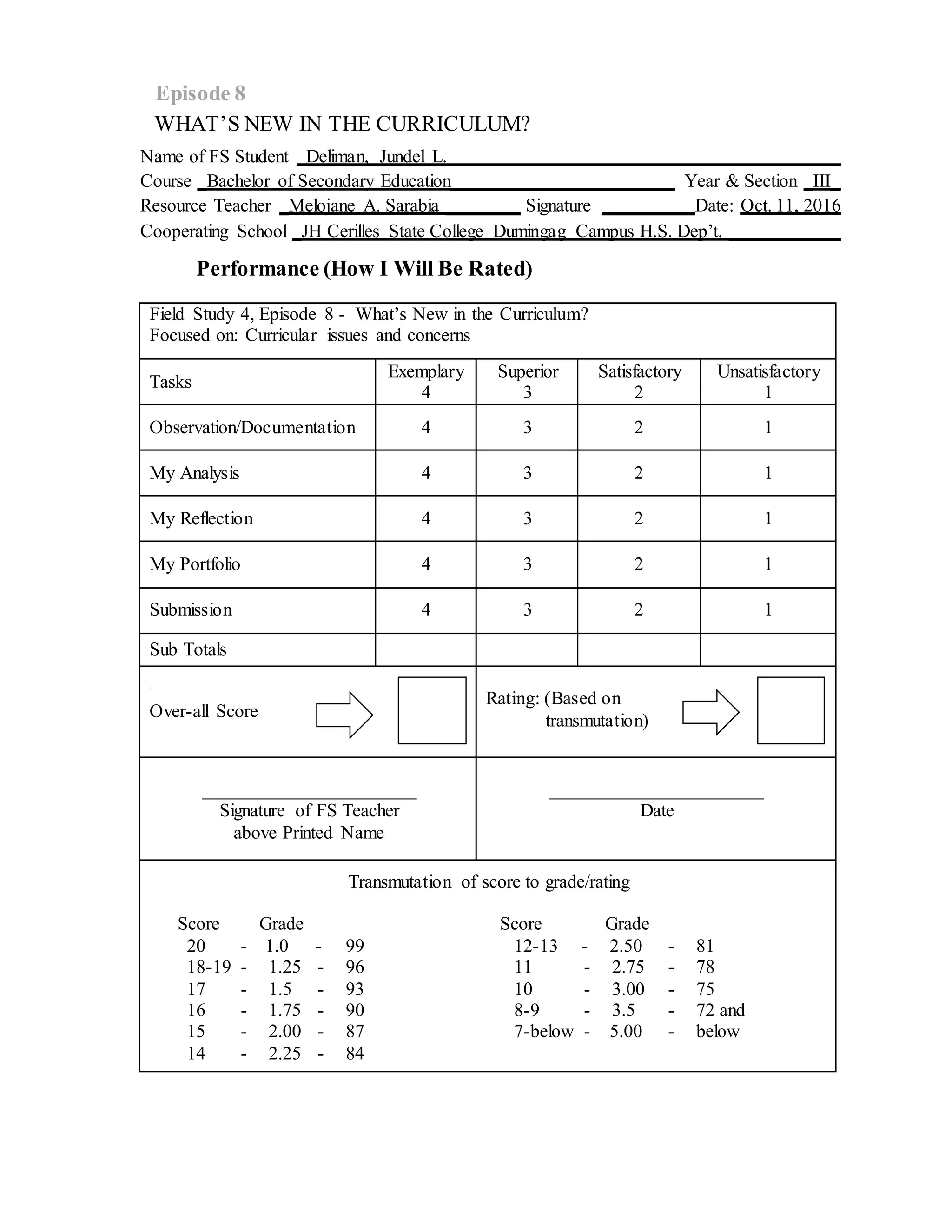
Field Study 4, Episode 8 - What’s New in the Curriculum?
Focused on: Curricular issues and concerns
Tasks
Exemplary
4
Superior
3
Satisfactory
2
Unsatisfactory
1
Observation/Documentation 4 3 2 1
My Analysis 4 3 2 1
My Reflection 4 3 2 1
My Portfolio 4 3 2 1
Submission 4 3 2 1
Sub Totals
{
Over-all Score
Rating: (Based on
transmutation)
_______________________
Signature of FS Teacher
above Printed Name
_______________________
Date
Transmutation of score to grade/rating
Score Grade Score Grade
20 - 1.0 - 99 12-13 - 2.50 - 81
18-19 - 1.25 - 96 11 - 2.75 - 78
17 - 1.5 - 93 10 - 3.00 - 75
16 - 1.75 - 90 8-9 - 3.5 - 72 and
15 - 2.00 - 87 7-below - 5.00 - below
14 - 2.25 - 84
My Tools
Interview school officials, faculty members or read education journals and magazines
to complete the matrix.
Curricular
Innovations
Advantages
(Merits)
Disadvantages
(Demerits)
My Insights
1. Third Elementary
Education
Program (TEEP)
 Builds
institutional
capacity
 Actively involve
parents, teachers,
community
leaders for quality
education.
 Offered only to
elementary
students.
TEEP is a good
innovation since it
aims the
improvement in the
elementary level.
Elementary should
be given more focus
because it is the
foundation years.
2. Secondary
Education
Improvement and
Development
Program (SEDIP)
 Improve equitable
access to
secondary
education in
poverty affected
areas.
 Not all benefit
from it since not
all division take
part in it.
SEDIP is like TEEP
but for the secondary
level. It has almost
the same purpose
and function. But,
same with TEEP, it
did not stay long in
implementation.
3. K-12 Curriculum  Decongest the
curriculum
 Uses the
progressive way
of teaching
 Promotes totality
of learning
 Additional years
mean addition
expenses in school
 Students will
spent more years
learning and
going to school
which could be
boring to their
part.
As of now, k-12 is
the greatest
curricular innovation
in the Philippines. Its
aims are very
appropriate to the
new era.
My Enriching Activities
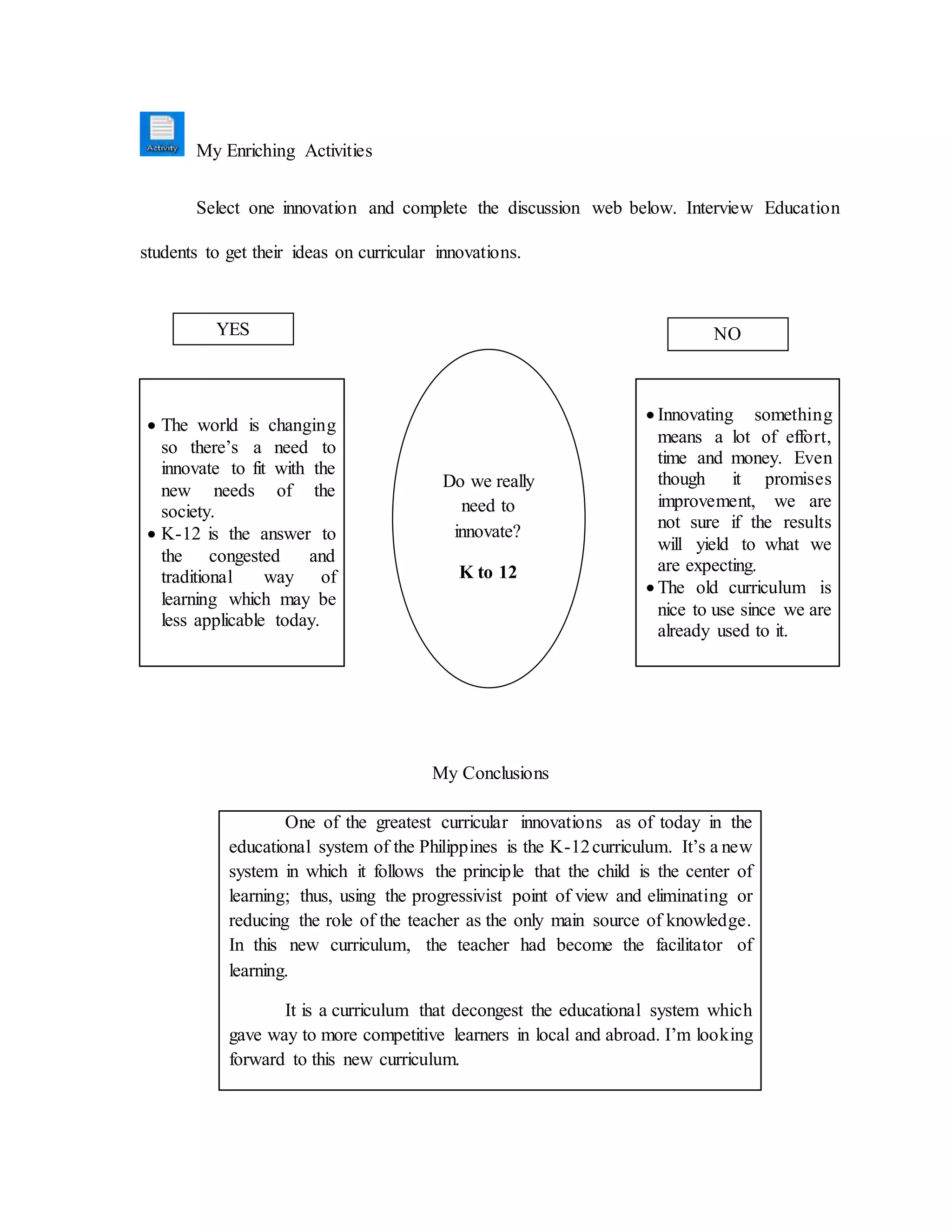
Select one innovation and complete the discussion web below. Interview Education
students to get their ideas on curricular innovations.
My Conclusions
 Innovating something
means a lot of effort,
time and money. Even
though it promises
improvement, we are
not sure if the results
will yield to what we
are expecting.
 The old curriculum is
nice to use since we are
already used to it.
 The world is changing
so there’s a need to
innovate to fit with the
new needs of the
society.
 K-12 is the answer to
the congested and
traditional way of
learning which may be
less applicable today.
One of the greatest curricular innovations as of today in the
educational system of the Philippines is the K-12curriculum. It’s a new
system in which it follows the principle that the child is the center of
learning; thus, using the progressivist point of view and eliminating or
reducing the role of the teacher as the only main source of knowledge.
In this new curriculum, the teacher had become the facilitator of
learning.
It is a curriculum that decongest the educational system which
gave way to more competitive learners in local and abroad. I’m looking
forward to this new curriculum.
YES NO
Do we really
need to
innovate?
K to 12
I Jundel L. Deliman an Education student of
JHCSC-Dumingag Campus fully commit myself to
implement the curricular innovation on JHCSC-
Dumingag Campusto best of my ability.
I fully realize that I need to do this for the
betterment of my learners and that of my society.
JUNDEL L. DELIMAN
Name and Signature
My Reflections/My Insights
State your commitment as a student regarding curricular innovations.
PLEDGE OF COMMITMENT

Field Study 4 Episode 8

  • 1.
    WHAT’S NEW INTHE CURRICULUM? Name of FS Student _Deliman, Jundel L.__________________________________________ Course _Bachelor of Secondary Education________________________ Year & Section _III_ Resource Teacher _Melojane A. Sarabia ________ Signature __________Date: Oct. 11, 2016 Cooperating School _JH Cerilles State College Dumingag Campus H.S. Dep’t. ____________ Performance (How I Will Be Rated) Field Study 4, Episode 8 - What’s New in the Curriculum? Focused on: Curricular issues and concerns Tasks Exemplary 4 Superior 3 Satisfactory 2 Unsatisfactory 1 Observation/Documentation 4 3 2 1 My Analysis 4 3 2 1 My Reflection 4 3 2 1 My Portfolio 4 3 2 1 Submission 4 3 2 1 Sub Totals { Over-all Score Rating: (Based on transmutation) _______________________ Signature of FS Teacher above Printed Name _______________________ Date Transmutation of score to grade/rating Score Grade Score Grade 20 - 1.0 - 99 12-13 - 2.50 - 81 18-19 - 1.25 - 96 11 - 2.75 - 78 17 - 1.5 - 93 10 - 3.00 - 75 16 - 1.75 - 90 8-9 - 3.5 - 72 and 15 - 2.00 - 87 7-below - 5.00 - below 14 - 2.25 - 84
  • 2.
    My Tools Interview schoolofficials, faculty members or read education journals and magazines to complete the matrix. Curricular Innovations Advantages (Merits) Disadvantages (Demerits) My Insights 1. Third Elementary Education Program (TEEP)  Builds institutional capacity  Actively involve parents, teachers, community leaders for quality education.  Offered only to elementary students. TEEP is a good innovation since it aims the improvement in the elementary level. Elementary should be given more focus because it is the foundation years. 2. Secondary Education Improvement and Development Program (SEDIP)  Improve equitable access to secondary education in poverty affected areas.  Not all benefit from it since not all division take part in it. SEDIP is like TEEP but for the secondary level. It has almost the same purpose and function. But, same with TEEP, it did not stay long in implementation. 3. K-12 Curriculum  Decongest the curriculum  Uses the progressive way of teaching  Promotes totality of learning  Additional years mean addition expenses in school  Students will spent more years learning and going to school which could be boring to their part. As of now, k-12 is the greatest curricular innovation in the Philippines. Its aims are very appropriate to the new era.
  • 3.
    My Enriching Activities Selectone innovation and complete the discussion web below. Interview Education students to get their ideas on curricular innovations. My Conclusions  Innovating something means a lot of effort, time and money. Even though it promises improvement, we are not sure if the results will yield to what we are expecting.  The old curriculum is nice to use since we are already used to it.  The world is changing so there’s a need to innovate to fit with the new needs of the society.  K-12 is the answer to the congested and traditional way of learning which may be less applicable today. One of the greatest curricular innovations as of today in the educational system of the Philippines is the K-12curriculum. It’s a new system in which it follows the principle that the child is the center of learning; thus, using the progressivist point of view and eliminating or reducing the role of the teacher as the only main source of knowledge. In this new curriculum, the teacher had become the facilitator of learning. It is a curriculum that decongest the educational system which gave way to more competitive learners in local and abroad. I’m looking forward to this new curriculum. YES NO Do we really need to innovate? K to 12
  • 4.
    I Jundel L.Deliman an Education student of JHCSC-Dumingag Campus fully commit myself to implement the curricular innovation on JHCSC- Dumingag Campusto best of my ability. I fully realize that I need to do this for the betterment of my learners and that of my society. JUNDEL L. DELIMAN Name and Signature My Reflections/My Insights State your commitment as a student regarding curricular innovations. PLEDGE OF COMMITMENT