THROMBOLYTIC
AGENTS
 Blood clots (thrombus/thrombi)
2
 Vascular bed/Blood vessels
 Coronary thrombi cause myocardial infarctions
 cerebrovascular thrombi produce strokes
 pulmonary thromboemboli can lead to respiratory
and cardiac failure
 So it is important to rapidly diagnose and treat blood clots.
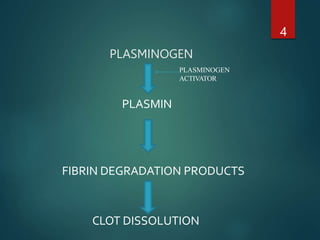
 Plasminogen, an inactive precursor
 It is converted to plasmin by cleavage of a single
peptide bond.
 Plasmin is a relatively nonspecific protease
 it digests fibrin clots and other plasma proteins,
including several coagulation factors.
3
PLASMINOGEN
4
PLASMIN
FIBRIN DEGRADATION PRODUCTS
CLOT DISSOLUTION
PLASMINOGEN
ACTIVATOR
5
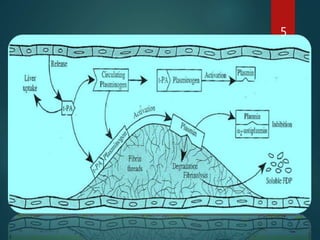
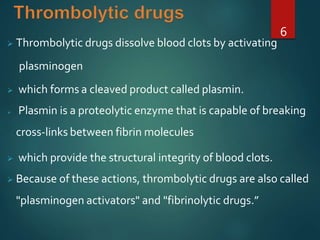
 Thrombolytic drugs dissolve blood clots by activating
plasminogen
 which forms a cleaved product called plasmin.
 Plasmin is a proteolytic enzyme that is capable of breaking
cross-links between fibrin molecules
 which provide the structural integrity of blood clots.
 Because of these actions, thrombolytic drugs are also called
"plasminogen activators" and "fibrinolytic drugs.”
6
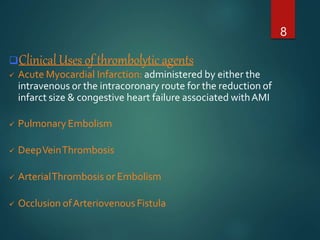
Clinical Uses of thrombolytic agents
 Acute Myocardial Infarction: administered by either the
intravenous or the intracoronary route for the reduction of
infarct size & congestive heart failure associated withAMI
 Pulmonary Embolism
 DeepVeinThrombosis
 ArterialThrombosis or Embolism
 Occlusion ofArteriovenousFistula
8
9
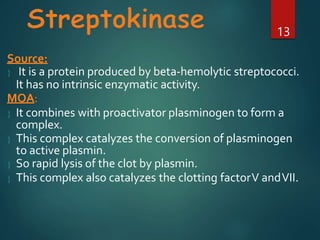
Source:
 It is a protein produced by beta-hemolytic streptococci.
It has no intrinsic enzymatic activity.
MOA:
 It combines with proactivator plasminogen to form a
complex.
 This complex catalyzes the conversion of plasminogen
to active plasmin.
 So rapid lysis of the clot by plasmin.
 This complex also catalyzes the clotting factorV andVII.
13
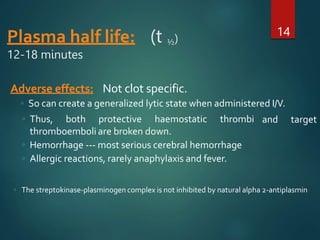
Plasma half life: (t ½)
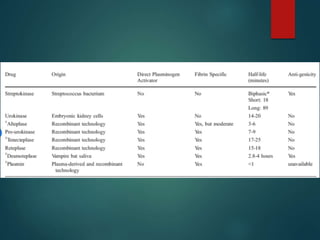
12-18 minutes
14
Adverse effects: Not clot specific.
◦ So can create a generalized lytic state when administered I/V.
and target
◦ Thus, both protective haemostatic thrombi
thromboemboli are broken down.
◦ Hemorrhage --- most serious cerebral hemorrhage
◦ Allergic reactions, rarely anaphylaxis and fever.
◦ The streptokinase-plasminogen complex is not inhibited by natural alpha 2-antiplasmin
Administration
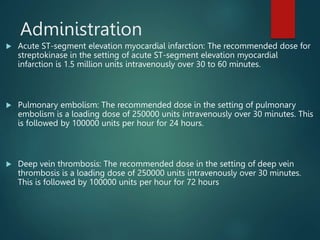
 Acute ST-segment elevation myocardial infarction: The recommended dose for
streptokinase in the setting of acute ST-segment elevation myocardial
infarction is 1.5 million units intravenously over 30 to 60 minutes.
 Pulmonary embolism: The recommended dose in the setting of pulmonary
embolism is a loading dose of 250000 units intravenously over 30 minutes. This
is followed by 100000 units per hour for 24 hours.
 Deep vein thrombosis: The recommended dose in the setting of deep vein
thrombosis is a loading dose of 250000 units intravenously over 30 minutes.
This is followed by 100000 units per hour for 72 hours
Administration
 Arterial thrombosis or embolism: The recommended dose in the setting
of arterial thrombosis or embolism is a loading dose of 250000 units
intravenously over 30 minutes. This is followed by 100000 units per hour
for 24 to 72 hours.
 Arteriovenous cannula occlusion: The recommended course of treatment
for arteriovenous cannula occlusion is to instill 250000 IU of
streptokinase in a 2 mL solution into the occluded cannula.
Adverse effects
 Streptokinase can precipitate an allergic reaction. Symptoms include fever,
shivering, and rash.
 Patients in rare instances have developed nonfatal anaphylactic reaction
 In cases of anaphylaxis, patients should be administered adrenaline(0.5ml
of 1:1000 IM) immediately and discontinue streptokinase therapy
 The toxicity of streptokinase is believed to be because it is a polypeptide
derivative of beta-hemolytic streptococci bacteria.
A two chain serine protease containing 411 amino acid
residues isolated from cultured human kidney cells.
19
It is an enzyme produced by the kidney, and found in the urine
MOA:
 It converts plasminogen to active plasmin.
 It is not clot specific:
◦ So can create a generalized lytic state when administered I/V.
◦ Thus, both protective haemostatic thrombi and target
thromboemboli are broken down.
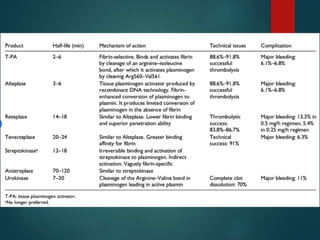
 It is a tissue plasminogen activator (t.PA) produced by
recombinant DNA technology of 527 amino acids
 Mechanism:
 It is an enzyme which has the property of fibrin-enhanced
conversion of plasminogen to plasmin
 It produces limited conversion of free plasminogen in the absence
of fibrin
 When introduced into the systemic circulation it binds to fibrin in
a thrombus and converts the entrapped plasminogen to plasmin
followed by activated local fibrinolysis with limited systemic
proteolysis
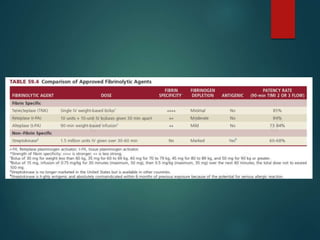
Alteplase (rt.PA) 20
Pharmacokinetics:
It has very short t1/2 of 2-6 minutes
Side-Effects:
Bleeding including GIT & cerebral hemorrhage
Allergic reactions, e.g., anaphylactoid reaction, laryngeal
edema, rash, and urticaria have been reported very rarely
(<0.02%)
21
Alteplase (rt.PA)
Acute Myocardial Infarction in adults for the improvement of
ventricular function following AMI the reduction of the incidence of
congestive heart failure, and the reduction of mortality associated with
AMI
Acute Ischemic Stroke for improving neurological recovery and
reducing the incidence of disability. Treatment should only be initiated
within 3 hours after the onset of stroke symptoms, and after exclusion
of intracranial hemorrhage
Pulmonary Embolism: Treatment of acute massive pulmonary
embolism
22
Reteplase:
 Recombinant human t-PA. from which several amino
acid sequences have been deleted.
 Faster onset & slighter longer DOA.
 Less expensive
 Less fibrin specific than t-PA.
Tenecteplase:
 Mutant form of t-PA with a longer DOA.
 Slightly more fibrin-specific than t-PA.
23
Conclusion
 Thrombolytic Agents are life saving drugs only when one knows
where, when and how to use these medications
 Risk:Benefit must be assessed in all patients

thrombolytic agents ICU nurse class.pptx

  • 1.
  • 2.
     Blood clots(thrombus/thrombi) 2  Vascular bed/Blood vessels  Coronary thrombi cause myocardial infarctions  cerebrovascular thrombi produce strokes  pulmonary thromboemboli can lead to respiratory and cardiac failure  So it is important to rapidly diagnose and treat blood clots.
  • 3.
     Plasminogen, aninactive precursor  It is converted to plasmin by cleavage of a single peptide bond.  Plasmin is a relatively nonspecific protease  it digests fibrin clots and other plasma proteins, including several coagulation factors. 3
  • 4.
  • 5.
  • 6.
     Thrombolytic drugsdissolve blood clots by activating plasminogen  which forms a cleaved product called plasmin.  Plasmin is a proteolytic enzyme that is capable of breaking cross-links between fibrin molecules  which provide the structural integrity of blood clots.  Because of these actions, thrombolytic drugs are also called "plasminogen activators" and "fibrinolytic drugs.” 6
  • 8.
    Clinical Uses ofthrombolytic agents  Acute Myocardial Infarction: administered by either the intravenous or the intracoronary route for the reduction of infarct size & congestive heart failure associated withAMI  Pulmonary Embolism  DeepVeinThrombosis  ArterialThrombosis or Embolism  Occlusion ofArteriovenousFistula 8
  • 9.
  • 13.
    Source:  It isa protein produced by beta-hemolytic streptococci. It has no intrinsic enzymatic activity. MOA:  It combines with proactivator plasminogen to form a complex.  This complex catalyzes the conversion of plasminogen to active plasmin.  So rapid lysis of the clot by plasmin.  This complex also catalyzes the clotting factorV andVII. 13
  • 14.
    Plasma half life:(t ½) 12-18 minutes 14 Adverse effects: Not clot specific. ◦ So can create a generalized lytic state when administered I/V. and target ◦ Thus, both protective haemostatic thrombi thromboemboli are broken down. ◦ Hemorrhage --- most serious cerebral hemorrhage ◦ Allergic reactions, rarely anaphylaxis and fever. ◦ The streptokinase-plasminogen complex is not inhibited by natural alpha 2-antiplasmin
  • 15.
    Administration  Acute ST-segmentelevation myocardial infarction: The recommended dose for streptokinase in the setting of acute ST-segment elevation myocardial infarction is 1.5 million units intravenously over 30 to 60 minutes.  Pulmonary embolism: The recommended dose in the setting of pulmonary embolism is a loading dose of 250000 units intravenously over 30 minutes. This is followed by 100000 units per hour for 24 hours.  Deep vein thrombosis: The recommended dose in the setting of deep vein thrombosis is a loading dose of 250000 units intravenously over 30 minutes. This is followed by 100000 units per hour for 72 hours
  • 16.
    Administration  Arterial thrombosisor embolism: The recommended dose in the setting of arterial thrombosis or embolism is a loading dose of 250000 units intravenously over 30 minutes. This is followed by 100000 units per hour for 24 to 72 hours.  Arteriovenous cannula occlusion: The recommended course of treatment for arteriovenous cannula occlusion is to instill 250000 IU of streptokinase in a 2 mL solution into the occluded cannula.
  • 17.
    Adverse effects  Streptokinasecan precipitate an allergic reaction. Symptoms include fever, shivering, and rash.  Patients in rare instances have developed nonfatal anaphylactic reaction  In cases of anaphylaxis, patients should be administered adrenaline(0.5ml of 1:1000 IM) immediately and discontinue streptokinase therapy  The toxicity of streptokinase is believed to be because it is a polypeptide derivative of beta-hemolytic streptococci bacteria.
  • 19.
    A two chainserine protease containing 411 amino acid residues isolated from cultured human kidney cells. 19 It is an enzyme produced by the kidney, and found in the urine MOA:  It converts plasminogen to active plasmin.  It is not clot specific: ◦ So can create a generalized lytic state when administered I/V. ◦ Thus, both protective haemostatic thrombi and target thromboemboli are broken down.
  • 20.
     It isa tissue plasminogen activator (t.PA) produced by recombinant DNA technology of 527 amino acids  Mechanism:  It is an enzyme which has the property of fibrin-enhanced conversion of plasminogen to plasmin  It produces limited conversion of free plasminogen in the absence of fibrin  When introduced into the systemic circulation it binds to fibrin in a thrombus and converts the entrapped plasminogen to plasmin followed by activated local fibrinolysis with limited systemic proteolysis Alteplase (rt.PA) 20
  • 21.
    Pharmacokinetics: It has veryshort t1/2 of 2-6 minutes Side-Effects: Bleeding including GIT & cerebral hemorrhage Allergic reactions, e.g., anaphylactoid reaction, laryngeal edema, rash, and urticaria have been reported very rarely (<0.02%) 21 Alteplase (rt.PA)
  • 22.
    Acute Myocardial Infarctionin adults for the improvement of ventricular function following AMI the reduction of the incidence of congestive heart failure, and the reduction of mortality associated with AMI Acute Ischemic Stroke for improving neurological recovery and reducing the incidence of disability. Treatment should only be initiated within 3 hours after the onset of stroke symptoms, and after exclusion of intracranial hemorrhage Pulmonary Embolism: Treatment of acute massive pulmonary embolism 22
  • 23.
    Reteplase:  Recombinant humant-PA. from which several amino acid sequences have been deleted.  Faster onset & slighter longer DOA.  Less expensive  Less fibrin specific than t-PA. Tenecteplase:  Mutant form of t-PA with a longer DOA.  Slightly more fibrin-specific than t-PA. 23
  • 24.
    Conclusion  Thrombolytic Agentsare life saving drugs only when one knows where, when and how to use these medications  Risk:Benefit must be assessed in all patients