GUINEA PIG, HAMSTER, RABBIT
By
Dr.Elza Joy
Munjely
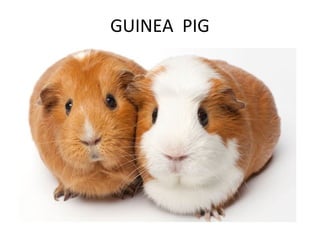
GUINEA PIG
• Cavia porcellus
• Suborder “Hystricomorpha”
• Herbivorous-green foods,seeds &
roots,readymade chow diet
• Very docile
• Require vit C in diet
• If greens -1 g/L of drinking water
per week
• If chow -200mg/L per day
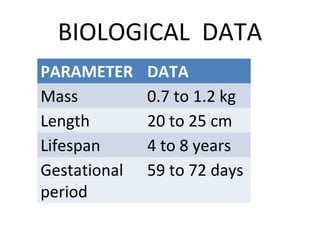
BIOLOGICAL DATA
PARAMETER DATA
Mass 0.7 to 1.2 kg
Length 20 to 25 cm
Lifespan 4 to 8 years
Gestational
period
59 to 72 days
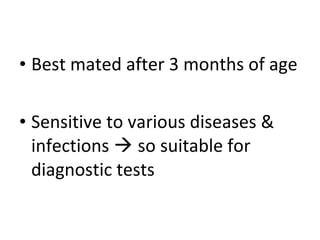
• Best mated after 3 months of age
• Sensitive to various diseases &
infections  so suitable for
diagnostic tests
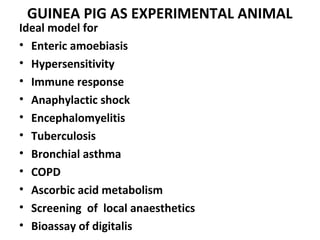
GUINEA PIG AS EXPERIMENTAL ANIMAL
Ideal model for
• Enteric amoebiasis
• Hypersensitivity
• Immune response
• Anaphylactic shock
• Encephalomyelitis
• Tuberculosis
• Bronchial asthma
• COPD
• Ascorbic acid metabolism
• Screening of local anaesthetics
• Bioassay of digitalis
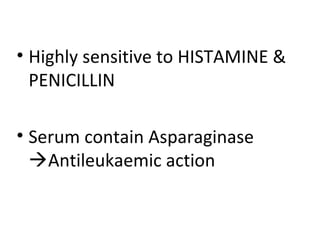
• Highly sensitive to HISTAMINE &
PENICILLIN
• Serum contain Asparaginase
Antileukaemic action
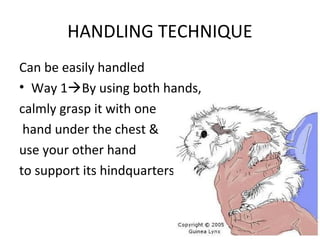
HANDLING TECHNIQUE
Can be easily handled
• Way 1By using both hands,
calmly grasp it with one
hand under the chest &
use your other hand
to support its hindquarters
• Way 2Handle guinea pig with one hand , by
holding its hind quarter
SEX DETERMINATION
• Female-detectable pink nipple on
either side
• Male-Penis & testes are palpable in
adults
Bleeding & I.V injection
• Small quantities from marginal ear vein
• Heart puncture after anaesthesia or
Carotid A after stunning/inducing anaesthesia
• Males penile Vs
INTRAGASTRIC ADMINISTRATION
• Similar to rat
• 15 to 16 gauge hypodermic needle of 7.5 to
10 cm length is blunted
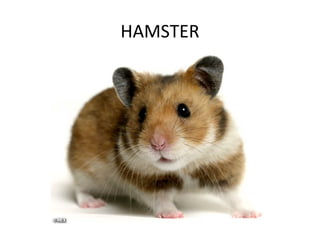
HAMSTER
• Mesocricetus auratus
• Different strains
–Syrian hamsters-most commonly used,rapid
development & short life cycle
–Chinese hamster-lowest number of
chromosomes(22)used for cytogenesis research
–European hamstersuitable for smoke
inhalational studies
–Armenian hamsterspecific for carcinogenic
& mutagenic agents
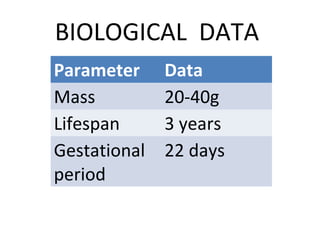
BIOLOGICAL DATA
Parameter Data
Mass 20-40g
Lifespan 3 years
Gestational
period
22 days
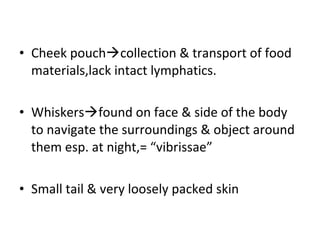
• Cheek pouchcollection & transport of food
materials,lack intact lymphatics.
• Whiskersfound on face & side of the body
to navigate the surroundings & object around
them esp. at night,= “vibrissae”
• Small tail & very loosely packed skin
Hamsters as experimental animals
Spontaneous model of human diseases such as
• Diabetes mellitus due to deficiency of β
cells/presence of defective β cells in the
pancreas
• Syrian hamster dystrophy
• Cholesterol cholelithiasis
• Polycystic diseases
• Dental caries
• Slow virus type C,Oncovirus,influenza virus,respiratory
syncytial virus studies & vaccine production
• Cheek pouches lack lymphatic drainage, so ideal site for
tissue transplants,such as tumours & grafts,pouch can be
pulled out under anaesthesia & can be stretched over an
illuminated surface for observation
• Strips cut from cheek pouchassay for prostaglandins E & F
• Invivo & invitro diagnostic techniques for infectious agents
i.e Clostridium spp,Leptospirosis spp
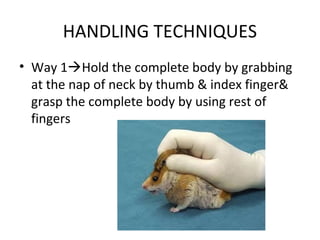
HANDLING TECHNIQUES
• Way 1Hold the complete body by grabbing
at the nap of neck by thumb & index finger&
grasp the complete body by using rest of
fingers
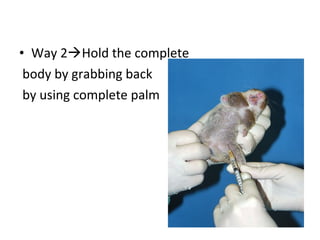
• Way 2Hold the complete
body by grabbing back
by using complete palm
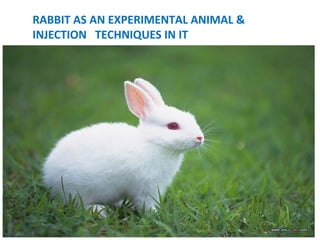
RABBIT AS AN EXPERIMENTAL ANIMAL &
INJECTION TECHNIQUES IN IT
Rabbit (oryctolagus cuniculus)
• Rabbits are very docile animals (2n =44 )
• FamilyLeporidae OrderLagomorpha
• Domestic - Oryctolagus cuniculus
• Wild - Sylvilagus,
Coprolagus,
Nesolagus,
Brachylagus
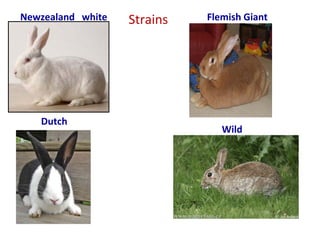
Common Strains
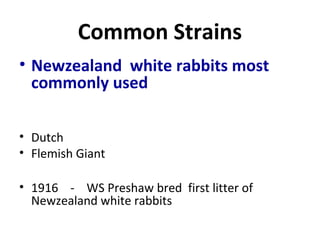
• Newzealand white rabbits most
commonly used
• Dutch
• Flemish Giant
• 1916 - WS Preshaw bred first litter of
Newzealand white rabbits
StrainsNewzealand white
Dutch
Flemish Giant
Wild
ANATOMICAL PECULIARITIES
• Simple cardiac conductive tissueAnimal of
choice for many cardiac studies
• No adrenergic vasodilator nerves No
Vasomotor reversal phenomenon
• Dopamine - fall in BP
• Histamine - rise in BP
• Very sensitive to histamine
ANATOMICAL PECULIARITIES
• Cannot vomit
• Genetic relationship b/w atropine esterase &
black pigmentation of the fur
• Wide field of vision
• Long ears-heat regulation
• Cytochrome 3A4 is absent
Reproductive cycle
• Non spontaneous ovulation
• Coitus induced Ovulation
• LH release 10 hrs after coitus
• Progesterone inhibits ovulation
• No seasonal anoestrum
• Short gestation period --31 days
• Duration sexual life - 36 months
• No of litters per year - 4
Biological Data
PARAMETER DATA
Adult weight 1.5-5 kg
Average life span 4-6 years
Age suitable for experiment 6 months
Age of first mating 6-7 months
Breeding habits (no of females to 1
male)
1
Gestation period 31 days
No of litters per year 4
Guidelines for animal handling
• Pet or soothe the animal by slow deliberate
movement on their body.
• Overcrowding near animal cage to be avoided.
• Noise - minimum as possible.
• Do not hold the animal too hard
• Agitation - lead to violent behavior for self
protection
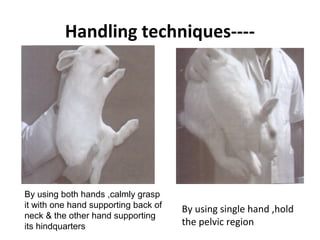
Handling techniques----
By using single hand ,hold
the pelvic region
By using both hands ,calmly grasp
it with one hand supporting back of
neck & the other hand supporting
its hindquarters
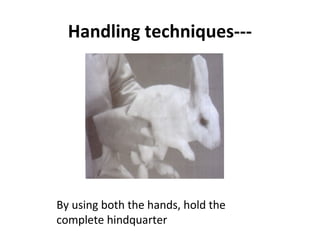
Handling techniques---
By using both the hands, hold the
complete hindquarter
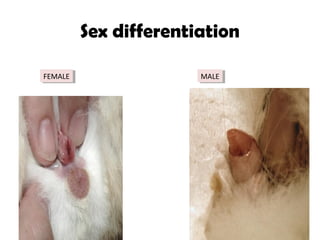
Sex differentiation
FEMALEFEMALE MALEMALE
Rabbit as an experimental animal
• Pyrogen testing in IV fluids
• To test toxic effects of cosmetics &
pharmaceuticals
• Good model for production of antibodies &
antiserums
• Study of agents affecting capillary
permeability
Contd-
• Screening of drugs for
TB, diabetes, diphtheria, cancer, heart
disease,embryotoxic drugs
• Study of topical irritants
• Insulin & other antidiabetic drugs
• Curare & sex hormones
• Studying circadian rhythmicity -
Contd -
• Suitable for research in reproductory
studies
- no seasonal anoestrum
- ovulation non spontaneous
- short gestation period
- semen easily collected
Contd -
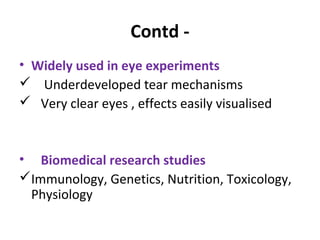
• Widely used in eye experiments
 Underdeveloped tear mechanisms
 Very clear eyes , effects easily visualised
• Biomedical research studies
Immunology, Genetics, Nutrition, Toxicology,
Physiology
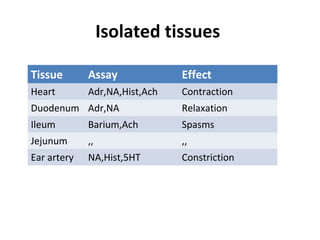
Isolated tissues
Tissue Assay Effect
Heart Adr,NA,Hist,Ach Contraction
Duodenum Adr,NA Relaxation
Ileum Barium,Ach Spasms
Jejunum ,, ,,
Ear artery NA,Hist,5HT Constriction
Zoonotic diseases spread while
handling rabbits
• Ring worm infection
• Mites
• Allergens
Glycoprotein in fur
proteins found in urine and saliva
Diet
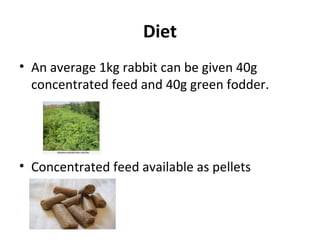
• An average 1kg rabbit can be given 40g
concentrated feed and 40g green fodder.
• Concentrated feed available as pellets
INJECTION TECHNIQUES
Precautions before injection
1. Injection site to be cleaned with a suitable
disinfectant/antiseptic(75%
alcohol/betadine)
2. Sterile syringes and needles to be used.
3. Always select smallest possible gauge to
limit tissue trauma.
4. Aspiration technique is an important aspect
before pushing injection solution at the site.
5. Ensure no air bubble in syringe
Intravenous injection
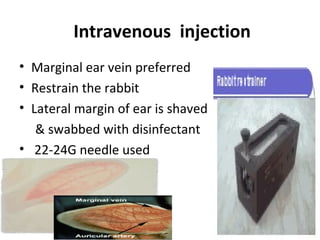
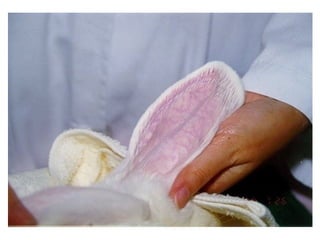
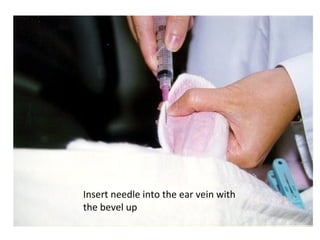
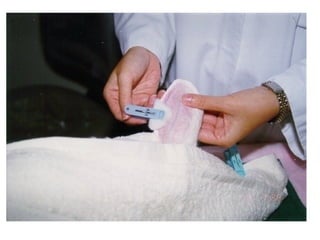
• Marginal ear vein preferred
• Restrain the rabbit
• Lateral margin of ear is shaved
& swabbed with disinfectant
• 22-24G needle used
Insert needle into the ear vein with
the bevel up
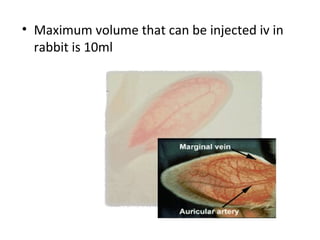
• Maximum volume that can be injected iv in
rabbit is 10ml
Subcutaneous injection
• Easy due to laxity of skin
• Not to be done on neck
• 22 G needle used
• Not more than 5 ml/site
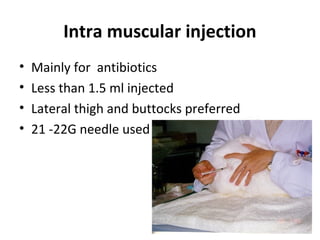
Intra muscular injection
• Mainly for antibiotics
• Less than 1.5 ml injected
• Lateral thigh and buttocks preferred
• 21 -22G needle used
Methods of blood collection
Sites
Marginal ear vein
Central ear artery
Cardiac puncture
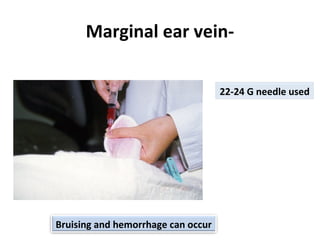
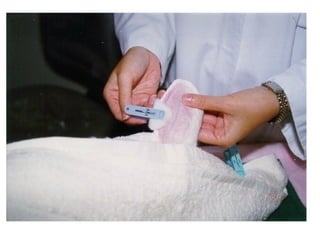
Marginal ear vein-
Bruising and hemorrhage can occur
22-24 G needle used
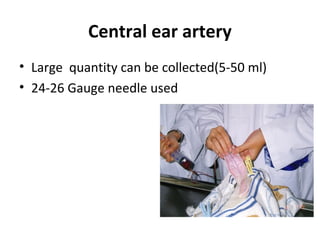
Central ear artery
• Large quantity can be collected(5-50 ml)
• 24-26 Gauge needle used
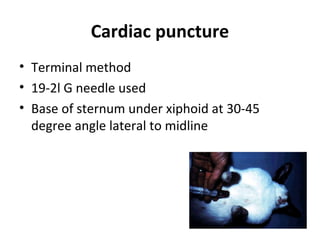
Cardiac puncture
• Terminal method
• 19-2l G needle used
• Base of sternum under xiphoid at 30-45
degree angle lateral to midline
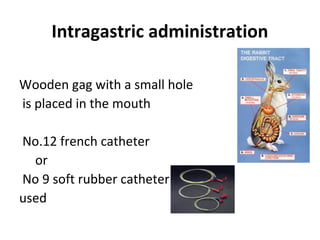
Intragastric administration
Wooden gag with a small hole
is placed in the mouth
No.12 french catheter
or
No 9 soft rubber catheter
used
Rabbit guineapig hamster

Rabbit guineapig hamster

  • 1.
    GUINEA PIG, HAMSTER,RABBIT By Dr.Elza Joy Munjely
  • 2.
  • 3.
    • Cavia porcellus •Suborder “Hystricomorpha” • Herbivorous-green foods,seeds & roots,readymade chow diet
  • 4.
    • Very docile •Require vit C in diet • If greens -1 g/L of drinking water per week • If chow -200mg/L per day
  • 5.
    BIOLOGICAL DATA PARAMETER DATA Mass0.7 to 1.2 kg Length 20 to 25 cm Lifespan 4 to 8 years Gestational period 59 to 72 days
  • 6.
    • Best matedafter 3 months of age • Sensitive to various diseases & infections  so suitable for diagnostic tests
  • 7.
    GUINEA PIG ASEXPERIMENTAL ANIMAL Ideal model for • Enteric amoebiasis • Hypersensitivity • Immune response • Anaphylactic shock • Encephalomyelitis • Tuberculosis • Bronchial asthma • COPD • Ascorbic acid metabolism • Screening of local anaesthetics • Bioassay of digitalis
  • 8.
    • Highly sensitiveto HISTAMINE & PENICILLIN • Serum contain Asparaginase Antileukaemic action
  • 9.
    HANDLING TECHNIQUE Can beeasily handled • Way 1By using both hands, calmly grasp it with one hand under the chest & use your other hand to support its hindquarters
  • 10.
    • Way 2Handleguinea pig with one hand , by holding its hind quarter
  • 11.
    SEX DETERMINATION • Female-detectablepink nipple on either side • Male-Penis & testes are palpable in adults
  • 12.
    Bleeding & I.Vinjection • Small quantities from marginal ear vein • Heart puncture after anaesthesia or Carotid A after stunning/inducing anaesthesia • Males penile Vs
  • 13.
    INTRAGASTRIC ADMINISTRATION • Similarto rat • 15 to 16 gauge hypodermic needle of 7.5 to 10 cm length is blunted
  • 14.
  • 15.
    • Mesocricetus auratus •Different strains –Syrian hamsters-most commonly used,rapid development & short life cycle –Chinese hamster-lowest number of chromosomes(22)used for cytogenesis research –European hamstersuitable for smoke inhalational studies –Armenian hamsterspecific for carcinogenic & mutagenic agents
  • 16.
    BIOLOGICAL DATA Parameter Data Mass20-40g Lifespan 3 years Gestational period 22 days
  • 17.
    • Cheek pouchcollection& transport of food materials,lack intact lymphatics. • Whiskersfound on face & side of the body to navigate the surroundings & object around them esp. at night,= “vibrissae” • Small tail & very loosely packed skin
  • 18.
    Hamsters as experimentalanimals Spontaneous model of human diseases such as • Diabetes mellitus due to deficiency of β cells/presence of defective β cells in the pancreas • Syrian hamster dystrophy • Cholesterol cholelithiasis • Polycystic diseases • Dental caries
  • 19.
    • Slow virustype C,Oncovirus,influenza virus,respiratory syncytial virus studies & vaccine production • Cheek pouches lack lymphatic drainage, so ideal site for tissue transplants,such as tumours & grafts,pouch can be pulled out under anaesthesia & can be stretched over an illuminated surface for observation • Strips cut from cheek pouchassay for prostaglandins E & F • Invivo & invitro diagnostic techniques for infectious agents i.e Clostridium spp,Leptospirosis spp
  • 20.
    HANDLING TECHNIQUES • Way1Hold the complete body by grabbing at the nap of neck by thumb & index finger& grasp the complete body by using rest of fingers
  • 21.
    • Way 2Holdthe complete body by grabbing back by using complete palm
  • 22.
    RABBIT AS ANEXPERIMENTAL ANIMAL & INJECTION TECHNIQUES IN IT
  • 23.
    Rabbit (oryctolagus cuniculus) •Rabbits are very docile animals (2n =44 ) • FamilyLeporidae OrderLagomorpha • Domestic - Oryctolagus cuniculus • Wild - Sylvilagus, Coprolagus, Nesolagus, Brachylagus
  • 24.
    Common Strains • Newzealandwhite rabbits most commonly used • Dutch • Flemish Giant • 1916 - WS Preshaw bred first litter of Newzealand white rabbits
  • 25.
  • 26.
    ANATOMICAL PECULIARITIES • Simplecardiac conductive tissueAnimal of choice for many cardiac studies • No adrenergic vasodilator nerves No Vasomotor reversal phenomenon • Dopamine - fall in BP • Histamine - rise in BP • Very sensitive to histamine
  • 27.
    ANATOMICAL PECULIARITIES • Cannotvomit • Genetic relationship b/w atropine esterase & black pigmentation of the fur • Wide field of vision • Long ears-heat regulation • Cytochrome 3A4 is absent
  • 28.
    Reproductive cycle • Nonspontaneous ovulation • Coitus induced Ovulation • LH release 10 hrs after coitus • Progesterone inhibits ovulation • No seasonal anoestrum • Short gestation period --31 days • Duration sexual life - 36 months • No of litters per year - 4
  • 29.
    Biological Data PARAMETER DATA Adultweight 1.5-5 kg Average life span 4-6 years Age suitable for experiment 6 months Age of first mating 6-7 months Breeding habits (no of females to 1 male) 1 Gestation period 31 days No of litters per year 4
  • 30.
    Guidelines for animalhandling • Pet or soothe the animal by slow deliberate movement on their body. • Overcrowding near animal cage to be avoided. • Noise - minimum as possible. • Do not hold the animal too hard • Agitation - lead to violent behavior for self protection
  • 31.
    Handling techniques---- By usingsingle hand ,hold the pelvic region By using both hands ,calmly grasp it with one hand supporting back of neck & the other hand supporting its hindquarters
  • 32.
    Handling techniques--- By usingboth the hands, hold the complete hindquarter
  • 33.
  • 34.
    Rabbit as anexperimental animal • Pyrogen testing in IV fluids • To test toxic effects of cosmetics & pharmaceuticals • Good model for production of antibodies & antiserums • Study of agents affecting capillary permeability
  • 35.
    Contd- • Screening ofdrugs for TB, diabetes, diphtheria, cancer, heart disease,embryotoxic drugs • Study of topical irritants • Insulin & other antidiabetic drugs • Curare & sex hormones • Studying circadian rhythmicity -
  • 36.
    Contd - • Suitablefor research in reproductory studies - no seasonal anoestrum - ovulation non spontaneous - short gestation period - semen easily collected
  • 37.
    Contd - • Widelyused in eye experiments  Underdeveloped tear mechanisms  Very clear eyes , effects easily visualised • Biomedical research studies Immunology, Genetics, Nutrition, Toxicology, Physiology
  • 38.
    Isolated tissues Tissue AssayEffect Heart Adr,NA,Hist,Ach Contraction Duodenum Adr,NA Relaxation Ileum Barium,Ach Spasms Jejunum ,, ,, Ear artery NA,Hist,5HT Constriction
  • 39.
    Zoonotic diseases spreadwhile handling rabbits • Ring worm infection • Mites • Allergens Glycoprotein in fur proteins found in urine and saliva
  • 40.
    Diet • An average1kg rabbit can be given 40g concentrated feed and 40g green fodder. • Concentrated feed available as pellets
  • 41.
  • 42.
    Precautions before injection 1.Injection site to be cleaned with a suitable disinfectant/antiseptic(75% alcohol/betadine) 2. Sterile syringes and needles to be used. 3. Always select smallest possible gauge to limit tissue trauma. 4. Aspiration technique is an important aspect before pushing injection solution at the site. 5. Ensure no air bubble in syringe
  • 43.
    Intravenous injection • Marginalear vein preferred • Restrain the rabbit • Lateral margin of ear is shaved & swabbed with disinfectant • 22-24G needle used
  • 45.
    Insert needle intothe ear vein with the bevel up
  • 47.
    • Maximum volumethat can be injected iv in rabbit is 10ml
  • 48.
    Subcutaneous injection • Easydue to laxity of skin • Not to be done on neck • 22 G needle used • Not more than 5 ml/site
  • 49.
    Intra muscular injection •Mainly for antibiotics • Less than 1.5 ml injected • Lateral thigh and buttocks preferred • 21 -22G needle used
  • 50.
    Methods of bloodcollection Sites Marginal ear vein Central ear artery Cardiac puncture
  • 51.
    Marginal ear vein- Bruisingand hemorrhage can occur 22-24 G needle used
  • 53.
    Central ear artery •Large quantity can be collected(5-50 ml) • 24-26 Gauge needle used
  • 54.
    Cardiac puncture • Terminalmethod • 19-2l G needle used • Base of sternum under xiphoid at 30-45 degree angle lateral to midline
  • 55.
    Intragastric administration Wooden gagwith a small hole is placed in the mouth No.12 french catheter or No 9 soft rubber catheter used