FIBRE OPTICS
Dr.KauShik Patel (PT)
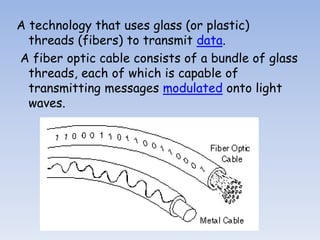
A technology that uses glass (or plastic)
threads (fibers) to transmit data.
A fiber optic cable consists of a bundle of glass
threads, each of which is capable of
transmitting messages modulated onto light
waves.
How an Optical Fiber Works
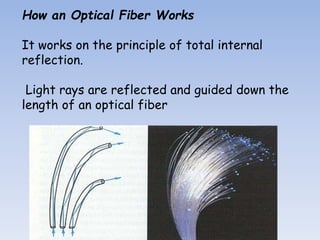
It works on the principle of total internal
reflection.
Light rays are reflected and guided down the
length of an optical fiber
When light enters the area between 2 materials
the light will be either entirely reflected or a
portion of it will be refracted, depending on
the angle.
If the light kept at an angle where it is entirely
reflected, it will become trapped inside and
transmitted along the fiber.
An optical fiber is made of three sections:
Core, Cladding, Coating
The core carries the light signals
The cladding keeps the light in the core
The coating protects the cladding
Fiber optics r made up from glass or fused quartz
with lengths of 10 to 100µm.
Quartz is used as it is highly transparent
The area where light is transmitted is called
the core, and the external area is called the
clad.
Optical fiber can also be made up of polymer
materials
Plastic optical fibers are optical fibers made of
polymer materials.
While they can not reach the performance of
glass fibers in various respects such as
propagation losses and data transmission
capacity.
CORE CHARACTERISTICS
1. The diameter of the light carrying region of
the fiber is the "core diameter.“
2. The larger the core, the more rays of light
that travel in the core.
3. The larger the core, the more optical power
that can be transmitted.
4. The core has a higher index of refraction
than the cladding.
Fiber-optic communication is a method of
transmitting information from one place to
another by sending pulses of light through an
optical fiber.
The light forms an electromagnetic carrier wave
that is modulated to carry information.
First developed in the 1970s, fiber-optic
communication systems have revolutionized
the telecommunications industry and have
played a major role in the advent of the
Information Age
Fiber optics VS
Traditional metal communication lines
Fiber optics has several advantages over
traditional metal communications lines:
Fiber optic cables have a much greater
bandwidth than metal cables. This means that
they can carry more data.
Fiber optic cables are less susceptible than
metal cables to interference.
Fiber optic cables are much thinner and lighter
than metal wires.
Data can be transmitted digitally (the natural
form for computer data) rather than
analogically
Advantageous
It is especially advantageous for long-distance
communications, because light propagates
through the fiber with little attenuation
compared to electrical cables
The fibers used in long-distance
telecommunications applications are always
glass, because of the lower optical
attenuation
Over short distances, such as networking within
a building, fiber saves space in cable ducts
because a single fiber can carry much more
data than a single electrical cable.
Fiber is also immune to electrical interference;
there is no cross-talk between signals in
different cables and no pickup of
environmental noise
The main Disadvantage of fiber optics is that
the cables are expensive to install. In
addition, they are more fragile than wire and
are difficult to splice.
Specially designed fibers are used for a variety
of other applications, including sensors and
fiber lasers.
A fiber optic sensor is a sensor that uses
optical fiber either as the sensing element
("intrinsic sensors"), or as a means of relaying
signals from a remote sensor to the
electronics that process the signals
("extrinsic sensors").
Light is kept in the core of the optical fiber by
total internal reflection. This causes the
fiber to act as a waveguide.
Fibers which support many propagation paths
or transverse modes are called multi-mode
fibers (MMF),
while those which can only support a single
mode are called single-mode fibers (SMF).
USES
Fibers are widely used in illumination
applications.
They are used as light guides in medical.
Optical fiber illumination is also used for
decorative applications, including signs, art,
and artificial Christmas trees.
Optical fiber is also used in imaging optics. A
coherent bundle of fibers is used, sometimes
along with endoscope, which is used to view
objects through a small hole.
Medical endoscopes are used for minimally
invasive exploratory or surgical procedures
(endoscopy).
Industrial endoscopes are used for inspecting
anything hard to reach, such as jet engine
interior.
In spectroscopy, optical fiber bundles are used
to transmit light from a spectrometer to a
substance which cannot be placed inside the
spectrometer itself, in order to analyze its
composition.
A spectrometer analyzes substances by
bouncing light off of and through them. By
using fibers, a spectrometer can be used to
study objects that are too large to fit inside,
or gasses, or reactions which occur in
pressure vessels
Optical fiber can be used as a medium for
telecommunication and networking because it
is flexible and can be bundled as cables
American Optical Corporation use a prototype
ruby laser photo coagulator to destroy a
human patient’s retinal tumor
Fiber optics is a particularly popular technology
for local-area networks. In addition,
telephone companies are steadily replacing
traditional telephone lines with fiber optic
cables.
In the future, almost all communications will
employ fiber OPTICS
Thank you…

FIBRE OPTICS..pptx

  • 1.
  • 2.
    A technology thatuses glass (or plastic) threads (fibers) to transmit data. A fiber optic cable consists of a bundle of glass threads, each of which is capable of transmitting messages modulated onto light waves.
  • 3.
    How an OpticalFiber Works It works on the principle of total internal reflection. Light rays are reflected and guided down the length of an optical fiber
  • 4.
    When light entersthe area between 2 materials the light will be either entirely reflected or a portion of it will be refracted, depending on the angle. If the light kept at an angle where it is entirely reflected, it will become trapped inside and transmitted along the fiber.
  • 5.
    An optical fiberis made of three sections: Core, Cladding, Coating The core carries the light signals The cladding keeps the light in the core The coating protects the cladding Fiber optics r made up from glass or fused quartz with lengths of 10 to 100µm. Quartz is used as it is highly transparent
  • 6.
    The area wherelight is transmitted is called the core, and the external area is called the clad.
  • 7.
    Optical fiber canalso be made up of polymer materials Plastic optical fibers are optical fibers made of polymer materials. While they can not reach the performance of glass fibers in various respects such as propagation losses and data transmission capacity.
  • 8.
    CORE CHARACTERISTICS 1. Thediameter of the light carrying region of the fiber is the "core diameter.“ 2. The larger the core, the more rays of light that travel in the core. 3. The larger the core, the more optical power that can be transmitted. 4. The core has a higher index of refraction than the cladding.
  • 9.
    Fiber-optic communication isa method of transmitting information from one place to another by sending pulses of light through an optical fiber. The light forms an electromagnetic carrier wave that is modulated to carry information. First developed in the 1970s, fiber-optic communication systems have revolutionized the telecommunications industry and have played a major role in the advent of the Information Age
  • 10.
    Fiber optics VS Traditionalmetal communication lines Fiber optics has several advantages over traditional metal communications lines: Fiber optic cables have a much greater bandwidth than metal cables. This means that they can carry more data. Fiber optic cables are less susceptible than metal cables to interference.
  • 11.
    Fiber optic cablesare much thinner and lighter than metal wires. Data can be transmitted digitally (the natural form for computer data) rather than analogically
  • 12.
    Advantageous It is especiallyadvantageous for long-distance communications, because light propagates through the fiber with little attenuation compared to electrical cables The fibers used in long-distance telecommunications applications are always glass, because of the lower optical attenuation Over short distances, such as networking within a building, fiber saves space in cable ducts because a single fiber can carry much more data than a single electrical cable.
  • 13.
    Fiber is alsoimmune to electrical interference; there is no cross-talk between signals in different cables and no pickup of environmental noise The main Disadvantage of fiber optics is that the cables are expensive to install. In addition, they are more fragile than wire and are difficult to splice.
  • 14.
    Specially designed fibersare used for a variety of other applications, including sensors and fiber lasers. A fiber optic sensor is a sensor that uses optical fiber either as the sensing element ("intrinsic sensors"), or as a means of relaying signals from a remote sensor to the electronics that process the signals ("extrinsic sensors").
  • 15.
    Light is keptin the core of the optical fiber by total internal reflection. This causes the fiber to act as a waveguide. Fibers which support many propagation paths or transverse modes are called multi-mode fibers (MMF), while those which can only support a single mode are called single-mode fibers (SMF).
  • 16.
    USES Fibers are widelyused in illumination applications. They are used as light guides in medical. Optical fiber illumination is also used for decorative applications, including signs, art, and artificial Christmas trees.
  • 17.
    Optical fiber isalso used in imaging optics. A coherent bundle of fibers is used, sometimes along with endoscope, which is used to view objects through a small hole. Medical endoscopes are used for minimally invasive exploratory or surgical procedures (endoscopy). Industrial endoscopes are used for inspecting anything hard to reach, such as jet engine interior.
  • 18.
    In spectroscopy, opticalfiber bundles are used to transmit light from a spectrometer to a substance which cannot be placed inside the spectrometer itself, in order to analyze its composition. A spectrometer analyzes substances by bouncing light off of and through them. By using fibers, a spectrometer can be used to study objects that are too large to fit inside, or gasses, or reactions which occur in pressure vessels
  • 19.
    Optical fiber canbe used as a medium for telecommunication and networking because it is flexible and can be bundled as cables American Optical Corporation use a prototype ruby laser photo coagulator to destroy a human patient’s retinal tumor
  • 20.
    Fiber optics isa particularly popular technology for local-area networks. In addition, telephone companies are steadily replacing traditional telephone lines with fiber optic cables. In the future, almost all communications will employ fiber OPTICS
  • 23.