

SHALET K S
Asst. Prof.
What is optical Fiber?
• An optical fiber is a hair thin cylindrical fiber of glass
or any transparent dielectric medium.
• The fiber which are used for optical communication
are wave guides made of transparent dielectrics.
• Its function is to guide visible and infrared light over
long distances.
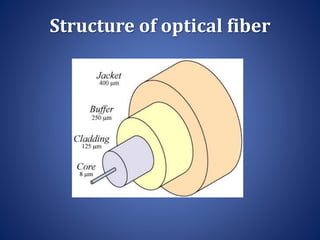
Structure of optical fiber
Core
The core of a fiber cable is a cylinder of plastic that runs all along the
fiber cable’s length, and offers protection by cladding. The diameter of
the core depends on the application used. Due to internal reflection,
the light travelling within the core reflects from the core, the cladding
boundary. The core cross section needs to be a circular one for most of
the applications.
Cladding
Cladding is an outer optical material that protects the core. The main
function of the cladding is that it reflects the light back into the core.
When light enters through the core (dense material) into the
cladding(less dense material), it changes its angle, and then reflects
back to the core.
Buffer
The main function of the buffer is to protect the fiber from
damage and thousands of optical fibers arranged in hundreds of
optical cables. These bundles are protected by the cable’s outer
covering that is called jacket.
Jacket
Fiber optic cable’s jackets are available in different colors that can
easily make us recognize the exact color of the cable we are
dealing with. The color yellow clearly signifies a single mode cable,
and orange color indicates multimode.
Working principle
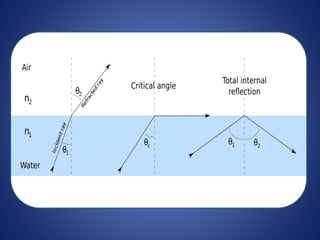
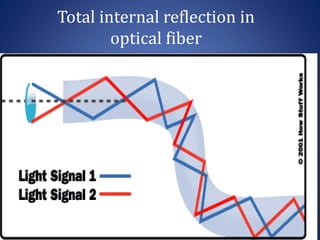
Total Internal Reflection
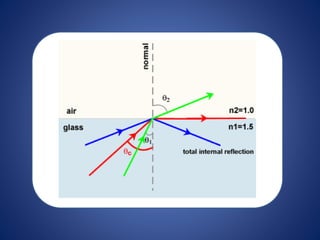
• When a ray of light travels from a denser to a rarer
medium such that the angle of incidence is greater than the
critical angle, the ray reflects back into the same medium
this phenomena is called total internal reflection.
• In the optical fiber the rays undergo repeated total number
of reflections until it emerges out of the other end of the
fiber, even if the fiber is bent.
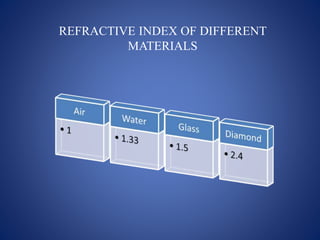
REFRACTIVE INDEX OF DIFFERENT
MATERIALS
The arrow and the bent pencil
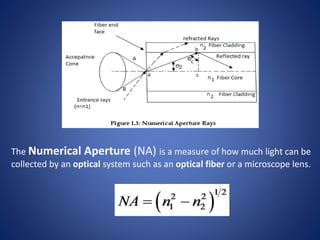
The Numerical Aperture (NA) is a measure of how much light can be
collected by an optical system such as an optical fiber or a microscope lens.
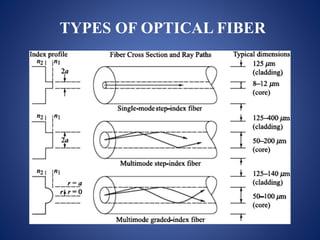
TYPES OF OPTICAL FIBER
Total internal reflection in
optical fiber
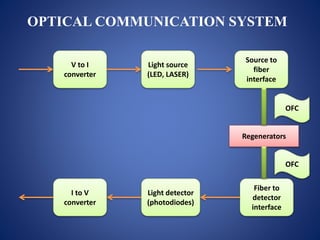
V to I
converter
Light source
(LED, LASER)
Source to
fiber
interface
I to V
converter
Light detector
(photodiodes)
Fiber to
detector
interface
Regenerators
OFC
OFC
OPTICAL COMMUNICATION SYSTEM
Advantages of optical fiber
communication
1) The life of fiber is longer than copper wire
2) Handling and installation costs of optical fiber is very
nominal
3) It is unaffected with electromagnetic interference
4) Attenuation in optical fiber is lower than coaxial cable
or twisted pair.
5) There is no necessity of additional equipment for
protecting against grounding and voltage problems.
6) As it does not radiates energy any antenna or detector
cannot detects it hence provides signal security
Disadvantages
1) Highly skilled staff would be required for maintenance
2) Only point to point working is possible on optical fiber
3) Precise and costly instruments would be required
4) Jointing of fiber and splicing is also time consuming.
Applications
• Telecommunication field
• Space applications
• Broadband applications
• Computer applications
• Industrial applications
• Mining applications
• Medical applications
• Military applications etc.
Optical fibre

Optical fibre

  • 1.
  • 2.
    What is opticalFiber? • An optical fiber is a hair thin cylindrical fiber of glass or any transparent dielectric medium. • The fiber which are used for optical communication are wave guides made of transparent dielectrics. • Its function is to guide visible and infrared light over long distances.
  • 3.
  • 4.
    Core The core ofa fiber cable is a cylinder of plastic that runs all along the fiber cable’s length, and offers protection by cladding. The diameter of the core depends on the application used. Due to internal reflection, the light travelling within the core reflects from the core, the cladding boundary. The core cross section needs to be a circular one for most of the applications. Cladding Cladding is an outer optical material that protects the core. The main function of the cladding is that it reflects the light back into the core. When light enters through the core (dense material) into the cladding(less dense material), it changes its angle, and then reflects back to the core.
  • 5.
    Buffer The main functionof the buffer is to protect the fiber from damage and thousands of optical fibers arranged in hundreds of optical cables. These bundles are protected by the cable’s outer covering that is called jacket. Jacket Fiber optic cable’s jackets are available in different colors that can easily make us recognize the exact color of the cable we are dealing with. The color yellow clearly signifies a single mode cable, and orange color indicates multimode.
  • 6.
    Working principle Total InternalReflection • When a ray of light travels from a denser to a rarer medium such that the angle of incidence is greater than the critical angle, the ray reflects back into the same medium this phenomena is called total internal reflection. • In the optical fiber the rays undergo repeated total number of reflections until it emerges out of the other end of the fiber, even if the fiber is bent.
  • 7.
    REFRACTIVE INDEX OFDIFFERENT MATERIALS
  • 8.
    The arrow andthe bent pencil
  • 12.
    The Numerical Aperture(NA) is a measure of how much light can be collected by an optical system such as an optical fiber or a microscope lens.
  • 13.
  • 14.
    Total internal reflectionin optical fiber
  • 15.
    V to I converter Lightsource (LED, LASER) Source to fiber interface I to V converter Light detector (photodiodes) Fiber to detector interface Regenerators OFC OFC OPTICAL COMMUNICATION SYSTEM
  • 16.
    Advantages of opticalfiber communication 1) The life of fiber is longer than copper wire 2) Handling and installation costs of optical fiber is very nominal 3) It is unaffected with electromagnetic interference 4) Attenuation in optical fiber is lower than coaxial cable or twisted pair. 5) There is no necessity of additional equipment for protecting against grounding and voltage problems. 6) As it does not radiates energy any antenna or detector cannot detects it hence provides signal security
  • 17.
    Disadvantages 1) Highly skilledstaff would be required for maintenance 2) Only point to point working is possible on optical fiber 3) Precise and costly instruments would be required 4) Jointing of fiber and splicing is also time consuming.
  • 18.
    Applications • Telecommunication field •Space applications • Broadband applications • Computer applications • Industrial applications • Mining applications • Medical applications • Military applications etc.