1
OVERVIEW
 Introduction
 Fundamentals of fiber
 Working of fiber optic communication
 Structure of optical fiber
 Comparision b/w fiber cable & copper
wire
 Classification of optical fibers
 Applications
 Advantages
 Disadvantages
 Conclusion
INTRODUCTION
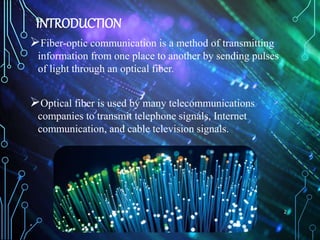
Fiber-optic communication is a method of transmitting
information from one place to another by sending pulses
of light through an optical fiber.
Optical fiber is used by many telecommunications
companies to transmit telephone signals, Internet
communication, and cable television signals.

2
FUNDAMENTALS OF FIBER
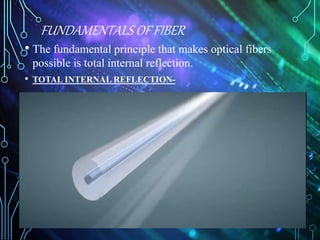
• The fundamental principle that makes optical fibers
possible is total internal reflection.
• TOTAL INTERNAL REFLECTION-
• From Snell’s Law we find that
refraction can only occur when
the angle theta1 is large enough.
• This implies that as the angle is reduced, there must be a
point when the light ray is reflected, where theta1 = theta2
• Critical angle is giving by
3
HISTORY OF TOTAL INTERNAL REFECTION
4
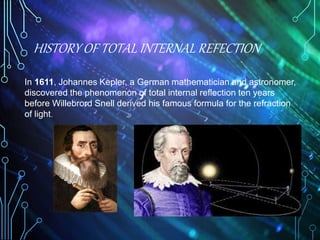
In 1611, Johannes Kepler, a German mathematician and astronomer,
discovered the phenomenon of total internal reflection ten years
before Willebrord Snell derived his famous formula for the refraction
of light.
HISTORY OF FIBRE OPTICS
5
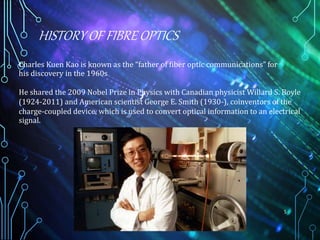
Charles Kuen Kao is known as the “father of fiber optic communications” for
his discovery in the 1960s
He shared the 2009 Nobel Prize in Physics with Canadian physicist Willard S. Boyle
(1924-2011) and American scientist George E. Smith (1930-), coinventors of the
charge-coupled device, which is used to convert optical information to an electrical
signal.
WORKING OF FIBER OPTIC COMMUNICATION:
6
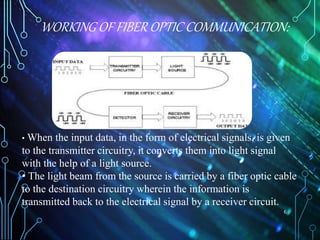
• When the input data, in the form of electrical signals, is given
to the transmitter circuitry, it converts them into light signal
with the help of a light source.
• The light beam from the source is carried by a fiber optic cable
to the destination circuitry wherein the information is
transmitted back to the electrical signal by a receiver circuit.
STRUCTURE OF OPTICAL FIBER
7
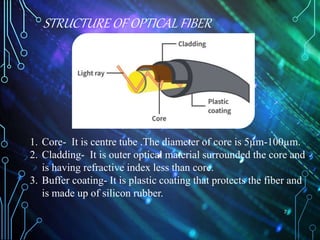
1. Core- It is centre tube .The diameter of core is 5µm-100µm.
2. Cladding- It is outer optical material surrounded the core and
is having refractive index less than core.
3. Buffer coating- It is plastic coating that protects the fiber and
is made up of silicon rubber.
CLASSIFICATION OF OPTICAL FIBERS
1. Based On The Materials Used:
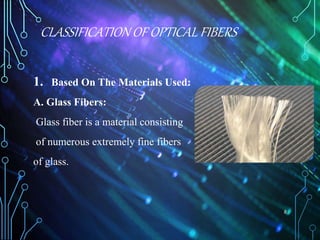
A. Glass Fibers:
Glass fiber is a material consisting
of numerous extremely fine fibers
of glass.
8
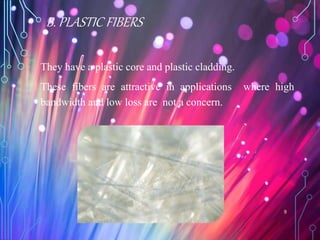
B. PLASTIC FIBERS
They have a plastic core and plastic cladding.
These fibers are attractive in applications where high
bandwidth and low loss are not a concern.
9
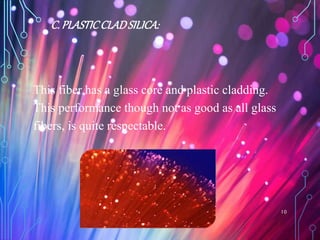
C. PLASTICCLADSILICA:
This fiber has a glass core and plastic cladding.
This performance though not as good as all glass
fibers, is quite respectable.
10
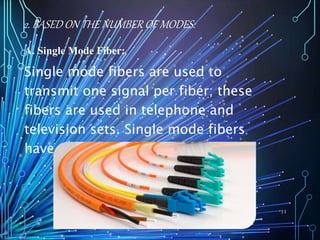
2. BASED ON THE NUMBER OF MODES:
A. Single Mode Fiber:
Single mode fibers are used to
transmit one signal per fiber; these
fibers are used in telephone and
television sets. Single mode fibers
have small cores.
11
B. MULTIMODE FIBER:
Multimode fibers are used to transmit many signals per
fiber; these signals are used in computer and local area
networks that have larger cores.
APPLICATIONS
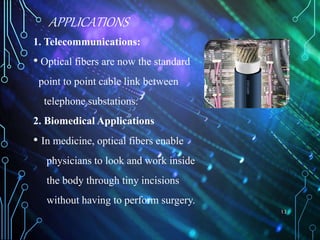
1. Telecommunications:
• Optical fibers are now the standard
point to point cable link between
telephone substations.
2. Biomedical Applications
• In medicine, optical fibers enable
physicians to look and work inside
the body through tiny incisions
without having to perform surgery.
13
3.Fiber Optic Cable Sensors
Fiber optic cables sensors are used to measure a variety of
physical properties such as mechanical strain, temperature, and
pressure.
4.Fiber Optic Lasers
Fiber optic cables make convenient lasers since
they are small and flexible.
5. Cable Tv
As mentioned before domestic cable TV
networks use optical fiber because of its very low power
consumption.
14
ADVANTAGES
• Wide Bandwidth:
Optical fibers offer greater bandwidth due to the use of light as carrier.
• Low Loss:
In an optical fiber the attenuation is independent of frequency.
They offer a loss of 0.2 dBm/km.
• Size:
In comparison to copper, a fiber optic cable has nearly 4.5 times as much
capacity as the wire cable has and a cross sectional area that is 30 times less.
15
6. In a decorative lamp or night light
Optical-fiber lamps are used for illumination in decorative
applications, including signs, art, toys and
artificial Christmas trees.
7. CCTV
Closed Circuit Television Security systems
use optical fiber because of its inherent security.
8. Telephone
With the use of fiber optic communication, you can connect faster
and have clear conversations without any lag on either side.
16
• Safety:
Fiber is a dielectric and does not carry electricity.
• Non conductivity:
Optical fibers are non-conductive and are not effective by
strong electromagnetic interference such as lighting.
• Weight:
Fiber optic cables are much thinner and lighter than metal
wires. They also occupy less space with cables of the
same information capacity. 17
DISADVANTAGES
Cannot branch the network
Expensive to Install.
Highly Susceptible.
Can’t Be Curved.
18
CONCLUSION
Fiber optic transmission has found a vast array of
applications in computer systems. Advances in
technology have enabled more data to be conveyed
through a single optical fiber over long distances. The
existing technology will develop to provide a faster
internet speed and more secured internet environment.
19
REFERENCE
Google
Wikipedia
Techtarget.com
20
Thank you
By SURIYA.B
21

Optical fibre and it's applications by SURIYA B-22ECR205

  • 1.
    1 OVERVIEW  Introduction  Fundamentalsof fiber  Working of fiber optic communication  Structure of optical fiber  Comparision b/w fiber cable & copper wire  Classification of optical fibers  Applications  Advantages  Disadvantages  Conclusion
  • 2.
    INTRODUCTION Fiber-optic communication isa method of transmitting information from one place to another by sending pulses of light through an optical fiber. Optical fiber is used by many telecommunications companies to transmit telephone signals, Internet communication, and cable television signals.  2
  • 3.
    FUNDAMENTALS OF FIBER •The fundamental principle that makes optical fibers possible is total internal reflection. • TOTAL INTERNAL REFLECTION- • From Snell’s Law we find that refraction can only occur when the angle theta1 is large enough. • This implies that as the angle is reduced, there must be a point when the light ray is reflected, where theta1 = theta2 • Critical angle is giving by 3
  • 4.
    HISTORY OF TOTALINTERNAL REFECTION 4 In 1611, Johannes Kepler, a German mathematician and astronomer, discovered the phenomenon of total internal reflection ten years before Willebrord Snell derived his famous formula for the refraction of light.
  • 5.
    HISTORY OF FIBREOPTICS 5 Charles Kuen Kao is known as the “father of fiber optic communications” for his discovery in the 1960s He shared the 2009 Nobel Prize in Physics with Canadian physicist Willard S. Boyle (1924-2011) and American scientist George E. Smith (1930-), coinventors of the charge-coupled device, which is used to convert optical information to an electrical signal.
  • 6.
    WORKING OF FIBEROPTIC COMMUNICATION: 6 • When the input data, in the form of electrical signals, is given to the transmitter circuitry, it converts them into light signal with the help of a light source. • The light beam from the source is carried by a fiber optic cable to the destination circuitry wherein the information is transmitted back to the electrical signal by a receiver circuit.
  • 7.
    STRUCTURE OF OPTICALFIBER 7 1. Core- It is centre tube .The diameter of core is 5µm-100µm. 2. Cladding- It is outer optical material surrounded the core and is having refractive index less than core. 3. Buffer coating- It is plastic coating that protects the fiber and is made up of silicon rubber.
  • 8.
    CLASSIFICATION OF OPTICALFIBERS 1. Based On The Materials Used: A. Glass Fibers: Glass fiber is a material consisting of numerous extremely fine fibers of glass. 8
  • 9.
    B. PLASTIC FIBERS Theyhave a plastic core and plastic cladding. These fibers are attractive in applications where high bandwidth and low loss are not a concern. 9
  • 10.
    C. PLASTICCLADSILICA: This fiberhas a glass core and plastic cladding. This performance though not as good as all glass fibers, is quite respectable. 10
  • 11.
    2. BASED ONTHE NUMBER OF MODES: A. Single Mode Fiber: Single mode fibers are used to transmit one signal per fiber; these fibers are used in telephone and television sets. Single mode fibers have small cores. 11
  • 12.
    B. MULTIMODE FIBER: Multimodefibers are used to transmit many signals per fiber; these signals are used in computer and local area networks that have larger cores.
  • 13.
    APPLICATIONS 1. Telecommunications: • Opticalfibers are now the standard point to point cable link between telephone substations. 2. Biomedical Applications • In medicine, optical fibers enable physicians to look and work inside the body through tiny incisions without having to perform surgery. 13
  • 14.
    3.Fiber Optic CableSensors Fiber optic cables sensors are used to measure a variety of physical properties such as mechanical strain, temperature, and pressure. 4.Fiber Optic Lasers Fiber optic cables make convenient lasers since they are small and flexible. 5. Cable Tv As mentioned before domestic cable TV networks use optical fiber because of its very low power consumption. 14
  • 15.
    ADVANTAGES • Wide Bandwidth: Opticalfibers offer greater bandwidth due to the use of light as carrier. • Low Loss: In an optical fiber the attenuation is independent of frequency. They offer a loss of 0.2 dBm/km. • Size: In comparison to copper, a fiber optic cable has nearly 4.5 times as much capacity as the wire cable has and a cross sectional area that is 30 times less. 15
  • 16.
    6. In adecorative lamp or night light Optical-fiber lamps are used for illumination in decorative applications, including signs, art, toys and artificial Christmas trees. 7. CCTV Closed Circuit Television Security systems use optical fiber because of its inherent security. 8. Telephone With the use of fiber optic communication, you can connect faster and have clear conversations without any lag on either side. 16
  • 17.
    • Safety: Fiber isa dielectric and does not carry electricity. • Non conductivity: Optical fibers are non-conductive and are not effective by strong electromagnetic interference such as lighting. • Weight: Fiber optic cables are much thinner and lighter than metal wires. They also occupy less space with cables of the same information capacity. 17
  • 18.
    DISADVANTAGES Cannot branch thenetwork Expensive to Install. Highly Susceptible. Can’t Be Curved. 18
  • 19.
    CONCLUSION Fiber optic transmissionhas found a vast array of applications in computer systems. Advances in technology have enabled more data to be conveyed through a single optical fiber over long distances. The existing technology will develop to provide a faster internet speed and more secured internet environment. 19
  • 20.
  • 21.