Optical fibres
14th of May 2018
What’s Optical Fiber ?
An optical fibre is a thin rod of high-quality glass that uses light
pulses instead of electrical pulses to transmit information. Very
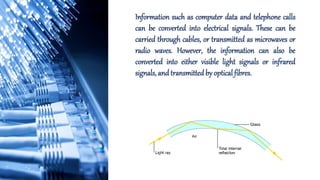
little light is absorbed by the glass. Light getting in at one end
undergoes repeated total internal reflection, even when the fibre
is bent, and emerges at the other end.
Information such as computer data and telephone calls
can be converted into electrical signals. These can be
carried through cables, or transmitted as microwaves or
radio waves. However, the information can also be
converted into either visible light signals or infrared
signals, and transmittedby optical fibres.
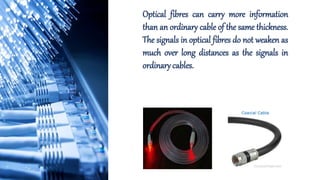
Optical fibres can carry more information
than an ordinary cable of the same thickness.
The signals in optical fibres do not weaken as
much over long distances as the signals in
ordinary cables.
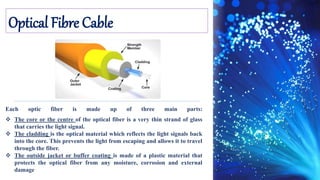
Optical Fibre Cable
Each optic fiber is made up of three main parts:
 The core or the centre of the optical fiber is a very thin strand of glass
that carries the light signal.
 The cladding is the optical material which reflects the light signals back
into the core. This prevents the light from escaping and allows it to travel
through the fiber.
 The outside jacket or buffer coating is made of a plastic material that
protects the optical fiber from any moisture, corrosion and external
damage
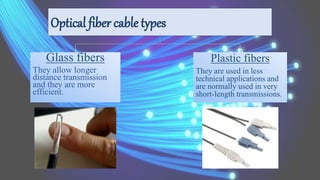
Glass fibers
They allow longer
distance transmission
and they are more
efficient.
Plastic fibers
They are used in less
technical applications and
are normally used in very
short-length transmissions.
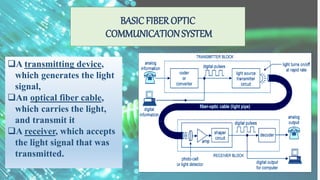
BASICFIBEROPTIC
COMMUNICATIONSYSTEM
A transmitting device,
which generates the light
signal,
An optical fiber cable,
which carries the light,
and transmit it
A receiver, which accepts
the light signal that was
transmitted.
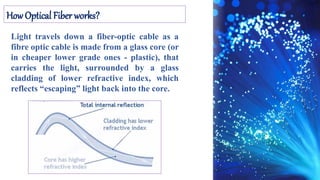
Light travels down a fiber-optic cable as a
fibre optic cable is made from a glass core (or
in cheaper lower grade ones - plastic), that
carries the light, surrounded by a glass
cladding of lower refractive index, which
reflects “escaping” light back into the core.
How Optical Fiber works?
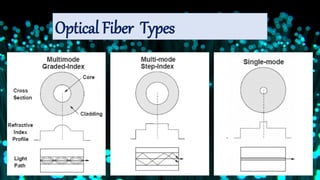
Optical Fiber Types
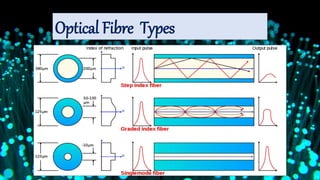
Optical Fibre Types
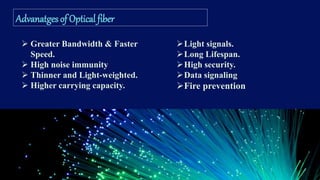
Advanatges of Optical fiber
 Greater Bandwidth & Faster
Speed.
 High noise immunity
 Thinner and Light-weighted.
 Higher carrying capacity.
Light signals.
Long Lifespan.
High security.
Data signaling
Fire prevention
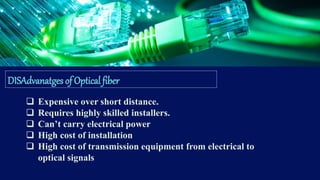
DISAdvanatges of Optical fiber
 Expensive over short distance.
 Requires highly skilled installers.
 Can’t carry electrical power
 High cost of installation
 High cost of transmission equipment from electrical to
optical signals
Optical Fiber Dispersion & LOSS
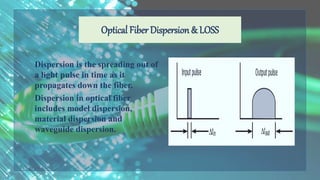
Dispersion is the spreading out of
a light pulse in time as it
propagates down the fiber.
Dispersion in optical fiber
includes model dispersion,
material dispersion and
waveguide dispersion.
Optical Fiber Dispersion & LOSS
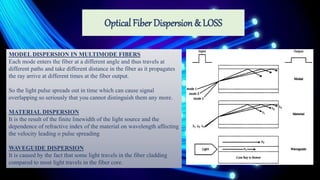
MODEL DISPERSION IN MULTIMODE FIBERS
Each mode enters the fiber at a different angle and thus travels at
different paths and take different distance in the fiber as it propagates
the ray arrive at different times at the fiber output.
So the light pulse spreads out in time which can cause signal
overlapping so seriously that you cannot distinguish them any more.
MATERIAL DISPERSION
It is the result of the finite linewidth of the light source and the
dependence of refractive index of the material on wavelength affecting
the velocity leading o pulse spreading
WAVEGUIDE DISPERSION
It is caused by the fact that some light travels in the fiber cladding
compared to most light travels in the fiber core.
Optical Fiber Applications
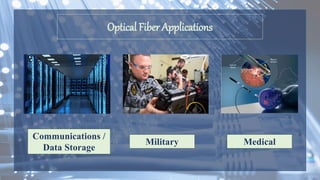
Communications /
Data Storage
Military Medical
Optical Fiber Applications
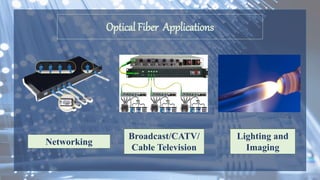
Networking
Broadcast/CATV/
Cable Television
Lighting and
Imaging
THANK
YOU!

Optical fibres

  • 1.
  • 2.
    What’s Optical Fiber? An optical fibre is a thin rod of high-quality glass that uses light pulses instead of electrical pulses to transmit information. Very little light is absorbed by the glass. Light getting in at one end undergoes repeated total internal reflection, even when the fibre is bent, and emerges at the other end.
  • 3.
    Information such ascomputer data and telephone calls can be converted into electrical signals. These can be carried through cables, or transmitted as microwaves or radio waves. However, the information can also be converted into either visible light signals or infrared signals, and transmittedby optical fibres.
  • 4.
    Optical fibres cancarry more information than an ordinary cable of the same thickness. The signals in optical fibres do not weaken as much over long distances as the signals in ordinary cables.
  • 5.
    Optical Fibre Cable Eachoptic fiber is made up of three main parts:  The core or the centre of the optical fiber is a very thin strand of glass that carries the light signal.  The cladding is the optical material which reflects the light signals back into the core. This prevents the light from escaping and allows it to travel through the fiber.  The outside jacket or buffer coating is made of a plastic material that protects the optical fiber from any moisture, corrosion and external damage
  • 6.
    Glass fibers They allowlonger distance transmission and they are more efficient. Plastic fibers They are used in less technical applications and are normally used in very short-length transmissions.
  • 7.
    BASICFIBEROPTIC COMMUNICATIONSYSTEM A transmitting device, whichgenerates the light signal, An optical fiber cable, which carries the light, and transmit it A receiver, which accepts the light signal that was transmitted.
  • 8.
    Light travels downa fiber-optic cable as a fibre optic cable is made from a glass core (or in cheaper lower grade ones - plastic), that carries the light, surrounded by a glass cladding of lower refractive index, which reflects “escaping” light back into the core. How Optical Fiber works?
  • 9.
  • 10.
  • 11.
    Advanatges of Opticalfiber  Greater Bandwidth & Faster Speed.  High noise immunity  Thinner and Light-weighted.  Higher carrying capacity. Light signals. Long Lifespan. High security. Data signaling Fire prevention
  • 12.
    DISAdvanatges of Opticalfiber  Expensive over short distance.  Requires highly skilled installers.  Can’t carry electrical power  High cost of installation  High cost of transmission equipment from electrical to optical signals
  • 13.
    Optical Fiber Dispersion& LOSS Dispersion is the spreading out of a light pulse in time as it propagates down the fiber. Dispersion in optical fiber includes model dispersion, material dispersion and waveguide dispersion.
  • 14.
    Optical Fiber Dispersion& LOSS MODEL DISPERSION IN MULTIMODE FIBERS Each mode enters the fiber at a different angle and thus travels at different paths and take different distance in the fiber as it propagates the ray arrive at different times at the fiber output. So the light pulse spreads out in time which can cause signal overlapping so seriously that you cannot distinguish them any more. MATERIAL DISPERSION It is the result of the finite linewidth of the light source and the dependence of refractive index of the material on wavelength affecting the velocity leading o pulse spreading WAVEGUIDE DISPERSION It is caused by the fact that some light travels in the fiber cladding compared to most light travels in the fiber core.
  • 15.
    Optical Fiber Applications Communications/ Data Storage Military Medical
  • 16.
  • 25.