A Presentation on
Li-Fi
By:- Deepak Khatri
IInd Year IVth Sem
Computer science Engg.
CONTENT
 Introduction
 What is Li-Fi
 Working
 Li-Fi v/s Wi-Fi
 Application
 Advantages
 Disadvantages
INTRODUCTION
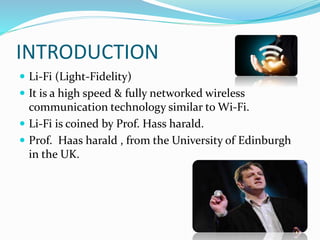
 Li-Fi (Light-Fidelity)
 It is a high speed & fully networked wireless
communication technology similar to Wi-Fi.
 Li-Fi is coined by Prof. Hass harald.
 Prof. Haas harald , from the University of Edinburgh
in the UK.
WHAT IS Li-Fi
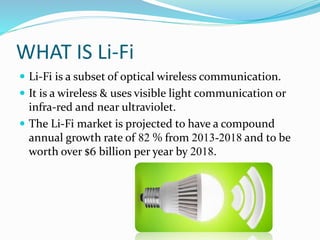
 Li-Fi is a subset of optical wireless communication.
 It is a wireless & uses visible light communication or
infra-red and near ultraviolet.
 The Li-Fi market is projected to have a compound
annual growth rate of 82 % from 2013-2018 and to be
worth over $6 billion per year by 2018.
WORKING
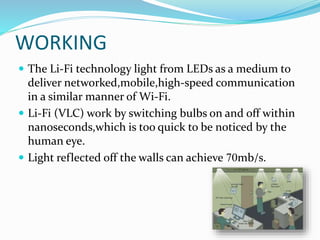
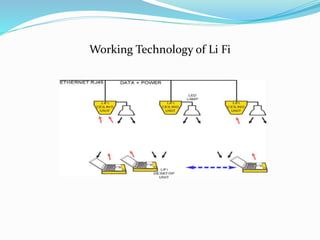
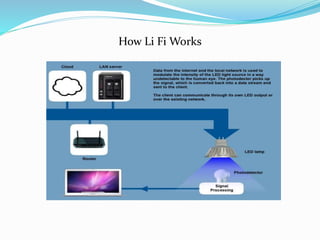
 The Li-Fi technology light from LEDs as a medium to
deliver networked,mobile,high-speed communication
in a similar manner of Wi-Fi.
 Li-Fi (VLC) work by switching bulbs on and off within
nanoseconds,which is too quick to be noticed by the
human eye.
 Light reflected off the walls can achieve 70mb/s.
Working Technology of Li Fi
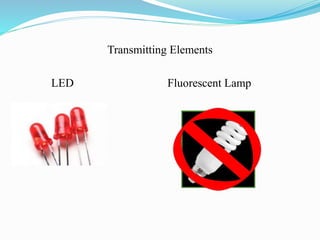
Transmitting Elements
LED Fluorescent Lamp
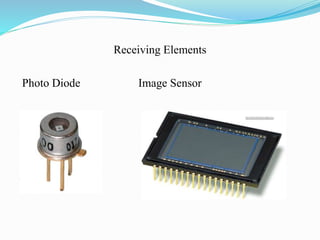
Receiving Elements
Photo Diode Image Sensor
How Li Fi Works
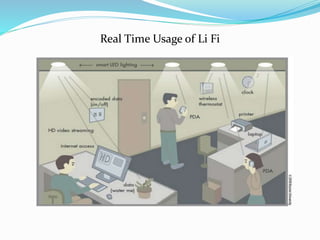
Real Time Usage of Li Fi
Li-Fi v/s Wi-Fi
 Both Li-Fi & Wi-Fi transmit data over the
electromagnetic spectrum
 But whereas Wi-Fi utilizes radio waves,Li-Fi uses
visible light.
 Wi-Fi is close to full capacity, Li-Fi has no limitations
on capacity.
 The visible light spectrum is 10,000 times larger than
the entire radio frequency spectrum.
APPLICATIONS
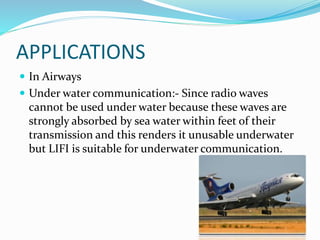
 In Airways
 Under water communication:- Since radio waves
cannot be used under water because these waves are
strongly absorbed by sea water within feet of their
transmission and this renders it unusable underwater
but LIFI is suitable for underwater communication.
ADVANTAGES
 Li-Fi has the advantage of being usful in
electromagnetic sensitive areas as an aircraft
cabins,hospitals and nuclear power plants without
causing electromagnetic interference.
 Researchers have reached data rates of over 10Gb/s.
 Li-Fi is ten time cheaper thanWi-Fi.
 It is green information technology.
 It can be used underwater.
DISADVANTAGES
 The mostly disadvantage is it has a short range.
 Wi-Fi has the long range for network.
 It uses visible light communication instead of Wi-Fi
uses radio frequency waves, which has much wider
bandwidth.
 Li-Fi doesn’t work in the dark and outdoors.
 We can not move another room.
LI-FI Technology ppt

LI-FI Technology ppt

  • 1.
    A Presentation on Li-Fi By:-Deepak Khatri IInd Year IVth Sem Computer science Engg.
  • 2.
    CONTENT  Introduction  Whatis Li-Fi  Working  Li-Fi v/s Wi-Fi  Application  Advantages  Disadvantages
  • 3.
    INTRODUCTION  Li-Fi (Light-Fidelity) It is a high speed & fully networked wireless communication technology similar to Wi-Fi.  Li-Fi is coined by Prof. Hass harald.  Prof. Haas harald , from the University of Edinburgh in the UK.
  • 4.
    WHAT IS Li-Fi Li-Fi is a subset of optical wireless communication.  It is a wireless & uses visible light communication or infra-red and near ultraviolet.  The Li-Fi market is projected to have a compound annual growth rate of 82 % from 2013-2018 and to be worth over $6 billion per year by 2018.
  • 5.
    WORKING  The Li-Fitechnology light from LEDs as a medium to deliver networked,mobile,high-speed communication in a similar manner of Wi-Fi.  Li-Fi (VLC) work by switching bulbs on and off within nanoseconds,which is too quick to be noticed by the human eye.  Light reflected off the walls can achieve 70mb/s.
  • 6.
  • 7.
  • 8.
  • 9.
    How Li FiWorks
  • 10.
  • 11.
    Li-Fi v/s Wi-Fi Both Li-Fi & Wi-Fi transmit data over the electromagnetic spectrum  But whereas Wi-Fi utilizes radio waves,Li-Fi uses visible light.  Wi-Fi is close to full capacity, Li-Fi has no limitations on capacity.  The visible light spectrum is 10,000 times larger than the entire radio frequency spectrum.
  • 12.
    APPLICATIONS  In Airways Under water communication:- Since radio waves cannot be used under water because these waves are strongly absorbed by sea water within feet of their transmission and this renders it unusable underwater but LIFI is suitable for underwater communication.
  • 13.
    ADVANTAGES  Li-Fi hasthe advantage of being usful in electromagnetic sensitive areas as an aircraft cabins,hospitals and nuclear power plants without causing electromagnetic interference.  Researchers have reached data rates of over 10Gb/s.  Li-Fi is ten time cheaper thanWi-Fi.  It is green information technology.  It can be used underwater.
  • 14.
    DISADVANTAGES  The mostlydisadvantage is it has a short range.  Wi-Fi has the long range for network.  It uses visible light communication instead of Wi-Fi uses radio frequency waves, which has much wider bandwidth.  Li-Fi doesn’t work in the dark and outdoors.  We can not move another room.