
FIBER OPTIC
COMMUNICATION
PRESENTED BY –
NAME – RUPAM DEY
ROLL NO. – 11901212022
DEPT. – BCA 6TH SEM
What Is Fiber Optic Communication?
Fiber-optic communication is a method of transmitting information
from one place to another by sending pulses of light through an
optical fiber.
The light forms an electromagnetic carrier wave that is modulated to
carry information. First developed in the 1970s, fiber-optic communication
systems have revolutionized the telecommunications industry and have
played a major role in the advent of the Information Age.
Because of its advantages over electrical transmission, optical
fibers have largely replaced copper wire communications in core networks
in the developed world.
Optical fiber is used by many telecommunications companies to
transmit telephone signals, Internet communication, and cable television
signals.
What Is Optical Fiber / Fiber Optics?
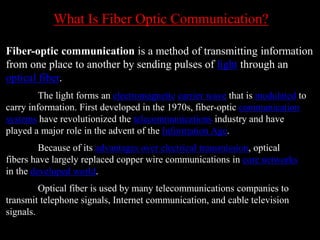
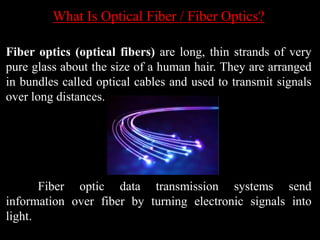
Fiber optics (optical fibers) are long, thin strands of very
pure glass about the size of a human hair. They are arranged
in bundles called optical cables and used to transmit signals
over long distances.
Fiber optic data transmission systems send
information over fiber by turning electronic signals into
light.
What Is Fiber Optic Cable?
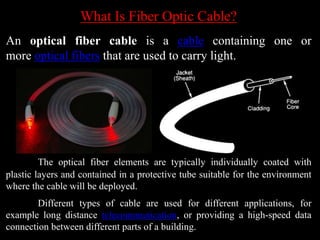
An optical fiber cable is a cable containing one or
more optical fibers that are used to carry light.
The optical fiber elements are typically individually coated with
plastic layers and contained in a protective tube suitable for the environment
where the cable will be deployed.
Different types of cable are used for different applications, for
example long distance telecommunication, or providing a high-speed data
connection between different parts of a building.
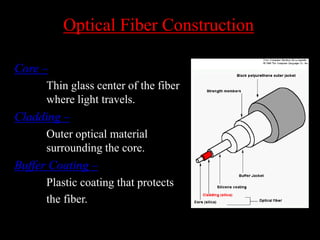
Optical Fiber Construction
Core –
Thin glass center of the fiber
where light travels.
Cladding –
Outer optical material
surrounding the core.
Buffer Coating –
Plastic coating that protects
the fiber.
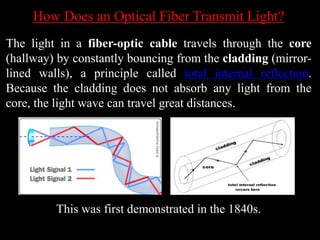
How Does an Optical Fiber Transmit Light?
The light in a fiber-optic cable travels through the core
(hallway) by constantly bouncing from the cladding (mirror-
lined walls), a principle called total internal reflection.
Because the cladding does not absorb any light from the
core, the light wave can travel great distances.
This was first demonstrated in the 1840s.
Advantages of Fiber Optic Communication
Bandwidth –
Fiber optic cables have a much greater bandwidth than metal cables. The amount of information
that can be transmitted per unit time of fiber over other transmission media is its most significant
advantage. With the high performance single mode cable used by telephone industries for long
distance telecommunication, the bandwidth surpasses the needs of today's applications and
gives room for growth tomorrow.
Size -
In comparison to copper, a fiber optic cable has nearly 4.5 times as much capacity as the wire
cable has and a cross sectional area that is 30 times less.
 Weight -
Fiber optic cables are much thinner and lighter than metal wires. They also occupy less space
with cables of the same information capacity. Lighter weight makes fiber easier to install.
Security -
Optical fibers are difficult to tap. As they do not radiate electromagnetic energy, emissions
cannot be intercepted. As physically tapping the fiber takes great skill to do undetected, fiber
is the most secure medium available for carrying sensitive data.
 Flexibility -
An optical fiber has greater tensile strength than copper or steel fibers of the same
diameter. It is flexible, bends easily and resists most corrosive elements that attack copper cable.
Disadvantages of Fiber Optic Communication
Cost -
Cables are expensive to install but last longer than copper cables.
Transmission -
Transmission on optical fiber requires repeating at distance intervals.
Fragile -
Fibers can be broken or have transmission loses when wrapped around curves of only
a few centimeters radius. However by encasing fibers in a plastic sheath, it is difficult
to bend the cable into a small enough radius to break the fiber.
Protection -
Optical fibers require more protection around the cable compared to copper.
Uses of Fiber Optic Communication
Fiber optic cables find many uses in a wide variety of industries and applications.
Some uses of fiber optic cables include:
1. Medical –
Used as light guides, imaging tools and also as lasers for surgeries
2. Defense / Government –
Used as hydrophones for seismic and SONAR uses, as wiring in aircraft,
submarines
3. Data Storage –
Used for data transmission
4. Telecommunication –
Fiber is laid and used for transmitting and receiving purposes
5. Networking –
Used to connect users and servers in a variety of network settings and
help increase the speed and accuracy of data transmission
6. Broadcast / CATV –
Broadcast/cable companies are using fiber optic cables for wiring CATV,
HDTV, internet, video on-demand and other applications
PRESENTED BY –
NAME – RUPAM DEY
ROLL NO. – 11901212022
DEPT. – BCA 6TH SEM

FIBER OPTIC COMMUNICATION by Rupam Dey

  • 1.
    FIBER OPTIC COMMUNICATION PRESENTED BY– NAME – RUPAM DEY ROLL NO. – 11901212022 DEPT. – BCA 6TH SEM
  • 2.
    What Is FiberOptic Communication? Fiber-optic communication is a method of transmitting information from one place to another by sending pulses of light through an optical fiber. The light forms an electromagnetic carrier wave that is modulated to carry information. First developed in the 1970s, fiber-optic communication systems have revolutionized the telecommunications industry and have played a major role in the advent of the Information Age. Because of its advantages over electrical transmission, optical fibers have largely replaced copper wire communications in core networks in the developed world. Optical fiber is used by many telecommunications companies to transmit telephone signals, Internet communication, and cable television signals.
  • 3.
    What Is OpticalFiber / Fiber Optics? Fiber optics (optical fibers) are long, thin strands of very pure glass about the size of a human hair. They are arranged in bundles called optical cables and used to transmit signals over long distances. Fiber optic data transmission systems send information over fiber by turning electronic signals into light.
  • 4.
    What Is FiberOptic Cable? An optical fiber cable is a cable containing one or more optical fibers that are used to carry light. The optical fiber elements are typically individually coated with plastic layers and contained in a protective tube suitable for the environment where the cable will be deployed. Different types of cable are used for different applications, for example long distance telecommunication, or providing a high-speed data connection between different parts of a building.
  • 5.
    Optical Fiber Construction Core– Thin glass center of the fiber where light travels. Cladding – Outer optical material surrounding the core. Buffer Coating – Plastic coating that protects the fiber.
  • 6.
    How Does anOptical Fiber Transmit Light? The light in a fiber-optic cable travels through the core (hallway) by constantly bouncing from the cladding (mirror- lined walls), a principle called total internal reflection. Because the cladding does not absorb any light from the core, the light wave can travel great distances. This was first demonstrated in the 1840s.
  • 7.
    Advantages of FiberOptic Communication Bandwidth – Fiber optic cables have a much greater bandwidth than metal cables. The amount of information that can be transmitted per unit time of fiber over other transmission media is its most significant advantage. With the high performance single mode cable used by telephone industries for long distance telecommunication, the bandwidth surpasses the needs of today's applications and gives room for growth tomorrow. Size - In comparison to copper, a fiber optic cable has nearly 4.5 times as much capacity as the wire cable has and a cross sectional area that is 30 times less.  Weight - Fiber optic cables are much thinner and lighter than metal wires. They also occupy less space with cables of the same information capacity. Lighter weight makes fiber easier to install. Security - Optical fibers are difficult to tap. As they do not radiate electromagnetic energy, emissions cannot be intercepted. As physically tapping the fiber takes great skill to do undetected, fiber is the most secure medium available for carrying sensitive data.  Flexibility - An optical fiber has greater tensile strength than copper or steel fibers of the same diameter. It is flexible, bends easily and resists most corrosive elements that attack copper cable.
  • 8.
    Disadvantages of FiberOptic Communication Cost - Cables are expensive to install but last longer than copper cables. Transmission - Transmission on optical fiber requires repeating at distance intervals. Fragile - Fibers can be broken or have transmission loses when wrapped around curves of only a few centimeters radius. However by encasing fibers in a plastic sheath, it is difficult to bend the cable into a small enough radius to break the fiber. Protection - Optical fibers require more protection around the cable compared to copper.
  • 9.
    Uses of FiberOptic Communication Fiber optic cables find many uses in a wide variety of industries and applications. Some uses of fiber optic cables include: 1. Medical – Used as light guides, imaging tools and also as lasers for surgeries 2. Defense / Government – Used as hydrophones for seismic and SONAR uses, as wiring in aircraft, submarines 3. Data Storage – Used for data transmission 4. Telecommunication – Fiber is laid and used for transmitting and receiving purposes 5. Networking – Used to connect users and servers in a variety of network settings and help increase the speed and accuracy of data transmission 6. Broadcast / CATV – Broadcast/cable companies are using fiber optic cables for wiring CATV, HDTV, internet, video on-demand and other applications
  • 10.
    PRESENTED BY – NAME– RUPAM DEY ROLL NO. – 11901212022 DEPT. – BCA 6TH SEM