Physiotherapy
in
Pre and Post operative stage
Dr. Kaushik Patel (MPT. PhD scholar)
Assistant professor SPB Physiotherapy college
• The incidence of pulmonary and circular complications is
higher after abdominal surgery
• Physical therapy has a valuable role to play in prevention of
respiratory and circulatory complications as well as their
treatment
Key Concepts
• Principles /Aims of physiotherapy
• Preoperative assessment
• Preoperative training
• Postoperative assessment
• Post operative training
• Pulmonary complications were more frequent, were associated
with longer hospital stay, and occurred in combination with
cardiac complications in a substantial proportion of cases.
• Lawrence va, hilsenbeck sg, mulrow cd, dhanda r, sapp j, page cp. Incidence and
hospital stay for cardiac and pulmonary complications after abdominal surgery.
Journal of general internal medicine. 1995 dec 1;10(12):671-8.
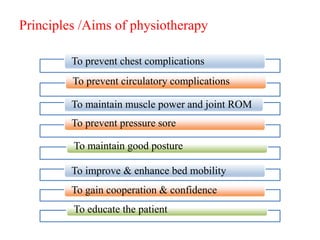
Principles /Aims of physiotherapy
To maintain muscle power and joint ROM
To prevent pressure sore
To maintain good posture
To improve & enhance bed mobility
To gain cooperation & confidence
To educate the patient
To prevent chest complications
To prevent circulatory complications
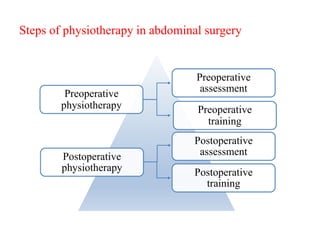
Steps of physiotherapy in abdominal surgery
Preoperative
assessment
Postoperative
physiotherapy
Postoperative
assessment
Postoperative
training
Preoperative
physiotherapy Preoperative
training
Preoperative physiotherapy
Ideally patient should be admitted to the hospital 24 hours or
more before the operation
This allowed the patient to settle in and to meet those who are
responsible for the surgery
Preoperative assessment
a) Read the notes
b) Assess the respiratory functions
c) Check for circulatory problems
d) Detailed history of the patient
It include both subjective and objective assessment
Benefits
• To gain good rapport
• To know the functional status
• To understand patients goals
a) Clinical notes reading
• Causes for surgery
• Comorbid conditions – like asthma, obesity, diabetes etc.
• Any other notes by the surgeon/ physician
b) Respiratory assessment
• Chest deformities – Kyphosis, Kyphoscoliosis,
pectusexcavatum and pectuscarninatum
• Breathing pattern – Normal rate
Inspiration and Expiration ratio
• Abnormal breathing pattern – Pursed lip breathing
Apnoea, Hypopnea
Cheyne stokes respiration
Ataxic breathing
Apneustic breathing
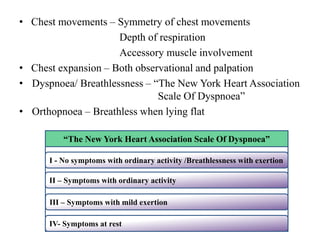
• Chest movements – Symmetry of chest movements
Depth of respiration
Accessory muscle involvement
• Chest expansion – Both observational and palpation
• Dyspnoea/ Breathlessness – “The New York Heart Association
Scale Of Dyspnoea”
• Orthopnoea – Breathless when lying flat
“The New York Heart Association Scale Of Dyspnoea”
I - No symptoms with ordinary activity /Breathlessness with exertion
II – Symptoms with ordinary activity
III – Symptoms with mild exertion
IV- Symptoms at rest
d) Circulatory assessment
• Homan’s test
• oedema- qualitative and quantitative both
e) History taking
• Medical history
• Subjective history
Preoperative training
Teach the patient any exercise that will be started during the very
early postoperative period
These often include..
• Breathing exercise
• Cough reflex
• Arm and leg exercise
• Posture correction
Benefits
• To educate and train the patient about the post operative
exercise program and physiotherapy importance
a) Patient education
• Explain the general plan of care
• Pre operative instructions
b) Breathing exercises
• Diaphragmatic and local expansion exercises
c) Cough
• Teach huffing and coughing technique
d) Arm exercises
• Short lever exercises
• Long lever exercises
e) Leg exercises
• Ankle& toe movements
• Static Q’ceps & glutei
f) Posture correction
• Advices
• Ergonomic advantages
• Preoperative exercise therapy is effective for reducing both
postoperative complication rates and length of hospital stay
after cardiac or abdominal surgery (SR: valkenet, K. Et al.,
2010)
• Valkenet, K. et al. The effects of preoperative exercise therapy on postoperative
outcome: a systematic review. Clinical Rehabilitation, Volume: 25 issue: 2, page(s):
99-111
• Preoperative inspiratory muscle training reduced the incidence
of postoperative pulmonary complications (such as actelectasis
and pneumonia) and length of hospital stay compared with
usual care in adults undergoing cardiac and major abdominal
surgery(sr: katsura M, et al.,2015)
• Katsura M, kuriyama A, takeshima T, fukuhara S, furukawa TA. Preoperative
inspiratory muscle training for postoperative pulmonary complications in adults
undergoing cardiac and major abdominal surgery. Cochrane database of
systematic reviews 2015, issue 10
Post-operative physiotherapy
Aim
• To avoid respiratory and circulatory complication
• To prevent pressure sore
• To prevent muscle wasting and joint stiffness
• To prevent wound infection
• Scar management
• Postural awareness
• Complete rehabilitation in ADL
Post operative assessment
(SOAP assessment format should be followed)
• Surgery notes reading
• Vital signs checking
• Understating the attachments
• Objective assessment
• Inspection of the surgical incision
Benefit –
• To know the post operative problems of the patient
a) Surgery notes reading
• Type of incision
• Type of anaesthesia
• Duration of surgery
• Immediate complications/unwanted
events/management
b) Vital signs checking
• Pulse oximetry
• PR
• ECG
• Heart sounds
• Systemic arterial blood pressure
• CVP
• TPR chart
• Ventilator support
• Lungs volume
• ABG analysis
c) Understanding the attachments
• IV lines
• Nasogastric tube
• Catheter
• PCA- patient control anaesthesia
• Drains
d) Orientation assessment
• Communication ability
• Alertness
• Perceptual ability to follow instructions
e) Objective assessment
i. Respiratory
ii. Circulatory
iii. ROM/MUSCLE POWER
iv. Mobility/functional
i) Respiratory assessment
• Painful Breathing
• Difficulty In Coughing
• Impaired Respiration
• Accumulation Of Secretions
• Palpation
• Auscultation
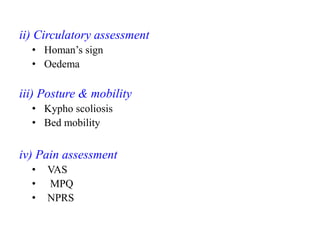
ii) Circulatory assessment
• Homan’s sign
• Oedema
iii) Posture & mobility
• Kypho scoliosis
• Bed mobility
iv) Pain assessment
• VAS
• MPQ
• NPRS
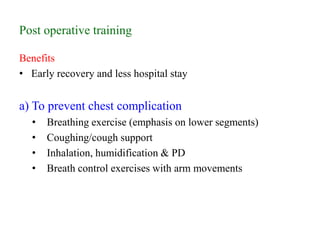
Post operative training
Benefits
• Early recovery and less hospital stay
a) To prevent chest complication
• Breathing exercise (emphasis on lower segments)
• Coughing/cough support
• Inhalation, humidification & PD
• Breath control exercises with arm movements
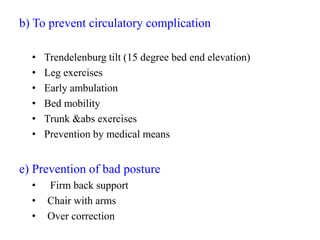
b) To prevent circulatory complication
• Trendelenburg tilt (15 degree bed end elevation)
• Leg exercises
• Early ambulation
• Bed mobility
• Trunk &abs exercises
• Prevention by medical means
e) Prevention of bad posture
• Firm back support
• Chair with arms
• Over correction
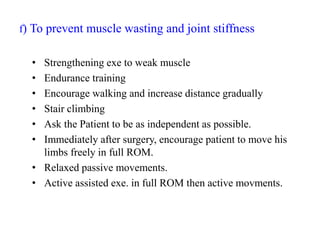
f) To prevent muscle wasting and joint stiffness
• Strengthening exe to weak muscle
• Endurance training
• Encourage walking and increase distance gradually
• Stair climbing
• Ask the Patient to be as independent as possible.
• Immediately after surgery, encourage patient to move his
limbs freely in full ROM.
• Relaxed passive movements.
• Active assisted exe. in full ROM then active movments.
g) Scar management
• Friction massage
• Modality like us.
h) Complete rehabilitation in ADL
• Chest physiotherapy during the immediate postoperative
period following upper abdominal surgery are effective for
improving oxygen-hemoglobin saturation without increased
abdominal pain. Breathing exercises could be adopted at post-
anesthesia care units with benefits for patients.
• Manzano RM, Carvalho CR, Saraiva-Romanholo BM, Vieira JE. Chest
physiotherapy during immediate postoperative period among patients undergoing
upper abdominal surgery: randomized clinical trial. Sao Paulo Medical Journal.
2008 Sep;126(5):269-73..
• The various techniques of physiotherapy (chest physiotherapy,
incentive spirometry, continuous positive airway pressure
breathing) seem to be equivalent in efficacy; but intermittent
positive pressure breathing has no advantages, compared with
the other treatments and could even be deleterious. Chest
physiotherapy and incentive spirometry are the most practical
methods available for decreasing secretion contents of
airways, whereas continuous positive airway pressure
breathing is efficient on atelectasis.
• Rezaiguia S, Jayr C. [Prevention of respiratory complications after abdominal
surgery] Annales Francaises D'anesthesie et de Reanimation. 1996 ;15(5):623-646.
• Physiotherapy interventions are likely to have a positive
impact across a range of outcomes including pain, qol,
physical function and depression.
• Physiotherapy interventions are likely to be effective in the
management of adults with Persistent post-surgical pain
(PPSP).
• Robinson A, McIntosh J, Peberdy H, Wishart D, Brown G, Pope H, Kumar S. The
effectiveness of physiotherapy interventions on pain and quality of life in adults
with persistent post-surgical pain compared to usual care: A systematic review.
PloS one. 2019 Dec 13;14(12):e0226227.

pre and post PT -kk 3.pptx

  • 1.
    Physiotherapy in Pre and Postoperative stage Dr. Kaushik Patel (MPT. PhD scholar) Assistant professor SPB Physiotherapy college
  • 2.
    • The incidenceof pulmonary and circular complications is higher after abdominal surgery • Physical therapy has a valuable role to play in prevention of respiratory and circulatory complications as well as their treatment Key Concepts • Principles /Aims of physiotherapy • Preoperative assessment • Preoperative training • Postoperative assessment • Post operative training
  • 3.
    • Pulmonary complicationswere more frequent, were associated with longer hospital stay, and occurred in combination with cardiac complications in a substantial proportion of cases. • Lawrence va, hilsenbeck sg, mulrow cd, dhanda r, sapp j, page cp. Incidence and hospital stay for cardiac and pulmonary complications after abdominal surgery. Journal of general internal medicine. 1995 dec 1;10(12):671-8.
  • 4.
    Principles /Aims ofphysiotherapy To maintain muscle power and joint ROM To prevent pressure sore To maintain good posture To improve & enhance bed mobility To gain cooperation & confidence To educate the patient To prevent chest complications To prevent circulatory complications
  • 5.
    Steps of physiotherapyin abdominal surgery Preoperative assessment Postoperative physiotherapy Postoperative assessment Postoperative training Preoperative physiotherapy Preoperative training
  • 6.
    Preoperative physiotherapy Ideally patientshould be admitted to the hospital 24 hours or more before the operation This allowed the patient to settle in and to meet those who are responsible for the surgery
  • 7.
    Preoperative assessment a) Readthe notes b) Assess the respiratory functions c) Check for circulatory problems d) Detailed history of the patient It include both subjective and objective assessment Benefits • To gain good rapport • To know the functional status • To understand patients goals
  • 8.
    a) Clinical notesreading • Causes for surgery • Comorbid conditions – like asthma, obesity, diabetes etc. • Any other notes by the surgeon/ physician b) Respiratory assessment • Chest deformities – Kyphosis, Kyphoscoliosis, pectusexcavatum and pectuscarninatum • Breathing pattern – Normal rate Inspiration and Expiration ratio • Abnormal breathing pattern – Pursed lip breathing Apnoea, Hypopnea Cheyne stokes respiration Ataxic breathing Apneustic breathing
  • 9.
    • Chest movements– Symmetry of chest movements Depth of respiration Accessory muscle involvement • Chest expansion – Both observational and palpation • Dyspnoea/ Breathlessness – “The New York Heart Association Scale Of Dyspnoea” • Orthopnoea – Breathless when lying flat “The New York Heart Association Scale Of Dyspnoea” I - No symptoms with ordinary activity /Breathlessness with exertion II – Symptoms with ordinary activity III – Symptoms with mild exertion IV- Symptoms at rest
  • 10.
    d) Circulatory assessment •Homan’s test • oedema- qualitative and quantitative both e) History taking • Medical history • Subjective history
  • 11.
    Preoperative training Teach thepatient any exercise that will be started during the very early postoperative period These often include.. • Breathing exercise • Cough reflex • Arm and leg exercise • Posture correction Benefits • To educate and train the patient about the post operative exercise program and physiotherapy importance
  • 12.
    a) Patient education •Explain the general plan of care • Pre operative instructions b) Breathing exercises • Diaphragmatic and local expansion exercises c) Cough • Teach huffing and coughing technique
  • 13.
    d) Arm exercises •Short lever exercises • Long lever exercises e) Leg exercises • Ankle& toe movements • Static Q’ceps & glutei f) Posture correction • Advices • Ergonomic advantages
  • 14.
    • Preoperative exercisetherapy is effective for reducing both postoperative complication rates and length of hospital stay after cardiac or abdominal surgery (SR: valkenet, K. Et al., 2010) • Valkenet, K. et al. The effects of preoperative exercise therapy on postoperative outcome: a systematic review. Clinical Rehabilitation, Volume: 25 issue: 2, page(s): 99-111
  • 15.
    • Preoperative inspiratorymuscle training reduced the incidence of postoperative pulmonary complications (such as actelectasis and pneumonia) and length of hospital stay compared with usual care in adults undergoing cardiac and major abdominal surgery(sr: katsura M, et al.,2015) • Katsura M, kuriyama A, takeshima T, fukuhara S, furukawa TA. Preoperative inspiratory muscle training for postoperative pulmonary complications in adults undergoing cardiac and major abdominal surgery. Cochrane database of systematic reviews 2015, issue 10
  • 16.
    Post-operative physiotherapy Aim • Toavoid respiratory and circulatory complication • To prevent pressure sore • To prevent muscle wasting and joint stiffness • To prevent wound infection • Scar management • Postural awareness • Complete rehabilitation in ADL
  • 17.
    Post operative assessment (SOAPassessment format should be followed) • Surgery notes reading • Vital signs checking • Understating the attachments • Objective assessment • Inspection of the surgical incision Benefit – • To know the post operative problems of the patient
  • 18.
    a) Surgery notesreading • Type of incision • Type of anaesthesia • Duration of surgery • Immediate complications/unwanted events/management b) Vital signs checking • Pulse oximetry • PR • ECG • Heart sounds • Systemic arterial blood pressure • CVP • TPR chart • Ventilator support • Lungs volume • ABG analysis
  • 19.
    c) Understanding theattachments • IV lines • Nasogastric tube • Catheter • PCA- patient control anaesthesia • Drains d) Orientation assessment • Communication ability • Alertness • Perceptual ability to follow instructions
  • 20.
    e) Objective assessment i.Respiratory ii. Circulatory iii. ROM/MUSCLE POWER iv. Mobility/functional
  • 21.
    i) Respiratory assessment •Painful Breathing • Difficulty In Coughing • Impaired Respiration • Accumulation Of Secretions • Palpation • Auscultation
  • 22.
    ii) Circulatory assessment •Homan’s sign • Oedema iii) Posture & mobility • Kypho scoliosis • Bed mobility iv) Pain assessment • VAS • MPQ • NPRS
  • 23.
    Post operative training Benefits •Early recovery and less hospital stay a) To prevent chest complication • Breathing exercise (emphasis on lower segments) • Coughing/cough support • Inhalation, humidification & PD • Breath control exercises with arm movements
  • 24.
    b) To preventcirculatory complication • Trendelenburg tilt (15 degree bed end elevation) • Leg exercises • Early ambulation • Bed mobility • Trunk &abs exercises • Prevention by medical means e) Prevention of bad posture • Firm back support • Chair with arms • Over correction
  • 25.
    f) To preventmuscle wasting and joint stiffness • Strengthening exe to weak muscle • Endurance training • Encourage walking and increase distance gradually • Stair climbing • Ask the Patient to be as independent as possible. • Immediately after surgery, encourage patient to move his limbs freely in full ROM. • Relaxed passive movements. • Active assisted exe. in full ROM then active movments.
  • 26.
    g) Scar management •Friction massage • Modality like us. h) Complete rehabilitation in ADL
  • 27.
    • Chest physiotherapyduring the immediate postoperative period following upper abdominal surgery are effective for improving oxygen-hemoglobin saturation without increased abdominal pain. Breathing exercises could be adopted at post- anesthesia care units with benefits for patients. • Manzano RM, Carvalho CR, Saraiva-Romanholo BM, Vieira JE. Chest physiotherapy during immediate postoperative period among patients undergoing upper abdominal surgery: randomized clinical trial. Sao Paulo Medical Journal. 2008 Sep;126(5):269-73..
  • 28.
    • The varioustechniques of physiotherapy (chest physiotherapy, incentive spirometry, continuous positive airway pressure breathing) seem to be equivalent in efficacy; but intermittent positive pressure breathing has no advantages, compared with the other treatments and could even be deleterious. Chest physiotherapy and incentive spirometry are the most practical methods available for decreasing secretion contents of airways, whereas continuous positive airway pressure breathing is efficient on atelectasis. • Rezaiguia S, Jayr C. [Prevention of respiratory complications after abdominal surgery] Annales Francaises D'anesthesie et de Reanimation. 1996 ;15(5):623-646.
  • 29.
    • Physiotherapy interventionsare likely to have a positive impact across a range of outcomes including pain, qol, physical function and depression. • Physiotherapy interventions are likely to be effective in the management of adults with Persistent post-surgical pain (PPSP). • Robinson A, McIntosh J, Peberdy H, Wishart D, Brown G, Pope H, Kumar S. The effectiveness of physiotherapy interventions on pain and quality of life in adults with persistent post-surgical pain compared to usual care: A systematic review. PloS one. 2019 Dec 13;14(12):e0226227.