How Fiber Optics Work


          Week10
           s1180014 Kuwana Keiko
           s1180009 Osada Takako
1. Introduction to Fiber Optics Work
You hear about fiber-optic
cables whenever people
talk about the telephone
system, the cable TV
system or the Internet.
Fiber-optic lines are strands
of optically pure glass as
thin as a human hair that
carry digital information over
long distances. They are
also used in medical
imaging and mechanical
engineering inspection.
2.What are Fiber Optics?
Fiber optics are long, thin strands of very pure glass about the
diameter of a human hair. They are arranged in bundles called optical
cables and used to transmit light signals over long distances.

[Parts]:
   [Core] - Thin glass center of the fiber where the light travels
   [Cladding] - Outer optical material surrounding the core that reflects
the light back into the core
   [Buffer coating] - Plastic coating that protects the fiber from
damage and moisture

Hundreds or thousands of these optical fibers are arranged in bundles
in optical cables. The bundles are protected by the cable's outer
covering, called a jacket.
3.How Does an Optical Fiber Transmit
                  Light?
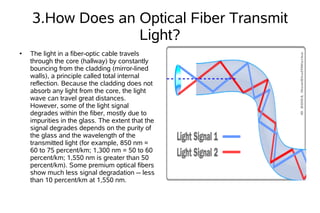
●   The light in a fiber-optic cable travels
    through the core (hallway) by constantly
    bouncing from the cladding (mirror-lined
    walls), a principle called total internal
    reflection. Because the cladding does not
    absorb any light from the core, the light
    wave can travel great distances.
    However, some of the light signal
    degrades within the fiber, mostly due to
    impurities in the glass. The extent that the
    signal degrades depends on the purity of
    the glass and the wavelength of the
    transmitted light (for example, 850 nm =
    60 to 75 percent/km; 1,300 nm = 50 to 60
    percent/km; 1,550 nm is greater than 50
    percent/km). Some premium optical fibers
    show much less signal degradation -- less
    than 10 percent/km at 1,550 nm.
4. A Fiber-Optic Relay System
●Fiber-optic relay systems
consist of the following:
●[Transmitter] - Produces and
encodes the light signals
● [Optical fiber] - Conducts the
light signals over a distance
●[Optical regenerator] - May be
necessary to boost the light
signal (for long distances)
●[Optical receiver] - Receives
and decodes the light signal
6. Advantages of Fiber Optics
  * Less expensive - Several miles of optical cable can be made cheaper than equivalent lengths of
copper wire. This saves your provider (cable TV, Internet) and you money.

  * Thinner - Optical fibers can be drawn to smaller diameters than copper wire.

  * Higher carrying capacity - Because optical fibers are thinner than copper wires, more fibers can be
bundled into a given-diameter cable than copper wires. This allows more phone lines to go over the
same cable or more channels to come through the cable into your cable TV box.

   * Light signals - Unlike electrical signals in copper wires, light signals from one fiber do not interfere
with those of other fibers in the same cable. This means clearer phone conversations or TV reception.

   * Low power - Because signals in optical fibers degrade less, lower-power transmitters can be used
instead of the high-voltage electrical transmitters needed for copper wires. Again, this saves your
provider and you money.

  * Digital signals - Optical fibers are ideally suited for carrying digital information, which is especially
useful in computer networks.

  * Non-flammable - Because no electricity is passed through optical fibers, there is no fire hazard.

  * Lightweight - An optical cable weighs less than a comparable copper wire cable. Fiber-optic
cables take up less space in the ground.

Week10 fiber optic

  • 1.
    How Fiber OpticsWork Week10 s1180014 Kuwana Keiko s1180009 Osada Takako
  • 2.
    1. Introduction toFiber Optics Work You hear about fiber-optic cables whenever people talk about the telephone system, the cable TV system or the Internet. Fiber-optic lines are strands of optically pure glass as thin as a human hair that carry digital information over long distances. They are also used in medical imaging and mechanical engineering inspection.
  • 3.
    2.What are FiberOptics? Fiber optics are long, thin strands of very pure glass about the diameter of a human hair. They are arranged in bundles called optical cables and used to transmit light signals over long distances. [Parts]: [Core] - Thin glass center of the fiber where the light travels [Cladding] - Outer optical material surrounding the core that reflects the light back into the core [Buffer coating] - Plastic coating that protects the fiber from damage and moisture Hundreds or thousands of these optical fibers are arranged in bundles in optical cables. The bundles are protected by the cable's outer covering, called a jacket.
  • 4.
    3.How Does anOptical Fiber Transmit Light? ● The light in a fiber-optic cable travels through the core (hallway) by constantly bouncing from the cladding (mirror-lined walls), a principle called total internal reflection. Because the cladding does not absorb any light from the core, the light wave can travel great distances. However, some of the light signal degrades within the fiber, mostly due to impurities in the glass. The extent that the signal degrades depends on the purity of the glass and the wavelength of the transmitted light (for example, 850 nm = 60 to 75 percent/km; 1,300 nm = 50 to 60 percent/km; 1,550 nm is greater than 50 percent/km). Some premium optical fibers show much less signal degradation -- less than 10 percent/km at 1,550 nm.
  • 5.
    4. A Fiber-OpticRelay System ●Fiber-optic relay systems consist of the following: ●[Transmitter] - Produces and encodes the light signals ● [Optical fiber] - Conducts the light signals over a distance ●[Optical regenerator] - May be necessary to boost the light signal (for long distances) ●[Optical receiver] - Receives and decodes the light signal
  • 6.
    6. Advantages ofFiber Optics * Less expensive - Several miles of optical cable can be made cheaper than equivalent lengths of copper wire. This saves your provider (cable TV, Internet) and you money. * Thinner - Optical fibers can be drawn to smaller diameters than copper wire. * Higher carrying capacity - Because optical fibers are thinner than copper wires, more fibers can be bundled into a given-diameter cable than copper wires. This allows more phone lines to go over the same cable or more channels to come through the cable into your cable TV box. * Light signals - Unlike electrical signals in copper wires, light signals from one fiber do not interfere with those of other fibers in the same cable. This means clearer phone conversations or TV reception. * Low power - Because signals in optical fibers degrade less, lower-power transmitters can be used instead of the high-voltage electrical transmitters needed for copper wires. Again, this saves your provider and you money. * Digital signals - Optical fibers are ideally suited for carrying digital information, which is especially useful in computer networks. * Non-flammable - Because no electricity is passed through optical fibers, there is no fire hazard. * Lightweight - An optical cable weighs less than a comparable copper wire cable. Fiber-optic cables take up less space in the ground.