Dr. Komal Parmar
22.12.16
Total number of Slides: 37
1
Pelvic Diaphragm
and Pudendal Canal
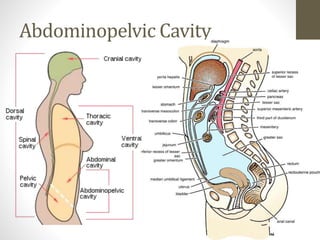
Abdominopelvic Cavity
2
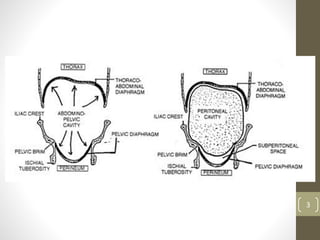
3
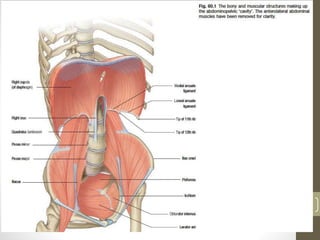
4
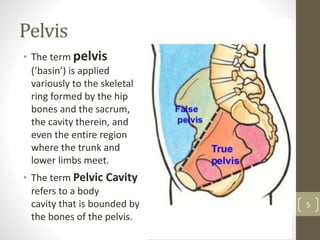
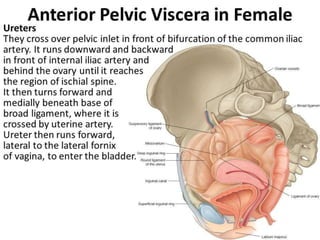
Pelvis
• The term pelvis
(‘basin’) is applied
variously to the skeletal
ring formed by the hip
bones and the sacrum,
the cavity therein, and
even the entire region
where the trunk and
lower limbs meet.
• The term Pelvic Cavity
refers to a body
cavity that is bounded by
the bones of the pelvis.
5
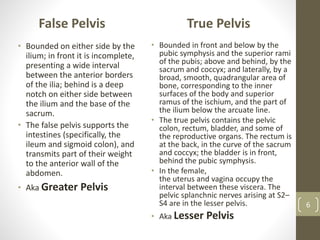
False Pelvis
• Bounded on either side by the
ilium; in front it is incomplete,
presenting a wide interval
between the anterior borders
of the ilia; behind is a deep
notch on either side between
the ilium and the base of the
sacrum.
• The false pelvis supports the
intestines (specifically, the
ileum and sigmoid colon), and
transmits part of their weight
to the anterior wall of the
abdomen.
• Aka Greater Pelvis
True Pelvis
• Bounded in front and below by the
pubic symphysis and the superior rami
of the pubis; above and behind, by the
sacrum and coccyx; and laterally, by a
broad, smooth, quadrangular area of
bone, corresponding to the inner
surfaces of the body and superior
ramus of the ischium, and the part of
the ilium below the arcuate line.
• The true pelvis contains the pelvic
colon, rectum, bladder, and some of
the reproductive organs. The rectum is
at the back, in the curve of the sacrum
and coccyx; the bladder is in front,
behind the pubic symphysis.
• In the female,
the uterus and vagina occupy the
interval between these viscera. The
pelvic splanchnic nerves arising at S2–
S4 are in the lesser pelvis.
• Aka Lesser Pelvis
6
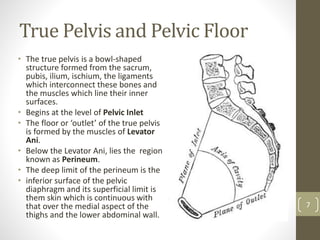
True Pelvis and Pelvic Floor
7
• The true pelvis is a bowl-shaped
structure formed from the sacrum,
pubis, ilium, ischium, the ligaments
which interconnect these bones and
the muscles which line their inner
surfaces.
• Begins at the level of Pelvic Inlet
• The floor or ‘outlet’ of the true pelvis
is formed by the muscles of Levator
Ani.
• Below the Levator Ani, lies the region
known as Perineum.
• The deep limit of the perineum is the
• inferior surface of the pelvic
diaphragm and its superficial limit is
them skin which is continuous with
that over the medial aspect of the
thighs and the lower abdominal wall.
8
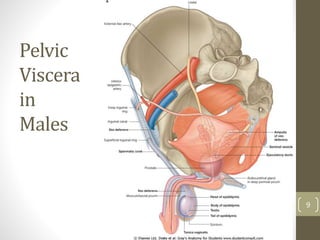
Pelvic
Viscera
in
Males
9
10
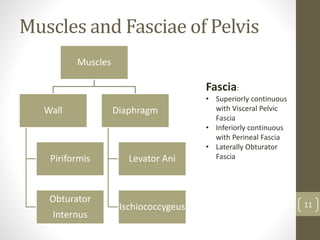
Muscles and Fasciae of Pelvis
Muscles
Wall
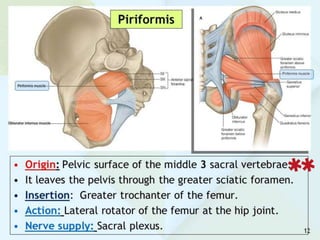
Piriformis
Obturator
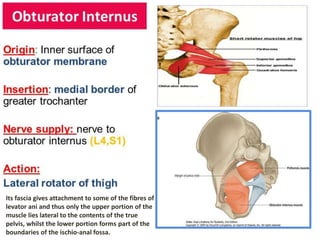
Internus
Diaphragm
Levator Ani
Ischiococcygeus 11
Fascia:
• Superiorly continuous
with Visceral Pelvic
Fascia
• Inferiorly continuous
with Perineal Fascia
• Laterally Obturator
Fascia
12
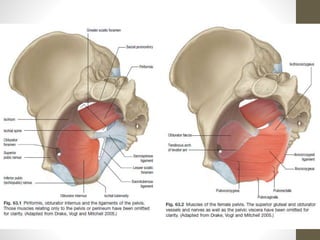
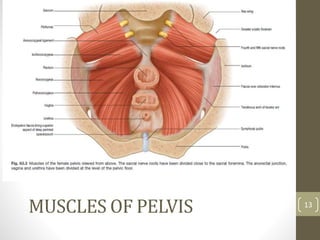
MUSCLES OF PELVIS 13
14
15
Its fascia gives attachment to some of the fibres of
levator ani and thus only the upper portion of the
muscle lies lateral to the contents of the true
pelvis, whilst the lower portion forms part of the
boundaries of the ischio-anal fossa.
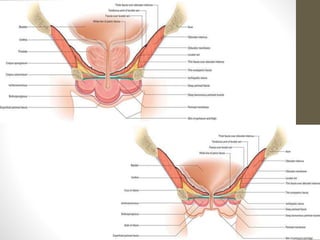
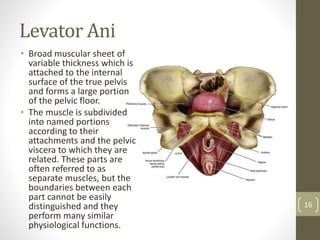
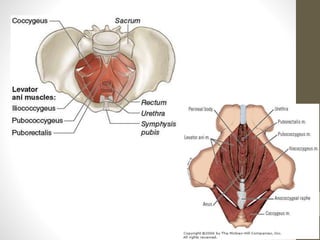
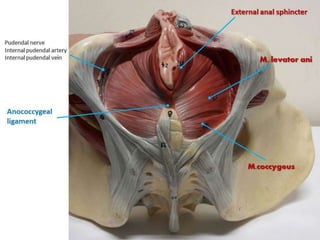
Levator Ani
• Broad muscular sheet of
variable thickness which is
attached to the internal
surface of the true pelvis
and forms a large portion
of the pelvic floor.
• The muscle is subdivided
into named portions
according to their
attachments and the pelvic
viscera to which they are
related. These parts are
often referred to as
separate muscles, but the
boundaries between each
part cannot be easily
distinguished and they
perform many similar
physiological functions.
16
17
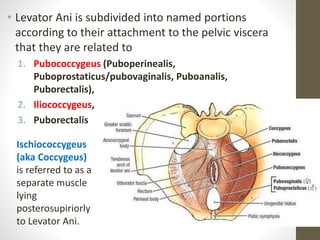
• Levator Ani is subdivided into named portions
according to their attachment to the pelvic viscera
that they are related to
1. Pubococcygeus (Puboperinealis,
Puboprostaticus/pubovaginalis, Puboanalis,
Puborectalis),
2. Iliococcygeus,
3. Puborectalis
18
Ischiococcygeus
(aka Coccygeus)
is referred to as a
separate muscle
lying
posterosupiriorly
to Levator Ani.
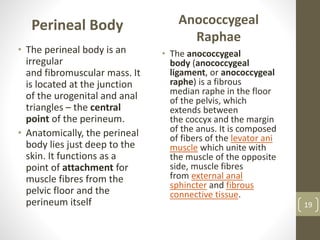
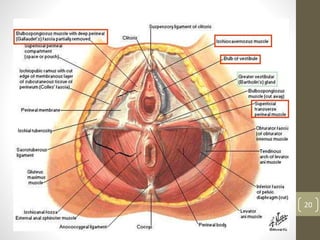
Perineal Body
• The perineal body is an
irregular
and fibromuscular mass. It
is located at the junction
of the urogenital and anal
triangles – the central
point of the perineum.
• Anatomically, the perineal
body lies just deep to the
skin. It functions as a
point of attachment for
muscle fibres from the
pelvic floor and the
perineum itself
Anococcygeal
Raphae
• The anococcygeal
body (anococcygeal
ligament, or anococcygeal
raphe) is a fibrous
median raphe in the floor
of the pelvis, which
extends between
the coccyx and the margin
of the anus. It is composed
of fibers of the levator ani
muscle which unite with
the muscle of the opposite
side, muscle fibres
from external anal
sphincter and fibrous
connective tissue.
19
20
21
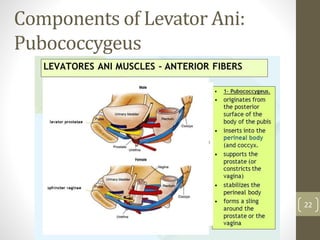
Components of Levator Ani:
Pubococcygeus
22
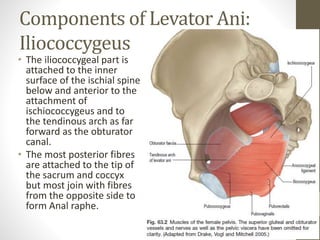
Components of Levator Ani:
Iliococcygeus
• The iliococcygeal part is
attached to the inner
surface of the ischial spine
below and anterior to the
attachment of
ischiococcygeus and to
the tendinous arch as far
forward as the obturator
canal.
• The most posterior fibres
are attached to the tip of
the sacrum and coccyx
but most join with fibres
from the opposite side to
form Anal raphe. 23
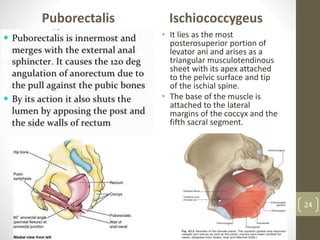
Puborectalis Ischiococcygeus
• It lies as the most
posterosuperior portion of
levator ani and arises as a
triangular musculotendinous
sheet with its apex attached
to the pelvic surface and tip
of the ischial spine.
• The base of the muscle is
attached to the lateral
margins of the coccyx and the
fifth sacral segment.
24
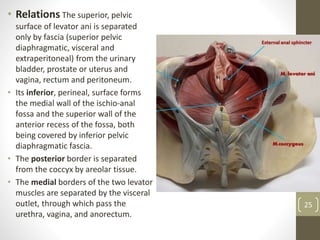
• Relations The superior, pelvic
surface of levator ani is separated
only by fascia (superior pelvic
diaphragmatic, visceral and
extraperitoneal) from the urinary
bladder, prostate or uterus and
vagina, rectum and peritoneum.
• Its inferior, perineal, surface forms
the medial wall of the ischio-anal
fossa and the superior wall of the
anterior recess of the fossa, both
being covered by inferior pelvic
diaphragmatic fascia.
• The posterior border is separated
from the coccyx by areolar tissue.
• The medial borders of the two levator
muscles are separated by the visceral
outlet, through which pass the
urethra, vagina, and anorectum.
25
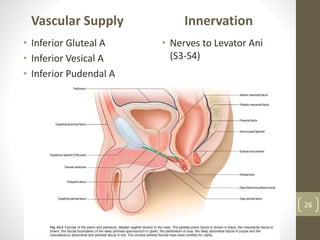
Vascular Supply
• Inferior Gluteal A
• Inferior Vesical A
• Inferior Pudendal A
Innervation
• Nerves to Levator Ani
(S3-S4)
26
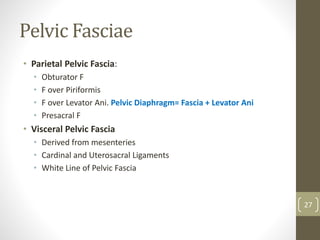
Pelvic Fasciae
• Parietal Pelvic Fascia:
• Obturator F
• F over Piriformis
• F over Levator Ani. Pelvic Diaphragm= Fascia + Levator Ani
• Presacral F
• Visceral Pelvic Fascia
• Derived from mesenteries
• Cardinal and Uterosacral Ligaments
• White Line of Pelvic Fascia
27
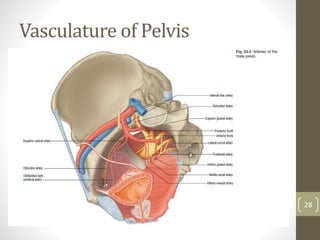
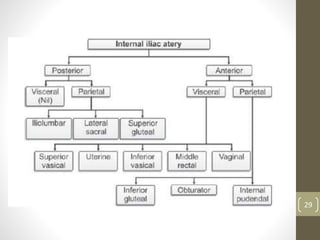
Vasculature of Pelvis
28
29
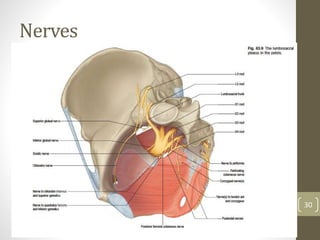
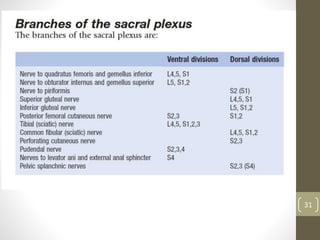
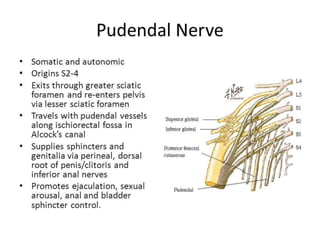
Nerves
30
31
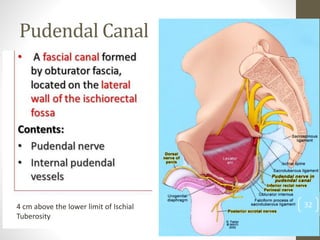
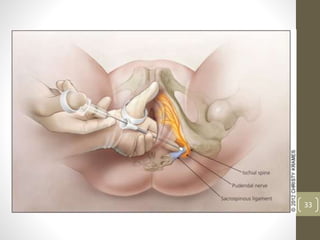
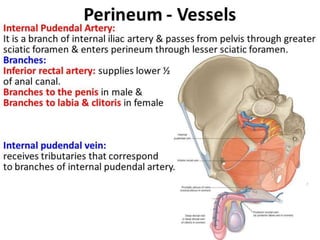
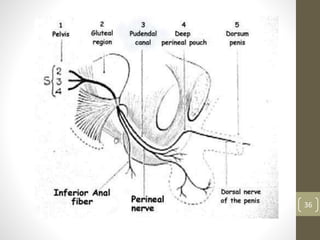
Pudendal Canal
324 cm above the lower limit of Ischial
Tuberosity
33
34
35
36
37

Pelvic Diaphragm

  • 1.
    Dr. Komal Parmar 22.12.16 Totalnumber of Slides: 37 1 Pelvic Diaphragm and Pudendal Canal
  • 2.
  • 3.
  • 4.
  • 5.
    Pelvis • The termpelvis (‘basin’) is applied variously to the skeletal ring formed by the hip bones and the sacrum, the cavity therein, and even the entire region where the trunk and lower limbs meet. • The term Pelvic Cavity refers to a body cavity that is bounded by the bones of the pelvis. 5
  • 6.
    False Pelvis • Boundedon either side by the ilium; in front it is incomplete, presenting a wide interval between the anterior borders of the ilia; behind is a deep notch on either side between the ilium and the base of the sacrum. • The false pelvis supports the intestines (specifically, the ileum and sigmoid colon), and transmits part of their weight to the anterior wall of the abdomen. • Aka Greater Pelvis True Pelvis • Bounded in front and below by the pubic symphysis and the superior rami of the pubis; above and behind, by the sacrum and coccyx; and laterally, by a broad, smooth, quadrangular area of bone, corresponding to the inner surfaces of the body and superior ramus of the ischium, and the part of the ilium below the arcuate line. • The true pelvis contains the pelvic colon, rectum, bladder, and some of the reproductive organs. The rectum is at the back, in the curve of the sacrum and coccyx; the bladder is in front, behind the pubic symphysis. • In the female, the uterus and vagina occupy the interval between these viscera. The pelvic splanchnic nerves arising at S2– S4 are in the lesser pelvis. • Aka Lesser Pelvis 6
  • 7.
    True Pelvis andPelvic Floor 7 • The true pelvis is a bowl-shaped structure formed from the sacrum, pubis, ilium, ischium, the ligaments which interconnect these bones and the muscles which line their inner surfaces. • Begins at the level of Pelvic Inlet • The floor or ‘outlet’ of the true pelvis is formed by the muscles of Levator Ani. • Below the Levator Ani, lies the region known as Perineum. • The deep limit of the perineum is the • inferior surface of the pelvic diaphragm and its superficial limit is them skin which is continuous with that over the medial aspect of the thighs and the lower abdominal wall.
  • 8.
  • 9.
  • 10.
  • 11.
    Muscles and Fasciaeof Pelvis Muscles Wall Piriformis Obturator Internus Diaphragm Levator Ani Ischiococcygeus 11 Fascia: • Superiorly continuous with Visceral Pelvic Fascia • Inferiorly continuous with Perineal Fascia • Laterally Obturator Fascia
  • 12.
  • 13.
  • 14.
  • 15.
    15 Its fascia givesattachment to some of the fibres of levator ani and thus only the upper portion of the muscle lies lateral to the contents of the true pelvis, whilst the lower portion forms part of the boundaries of the ischio-anal fossa.
  • 16.
    Levator Ani • Broadmuscular sheet of variable thickness which is attached to the internal surface of the true pelvis and forms a large portion of the pelvic floor. • The muscle is subdivided into named portions according to their attachments and the pelvic viscera to which they are related. These parts are often referred to as separate muscles, but the boundaries between each part cannot be easily distinguished and they perform many similar physiological functions. 16
  • 17.
  • 18.
    • Levator Aniis subdivided into named portions according to their attachment to the pelvic viscera that they are related to 1. Pubococcygeus (Puboperinealis, Puboprostaticus/pubovaginalis, Puboanalis, Puborectalis), 2. Iliococcygeus, 3. Puborectalis 18 Ischiococcygeus (aka Coccygeus) is referred to as a separate muscle lying posterosupiriorly to Levator Ani.
  • 19.
    Perineal Body • Theperineal body is an irregular and fibromuscular mass. It is located at the junction of the urogenital and anal triangles – the central point of the perineum. • Anatomically, the perineal body lies just deep to the skin. It functions as a point of attachment for muscle fibres from the pelvic floor and the perineum itself Anococcygeal Raphae • The anococcygeal body (anococcygeal ligament, or anococcygeal raphe) is a fibrous median raphe in the floor of the pelvis, which extends between the coccyx and the margin of the anus. It is composed of fibers of the levator ani muscle which unite with the muscle of the opposite side, muscle fibres from external anal sphincter and fibrous connective tissue. 19
  • 20.
  • 21.
  • 22.
    Components of LevatorAni: Pubococcygeus 22
  • 23.
    Components of LevatorAni: Iliococcygeus • The iliococcygeal part is attached to the inner surface of the ischial spine below and anterior to the attachment of ischiococcygeus and to the tendinous arch as far forward as the obturator canal. • The most posterior fibres are attached to the tip of the sacrum and coccyx but most join with fibres from the opposite side to form Anal raphe. 23
  • 24.
    Puborectalis Ischiococcygeus • Itlies as the most posterosuperior portion of levator ani and arises as a triangular musculotendinous sheet with its apex attached to the pelvic surface and tip of the ischial spine. • The base of the muscle is attached to the lateral margins of the coccyx and the fifth sacral segment. 24
  • 25.
    • Relations Thesuperior, pelvic surface of levator ani is separated only by fascia (superior pelvic diaphragmatic, visceral and extraperitoneal) from the urinary bladder, prostate or uterus and vagina, rectum and peritoneum. • Its inferior, perineal, surface forms the medial wall of the ischio-anal fossa and the superior wall of the anterior recess of the fossa, both being covered by inferior pelvic diaphragmatic fascia. • The posterior border is separated from the coccyx by areolar tissue. • The medial borders of the two levator muscles are separated by the visceral outlet, through which pass the urethra, vagina, and anorectum. 25
  • 26.
    Vascular Supply • InferiorGluteal A • Inferior Vesical A • Inferior Pudendal A Innervation • Nerves to Levator Ani (S3-S4) 26
  • 27.
    Pelvic Fasciae • ParietalPelvic Fascia: • Obturator F • F over Piriformis • F over Levator Ani. Pelvic Diaphragm= Fascia + Levator Ani • Presacral F • Visceral Pelvic Fascia • Derived from mesenteries • Cardinal and Uterosacral Ligaments • White Line of Pelvic Fascia 27
  • 28.
  • 29.
  • 30.
  • 31.
  • 32.
    Pudendal Canal 324 cmabove the lower limit of Ischial Tuberosity
  • 33.
  • 34.
  • 35.
  • 36.
  • 37.