FEISTEL CIPHER
Unraveling the Secrets of Secure Encryption
BY - JIYA DARIYANI
BCA IIIrd YEAR
INDEX:
 Introduction to Feistel Cipher
 The Feistel Cipher Structure
 Advantages of Feistel Cipher
 Weaknesses of Feistel Cipher
 Applications of Feistel Cipher
 Conclusion
Introduction to Feistel Cipher
Feistel cipher is a symmetric encryption algorithm that
was developed by Horst Feistel in the early 1970s. It is
widely used in many cryptographic applications such as
electronic payment systems, secure communication
protocols, and data storage.
The Feistel cipher uses a combination of substitution and
permutation operations to encrypt plaintext into
ciphertext. The plaintext is divided into two halves, which
are then subjected to a series of rounds of encryption and
decryption using a secret key.
The Feistel Cipher Structure
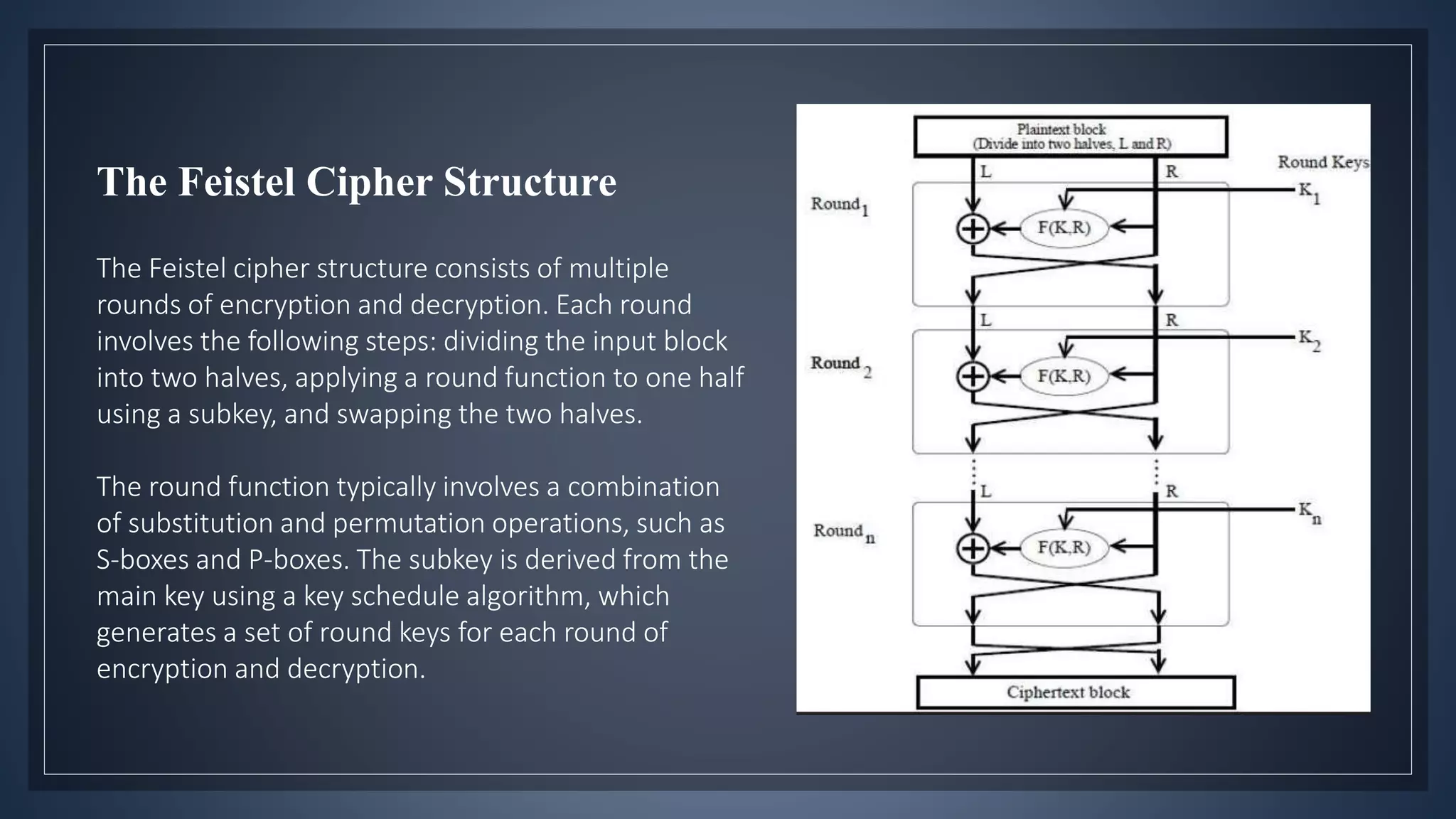
The Feistel cipher structure consists of multiple
rounds of encryption and decryption. Each round
involves the following steps: dividing the input block
into two halves, applying a round function to one half
using a subkey, and swapping the two halves.
The round function typically involves a combination
of substitution and permutation operations, such as
S-boxes and P-boxes. The subkey is derived from the
main key using a key schedule algorithm, which
generates a set of round keys for each round of
encryption and decryption.
Advantages of Feistel Cipher
One of the main advantages of the Feistel cipher is
its simplicity and efficiency. The encryption and
decryption operations are easy to implement and
require only basic arithmetic and logical operations.
Another advantage is its resistance to differential
and linear cryptanalysis attacks. These attacks are
commonly used to break other encryption
algorithms, but the Feistel cipher has been proven
to be resistant to them.
Weaknesses of Feistel Cipher
Although the Feistel cipher is generally considered
to be a strong encryption algorithm, it does have
some weaknesses. One weakness is its vulnerability
to brute force attacks, where an attacker tries all
possible keys until the correct one is found.
Another weakness is its susceptibility to side-
channel attacks, where an attacker can gain
information about the key or plaintext by observing
the physical characteristics of the system, such as
power consumption or electromagnetic radiation.
Applications of Feistel Cipher
The Feistel cipher is widely used in many cryptographic
applications, such as electronic payment systems, secure
communication protocols, and data storage. It is also
used in popular encryption standards such as DES, Triple
DES, and Blowfish.
In addition, the Feistel cipher has been adapted for use
in other areas such as image and audio encryption,
where it is used to protect sensitive digital content from
unauthorized access.
Conclusion
In conclusion, the Feistel cipher is a powerful
and widely used encryption algorithm that
provides strong security for many applications.
Its simple structure and resistance to certain
types of attacks make it an attractive choice for
many developers and users.
However, it is important to be aware of its
weaknesses and potential vulnerabilities, and
to implement appropriate safeguards to
protect against these threats.
THANKYOU

Feistel Cipher.pptx

  • 1.
    FEISTEL CIPHER Unraveling theSecrets of Secure Encryption BY - JIYA DARIYANI BCA IIIrd YEAR
  • 2.
    INDEX:  Introduction toFeistel Cipher  The Feistel Cipher Structure  Advantages of Feistel Cipher  Weaknesses of Feistel Cipher  Applications of Feistel Cipher  Conclusion
  • 3.
    Introduction to FeistelCipher Feistel cipher is a symmetric encryption algorithm that was developed by Horst Feistel in the early 1970s. It is widely used in many cryptographic applications such as electronic payment systems, secure communication protocols, and data storage. The Feistel cipher uses a combination of substitution and permutation operations to encrypt plaintext into ciphertext. The plaintext is divided into two halves, which are then subjected to a series of rounds of encryption and decryption using a secret key.
  • 4.
    The Feistel CipherStructure The Feistel cipher structure consists of multiple rounds of encryption and decryption. Each round involves the following steps: dividing the input block into two halves, applying a round function to one half using a subkey, and swapping the two halves. The round function typically involves a combination of substitution and permutation operations, such as S-boxes and P-boxes. The subkey is derived from the main key using a key schedule algorithm, which generates a set of round keys for each round of encryption and decryption.
  • 5.
    Advantages of FeistelCipher One of the main advantages of the Feistel cipher is its simplicity and efficiency. The encryption and decryption operations are easy to implement and require only basic arithmetic and logical operations. Another advantage is its resistance to differential and linear cryptanalysis attacks. These attacks are commonly used to break other encryption algorithms, but the Feistel cipher has been proven to be resistant to them.
  • 6.
    Weaknesses of FeistelCipher Although the Feistel cipher is generally considered to be a strong encryption algorithm, it does have some weaknesses. One weakness is its vulnerability to brute force attacks, where an attacker tries all possible keys until the correct one is found. Another weakness is its susceptibility to side- channel attacks, where an attacker can gain information about the key or plaintext by observing the physical characteristics of the system, such as power consumption or electromagnetic radiation.
  • 7.
    Applications of FeistelCipher The Feistel cipher is widely used in many cryptographic applications, such as electronic payment systems, secure communication protocols, and data storage. It is also used in popular encryption standards such as DES, Triple DES, and Blowfish. In addition, the Feistel cipher has been adapted for use in other areas such as image and audio encryption, where it is used to protect sensitive digital content from unauthorized access.
  • 8.
    Conclusion In conclusion, theFeistel cipher is a powerful and widely used encryption algorithm that provides strong security for many applications. Its simple structure and resistance to certain types of attacks make it an attractive choice for many developers and users. However, it is important to be aware of its weaknesses and potential vulnerabilities, and to implement appropriate safeguards to protect against these threats.
  • 9.