Information Security
Week 4
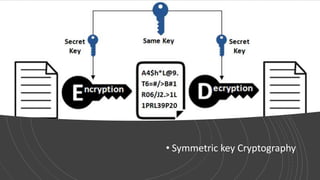
• Symmetric key Cryptography
Feistel Cipher
• Feistel Cipher is not a specific scheme of block cipher. It is a design
model from which many different block ciphers are derived. DES is
just one example of a Feistel Cipher. A cryptographic system based on
Feistel cipher structure uses the same algorithm for both encryption
and decryption.
Encryption Process
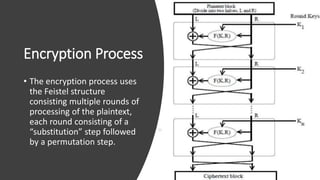
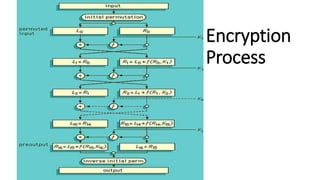
• The encryption process uses
the Feistel structure
consisting multiple rounds of
processing of the plaintext,
each round consisting of a
“substitution” step followed
by a permutation step.
Encryption
Process
Encryption Process
• The input block to each round is divided into two halves that can be
denoted as L and R for the left half and the right half.
• In each round, the right half of the block, R, goes through unchanged. But
the left half, L, goes through an operation that depends on R and the
encryption key. First, we apply an encrypting function ‘f’ that takes two
input − the key K and R. The function produces the output f(R,K). Then, we
XOR the output of the mathematical function with L.
• In real implementation of the Feistel Cipher, such as DES, instead of using
the whole encryption key during each round, a round-dependent key (a
subkey) is derived from the encryption key. This means that each round
uses a different key, although all these subkeys are related to the original
key.
Encryption Process
• The permutation step at the end of each round swaps the modified L and
unmodified R. Therefore, the L for the next round would be R of the
current round. And R for the next round be the output L of the current
round.
• Above substitution and permutation steps form a ‘round’. The number of
rounds are specified by the algorithm design.
• Once the last round is completed then the two sub blocks, ‘R’ and ‘L’ are
concatenated in this order to form the ciphertext block.
• The difficult part of designing a Feistel Cipher is selection of round function
‘f’. In order to be unbreakable scheme, this function needs to have several
important properties that are beyond the scope of our discussion.
Decryption Process
• The process of decryption in Feistel cipher is almost similar. Instead of
starting with a block of plaintext, the ciphertext block is fed into the
start of the Feistel structure and then the process thereafter is exactly
the same as described in the given illustration.
• The process is said to be almost similar and not exactly same. In the
case of decryption, the only difference is that the subkeys used in
encryption are used in the reverse order.
• The final swapping of ‘L’ and ‘R’ in last step of the Feistel Cipher is
essential. If these are not swapped then the resulting ciphertext could
not be decrypted using the same algorithm.
Number of Rounds
• The number of rounds used in a Feistel Cipher depends on desired
security from the system. More number of rounds provide more
secure system. But at the same time, more rounds mean the
inefficient slow encryption and decryption processes. Number of
rounds in the systems thus depend upon efficiency–security tradeoff.
Data Encryption
Standard
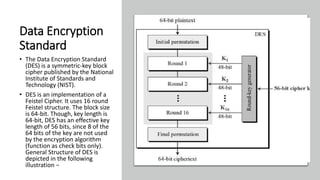
• The Data Encryption Standard
(DES) is a symmetric-key block
cipher published by the National
Institute of Standards and
Technology (NIST).
• DES is an implementation of a
Feistel Cipher. It uses 16 round
Feistel structure. The block size
is 64-bit. Though, key length is
64-bit, DES has an effective key
length of 56 bits, since 8 of the
64 bits of the key are not used
by the encryption algorithm
(function as check bits only).
General Structure of DES is
depicted in the following
illustration −
Data Encryption Standard
• Since DES is based on the Feistel Cipher, all that is required to specify
DES is −
• Round function
• Key schedule
• Any additional processing − Initial and final permutation
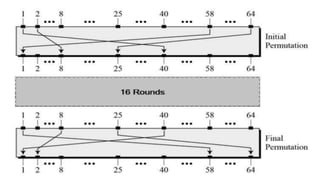
Initial and Final Permutation
• The initial and final permutations are straight Permutation boxes (P-
boxes) that are inverses of each other. They have no cryptography
significance in DES. The initial and final permutations are shown as
follows −
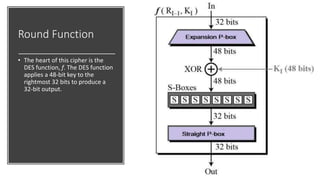
Round Function
• The heart of this cipher is the
DES function, f. The DES function
applies a 48-bit key to the
rightmost 32 bits to produce a
32-bit output.
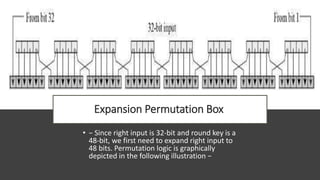
Expansion Permutation Box
• − Since right input is 32-bit and round key is a
48-bit, we first need to expand right input to
48 bits. Permutation logic is graphically
depicted in the following illustration −
• XOR (Whitener). − After the expansion permutation, DES does XOR
operation on the expanded right section and the round key. The
round key is used only in this operation.
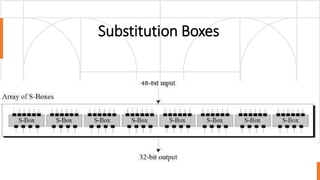
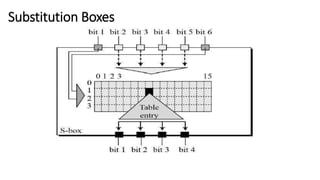
• Substitution Boxes. − The S-boxes carry out the real mixing
(confusion). DES uses 8 S-boxes, each with a 6-bit input and a 4-bit
output. Refer the following illustration −
Substitution Boxes
Substitution Boxes
• There are a total of eight S-box tables. The output of all eight s-boxes
is then combined in to 32 bit section.
• Straight Permutation − The 32 bit output of S-boxes is then subjected
to the straight permutation.
Key Generation
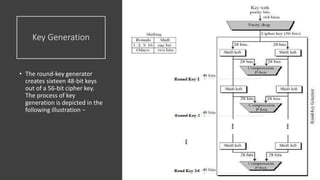
• The round-key generator
creates sixteen 48-bit keys
out of a 56-bit cipher key.
The process of key
generation is depicted in the
following illustration −
DES Analysis
• The DES satisfies both the desired properties of block cipher. These two
properties make cipher very strong.
• Avalanche effect − A small change in plaintext results in the very great
change in the ciphertext.
• Completeness − Each bit of ciphertext depends on many bits of plaintext.
• During the last few years, cryptanalysis have found some weaknesses in
DES when key selected are weak keys. These keys shall be avoided.
• DES has proved to be a very well designed block cipher. There have been
no significant cryptanalytic attacks on DES other than exhaustive key
search.

information security(Feistal Cipher)

  • 1.
  • 2.
    • Symmetric keyCryptography
  • 3.
    Feistel Cipher • FeistelCipher is not a specific scheme of block cipher. It is a design model from which many different block ciphers are derived. DES is just one example of a Feistel Cipher. A cryptographic system based on Feistel cipher structure uses the same algorithm for both encryption and decryption.
  • 4.
    Encryption Process • Theencryption process uses the Feistel structure consisting multiple rounds of processing of the plaintext, each round consisting of a “substitution” step followed by a permutation step.
  • 5.
  • 6.
    Encryption Process • Theinput block to each round is divided into two halves that can be denoted as L and R for the left half and the right half. • In each round, the right half of the block, R, goes through unchanged. But the left half, L, goes through an operation that depends on R and the encryption key. First, we apply an encrypting function ‘f’ that takes two input − the key K and R. The function produces the output f(R,K). Then, we XOR the output of the mathematical function with L. • In real implementation of the Feistel Cipher, such as DES, instead of using the whole encryption key during each round, a round-dependent key (a subkey) is derived from the encryption key. This means that each round uses a different key, although all these subkeys are related to the original key.
  • 7.
    Encryption Process • Thepermutation step at the end of each round swaps the modified L and unmodified R. Therefore, the L for the next round would be R of the current round. And R for the next round be the output L of the current round. • Above substitution and permutation steps form a ‘round’. The number of rounds are specified by the algorithm design. • Once the last round is completed then the two sub blocks, ‘R’ and ‘L’ are concatenated in this order to form the ciphertext block. • The difficult part of designing a Feistel Cipher is selection of round function ‘f’. In order to be unbreakable scheme, this function needs to have several important properties that are beyond the scope of our discussion.
  • 8.
    Decryption Process • Theprocess of decryption in Feistel cipher is almost similar. Instead of starting with a block of plaintext, the ciphertext block is fed into the start of the Feistel structure and then the process thereafter is exactly the same as described in the given illustration. • The process is said to be almost similar and not exactly same. In the case of decryption, the only difference is that the subkeys used in encryption are used in the reverse order. • The final swapping of ‘L’ and ‘R’ in last step of the Feistel Cipher is essential. If these are not swapped then the resulting ciphertext could not be decrypted using the same algorithm.
  • 9.
    Number of Rounds •The number of rounds used in a Feistel Cipher depends on desired security from the system. More number of rounds provide more secure system. But at the same time, more rounds mean the inefficient slow encryption and decryption processes. Number of rounds in the systems thus depend upon efficiency–security tradeoff.
  • 10.
    Data Encryption Standard • TheData Encryption Standard (DES) is a symmetric-key block cipher published by the National Institute of Standards and Technology (NIST). • DES is an implementation of a Feistel Cipher. It uses 16 round Feistel structure. The block size is 64-bit. Though, key length is 64-bit, DES has an effective key length of 56 bits, since 8 of the 64 bits of the key are not used by the encryption algorithm (function as check bits only). General Structure of DES is depicted in the following illustration −
  • 11.
    Data Encryption Standard •Since DES is based on the Feistel Cipher, all that is required to specify DES is − • Round function • Key schedule • Any additional processing − Initial and final permutation
  • 12.
    Initial and FinalPermutation • The initial and final permutations are straight Permutation boxes (P- boxes) that are inverses of each other. They have no cryptography significance in DES. The initial and final permutations are shown as follows −
  • 14.
    Round Function • Theheart of this cipher is the DES function, f. The DES function applies a 48-bit key to the rightmost 32 bits to produce a 32-bit output.
  • 15.
    Expansion Permutation Box •− Since right input is 32-bit and round key is a 48-bit, we first need to expand right input to 48 bits. Permutation logic is graphically depicted in the following illustration −
  • 16.
    • XOR (Whitener).− After the expansion permutation, DES does XOR operation on the expanded right section and the round key. The round key is used only in this operation. • Substitution Boxes. − The S-boxes carry out the real mixing (confusion). DES uses 8 S-boxes, each with a 6-bit input and a 4-bit output. Refer the following illustration −
  • 17.
  • 18.
  • 19.
    • There area total of eight S-box tables. The output of all eight s-boxes is then combined in to 32 bit section. • Straight Permutation − The 32 bit output of S-boxes is then subjected to the straight permutation.
  • 20.
    Key Generation • Theround-key generator creates sixteen 48-bit keys out of a 56-bit cipher key. The process of key generation is depicted in the following illustration −
  • 21.
    DES Analysis • TheDES satisfies both the desired properties of block cipher. These two properties make cipher very strong. • Avalanche effect − A small change in plaintext results in the very great change in the ciphertext. • Completeness − Each bit of ciphertext depends on many bits of plaintext. • During the last few years, cryptanalysis have found some weaknesses in DES when key selected are weak keys. These keys shall be avoided. • DES has proved to be a very well designed block cipher. There have been no significant cryptanalytic attacks on DES other than exhaustive key search.