Better
Fearless Feedback for
Software Teams
@eacarlson
Hello!
• Hi! I’m Erika.
• (I’m @eacarlson, too.)
• I’m a software developer.
• I work at Detroit Labs in Detroit,
Michigan.
• I train and coach software developers.
Introduction
• What is feedback?
• Why is feedback important to teams?
• Why do teams struggle with giving and
receiving feedback?
• How do we get better at feedback?
• How do I know?
@eacarlson
What is Feedback?
• A response to a person’s behavior
and/or performance, shared with the
person for the purposes of:
• Increasing his/her awareness
• Shaping his/her behavior
@eacarlson
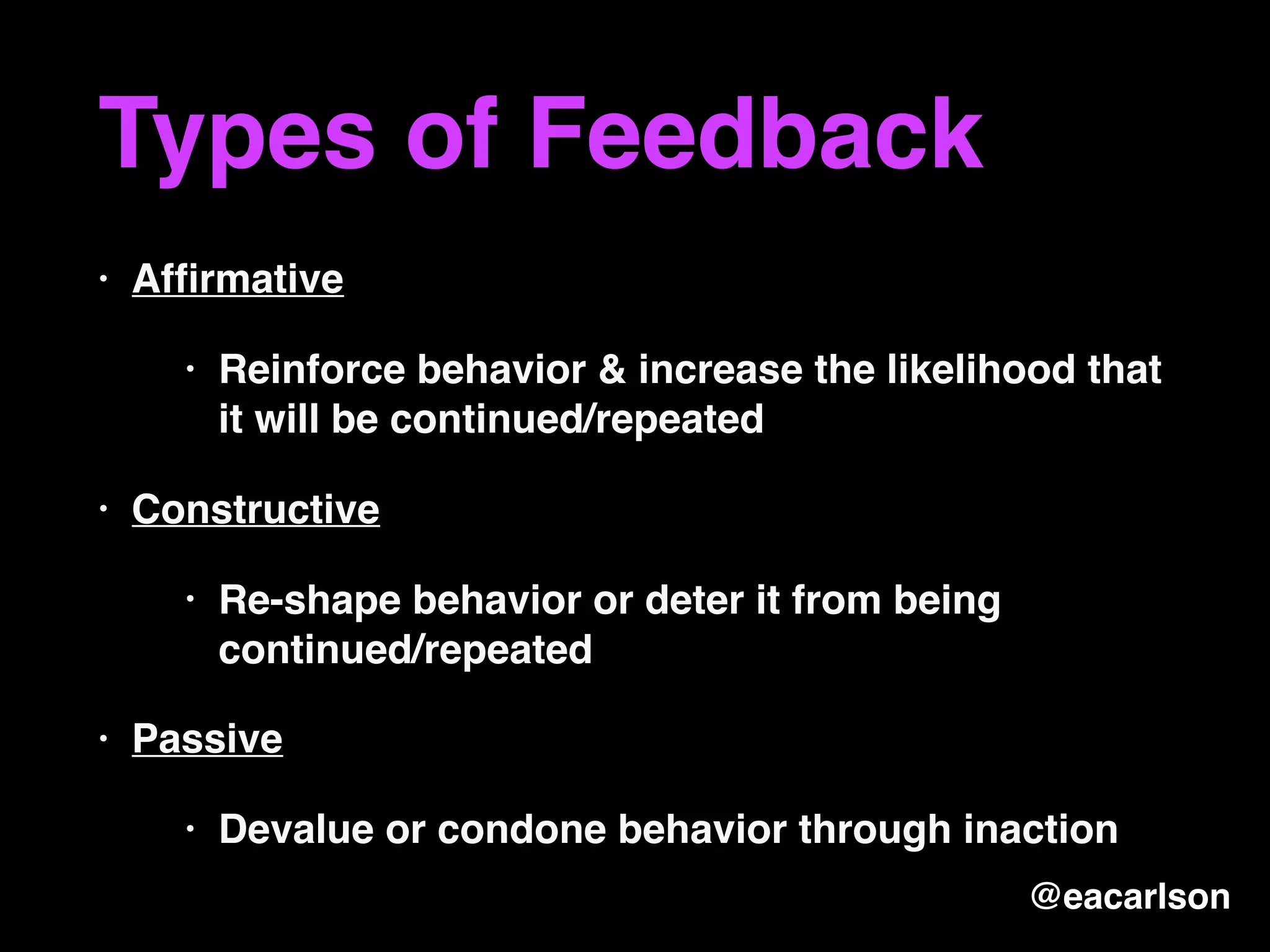
Types of Feedback
• Affirmative
• Reinforce behavior & increase the likelihood that
it will be continued/repeated
• Constructive
• Re-shape behavior or deter it from being
continued/repeated
• Passive
• Devalue or condone behavior through inaction
@eacarlson
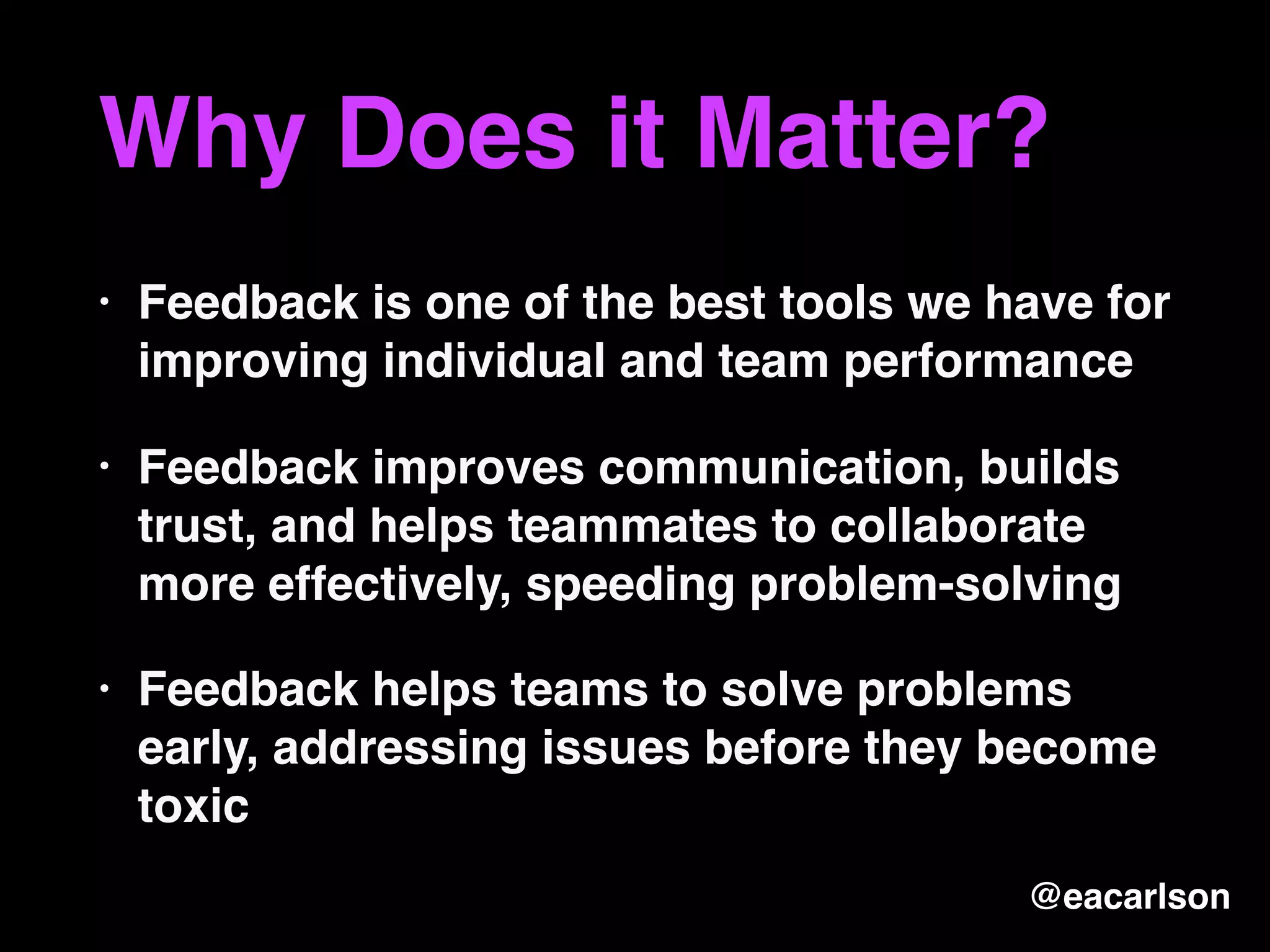
Why Does it Matter?
• Feedback is one of the best tools we have for
improving individual and team performance
• Feedback improves communication, builds
trust, and helps teammates to collaborate
more effectively, speeding problem-solving
• Feedback helps teams to solve problems
early, addressing issues before they become
toxic
@eacarlson
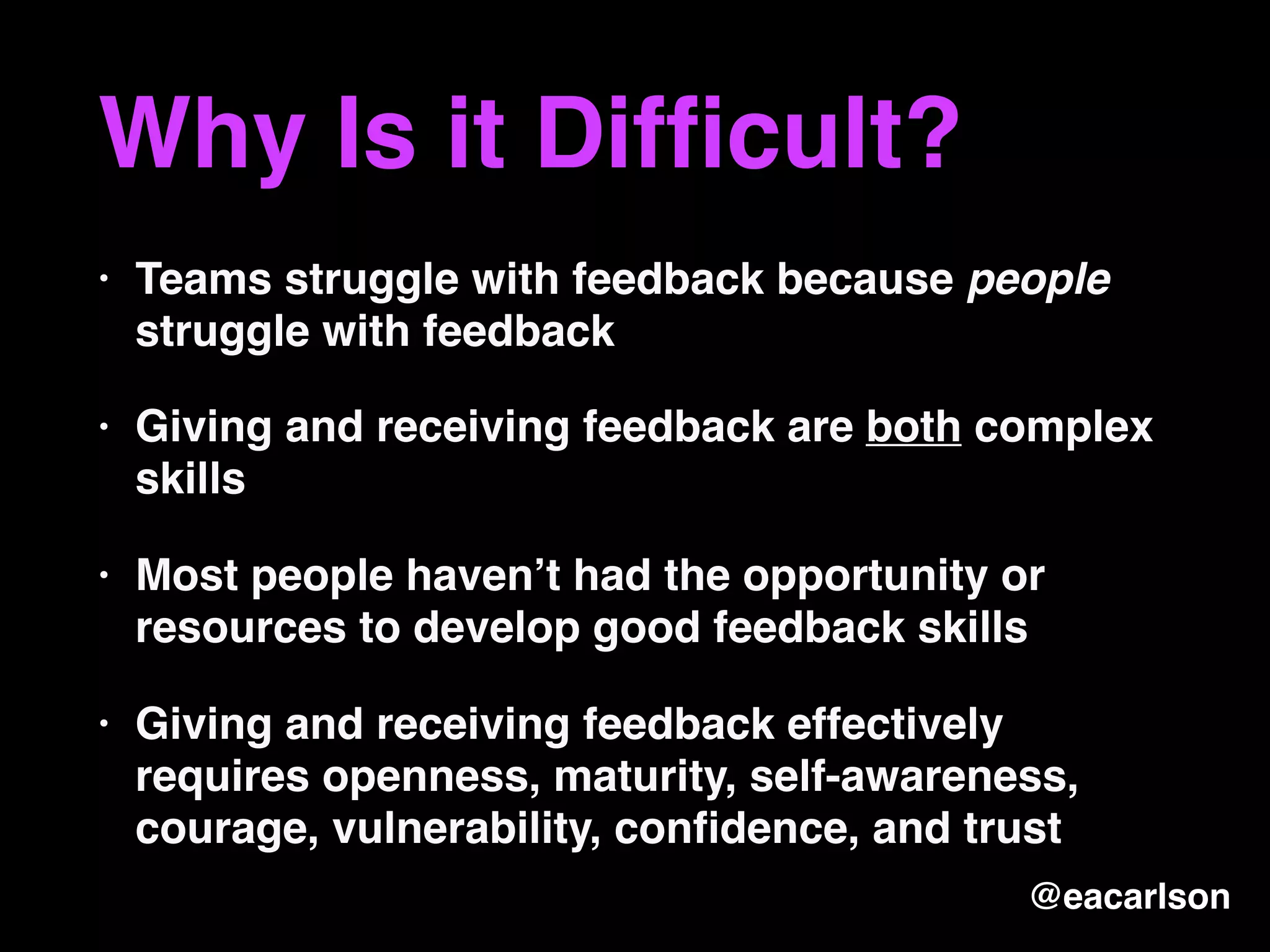
Why Is it Difficult?
• Teams struggle with feedback because people
struggle with feedback
• Giving and receiving feedback are both complex
skills
• Most people haven’t had the opportunity or
resources to develop good feedback skills
• Giving and receiving feedback effectively
requires openness, maturity, self-awareness,
courage, vulnerability, confidence, and trust
@eacarlson
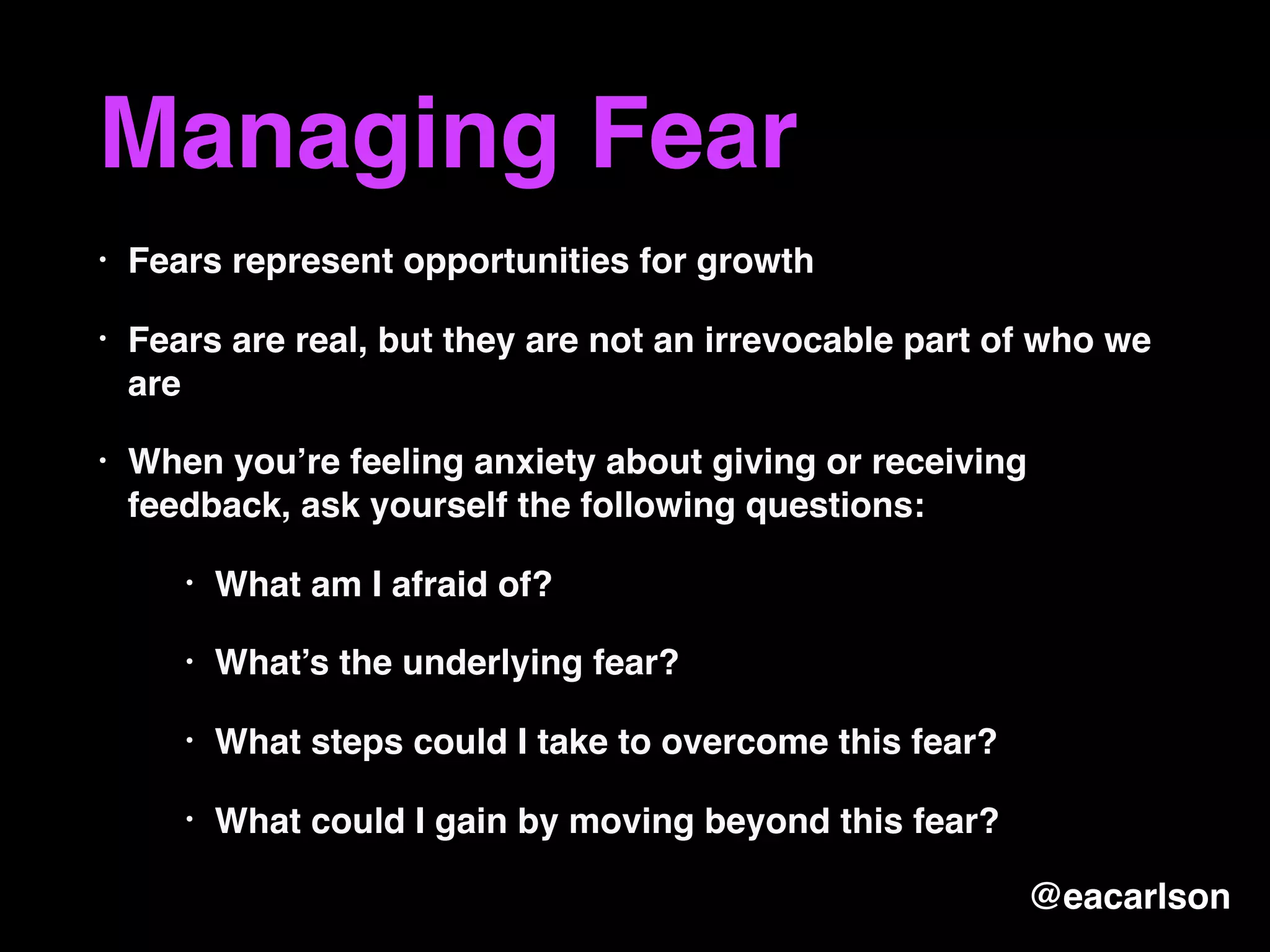
Managing Fear
• Fears represent opportunities for growth
• Fears are real, but they are not an irrevocable part of who we
are
• When you’re feeling anxiety about giving or receiving
feedback, ask yourself the following questions:
• What am I afraid of?
• What’s the underlying fear?
• What steps could I take to overcome this fear?
• What could I gain by moving beyond this fear?
@eacarlson
Feedback 101
• Be specific, thoughtful, and direct
• Structure: Situation, Behavior, Impact
• In (SITUATION), when you did (BEHAVIOR), the outcome
was (IMPACT).
• Example (Affirmative): “On today’s phone call, when you
praised our demo, the team was inspired and motivated to
repeat that success.”
• Example (Constructive): “In yesterday’s client meeting,
when you interrupted and talked over me, I felt frustrated
and hurt.”
@eacarlson
1. Listen actively.
• While you are receiving feedback, listen
intentionally
• Listen to listen, not to respond
• Be conscious of your body language
• If you are receiving constructive feedback, it may
be helpful to confirm understanding: “What I’m
hearing you say is that it’s disruptive to you
when I drop by your desk without asking first,
and that’s making you feel frustrated.”
@eacarlson
2. Say “Thank you.”
• Accept positive feedback graciously,
without denying or minimizing
• Say “Thank you.”
• Accept constructive feedback without
arguing, pushing back, or getting
defensive
• Say “Thank you for the feedback.”
@eacarlson
3. Respond (later).
• When you receive constructive feedback,
take some time to assess your emotions
• Try to complete this sentence: “I feel
_____ about this feedback”
• Sit with the feedback until you feel less
emotional about it
• Decide if and how to act
@eacarlson
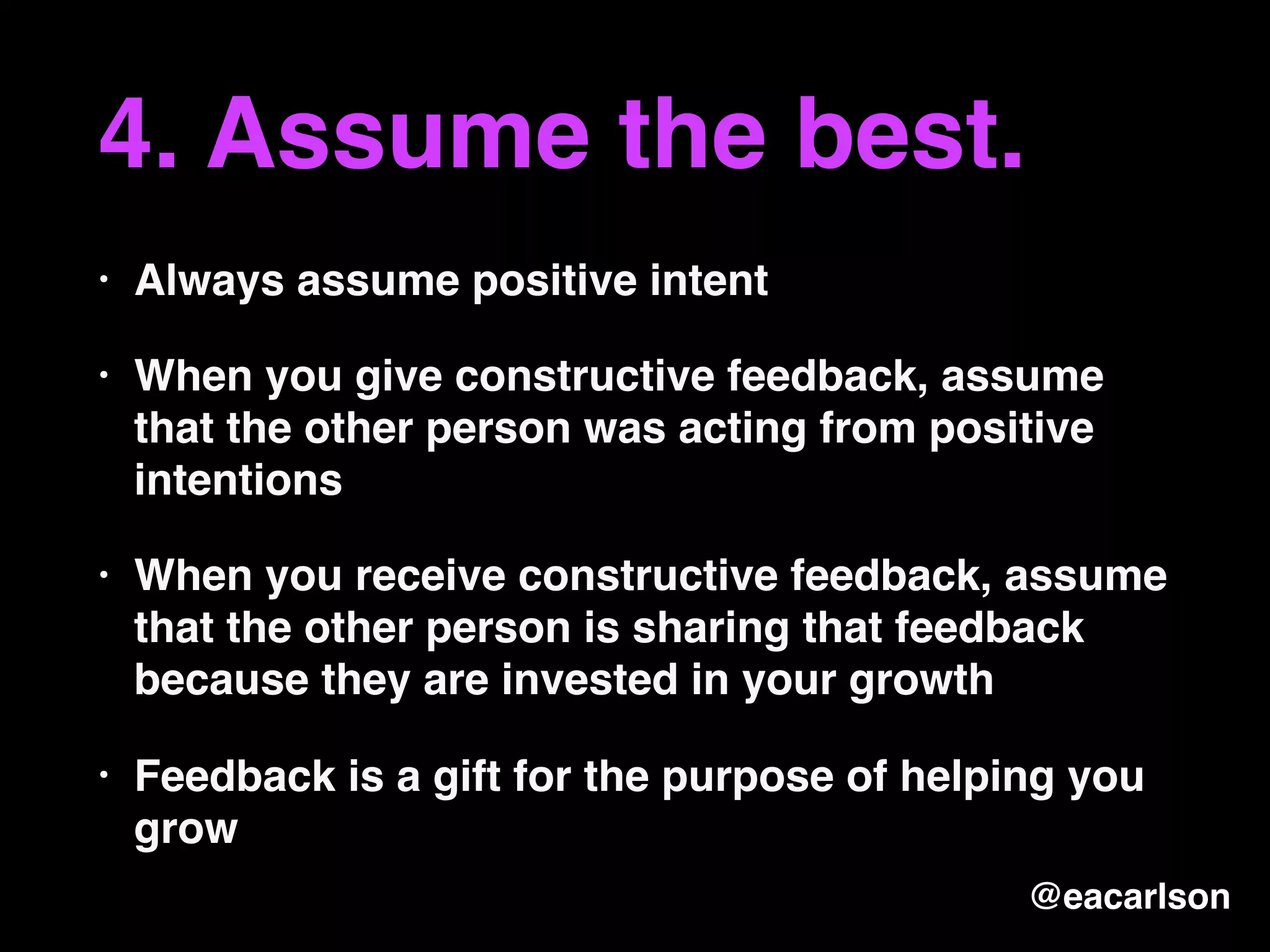
4. Assume the best.
• Always assume positive intent
• When you give constructive feedback, assume
that the other person was acting from positive
intentions
• When you receive constructive feedback, assume
that the other person is sharing that feedback
because they are invested in your growth
• Feedback is a gift for the purpose of helping you
grow
@eacarlson
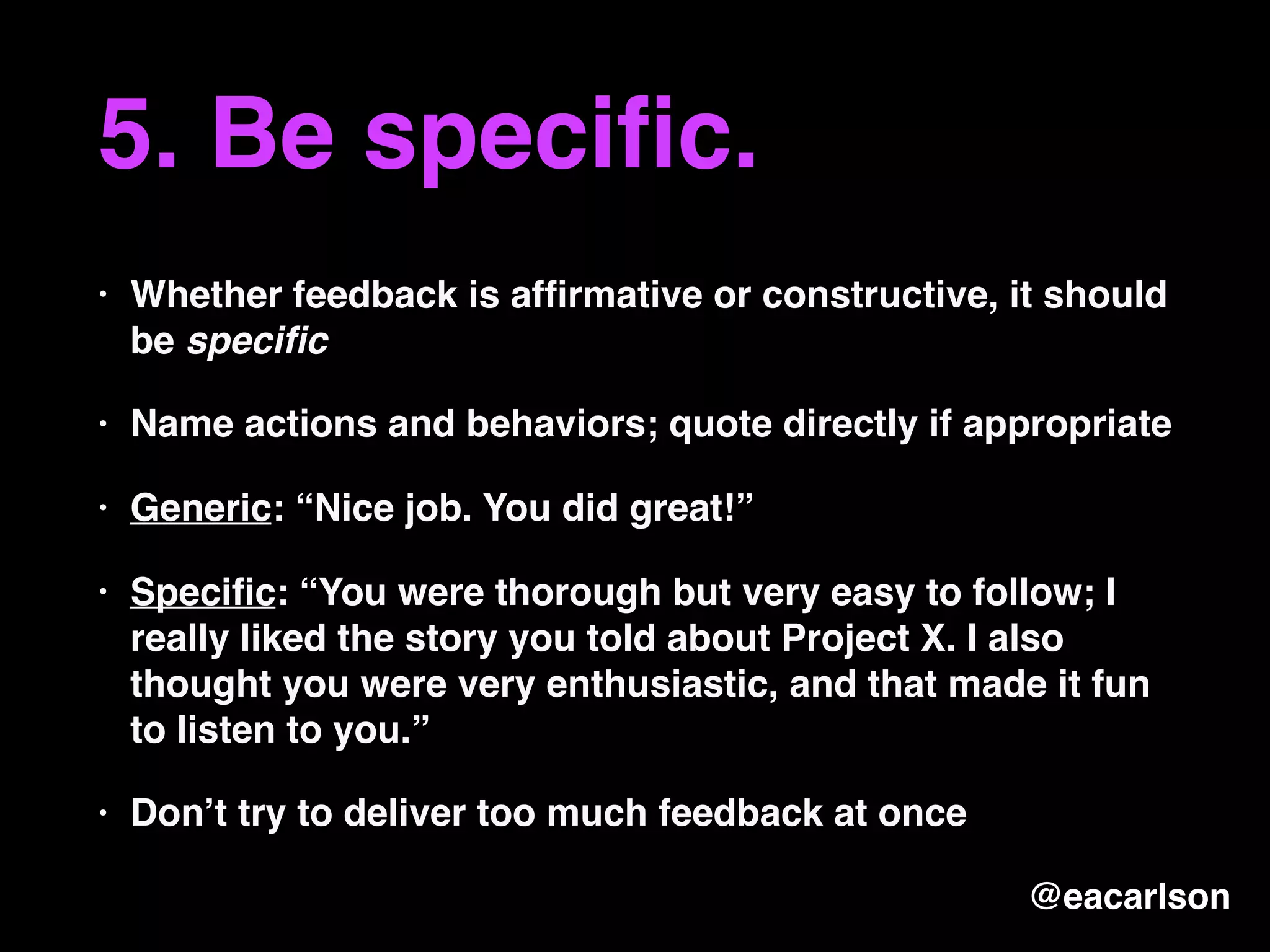
5. Be specific.
• Whether feedback is affirmative or constructive, it should
be specific
• Name actions and behaviors; quote directly if appropriate
• Generic: “Nice job. You did great!”
• Specific: “You were thorough but very easy to follow; I
really liked the story you told about Project X. I also
thought you were very enthusiastic, and that made it fun
to listen to you.”
• Don’t try to deliver too much feedback at once
@eacarlson
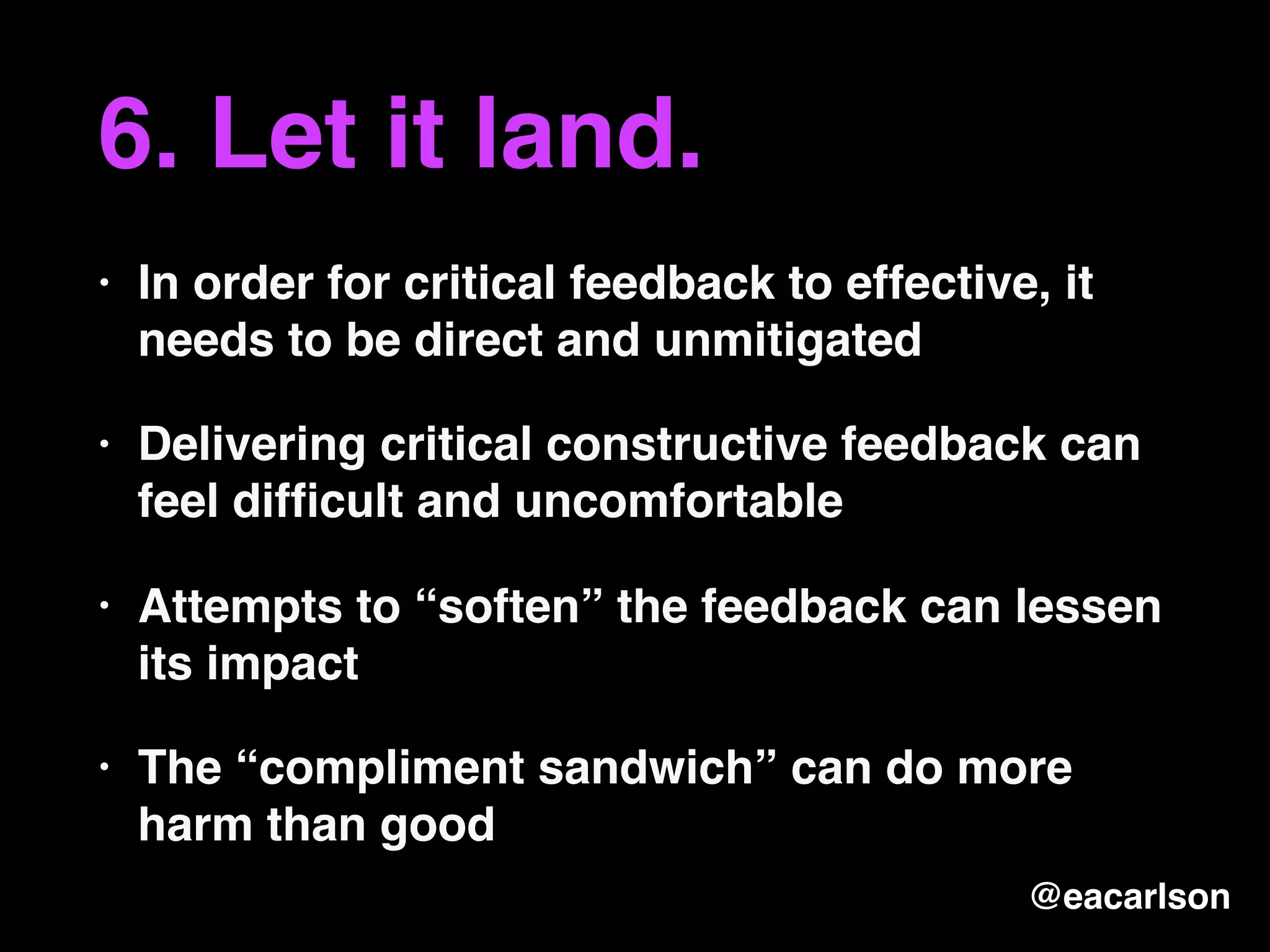
6. Let it land.
• In order for critical feedback to effective, it
needs to be direct and unmitigated
• Delivering critical constructive feedback can
feel difficult and uncomfortable
• Attempts to “soften” the feedback can lessen
its impact
• The “compliment sandwich” can do more
harm than good
@eacarlson
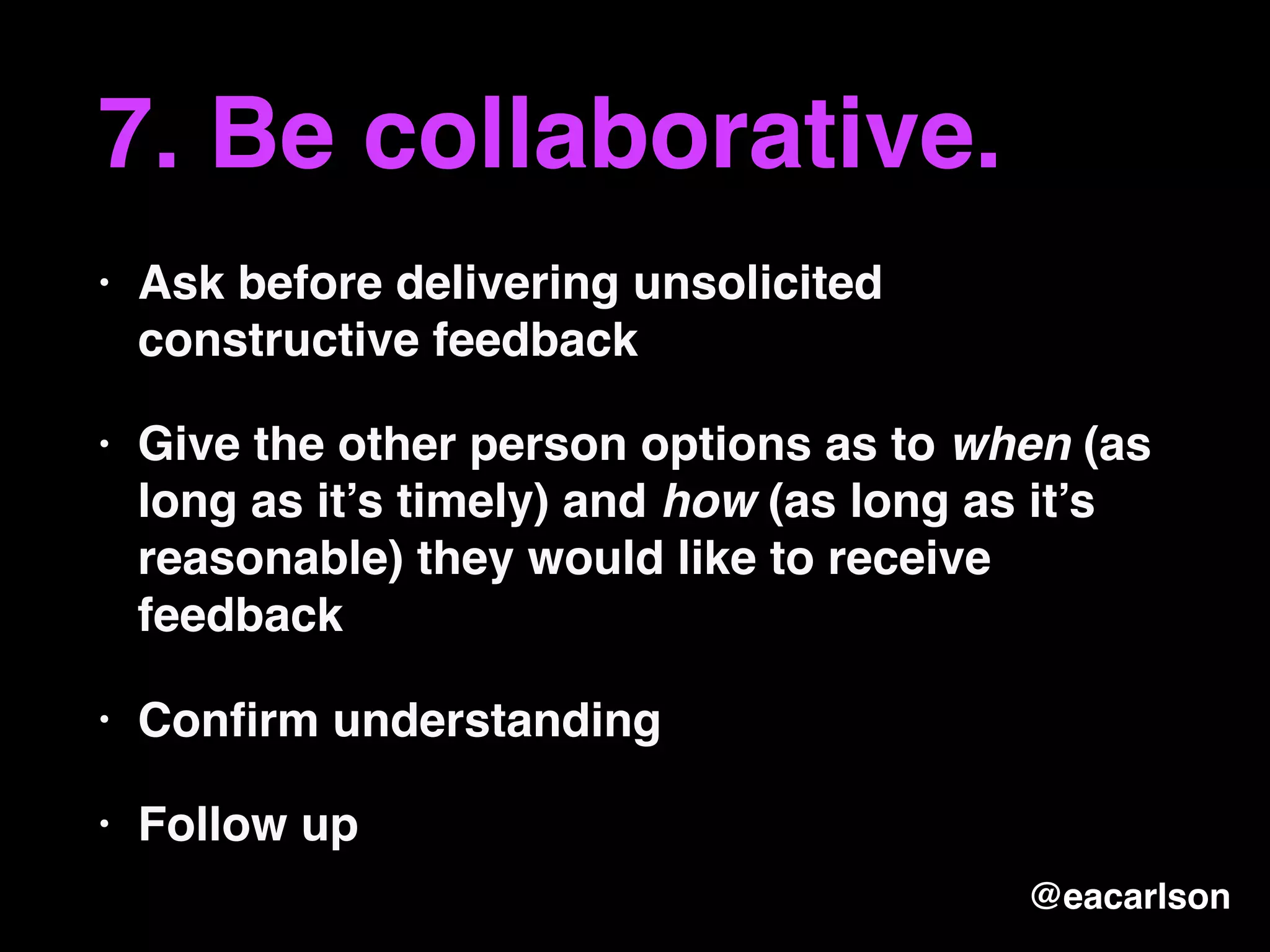
7. Be collaborative.
• Ask before delivering unsolicited
constructive feedback
• Give the other person options as to when (as
long as it’s timely) and how (as long as it’s
reasonable) they would like to receive
feedback
• Confirm understanding
• Follow up
@eacarlson
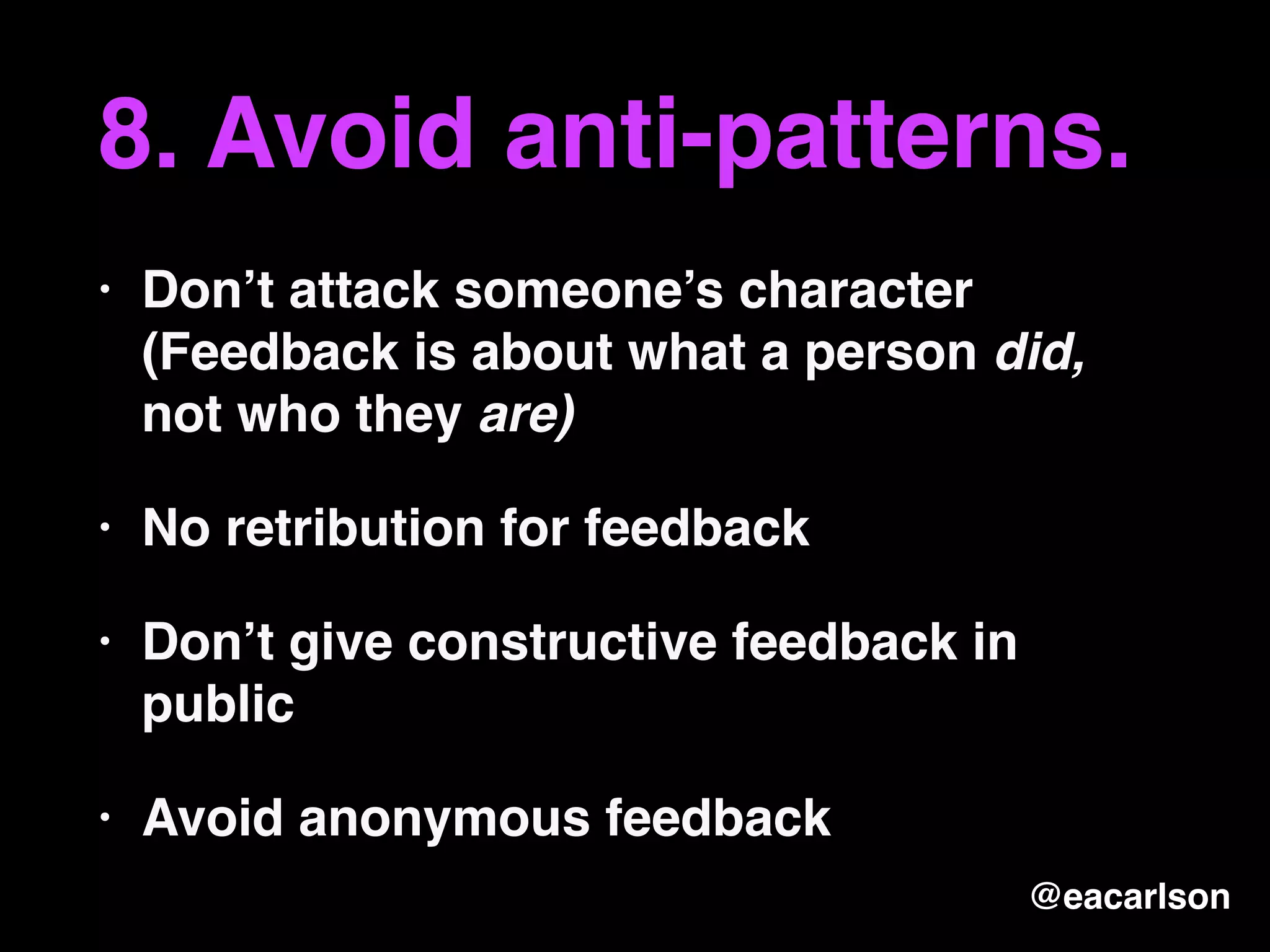
8. Avoid anti-patterns.
• Don’t attack someone’s character
(Feedback is about what a person did,
not who they are)
• No retribution for feedback
• Don’t give constructive feedback in
public
• Avoid anonymous feedback
@eacarlson
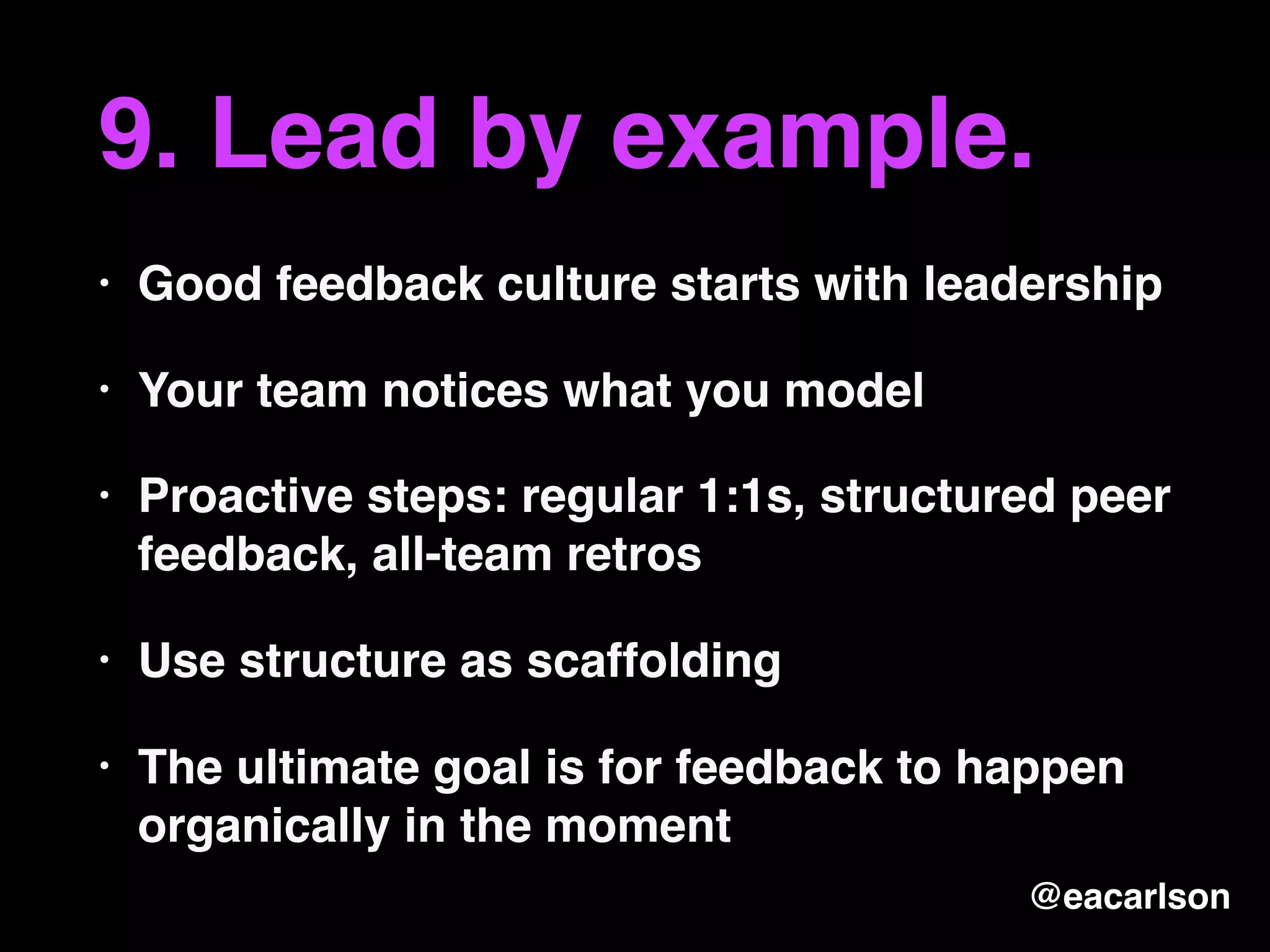
9. Lead by example.
• Good feedback culture starts with leadership
• Your team notices what you model
• Proactive steps: regular 1:1s, structured peer
feedback, all-team retros
• Use structure as scaffolding
• The ultimate goal is for feedback to happen
organically in the moment
@eacarlson
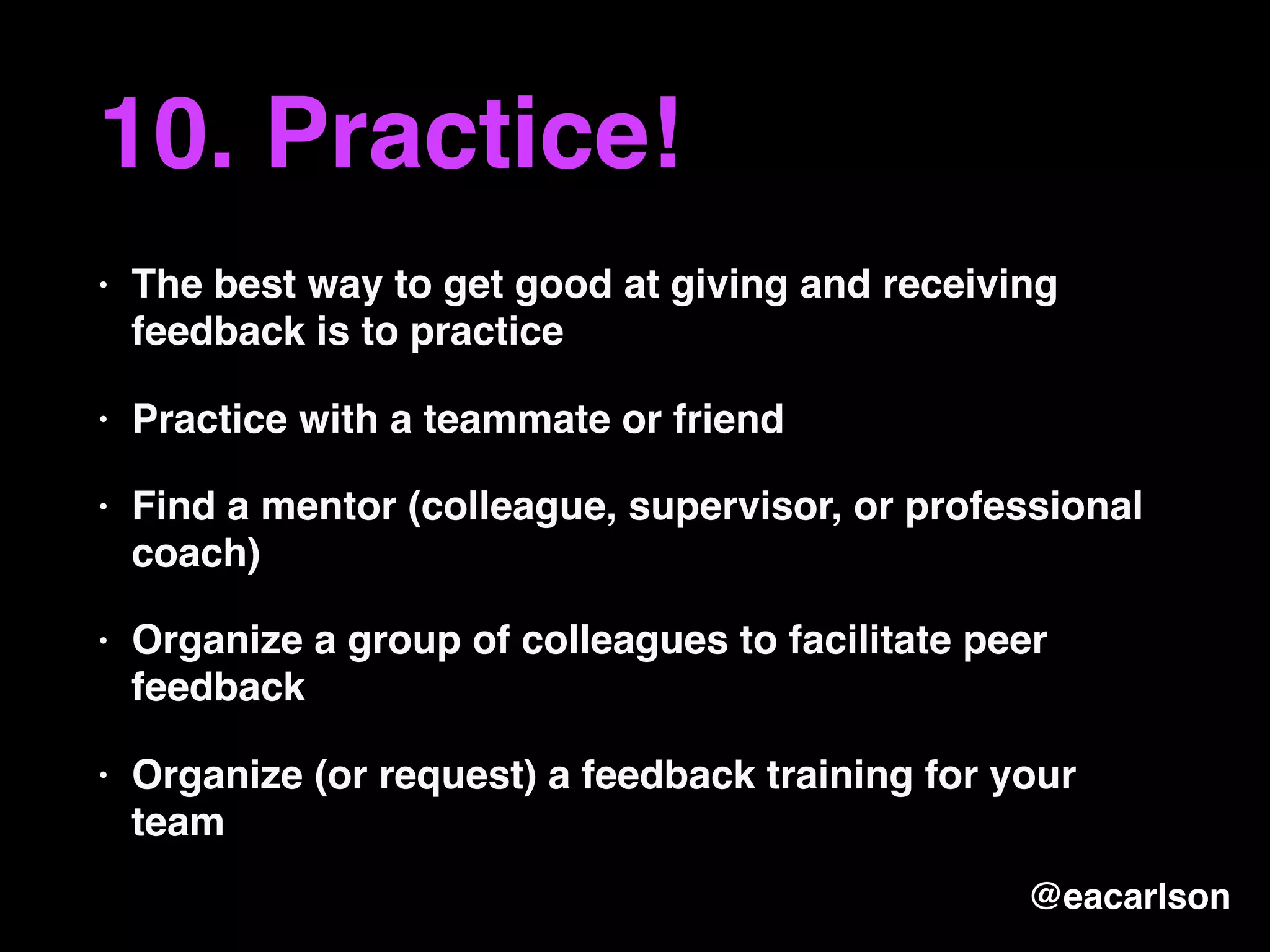
10. Practice!
• The best way to get good at giving and receiving
feedback is to practice
• Practice with a teammate or friend
• Find a mentor (colleague, supervisor, or professional
coach)
• Organize a group of colleagues to facilitate peer
feedback
• Organize (or request) a feedback training for your
team
@eacarlson
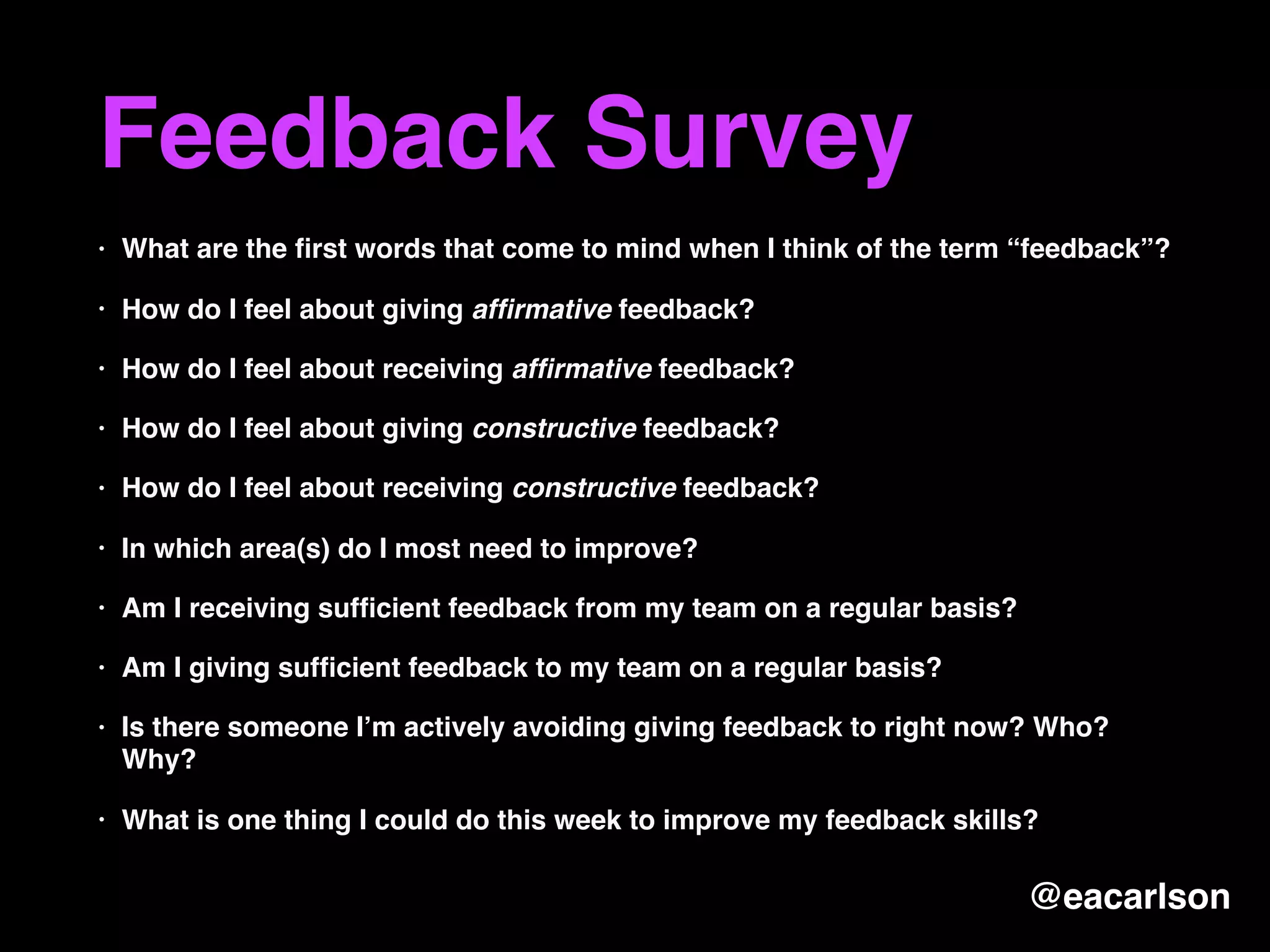
Feedback Survey
• What are the first words that come to mind when I think of the term “feedback”?
• How do I feel about giving affirmative feedback?
• How do I feel about receiving affirmative feedback?
• How do I feel about giving constructive feedback?
• How do I feel about receiving constructive feedback?
• In which area(s) do I most need to improve?
• Am I receiving sufficient feedback from my team on a regular basis?
• Am I giving sufficient feedback to my team on a regular basis?
• Is there someone I’m actively avoiding giving feedback to right now? Who?
Why?
• What is one thing I could do this week to improve my feedback skills?
@eacarlson
Challenges
• Give a teammate specific, thoughtful, affirmative
feedback
• Ask a teammate (or supervisor) to tell you one thing
you do well and one thing you could do better
• Create a #thanks Slack channel (or other forum)
where teammates can acknowledge each other for a
job well done
• Bonus: Start a conversation with your team: “How do
you think we’re doing at giving and receiving
feedback? How could we be better?”
@eacarlson
Additional Resources
• Thanks for the Feedback: The Science and
Art of Receiving Feedback Well - Douglas
Stone & Sheila Heen
• The 5 Keys to Mindful Communication -
Susan Gillis Chapman
• Crucial Conversations - Kerry Patterson
• What We Say Matters: Practicing Nonviolent
Communication - Ike Lasater
@eacarlson
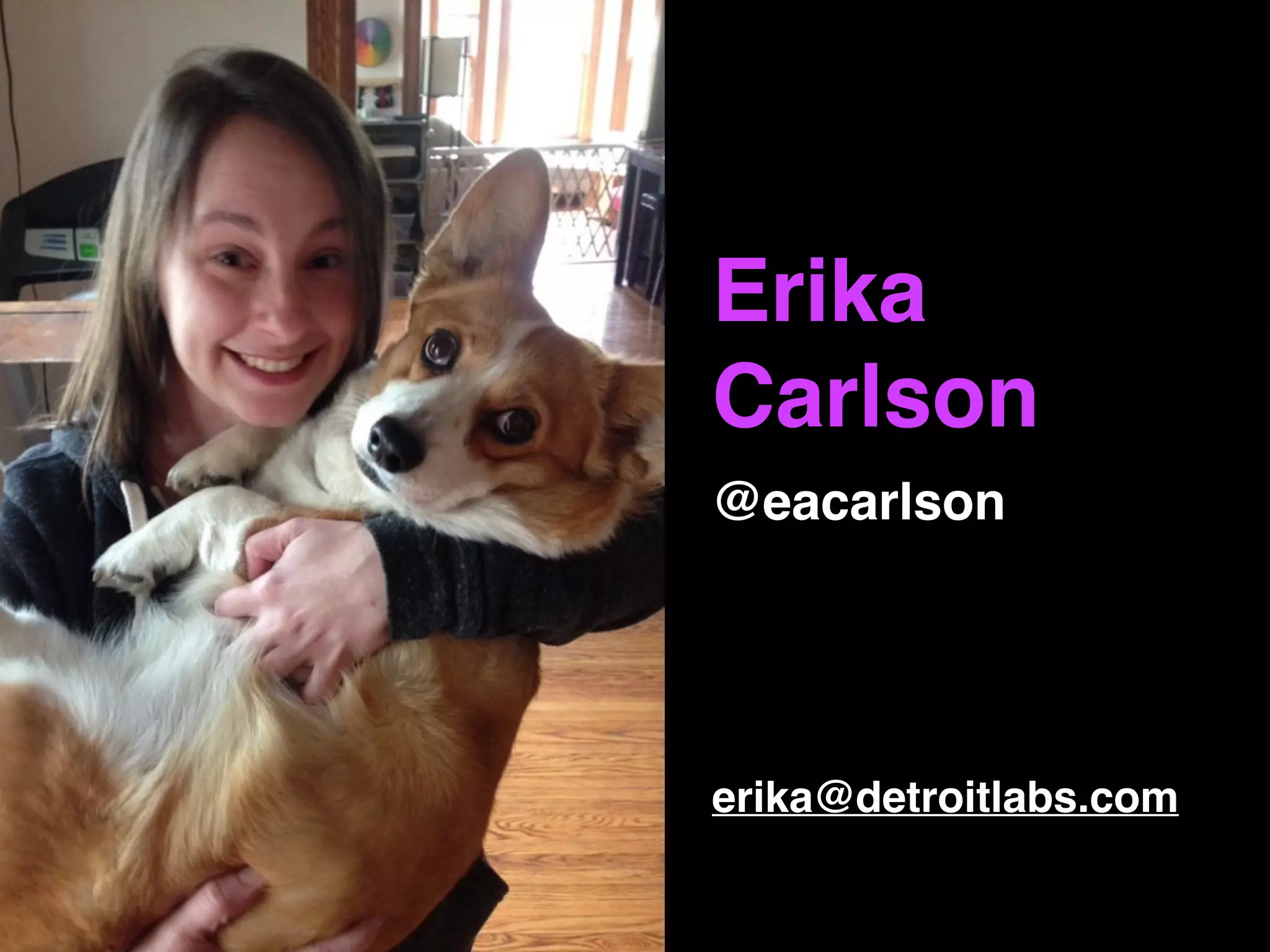
Erika
Carlson
@eacarlson
erika@detroitlabs.com

Better - Fearless Feedback for Software Teams

  • 1.
  • 2.
    Hello! • Hi! I’mErika. • (I’m @eacarlson, too.) • I’m a software developer. • I work at Detroit Labs in Detroit, Michigan. • I train and coach software developers.
  • 3.
    Introduction • What isfeedback? • Why is feedback important to teams? • Why do teams struggle with giving and receiving feedback? • How do we get better at feedback? • How do I know? @eacarlson
  • 4.
    What is Feedback? •A response to a person’s behavior and/or performance, shared with the person for the purposes of: • Increasing his/her awareness • Shaping his/her behavior @eacarlson
  • 5.
    Types of Feedback •Affirmative • Reinforce behavior & increase the likelihood that it will be continued/repeated • Constructive • Re-shape behavior or deter it from being continued/repeated • Passive • Devalue or condone behavior through inaction @eacarlson
  • 6.
    Why Does itMatter? • Feedback is one of the best tools we have for improving individual and team performance • Feedback improves communication, builds trust, and helps teammates to collaborate more effectively, speeding problem-solving • Feedback helps teams to solve problems early, addressing issues before they become toxic @eacarlson
  • 7.
    Why Is itDifficult? • Teams struggle with feedback because people struggle with feedback • Giving and receiving feedback are both complex skills • Most people haven’t had the opportunity or resources to develop good feedback skills • Giving and receiving feedback effectively requires openness, maturity, self-awareness, courage, vulnerability, confidence, and trust @eacarlson
  • 8.
    Managing Fear • Fearsrepresent opportunities for growth • Fears are real, but they are not an irrevocable part of who we are • When you’re feeling anxiety about giving or receiving feedback, ask yourself the following questions: • What am I afraid of? • What’s the underlying fear? • What steps could I take to overcome this fear? • What could I gain by moving beyond this fear? @eacarlson
  • 9.
    Feedback 101 • Bespecific, thoughtful, and direct • Structure: Situation, Behavior, Impact • In (SITUATION), when you did (BEHAVIOR), the outcome was (IMPACT). • Example (Affirmative): “On today’s phone call, when you praised our demo, the team was inspired and motivated to repeat that success.” • Example (Constructive): “In yesterday’s client meeting, when you interrupted and talked over me, I felt frustrated and hurt.” @eacarlson
  • 10.
    1. Listen actively. •While you are receiving feedback, listen intentionally • Listen to listen, not to respond • Be conscious of your body language • If you are receiving constructive feedback, it may be helpful to confirm understanding: “What I’m hearing you say is that it’s disruptive to you when I drop by your desk without asking first, and that’s making you feel frustrated.” @eacarlson
  • 11.
    2. Say “Thankyou.” • Accept positive feedback graciously, without denying or minimizing • Say “Thank you.” • Accept constructive feedback without arguing, pushing back, or getting defensive • Say “Thank you for the feedback.” @eacarlson
  • 12.
    3. Respond (later). •When you receive constructive feedback, take some time to assess your emotions • Try to complete this sentence: “I feel _____ about this feedback” • Sit with the feedback until you feel less emotional about it • Decide if and how to act @eacarlson
  • 13.
    4. Assume thebest. • Always assume positive intent • When you give constructive feedback, assume that the other person was acting from positive intentions • When you receive constructive feedback, assume that the other person is sharing that feedback because they are invested in your growth • Feedback is a gift for the purpose of helping you grow @eacarlson
  • 14.
    5. Be specific. •Whether feedback is affirmative or constructive, it should be specific • Name actions and behaviors; quote directly if appropriate • Generic: “Nice job. You did great!” • Specific: “You were thorough but very easy to follow; I really liked the story you told about Project X. I also thought you were very enthusiastic, and that made it fun to listen to you.” • Don’t try to deliver too much feedback at once @eacarlson
  • 15.
    6. Let itland. • In order for critical feedback to effective, it needs to be direct and unmitigated • Delivering critical constructive feedback can feel difficult and uncomfortable • Attempts to “soften” the feedback can lessen its impact • The “compliment sandwich” can do more harm than good @eacarlson
  • 16.
    7. Be collaborative. •Ask before delivering unsolicited constructive feedback • Give the other person options as to when (as long as it’s timely) and how (as long as it’s reasonable) they would like to receive feedback • Confirm understanding • Follow up @eacarlson
  • 17.
    8. Avoid anti-patterns. •Don’t attack someone’s character (Feedback is about what a person did, not who they are) • No retribution for feedback • Don’t give constructive feedback in public • Avoid anonymous feedback @eacarlson
  • 18.
    9. Lead byexample. • Good feedback culture starts with leadership • Your team notices what you model • Proactive steps: regular 1:1s, structured peer feedback, all-team retros • Use structure as scaffolding • The ultimate goal is for feedback to happen organically in the moment @eacarlson
  • 19.
    10. Practice! • Thebest way to get good at giving and receiving feedback is to practice • Practice with a teammate or friend • Find a mentor (colleague, supervisor, or professional coach) • Organize a group of colleagues to facilitate peer feedback • Organize (or request) a feedback training for your team @eacarlson
  • 20.
    Feedback Survey • Whatare the first words that come to mind when I think of the term “feedback”? • How do I feel about giving affirmative feedback? • How do I feel about receiving affirmative feedback? • How do I feel about giving constructive feedback? • How do I feel about receiving constructive feedback? • In which area(s) do I most need to improve? • Am I receiving sufficient feedback from my team on a regular basis? • Am I giving sufficient feedback to my team on a regular basis? • Is there someone I’m actively avoiding giving feedback to right now? Who? Why? • What is one thing I could do this week to improve my feedback skills? @eacarlson
  • 21.
    Challenges • Give ateammate specific, thoughtful, affirmative feedback • Ask a teammate (or supervisor) to tell you one thing you do well and one thing you could do better • Create a #thanks Slack channel (or other forum) where teammates can acknowledge each other for a job well done • Bonus: Start a conversation with your team: “How do you think we’re doing at giving and receiving feedback? How could we be better?” @eacarlson
  • 22.
    Additional Resources • Thanksfor the Feedback: The Science and Art of Receiving Feedback Well - Douglas Stone & Sheila Heen • The 5 Keys to Mindful Communication - Susan Gillis Chapman • Crucial Conversations - Kerry Patterson • What We Say Matters: Practicing Nonviolent Communication - Ike Lasater @eacarlson
  • 23.