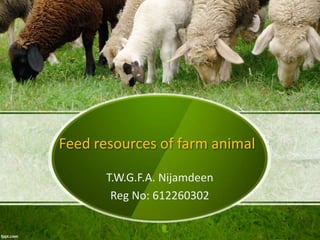
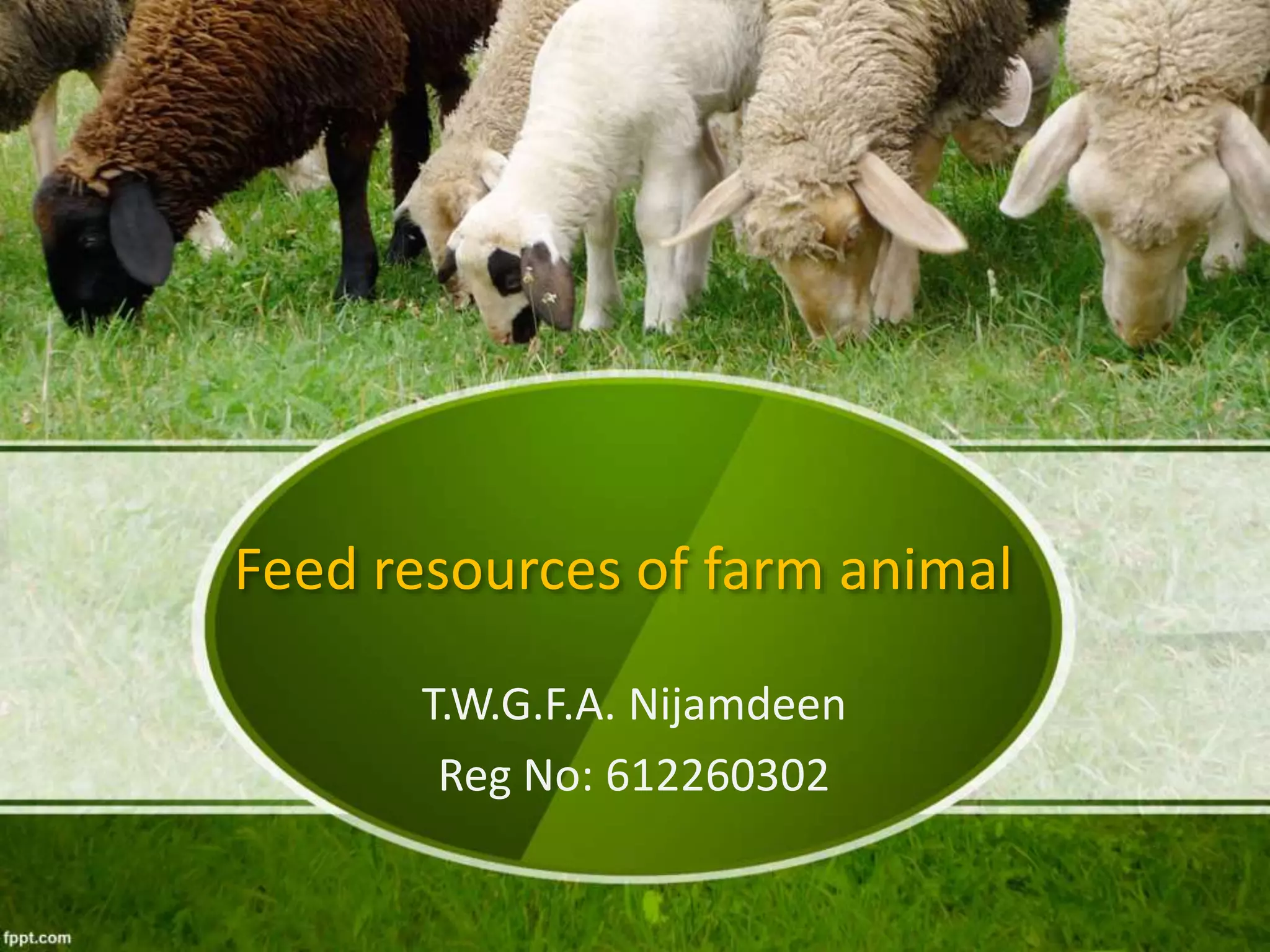
Feed resources of farm animal
T.W.G.F.A. Nijamdeen
Reg No: 612260302
Introduction
• Livestock play an important role in most small-scale farming
systems throughout the world.
• They provide traction to cultivate fields, manure to maintain
crop productivity, and nutritious food products for human
consumption and income-generation.
• Despite the importance of livestock, inadequate livestock
nutrition is a common problem in the developing world, and a
major factor affecting the development of viable livestock
industries in poor countries.
• Thus the feed resources plays a major role in farm animals.
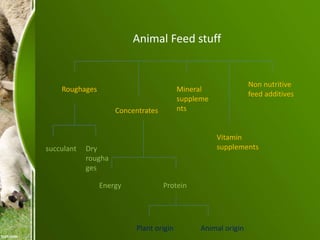
Classification of feedstuff
• Live stock feeds are generally classified according to
the amount of a specific nutrient they furnish in the
ration.
• They are divided into two main classes.
- Roughages
- Concentrates
• Other classes are mineral supplement, vitamin
supplement and non nutritive feed additives
Animal Feed stuff
Concentrates
Roughages Mineral
suppleme
nts
Vitamin
supplements
Non nutritive
feed additives
succulant Dry
rougha
ges
Energy Protein
Plant origin Animal origin
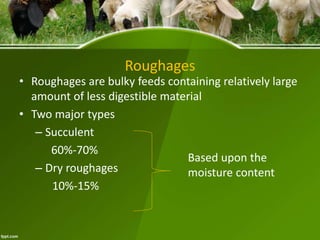
Roughages
• Roughages are bulky feeds containing relatively large
amount of less digestible material
• Two major types
– Succulent
60%-70%
– Dry roughages
10%-15%
Based upon the
moisture content
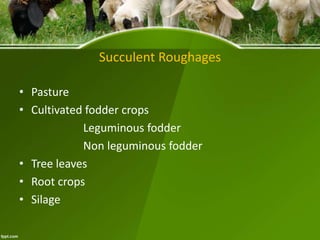
Succulent Roughages
• Pasture
• Cultivated fodder crops
Leguminous fodder
Non leguminous fodder
• Tree leaves
• Root crops
• Silage
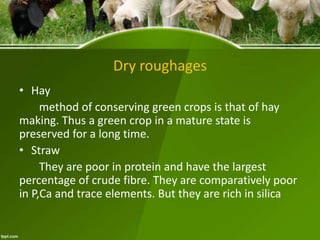
Dry roughages
• Hay
method of conserving green crops is that of hay
making. Thus a green crop in a mature state is
preserved for a long time.
• Straw
They are poor in protein and have the largest
percentage of crude fibre. They are comparatively poor
in P,Ca and trace elements. But they are rich in silica
concentrates
• A concentrate is usually described as feed mixture,
which supplies primary nutrients.
• Two major types
Energy rich concentrates Rich in energy or
protein
Protein rich concentrates
Energy rich concentrates
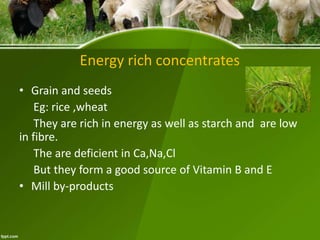
• Grain and seeds
Eg: rice ,wheat
They are rich in energy as well as starch and are low
in fibre.
The are deficient in Ca,Na,Cl
But they form a good source of Vitamin B and E
• Mill by-products
Protein rich concentrates
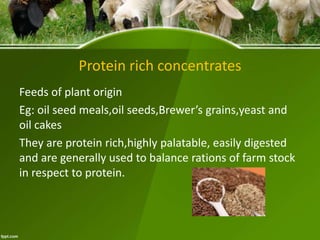
Feeds of plant origin
Eg: oil seed meals,oil seeds,Brewer’s grains,yeast and
oil cakes
They are protein rich,highly palatable, easily digested
and are generally used to balance rations of farm stock
in respect to protein.
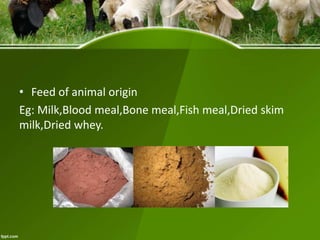
• Feed of animal origin
Eg: Milk,Blood meal,Bone meal,Fish meal,Dried skim
milk,Dried whey.
Mineral supplement
• It may be natural or artificial mineral suppliment
Eg:Ca - lime stone, Dicalcium phosphate
Na – Salt
Vitamin supplement
• It may be natural or artificial
Non-nutritive feed additives
• They are used to improve the palatability,to preserve
feeds and to prevent certain diseases.
Eg: Antibiotics,hormones,pigments,enzymes ect.
Water
• Importance for the sustainability of any living
being
Alternative feeds for farm animals
• Due to increase in population and restriction in land
use and increasing prices of animal feeds,it is not
possible to always depend on the conventional feeds
such as grass,corn,fish meal ect.
• In order to have a regular supply of low cost feeds for
livestock there is a need of an alternative feed stuffs.
• The main sources of alternative feeds are Crop
residues and agro industrial by products.
• Crop residues
Two major sources are;
- paddy straw
- Sugar cane by-products
a) sugar cane tops
b) sugar cane baggase
• Agro industrial by products
Milling industry
- oil cakes,Rice bran/rice polish,Molasses
canning industry
- fruits/vegetables,fish/meat
Slaughter house waste
- Inedible parts
Animal wastes
- Bio gas slurry
- Poultry manure
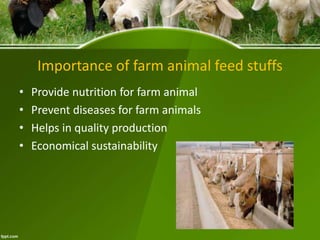
Importance of farm animal feed stuffs
• Provide nutrition for farm animal
• Prevent diseases for farm animals
• Helps in quality production
• Economical sustainability
Conclusion
• Livestock play an important role in most farming
systems throughout the world.
• They provide traction to cultivate fields, manure to
maintain crop productivity, and nutritious food
products for human consumption and income-
generation
• Therefore proper feeding of farm animals is more
important to gain success in the industry.
Thank you

Feed resources of farm animal

  • 1.
    Feed resources offarm animal T.W.G.F.A. Nijamdeen Reg No: 612260302
  • 2.
    Introduction • Livestock playan important role in most small-scale farming systems throughout the world. • They provide traction to cultivate fields, manure to maintain crop productivity, and nutritious food products for human consumption and income-generation. • Despite the importance of livestock, inadequate livestock nutrition is a common problem in the developing world, and a major factor affecting the development of viable livestock industries in poor countries. • Thus the feed resources plays a major role in farm animals.
  • 3.
    Classification of feedstuff •Live stock feeds are generally classified according to the amount of a specific nutrient they furnish in the ration. • They are divided into two main classes. - Roughages - Concentrates • Other classes are mineral supplement, vitamin supplement and non nutritive feed additives
  • 4.
    Animal Feed stuff Concentrates RoughagesMineral suppleme nts Vitamin supplements Non nutritive feed additives succulant Dry rougha ges Energy Protein Plant origin Animal origin
  • 5.
    Roughages • Roughages arebulky feeds containing relatively large amount of less digestible material • Two major types – Succulent 60%-70% – Dry roughages 10%-15% Based upon the moisture content
  • 6.
    Succulent Roughages • Pasture •Cultivated fodder crops Leguminous fodder Non leguminous fodder • Tree leaves • Root crops • Silage
  • 7.
    Dry roughages • Hay methodof conserving green crops is that of hay making. Thus a green crop in a mature state is preserved for a long time. • Straw They are poor in protein and have the largest percentage of crude fibre. They are comparatively poor in P,Ca and trace elements. But they are rich in silica
  • 8.
    concentrates • A concentrateis usually described as feed mixture, which supplies primary nutrients. • Two major types Energy rich concentrates Rich in energy or protein Protein rich concentrates
  • 9.
    Energy rich concentrates •Grain and seeds Eg: rice ,wheat They are rich in energy as well as starch and are low in fibre. The are deficient in Ca,Na,Cl But they form a good source of Vitamin B and E • Mill by-products
  • 10.
    Protein rich concentrates Feedsof plant origin Eg: oil seed meals,oil seeds,Brewer’s grains,yeast and oil cakes They are protein rich,highly palatable, easily digested and are generally used to balance rations of farm stock in respect to protein.
  • 11.
    • Feed ofanimal origin Eg: Milk,Blood meal,Bone meal,Fish meal,Dried skim milk,Dried whey.
  • 12.
    Mineral supplement • Itmay be natural or artificial mineral suppliment Eg:Ca - lime stone, Dicalcium phosphate Na – Salt Vitamin supplement • It may be natural or artificial Non-nutritive feed additives • They are used to improve the palatability,to preserve feeds and to prevent certain diseases. Eg: Antibiotics,hormones,pigments,enzymes ect. Water • Importance for the sustainability of any living being
  • 13.
    Alternative feeds forfarm animals • Due to increase in population and restriction in land use and increasing prices of animal feeds,it is not possible to always depend on the conventional feeds such as grass,corn,fish meal ect. • In order to have a regular supply of low cost feeds for livestock there is a need of an alternative feed stuffs.
  • 14.
    • The mainsources of alternative feeds are Crop residues and agro industrial by products. • Crop residues Two major sources are; - paddy straw - Sugar cane by-products a) sugar cane tops b) sugar cane baggase
  • 15.
    • Agro industrialby products Milling industry - oil cakes,Rice bran/rice polish,Molasses canning industry - fruits/vegetables,fish/meat Slaughter house waste - Inedible parts Animal wastes - Bio gas slurry - Poultry manure
  • 16.
    Importance of farmanimal feed stuffs • Provide nutrition for farm animal • Prevent diseases for farm animals • Helps in quality production • Economical sustainability
  • 17.
    Conclusion • Livestock playan important role in most farming systems throughout the world. • They provide traction to cultivate fields, manure to maintain crop productivity, and nutritious food products for human consumption and income- generation • Therefore proper feeding of farm animals is more important to gain success in the industry.
  • 18.