Project Planning 1:    Development  Project Planning Overview
Overview of this session What is Development Planning? Project Cycle Management Planning Tools STAKEHOLDER ANALYSIS LOGICAL FRAMEWORK ANALYSIS MONITORING & EVALUATION Comments on Project Planning
“ If you don’t know where you are going, any road will get you there”
Development Planning Theory Development Planning has become a special field of study Lets look at some of the ideas and concepts of modern Development Planning
Development Planning Theory Some of the ideas What ‘just happens’  vs. intentional acts    a planned process Development as Vision Can be Positive or Negative Trusteeship  (act for other people)
Development Planning Theory Some of the ideas Development Administration & Management  Structure of the country social, cultural, political relationships Agency  the ability of people and groups to influence events Agencies (organisations at all levels) Institutions (laws, codes)
Development Planning Theory Some of the ideas All this is done by simplifying – called ‘Reductionism’:  to look at complex systems with simple principles examples power capacity
Plans, Programmes, Projects Plan:  a statement of forward looking decisions, how they work together and the criteria used in making them  Programme: usually a long-term series of interventions, sometimes with no defined end point Project: a discrete activity aimed at a specific objective with a defined budget and limited timeframe
Aspects of Project Cycle Management Credibility “ Ownership” Efficiency Monitoring and control Formal contingency planning Participatory, flexible, … but … you need some form of rule book to keep to budgets and timeframes
‘Reductionist’ Project   Approach Scientific Management Simplifies and reduces management to a series of inter-related and quantifiable components Inputs Outputs Outcomes Defined processes and relationships Has serious problems,  but used in all development work
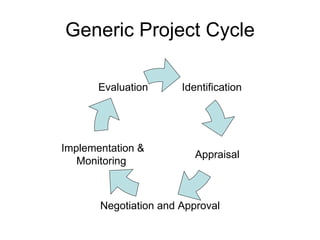
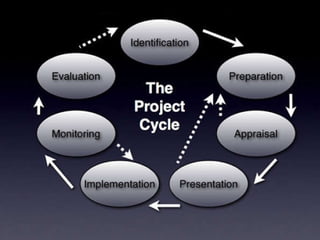
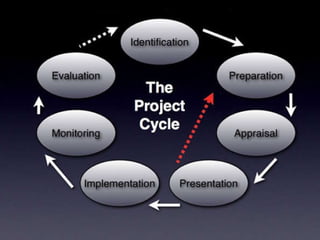
Generic Project Cycle Identification Appraisal Negotiation and Approval Implementation & Monitoring  Evaluation
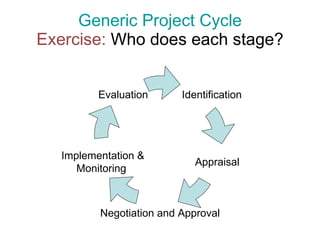
Generic Project Cycle Exercise:  Who does each stage? Identification Appraisal Negotiation and Approval Implementation & Monitoring  Evaluation
Some examples of project cycle methods
 
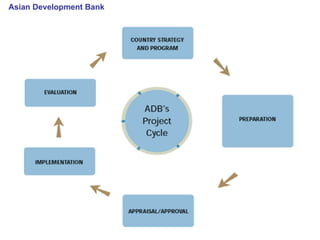
Asian Development Bank
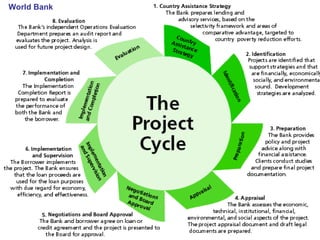
World Bank
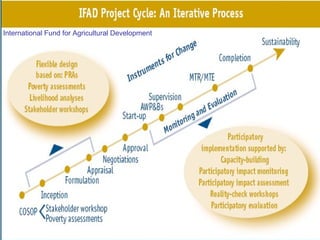
International Fund for Agricultural Development
Logical Framework Approach  ZOPP  (Zielorientierte Projektplanung) GOPP - Goal Oriented Project Planning OOPP  - Objective Oriented Project Planning Planning, by a participatory process, aimed at the needs of target groups,  the key parts of a project are agreed with those concerned
Logical Framework Approach Use a planning matrix – the logical framework – which: summarises the main parts of a project, and  highlights logical lines between  intended inputs,  planned activities and  expected results .
ZOPP and the Project Cycle  GTZ - 5 ZOPP Stages Identification Appraisal Partner Negotiation -  Plan Finalization Implementation and Monitoring Evaluation
Identification: Identify need Problem Analysis Stakeholder consultations Preliminary feasibility study Identification of funding agencies Consideration of possible approaches Site consultation Possible outputs Concept note/paper Proposal Preliminary feasibility report
Pre-project planning In-house exercise by agency  Participatory Action Research Situation Analysis  Problem Identification: Problem Tree Stakeholder Analysis Objectives Analysis Alternatives Analysis Strategies Analysis
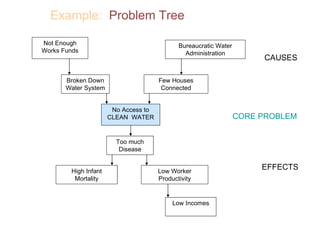
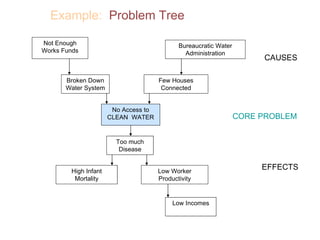
Problem Tree A process of putting a lot of problems on cards, and then sorting causes effects By sorting these you will find a natural focal point (or points) – the  core problem Note:   this is different to  Visualisation in Participatory Processes  where the core problem has already been identified
Example:  Problem Tree Sufficient Funds Best Practice Water Administration Low Rate of Disease Low Infant Mortality High Productivity High Incomes Low Infant Mortality High Incomes High Productivity Low Infant Mortality High Incomes Low Rate of Disease High Productivity Low Infant Mortality High Incomes Low Rate of Disease High Productivity Low Infant Mortality High Incomes Low Rate of Disease High Productivity Low Infant Mortality High Incomes Best Practice Water Administration Few Houses Connected Low Rate of Disease High Productivity Low Infant Mortality High Incomes Best Practice Water Administration No Access to CLEAN  WATER Low Rate of Disease High Productivity Low Infant Mortality High Incomes Not Enough Works Funds Broken Down Water System Bureaucratic Water Administration Too much Disease Low Worker Productivity High Infant Mortality Low Incomes CAUSES EFFECTS CORE PROBLEM
Stakeholder Analysis Consider appropriate level for analysis Identify & list key stakeholders Look at their needs, characteristics, circumstances Identify relationships between stakeholders Assess power (influence) and potential (importance) Create a Matrix
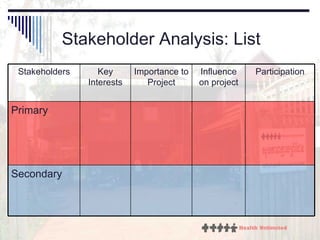
Stakeholder Analysis: List Secondary Primary Participation Influence on project Importance to Project Key Interests Stakeholders
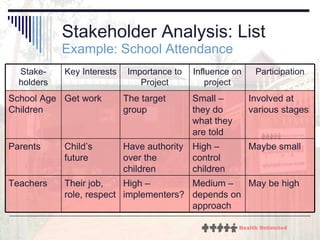
Stakeholder Analysis: List Example: School Attendance May be high Medium – depends on approach High – implementers? Their job, role, respect Teachers Maybe small High – control children Have authority over the children Child’s future Parents Involved at various stages Small – they do what they are told The target group Get work School Age Children Participation Influence on project Importance to Project Key Interests Stake-holders
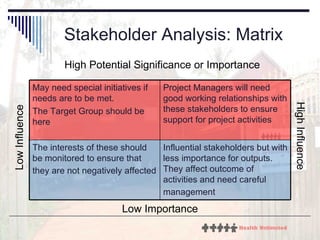
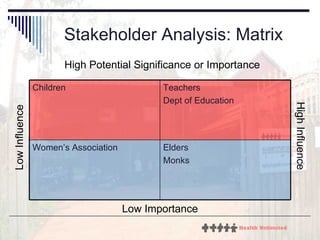
Stakeholder Analysis: Matrix Low Influence High Influence High Potential Significance or Importance Low Importance Influential stakeholders but with less importance for outputs. They affect outcome of activities and need careful management   The interests of these should be monitored to ensure that they are not negatively affected   Project Managers will need good working relationships with these stakeholders to ensure support for project activities May need special initiatives if needs are to be met.  The Target Group should be here
Stakeholder Analysis: Matrix Low Influence High Influence High Potential Significance or Importance Low Importance Elders Monks Women’s Association Teachers Dept of Education Children
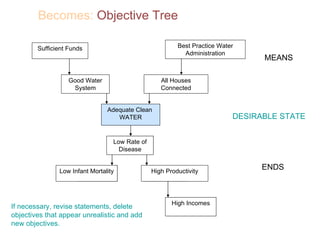
Objectives Analysis Change the Problem Tree into an Objectives Tree Change the negative problems into positive outcomes “ no staff in clinic’ becomes “fully staffed clinic”
Example:  Problem Tree Sufficient Funds Best Practice Water Administration Low Rate of Disease Low Infant Mortality High Productivity High Incomes Low Infant Mortality High Incomes High Productivity Low Infant Mortality High Incomes Low Rate of Disease High Productivity Low Infant Mortality High Incomes Low Rate of Disease High Productivity Low Infant Mortality High Incomes Low Rate of Disease High Productivity Low Infant Mortality High Incomes Best Practice Water Administration Few Houses Connected Low Rate of Disease High Productivity Low Infant Mortality High Incomes Best Practice Water Administration No Access to CLEAN  WATER Low Rate of Disease High Productivity Low Infant Mortality High Incomes Not Enough Works Funds Broken Down Water System Bureaucratic Water Administration Too much Disease Low Worker Productivity High Infant Mortality Low Incomes CAUSES EFFECTS CORE PROBLEM
Becomes:  Objective Tree Sufficient Funds Best Practice Water Administration Low Rate of Disease Low Infant Mortality High Productivity High Incomes Low Infant Mortality High Incomes High Productivity Low Infant Mortality High Incomes Low Rate of Disease High Productivity Low Infant Mortality High Incomes Low Rate of Disease High Productivity Low Infant Mortality High Incomes Low Rate of Disease High Productivity Low Infant Mortality High Incomes Best Practice Water Administration All Houses Connected Low Rate of Disease High Productivity Low Infant Mortality High Incomes Best Practice Water Administration Adequate Clean  WATER Low Rate of Disease High Productivity Low Infant Mortality High Incomes Sufficient Funds Good Water System Best Practice Water Administration Low Rate of Disease High Productivity Low Infant Mortality High Incomes MEANS ENDS DESIRABLE STATE If necessary, revise statements, delete objectives that appear unrealistic and add new objectives.
Exercise:   Problem Tree & Stakeholder Analysis Choose a problem in our work area Divide into groups 1. Do a problem tree 2. Do a stakeholder analysis
Take a Break
Exercise:   Problem Tree & Stakeholder Analysis Share 1. problem tree 2. stakeholder analysis
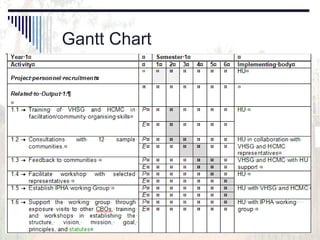
2. Starting Appraisal:   Appraisal ( ex-ante ) Full feasibility study Baseline study, needs assessment Possible outputs Needs assessment report Baseline data Detailed set of indicators Amended proposal Project plan, Gantt chart etc. Project Planning Matrix - Logframe
Gantt Chart
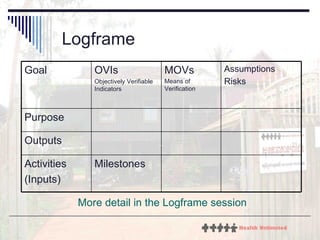
Project Planning Matrix (PPM) Logframe, Logical Framework (Analysis), LFA 4x4 matrix Ensures clear statement of objectives (distinction between purpose and objectives) Introduces indicators of progress Focuses attention on the assumptions and risks involved
Logframe More detail in the Logframe session Milestones Activities (Inputs) Outputs Purpose Assumptions Risks   MOVs Means of Verification   OVIs Objectively Verifiable Indicators Goal
3. Partner Negotiation: Negotiation with finance provider Possible outputs Project memorandum Signed contract (or go back and redesign)
 
Plan Finalisation: Detail of the activities work plans,  staff structures, terms of reference budgets
4. Implementation and Monitoring : Team selection and startup Person specification/job allocation Interviews and selection Terms of engagement  Lines of responsibility Briefing
4. Implementation and Monitoring : Do the work Implementation of project plan Regular reports, meetings, workshops Monitoring: systematic documentation of performance - indicating whether project is performing as intended
Monitoring  (Performance Measurement ) Monitoring – of  the Process Inputs Outputs Outcomes ( Results Based Management   ) Logical framework approach Tools: Progress reports Team meetings, team briefing reports Mid term review
Quick Exercise List all the forms of monitoring used in your project Share
Take a break
Monitoring  (Performance Measurement ) Levels of Indicators Strategic Sustainability Attainment Performance  Quality, Quantity, Time
5. Evaluation and Closure Obtain “sign off” from project participants Project evaluation ( Ex-post  ) When possible to assess full effects External evaluator may be necessary/appropriate Record lessons learned Formulate recommendations for next phase Submission of completion report and evaluation Donors may demand closing activities
Evaluation:   Impact Assessment Approach Baseline, (midterm?) and End of Project Impact from beneficiaries’ point of view What do they think is significant? To whom is it important? Criteria Efficiency – relate inputs to outputs Effectiveness- extent to which achieved objectives Consistency- methods/approaches with objectives Impact – change to lives/environment
Evaluation:   Feedback to Planning Lessons Learned Used to replan the project Used to plan the next project Most useful in development of LFA Discussion:  How we use feed back When?  Method?  Who?   Lessons learned
Limits to Rational Planning and Systematic Management
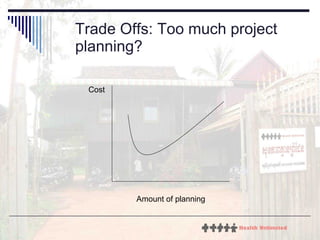
Trade Offs: Too much project planning? Amount of planning Cost
Things that  Limit  using the process Costly and ineffective analysis Full planning vs. flexible interaction Inflexibility and unnecessary constraints on managers,  Delegation to experts and inappropriate intervention No involvement of intended beneficiaries in planning and management Reluctance to engage in evaluation and error detection
Constraints  (that limit effectiveness) Difficulty in precise definition of objectives and goals  Lack of appropriate or adequate data Not understand social and cultural activities Weak ways to guide behaviour Low administrative capacity
Discussion Questions and follow ups Feedback
Thank you   GrKuN
Produced by Tony Hobbs Health Unlimited,  Ratanakiri, Cambodia www.healthunlimited.org With the support of  Australian Volunteers International www.australianvolunteers.com © 2009 HU. Use with Acknowledgement

3 Project Cycle and Planning (4-6 hours)

  • 1.
    Project Planning 1: Development Project Planning Overview
  • 2.
    Overview of thissession What is Development Planning? Project Cycle Management Planning Tools STAKEHOLDER ANALYSIS LOGICAL FRAMEWORK ANALYSIS MONITORING & EVALUATION Comments on Project Planning
  • 3.
    “ If youdon’t know where you are going, any road will get you there”
  • 4.
    Development Planning TheoryDevelopment Planning has become a special field of study Lets look at some of the ideas and concepts of modern Development Planning
  • 5.
    Development Planning TheorySome of the ideas What ‘just happens’ vs. intentional acts  a planned process Development as Vision Can be Positive or Negative Trusteeship (act for other people)
  • 6.
    Development Planning TheorySome of the ideas Development Administration & Management Structure of the country social, cultural, political relationships Agency the ability of people and groups to influence events Agencies (organisations at all levels) Institutions (laws, codes)
  • 7.
    Development Planning TheorySome of the ideas All this is done by simplifying – called ‘Reductionism’: to look at complex systems with simple principles examples power capacity
  • 8.
    Plans, Programmes, ProjectsPlan: a statement of forward looking decisions, how they work together and the criteria used in making them Programme: usually a long-term series of interventions, sometimes with no defined end point Project: a discrete activity aimed at a specific objective with a defined budget and limited timeframe
  • 9.
    Aspects of ProjectCycle Management Credibility “ Ownership” Efficiency Monitoring and control Formal contingency planning Participatory, flexible, … but … you need some form of rule book to keep to budgets and timeframes
  • 10.
    ‘Reductionist’ Project Approach Scientific Management Simplifies and reduces management to a series of inter-related and quantifiable components Inputs Outputs Outcomes Defined processes and relationships Has serious problems, but used in all development work
  • 11.
    Generic Project CycleIdentification Appraisal Negotiation and Approval Implementation & Monitoring Evaluation
  • 12.
    Generic Project CycleExercise: Who does each stage? Identification Appraisal Negotiation and Approval Implementation & Monitoring Evaluation
  • 13.
    Some examples ofproject cycle methods
  • 14.
  • 15.
  • 16.
  • 17.
    International Fund forAgricultural Development
  • 18.
    Logical Framework Approach ZOPP (Zielorientierte Projektplanung) GOPP - Goal Oriented Project Planning OOPP - Objective Oriented Project Planning Planning, by a participatory process, aimed at the needs of target groups, the key parts of a project are agreed with those concerned
  • 19.
    Logical Framework ApproachUse a planning matrix – the logical framework – which: summarises the main parts of a project, and highlights logical lines between intended inputs, planned activities and expected results .
  • 20.
    ZOPP and theProject Cycle GTZ - 5 ZOPP Stages Identification Appraisal Partner Negotiation - Plan Finalization Implementation and Monitoring Evaluation
  • 21.
    Identification: Identify needProblem Analysis Stakeholder consultations Preliminary feasibility study Identification of funding agencies Consideration of possible approaches Site consultation Possible outputs Concept note/paper Proposal Preliminary feasibility report
  • 22.
    Pre-project planning In-houseexercise by agency Participatory Action Research Situation Analysis Problem Identification: Problem Tree Stakeholder Analysis Objectives Analysis Alternatives Analysis Strategies Analysis
  • 23.
    Problem Tree Aprocess of putting a lot of problems on cards, and then sorting causes effects By sorting these you will find a natural focal point (or points) – the core problem Note: this is different to Visualisation in Participatory Processes where the core problem has already been identified
  • 24.
    Example: ProblemTree Sufficient Funds Best Practice Water Administration Low Rate of Disease Low Infant Mortality High Productivity High Incomes Low Infant Mortality High Incomes High Productivity Low Infant Mortality High Incomes Low Rate of Disease High Productivity Low Infant Mortality High Incomes Low Rate of Disease High Productivity Low Infant Mortality High Incomes Low Rate of Disease High Productivity Low Infant Mortality High Incomes Best Practice Water Administration Few Houses Connected Low Rate of Disease High Productivity Low Infant Mortality High Incomes Best Practice Water Administration No Access to CLEAN WATER Low Rate of Disease High Productivity Low Infant Mortality High Incomes Not Enough Works Funds Broken Down Water System Bureaucratic Water Administration Too much Disease Low Worker Productivity High Infant Mortality Low Incomes CAUSES EFFECTS CORE PROBLEM
  • 25.
    Stakeholder Analysis Considerappropriate level for analysis Identify & list key stakeholders Look at their needs, characteristics, circumstances Identify relationships between stakeholders Assess power (influence) and potential (importance) Create a Matrix
  • 26.
    Stakeholder Analysis: ListSecondary Primary Participation Influence on project Importance to Project Key Interests Stakeholders
  • 27.
    Stakeholder Analysis: ListExample: School Attendance May be high Medium – depends on approach High – implementers? Their job, role, respect Teachers Maybe small High – control children Have authority over the children Child’s future Parents Involved at various stages Small – they do what they are told The target group Get work School Age Children Participation Influence on project Importance to Project Key Interests Stake-holders
  • 28.
    Stakeholder Analysis: MatrixLow Influence High Influence High Potential Significance or Importance Low Importance Influential stakeholders but with less importance for outputs. They affect outcome of activities and need careful management The interests of these should be monitored to ensure that they are not negatively affected Project Managers will need good working relationships with these stakeholders to ensure support for project activities May need special initiatives if needs are to be met. The Target Group should be here
  • 29.
    Stakeholder Analysis: MatrixLow Influence High Influence High Potential Significance or Importance Low Importance Elders Monks Women’s Association Teachers Dept of Education Children
  • 30.
    Objectives Analysis Changethe Problem Tree into an Objectives Tree Change the negative problems into positive outcomes “ no staff in clinic’ becomes “fully staffed clinic”
  • 31.
    Example: ProblemTree Sufficient Funds Best Practice Water Administration Low Rate of Disease Low Infant Mortality High Productivity High Incomes Low Infant Mortality High Incomes High Productivity Low Infant Mortality High Incomes Low Rate of Disease High Productivity Low Infant Mortality High Incomes Low Rate of Disease High Productivity Low Infant Mortality High Incomes Low Rate of Disease High Productivity Low Infant Mortality High Incomes Best Practice Water Administration Few Houses Connected Low Rate of Disease High Productivity Low Infant Mortality High Incomes Best Practice Water Administration No Access to CLEAN WATER Low Rate of Disease High Productivity Low Infant Mortality High Incomes Not Enough Works Funds Broken Down Water System Bureaucratic Water Administration Too much Disease Low Worker Productivity High Infant Mortality Low Incomes CAUSES EFFECTS CORE PROBLEM
  • 32.
    Becomes: ObjectiveTree Sufficient Funds Best Practice Water Administration Low Rate of Disease Low Infant Mortality High Productivity High Incomes Low Infant Mortality High Incomes High Productivity Low Infant Mortality High Incomes Low Rate of Disease High Productivity Low Infant Mortality High Incomes Low Rate of Disease High Productivity Low Infant Mortality High Incomes Low Rate of Disease High Productivity Low Infant Mortality High Incomes Best Practice Water Administration All Houses Connected Low Rate of Disease High Productivity Low Infant Mortality High Incomes Best Practice Water Administration Adequate Clean WATER Low Rate of Disease High Productivity Low Infant Mortality High Incomes Sufficient Funds Good Water System Best Practice Water Administration Low Rate of Disease High Productivity Low Infant Mortality High Incomes MEANS ENDS DESIRABLE STATE If necessary, revise statements, delete objectives that appear unrealistic and add new objectives.
  • 33.
    Exercise: Problem Tree & Stakeholder Analysis Choose a problem in our work area Divide into groups 1. Do a problem tree 2. Do a stakeholder analysis
  • 34.
  • 35.
    Exercise: Problem Tree & Stakeholder Analysis Share 1. problem tree 2. stakeholder analysis
  • 36.
    2. Starting Appraisal: Appraisal ( ex-ante ) Full feasibility study Baseline study, needs assessment Possible outputs Needs assessment report Baseline data Detailed set of indicators Amended proposal Project plan, Gantt chart etc. Project Planning Matrix - Logframe
  • 37.
  • 38.
    Project Planning Matrix(PPM) Logframe, Logical Framework (Analysis), LFA 4x4 matrix Ensures clear statement of objectives (distinction between purpose and objectives) Introduces indicators of progress Focuses attention on the assumptions and risks involved
  • 39.
    Logframe More detailin the Logframe session Milestones Activities (Inputs) Outputs Purpose Assumptions Risks MOVs Means of Verification OVIs Objectively Verifiable Indicators Goal
  • 40.
    3. Partner Negotiation:Negotiation with finance provider Possible outputs Project memorandum Signed contract (or go back and redesign)
  • 41.
  • 42.
    Plan Finalisation: Detailof the activities work plans, staff structures, terms of reference budgets
  • 43.
    4. Implementation andMonitoring : Team selection and startup Person specification/job allocation Interviews and selection Terms of engagement Lines of responsibility Briefing
  • 44.
    4. Implementation andMonitoring : Do the work Implementation of project plan Regular reports, meetings, workshops Monitoring: systematic documentation of performance - indicating whether project is performing as intended
  • 45.
    Monitoring (PerformanceMeasurement ) Monitoring – of the Process Inputs Outputs Outcomes ( Results Based Management ) Logical framework approach Tools: Progress reports Team meetings, team briefing reports Mid term review
  • 46.
    Quick Exercise Listall the forms of monitoring used in your project Share
  • 47.
  • 48.
    Monitoring (PerformanceMeasurement ) Levels of Indicators Strategic Sustainability Attainment Performance Quality, Quantity, Time
  • 49.
    5. Evaluation andClosure Obtain “sign off” from project participants Project evaluation ( Ex-post ) When possible to assess full effects External evaluator may be necessary/appropriate Record lessons learned Formulate recommendations for next phase Submission of completion report and evaluation Donors may demand closing activities
  • 50.
    Evaluation: Impact Assessment Approach Baseline, (midterm?) and End of Project Impact from beneficiaries’ point of view What do they think is significant? To whom is it important? Criteria Efficiency – relate inputs to outputs Effectiveness- extent to which achieved objectives Consistency- methods/approaches with objectives Impact – change to lives/environment
  • 51.
    Evaluation: Feedback to Planning Lessons Learned Used to replan the project Used to plan the next project Most useful in development of LFA Discussion: How we use feed back When? Method? Who? Lessons learned
  • 52.
    Limits to RationalPlanning and Systematic Management
  • 53.
    Trade Offs: Toomuch project planning? Amount of planning Cost
  • 54.
    Things that Limit using the process Costly and ineffective analysis Full planning vs. flexible interaction Inflexibility and unnecessary constraints on managers, Delegation to experts and inappropriate intervention No involvement of intended beneficiaries in planning and management Reluctance to engage in evaluation and error detection
  • 55.
    Constraints (thatlimit effectiveness) Difficulty in precise definition of objectives and goals Lack of appropriate or adequate data Not understand social and cultural activities Weak ways to guide behaviour Low administrative capacity
  • 56.
    Discussion Questions andfollow ups Feedback
  • 57.
  • 58.
    Produced by TonyHobbs Health Unlimited, Ratanakiri, Cambodia www.healthunlimited.org With the support of Australian Volunteers International www.australianvolunteers.com © 2009 HU. Use with Acknowledgement

Editor's Notes

  • #2 3 – 4 hours with exercises. Need: Flip Charts 2-3, Marker pens Print: Basic Cycle (slide 8), List of stages (20), Problem Tree, Stakeholder grid
  • #6 Trusteeship: acting on behalf of others to promote improvements – to “develop” them Reductionism : An attempt to explain complex phenomena or structures by relatively simple principles Example who is the boss in the family? Simple ‘reductionist’ answer may be father, but the real complex might be father for outside the home, mama inside, a child for English speaking, grandpa for planting rice….. Power : control of resources, physical and cultural Capacity : a western view (may not embrace culture, IP)
  • #7 Structure: the pattern or framework of relationships between social institutions such as markets, families, classes and political factions. It includes rules of behaviour associated with moral norms and hierarchies Agency: actions of individuals or groups and capacities to influence events Institutions: laws and codes etc.
  • #8 Reductionism : An attempt to explain complex phenomena or structures by relatively simple principles Example who is the boss in the family? Simple ‘reductionist’ answer may be father, but the real complex might be father for outside the home, mama inside, a child for English speaking, grandpa for planting rice….. Power : control of resources, physical and cultural Capacity : a western view (may not embrace culture, IP)
  • #9 Plan Millennium Development Goals Programme: DFID, EU, HU Project: Novelty, Finite Duration and Budget, Clear Objectives, Some Complexity
  • #12 PRINT THIS AS HANDOUT / PINUP
  • #13 Group Discussion
  • #15 Here we have a generic project cycle, but this version shows some iterations of steps – feed back lessons learned, modify to suit the situation
  • #16 Asian Development Bank Project Cycle
  • #17 World Bank Project Cycle
  • #18 International Fund for Agricultural Development AWP&Bs = Annual Work Plans & Budgets MTR Mid-term Review PRA Participatory Rural Appraisal
  • #19 Developed by USAID in 1960s, developed by various UN agencies, then adopted by GTZ in 1980s but now optional. In widespread use by the larger donor organizations, partially because of the orderly structuring and documentation of information and its demand for more skill in use DFID require it
  • #21 Ex-Ante Appraisal: A. Outline funding mechanisms and budget B. Define project PRINT THIS AS HANDOUT C. socio-economic context of the intervention D. Analysis of the strengths, weaknesses, opportunities and threats E. Take account of the success / failure of the past programmes F. Means to attain the Objectives G. Assessment the rationale and overall consistency of the strategy H. Quantify objectives (Output, and Impact indicators for each measure)
  • #25 The technique is an integral part of the ZOPP approach Often shown upside down assists in analysing an existing situation by identifying the major problems and their main causal relationships
  • #26 Internal and External Primary and Secondary
  • #27 May also use a ranking exercise
  • #29 Primary stakeholders will usually be found in top two boxes and secondary in lower two
  • #30 Primary stakeholders will usually be found in top two boxes and secondary in lower two
  • #32 The technique is an integral part of the ZOPP approach Often shown upside down assists in analysing an existing situation by identifying the major problems and their main causal relationships
  • #37 Ex Ante – before the event Ga n t t chart – bar chart showing project schedule - see next slide
  • #39 Helps to control scope creep
  • #40 This is the first style of Logframe – activity oriented. Then introduced results oriented
  • #41 See next slide illustrating iteration
  • #46 Focussing on the PROCESS
  • #49 Focussing on the PROCESS
  • #50 External evaluator may be necessary (for donor) / appropriate (for objectivity)
  • #51 Focus on the IMPACTS At evaluation level a social cost-benefit analysis as well as cost-benefit analysis is useful Roche’s model assumes sustainability – generic indicators Rights, Livelihoods, Knowledge, Resources
  • #52 Is evaluation a tool that is used just to give information back to donors about how the money was spent? No! Lessons learned help replan.
  • #54 Too little planning costs, too much planning costs
  • #55 Rondinelli
  • #56 Weak incentives or controls to guide behaviour