Conservation of fodder
Silage making
Vishnu Vardhan Reddy.P
TVM/2015-029
What is Conservation of fodder
• Conservation of fodder means preservation and careful
maintenance of certain quantities fodder unchanged
during chemical reactions or physical transformations
of fodder when it is excessively available for future
needs.
What for Conservation of fodder
• To preserve feed when it is available in excess.
• To maintain optimum nutritional value of fodder.
• To shift available feed from the present to the future.
• To move feed from one location to another location.
• To assist pasture management.
Methods of Conservation
• Hay and silage are the main methods of conserving
forage
• Hay is preserved by drying and will generally keep
while it is kept dry.
• Silage involves natural fermentation, which produces
lactic and other acids, which ‘pickle’ or preserve the
forage.
What is silage
 Silage is the green material produced by controlled
fermentation of the green fodder crop retaining the
high moisture content.
• Contain 20-40% DM and 14-16% CP
Advantages of silage making
• Silage can be prepared from green fodder when
the weather does not permit for haymaking.
• Silage can be prepared from plants having thick
stems and are generally not very suitable for
haymaking like sorghum, maize
Advantages cont.…
• Weeds can also be utilized along with main
fodder crops for silage making. Silage making
kills majority of weed seeds.
• It is highly palatable.
The organic acids produced in the silage are
similar to those normally produced in the digestive
tract of the ruminants and therefore are used in the
same manner.
Principle of Silage making
• Anaerobic condition is first and foremost requirement
for silage making, as it allows lactic acid bacteria to
grow, which converts sugars into lactic acid, a strong
organic acid.
• As pH declines, the degrading actions of plant enzymes
and undesirable bacteria are inhibited and at pH 3-4,
most degrading enzymes are inhibited and the growth
of lactic acid bacteria is also inhibited.
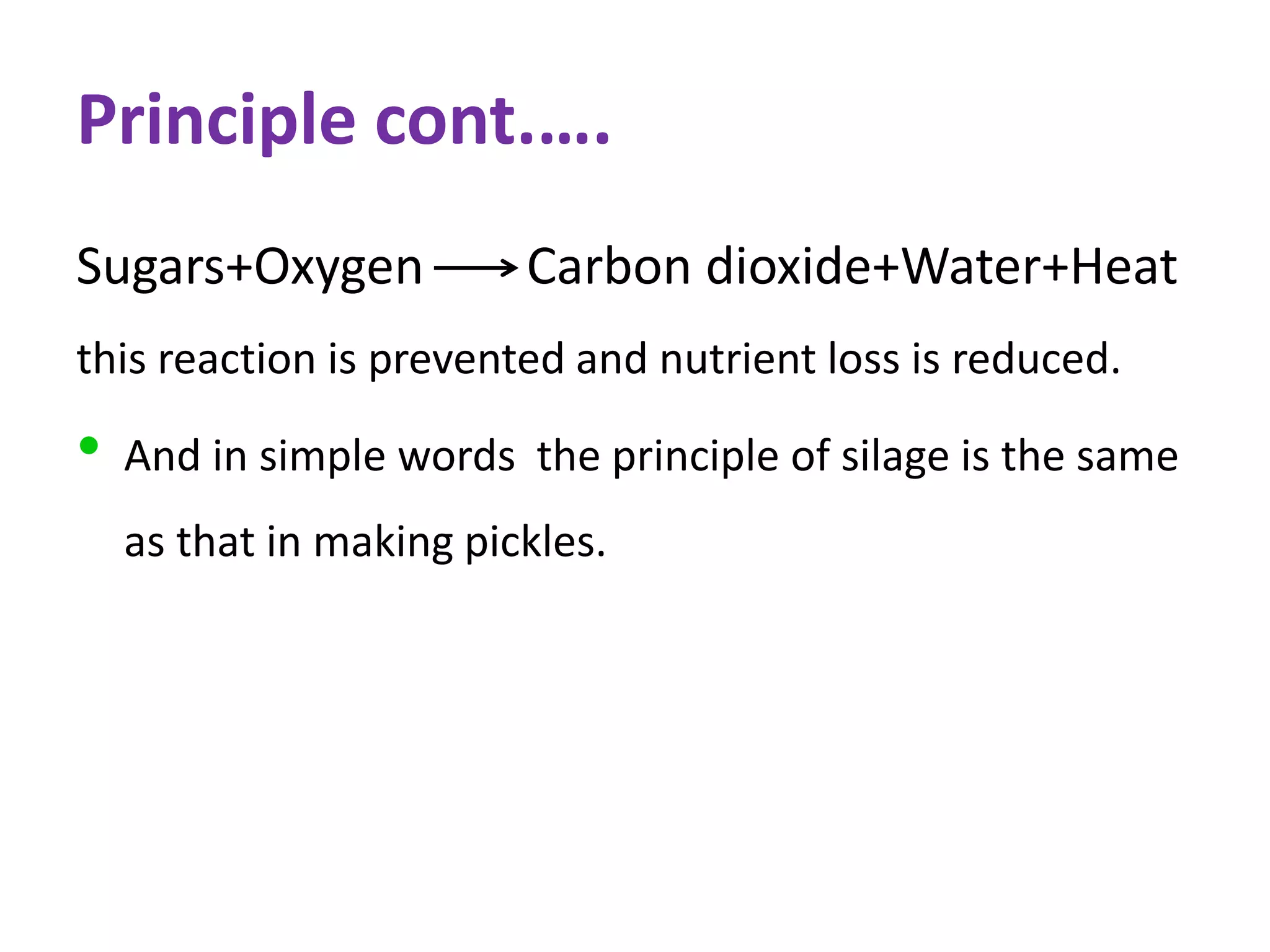
Principle cont.….
Sugars+Oxygen Carbon dioxide+Water+Heat
this reaction is prevented and nutrient loss is reduced.
• And in simple words the principle of silage is the same
as that in making pickles.
Selection of crops for silage
making
It is easier to ensile forages that have:
• High level of fermentable sugar.
• Low level of protein.
• Low buffering capacity.
• Should have about 35 per cent dry matter at the
time of ensiling.
Selection of crops cont.…
• Pasture grasses: Elephantgrass (Napiergrass), Guineagrass,
Rhodesgrass, Sudangrass, Setaria, Ruzigrass, etc.
• Pasture legumes: Stylo.
• Fodder tree: Leucaena, etc.
• Straws: rice straw, wheat straw, soybean chaff, peanut
hulls, etc.
• Corn, Sorghum.
• Farm by-products.
Site for construction of silo
• The place where we intended to construct silo should
be elevated from other places.
• The place must be free from water clogging.
• Walls of silo pit must be leak proof.
• It should at least six feet away from form animal shed.
• If it is possible construct the silo south side of the
animal shed.
Size of a silo
• The silo size is
determined by a herd
size, the amount of
daily feed, the number
of feeding days and
packed density of the
raw materials.
Making of Silage
 Harvesting of fodder.
• Pasture grasses: From early heading to heading stage.
• Pasture legumes: From budding to early flowering stage.
• Corn: Yellow ripening stage.
• Sorghum: Dough stage.
Making of Silage cont.…
 Moisture Testing 65-70 % moisture level in green
fodder is ideal for silage making (if moisture level is
high Wilting is required).
High moisture content leads to poor fermentation.
 Chopping of forage to short length (1-3 cm).
so that the packing density is kept higher, lactic acid
fermentation takes place in good condition.
Making of Silage cont.…
 Spreading chopped fodder to make a bed of 2 feet
height in Silo-Pit.
 Compact forage as tightly as possible with help of
tractor or hand roller or any heavy object.
 Sprinkle Molasses solution over it at 2-3% of the
material weight.
If the moisture content of the raw material is high,
molasses addition may have no effect.
Making of Silage cont.…
 Addition of bran and other silage additives.
When the moisture content of the raw materials is
80% or higher, brans are evenly sprayed at about 10% of
material weight.
 Sprinkle Silage SAVOR solution uniformly over the
fodder bed.
 Repeat steps no. 4-7 at least 6 to 10 times till the Silo-
Pit is completely filled up.
Making of Silage cont.…
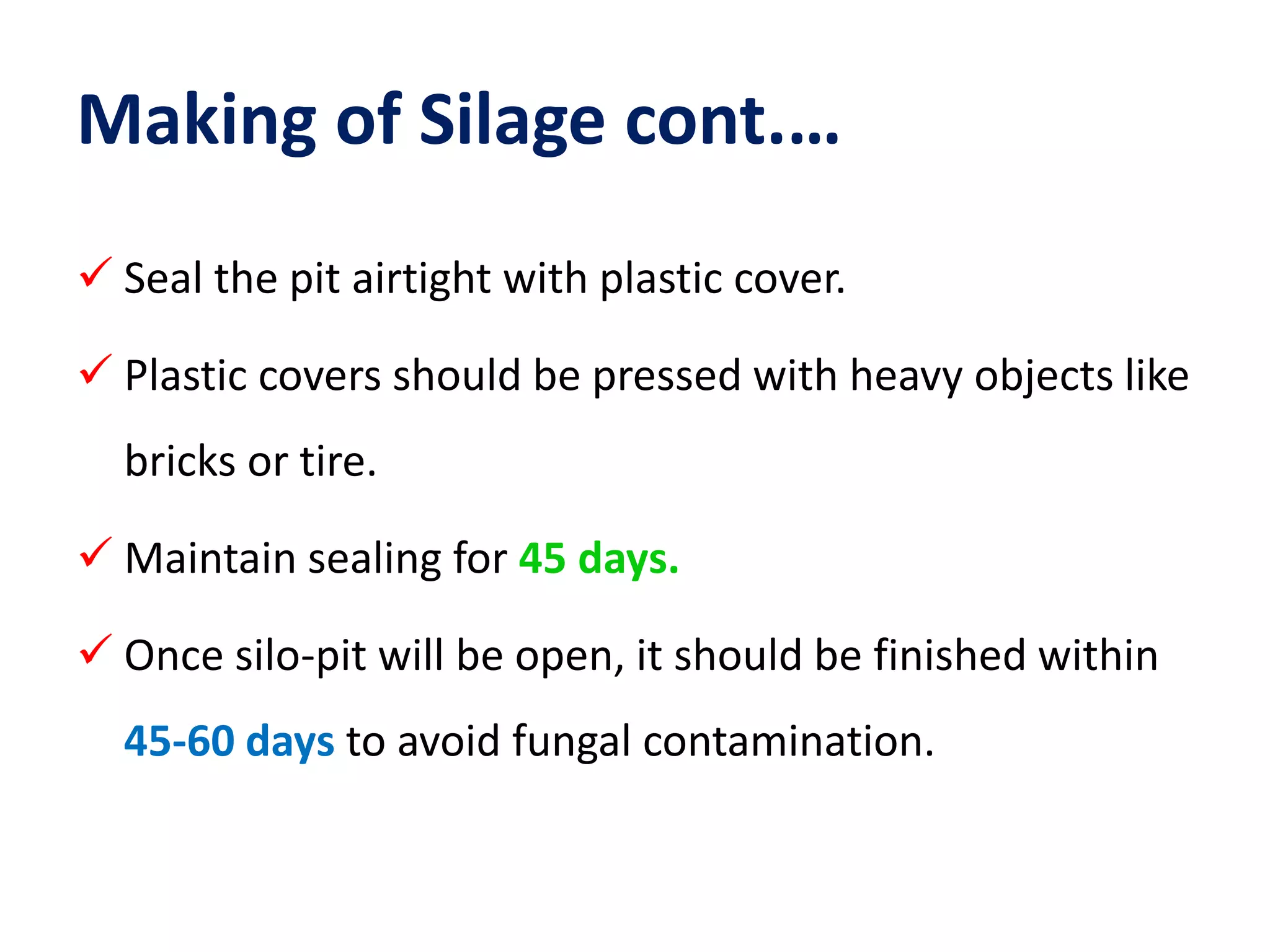
 Seal the pit airtight with plastic cover.
 Plastic covers should be pressed with heavy objects like
bricks or tire.
 Maintain sealing for 45 days.
 Once silo-pit will be open, it should be finished within
45-60 days to avoid fungal contamination.
Silage additives
Silage additives should
1.increase DM (nutrient) recovery,
2.improve animal performance
3.decrease heating and molding during storage and feed
out.
Direct acidifiers
• inorganic/organic acids –decreases pH
• E.g. Sulphuric and formic acids.
Silage additives cont.…
Fermentation inhibitors
• Immediately decreases pH
• Sterilents to inhibit micro flora
• e.g. formaldehyde, Maxgrass, Add safe, sorbic acid salts
Fermentation stimulants
• provide substrates for fermentation e.g. molasses
• enzymes -speed-up fermentation e.g.. cellulase
Silage additives cont.…
Inoculants -microbial cultures
• E.g. homofermentative lactobacille.
Others
• Specific antibiotics/ to nutritive value (NaCl, starch,
CaCO3etc)
Silage inoculants
• The primary purpose for adding bacterial inoculants
is to increase the number of lactic acid-producing
bacteria. Most commercial inoculants for silage
include
• Homo- fermentative lactic acid bacteria
e.g. Lactobacillus plantarum, Enterococcus
faecium and Pediococcus spp.
• Hetero-fermentative LAB is include, L. buchneri
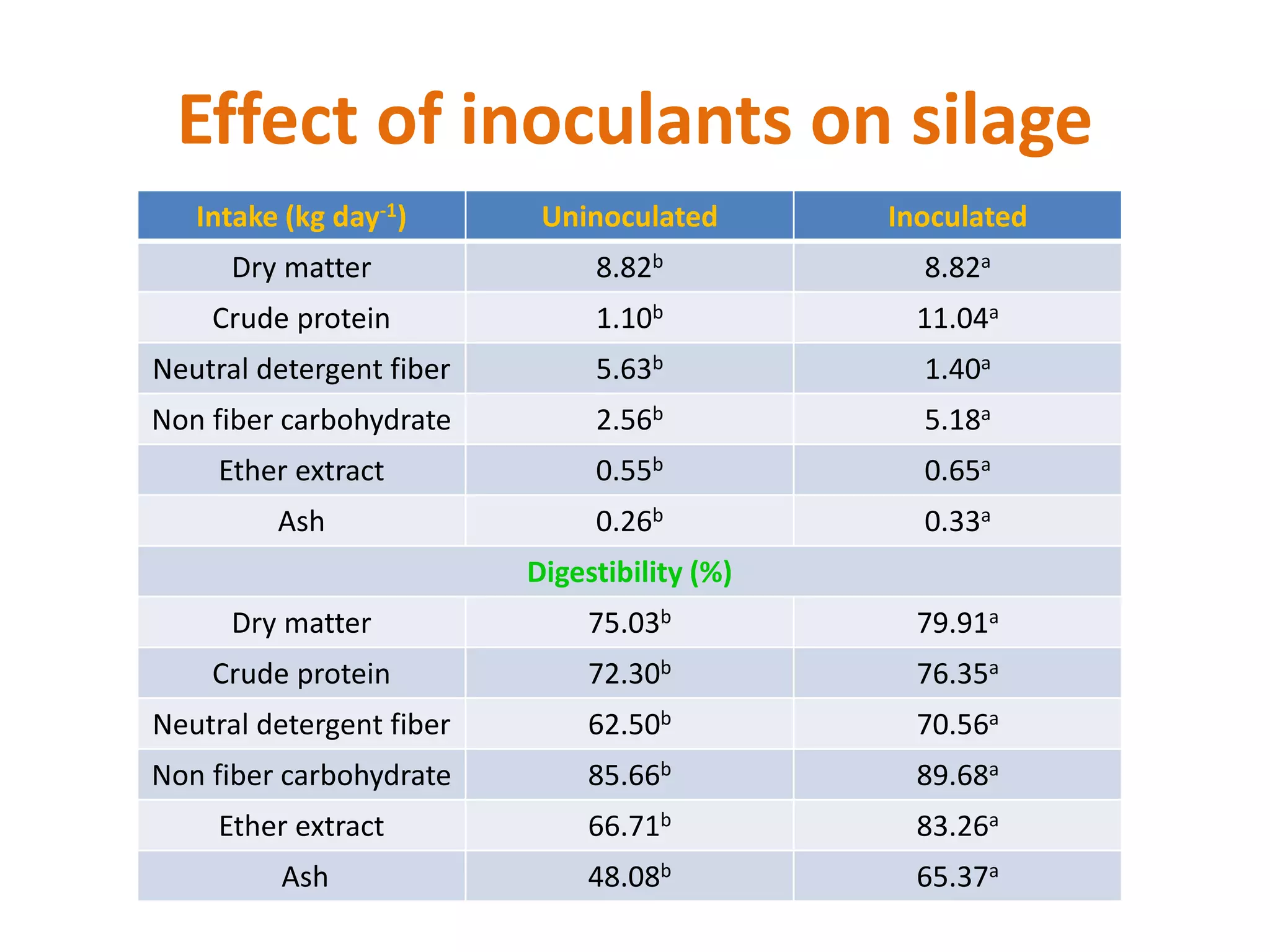
Effect of inoculants on silage
Intake (kg day-1) Uninoculated Inoculated
Dry matter 8.82b 8.82a
Crude protein 1.10b 11.04a
Neutral detergent fiber 5.63b 1.40a
Non fiber carbohydrate 2.56b 5.18a
Ether extract 0.55b 0.65a
Ash 0.26b 0.33a
Digestibility (%)
Dry matter 75.03b 79.91a
Crude protein 72.30b 76.35a
Neutral detergent fiber 62.50b 70.56a
Non fiber carbohydrate 85.66b 89.68a
Ether extract 66.71b 83.26a
Ash 48.08b 65.37a
Fermentation of Silage
Types of fermentation in Silage
formation
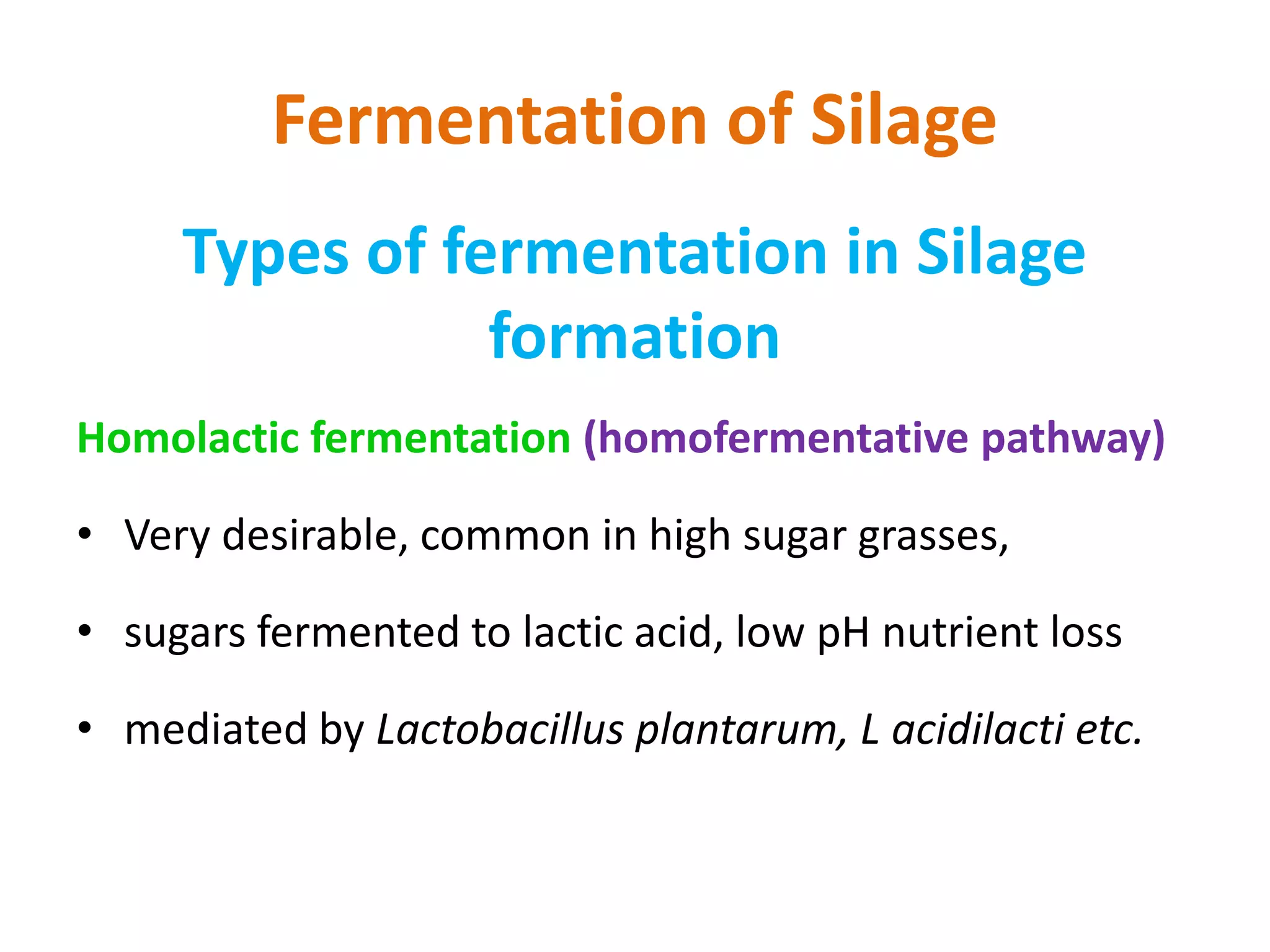
Homolactic fermentation (homofermentative pathway)
• Very desirable, common in high sugar grasses,
• sugars fermented to lactic acid, low pH nutrient loss
• mediated by Lactobacillus plantarum, L acidilacti etc.
Heterolactic fermentations (heterofermentative pathway)
• Less desirable, occurs when limited sugars are available,
• Mediated by Lactobacillus brevis, L. buchneri.
• Sugars mainly fermented to acetic acid, & alcohols.
• Less efficient than Homolactic fermentation.
Secondary fermentation
• Very undesirable.
• Degradation of lactate by clostridial bacteria to Ac & Bu
• Facilitated by high moisture contents & high pH
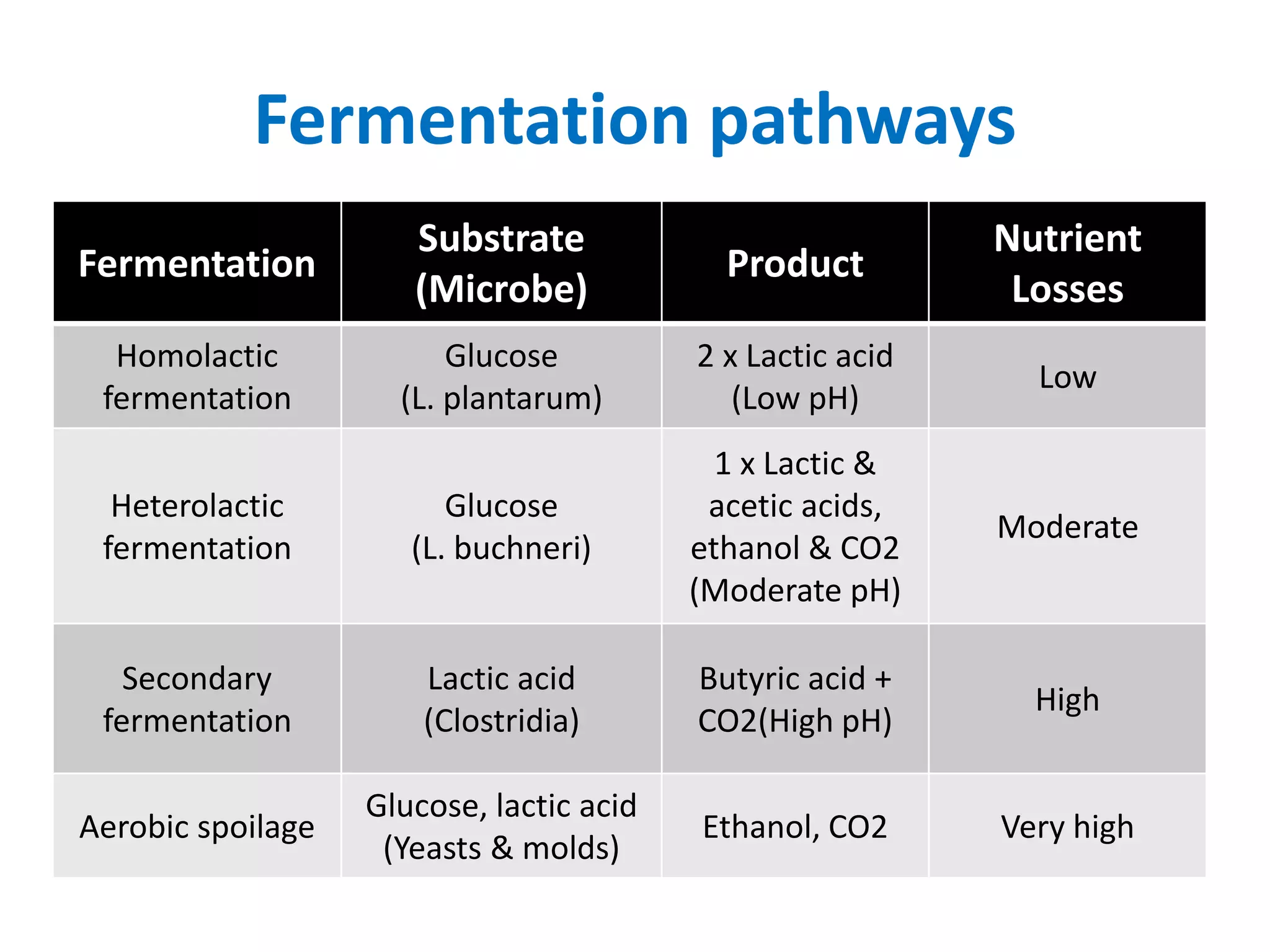
Fermentation pathways
Fermentation
Substrate
(Microbe)
Product
Nutrient
Losses
Homolactic
fermentation
Glucose
(L. plantarum)
2 x Lactic acid
(Low pH)
Low
Heterolactic
fermentation
Glucose
(L. buchneri)
1 x Lactic &
acetic acids,
ethanol & CO2
(Moderate pH)
Moderate
Secondary
fermentation
Lactic acid
(Clostridia)
Butyric acid +
CO2(High pH)
High
Aerobic spoilage
Glucose, lactic acid
(Yeasts & molds)
Ethanol, CO2 Very high
Fermentation process of silage
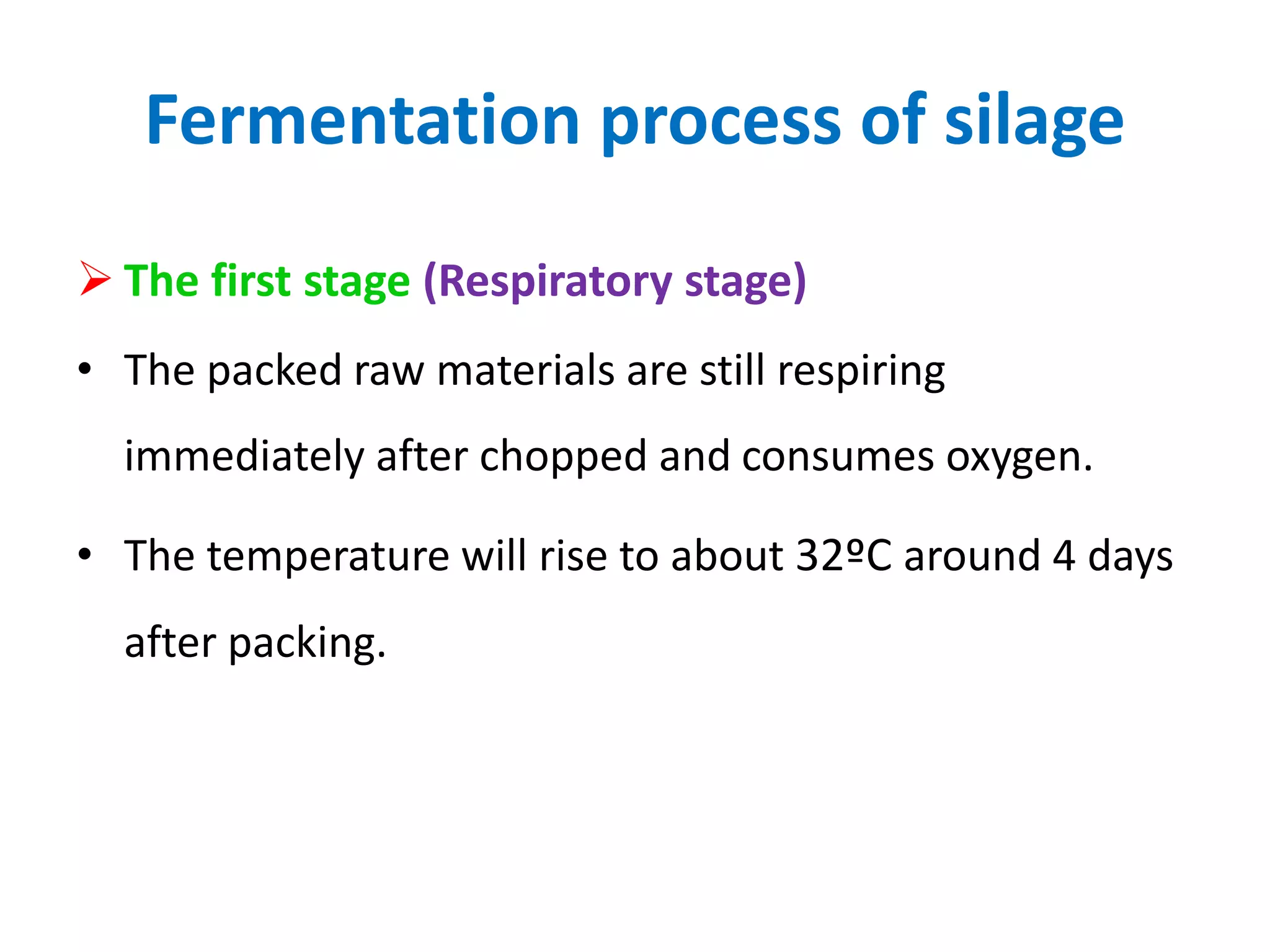
 The first stage (Respiratory stage)
• The packed raw materials are still respiring
immediately after chopped and consumes oxygen.
• The temperature will rise to about 32ºC around 4 days
after packing.
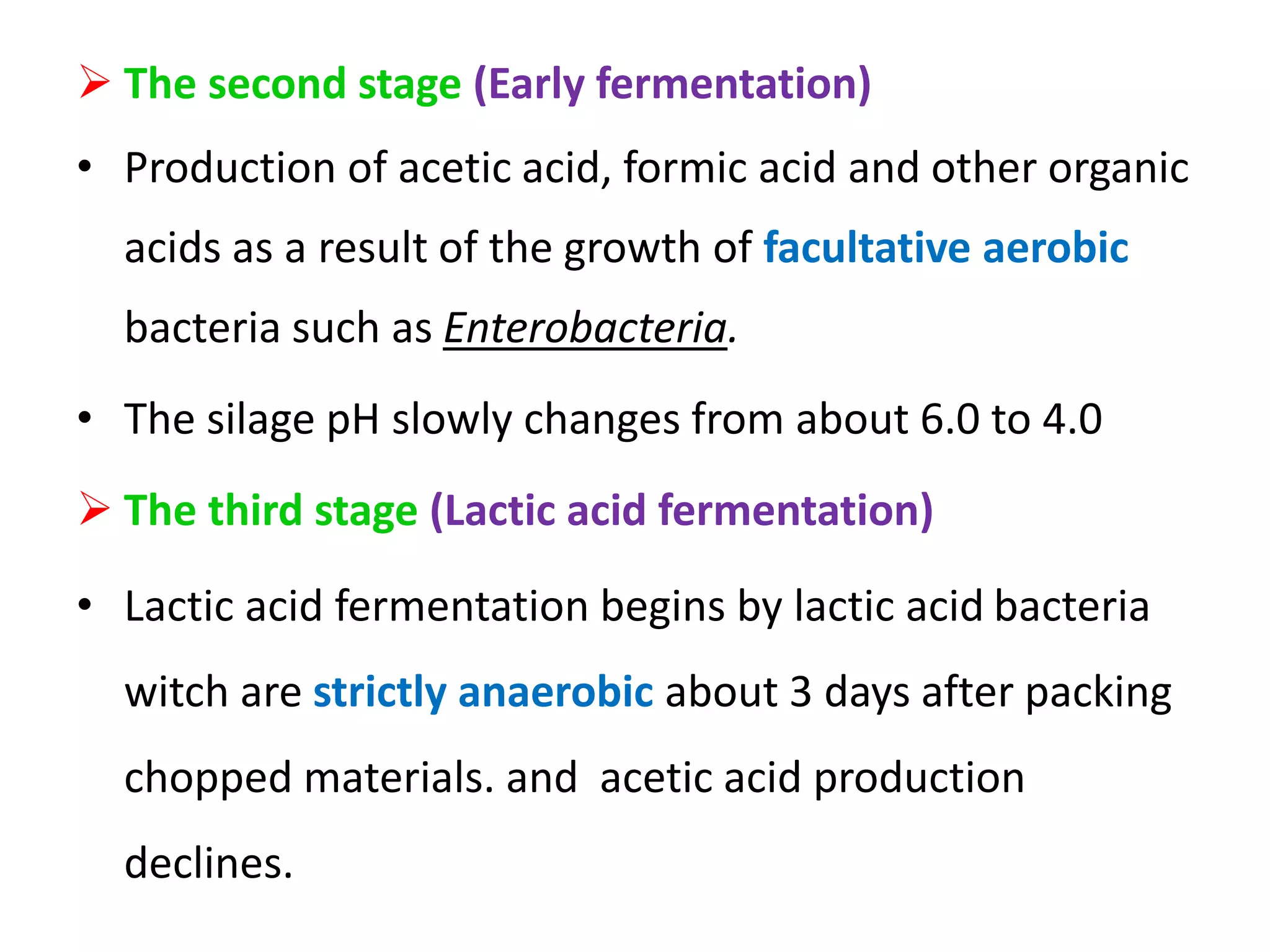
 The second stage (Early fermentation)
• Production of acetic acid, formic acid and other organic
acids as a result of the growth of facultative aerobic
bacteria such as Enterobacteria.
• The silage pH slowly changes from about 6.0 to 4.0
 The third stage (Lactic acid fermentation)
• Lactic acid fermentation begins by lactic acid bacteria
witch are strictly anaerobic about 3 days after packing
chopped materials. and acetic acid production
declines.
 The fourth stage (Cont.… of Lactic acid fermentation)
• Lactic acid production continues for about 2 weeks.
• The temperature goes down slowly to about the normal
atmospheric temperature. and pH is maintained at 4.0
 The fifth stage (Stabilization phase)
• Due to the presence of lactic acid, further degradation is
inhibited, as bacterial and fungal growths are checked.
• The lactic acid fermentation completes in about 20 days,
and the silage product is finished.
Fermentation at glance
If the lactic acid production is insufficient, butyric acid
fermentation begins and quality deterioration occurs.
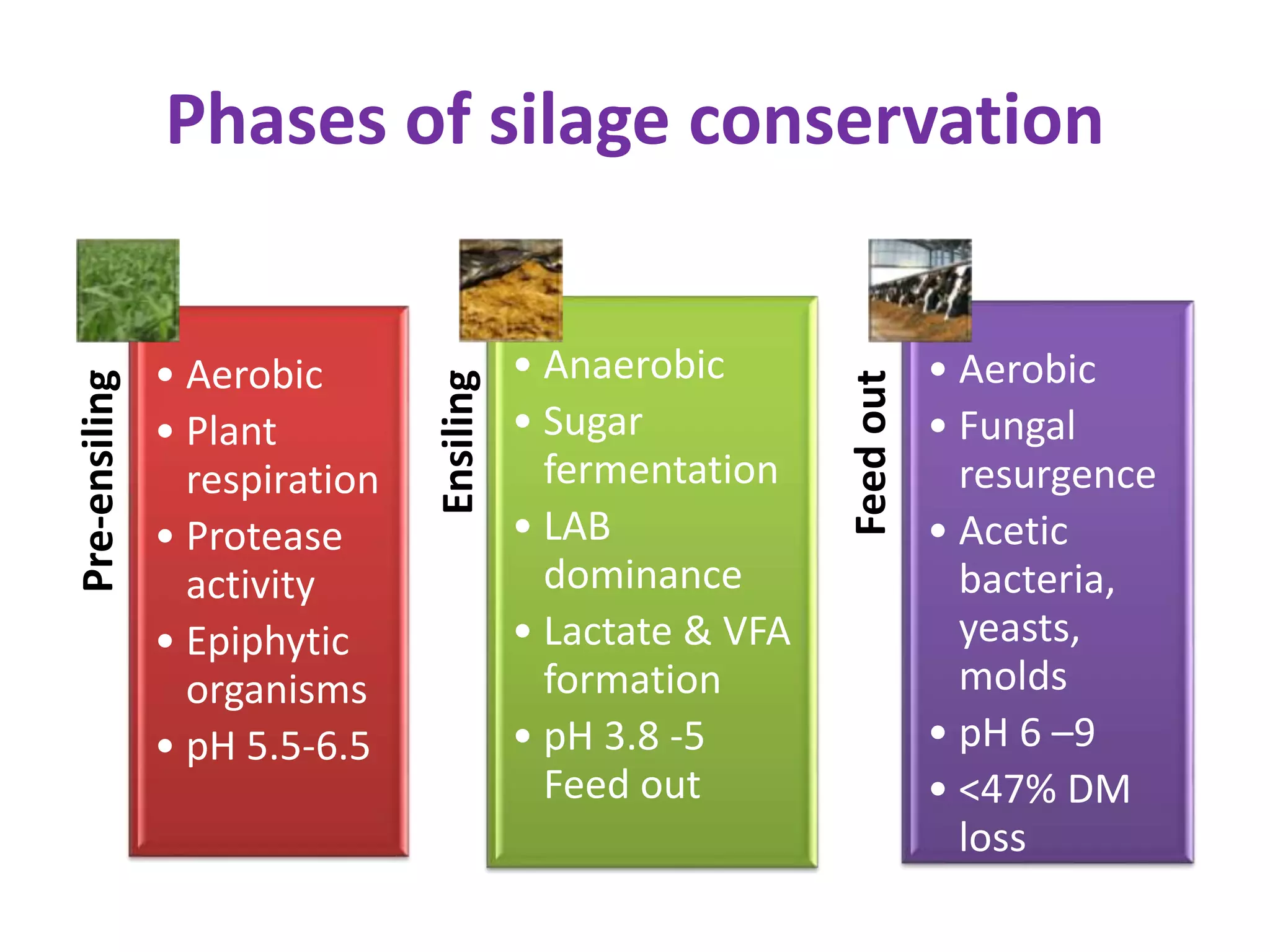
Phases of silage conservationPre-ensiling
• Aerobic
• Plant
respiration
• Protease
activity
• Epiphytic
organisms
• pH 5.5-6.5
Ensiling
• Anaerobic
• Sugar
fermentation
• LAB
dominance
• Lactate & VFA
formation
• pH 3.8 -5
Feed out
Feedout
• Aerobic
• Fungal
resurgence
• Acetic
bacteria,
yeasts,
molds
• pH 6 –9
• <47% DM
loss
Chemical changes during
fermentation
• Sugars are fermented into volatile fatty acids (VFA) like
lactic, acetic, propionic & butyric)acids by anaerobic
microorganisms.
• The formation of the acids reduces the pH (target = 4)
• Protein is degraded into ammonia and NPN (target
=<100g ammonia/kg total Nitrogen)
Chemical changes during
fermentation
Day 1-10 Day 11-20 Day 21-30 Day 31-40 Day 41-50
Sugars
CP
Ammonia
Buteric acid
Acetic acid
Lactate
Grass Silage
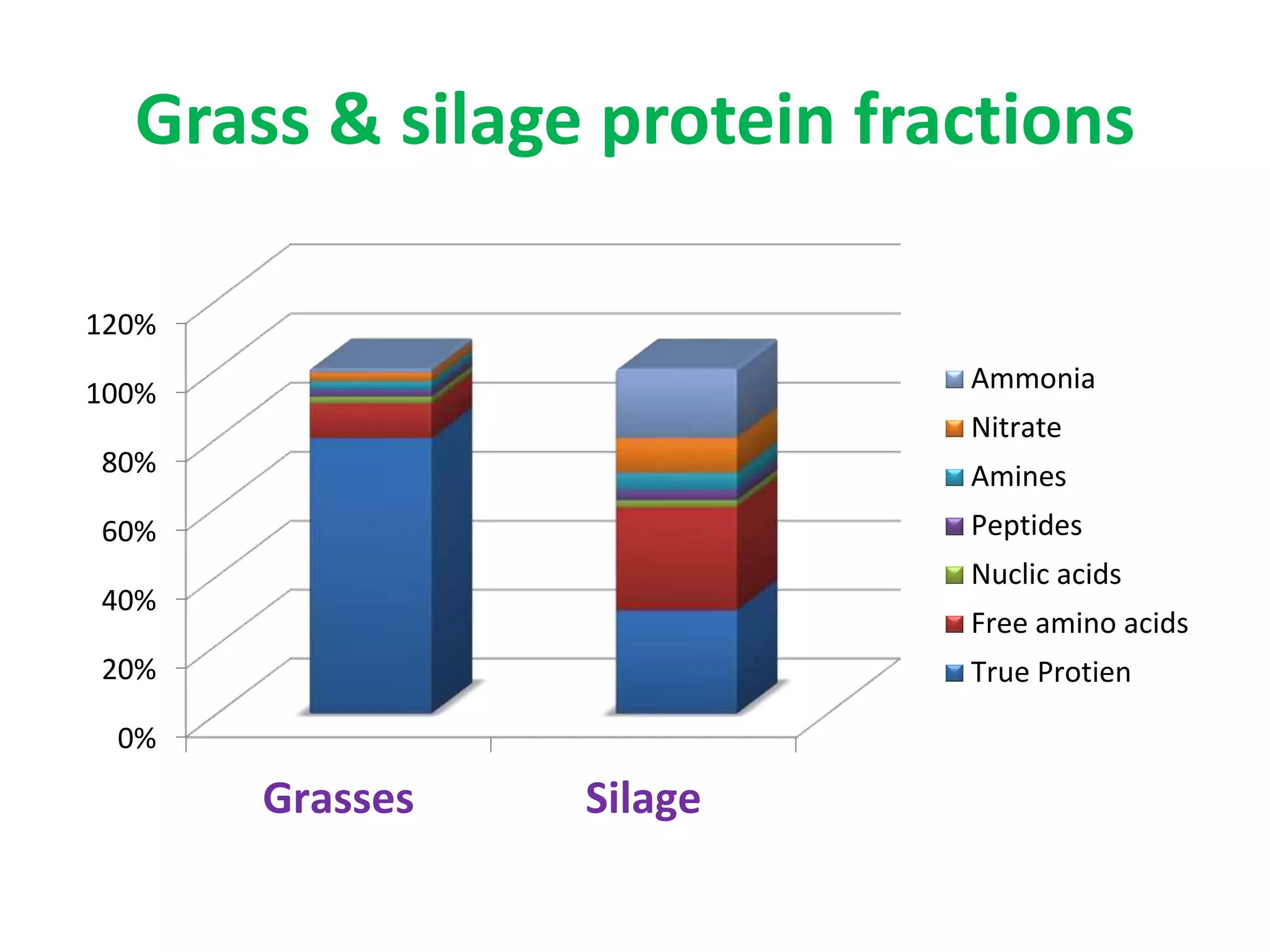
Grass & silage protein fractions
0%
20%
40%
60%
80%
100%
120%
Grasses Silage
Ammonia
Nitrate
Amines
Peptides
Nuclic acids
Free amino acids
True Protien
Kinds of silos
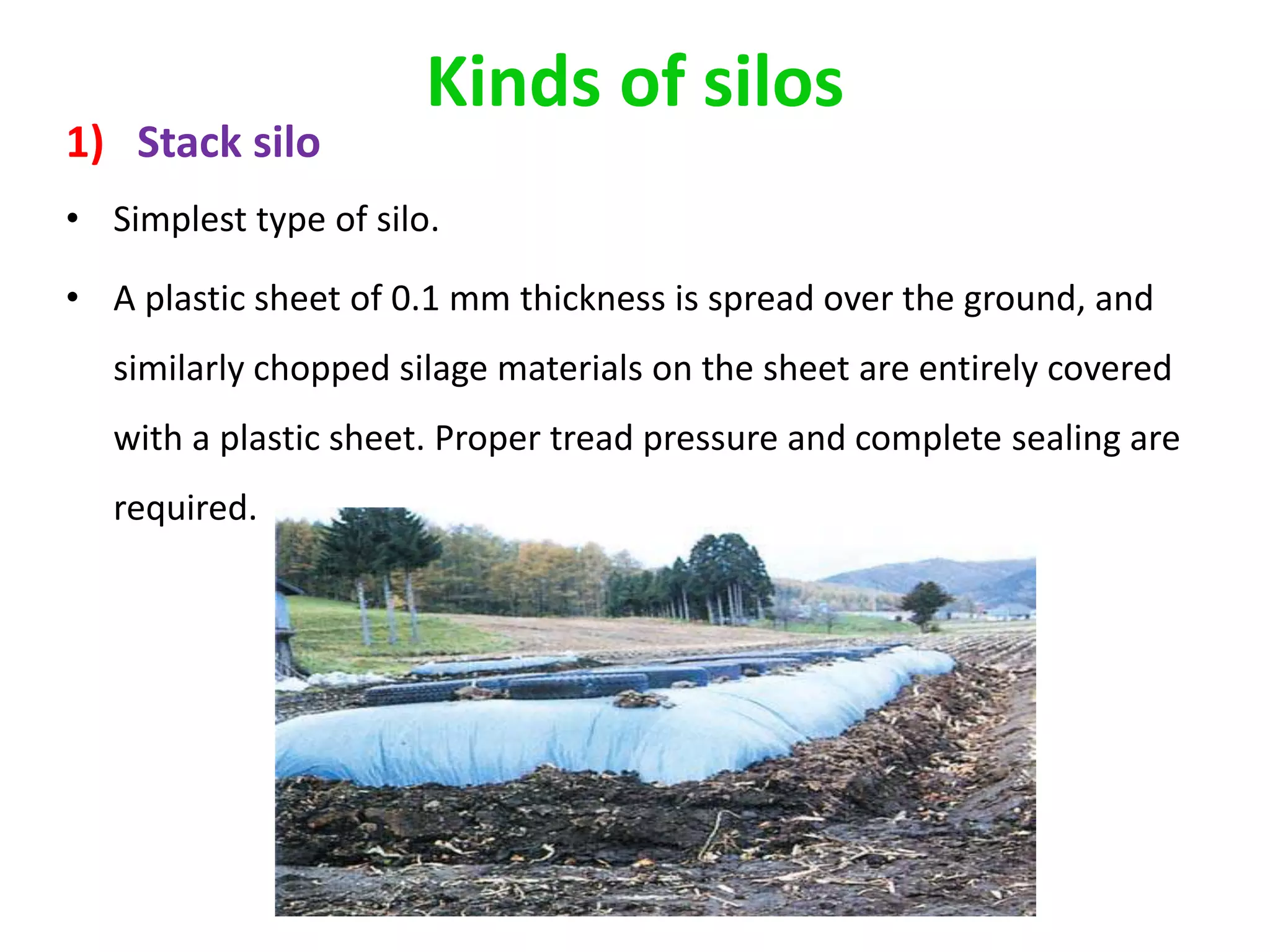
1) Stack silo
• Simplest type of silo.
• A plastic sheet of 0.1 mm thickness is spread over the ground, and
similarly chopped silage materials on the sheet are entirely covered
with a plastic sheet. Proper tread pressure and complete sealing are
required.
2) Bunker silo
• A bunker silo is generally built on the ground but there
are other building methods to build a silo using the
configuration of the ground (slope 3-5%) or a semi
underground type, which is half below from the ground
level.
• Side walls made of wood and concrete are needed, and
the interior is preferably sealed by plastic sheets.
Proper tread pressure has to be applied, and complete
sealing is required.
• Supports are needed so that the side walls do not fall
outside.
• The width of the front should be such that the total
amount of silage per day can be taken out with a
thickness of 20-30 cm to prevent aerobic deterioration.
3) Pit/Trench silo
• A trench silo can be built by simply digging the ground,
but it is better to place plastic sheets inside to prevent
loss.
• A trench silo whose interior is coated with concrete can
be used for a long time
4) Plastic bag silo
• In this type plastic bags with thickness of 0.1 mm are
taken and fill bags with chopped raw materials,
compressed as much as possible to remove the internal
air and then sealed completely.
5) Fenced silo (framed silo)
• The frame is made of bamboo, wooden, iron materials,
etc., the shape of cross section may be circular or
rectangular. and inside is sealed with plastic sheets.
6) Tower silo
• In this type storage silos are
cylindrical structures, typically
10 to 90 ft. (3 to 27 m) in
diameter and 30 to 275 ft. (10
to 90 m) in height .
• Tower silos containing silage
are usually unloaded from the
top of the pile.
Judging the quality of silage
The quality of silage can be judged by its color, smell,
taste and touch.
• Color: In general, pale yellow indicates good quality. If
the color is from dark brown to dark green, the silage
underwent bad fermentation and is of bad quality.
• Smell: Acidic or a sweet-sour pleasant smell indicates
good quality. On the other hand, if there is a manure
smell or putrid smell and it is so repugnant that one
cannot put the silage near one's nose, the quality is
poor.
• Taste: If the silage tastes sour and there is no problem
in putting it in one's mouth, the quality is good. On the
other hand, if the silage tastes bitter and one cannot
put it in one's mouth, the quality is poor.
• Touch: When squeezing the silage tightly in a hand and
then opening the hand, if the silage breaks slowly into
two, that silage is of good quality. If the silage breaks
into small pieces separately, the silage is deficient in
moisture content. If water is dripping, the moisture
content of the silage is too high.
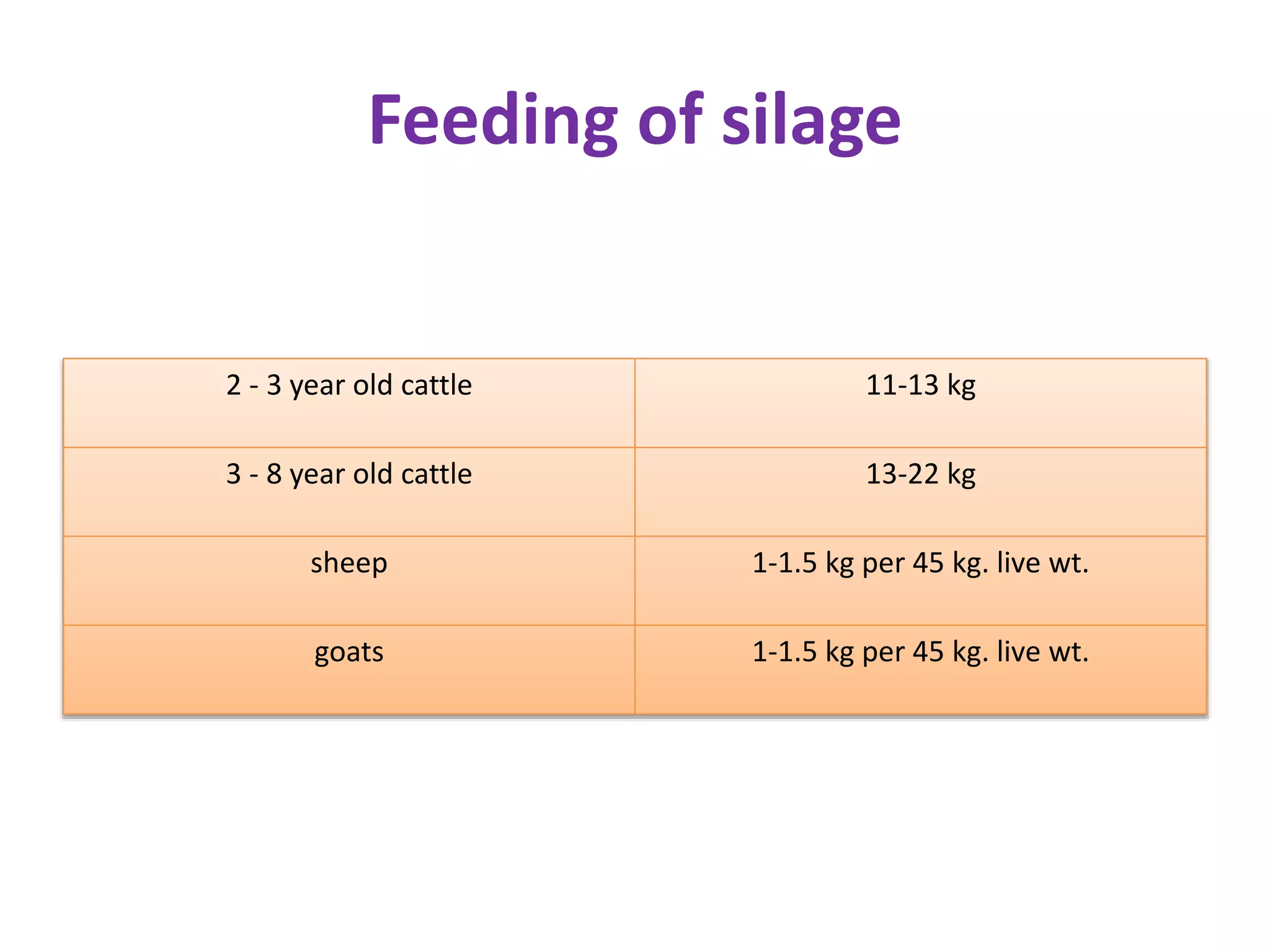
Feeding of silage
2 - 3 year old cattle 11-13 kg
3 - 8 year old cattle 13-22 kg
sheep 1-1.5 kg per 45 kg. live wt.
goats 1-1.5 kg per 45 kg. live wt.
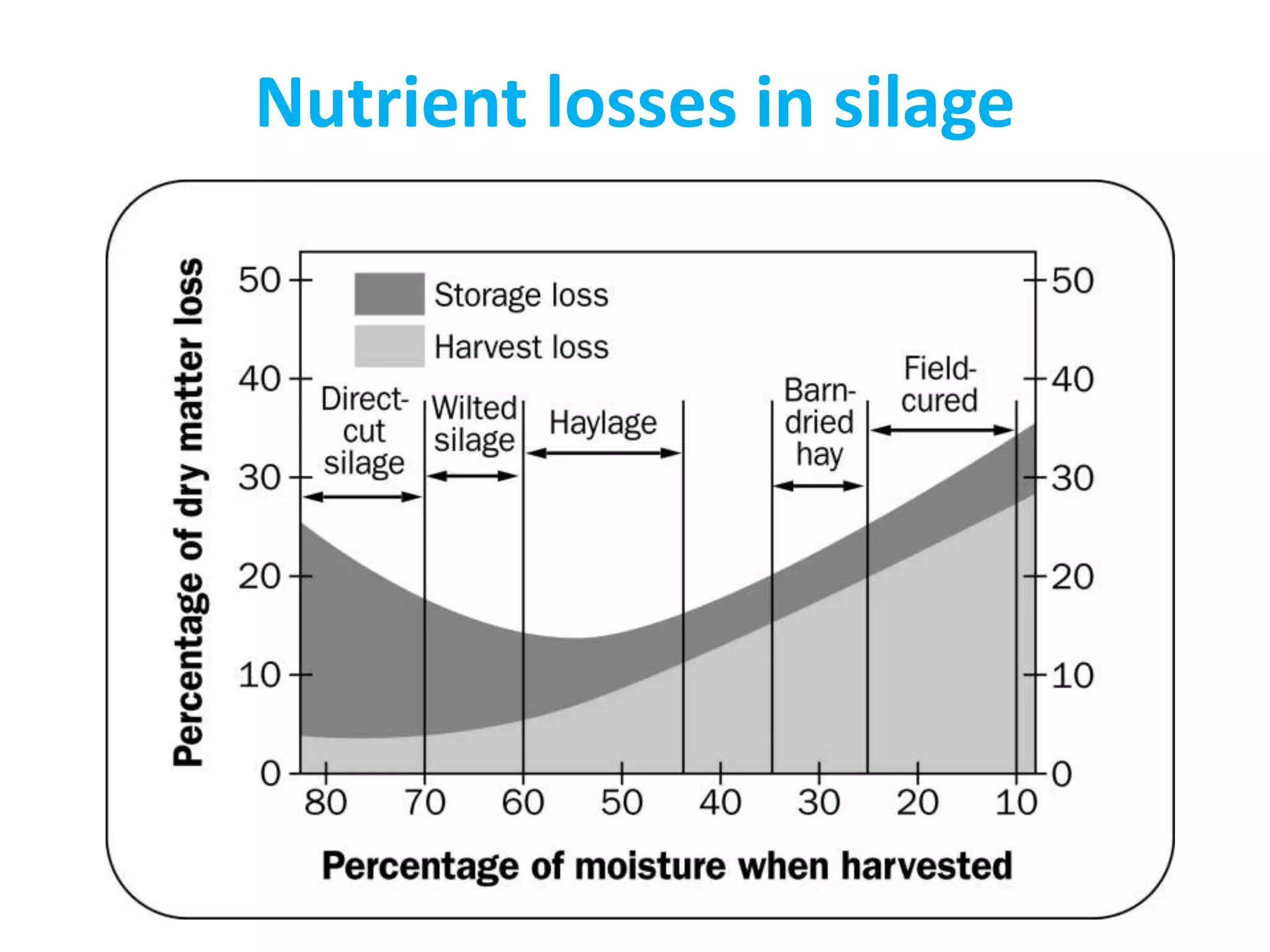
Nutrient losses in silage
Energy losses in silage and causative factors
Process Classification
Approximate
loss (%)
Causative factors
Residual
respiration
Unavoidable 1-2 Plant enzymes
Fermentation Unavoidable 2- 4 Microorganisms
Effluent Mutually 5 -7
Dry matter content is too
low
Wilting losses unavoidable 2- 5 Weather, technique, crop
Secondary
fermentation
Avoidable 0 - 5
Buffering capacity, Dry
matter content is too low
Aerobic
deterioration
during storage
Avoidable 0 -10
Delayed filling and
compaction, sealing, crop
susceptibility
Aerobic
deterioration after
unloading
Avoidable 0 -15
As above, DM content,
season, unloading
technique and rate
Total 7- 40
Factors enhance the nutrient
quality of silage
Add dry matter to reduce moisture content:
To reduce seepage losses and
To provide a more suitable medium for the
fermentation process.
• Generally, grasses and legumes are wilted or dried to
an average of about 65% moisture or less depending
on the type of storage used.
• If in any case, forage crops are harvested at too wet for
silage, the following guideline for dry matter addition
may be used.
Coarsely ground cereal grains or chopped grasses are
used @ for 5% reduction moisture about 150 to 200
pounds of material is added per ton of wet forage
weight.
Add water to increase moisture content:
• If forage crops to be stored as silage are too dry,
then packing to exclude air is difficult.
• Under such conditions, water must be added to raise
the moisture content to the desired level to increase
forage moisture content 1% unit approximately 5 to 6
gallons/ ton of ensiled material.
Rate, amount and kind of acid production:
• The rate, amount and kind of acid produced is
influenced by the moisture content of the chopped
forage and the readily available carbohydrate content
of the forage.
• Acid production is essential in the keeping qualities of
silage.
Adding of molasses
• Molasses is an excellent carbohydrate or sugar source
for legumes and grasses containing 75 to 80%
moisture.
• For legumes, about 80 pounds of molasses per ton is
required, and for grasses 40 pounds is generally used.
Acidifying the silage:
• Acidifying silage, using a strong acid, generally
practiced in Europe on high-moisture grass silage.
• The purpose was to produce an immediate acid
condition rather than waiting for the silage to produce
its own acid.
• This practice is not recommended in the USA because
of its high cost, the corrosive nature of the acids and
low forage palatability.
Inhibition of bacteria and mold growth:
• Generally formic and propionic acids are commonly used
as preservative to prevent bacterial and mold growth.
• The major benefit of adding these acids to silage is
reduce the spoilage in open storage structures.
• Formic acid is added to hay crop silages @ 0.45% of the
wet weight or 2.25% of the DM weight.
• Propionic acid is added @ 0.5 to 1.0% of the wet forage
weight.
Increasing the nutrient content
of silage
• To increase the nutritive value of silages, Materials
such as cereal grains, molasses, dry forages, limestone,
urea and anhydrous ammonia etc., are added to silage.
• Commercial products are also available that contain
one or more of the above materials.
• Limestone (calcium carbonate) is sometimes added to
corn silage to increase the calcium content and extend
the fermentation process @ 10 to 20 pounds per ton of
corn silage.
• To increase the protein content of silage, Sometimes
Urea and anhydrous ammonia, NPN sources are also
added.
• Usually they increase the forage protein content about
4% units on a dry matter basis.
NPN Sources Form % Nitrogen
Application Rate
(lbs./wet ton)
Urea dry 45 10
Mono-ammonium
phosphate
dry 11 202
Pre-mixed
ammonia-water
liquid 20-30 17-25
Anhydrous
ammonia
gas 81 6-7
Ammonia, cold
flow
gas-liquid 81 6-7
THANK YOU
Vishnu Vardhan Reddy.P
TVM/2015-029

Silage

  • 1.
    Conservation of fodder Silagemaking Vishnu Vardhan Reddy.P TVM/2015-029
  • 2.
    What is Conservationof fodder • Conservation of fodder means preservation and careful maintenance of certain quantities fodder unchanged during chemical reactions or physical transformations of fodder when it is excessively available for future needs.
  • 3.
    What for Conservationof fodder • To preserve feed when it is available in excess. • To maintain optimum nutritional value of fodder. • To shift available feed from the present to the future. • To move feed from one location to another location. • To assist pasture management.
  • 4.
    Methods of Conservation •Hay and silage are the main methods of conserving forage • Hay is preserved by drying and will generally keep while it is kept dry. • Silage involves natural fermentation, which produces lactic and other acids, which ‘pickle’ or preserve the forage.
  • 5.
    What is silage Silage is the green material produced by controlled fermentation of the green fodder crop retaining the high moisture content. • Contain 20-40% DM and 14-16% CP
  • 6.
    Advantages of silagemaking • Silage can be prepared from green fodder when the weather does not permit for haymaking. • Silage can be prepared from plants having thick stems and are generally not very suitable for haymaking like sorghum, maize
  • 7.
    Advantages cont.… • Weedscan also be utilized along with main fodder crops for silage making. Silage making kills majority of weed seeds. • It is highly palatable. The organic acids produced in the silage are similar to those normally produced in the digestive tract of the ruminants and therefore are used in the same manner.
  • 8.
    Principle of Silagemaking • Anaerobic condition is first and foremost requirement for silage making, as it allows lactic acid bacteria to grow, which converts sugars into lactic acid, a strong organic acid. • As pH declines, the degrading actions of plant enzymes and undesirable bacteria are inhibited and at pH 3-4, most degrading enzymes are inhibited and the growth of lactic acid bacteria is also inhibited.
  • 9.
    Principle cont.…. Sugars+Oxygen Carbondioxide+Water+Heat this reaction is prevented and nutrient loss is reduced. • And in simple words the principle of silage is the same as that in making pickles.
  • 10.
    Selection of cropsfor silage making It is easier to ensile forages that have: • High level of fermentable sugar. • Low level of protein. • Low buffering capacity. • Should have about 35 per cent dry matter at the time of ensiling.
  • 11.
    Selection of cropscont.… • Pasture grasses: Elephantgrass (Napiergrass), Guineagrass, Rhodesgrass, Sudangrass, Setaria, Ruzigrass, etc. • Pasture legumes: Stylo. • Fodder tree: Leucaena, etc. • Straws: rice straw, wheat straw, soybean chaff, peanut hulls, etc. • Corn, Sorghum. • Farm by-products.
  • 12.
    Site for constructionof silo • The place where we intended to construct silo should be elevated from other places. • The place must be free from water clogging. • Walls of silo pit must be leak proof. • It should at least six feet away from form animal shed. • If it is possible construct the silo south side of the animal shed.
  • 13.
    Size of asilo • The silo size is determined by a herd size, the amount of daily feed, the number of feeding days and packed density of the raw materials.
  • 14.
    Making of Silage Harvesting of fodder. • Pasture grasses: From early heading to heading stage. • Pasture legumes: From budding to early flowering stage. • Corn: Yellow ripening stage. • Sorghum: Dough stage.
  • 15.
    Making of Silagecont.…  Moisture Testing 65-70 % moisture level in green fodder is ideal for silage making (if moisture level is high Wilting is required). High moisture content leads to poor fermentation.  Chopping of forage to short length (1-3 cm). so that the packing density is kept higher, lactic acid fermentation takes place in good condition.
  • 16.
    Making of Silagecont.…  Spreading chopped fodder to make a bed of 2 feet height in Silo-Pit.  Compact forage as tightly as possible with help of tractor or hand roller or any heavy object.  Sprinkle Molasses solution over it at 2-3% of the material weight. If the moisture content of the raw material is high, molasses addition may have no effect.
  • 17.
    Making of Silagecont.…  Addition of bran and other silage additives. When the moisture content of the raw materials is 80% or higher, brans are evenly sprayed at about 10% of material weight.  Sprinkle Silage SAVOR solution uniformly over the fodder bed.  Repeat steps no. 4-7 at least 6 to 10 times till the Silo- Pit is completely filled up.
  • 18.
    Making of Silagecont.…  Seal the pit airtight with plastic cover.  Plastic covers should be pressed with heavy objects like bricks or tire.  Maintain sealing for 45 days.  Once silo-pit will be open, it should be finished within 45-60 days to avoid fungal contamination.
  • 19.
    Silage additives Silage additivesshould 1.increase DM (nutrient) recovery, 2.improve animal performance 3.decrease heating and molding during storage and feed out. Direct acidifiers • inorganic/organic acids –decreases pH • E.g. Sulphuric and formic acids.
  • 20.
    Silage additives cont.… Fermentationinhibitors • Immediately decreases pH • Sterilents to inhibit micro flora • e.g. formaldehyde, Maxgrass, Add safe, sorbic acid salts Fermentation stimulants • provide substrates for fermentation e.g. molasses • enzymes -speed-up fermentation e.g.. cellulase
  • 21.
    Silage additives cont.… Inoculants-microbial cultures • E.g. homofermentative lactobacille. Others • Specific antibiotics/ to nutritive value (NaCl, starch, CaCO3etc)
  • 22.
    Silage inoculants • Theprimary purpose for adding bacterial inoculants is to increase the number of lactic acid-producing bacteria. Most commercial inoculants for silage include • Homo- fermentative lactic acid bacteria e.g. Lactobacillus plantarum, Enterococcus faecium and Pediococcus spp. • Hetero-fermentative LAB is include, L. buchneri
  • 23.
    Effect of inoculantson silage Intake (kg day-1) Uninoculated Inoculated Dry matter 8.82b 8.82a Crude protein 1.10b 11.04a Neutral detergent fiber 5.63b 1.40a Non fiber carbohydrate 2.56b 5.18a Ether extract 0.55b 0.65a Ash 0.26b 0.33a Digestibility (%) Dry matter 75.03b 79.91a Crude protein 72.30b 76.35a Neutral detergent fiber 62.50b 70.56a Non fiber carbohydrate 85.66b 89.68a Ether extract 66.71b 83.26a Ash 48.08b 65.37a
  • 24.
    Fermentation of Silage Typesof fermentation in Silage formation Homolactic fermentation (homofermentative pathway) • Very desirable, common in high sugar grasses, • sugars fermented to lactic acid, low pH nutrient loss • mediated by Lactobacillus plantarum, L acidilacti etc.
  • 25.
    Heterolactic fermentations (heterofermentativepathway) • Less desirable, occurs when limited sugars are available, • Mediated by Lactobacillus brevis, L. buchneri. • Sugars mainly fermented to acetic acid, & alcohols. • Less efficient than Homolactic fermentation. Secondary fermentation • Very undesirable. • Degradation of lactate by clostridial bacteria to Ac & Bu • Facilitated by high moisture contents & high pH
  • 26.
    Fermentation pathways Fermentation Substrate (Microbe) Product Nutrient Losses Homolactic fermentation Glucose (L. plantarum) 2x Lactic acid (Low pH) Low Heterolactic fermentation Glucose (L. buchneri) 1 x Lactic & acetic acids, ethanol & CO2 (Moderate pH) Moderate Secondary fermentation Lactic acid (Clostridia) Butyric acid + CO2(High pH) High Aerobic spoilage Glucose, lactic acid (Yeasts & molds) Ethanol, CO2 Very high
  • 27.
    Fermentation process ofsilage  The first stage (Respiratory stage) • The packed raw materials are still respiring immediately after chopped and consumes oxygen. • The temperature will rise to about 32ºC around 4 days after packing.
  • 28.
     The secondstage (Early fermentation) • Production of acetic acid, formic acid and other organic acids as a result of the growth of facultative aerobic bacteria such as Enterobacteria. • The silage pH slowly changes from about 6.0 to 4.0  The third stage (Lactic acid fermentation) • Lactic acid fermentation begins by lactic acid bacteria witch are strictly anaerobic about 3 days after packing chopped materials. and acetic acid production declines.
  • 29.
     The fourthstage (Cont.… of Lactic acid fermentation) • Lactic acid production continues for about 2 weeks. • The temperature goes down slowly to about the normal atmospheric temperature. and pH is maintained at 4.0  The fifth stage (Stabilization phase) • Due to the presence of lactic acid, further degradation is inhibited, as bacterial and fungal growths are checked. • The lactic acid fermentation completes in about 20 days, and the silage product is finished.
  • 30.
    Fermentation at glance Ifthe lactic acid production is insufficient, butyric acid fermentation begins and quality deterioration occurs.
  • 31.
    Phases of silageconservationPre-ensiling • Aerobic • Plant respiration • Protease activity • Epiphytic organisms • pH 5.5-6.5 Ensiling • Anaerobic • Sugar fermentation • LAB dominance • Lactate & VFA formation • pH 3.8 -5 Feed out Feedout • Aerobic • Fungal resurgence • Acetic bacteria, yeasts, molds • pH 6 –9 • <47% DM loss
  • 32.
    Chemical changes during fermentation •Sugars are fermented into volatile fatty acids (VFA) like lactic, acetic, propionic & butyric)acids by anaerobic microorganisms. • The formation of the acids reduces the pH (target = 4) • Protein is degraded into ammonia and NPN (target =<100g ammonia/kg total Nitrogen)
  • 33.
    Chemical changes during fermentation Day1-10 Day 11-20 Day 21-30 Day 31-40 Day 41-50 Sugars CP Ammonia Buteric acid Acetic acid Lactate Grass Silage
  • 34.
    Grass & silageprotein fractions 0% 20% 40% 60% 80% 100% 120% Grasses Silage Ammonia Nitrate Amines Peptides Nuclic acids Free amino acids True Protien
  • 35.
    Kinds of silos 1)Stack silo • Simplest type of silo. • A plastic sheet of 0.1 mm thickness is spread over the ground, and similarly chopped silage materials on the sheet are entirely covered with a plastic sheet. Proper tread pressure and complete sealing are required.
  • 36.
    2) Bunker silo •A bunker silo is generally built on the ground but there are other building methods to build a silo using the configuration of the ground (slope 3-5%) or a semi underground type, which is half below from the ground level.
  • 37.
    • Side wallsmade of wood and concrete are needed, and the interior is preferably sealed by plastic sheets. Proper tread pressure has to be applied, and complete sealing is required. • Supports are needed so that the side walls do not fall outside. • The width of the front should be such that the total amount of silage per day can be taken out with a thickness of 20-30 cm to prevent aerobic deterioration.
  • 38.
    3) Pit/Trench silo •A trench silo can be built by simply digging the ground, but it is better to place plastic sheets inside to prevent loss. • A trench silo whose interior is coated with concrete can be used for a long time
  • 39.
    4) Plastic bagsilo • In this type plastic bags with thickness of 0.1 mm are taken and fill bags with chopped raw materials, compressed as much as possible to remove the internal air and then sealed completely.
  • 40.
    5) Fenced silo(framed silo) • The frame is made of bamboo, wooden, iron materials, etc., the shape of cross section may be circular or rectangular. and inside is sealed with plastic sheets.
  • 41.
    6) Tower silo •In this type storage silos are cylindrical structures, typically 10 to 90 ft. (3 to 27 m) in diameter and 30 to 275 ft. (10 to 90 m) in height . • Tower silos containing silage are usually unloaded from the top of the pile.
  • 42.
    Judging the qualityof silage The quality of silage can be judged by its color, smell, taste and touch. • Color: In general, pale yellow indicates good quality. If the color is from dark brown to dark green, the silage underwent bad fermentation and is of bad quality.
  • 43.
    • Smell: Acidicor a sweet-sour pleasant smell indicates good quality. On the other hand, if there is a manure smell or putrid smell and it is so repugnant that one cannot put the silage near one's nose, the quality is poor. • Taste: If the silage tastes sour and there is no problem in putting it in one's mouth, the quality is good. On the other hand, if the silage tastes bitter and one cannot put it in one's mouth, the quality is poor.
  • 44.
    • Touch: Whensqueezing the silage tightly in a hand and then opening the hand, if the silage breaks slowly into two, that silage is of good quality. If the silage breaks into small pieces separately, the silage is deficient in moisture content. If water is dripping, the moisture content of the silage is too high.
  • 45.
    Feeding of silage 2- 3 year old cattle 11-13 kg 3 - 8 year old cattle 13-22 kg sheep 1-1.5 kg per 45 kg. live wt. goats 1-1.5 kg per 45 kg. live wt.
  • 46.
  • 47.
    Energy losses insilage and causative factors Process Classification Approximate loss (%) Causative factors Residual respiration Unavoidable 1-2 Plant enzymes Fermentation Unavoidable 2- 4 Microorganisms Effluent Mutually 5 -7 Dry matter content is too low Wilting losses unavoidable 2- 5 Weather, technique, crop Secondary fermentation Avoidable 0 - 5 Buffering capacity, Dry matter content is too low Aerobic deterioration during storage Avoidable 0 -10 Delayed filling and compaction, sealing, crop susceptibility Aerobic deterioration after unloading Avoidable 0 -15 As above, DM content, season, unloading technique and rate Total 7- 40
  • 48.
    Factors enhance thenutrient quality of silage Add dry matter to reduce moisture content: To reduce seepage losses and To provide a more suitable medium for the fermentation process. • Generally, grasses and legumes are wilted or dried to an average of about 65% moisture or less depending on the type of storage used.
  • 49.
    • If inany case, forage crops are harvested at too wet for silage, the following guideline for dry matter addition may be used. Coarsely ground cereal grains or chopped grasses are used @ for 5% reduction moisture about 150 to 200 pounds of material is added per ton of wet forage weight.
  • 50.
    Add water toincrease moisture content: • If forage crops to be stored as silage are too dry, then packing to exclude air is difficult. • Under such conditions, water must be added to raise the moisture content to the desired level to increase forage moisture content 1% unit approximately 5 to 6 gallons/ ton of ensiled material.
  • 51.
    Rate, amount andkind of acid production: • The rate, amount and kind of acid produced is influenced by the moisture content of the chopped forage and the readily available carbohydrate content of the forage. • Acid production is essential in the keeping qualities of silage.
  • 52.
    Adding of molasses •Molasses is an excellent carbohydrate or sugar source for legumes and grasses containing 75 to 80% moisture. • For legumes, about 80 pounds of molasses per ton is required, and for grasses 40 pounds is generally used.
  • 53.
    Acidifying the silage: •Acidifying silage, using a strong acid, generally practiced in Europe on high-moisture grass silage. • The purpose was to produce an immediate acid condition rather than waiting for the silage to produce its own acid. • This practice is not recommended in the USA because of its high cost, the corrosive nature of the acids and low forage palatability.
  • 54.
    Inhibition of bacteriaand mold growth: • Generally formic and propionic acids are commonly used as preservative to prevent bacterial and mold growth. • The major benefit of adding these acids to silage is reduce the spoilage in open storage structures. • Formic acid is added to hay crop silages @ 0.45% of the wet weight or 2.25% of the DM weight. • Propionic acid is added @ 0.5 to 1.0% of the wet forage weight.
  • 55.
    Increasing the nutrientcontent of silage • To increase the nutritive value of silages, Materials such as cereal grains, molasses, dry forages, limestone, urea and anhydrous ammonia etc., are added to silage. • Commercial products are also available that contain one or more of the above materials.
  • 56.
    • Limestone (calciumcarbonate) is sometimes added to corn silage to increase the calcium content and extend the fermentation process @ 10 to 20 pounds per ton of corn silage. • To increase the protein content of silage, Sometimes Urea and anhydrous ammonia, NPN sources are also added. • Usually they increase the forage protein content about 4% units on a dry matter basis.
  • 57.
    NPN Sources Form% Nitrogen Application Rate (lbs./wet ton) Urea dry 45 10 Mono-ammonium phosphate dry 11 202 Pre-mixed ammonia-water liquid 20-30 17-25 Anhydrous ammonia gas 81 6-7 Ammonia, cold flow gas-liquid 81 6-7
  • 58.
    THANK YOU Vishnu VardhanReddy.P TVM/2015-029