MAKINGVISUAL
MEANINGS
La Salle University
School of Education Sciences
Yamith José Fandiño Parra
10/7/2016 Bogotá, Colombia 1
Word and
image: making
the
connections
 Writing vs. image
- Written meaning has been privileged over visual meaning since the rise of
print culture and mass-institutionalized schooling.
- Literacy is supposed to be essential and more ‘academic’, while ‘Art’ is
regarded as optional and oriented towards craft and trade skills.
Language turn (before)
- Language frames everything in our worlds of meaning and social
interaction.
- Our consciousness is considered to be structured like a language, as we
categorize things by naming them with words.
Pictorial turn (now)
- The intrinsic multimodality of everyday communications in the era of the
new media.
- A literacies pedagogy supports shifting between different modes, or
synaesthesia.
10/7/2016 Bogotá, Colombia 2
Perceptual and
mental images
 Words and images
- An image is a visual likeness, a resemblance to some thing, idea or
feeling.
- An image makes sense of the world as a result of some cognitive or
thinking work that which produces visual meaning or visual
representation.
- There are two kinds of visual representation or making visual meaning for
oneself:
a. perceptual images (seeing things with the body’s eye, or ‘vision’), and
b. mental images (seeing things in the mind’s eye, or ‘envisioning’).
10/7/2016 Bogotá, Colombia 3
Perceptual and
mental images
 Perceptual images
- They involve a direct, material and bodily encounter with meanings-in-the-
world.
- They result from the integrative work of our eyes’ cornea, lens, retina, and optic
nerve. However, we do not see with our eyes. We see with our brain as it
combines and recombines information to create images. This mental
interconnectedness is called “binding”.
- The world does not simply present itself to us. It requires our selective attention.
Seeing is a process of choosing the parts of what we can see to which we want
to direct our attention. We look out for things that are going to be meaningful to
us. We only notice things that are meaningful.
- Visual perception may be considered to be understood as an act of cognition – a
mental process of knowing.
10/7/2016 Bogotá, Colombia 4
Perceptual and
mental images
 Perceptual images
- Visual perception is a complex cultural process, only possible when we have
learned the arts of perceptive attention of our culture. That is, our culture
teaches us what to look out for.
 Visual meaning is made based on the pre-existing visual meanings we as
viewers bring to the process of perception. Vision is not about all what we see;
but the things we make meaningful to ourselves.
- We learn vision before we learn language and, as a consequence, language is
to a substantial degree a creature of vision. Language is layered on top of
vision.
- Our first thinking is visual. As babies, we learn to see people, things,
movements, colors, spaces and distances. We learn to narrow our focus to see
one particular thing at a time, to separate it as a distinguishable thing from all
else we can see.
10/7/2016 Bogotá, Colombia 5
Perceptual and
mental images
 Perceptual images
- Visual perception is a mental act of recognition and a process of making a
judgement about what exists in a field of vision.
10/7/2016 Bogotá, Colombia 6
Perceptual and
mental images
 Mental images
- Mental images are very different from perceptual images. They are images of
things you can’t for the moment see.They come from memories of perception.
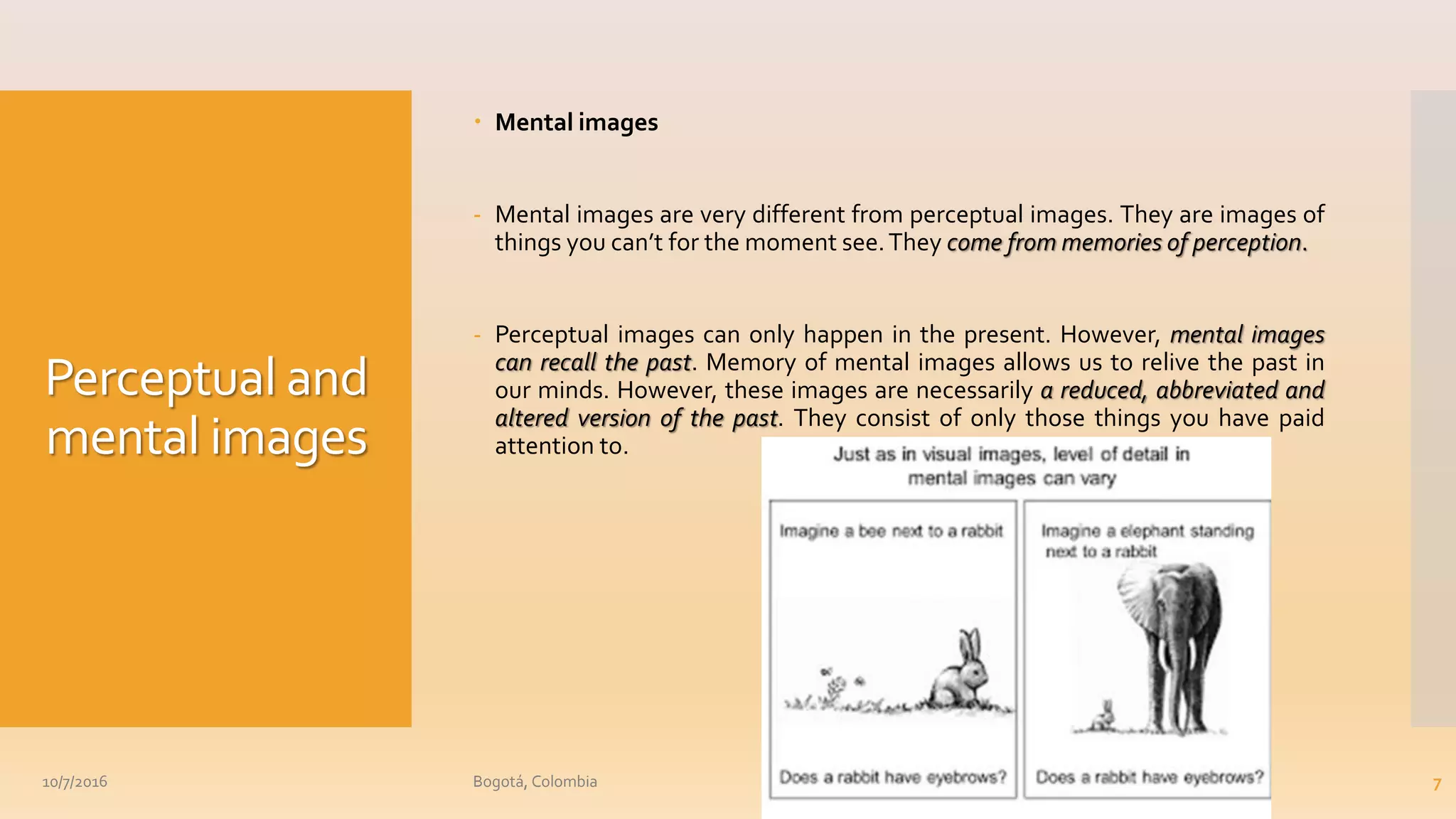
- Perceptual images can only happen in the present. However, mental images
can recall the past. Memory of mental images allows us to relive the past in
our minds. However, these images are necessarily a reduced, abbreviated and
altered version of the past. They consist of only those things you have paid
attention to.
10/7/2016 Bogotá, Colombia 7
Perceptual and
mental images
10/7/2016 Bogotá, Colombia 8
Perceptual and
mental images
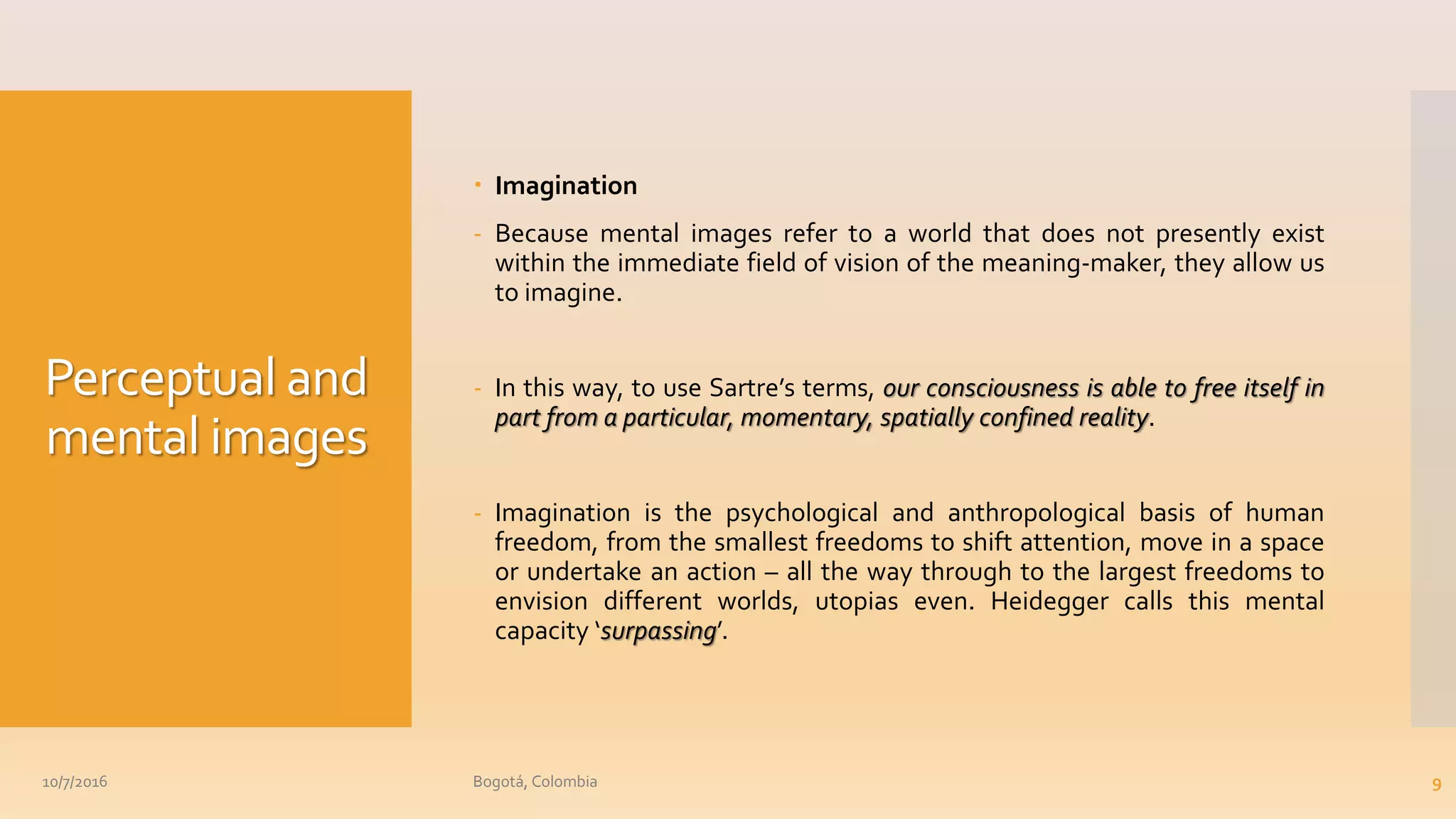
 Imagination
- Because mental images refer to a world that does not presently exist
within the immediate field of vision of the meaning-maker, they allow us
to imagine.
- In this way, to use Sartre’s terms, our consciousness is able to free itself in
part from a particular, momentary, spatially confined reality.
- Imagination is the psychological and anthropological basis of human
freedom, from the smallest freedoms to shift attention, move in a space
or undertake an action – all the way through to the largest freedoms to
envision different worlds, utopias even. Heidegger calls this mental
capacity ‘surpassing’.
10/7/2016 Bogotá, Colombia 9
The visual
design process
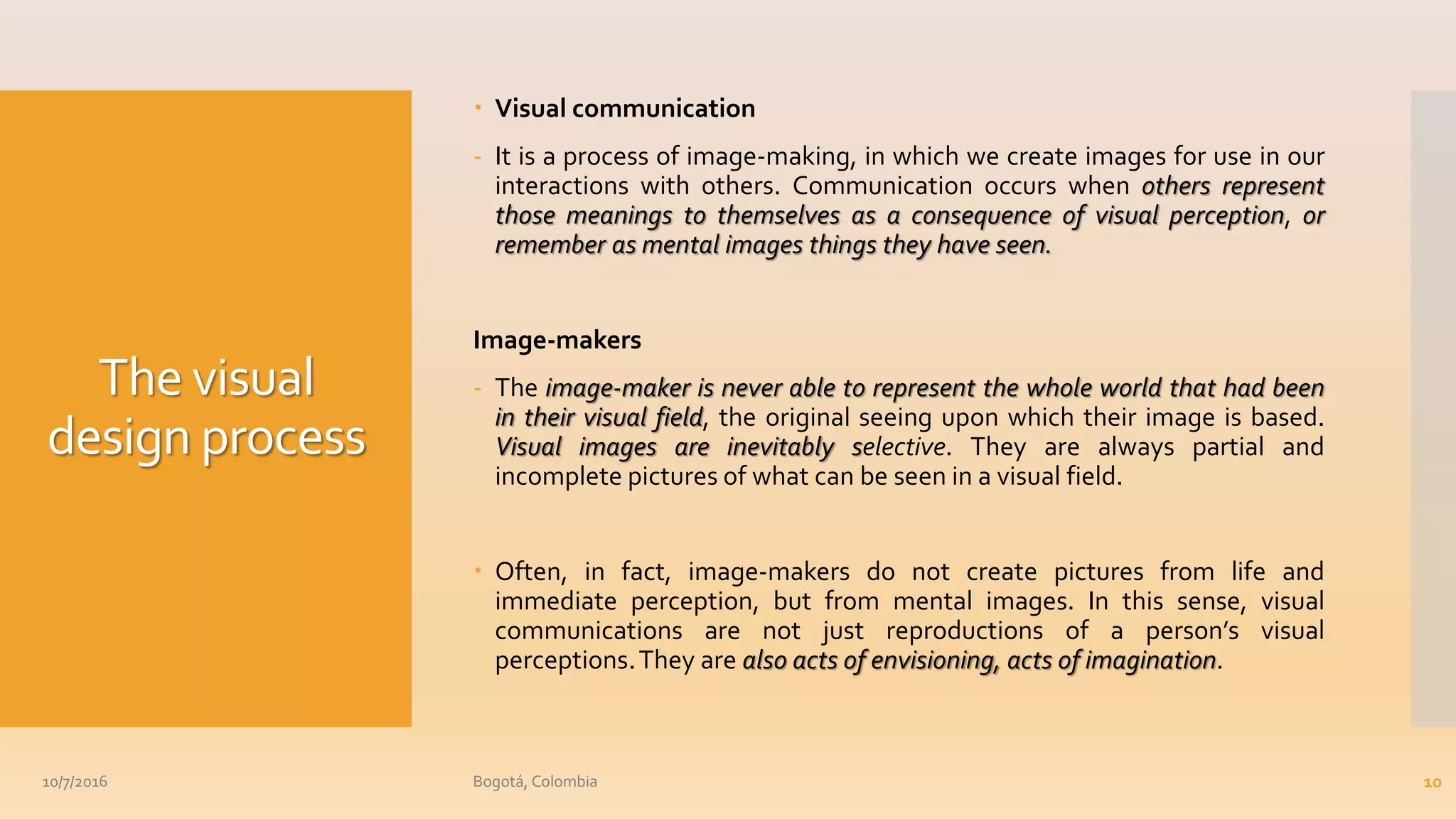
 Visual communication
- It is a process of image-making, in which we create images for use in our
interactions with others. Communication occurs when others represent
those meanings to themselves as a consequence of visual perception, or
remember as mental images things they have seen.
Image-makers
- The image-maker is never able to represent the whole world that had been
in their visual field, the original seeing upon which their image is based.
Visual images are inevitably selective. They are always partial and
incomplete pictures of what can be seen in a visual field.
 Often, in fact, image-makers do not create pictures from life and
immediate perception, but from mental images. In this sense, visual
communications are not just reproductions of a person’s visual
perceptions.They are also acts of envisioning, acts of imagination.
10/7/2016 Bogotá, Colombia 10
The visual
design process
Image-viewers
- When a viewer comes onto the scene, his/her inevitable perceptual selectivity shapes
their interpretation, the sense they make of an image as they make sense of it for
themselves.
- The viewer is always guided by the image-maker’s selectivity. However, the viewer also
uses their own selectivity and has to put in additional work to interpret it.
- The viewer’s interpretation remains with him/her as a mental image, with all the
reductions and simplifications, and all the biases of selective interest that mental
images inevitably entail.
10/7/2016 Bogotá, Colombia 11
The visual
design process
 Visual communication
- This does not mean, however, that we only ever see what we want to see and
no more. Our sociable species is always interested in the other person’s
purposes. So we are always trying to interpret and understand what the
meaning-designer intended because we want to understand who they are, what
they want with us, and what they are trying to tell us.
- Visual communication always involves person-to-person exchange of
meaning.
10/7/2016 Bogotá, Colombia 12
C
O
M
M
U
N
I
C
A
T
I
O
N
The visual
design process
 Visual design
10/7/2016 Bogotá, Colombia 13
Available designs
• Visual designs in
nature and
constructed by people
= Resources for visual
representation.
• They shape visual
representation and
visual communication.
Designing
• When we see, we
create meanings for
ourselves from our
visual perception and
our remembered visual
designs.
• Every perceptual
image is to some
degree a unique
product of our
designing agency.
• We make
transformative
meanings for ourselves
and apply them in the
design of new images.
The re-designed
• Visual representations
(perceptual and mental
images) result in the
making of objects that
re-enter the world of
meaning when they
appear in the
perceptual field of
others (visual
communication).
• They in turn become
the objects of
interpretation: mental
images as resources
for the making of new
visual meanings.
Visual design
in the
classroom
 How to bring together written and visual language.
a) Expose SS to ‘available designs’ in the form of written and visual meanings.
b) Have SS do ‘designing’ as they create visual and written meanings of their own.
c) SS’ “designed multimodal texts” are products of their learning experiences that
enter the world of experienced meanings.
 Making visual meaning
- Synaesthesia, switching from one mode of meaning to another, is convenient as
visual meanings are not only one of the first designs of meaning that we learn as we
represent the world to ourselves and learn to communicate. They are also closely
connected with tactile modes and gestural modes.
- Also, it is important to have an approach that balances reading and writing with
drama, dance, construction, visual arts and access to a range of digital technologies.
This kind of approach sees the children as curious, creative, capable and
multiliterate with many existing experiences and skills that could be further
extended at school.
10/7/2016 Bogotá, Colombia 14
Visual design
in the
classroom
 Parallels and differences between visual and written language
- On the parallel side, a grammar of the visual can explain the ways in
which images work like language. For instance:
a) Action expressed by verbs in sentences may be expressed by vectors in
images (‘The car is driving down the street’).
b) Locative prepositions in language (‘near’, ‘behind’) are like
foregrounding or backgrounding in images.
c) Comparatives in language (‘larger’, ‘shinier’) are like sizing and
juxtaposition in images.
d) The ‘given’ and the ‘new’ English clause structures are like left/right
placement in images.
10/7/2016 Bogotá, Colombia 15
Visual design
in the
classroom
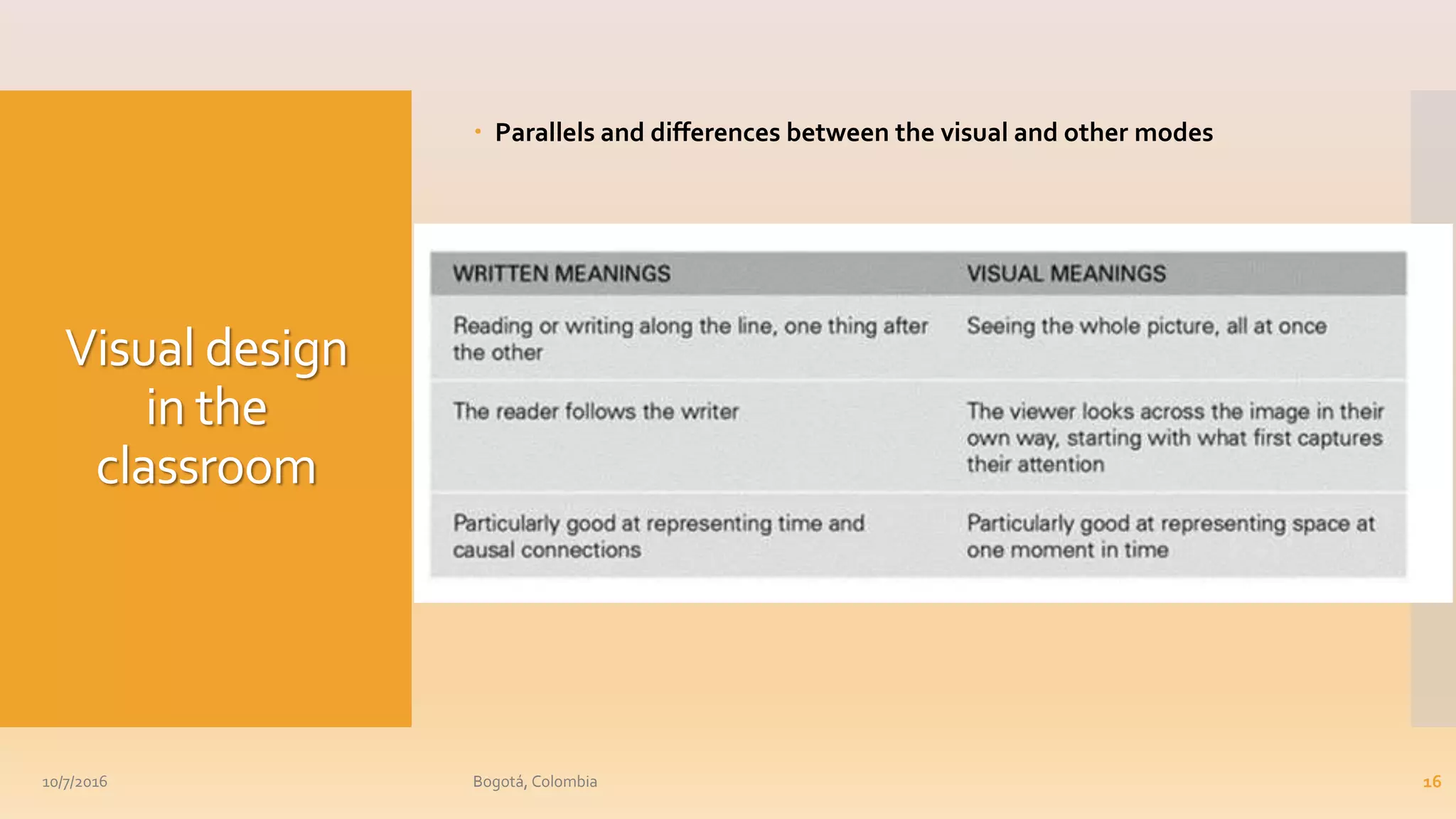
 Parallels and differences between the visual and other modes
10/7/2016 Bogotá, Colombia 16
Visual design
in the
classroom
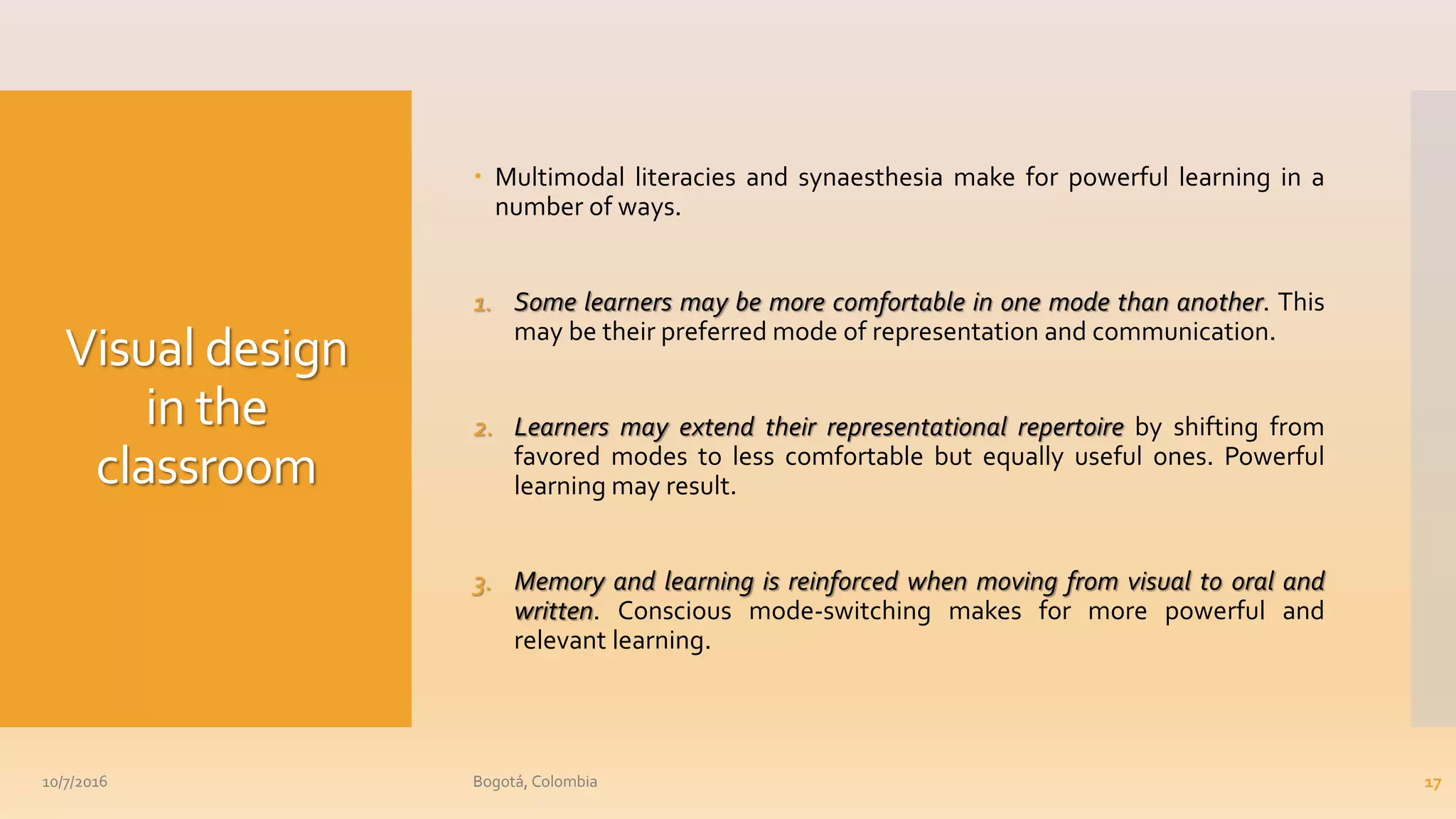
 Multimodal literacies and synaesthesia make for powerful learning in a
number of ways.
1. Some learners may be more comfortable in one mode than another. This
may be their preferred mode of representation and communication.
2. Learners may extend their representational repertoire by shifting from
favored modes to less comfortable but equally useful ones. Powerful
learning may result.
3. Memory and learning is reinforced when moving from visual to oral and
written. Conscious mode-switching makes for more powerful and
relevant learning.
10/7/2016 Bogotá, Colombia 17
References
Kalantzis, M., & Cope, B. (2012). Literacies. USA:
Cambridge University Press, New York (Chapter 9.
Making visual meanings, pp. 248-280).
10/7/2016 Bogotá, Colombia 18

Making visual meanings

  • 1.
    MAKINGVISUAL MEANINGS La Salle University Schoolof Education Sciences Yamith José Fandiño Parra 10/7/2016 Bogotá, Colombia 1
  • 2.
    Word and image: making the connections Writing vs. image - Written meaning has been privileged over visual meaning since the rise of print culture and mass-institutionalized schooling. - Literacy is supposed to be essential and more ‘academic’, while ‘Art’ is regarded as optional and oriented towards craft and trade skills. Language turn (before) - Language frames everything in our worlds of meaning and social interaction. - Our consciousness is considered to be structured like a language, as we categorize things by naming them with words. Pictorial turn (now) - The intrinsic multimodality of everyday communications in the era of the new media. - A literacies pedagogy supports shifting between different modes, or synaesthesia. 10/7/2016 Bogotá, Colombia 2
  • 3.
    Perceptual and mental images Words and images - An image is a visual likeness, a resemblance to some thing, idea or feeling. - An image makes sense of the world as a result of some cognitive or thinking work that which produces visual meaning or visual representation. - There are two kinds of visual representation or making visual meaning for oneself: a. perceptual images (seeing things with the body’s eye, or ‘vision’), and b. mental images (seeing things in the mind’s eye, or ‘envisioning’). 10/7/2016 Bogotá, Colombia 3
  • 4.
    Perceptual and mental images Perceptual images - They involve a direct, material and bodily encounter with meanings-in-the- world. - They result from the integrative work of our eyes’ cornea, lens, retina, and optic nerve. However, we do not see with our eyes. We see with our brain as it combines and recombines information to create images. This mental interconnectedness is called “binding”. - The world does not simply present itself to us. It requires our selective attention. Seeing is a process of choosing the parts of what we can see to which we want to direct our attention. We look out for things that are going to be meaningful to us. We only notice things that are meaningful. - Visual perception may be considered to be understood as an act of cognition – a mental process of knowing. 10/7/2016 Bogotá, Colombia 4
  • 5.
    Perceptual and mental images Perceptual images - Visual perception is a complex cultural process, only possible when we have learned the arts of perceptive attention of our culture. That is, our culture teaches us what to look out for.  Visual meaning is made based on the pre-existing visual meanings we as viewers bring to the process of perception. Vision is not about all what we see; but the things we make meaningful to ourselves. - We learn vision before we learn language and, as a consequence, language is to a substantial degree a creature of vision. Language is layered on top of vision. - Our first thinking is visual. As babies, we learn to see people, things, movements, colors, spaces and distances. We learn to narrow our focus to see one particular thing at a time, to separate it as a distinguishable thing from all else we can see. 10/7/2016 Bogotá, Colombia 5
  • 6.
    Perceptual and mental images Perceptual images - Visual perception is a mental act of recognition and a process of making a judgement about what exists in a field of vision. 10/7/2016 Bogotá, Colombia 6
  • 7.
    Perceptual and mental images Mental images - Mental images are very different from perceptual images. They are images of things you can’t for the moment see.They come from memories of perception. - Perceptual images can only happen in the present. However, mental images can recall the past. Memory of mental images allows us to relive the past in our minds. However, these images are necessarily a reduced, abbreviated and altered version of the past. They consist of only those things you have paid attention to. 10/7/2016 Bogotá, Colombia 7
  • 8.
  • 9.
    Perceptual and mental images Imagination - Because mental images refer to a world that does not presently exist within the immediate field of vision of the meaning-maker, they allow us to imagine. - In this way, to use Sartre’s terms, our consciousness is able to free itself in part from a particular, momentary, spatially confined reality. - Imagination is the psychological and anthropological basis of human freedom, from the smallest freedoms to shift attention, move in a space or undertake an action – all the way through to the largest freedoms to envision different worlds, utopias even. Heidegger calls this mental capacity ‘surpassing’. 10/7/2016 Bogotá, Colombia 9
  • 10.
    The visual design process Visual communication - It is a process of image-making, in which we create images for use in our interactions with others. Communication occurs when others represent those meanings to themselves as a consequence of visual perception, or remember as mental images things they have seen. Image-makers - The image-maker is never able to represent the whole world that had been in their visual field, the original seeing upon which their image is based. Visual images are inevitably selective. They are always partial and incomplete pictures of what can be seen in a visual field.  Often, in fact, image-makers do not create pictures from life and immediate perception, but from mental images. In this sense, visual communications are not just reproductions of a person’s visual perceptions.They are also acts of envisioning, acts of imagination. 10/7/2016 Bogotá, Colombia 10
  • 11.
    The visual design process Image-viewers -When a viewer comes onto the scene, his/her inevitable perceptual selectivity shapes their interpretation, the sense they make of an image as they make sense of it for themselves. - The viewer is always guided by the image-maker’s selectivity. However, the viewer also uses their own selectivity and has to put in additional work to interpret it. - The viewer’s interpretation remains with him/her as a mental image, with all the reductions and simplifications, and all the biases of selective interest that mental images inevitably entail. 10/7/2016 Bogotá, Colombia 11
  • 12.
    The visual design process Visual communication - This does not mean, however, that we only ever see what we want to see and no more. Our sociable species is always interested in the other person’s purposes. So we are always trying to interpret and understand what the meaning-designer intended because we want to understand who they are, what they want with us, and what they are trying to tell us. - Visual communication always involves person-to-person exchange of meaning. 10/7/2016 Bogotá, Colombia 12 C O M M U N I C A T I O N
  • 13.
    The visual design process Visual design 10/7/2016 Bogotá, Colombia 13 Available designs • Visual designs in nature and constructed by people = Resources for visual representation. • They shape visual representation and visual communication. Designing • When we see, we create meanings for ourselves from our visual perception and our remembered visual designs. • Every perceptual image is to some degree a unique product of our designing agency. • We make transformative meanings for ourselves and apply them in the design of new images. The re-designed • Visual representations (perceptual and mental images) result in the making of objects that re-enter the world of meaning when they appear in the perceptual field of others (visual communication). • They in turn become the objects of interpretation: mental images as resources for the making of new visual meanings.
  • 14.
    Visual design in the classroom How to bring together written and visual language. a) Expose SS to ‘available designs’ in the form of written and visual meanings. b) Have SS do ‘designing’ as they create visual and written meanings of their own. c) SS’ “designed multimodal texts” are products of their learning experiences that enter the world of experienced meanings.  Making visual meaning - Synaesthesia, switching from one mode of meaning to another, is convenient as visual meanings are not only one of the first designs of meaning that we learn as we represent the world to ourselves and learn to communicate. They are also closely connected with tactile modes and gestural modes. - Also, it is important to have an approach that balances reading and writing with drama, dance, construction, visual arts and access to a range of digital technologies. This kind of approach sees the children as curious, creative, capable and multiliterate with many existing experiences and skills that could be further extended at school. 10/7/2016 Bogotá, Colombia 14
  • 15.
    Visual design in the classroom Parallels and differences between visual and written language - On the parallel side, a grammar of the visual can explain the ways in which images work like language. For instance: a) Action expressed by verbs in sentences may be expressed by vectors in images (‘The car is driving down the street’). b) Locative prepositions in language (‘near’, ‘behind’) are like foregrounding or backgrounding in images. c) Comparatives in language (‘larger’, ‘shinier’) are like sizing and juxtaposition in images. d) The ‘given’ and the ‘new’ English clause structures are like left/right placement in images. 10/7/2016 Bogotá, Colombia 15
  • 16.
    Visual design in the classroom Parallels and differences between the visual and other modes 10/7/2016 Bogotá, Colombia 16
  • 17.
    Visual design in the classroom Multimodal literacies and synaesthesia make for powerful learning in a number of ways. 1. Some learners may be more comfortable in one mode than another. This may be their preferred mode of representation and communication. 2. Learners may extend their representational repertoire by shifting from favored modes to less comfortable but equally useful ones. Powerful learning may result. 3. Memory and learning is reinforced when moving from visual to oral and written. Conscious mode-switching makes for more powerful and relevant learning. 10/7/2016 Bogotá, Colombia 17
  • 18.
    References Kalantzis, M., &Cope, B. (2012). Literacies. USA: Cambridge University Press, New York (Chapter 9. Making visual meanings, pp. 248-280). 10/7/2016 Bogotá, Colombia 18