11-arid-971

11-arid-934

11-arid-936

11-arid-967
 The   forages like grasses and legumes that
  have been cut ,and then dried under
  sunlight.
 It is used when there is shortage of
  forages.
 Hay making is preferred mode of
  conserving the food of all green forages.
  It is used when there is less
      availability of fodder.
 The chances of spoilage will be less
  than the silage.
 It require less space for its storage.
 It also require a lot of time and extra
  labour.
 During hay making process 10-15% loss of
  nutrient occur.
 Hay making is done in presence of sun
  light.
 If sun light not available it difficult the
  hay making process.
 Fast drying maximizes green color
  and palatability.
 The rapid drying is more suitable for
  hay making as it minimize the
  microbial growth.
 The basic principle is to reduce
  moisture content in order to inhibit
  the action of microbial enzymes.
 In order to store green crops in a
  stack the moisture content should
  be reduced to 15-20%.
 For leguminous fodder harvesting is done
  at the start of flowering.
 Grasses should be harvested for hay
  making when there is emergence of head.
 At this stage there are maximum
  nutrients and green matters.
 March and april are best season for hay
  making from leguminus fodder.
 For grasses after rainy season.
   In case of leguminous fodder
     lucerne and oat is best for making
    of hay and may be barseem.
    In case of grasses
      like sudan grasses and sadabahar.
There are two methods of hay
  making.
 Traditional method
 New mechanised technique
 It consist of following steps
 Mowing
 Tedding
 Raking
 Baling
 Cut  the crop , when easy to break
  the stem by hand.
 Dry the crop under sunlight in the
  field.
 Turn the forage before sunset or
  sunrise to avoid shattering of leaves.
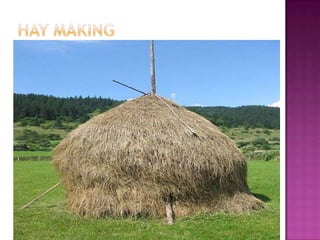
 Then hang with a rope.
 Stack it by using 3 bamboos.
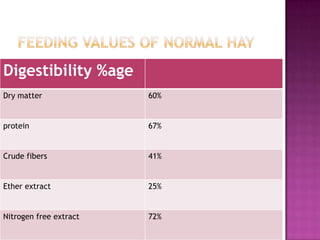
Digestibility %age
Dry matter              60%


protein                 67%


Crude fibers            41%


Ether extract           25%


Nitrogen free extract   72%
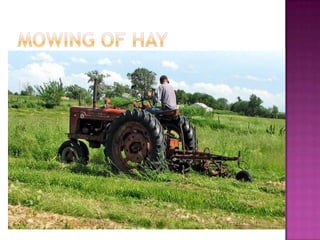
 To cut the grasses a machine is
 used which is called mower.
 It is the first step in making of
 hay.
 Mowing is done in the morning.
 It can be at the end of the day
 when the grass is drier.
 So that it can increase the
 energy level of the forage by
 capturing some of the sugars.
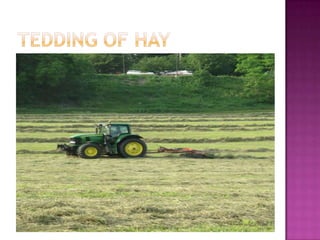
 For spreading of hay tedding is done.
 Hay tedders have several orbital wheels
  that lift hay By a turn.
 Tedding is immediately after mowing to
  spread the swath.
 It may require a second tedding the next
  day to speed up the drying process.
 More tedding can shatter leaves of
  alfalfa.
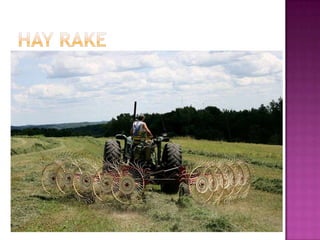
 Tocollect the hay .Hay rake is used.
 When the hay has tedded and is nearly
 dry, it is ready to rake.
 Raking turns the hay one more time to
 Ready to be baled.
 Hay is gathered loose and stacked
 without being baled first.
 Spontaneous combustion may occur if hay
 becomes wet while in storage.
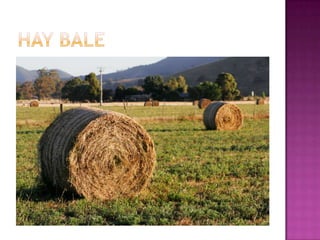
A baler is a machine that coiled the cut
 hay in to round shape.
 After cutting, drying and raking baling is
 done.
 Then should be hauled to a central
 location for storage.
 It depend on geography, region and
 climate.
 In this process hay is usually gathered in
 the form of bales.
 Bacterial fermentation may occur in
  the forages that has been laid in the
  field.
 It may lead to production of acetic
  acid and propionic acid.
 Mouldy hay is unpalatable and
  harmfull.
 It may lead to production of
  mycotoxin.
 The provitamin and carotene may be
  reduced from 150-200mg/kg in the dry
  matter.
 Hay   can be stored under a roof when
  resources permit.
 It is frequently kept inside sheds and may
  be stacked inside a bale
 Hay never exposed to any possible source
  of heat.
 Because dry hay and the dust it produces
  are highly flammable.
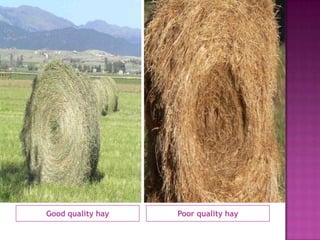
   Moisture contents should be less
    than 15%.
 More leafy and green.
 It should be free from dust and
  mold.
 It should be easily palatable.
 It should be less expensive.
Good quality hay   Poor quality hay
THANK YOU

Hay making

  • 2.
  • 3.
     The forages like grasses and legumes that have been cut ,and then dried under sunlight.  It is used when there is shortage of forages.  Hay making is preferred mode of conserving the food of all green forages.
  • 5.
     Itis used when there is less availability of fodder.  The chances of spoilage will be less than the silage.  It require less space for its storage.
  • 6.
     It alsorequire a lot of time and extra labour.  During hay making process 10-15% loss of nutrient occur.  Hay making is done in presence of sun light.  If sun light not available it difficult the hay making process.
  • 7.
     Fast dryingmaximizes green color and palatability.  The rapid drying is more suitable for hay making as it minimize the microbial growth.  The basic principle is to reduce moisture content in order to inhibit the action of microbial enzymes.  In order to store green crops in a stack the moisture content should be reduced to 15-20%.
  • 8.
     For leguminousfodder harvesting is done at the start of flowering.  Grasses should be harvested for hay making when there is emergence of head.  At this stage there are maximum nutrients and green matters.  March and april are best season for hay making from leguminus fodder.  For grasses after rainy season.
  • 9.
    In case of leguminous fodder lucerne and oat is best for making of hay and may be barseem.  In case of grasses like sudan grasses and sadabahar.
  • 10.
    There are twomethods of hay making.  Traditional method  New mechanised technique  It consist of following steps  Mowing  Tedding  Raking  Baling
  • 11.
     Cut the crop , when easy to break the stem by hand.  Dry the crop under sunlight in the field.  Turn the forage before sunset or sunrise to avoid shattering of leaves.  Then hang with a rope.  Stack it by using 3 bamboos.
  • 13.
    Digestibility %age Dry matter 60% protein 67% Crude fibers 41% Ether extract 25% Nitrogen free extract 72%
  • 14.
     To cutthe grasses a machine is used which is called mower.  It is the first step in making of hay.  Mowing is done in the morning.  It can be at the end of the day when the grass is drier.  So that it can increase the energy level of the forage by capturing some of the sugars.
  • 16.
     For spreadingof hay tedding is done.  Hay tedders have several orbital wheels that lift hay By a turn.  Tedding is immediately after mowing to spread the swath.  It may require a second tedding the next day to speed up the drying process.  More tedding can shatter leaves of alfalfa.
  • 18.
     Tocollect thehay .Hay rake is used.  When the hay has tedded and is nearly dry, it is ready to rake.  Raking turns the hay one more time to Ready to be baled.  Hay is gathered loose and stacked without being baled first.  Spontaneous combustion may occur if hay becomes wet while in storage.
  • 20.
    A baler isa machine that coiled the cut hay in to round shape.  After cutting, drying and raking baling is done.  Then should be hauled to a central location for storage.  It depend on geography, region and climate.  In this process hay is usually gathered in the form of bales.
  • 22.
     Bacterial fermentationmay occur in the forages that has been laid in the field.  It may lead to production of acetic acid and propionic acid.  Mouldy hay is unpalatable and harmfull.  It may lead to production of mycotoxin.  The provitamin and carotene may be reduced from 150-200mg/kg in the dry matter.
  • 23.
     Hay can be stored under a roof when resources permit.  It is frequently kept inside sheds and may be stacked inside a bale  Hay never exposed to any possible source of heat.  Because dry hay and the dust it produces are highly flammable.
  • 24.
    Moisture contents should be less than 15%.  More leafy and green.  It should be free from dust and mold.  It should be easily palatable.  It should be less expensive.
  • 25.
    Good quality hay Poor quality hay
  • 26.