By: Olla S. BaEissa
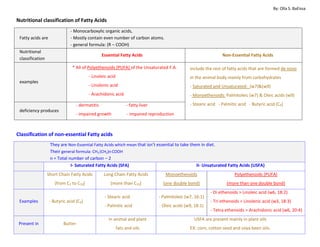
Nutritional classification of Fatty Acids
Fatty acids are
- Monocarboxylic organic acids,
- Mostly contain even number of carbon atoms.
- general formula: (R – COOH)
Nutritional
classification
Essential Fatty Acids Non-Essential Fatty Acids
examples
* All of Polyethenoids (PUFA) of the Unsaturated F.A.
- Linoleic acid
- Linolenic acid
- Arachidonic acid
include the rest of fatty acids that are formed de novo
in the animal body mainly from carbohydrates
- Saturated and Unsaturated: (w7)&(w9)
- Monoethenoids: Palmitoleic (w7) & Oleic acids (w9)
- Stearic acid - Palmitic acid - Butyric acid (C4)
deficiency produces
- dermatitis - fatty liver
- impaired growth - impaired reproduction
Classification of non-essential Fatty acids
They are Non-Essential Fatty Acids which mean that isn’t essential to take them in diet.
Their general formula: CH3 (CH2)nCOOH
n = Total number of carbon – 2
I- Saturated Fatty Acids (SFA) II- Unsaturated Fatty Acids (USFA)
Short Chain Fatty Acids
(from C2 to C10)
Long Chain Fatty Acids
(more than C10)
Monoethenoids
(one double bond)
Polyethenoids (PUFA)
(more than one double bond)
Examples - Butyric acid (C4)
- Stearic acid
- Palmitic acid
- Palmitoleic (w7, 16:1)
- Oleic acids (w9, 18:1)
- Di ethenoids > Linoleic acid (w6, 18:2)
- Tri ethenoids > Linolenic acid (w3, 18:3)
- Tetra ethenoids > Arachidonic acid (w6, 20:4)
Present in Butter
in animal and plant
fats and oils
USFA are present mainly in plant oils
EX: corn, cotton seed and soya been oils.
By: Olla S. BaEissa
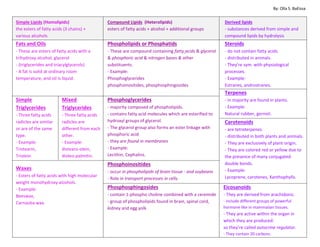
Simple Lipids (Homolipids)
the esters of fatty acids (3 chains) +
various alcohols
Compound Lipids (Heterolipids)
esters of fatty acids + alcohol + additional groups
Derived lipids
- substances derived from simple and
compound lipids by hydrolysis
Fats and Oils
- These are esters of fatty acids with a
trihydroxy alcohol, glycerol
- (triglycerides and triacylglycerols)
- A fat is solid at ordinary room
temperature, and oil is liquid.
Phospholipids or Phosphatids
- These are compound containing fatty acids & glycerol
& phosphoric acid & nitrogen bases & other
substituents.
- Example:
Phosphoglycerides
phosphoinositides, phosphosphingosides
Steroids
- do not contain fatty acids.
- distributed in animals.
- They’re sym. with physiological
processes.
- Example:
Estranes, androstranes.
Terpenes
- in majority are found in plants.
- Example:
Natural rubber, gernoil.
Simple
Triglycerides
- Three fatty acids
radicles are similar
or are of the same
type.
- Example:
Tristearin,
Triolein.
Mixed
Triglycerides
- Three fatty acids
radicles are
different from each
other.
- Example:
distearo-olein,
dioleo-palmitin.
Phosphoglycerides
- majority composed of phospholipids.
- contains fatty acid molecules which are esterified to
hydroxyl groups of glycerol.
- The glycerol group also forms an ester linkage with
phosphoric acid
- they are found in membranes
- Example:
Lecithin, Cephalins.
Carotenoids
- are tetraterpenes.
- distributed in both plants and animals.
- They are exclusively of plant origin.
- They are colored red or yellow due to
the presence of many conjugated
double bonds.
- Example:
Lycoprene, carotenes, Xanthophylls.
Waxes
- Esters of fatty acids with high molecular
weight monohydroxy alcohols.
- Example:
Beeswax,
Carnauba wax.
Phosphoinositides
- occur in phospholipids of brain tissue - and soybeans
- Role in transport processes in cells.
Phosphosphingosides
- contain 1-phospho choline combined with a ceremide
- group of phospholipids found in brain, spinal cord,
kidney and egg yolk
Eicosanoids
- They are derived from arachidonic.
- include different groups of powerful
hormone like in mammalian tissues.
- They are active within the organ in
which they are produced:
so they’re called autocrine regulator.
- They contain 20 carbons.

Fatty acids

  • 1.
    By: Olla S.BaEissa Nutritional classification of Fatty Acids Fatty acids are - Monocarboxylic organic acids, - Mostly contain even number of carbon atoms. - general formula: (R – COOH) Nutritional classification Essential Fatty Acids Non-Essential Fatty Acids examples * All of Polyethenoids (PUFA) of the Unsaturated F.A. - Linoleic acid - Linolenic acid - Arachidonic acid include the rest of fatty acids that are formed de novo in the animal body mainly from carbohydrates - Saturated and Unsaturated: (w7)&(w9) - Monoethenoids: Palmitoleic (w7) & Oleic acids (w9) - Stearic acid - Palmitic acid - Butyric acid (C4) deficiency produces - dermatitis - fatty liver - impaired growth - impaired reproduction Classification of non-essential Fatty acids They are Non-Essential Fatty Acids which mean that isn’t essential to take them in diet. Their general formula: CH3 (CH2)nCOOH n = Total number of carbon – 2 I- Saturated Fatty Acids (SFA) II- Unsaturated Fatty Acids (USFA) Short Chain Fatty Acids (from C2 to C10) Long Chain Fatty Acids (more than C10) Monoethenoids (one double bond) Polyethenoids (PUFA) (more than one double bond) Examples - Butyric acid (C4) - Stearic acid - Palmitic acid - Palmitoleic (w7, 16:1) - Oleic acids (w9, 18:1) - Di ethenoids > Linoleic acid (w6, 18:2) - Tri ethenoids > Linolenic acid (w3, 18:3) - Tetra ethenoids > Arachidonic acid (w6, 20:4) Present in Butter in animal and plant fats and oils USFA are present mainly in plant oils EX: corn, cotton seed and soya been oils.
  • 2.
    By: Olla S.BaEissa Simple Lipids (Homolipids) the esters of fatty acids (3 chains) + various alcohols Compound Lipids (Heterolipids) esters of fatty acids + alcohol + additional groups Derived lipids - substances derived from simple and compound lipids by hydrolysis Fats and Oils - These are esters of fatty acids with a trihydroxy alcohol, glycerol - (triglycerides and triacylglycerols) - A fat is solid at ordinary room temperature, and oil is liquid. Phospholipids or Phosphatids - These are compound containing fatty acids & glycerol & phosphoric acid & nitrogen bases & other substituents. - Example: Phosphoglycerides phosphoinositides, phosphosphingosides Steroids - do not contain fatty acids. - distributed in animals. - They’re sym. with physiological processes. - Example: Estranes, androstranes. Terpenes - in majority are found in plants. - Example: Natural rubber, gernoil. Simple Triglycerides - Three fatty acids radicles are similar or are of the same type. - Example: Tristearin, Triolein. Mixed Triglycerides - Three fatty acids radicles are different from each other. - Example: distearo-olein, dioleo-palmitin. Phosphoglycerides - majority composed of phospholipids. - contains fatty acid molecules which are esterified to hydroxyl groups of glycerol. - The glycerol group also forms an ester linkage with phosphoric acid - they are found in membranes - Example: Lecithin, Cephalins. Carotenoids - are tetraterpenes. - distributed in both plants and animals. - They are exclusively of plant origin. - They are colored red or yellow due to the presence of many conjugated double bonds. - Example: Lycoprene, carotenes, Xanthophylls. Waxes - Esters of fatty acids with high molecular weight monohydroxy alcohols. - Example: Beeswax, Carnauba wax. Phosphoinositides - occur in phospholipids of brain tissue - and soybeans - Role in transport processes in cells. Phosphosphingosides - contain 1-phospho choline combined with a ceremide - group of phospholipids found in brain, spinal cord, kidney and egg yolk Eicosanoids - They are derived from arachidonic. - include different groups of powerful hormone like in mammalian tissues. - They are active within the organ in which they are produced: so they’re called autocrine regulator. - They contain 20 carbons.