Replication, Transcription and Translation
• DNA replication is like printing a copy of all the pages of a book. The
replication process occurs only at the time of cell division.
• Transcription is taking place all the time. Only certain areas of the
DNA are copied (selected regions on the sense strand). This is like
taking xerox copy of particular page of the book. So, the genetic
information of DNA is transcribed (copied) to the messenger RNA
(mRNA). During transcription, the message from the DNA is copied in
the language of nucleotides (4 letter language).
• The mRNA then reaches the cytoplasm where it is translated into
functional proteins during translation, the nucleotide sequence is
translated to the language of amino acid sequence (20 letter language)
Transcription and Translation
• Cells are governed by a cellular chain of command
– DNA  RNA  protein
• Transcription
– Is the synthesis of RNA under the direction of DNA
– Produces messenger RNA (mRNA)
• Translation
– Is the actual synthesis of a polypeptide, which occurs under the
direction of mRNA
– Occurs on ribosomes
Protein Synthesis
• The information content of DNA is in the form of specific sequences of
nucleotides along the DNA strands
• The DNA inherited by an organism leads to specific traits by dictating
the synthesis of proteins
• The process by which DNA directs protein synthesis, gene expression
includes two stages, called transcription and translation.
By:Olla BaEissa
REPLICATION OF DNA
(Both strands are replicated)
• During cell division, each daughter cell gets an exact copy of the genetic
information of the mother cell. In the daughter cell, one strand is derived
from the mother cell; while the other strand is newly synthesized.
• This is called semiconservative type (process) of DNA replication.
Which mean that each strand serves as a template or mould, over
which a new complementary strand is synthesized.
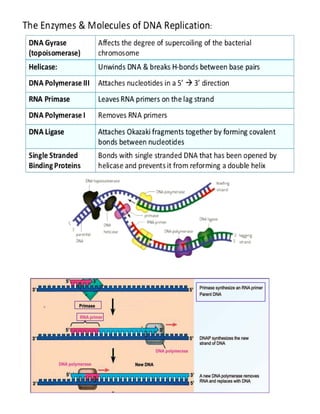
1. Origin of replication is identified by Topoisomerases
• Then unwinding of parental DNA to form a replication fork by Helicases
• 2. RNA primer complementary to the DNA template is synthesized by
RNA primase.
• 3. DNA synthesis is continuous in the leading strand (towards replication
fork) by DNA polymerase III.
• 4. DNA synthesis is discontinuous in the lagging strand (away from the
fork), as Okazaki fragments.
• 5. Elongation: In both strands, the synthesis is from 5' to 3' direction.
• 6. Then the RNA pieces are removed; the gaps filled by deoxynucleotides
by DNA polymerase I. and the pieces are ligated by DNA ligase.
• 7. Proof reading is done by the DNA polymerase III.
• 8. Finally organised into chromatin.
• 9. Main enzymes involved in replication are:
DNA polymerases (I, III):
Helicases:
Topoisomerases;
DNA primase:
Single strand binding proteins:
DNA ligase:
Transcription and Translation understanding
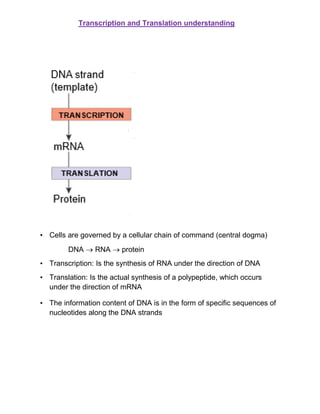
• Cells are governed by a cellular chain of command (central dogma)
DNA  RNA  protein
• Transcription: Is the synthesis of RNA under the direction of DNA
• Translation: Is the actual synthesis of a polypeptide, which occurs
under the direction of mRNA
• The information content of DNA is in the form of specific sequences of
nucleotides along the DNA strands
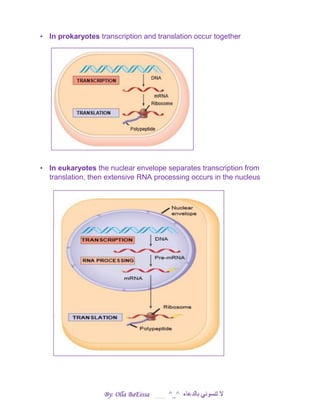
• In prokaryotes transcription and translation occur together
• In eukaryotes the nuclear envelope separates transcription from
translation, then extensive RNA processing occurs in the nucleus
By: Olla BaEissa ‫بالدعاء‬ ‫تنسوني‬ ‫ال‬^_^

Replication

  • 1.
    Replication, Transcription andTranslation • DNA replication is like printing a copy of all the pages of a book. The replication process occurs only at the time of cell division. • Transcription is taking place all the time. Only certain areas of the DNA are copied (selected regions on the sense strand). This is like taking xerox copy of particular page of the book. So, the genetic information of DNA is transcribed (copied) to the messenger RNA (mRNA). During transcription, the message from the DNA is copied in the language of nucleotides (4 letter language). • The mRNA then reaches the cytoplasm where it is translated into functional proteins during translation, the nucleotide sequence is translated to the language of amino acid sequence (20 letter language) Transcription and Translation • Cells are governed by a cellular chain of command – DNA  RNA  protein • Transcription – Is the synthesis of RNA under the direction of DNA – Produces messenger RNA (mRNA) • Translation – Is the actual synthesis of a polypeptide, which occurs under the direction of mRNA – Occurs on ribosomes Protein Synthesis • The information content of DNA is in the form of specific sequences of nucleotides along the DNA strands • The DNA inherited by an organism leads to specific traits by dictating the synthesis of proteins • The process by which DNA directs protein synthesis, gene expression includes two stages, called transcription and translation. By:Olla BaEissa
  • 2.
    REPLICATION OF DNA (Bothstrands are replicated) • During cell division, each daughter cell gets an exact copy of the genetic information of the mother cell. In the daughter cell, one strand is derived from the mother cell; while the other strand is newly synthesized. • This is called semiconservative type (process) of DNA replication. Which mean that each strand serves as a template or mould, over which a new complementary strand is synthesized. 1. Origin of replication is identified by Topoisomerases • Then unwinding of parental DNA to form a replication fork by Helicases • 2. RNA primer complementary to the DNA template is synthesized by RNA primase. • 3. DNA synthesis is continuous in the leading strand (towards replication fork) by DNA polymerase III. • 4. DNA synthesis is discontinuous in the lagging strand (away from the fork), as Okazaki fragments. • 5. Elongation: In both strands, the synthesis is from 5' to 3' direction. • 6. Then the RNA pieces are removed; the gaps filled by deoxynucleotides by DNA polymerase I. and the pieces are ligated by DNA ligase. • 7. Proof reading is done by the DNA polymerase III. • 8. Finally organised into chromatin. • 9. Main enzymes involved in replication are: DNA polymerases (I, III): Helicases: Topoisomerases; DNA primase: Single strand binding proteins: DNA ligase:
  • 4.
    Transcription and Translationunderstanding • Cells are governed by a cellular chain of command (central dogma) DNA  RNA  protein • Transcription: Is the synthesis of RNA under the direction of DNA • Translation: Is the actual synthesis of a polypeptide, which occurs under the direction of mRNA • The information content of DNA is in the form of specific sequences of nucleotides along the DNA strands
  • 5.
    • In prokaryotestranscription and translation occur together • In eukaryotes the nuclear envelope separates transcription from translation, then extensive RNA processing occurs in the nucleus By: Olla BaEissa ‫بالدعاء‬ ‫تنسوني‬ ‫ال‬^_^