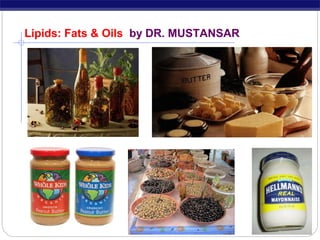

Lipids: Fats & Oils by DR. MUSTANSAR
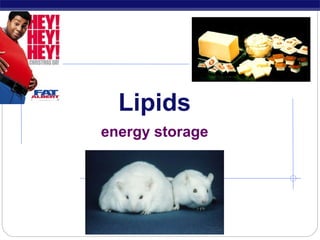
Lipids
energy storage
Chemistry of Lipids
Definition:
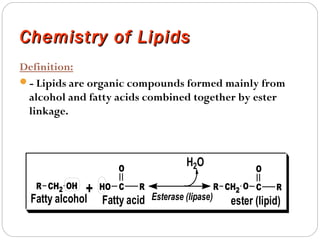
- Lipids are organic compounds formed mainly from
alcohol and fatty acids combined together by ester
linkage.

H2O

O
R CH2 OH

+

Fatty alcohol

HO C

R

Fatty acid Esterase (lipase)

O
R CH2 O C

R

ester (lipid)
Lipids are insoluble in water, but
soluble in fat or organic solvents (ether,
chloroform, benzene, acetone).
- Lipids include fats, oils, waxes and
related compounds.
They are widely distributed in nature
both in plants and in animals.
-
Biological Importance of Lipids:
1.
2.

3.
4.
5.
6.

They are more palatable and storable to unlimited amount
compared to carbohydrates.
They have a high-energy value (25% of body needs) and
they provide more energy per gram than carbohydrates
and proteins but carbohydrates are the preferable source
of energy.
Supply the essential fatty acids that cannot be synthesized
by the body.
Supply the body with fat-soluble vitamins (A, D, E and K).
They are important constituents of the nervous system.
Tissue fat is an essential constituent of cell membrane and
nervous system. It is mainly phospholipids in nature that
are not affected by starvation.
7-Stored lipids “depot fat” is stored in all human cells acts as:
 A store of energy.
 A pad for the internal organs to protect them from outside
shocks.
 A subcutaneous thermal insulator against loss of body heat.
8-Lipoproteins, which are complex of lipids and proteins, are
important cellular constituents that present both in the cellular
and subcellular membranes.
9-Cholesterol enters in membrane structure and is used for
synthesis of adrenal cortical hormones, vitamin D3 and bile
acids.
10- Lipids provide bases for dealing with diseases such as obesity,
atherosclerosis, lipid-storage diseases, essential fatty acid
deficiency, respiratory distress syndrome,
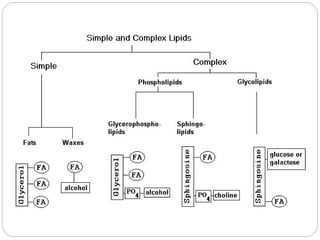
Classification of Lipids
1. Simple lipids (Fats & Waxes)
2. Compound or conjugated lipids
3. Derived Lipids
4. Lipid-associating substances
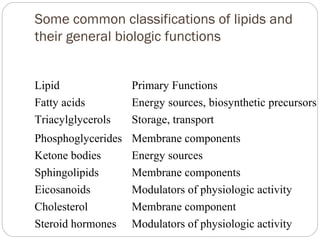
Some common classifications of lipids and
their general biologic functions
Lipid
Fatty acids
Triacylglycerols

Primary Functions
Energy sources, biosynthetic precursors
Storage, transport

Phosphoglycerides
Ketone bodies
Sphingolipids
Eicosanoids
Cholesterol
Steroid hormones

Membrane components
Energy sources
Membrane components
Modulators of physiologic activity
Membrane component
Modulators of physiologic activity
Fatty alcohols
1-Glycerol:
It is a trihydric alcohol (i.e., containing three OH

groups) and has the popular name glycerin.
It is synthesized in the body from glucose.
 It has the following properties:
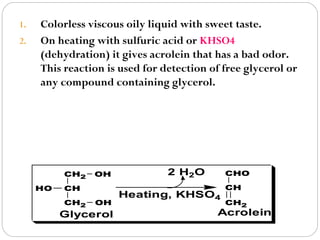
1.
2.

Colorless viscous oily liquid with sweet taste.
On heating with sulfuric acid or KHSO4
(dehydration) it gives acrolein that has a bad odor.
This reaction is used for detection of free glycerol or
any compound containing glycerol.

CH2
HO

OH

CH
CH2

OH

Glycerol

2 H2O

CHO

Heating, KHSO4

CH
CH2

Acrolein
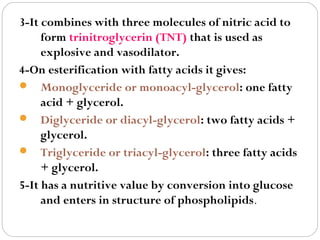
3-It combines with three molecules of nitric acid to
form trinitroglycerin (TNT) that is used as
explosive and vasodilator.
4-On esterification with fatty acids it gives:
 Monoglyceride or monoacyl-glycerol: one fatty
acid + glycerol.
 Diglyceride or diacyl-glycerol: two fatty acids +
glycerol.
 Triglyceride or triacyl-glycerol: three fatty acids
+ glycerol.
5-It has a nutritive value by conversion into glucose
and enters in structure of phospholipids.
Uses of Glycerol:
1. Glycerol enters in pharmaceutical and cosmetic
preparations.
2. Reduces brain edema in cerebrovascular disease.
3. Nitroglycerin is used as vasodilator especially for
the coronary arteries, thus it is used in treatment
of angina pectoris. Also, enters in explosives
manufacturing.
4. Glycerol is used in treatment of glaucoma
(increased intraocular pressure)due to its ability
to dehydrate the tissue from its water content.
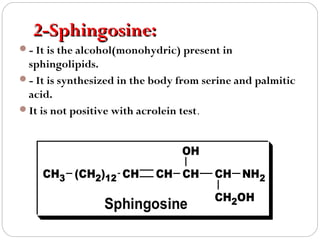
2-Sphingosine:
- It is the alcohol(monohydric) present in

sphingolipids.
- It is synthesized in the body from serine and palmitic
acid.
It is not positive with acrolein test.
OH
CH3 (CH2)12 CH

CH CH

Sphingosine

CH NH2
CH2OH
Fatty Acids
Definition:
Definition
Fatty acids are aliphatic mono-carboxylic acids
that are mostly obtained from the hydrolysis of
natural fats and oils.
Have the general formula R-(CH2)n-COOH and
mostly have straight chain (a few exceptions have
branched and heterocyclic chains). In this formula
"n" is mostly an even number of carbon atoms (234) with a few exceptions that have an odd
number.
Fatty acids are classified according to several bases
as follows:
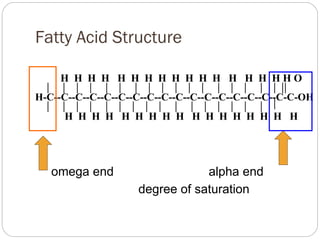
Fatty Acid Structure
H H H H H H H H H H H H H H H HHO
H-C--C--C--C--C--C--C--C--C--C--C--C--C--C--C--C--C-C-OH

H H H H H H H H H H H H H H H H H

omega end

alpha end
degree of saturation
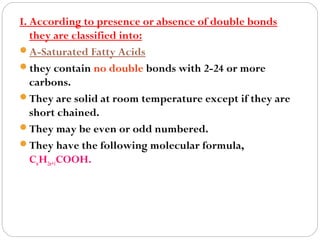
I. According to presence or absence of double bonds
they are classified into:
A-Saturated Fatty Acids
they contain no double bonds with 2-24 or more
carbons.
They are solid at room temperature except if they are
short chained.
They may be even or odd numbered.
They have the following molecular formula,
CnH2n+1COOH.
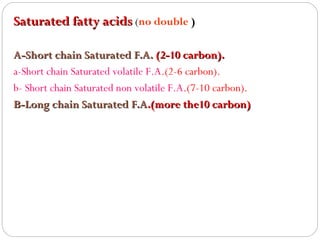
Saturated fatty acids (no double )
A-Short chain Saturated F.A. (2-10 carbon).
a-Short chain Saturated volatile F.A.(2-6 carbon).
b- Short chain Saturated non volatile F.A.(7-10 carbon).
B-Long chain Saturated F.A.(more the10 carbon)
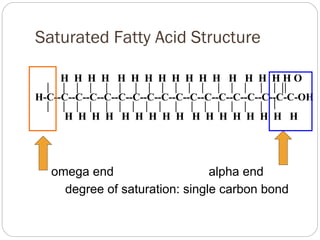
Saturated Fatty Acid Structure
H H H H H H H H H H H H H H H HHO
H-C--C--C--C--C--C--C--C--C--C--C--C--C--C--C--C--C-C-OH

H H H H H H H H H H H H H H H H H

omega end
alpha end
degree of saturation: single carbon bond
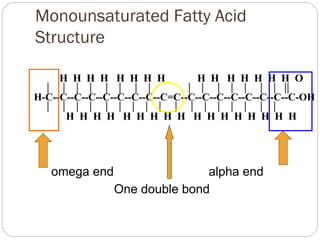
Monounsaturated Fatty Acid
Structure
H H H H H H H H

H H H H H H H O

H-C--C--C--C--C--C--C--C--C=C--C--C--C--C--C--C--C--C-OH

H H H H H H H H H H H H H H H H H

omega end

alpha end
One double bond
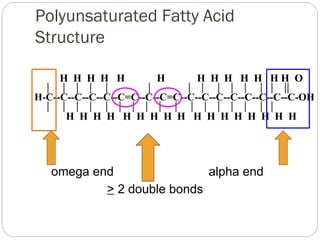
Polyunsaturated Fatty Acid
Structure
H H H H H

H

H H H H H HH O

H-C--C--C--C--C--C=C--C--C=C--C--C--C--C--C--C--C--C-OH

H H H H H H H H H H H H H H H H H

omega end
alpha end
> 2 double bonds
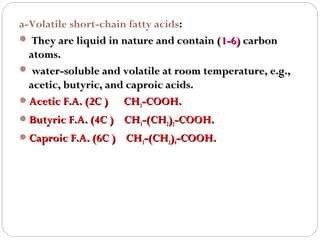
a-Volatile short-chain fatty acids:
 They are liquid in nature and contain (1-6) carbon
atoms.
 water-soluble and volatile at room temperature, e.g.,
acetic, butyric, and caproic acids.
Acetic F.A. (2C )
CH3-COOH.
Butyric F.A. (4C )

CH3-(CH2)2-COOH.

Caproic F.A. (6C ) CH3-(CH2)4-COOH.
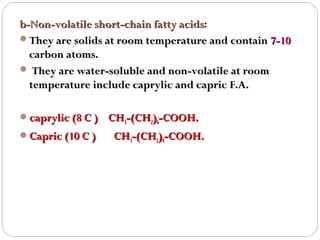
b-Non-volatile short-chain fatty acids:
acids
They are solids at room temperature and contain 7-10
carbon atoms.
 They are water-soluble and non-volatile at room
temperature include caprylic and capric F.A.
caprylic (8 C ) CH3-(CH2)6-COOH.
Capric (10 C )

CH3-(CH2)8-COOH.
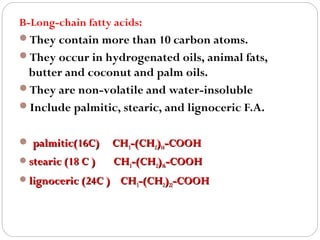
B-Long-chain fatty acids:
They contain more than 10 carbon atoms.
They occur in hydrogenated oils, animal fats,

butter and coconut and palm oils.
They are non-volatile and water-insoluble
Include palmitic, stearic, and lignoceric F.A.
 palmitic(16C)

CH3-(CH2)14-COOH

stearic (18 C )

CH3-(CH2)16-COOH

lignoceric (24C )

CH3-(CH2)22-COOH
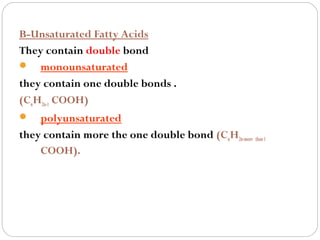
B-Unsaturated Fatty Acids
They contain double bond
 monounsaturated
they contain one double bonds .
(CnH2n-1 COOH)


polyunsaturated
they contain more the one double bond (CnH2n-more than 1
COOH).
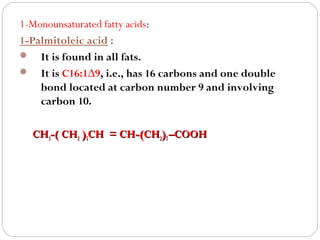
1-Monounsaturated fatty acids:
1-Palmitoleic acid :
 It is found in all fats.
 It is C16:1∆9, i.e., has 16 carbons and one double
bond located at carbon number 9 and involving
carbon 10.
CH3-( CH2 )5CH = CH-(CH2)7 –COOH
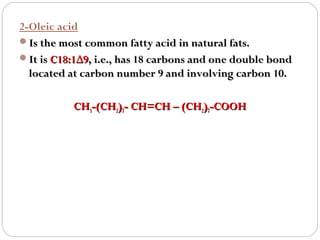
2-Oleic acid
Is the most common fatty acid in natural fats.
It is C18:1∆9, i.e., has 18 carbons and one double bond
located at carbon number 9 and involving carbon 10.
CH3-(CH2)7- CH=CH – (CH2)7-COOH
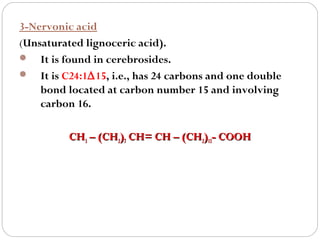
3-Nervonic acid
(Unsaturated lignoceric acid).
 It is found in cerebrosides.
 It is C24:1∆15, i.e., has 24 carbons and one double
bond located at carbon number 15 and involving
carbon 16.
CH3 – (CH2)7 CH= CH – (CH2)13- COOH
2-Polyunsaturated fatty acids :
(Essential fatty acids):
 Definition:
 They are essential fatty acids that can not be
synthesized in the human body and must be taken in
adequate amounts in the diet.
 They are required for normal growth and
metabolism
Source: vegetable oils such as corn oil, linseed oil,

peanut oil, olive oil, cottonseed oil, soybean oil and
many other plant oils, cod liver oil and animal fats.
 Deficiency: Their deficiency in the diet leads to
nutrition deficiency disease.
Its symptoms include: poor growth and health with
susceptibility to infections, dermatitis, decreased
capacity to reproduce, impaired transport of lipids,
fatty liver, and lowered resistance to stress.

1.

2.
3.
4.
5.
6.
7.
8.

Function of Essential Fatty Acids:
They are useful in the treatment of atherosclerosis by help
transporting blood cholesterol and lowering it and
transporting triglycerides.
The hormones are synthesized from them.
They enter in structure of all cellular and subcellular
membranes and the transporting plasma phospholipids.
They are essential for skin integrity, normal growth and
reproduction.
They have an important role in blood clotting (intrinsic
factor).
Important in preventing and treating fatty liver.
Important role in health of the retina and vision.
They can be oxidized for energy production.
Signs and Symptoms of Essential
Fatty Acids Deficiency
Flaky, itchy skin
Diarrhea
Infections
Retarded growth and wound healing
Anemia
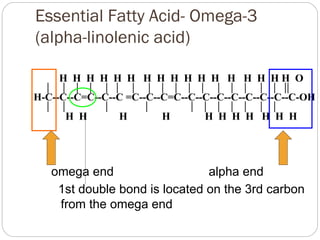
Essential Fatty Acid- Omega-3
(alpha-linolenic acid)
H H H H H H H H H H H H H H H HH O
H-C--C--C=C--C--C =C--C--C=C--C--C--C--C--C--C--C--C-OH

H H

H

H

H H H H H H H

omega end
alpha end
1st double bond is located on the 3rd carbon
from the omega end
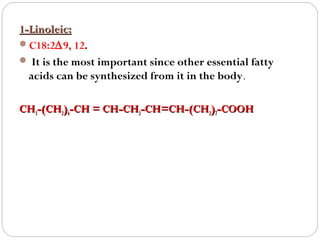
1-Linoleic:
C18:2∆9, 12.
 It is the most important since other essential fatty
acids can be synthesized from it in the body.
CH3-(CH2)4-CH = CH-CH2-CH=CH-(CH2)7-COOH
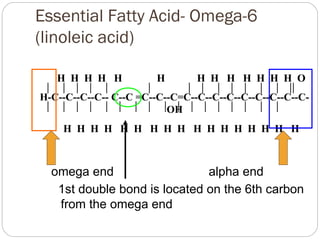
Essential Fatty Acid- Omega-6
(linoleic acid)
H H H H H

H

H H H H H H H O

H-C--C--C--C-- C--C =C--C--C=C--C--C--C--C--C--C--C--COH

H H H H H H H H H H H H H H H H H

omega end
alpha end
1st double bond is located on the 6th carbon
from the omega end
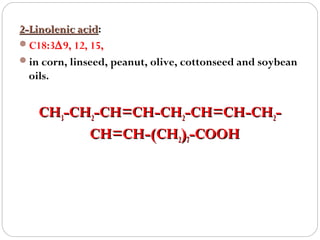
2-Linolenic acid:
acid
C18:3∆9, 12, 15,
in corn, linseed, peanut, olive, cottonseed and soybean
oils.

CH3-CH2-CH=CH-CH2-CH=CH-CH2CH=CH-(CH2)7-COOH
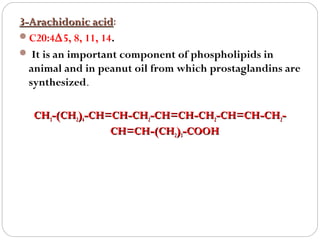
3-Arachidonic acid:
acid
C20:4∆5, 8, 11, 14.
 It is an important component of phospholipids in
animal and in peanut oil from which prostaglandins are
synthesized.
CH3-(CH2)4-CH=CH-CH2-CH=CH-CH2-CH=CH-CH2CH=CH-(CH2)3-COOH
1-Simple Lipids
A-Neutral Fats and oils (Triglycerides)
Definition:
- They are called neutral because they are uncharged
due to absence of ionizable groups in it.
 The neutral fats are the most abundant lipids in nature.
They constitute about 98% of the lipids of adipose
tissue, 30% of plasma or liver lipids, less than 10% of
erythrocyte lipids.
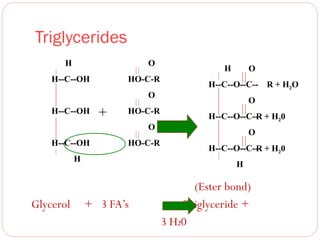
Triglycerides
H

O

H--C--OH

HO-C-R
O

H--C--OH

+

HO-C-R
O

H--C--OH

HO-C-R

H

Glycerol

H

O

H--C--O--C-- R + H2O
O
H--C--O--C-- + H20
R
O
H--C--O--C-- + H20
R
H

+ 3 FA’s

(Ester bond)
Triglyceride +
3 H20
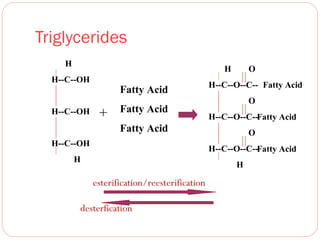
Triglycerides
H

H

H--C--OH

H--C--OH

Fatty Acid

+

Fatty Acid

O

H--C--O--C-- Fatty Acid
O
H--C--O--C--Fatty Acid

Fatty Acid
H--C--OH

O
H--C--O--C--Fatty Acid

H

H

esterification/reesterification
desterfication
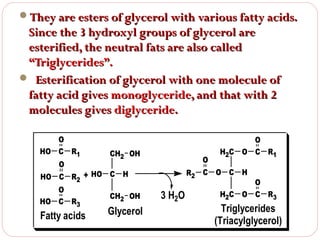
They are esters of glycerol with various fatty acids.

Since the 3 hydroxyl groups of glycerol are
esterified, the neutral fats are also called
“Triglycerides”.
 Esterification of glycerol with one molecule of
fatty acid gives monoglyceride, and that with 2
molecules gives diglyceride.
O
HO C R1
O

CH2 OH

HO C R2 + HO C H
O
CH2 OH
HO C R3

Fatty acids

Glycerol

O

O
H2C O C R1

R2 C O C H

3 H2O

O
H2C O C R3

Triglycerides
(Triacylglycerol)
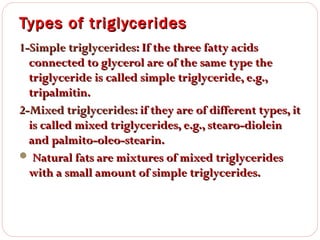
Types of triglycerides
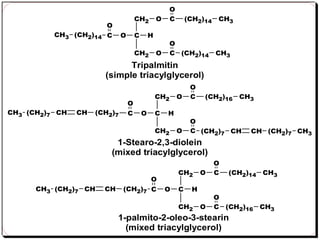
1-Simple triglycerides: If the three fatty acids
connected to glycerol are of the same type the
triglyceride is called simple triglyceride, e.g.,
tripalmitin.
2-Mixed triglycerides: if they are of different types, it
is called mixed triglycerides, e.g., stearo-diolein
and palmito-oleo-stearin.
 Natural fats are mixtures of mixed triglycerides
with a small amount of simple triglycerides.
O

O

CH2

O
CH3 (CH2)14 C

O

C

O
C

O
C (CH2)14

H

CH2

(CH2)14

CH3

CH3

Tripalmitin
(simple triacylglycerol)
CH2

O
CH3 (CH2)7 CH

CH

(CH2)7

C

O

C

O

O
C

O

O
C (CH2)7 CH

H

CH2

(CH2)16

CH3

CH (CH2)7 CH3

1-Stearo-2,3-diolein
(mixed triacylglycerol)
CH2

O
CH3 (CH2)7 CH

CH

(CH2)7 C

O

C

O

O
C

O

O
C (CH2)16

H

CH2

(CH2)14

1-palmito-2-oleo-3-stearin
(mixed triacylglycerol)

CH3

CH3
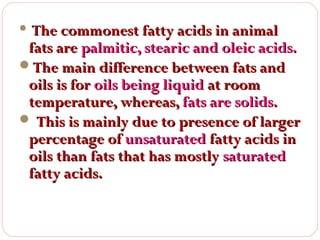
The commonest fatty acids in animal
fats are palmitic, stearic and oleic acids.
The main difference between fats and
oils is for oils being liquid at room
temperature, whereas, fats are solids.
 This is mainly due to presence of larger
percentage of unsaturated fatty acids in
oils than fats that has mostly saturated
fatty acids.

Physical properties of fat and oils:
1.

2.
3.
4.

Freshly prepared fats and oils are colorless,
odorless and tasteless.Any color, or taste is due
to association with other foreign substances, e.g.,
the yellow color of body fat or milk fat is due to
carotene pigments(cow milk).
Fats have specific gravity less than 1 and,
therefore, they float on water.
Fats are insoluble in water, but soluble in organic
solvents as ether and benzene.
Melting points of fats are usually low, but higher
than the solidification point,
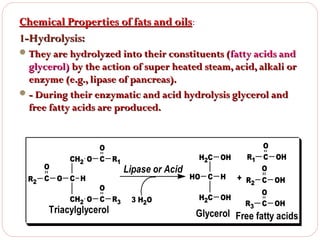
Chemical Properties of fats and oils:
oils
1-Hydrolysis:
 They are hydrolyzed into their constituents (fatty acids and

glycerol) by the action of super heated steam, acid, alkali or
enzyme (e.g., lipase of pancreas).
 - During their enzymatic and acid hydrolysis glycerol and
free fatty acids are produced.

O
R2

C

O
CH2 O C R1
O C H

O
CH2 O C R3

Triacylglycerol

Lipase or Acid
3 H2O

H2C
HO C
H2C

OH
H
OH

O
R1 C OH
O

+ R C OH
2
R3

O
C OH

Glycerol Free fatty acids
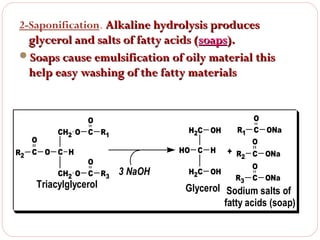
2-Saponification. Alkaline hydrolysis produces

glycerol and salts of fatty acids (soaps).
Soaps cause emulsification of oily material this
help easy washing of the fatty materials

O

O
CH2 O C R1

H2C OH
HO C H

R2 C O C H

O
CH2 O C R3

Triacylglycerol

3 NaOH

H2C OH

O
R1 C ONa
O

+ R C ONa
2
R3

O
C ONa

Glycerol Sodium salts of
fatty acids (soap)
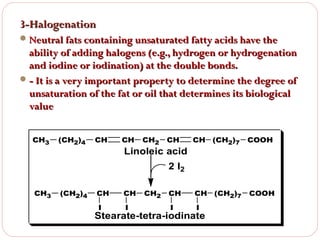
3-Halogenation
 Neutral fats containing unsaturated fatty acids have the

ability of adding halogens (e.g., hydrogen or hydrogenation
and iodine or iodination) at the double bonds.
 - It is a very important property to determine the degree of
unsaturation of the fat or oil that determines its biological
value
CH3

(CH2)4

CH

CH

CH2

CH

CH

(CH2)7

COOH

CH

CH

(CH2)7

COOH

I

I

Linoleic acid
2 I2

CH3

(CH2)4

CH

CH

I

I

CH2

Stearate-tetra-iodinate
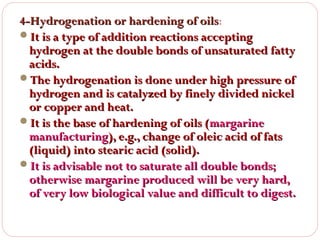
4-Hydrogenation or hardening of oils:
oils
It is a type of addition reactions accepting
hydrogen at the double bonds of unsaturated fatty
acids.
The hydrogenation is done under high pressure of
hydrogen and is catalyzed by finely divided nickel
or copper and heat.
It is the base of hardening of oils (margarine
manufacturing), e.g., change of oleic acid of fats
(liquid) into stearic acid (solid).
It is advisable not to saturate all double bonds;
otherwise margarine produced will be very hard,
of very low biological value and difficult to digest.
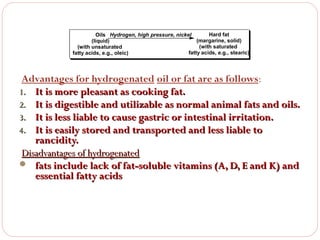
Hard fat
Oils Hydrogen, high pressure, nickel
(margarine, solid)
(liquid)
(with saturated
(with unsaturated
fatty acids, e.g., stearic)
fatty acids, e.g., oleic)

Advantages for hydrogenated oil or fat are as follows:
1. It is more pleasant as cooking fat.
2. It is digestible and utilizable as normal animal fats and oils.
3. It is less liable to cause gastric or intestinal irritation.
4. It is easily stored and transported and less liable to
rancidity.
Disadvantages of hydrogenated
 fats include lack of fat-soluble vitamins (A, D, E and K) and
essential fatty acids
5-Oxidation(Rancidty)
This toxic reaction of triglycerides leads to unpleasant
odour or taste of oils and fats developing after
oxidation by oxygen of air, bacteria, or moisture.
Also this is the base of the drying oils after exposure to
atmospheric oxygen.
Example is linseed oil, which is used in paints and
varnishes manufacturing
Rancidity

Definition:
It is a physico-chemical change in the natural
properties of the fat leading to the development of
unpleasant odor or taste or abnormal color
particularly on aging after exposure to atmospheric
oxygen, light, moisture, bacterial or fungal
contamination and/or heat.
 Saturated fats resist rancidity more than unsaturated
fats that have unsaturated double bonds.
Types and causes of Rancidity:
Hydrolytic rancidity
Oxidative rancidity
3. Ketonic rancidity
1-Hydrolytic rancidity:
rancidity
1.
2.

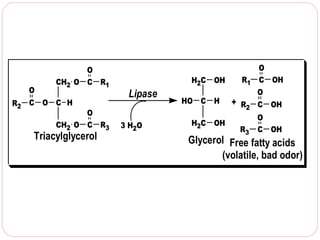
It results from slight hydrolysis of the fat by
lipase from bacterial contamination leading to
the liberation of free fatty acids and glycerol at
high temperature and moisture.
 Volatile short-chain fatty acids have unpleasant
odor.

O

O
CH2 O C R1

R2 C O C H

O
CH2 O C R3

Triacylglycerol

Lipase
3 H2O

H2C OH
HO C H
H2C OH

O
R1 C OH
O

+ R C OH
2
R3

O
C OH

Glycerol Free fatty acids
(volatile, bad odor)
2-Oxidative Rancidity:
Rancidity
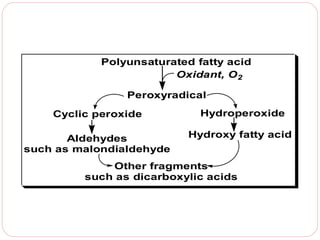
It is oxidation of fat or oil catalyzed by exposure to
oxygen, light and/or heat producing peroxide
derivatives which on decomposition give substances,
e.g., peroxides, aldehydes, ketones and dicarboxylic
acids that are toxic and have bad odor.
This occurs due to oxidative addition of oxygen at the
unsaturated double bond of unsaturated fatty acid of
oils.
Polyunsaturated fatty acid
Oxidant, O2
Peroxyradical
Cyclic peroxide

Hydroperoxide

Aldehydes
such as malondialdehyde

Hydroxy fatty acid

Other fragments
such as dicarboxylic acids
3-Ketonic Rancidity:
It is due to the contamination with certain fungi such
as Asperigillus Niger on fats such as coconut oil.
 Ketones, fatty aldehydes, short chain fatty acids and
fatty alcohols are formed.
Moisture accelerates ketonic rancidity.
 Prevention of rancidity is achieved by:

1. Avoidance of the causes (exposure to light,

oxygen, moisture, high temperature and bacteria
or fungal contamination). By keeping fats or oils
in well-closed containers in cold, dark and dry
place (i.e., good storage conditions).
2. Removal of catalysts such as lead and copper that
catalyze rancidity.
3. Addition of anti-oxidants to prevent
peroxidation in fat (i.e., rancidity). They include
phenols, naphthols, tannins and hydroquinones.
The most common natural antioxidant is vitamin
E that is important in vitro and in vivo.
Hazards of Rancid Fats:
1. The products of rancidity are toxic, i.e., causes food
poisoning and cancer.
2. Rancidity destroys the fat-soluble vitamins (vitamins
A, D, K and E).
3. Rancidity destroys the polyunsaturated essential
fatty acids.
4. Rancidity causes economical loss because rancid fat
is inedible.

1.
2.
3.
4.

Analysis and Identification of fats and oils
(Fat Constants)
Fat constants or numbers are tests used for:
Checking the purity of fat for detection of
adulteration.
To quantitatively estimate certain properties of
fat.
To identify the biological value and natural
characteristics of fat.
Detection of fat rancidity and presence of toxic
hydroxy fatty acids.
1-Iodine number (or value):
Definition: It is the number of grams of iodine absorbed
by 100 grams of fat or oil.
Uses: It is a measure for the degree of unsaturation

of the fat, as a natural property for it.
Unsaturated fatty acids absorb iodine at their
double bonds, therefore, as the degree of
unsaturation increases iodine number and hence
biological value of the fat increase.
It is used for identification of the type of fat,
detection of adulteration and determining the
biological value of fat.
2-Saponification number (or value):
Definition: It is the number of milligrams of KOH
Definition

required to completely saponify one gram of fat.
fat
Uses:
Uses
Since each carboxyl group of a fatty acid reacts
with one mole of KOH during saponification,
therefore, the amount of alkali needed to saponify
certain weight of fat depends upon the number of
fatty acids present per weight.
Thus, fats containing short-chain acids will have
more carboxyl groups per gram than long chain
fatty acids and consume more alkali, i.e., will have
higher saponification number.
3-Acids Number (or value):
Definition:
It is the number of milligrams of KOH required to
neutralize the free fatty acids present in one gram of
fat.
Uses:
It is used for detection of hydrolytic rancidity because
it measures the amount of free fatty acids present.
4-Reichert- Meissl Number (or value):
Definition: It is the number of milliliters of 0.1 N
KOH required to neutralize the water-soluble fatty
acids distilled from 5 grams of fat. Short-chain fatty
acid (less than 10 carbons) is distillated by steam.
Uses: This studies the natural composition of the
fat and is used for detection of fat adulteration.
 Butter that has high percentage of short-chain
fatty acids has highest Reichert-Meissl number
compared to margarine.
5-Acetyl Number (or value):
Definition: It is number of milligrams of KOH
Definition
needed to neutralize the acetic acid liberated from
hydrolysis of 1 gram of acetylated fat (hydroxy fat
reacted with acetic anhydride).
anhydride
Uses: The natural or rancid fat that contains fatty
acids with free hydroxyl groups are converted into
acetylated fat by reaction with acetic anhydride.
 Thus, acetyl number is a measure of number of
hydroxyl groups present.
 It is used for studying the natural properties of the
fat and to detect adulteration and rancidity.
B-Waxes
Definition: Waxes are solid simple lipids
Definition

containing a monohydric alcohol (with a higher
molecular weight than glycerol) esterified to longchain fatty acids. Examples of these alcohols are
palmitoyl alcohol, cholesterol, vitamin A or D.
Properties of waxes: Waxes are insoluble in water,
but soluble in fat solvents and are negative for
acrolein test.
Waxes are not easily hydrolyzed as the fats and are
indigestible by lipases and are very resistant to
rancidity.
Thus they are of no nutritional value.
Type of Waxes:
Waxes
- Waxes are widely distributed in nature such as the
secretion of certain insects as bees-wax, protective coatings
of the skins and furs of animals and leaves and fruits of
plants. They are classified into true-waxes and wax-like
compounds as follows:
A-True waxes: include:
waxes
Bees-wax is secreted by the honeybees that use it to form
the combs. It is a mixture of waxes with the chief
constituent is mericyl palmitate.
C15H31

O
C

Palmitic
acid

OH

+ C30H61OH

Mericyl
alcohol

C15H31

H2O

O
C

O

C30H61

Mericyl
palmitate

B-Wax-like compounds:
 Cholesterol esters: Lanolin (or wool fat) is
esters

prepared from the wool-associated skin glands
and is secreted by sebaceous glands of the skin.
 It is very complex mixture, contains both free
and esterified cholesterol, e.g., cholesterolpalmitate and other sterols.
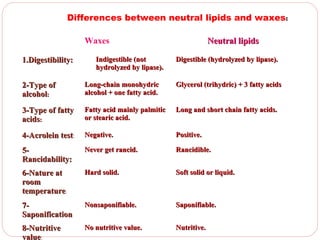
Differences between neutral lipids and waxes:
Waxes
1.Digestibility:

Indigestible (not
hydrolyzed by lipase).

Neutral lipids
Digestible (hydrolyzed by lipase).

2-Type of
alcohol:

Long-chain monohydric
alcohol + one fatty acid.

Glycerol (trihydric) + 3 fatty acids

3-Type of fatty
acids:

Fatty acid mainly palmitic
or stearic acid.

Long and short chain fatty acids.

4-Acrolein test:

Negative.

Positive.

5Rancidability:

Never get rancid.

Rancidible.

6-Nature at
room
temperature.

Hard solid.

Soft solid or liquid.

7Saponification

Nonsaponifiable.

Saponifiable.

8-Nutritive
value:

No nutritive value.

Nutritive.
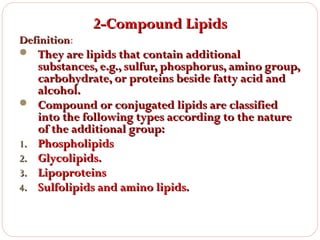
Definition:

2-Compound Lipids

 They are lipids that contain additional



1.
2.
3.
4.

substances, e.g., sulfur, phosphorus, amino group,
carbohydrate, or proteins beside fatty acid and
alcohol.
Compound or conjugated lipids are classified
into the following types according to the nature
of the additional group:
Phospholipids
Glycolipids.
Lipoproteins
Sulfolipids and amino lipids.
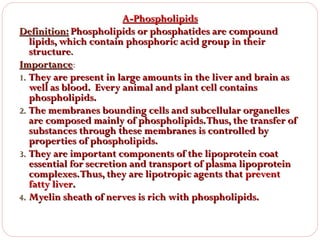
A-Phospholipids
Definition: Phospholipids or phosphatides are compound
lipids, which contain phosphoric acid group in their
structure.
Importance:
Importance
1. They are present in large amounts in the liver and brain as
well as blood. Every animal and plant cell contains
phospholipids.
2. The membranes bounding cells and subcellular organelles
are composed mainly of phospholipids. Thus, the transfer of
substances through these membranes is controlled by
properties of phospholipids.
3. They are important components of the lipoprotein coat
essential for secretion and transport of plasma lipoprotein
complexes. Thus, they are lipotropic agents that prevent
fatty liver.
4. Myelin sheath of nerves is rich with phospholipids.
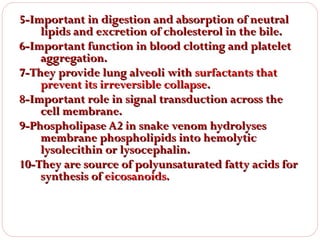
5-Important in digestion and absorption of neutral
lipids and excretion of cholesterol in the bile.
6-Important function in blood clotting and platelet
aggregation.
7-They provide lung alveoli with surfactants that
prevent its irreversible collapse.
8-Important role in signal transduction across the
cell membrane.
9-Phospholipase A2 in snake venom hydrolyses
membrane phospholipids into hemolytic
lysolecithin or lysocephalin.
10-They are source of polyunsaturated fatty acids for
synthesis of eicosanoids.
Sources: They are found in all cells (plant and animal),
milk and egg-yolk in the form of lecithins.
Structure: phospholipids are composed of:
Structure
1. Fatty acids (a saturated and an unsaturated fatty
acid).
2. Nitrogenous base (choline, serine, threonine, or
ethanolamine).
3. Phosphoric acid.
4. Fatty alcohols (glycerol, inositol or sphingosine).
 Classification of Phospholipids are classified into 2

groups according to the type of the alcohol
present into two types:
A-Glycerophospholipids: They are regarded as derivatives
Glycerophospholipids
of phosphatidic acids that are the simplest type of
phospholipids and include:
1. Phosphatidic acids.
2. Lecithins
3. Cephalins.
4. Plasmalogens.
5. Inositides.
6. Cardiolipin.
Cardiolipin
B-Sphingophospholipids: They contain sphingosine as an
B-Sphingophospholipids
alcohol and are named Sphingomyelins.
Sphingomyelins
A-Glycerophospholipids
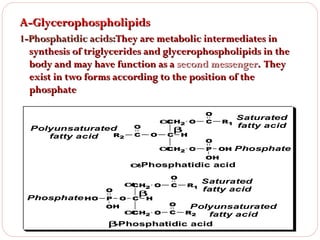
1-Phosphatidic acids:They are metabolic intermediates in
synthesis of triglycerides and glycerophospholipids in the
body and may have function as a second messenger. They
exist in two forms according to the position of the
phosphate

Polyunsaturated
R2
fatty acid

O
C

O

α 2
CH
β
C

O

H

α
CH2

O
C

Saturated
fatty acid

R1

O
O

P

OH

Phosphate

OH

α
-Phosphatidic acid
O

Phosphate HO

P

α
CH2
β

O

C

H

O

O
C
O

R1

Saturated
fatty acid

Polyunsaturated
α
C
CH2 O
R2
fatty acid
β
-Phosphatidic acid

OH
2-Lecithins:
Definition: Lecithins are glycerophospholipids
Definition

that contain choline as a base beside phosphatidic
acid. They exist in 2 forms α - and β -lecithins.
Lecithins are a common cell constituent obtained
from brain (α -type), egg yolk (β -type), or liver
(both types). Lecithins are important in the
metabolism of fat by the liver.
Structure: Glycerol is connected at C2 or C3 with a
polyunsaturated fatty acid, at C1 with a saturated
fatty acid, at C3 or C2 by phosphate to which the
choline base is connected. The common fatty acids
in lecithins are stearic, palmitic, oleic, linoleic,
linolenic, clupandonic or arachidonic acids.
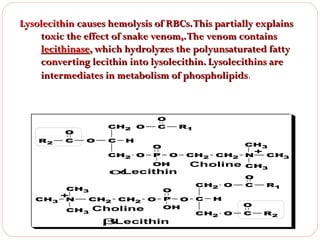
Lysolecithin causes hemolysis of RBCs. This partially explains
toxic the effect of snake venom,. The venom contains
lecithinase, which hydrolyzes the polyunsaturated fatty
converting lecithin into lysolecithin. Lysolecithins are
intermediates in metabolism of phospholipids.

CH2 O

O
R2

C

O
C

O

C

H

CH2 O

R1
CH3

O
P

O

OH

CH2

α
-Lecithin
CH3

CH3

+
N

O

CH2

CH3

CH2

Choline

O

P

O
OH

β
-Lecithin

CH2

Choline
CH2 O
C

H

CH2 O

N

+

CH3

CH3
O
C

R1

O
C

R2








Lung surfactant

Is a complex of dipalmitoyl-lecithin, sphingomyelin and a
group of apoproteins called apoprotein A, B, C, and D.
It is produced by type II alveolar cells and is anchored to
the alveolar surface of type II and I cells.
It lowers alveolar surface tension and improves gas
exchange besides activating macrophages to kill
pathogens.
In premature babies, this surfactant is deficient and they
suffer from respiratory distress syndrome.
Glucocorticoids increase the synthesis of the surfactant
complex and promote differentiation of lung cells.
3-Cephalins (or Kephalins):
Definition: They are phosphatidyl-ethanolamine or
Definition
serine. Cephalins occur in association with lecithins in
tissues and are isolated from the brain (Kephale =
head).
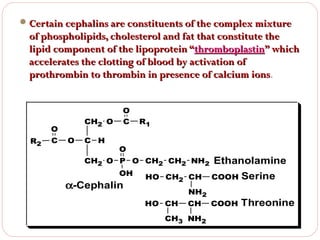
Structure: Cephalins resemble lecithins in structure
except that choline is replaced by ethanolamine, serine
or threonine amino acids.
 Certain cephalins are constituents of the complex mixture

of phospholipids, cholesterol and fat that constitute the
lipid component of the lipoprotein “thromboplastin” which
accelerates the clotting of blood by activation of
prothrombin to thrombin in presence of calcium ions.
ions

CH2 O

O
R2

C

O

C H

O
C

R1

O

CH2 O P O CH2 CH2 NH2 Ethanolamine
OH
HO CH CH COOH Serine
2

α-Cephalin

HO CH

NH2

CH

CH3 NH2

COOH

Threonine
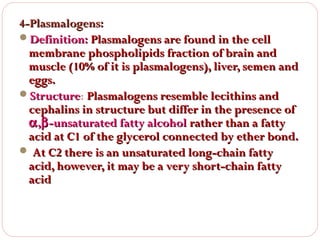
4-Plasmalogens:
Definition: Plasmalogens are found in the cell
membrane phospholipids fraction of brain and
muscle (10% of it is plasmalogens), liver, semen and
eggs.
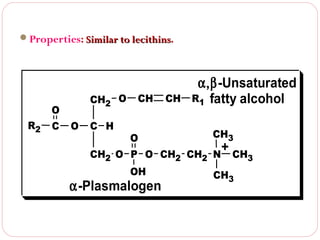
Structure: Plasmalogens resemble lecithins and
Structure
cephalins in structure but differ in the presence of
α ,β -unsaturated fatty alcohol rather than a fatty
acid at C1 of the glycerol connected by ether bond.
 At C2 there is an unsaturated long-chain fatty
acid, however, it may be a very short-chain fatty
acid
Properties: Similar to lecithins.

CH2 O

O
R2

C

O

C H

CH

CH

α,β-Unsaturated
R1 fatty alcohol

O

CH2 O P O CH2 CH2
OH

α-Plasmalogen

CH3

+ CH
N

3

CH3
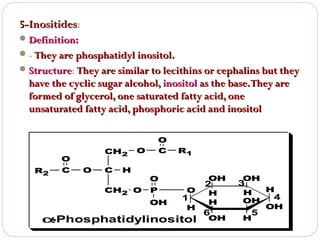
5-Inositides:
5-Inositides
 Definition:
 - They are phosphatidyl inositol.
 Structure: They are similar to lecithins or cephalins but they
Structure

have the cyclic sugar alcohol, inositol as the base. They are
formed of glycerol, one saturated fatty acid, one
unsaturated fatty acid, phosphoric acid and inositol

CH2

O
R2

C

O

C

O
C

O

H

CH2 O

R1
OH

O
P
OH

O

1

H

α
-Phosphatidylinositol

2

H
H

6

OH

OH

3

H
H
4
OH
OH

5

H
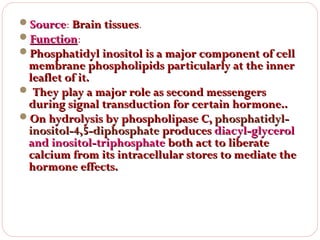
Source: Brain tissues.
Source
tissues
Function:
Function
Phosphatidyl inositol is a major component of cell

membrane phospholipids particularly at the inner
leaflet of it.
 They play a major role as second messengers
during signal transduction for certain hormone..
On hydrolysis by phospholipase C, phosphatidylinositol-4,5-diphosphate produces diacyl-glycerol
and inositol-triphosphate both act to liberate
calcium from its intracellular stores to mediate the
hormone effects.
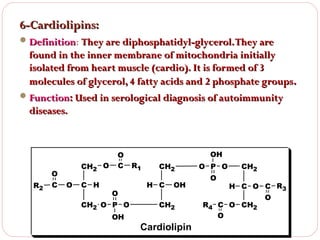
6-Cardiolipins:
 Definition: They are diphosphatidyl-glycerol. They are

found in the inner membrane of mitochondria initially
isolated from heart muscle (cardio). It is formed of 3
molecules of glycerol, 4 fatty acids and 2 phosphate groups.
 Function: Used in serological diagnosis of autoimmunity
diseases.

CH2 O

O
R2

C

O

C H

O
C
O

CH2 O P O
OH

OH
R1

CH2
H C

OH

CH2

Cardiolipin

O P O
O

CH2

H C O C R3
O
R4 C O CH2
O
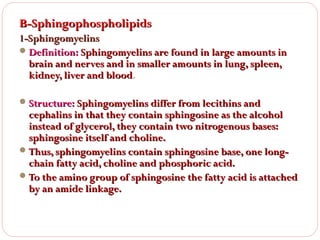
B-Sphingophospholipids
1-Sphingomyelins
 Definition: Sphingomyelins are found in large amounts in
brain and nerves and in smaller amounts in lung, spleen,
kidney, liver and blood.
blood
 Structure: Sphingomyelins differ from lecithins and

cephalins in that they contain sphingosine as the alcohol
instead of glycerol, they contain two nitrogenous bases:
sphingosine itself and choline.
 Thus, sphingomyelins contain sphingosine base, one longchain fatty acid, choline and phosphoric acid.
 To the amino group of sphingosine the fatty acid is attached
by an amide linkage.
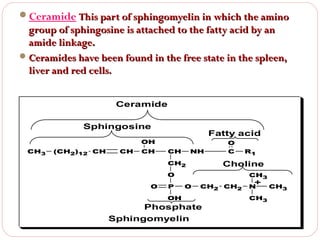
Ceramide This part of sphingomyelin in which the amino

group of sphingosine is attached to the fatty acid by an
amide linkage.
 Ceramides have been found in the free state in the spleen,
liver and red cells.
Ceramide
Sphingosine

Fatty acid

OH
CH3

(CH2)12 CH

CH

CH

CH

NH

CH2

O
C

Choline

O
O

P

R1
CH3

O

CH2 CH2

OH

Phosphate
Sphingomyelin

+

N

CH3

CH3
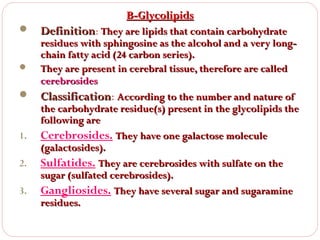
B-Glycolipids






1.
2.
3.

Definition: They are lipids that contain carbohydrate

residues with sphingosine as the alcohol and a very longchain fatty acid (24 carbon series).
They are present in cerebral tissue, therefore are called
cerebrosides
Classification: According to the number and nature of
Classification
the carbohydrate residue(s) present in the glycolipids the
following are
Cerebrosides. They have one galactose molecule
(galactosides).
Sulfatides. They are cerebrosides with sulfate on the
sugar (sulfated cerebrosides).
Gangliosides. They have several sugar and sugaramine
residues.
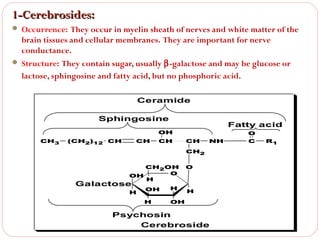
1-Cerebrosides:
 Occurrence: They occur in myelin sheath of nerves and white matter of the

brain tissues and cellular membranes. They are important for nerve
conductance.
 Structure: They contain sugar, usually β-galactose and may be glucose or
lactose, sphingosine and fatty acid, but no phosphoric acid.
Ceramide
Sphingosine

Fatty acid

OH
CH3

(CH2)12 CH

CH

CH

CH

NH

CH2
CH2OH
O
OH
H

Galactose

OH

H

H

H

O

OH

H

Psychosin
Cerebroside

O
C

R1
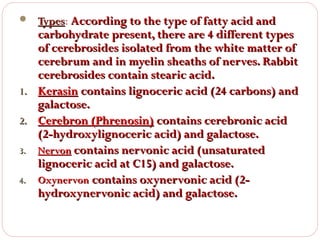
 Types: According to the type of fatty acid and

carbohydrate present, there are 4 different types
of cerebrosides isolated from the white matter of
cerebrum and in myelin sheaths of nerves. Rabbit
cerebrosides contain stearic acid.
1. Kerasin contains lignoceric acid (24 carbons) and
galactose.
2. Cerebron (Phrenosin) contains cerebronic acid
(2-hydroxylignoceric acid) and galactose.
3. Nervon contains nervonic acid (unsaturated
lignoceric acid at C15) and galactose.
4. Oxynervon contains oxynervonic acid (2hydroxynervonic acid) and galactose.
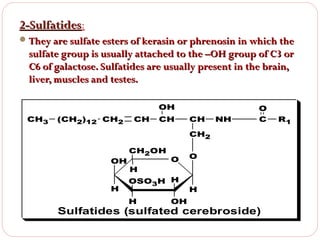
2-Sulfatides:
2-Sulfatides
 They are sulfate esters of kerasin or phrenosin in which the

sulfate group is usually attached to the –OH group of C3 or
C6 of galactose. Sulfatides are usually present in the brain,
liver, muscles and testes.
OH
CH3

(CH2)12 CH2

CH

CH

CH

NH

O
C

CH2
OH
H

CH2OH
H

O

OSO3H H
H

OH

O

H

Sulfatides (sulfated cerebroside)

R1
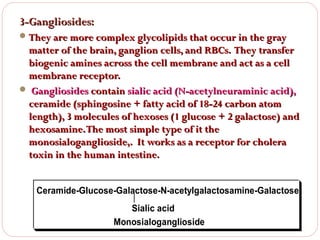
3-Gangliosides:
 They are more complex glycolipids that occur in the gray

matter of the brain, ganglion cells, and RBCs. They transfer
biogenic amines across the cell membrane and act as a cell
membrane receptor.
 Gangliosides contain sialic acid (N-acetylneuraminic acid),
ceramide (sphingosine + fatty acid of 18-24 carbon atom
length), 3 molecules of hexoses (1 glucose + 2 galactose) and
hexosamine. The most simple type of it the
monosialoganglioside,. It works as a receptor for cholera
toxin in the human intestine.
Ceramide-Glucose-Galactose-N-acetylgalactosamine-Galactose
Sialic acid
Monosialoganglioside
C-Lipoproteins

 Definition: Lipoproteins are lipids combined with proteins


1.




in the tissues. The lipid component is phospholipid,
cholesterol or triglycerides. The holding bonds are
secondary bonds.
They include:
Structural lipoproteins: These are widely distributed in
tissues being present in cellular and subcellular
membranes. In lung tissues acting as a surfactant in a
complex of a protein and lecithin. In the eye, rhodopsin of
rods is a lipoprotein complex.
Transport lipoproteins:
These are the forms present in blood plasma. They are
composed of a protein called apolipoprotein and different
types of lipids. (Cholesterol, cholesterol esters,
phospholipids and triglycerides). As the lipid content
increases, the density of plasma lipoproteins decreases

1.

2.

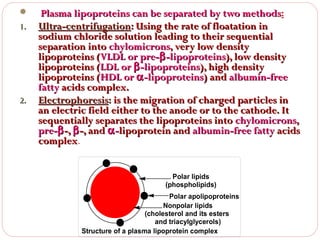
Plasma lipoproteins can be separated by two methods:
methods
Ultra-centrifugation: Using the rate of floatation in
sodium chloride solution leading to their sequential
separation into chylomicrons, very low density
lipoproteins (VLDL or pre-β -lipoproteins), low density
lipoproteins (LDL or β -lipoproteins), high density
lipoproteins (HDL or α -lipoproteins) and albumin-free
fatty acids complex.
Electrophoresis: is the migration of charged particles in
an electric field either to the anode or to the cathode. It
sequentially separates the lipoproteins into chylomicrons,
pre-β -, β -, and α -lipoprotein and albumin-free fatty acids
complex.
complex
Polar lipids
(phospholipids)
Polar apolipoproteins
Nonpolar lipids
(cholesterol and its esters
and triacylglycerols)
Structure of a plasma lipoprotein complex
a) Chylomicrons: They have the largest diameter and the

least density. They contain 1-2% protein only and 98-99% fat.
The main lipid fraction is triglycerides absorbed from the
intestine and they contain small amounts of the absorbed
cholesterol and phospholipids.

b) Very low-density lipoproteins (VLDL) or pre-β lipoproteins: Their diameter is smaller than chylomicrons.
They contain about 7-10% protein and 90-93% lipid. The
lipid content is mainly triglycerides formed in the liver.
They contain phospholipid and cholesterol more than
chylomicrons.

c) Low-density lipoproteins (LDL) or β -lipoproteins:
They contain 10-20% proteins in the form of apolipoprotein
B. Their lipid content varies from 80-90%. They contain
about 60% of total blood cholesterol and 40% of total blood
phospholipids. As their percentage increases, the liability to
atherosclerosis increases.
d) High-density lipoproteins (HDL) or α Lipoproteins: They contain 35-55% proteins in the
Lipoproteins
form of apolipoprotein A. They contain 45-65%
lipids formed of cholesterol (40% of total blood
content) and phospholipids (60% of total blood
content). They act as cholesterol scavengers, as
their percentage increases, the liability to
atherosclerosis decreases. They are higher in
females than in males. Due to their high protein
content they possess the highest density.
e) Albumin-free fatty acids complex: It is a
proteolipid complex with 99% protein content
associated with long-chain free fatty acids for
transporting them.
Cholesterol:
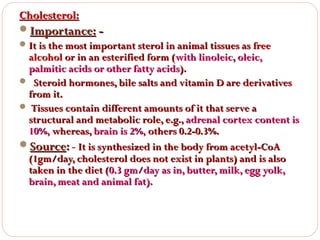
Importance:  It is the most important sterol in animal tissues as free

alcohol or in an esterified form (with linoleic, oleic,
palmitic acids or other fatty acids).
 Steroid hormones, bile salts and vitamin D are derivatives
from it.
 Tissues contain different amounts of it that serve a
structural and metabolic role, e.g., adrenal cortex content is
10%, whereas, brain is 2%, others 0.2-0.3%.
Source: - It is synthesized in the body from acetyl-CoA
(1gm/day, cholesterol does not exist in plants) and is also
taken in the diet (0.3 gm/day as in, butter, milk, egg yolk,
brain, meat and animal fat).
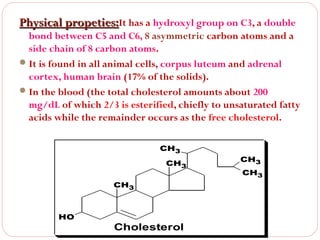
Physical propeties:It has a hydroxyl group on C3, a double

bond between C5 and C6, 8 asymmetric carbon atoms and a
side chain of 8 carbon atoms.
 It is found in all animal cells, corpus luteum and adrenal
cortex, human brain (17% of the solids).
 In the blood (the total cholesterol amounts about 200
mg/dL of which 2/3 is esterified, chiefly to unsaturated fatty
acids while the remainder occurs as the free cholesterol.
CH3
CH3
CH3

HO

Cholesterol

CH3
CH3
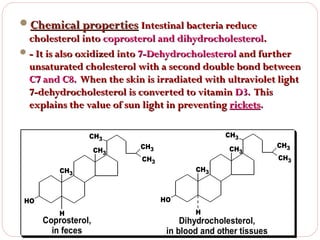
Chemical properties Intestinal bacteria reduce
cholesterol into coprosterol and dihydrocholesterol.
 - It is also oxidized into 7-Dehydrocholesterol and further
unsaturated cholesterol with a second double bond between
C7 and C8. When the skin is irradiated with ultraviolet light
7-dehydrocholesterol is converted to vitamin D3. This
explains the value of sun light in preventing rickets.
CH3
CH3

CH3
CH3

CH3

CH3

CH3

CH3

HO

HO
H

Coprosterol,
in feces

H

Dihydrocholesterol,
in blood and other tissues

CH3
CH3
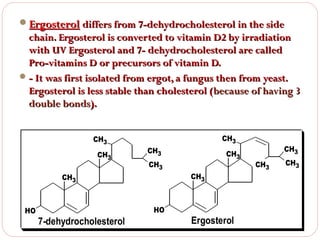
Ergosterol differs from 7-dehydrocholesterol in the side

chain. Ergosterol is converted to vitamin D2 by irradiation
with UV Ergosterol and 7- dehydrocholesterol are called
Pro-vitamins D or precursors of vitamin D.
 - It was first isolated from ergot, a fungus then from yeast.
Ergosterol is less stable than cholesterol (because of having 3
double bonds).
CH3
CH3

CH3
CH3

CH3

HO

HO

7-dehydrocholesterol

CH3
CH3
CH3

Ergosterol

CH3
CH3

CH3
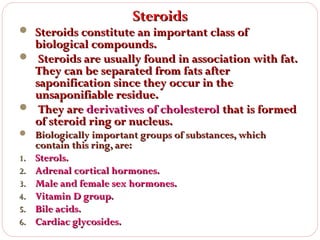
Steroids

 Steroids constitute an important class of

biological compounds.
 Steroids are usually found in association with fat.
They can be separated from fats after
saponification since they occur in the
unsaponifiable residue.
 They are derivatives of cholesterol that is formed
of steroid ring or nucleus.
 Biologically important groups of substances, which
1.
2.
3.
4.
5.
6.

contain this ring, are:
Sterols.
Adrenal cortical hormones.
Male and female sex hormones.
Vitamin D group.
Bile acids.
Cardiac glycosides.
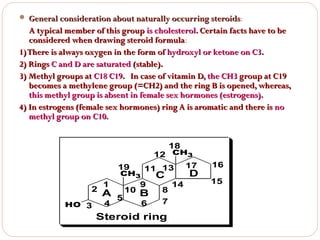
 General consideration about naturally occurring steroids:
steroids

A typical member of this group is cholesterol. Certain facts have to be
considered when drawing steroid formula:
formula
1) There is always oxygen in the form of hydroxyl or ketone on C3.
2) Rings C and D are saturated (stable).
3) Methyl groups at C18 C19. In case of vitamin D, the CH3 group at C19
becomes a methylene group (=CH2) and the ring B is opened, whereas,
this methyl group is absent in female sex hormones (estrogens).
4) In estrogens (female sex hormones) ring A is aromatic and there is no
methyl group on C10.
18

19

CH3

1

9

4

2
HO 3

12 CH3
11 13 17

6

A 5 10 B

C

8
7

Steroid ring

D

14

16
15
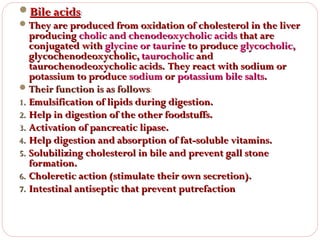
Bile acids:
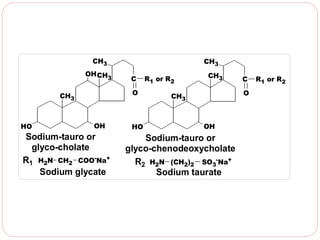
 They are produced from oxidation of cholesterol in the liver
producing cholic and chenodeoxycholic acids that are
conjugated with glycine or taurine to produce glycocholic,
glycochenodeoxycholic, taurocholic and
taurochenodeoxycholic acids. They react with sodium or
potassium to produce sodium or potassium bile salts.
 Their function is as follows:
1. Emulsification of lipids during digestion.
2. Help in digestion of the other foodstuffs.
3. Activation of pancreatic lipase.
4. Help digestion and absorption of fat-soluble vitamins.
5. Solubilizing cholesterol in bile and prevent gall stone
formation.
6. Choleretic action (stimulate their own secretion).
7. Intestinal antiseptic that prevent putrefaction
CH3

CH3

OH CH

3

O

CH3

HO

C

OH

Sodium-tauro or
glyco-cholate
R1 H2N CH2 COO-Na+
Sodium glycate

HO

R1 or R2

CH3

C
O

CH3

OH

Sodium-tauro or
glyco-chenodeoxycholate
R2 H2N (CH2)2 SO3-Na+
Sodium taurate

R1 or R2
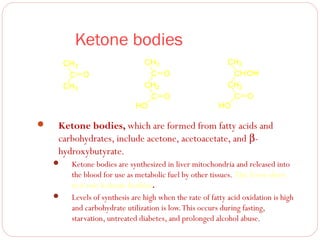
Ketone bodies
CH3
C O
CH3



CH3
C O
CH2
C O
HO

CH3
CH OH
CH2
C O
HO

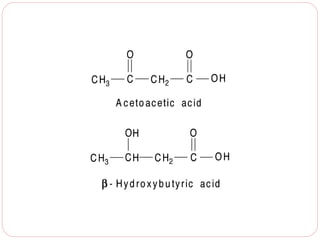
Ketone bodies, which are formed from fatty acids and
carbohydrates, include acetone, acetoacetate, and βhydroxybutyrate.




Ketone bodies are synthesized in liver mitochondria and released into
the blood for use as metabolic fuel by other tissues. The liver does
not use ketone bodies.
Levels of synthesis are high when the rate of fatty acid oxidation is high
and carbohydrate utilization is low. This occurs during fasting,
starvation, untreated diabetes, and prolonged alcohol abuse.
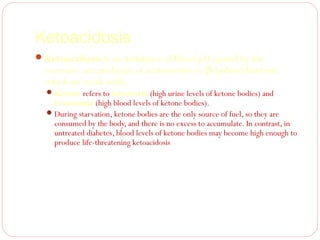
Ketoacidosis
 Ketoacidosis is an imbalance of blood pH caused by the

excessive accumulation of acetoacetate or β-hydroxybutyrate,
which are weak acids.
 Ketosis refers to ketonuria (high urine levels of ketone bodies) and

ketonemia (high blood levels of ketone bodies).
 During starvation, ketone bodies are the only source of fuel, so they are
consumed by the body, and there is no excess to accumulate. In contrast, in
untreated diabetes, blood levels of ketone bodies may become high enough to
produce life-threatening ketoacidosis
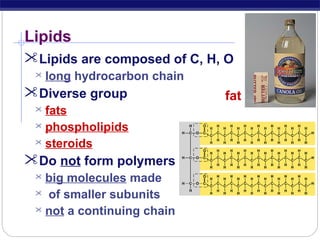
Lipids
Lipids are composed of C, H, O


long hydrocarbon chain

Diverse group
fats
 phospholipids
 steroids


Do not form polymers
big molecules made
 of smaller subunits
 not a continuing chain


fat
Fat subunits
Structure:


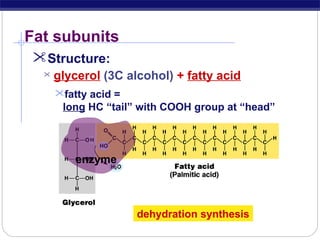
glycerol (3C alcohol) + fatty acid
fatty acid =

long HC “tail” with COOH group at “head”

enzyme

dehydration synthesis
Building Fats
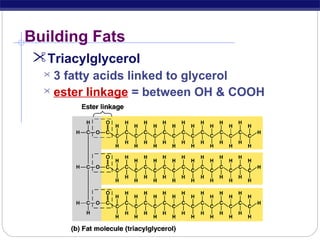
Triacylglycerol
3 fatty acids linked to glycerol
 ester linkage = between OH & COOH

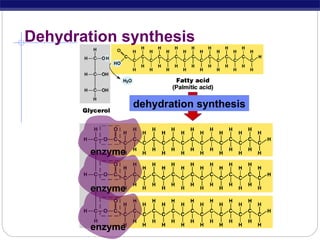
Dehydration synthesis

dehydration synthesis

enzyme

enzyme

enzyme
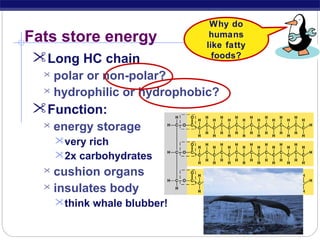
Fats store energy
Long HC chain

Why do
humans
like fatty
foods?

polar or non-polar?
 hydrophilic or hydrophobic?


Function:


energy storage
very rich
2x carbohydrates

cushion organs
 insulates body


think whale blubber!
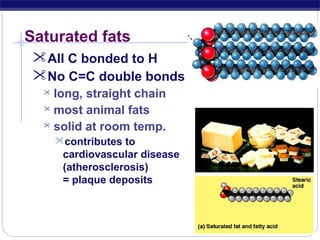
Saturated fats
All C bonded to H
No C=C double bonds
long, straight chain
 most animal fats
 solid at room temp.


contributes to

cardiovascular disease
(atherosclerosis)
= plaque deposits
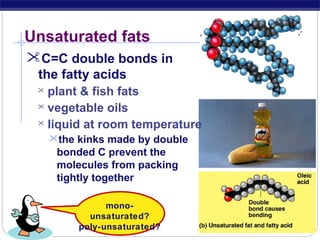
Unsaturated fats
C=C double bonds in
the fatty acids
plant & fish fats
 vegetable oils
 liquid at room temperature


the kinks made by double

bonded C prevent the
molecules from packing
tightly together

AP Biology

monounsaturated?
poly-unsaturated?
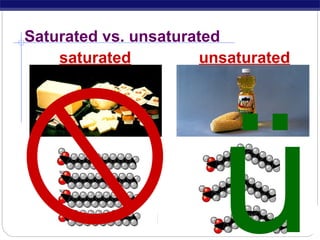
Saturated vs. unsaturated
saturated
unsaturated

ü
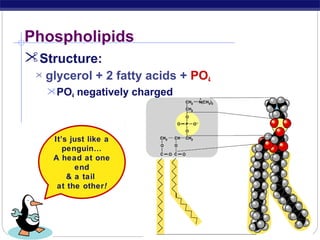
Phospholipids
Structure:


glycerol + 2 fatty acids + PO4
PO4 negatively charged

It’s just like a
penguin…
A head at one
end
& a tail
at the other!

AP Biology
Phospholipids
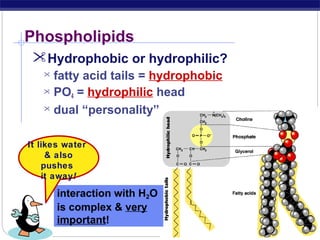
Hydrophobic or hydrophilic?
fatty acid tails = hydrophobic
 PO = hydrophilic head
4
 dual “personality”


It likes water
& also
pushes
it away!

interaction with H2O
is complex & very
important!
AP Biology
Phospholipids in water
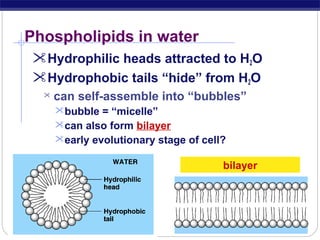
Hydrophilic heads attracted to H2O
Hydrophobic tails “hide” from H2O


can self-assemble into “bubbles”
bubble = “micelle”
can also form bilayer
early evolutionary stage of cell?

bilayer

AP Biology
Why is this important?
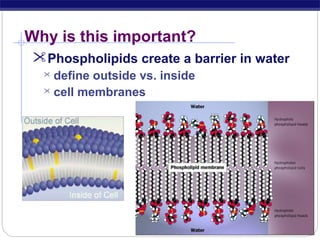
Phospholipids create a barrier in water
define outside vs. inside
 cell membranes

Phospholipids & cells
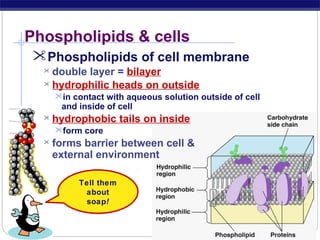
Phospholipids of cell membrane
double layer = bilayer
 hydrophilic heads on outside


in contact with aqueous solution outside of cell

and inside of cell



hydrophobic tails on inside
form core



forms barrier between cell &
external environment
Tell them
about
soap!

AP Biology
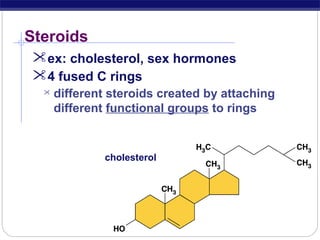
Steroids
ex: cholesterol, sex hormones
4 fused C rings


different steroids created by attaching
different functional groups to rings

cholesterol
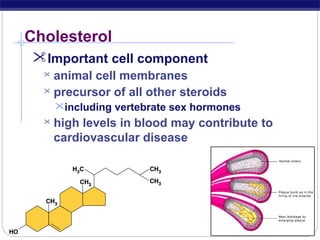
Cholesterol
Important cell component
animal cell membranes
 precursor of all other steroids


including vertebrate sex hormones


AP Biology

high levels in blood may contribute to
cardiovascular disease
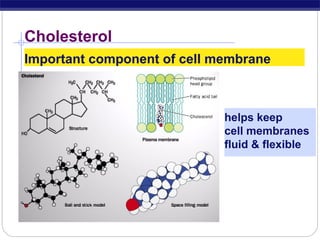
Cholesterol
Important component of cell membrane

helps keep
cell membranes
fluid & flexible
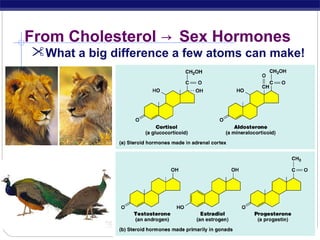
From Cholesterol → Sex Hormones

What a big difference a few atoms can make!
THANKS

Mustansar 2014 lipid

  • 2.
    Lipids: Fats &Oils by DR. MUSTANSAR
  • 3.
  • 4.
    Chemistry of Lipids Definition: -Lipids are organic compounds formed mainly from alcohol and fatty acids combined together by ester linkage. H2O O R CH2 OH + Fatty alcohol HO C R Fatty acid Esterase (lipase) O R CH2 O C R ester (lipid)
  • 5.
    Lipids are insolublein water, but soluble in fat or organic solvents (ether, chloroform, benzene, acetone). - Lipids include fats, oils, waxes and related compounds. They are widely distributed in nature both in plants and in animals. -
  • 6.
    Biological Importance ofLipids: 1. 2. 3. 4. 5. 6. They are more palatable and storable to unlimited amount compared to carbohydrates. They have a high-energy value (25% of body needs) and they provide more energy per gram than carbohydrates and proteins but carbohydrates are the preferable source of energy. Supply the essential fatty acids that cannot be synthesized by the body. Supply the body with fat-soluble vitamins (A, D, E and K). They are important constituents of the nervous system. Tissue fat is an essential constituent of cell membrane and nervous system. It is mainly phospholipids in nature that are not affected by starvation.
  • 7.
    7-Stored lipids “depotfat” is stored in all human cells acts as:  A store of energy.  A pad for the internal organs to protect them from outside shocks.  A subcutaneous thermal insulator against loss of body heat. 8-Lipoproteins, which are complex of lipids and proteins, are important cellular constituents that present both in the cellular and subcellular membranes. 9-Cholesterol enters in membrane structure and is used for synthesis of adrenal cortical hormones, vitamin D3 and bile acids. 10- Lipids provide bases for dealing with diseases such as obesity, atherosclerosis, lipid-storage diseases, essential fatty acid deficiency, respiratory distress syndrome,
  • 8.
    Classification of Lipids 1.Simple lipids (Fats & Waxes) 2. Compound or conjugated lipids 3. Derived Lipids 4. Lipid-associating substances
  • 10.
    Some common classificationsof lipids and their general biologic functions Lipid Fatty acids Triacylglycerols Primary Functions Energy sources, biosynthetic precursors Storage, transport Phosphoglycerides Ketone bodies Sphingolipids Eicosanoids Cholesterol Steroid hormones Membrane components Energy sources Membrane components Modulators of physiologic activity Membrane component Modulators of physiologic activity
  • 11.
    Fatty alcohols 1-Glycerol: It isa trihydric alcohol (i.e., containing three OH groups) and has the popular name glycerin. It is synthesized in the body from glucose.  It has the following properties:
  • 12.
    1. 2. Colorless viscous oilyliquid with sweet taste. On heating with sulfuric acid or KHSO4 (dehydration) it gives acrolein that has a bad odor. This reaction is used for detection of free glycerol or any compound containing glycerol. CH2 HO OH CH CH2 OH Glycerol 2 H2O CHO Heating, KHSO4 CH CH2 Acrolein
  • 13.
    3-It combines withthree molecules of nitric acid to form trinitroglycerin (TNT) that is used as explosive and vasodilator. 4-On esterification with fatty acids it gives:  Monoglyceride or monoacyl-glycerol: one fatty acid + glycerol.  Diglyceride or diacyl-glycerol: two fatty acids + glycerol.  Triglyceride or triacyl-glycerol: three fatty acids + glycerol. 5-It has a nutritive value by conversion into glucose and enters in structure of phospholipids.
  • 14.
    Uses of Glycerol: 1.Glycerol enters in pharmaceutical and cosmetic preparations. 2. Reduces brain edema in cerebrovascular disease. 3. Nitroglycerin is used as vasodilator especially for the coronary arteries, thus it is used in treatment of angina pectoris. Also, enters in explosives manufacturing. 4. Glycerol is used in treatment of glaucoma (increased intraocular pressure)due to its ability to dehydrate the tissue from its water content.
  • 15.
    2-Sphingosine: - It isthe alcohol(monohydric) present in sphingolipids. - It is synthesized in the body from serine and palmitic acid. It is not positive with acrolein test. OH CH3 (CH2)12 CH CH CH Sphingosine CH NH2 CH2OH
  • 16.
    Fatty Acids Definition: Definition Fatty acidsare aliphatic mono-carboxylic acids that are mostly obtained from the hydrolysis of natural fats and oils. Have the general formula R-(CH2)n-COOH and mostly have straight chain (a few exceptions have branched and heterocyclic chains). In this formula "n" is mostly an even number of carbon atoms (234) with a few exceptions that have an odd number. Fatty acids are classified according to several bases as follows:
  • 17.
    Fatty Acid Structure HH H H H H H H H H H H H H H HHO H-C--C--C--C--C--C--C--C--C--C--C--C--C--C--C--C--C-C-OH H H H H H H H H H H H H H H H H H omega end alpha end degree of saturation
  • 18.
    I. According topresence or absence of double bonds they are classified into: A-Saturated Fatty Acids they contain no double bonds with 2-24 or more carbons. They are solid at room temperature except if they are short chained. They may be even or odd numbered. They have the following molecular formula, CnH2n+1COOH.
  • 19.
    Saturated fatty acids(no double ) A-Short chain Saturated F.A. (2-10 carbon). a-Short chain Saturated volatile F.A.(2-6 carbon). b- Short chain Saturated non volatile F.A.(7-10 carbon). B-Long chain Saturated F.A.(more the10 carbon)
  • 20.
    Saturated Fatty AcidStructure H H H H H H H H H H H H H H H HHO H-C--C--C--C--C--C--C--C--C--C--C--C--C--C--C--C--C-C-OH H H H H H H H H H H H H H H H H H omega end alpha end degree of saturation: single carbon bond
  • 21.
    Monounsaturated Fatty Acid Structure HH H H H H H H H H H H H H H O H-C--C--C--C--C--C--C--C--C=C--C--C--C--C--C--C--C--C-OH H H H H H H H H H H H H H H H H H omega end alpha end One double bond
  • 22.
    Polyunsaturated Fatty Acid Structure HH H H H H H H H H H HH O H-C--C--C--C--C--C=C--C--C=C--C--C--C--C--C--C--C--C-OH H H H H H H H H H H H H H H H H H omega end alpha end > 2 double bonds
  • 23.
    a-Volatile short-chain fattyacids:  They are liquid in nature and contain (1-6) carbon atoms.  water-soluble and volatile at room temperature, e.g., acetic, butyric, and caproic acids. Acetic F.A. (2C ) CH3-COOH. Butyric F.A. (4C ) CH3-(CH2)2-COOH. Caproic F.A. (6C ) CH3-(CH2)4-COOH.
  • 24.
    b-Non-volatile short-chain fattyacids: acids They are solids at room temperature and contain 7-10 carbon atoms.  They are water-soluble and non-volatile at room temperature include caprylic and capric F.A. caprylic (8 C ) CH3-(CH2)6-COOH. Capric (10 C ) CH3-(CH2)8-COOH.
  • 25.
    B-Long-chain fatty acids: Theycontain more than 10 carbon atoms. They occur in hydrogenated oils, animal fats, butter and coconut and palm oils. They are non-volatile and water-insoluble Include palmitic, stearic, and lignoceric F.A.  palmitic(16C) CH3-(CH2)14-COOH stearic (18 C ) CH3-(CH2)16-COOH lignoceric (24C ) CH3-(CH2)22-COOH
  • 26.
    B-Unsaturated Fatty Acids Theycontain double bond  monounsaturated they contain one double bonds . (CnH2n-1 COOH)  polyunsaturated they contain more the one double bond (CnH2n-more than 1 COOH).
  • 27.
    1-Monounsaturated fatty acids: 1-Palmitoleicacid :  It is found in all fats.  It is C16:1∆9, i.e., has 16 carbons and one double bond located at carbon number 9 and involving carbon 10. CH3-( CH2 )5CH = CH-(CH2)7 –COOH
  • 28.
    2-Oleic acid Is themost common fatty acid in natural fats. It is C18:1∆9, i.e., has 18 carbons and one double bond located at carbon number 9 and involving carbon 10. CH3-(CH2)7- CH=CH – (CH2)7-COOH
  • 29.
    3-Nervonic acid (Unsaturated lignocericacid).  It is found in cerebrosides.  It is C24:1∆15, i.e., has 24 carbons and one double bond located at carbon number 15 and involving carbon 16. CH3 – (CH2)7 CH= CH – (CH2)13- COOH
  • 30.
    2-Polyunsaturated fatty acids: (Essential fatty acids):  Definition:  They are essential fatty acids that can not be synthesized in the human body and must be taken in adequate amounts in the diet.  They are required for normal growth and metabolism
  • 31.
    Source: vegetable oilssuch as corn oil, linseed oil, peanut oil, olive oil, cottonseed oil, soybean oil and many other plant oils, cod liver oil and animal fats.  Deficiency: Their deficiency in the diet leads to nutrition deficiency disease. Its symptoms include: poor growth and health with susceptibility to infections, dermatitis, decreased capacity to reproduce, impaired transport of lipids, fatty liver, and lowered resistance to stress.
  • 32.
     1. 2. 3. 4. 5. 6. 7. 8. Function of EssentialFatty Acids: They are useful in the treatment of atherosclerosis by help transporting blood cholesterol and lowering it and transporting triglycerides. The hormones are synthesized from them. They enter in structure of all cellular and subcellular membranes and the transporting plasma phospholipids. They are essential for skin integrity, normal growth and reproduction. They have an important role in blood clotting (intrinsic factor). Important in preventing and treating fatty liver. Important role in health of the retina and vision. They can be oxidized for energy production.
  • 33.
    Signs and Symptomsof Essential Fatty Acids Deficiency Flaky, itchy skin Diarrhea Infections Retarded growth and wound healing Anemia
  • 34.
    Essential Fatty Acid-Omega-3 (alpha-linolenic acid) H H H H H H H H H H H H H H H HH O H-C--C--C=C--C--C =C--C--C=C--C--C--C--C--C--C--C--C-OH H H H H H H H H H H H omega end alpha end 1st double bond is located on the 3rd carbon from the omega end
  • 35.
    1-Linoleic: C18:2∆9, 12.  Itis the most important since other essential fatty acids can be synthesized from it in the body. CH3-(CH2)4-CH = CH-CH2-CH=CH-(CH2)7-COOH
  • 36.
    Essential Fatty Acid-Omega-6 (linoleic acid) H H H H H H H H H H H H H O H-C--C--C--C-- C--C =C--C--C=C--C--C--C--C--C--C--C--COH H H H H H H H H H H H H H H H H H omega end alpha end 1st double bond is located on the 6th carbon from the omega end
  • 37.
    2-Linolenic acid: acid C18:3∆9, 12,15, in corn, linseed, peanut, olive, cottonseed and soybean oils. CH3-CH2-CH=CH-CH2-CH=CH-CH2CH=CH-(CH2)7-COOH
  • 38.
    3-Arachidonic acid: acid C20:4∆5, 8,11, 14.  It is an important component of phospholipids in animal and in peanut oil from which prostaglandins are synthesized. CH3-(CH2)4-CH=CH-CH2-CH=CH-CH2-CH=CH-CH2CH=CH-(CH2)3-COOH
  • 39.
    1-Simple Lipids A-Neutral Fatsand oils (Triglycerides) Definition: - They are called neutral because they are uncharged due to absence of ionizable groups in it.  The neutral fats are the most abundant lipids in nature. They constitute about 98% of the lipids of adipose tissue, 30% of plasma or liver lipids, less than 10% of erythrocyte lipids.
  • 40.
    Triglycerides H O H--C--OH HO-C-R O H--C--OH + HO-C-R O H--C--OH HO-C-R H Glycerol H O H--C--O--C-- R +H2O O H--C--O--C-- + H20 R O H--C--O--C-- + H20 R H + 3 FA’s (Ester bond) Triglyceride + 3 H20
  • 41.
    Triglycerides H H H--C--OH H--C--OH Fatty Acid + Fatty Acid O H--C--O--C--Fatty Acid O H--C--O--C--Fatty Acid Fatty Acid H--C--OH O H--C--O--C--Fatty Acid H H esterification/reesterification desterfication
  • 42.
    They are estersof glycerol with various fatty acids. Since the 3 hydroxyl groups of glycerol are esterified, the neutral fats are also called “Triglycerides”.  Esterification of glycerol with one molecule of fatty acid gives monoglyceride, and that with 2 molecules gives diglyceride. O HO C R1 O CH2 OH HO C R2 + HO C H O CH2 OH HO C R3 Fatty acids Glycerol O O H2C O C R1 R2 C O C H 3 H2O O H2C O C R3 Triglycerides (Triacylglycerol)
  • 43.
    Types of triglycerides 1-Simpletriglycerides: If the three fatty acids connected to glycerol are of the same type the triglyceride is called simple triglyceride, e.g., tripalmitin. 2-Mixed triglycerides: if they are of different types, it is called mixed triglycerides, e.g., stearo-diolein and palmito-oleo-stearin.  Natural fats are mixtures of mixed triglycerides with a small amount of simple triglycerides.
  • 44.
    O O CH2 O CH3 (CH2)14 C O C O C O C(CH2)14 H CH2 (CH2)14 CH3 CH3 Tripalmitin (simple triacylglycerol) CH2 O CH3 (CH2)7 CH CH (CH2)7 C O C O O C O O C (CH2)7 CH H CH2 (CH2)16 CH3 CH (CH2)7 CH3 1-Stearo-2,3-diolein (mixed triacylglycerol) CH2 O CH3 (CH2)7 CH CH (CH2)7 C O C O O C O O C (CH2)16 H CH2 (CH2)14 1-palmito-2-oleo-3-stearin (mixed triacylglycerol) CH3 CH3
  • 45.
    The commonest fattyacids in animal fats are palmitic, stearic and oleic acids. The main difference between fats and oils is for oils being liquid at room temperature, whereas, fats are solids.  This is mainly due to presence of larger percentage of unsaturated fatty acids in oils than fats that has mostly saturated fatty acids. 
  • 46.
    Physical properties offat and oils: 1. 2. 3. 4. Freshly prepared fats and oils are colorless, odorless and tasteless.Any color, or taste is due to association with other foreign substances, e.g., the yellow color of body fat or milk fat is due to carotene pigments(cow milk). Fats have specific gravity less than 1 and, therefore, they float on water. Fats are insoluble in water, but soluble in organic solvents as ether and benzene. Melting points of fats are usually low, but higher than the solidification point,
  • 47.
    Chemical Properties offats and oils: oils 1-Hydrolysis:  They are hydrolyzed into their constituents (fatty acids and glycerol) by the action of super heated steam, acid, alkali or enzyme (e.g., lipase of pancreas).  - During their enzymatic and acid hydrolysis glycerol and free fatty acids are produced. O R2 C O CH2 O C R1 O C H O CH2 O C R3 Triacylglycerol Lipase or Acid 3 H2O H2C HO C H2C OH H OH O R1 C OH O + R C OH 2 R3 O C OH Glycerol Free fatty acids
  • 48.
    2-Saponification. Alkaline hydrolysisproduces glycerol and salts of fatty acids (soaps). Soaps cause emulsification of oily material this help easy washing of the fatty materials O O CH2 O C R1 H2C OH HO C H R2 C O C H O CH2 O C R3 Triacylglycerol 3 NaOH H2C OH O R1 C ONa O + R C ONa 2 R3 O C ONa Glycerol Sodium salts of fatty acids (soap)
  • 49.
    3-Halogenation  Neutral fatscontaining unsaturated fatty acids have the ability of adding halogens (e.g., hydrogen or hydrogenation and iodine or iodination) at the double bonds.  - It is a very important property to determine the degree of unsaturation of the fat or oil that determines its biological value CH3 (CH2)4 CH CH CH2 CH CH (CH2)7 COOH CH CH (CH2)7 COOH I I Linoleic acid 2 I2 CH3 (CH2)4 CH CH I I CH2 Stearate-tetra-iodinate
  • 50.
    4-Hydrogenation or hardeningof oils: oils It is a type of addition reactions accepting hydrogen at the double bonds of unsaturated fatty acids. The hydrogenation is done under high pressure of hydrogen and is catalyzed by finely divided nickel or copper and heat. It is the base of hardening of oils (margarine manufacturing), e.g., change of oleic acid of fats (liquid) into stearic acid (solid). It is advisable not to saturate all double bonds; otherwise margarine produced will be very hard, of very low biological value and difficult to digest.
  • 51.
    Hard fat Oils Hydrogen,high pressure, nickel (margarine, solid) (liquid) (with saturated (with unsaturated fatty acids, e.g., stearic) fatty acids, e.g., oleic) Advantages for hydrogenated oil or fat are as follows: 1. It is more pleasant as cooking fat. 2. It is digestible and utilizable as normal animal fats and oils. 3. It is less liable to cause gastric or intestinal irritation. 4. It is easily stored and transported and less liable to rancidity. Disadvantages of hydrogenated  fats include lack of fat-soluble vitamins (A, D, E and K) and essential fatty acids
  • 52.
    5-Oxidation(Rancidty) This toxic reactionof triglycerides leads to unpleasant odour or taste of oils and fats developing after oxidation by oxygen of air, bacteria, or moisture. Also this is the base of the drying oils after exposure to atmospheric oxygen. Example is linseed oil, which is used in paints and varnishes manufacturing
  • 53.
    Rancidity Definition: It is aphysico-chemical change in the natural properties of the fat leading to the development of unpleasant odor or taste or abnormal color particularly on aging after exposure to atmospheric oxygen, light, moisture, bacterial or fungal contamination and/or heat.  Saturated fats resist rancidity more than unsaturated fats that have unsaturated double bonds.
  • 54.
    Types and causesof Rancidity: Hydrolytic rancidity Oxidative rancidity 3. Ketonic rancidity 1-Hydrolytic rancidity: rancidity 1. 2. It results from slight hydrolysis of the fat by lipase from bacterial contamination leading to the liberation of free fatty acids and glycerol at high temperature and moisture.  Volatile short-chain fatty acids have unpleasant odor. 
  • 55.
    O O CH2 O CR1 R2 C O C H O CH2 O C R3 Triacylglycerol Lipase 3 H2O H2C OH HO C H H2C OH O R1 C OH O + R C OH 2 R3 O C OH Glycerol Free fatty acids (volatile, bad odor)
  • 56.
    2-Oxidative Rancidity: Rancidity It isoxidation of fat or oil catalyzed by exposure to oxygen, light and/or heat producing peroxide derivatives which on decomposition give substances, e.g., peroxides, aldehydes, ketones and dicarboxylic acids that are toxic and have bad odor. This occurs due to oxidative addition of oxygen at the unsaturated double bond of unsaturated fatty acid of oils.
  • 57.
    Polyunsaturated fatty acid Oxidant,O2 Peroxyradical Cyclic peroxide Hydroperoxide Aldehydes such as malondialdehyde Hydroxy fatty acid Other fragments such as dicarboxylic acids
  • 58.
    3-Ketonic Rancidity: It isdue to the contamination with certain fungi such as Asperigillus Niger on fats such as coconut oil.  Ketones, fatty aldehydes, short chain fatty acids and fatty alcohols are formed. Moisture accelerates ketonic rancidity.
  • 59.
     Prevention ofrancidity is achieved by: 1. Avoidance of the causes (exposure to light, oxygen, moisture, high temperature and bacteria or fungal contamination). By keeping fats or oils in well-closed containers in cold, dark and dry place (i.e., good storage conditions). 2. Removal of catalysts such as lead and copper that catalyze rancidity. 3. Addition of anti-oxidants to prevent peroxidation in fat (i.e., rancidity). They include phenols, naphthols, tannins and hydroquinones. The most common natural antioxidant is vitamin E that is important in vitro and in vivo.
  • 60.
    Hazards of RancidFats: 1. The products of rancidity are toxic, i.e., causes food poisoning and cancer. 2. Rancidity destroys the fat-soluble vitamins (vitamins A, D, K and E). 3. Rancidity destroys the polyunsaturated essential fatty acids. 4. Rancidity causes economical loss because rancid fat is inedible.
  • 61.
     1. 2. 3. 4. Analysis and Identificationof fats and oils (Fat Constants) Fat constants or numbers are tests used for: Checking the purity of fat for detection of adulteration. To quantitatively estimate certain properties of fat. To identify the biological value and natural characteristics of fat. Detection of fat rancidity and presence of toxic hydroxy fatty acids.
  • 62.
    1-Iodine number (orvalue): Definition: It is the number of grams of iodine absorbed by 100 grams of fat or oil. Uses: It is a measure for the degree of unsaturation of the fat, as a natural property for it. Unsaturated fatty acids absorb iodine at their double bonds, therefore, as the degree of unsaturation increases iodine number and hence biological value of the fat increase. It is used for identification of the type of fat, detection of adulteration and determining the biological value of fat.
  • 63.
    2-Saponification number (orvalue): Definition: It is the number of milligrams of KOH Definition required to completely saponify one gram of fat. fat Uses: Uses Since each carboxyl group of a fatty acid reacts with one mole of KOH during saponification, therefore, the amount of alkali needed to saponify certain weight of fat depends upon the number of fatty acids present per weight. Thus, fats containing short-chain acids will have more carboxyl groups per gram than long chain fatty acids and consume more alkali, i.e., will have higher saponification number.
  • 64.
    3-Acids Number (orvalue): Definition: It is the number of milligrams of KOH required to neutralize the free fatty acids present in one gram of fat. Uses: It is used for detection of hydrolytic rancidity because it measures the amount of free fatty acids present.
  • 65.
    4-Reichert- Meissl Number(or value): Definition: It is the number of milliliters of 0.1 N KOH required to neutralize the water-soluble fatty acids distilled from 5 grams of fat. Short-chain fatty acid (less than 10 carbons) is distillated by steam. Uses: This studies the natural composition of the fat and is used for detection of fat adulteration.  Butter that has high percentage of short-chain fatty acids has highest Reichert-Meissl number compared to margarine.
  • 66.
    5-Acetyl Number (orvalue): Definition: It is number of milligrams of KOH Definition needed to neutralize the acetic acid liberated from hydrolysis of 1 gram of acetylated fat (hydroxy fat reacted with acetic anhydride). anhydride Uses: The natural or rancid fat that contains fatty acids with free hydroxyl groups are converted into acetylated fat by reaction with acetic anhydride.  Thus, acetyl number is a measure of number of hydroxyl groups present.  It is used for studying the natural properties of the fat and to detect adulteration and rancidity.
  • 67.
    B-Waxes Definition: Waxes aresolid simple lipids Definition containing a monohydric alcohol (with a higher molecular weight than glycerol) esterified to longchain fatty acids. Examples of these alcohols are palmitoyl alcohol, cholesterol, vitamin A or D. Properties of waxes: Waxes are insoluble in water, but soluble in fat solvents and are negative for acrolein test. Waxes are not easily hydrolyzed as the fats and are indigestible by lipases and are very resistant to rancidity. Thus they are of no nutritional value.
  • 68.
    Type of Waxes: Waxes -Waxes are widely distributed in nature such as the secretion of certain insects as bees-wax, protective coatings of the skins and furs of animals and leaves and fruits of plants. They are classified into true-waxes and wax-like compounds as follows: A-True waxes: include: waxes Bees-wax is secreted by the honeybees that use it to form the combs. It is a mixture of waxes with the chief constituent is mericyl palmitate.
  • 69.
    C15H31 O C Palmitic acid OH + C30H61OH Mericyl alcohol C15H31 H2O O C O C30H61 Mericyl palmitate B-Wax-like compounds: Cholesterol esters: Lanolin (or wool fat) is esters prepared from the wool-associated skin glands and is secreted by sebaceous glands of the skin.  It is very complex mixture, contains both free and esterified cholesterol, e.g., cholesterolpalmitate and other sterols.
  • 70.
    Differences between neutrallipids and waxes: Waxes 1.Digestibility: Indigestible (not hydrolyzed by lipase). Neutral lipids Digestible (hydrolyzed by lipase). 2-Type of alcohol: Long-chain monohydric alcohol + one fatty acid. Glycerol (trihydric) + 3 fatty acids 3-Type of fatty acids: Fatty acid mainly palmitic or stearic acid. Long and short chain fatty acids. 4-Acrolein test: Negative. Positive. 5Rancidability: Never get rancid. Rancidible. 6-Nature at room temperature. Hard solid. Soft solid or liquid. 7Saponification Nonsaponifiable. Saponifiable. 8-Nutritive value: No nutritive value. Nutritive.
  • 71.
    Definition: 2-Compound Lipids  Theyare lipids that contain additional  1. 2. 3. 4. substances, e.g., sulfur, phosphorus, amino group, carbohydrate, or proteins beside fatty acid and alcohol. Compound or conjugated lipids are classified into the following types according to the nature of the additional group: Phospholipids Glycolipids. Lipoproteins Sulfolipids and amino lipids.
  • 72.
    A-Phospholipids Definition: Phospholipids orphosphatides are compound lipids, which contain phosphoric acid group in their structure. Importance: Importance 1. They are present in large amounts in the liver and brain as well as blood. Every animal and plant cell contains phospholipids. 2. The membranes bounding cells and subcellular organelles are composed mainly of phospholipids. Thus, the transfer of substances through these membranes is controlled by properties of phospholipids. 3. They are important components of the lipoprotein coat essential for secretion and transport of plasma lipoprotein complexes. Thus, they are lipotropic agents that prevent fatty liver. 4. Myelin sheath of nerves is rich with phospholipids.
  • 73.
    5-Important in digestionand absorption of neutral lipids and excretion of cholesterol in the bile. 6-Important function in blood clotting and platelet aggregation. 7-They provide lung alveoli with surfactants that prevent its irreversible collapse. 8-Important role in signal transduction across the cell membrane. 9-Phospholipase A2 in snake venom hydrolyses membrane phospholipids into hemolytic lysolecithin or lysocephalin. 10-They are source of polyunsaturated fatty acids for synthesis of eicosanoids.
  • 74.
    Sources: They arefound in all cells (plant and animal), milk and egg-yolk in the form of lecithins. Structure: phospholipids are composed of: Structure 1. Fatty acids (a saturated and an unsaturated fatty acid). 2. Nitrogenous base (choline, serine, threonine, or ethanolamine). 3. Phosphoric acid. 4. Fatty alcohols (glycerol, inositol or sphingosine).
  • 75.
     Classification ofPhospholipids are classified into 2 groups according to the type of the alcohol present into two types: A-Glycerophospholipids: They are regarded as derivatives Glycerophospholipids of phosphatidic acids that are the simplest type of phospholipids and include: 1. Phosphatidic acids. 2. Lecithins 3. Cephalins. 4. Plasmalogens. 5. Inositides. 6. Cardiolipin. Cardiolipin B-Sphingophospholipids: They contain sphingosine as an B-Sphingophospholipids alcohol and are named Sphingomyelins. Sphingomyelins
  • 76.
    A-Glycerophospholipids 1-Phosphatidic acids:They aremetabolic intermediates in synthesis of triglycerides and glycerophospholipids in the body and may have function as a second messenger. They exist in two forms according to the position of the phosphate Polyunsaturated R2 fatty acid O C O α 2 CH β C O H α CH2 O C Saturated fatty acid R1 O O P OH Phosphate OH α -Phosphatidic acid O Phosphate HO P α CH2 β O C H O O C O R1 Saturated fatty acid Polyunsaturated α C CH2 O R2 fatty acid β -Phosphatidic acid OH
  • 77.
    2-Lecithins: Definition: Lecithins areglycerophospholipids Definition that contain choline as a base beside phosphatidic acid. They exist in 2 forms α - and β -lecithins. Lecithins are a common cell constituent obtained from brain (α -type), egg yolk (β -type), or liver (both types). Lecithins are important in the metabolism of fat by the liver. Structure: Glycerol is connected at C2 or C3 with a polyunsaturated fatty acid, at C1 with a saturated fatty acid, at C3 or C2 by phosphate to which the choline base is connected. The common fatty acids in lecithins are stearic, palmitic, oleic, linoleic, linolenic, clupandonic or arachidonic acids.
  • 78.
    Lysolecithin causes hemolysisof RBCs. This partially explains toxic the effect of snake venom,. The venom contains lecithinase, which hydrolyzes the polyunsaturated fatty converting lecithin into lysolecithin. Lysolecithins are intermediates in metabolism of phospholipids. CH2 O O R2 C O C O C H CH2 O R1 CH3 O P O OH CH2 α -Lecithin CH3 CH3 + N O CH2 CH3 CH2 Choline O P O OH β -Lecithin CH2 Choline CH2 O C H CH2 O N + CH3 CH3 O C R1 O C R2
  • 79.
          Lung surfactant Is acomplex of dipalmitoyl-lecithin, sphingomyelin and a group of apoproteins called apoprotein A, B, C, and D. It is produced by type II alveolar cells and is anchored to the alveolar surface of type II and I cells. It lowers alveolar surface tension and improves gas exchange besides activating macrophages to kill pathogens. In premature babies, this surfactant is deficient and they suffer from respiratory distress syndrome. Glucocorticoids increase the synthesis of the surfactant complex and promote differentiation of lung cells.
  • 80.
    3-Cephalins (or Kephalins): Definition:They are phosphatidyl-ethanolamine or Definition serine. Cephalins occur in association with lecithins in tissues and are isolated from the brain (Kephale = head). Structure: Cephalins resemble lecithins in structure except that choline is replaced by ethanolamine, serine or threonine amino acids.
  • 81.
     Certain cephalinsare constituents of the complex mixture of phospholipids, cholesterol and fat that constitute the lipid component of the lipoprotein “thromboplastin” which accelerates the clotting of blood by activation of prothrombin to thrombin in presence of calcium ions. ions CH2 O O R2 C O C H O C R1 O CH2 O P O CH2 CH2 NH2 Ethanolamine OH HO CH CH COOH Serine 2 α-Cephalin HO CH NH2 CH CH3 NH2 COOH Threonine
  • 82.
    4-Plasmalogens: Definition: Plasmalogens arefound in the cell membrane phospholipids fraction of brain and muscle (10% of it is plasmalogens), liver, semen and eggs. Structure: Plasmalogens resemble lecithins and Structure cephalins in structure but differ in the presence of α ,β -unsaturated fatty alcohol rather than a fatty acid at C1 of the glycerol connected by ether bond.  At C2 there is an unsaturated long-chain fatty acid, however, it may be a very short-chain fatty acid
  • 83.
    Properties: Similar tolecithins. CH2 O O R2 C O C H CH CH α,β-Unsaturated R1 fatty alcohol O CH2 O P O CH2 CH2 OH α-Plasmalogen CH3 + CH N 3 CH3
  • 84.
    5-Inositides: 5-Inositides  Definition:  -They are phosphatidyl inositol.  Structure: They are similar to lecithins or cephalins but they Structure have the cyclic sugar alcohol, inositol as the base. They are formed of glycerol, one saturated fatty acid, one unsaturated fatty acid, phosphoric acid and inositol CH2 O R2 C O C O C O H CH2 O R1 OH O P OH O 1 H α -Phosphatidylinositol 2 H H 6 OH OH 3 H H 4 OH OH 5 H
  • 85.
    Source: Brain tissues. Source tissues Function: Function Phosphatidylinositol is a major component of cell membrane phospholipids particularly at the inner leaflet of it.  They play a major role as second messengers during signal transduction for certain hormone.. On hydrolysis by phospholipase C, phosphatidylinositol-4,5-diphosphate produces diacyl-glycerol and inositol-triphosphate both act to liberate calcium from its intracellular stores to mediate the hormone effects.
  • 86.
    6-Cardiolipins:  Definition: Theyare diphosphatidyl-glycerol. They are found in the inner membrane of mitochondria initially isolated from heart muscle (cardio). It is formed of 3 molecules of glycerol, 4 fatty acids and 2 phosphate groups.  Function: Used in serological diagnosis of autoimmunity diseases. CH2 O O R2 C O C H O C O CH2 O P O OH OH R1 CH2 H C OH CH2 Cardiolipin O P O O CH2 H C O C R3 O R4 C O CH2 O
  • 87.
    B-Sphingophospholipids 1-Sphingomyelins  Definition: Sphingomyelinsare found in large amounts in brain and nerves and in smaller amounts in lung, spleen, kidney, liver and blood. blood  Structure: Sphingomyelins differ from lecithins and cephalins in that they contain sphingosine as the alcohol instead of glycerol, they contain two nitrogenous bases: sphingosine itself and choline.  Thus, sphingomyelins contain sphingosine base, one longchain fatty acid, choline and phosphoric acid.  To the amino group of sphingosine the fatty acid is attached by an amide linkage.
  • 88.
    Ceramide This partof sphingomyelin in which the amino group of sphingosine is attached to the fatty acid by an amide linkage.  Ceramides have been found in the free state in the spleen, liver and red cells. Ceramide Sphingosine Fatty acid OH CH3 (CH2)12 CH CH CH CH NH CH2 O C Choline O O P R1 CH3 O CH2 CH2 OH Phosphate Sphingomyelin + N CH3 CH3
  • 89.
    B-Glycolipids    1. 2. 3. Definition: They arelipids that contain carbohydrate residues with sphingosine as the alcohol and a very longchain fatty acid (24 carbon series). They are present in cerebral tissue, therefore are called cerebrosides Classification: According to the number and nature of Classification the carbohydrate residue(s) present in the glycolipids the following are Cerebrosides. They have one galactose molecule (galactosides). Sulfatides. They are cerebrosides with sulfate on the sugar (sulfated cerebrosides). Gangliosides. They have several sugar and sugaramine residues.
  • 90.
    1-Cerebrosides:  Occurrence: Theyoccur in myelin sheath of nerves and white matter of the brain tissues and cellular membranes. They are important for nerve conductance.  Structure: They contain sugar, usually β-galactose and may be glucose or lactose, sphingosine and fatty acid, but no phosphoric acid. Ceramide Sphingosine Fatty acid OH CH3 (CH2)12 CH CH CH CH NH CH2 CH2OH O OH H Galactose OH H H H O OH H Psychosin Cerebroside O C R1
  • 91.
     Types: Accordingto the type of fatty acid and carbohydrate present, there are 4 different types of cerebrosides isolated from the white matter of cerebrum and in myelin sheaths of nerves. Rabbit cerebrosides contain stearic acid. 1. Kerasin contains lignoceric acid (24 carbons) and galactose. 2. Cerebron (Phrenosin) contains cerebronic acid (2-hydroxylignoceric acid) and galactose. 3. Nervon contains nervonic acid (unsaturated lignoceric acid at C15) and galactose. 4. Oxynervon contains oxynervonic acid (2hydroxynervonic acid) and galactose.
  • 92.
    2-Sulfatides: 2-Sulfatides  They aresulfate esters of kerasin or phrenosin in which the sulfate group is usually attached to the –OH group of C3 or C6 of galactose. Sulfatides are usually present in the brain, liver, muscles and testes. OH CH3 (CH2)12 CH2 CH CH CH NH O C CH2 OH H CH2OH H O OSO3H H H OH O H Sulfatides (sulfated cerebroside) R1
  • 93.
    3-Gangliosides:  They aremore complex glycolipids that occur in the gray matter of the brain, ganglion cells, and RBCs. They transfer biogenic amines across the cell membrane and act as a cell membrane receptor.  Gangliosides contain sialic acid (N-acetylneuraminic acid), ceramide (sphingosine + fatty acid of 18-24 carbon atom length), 3 molecules of hexoses (1 glucose + 2 galactose) and hexosamine. The most simple type of it the monosialoganglioside,. It works as a receptor for cholera toxin in the human intestine. Ceramide-Glucose-Galactose-N-acetylgalactosamine-Galactose Sialic acid Monosialoganglioside
  • 94.
    C-Lipoproteins  Definition: Lipoproteinsare lipids combined with proteins  1.   in the tissues. The lipid component is phospholipid, cholesterol or triglycerides. The holding bonds are secondary bonds. They include: Structural lipoproteins: These are widely distributed in tissues being present in cellular and subcellular membranes. In lung tissues acting as a surfactant in a complex of a protein and lecithin. In the eye, rhodopsin of rods is a lipoprotein complex. Transport lipoproteins: These are the forms present in blood plasma. They are composed of a protein called apolipoprotein and different types of lipids. (Cholesterol, cholesterol esters, phospholipids and triglycerides). As the lipid content increases, the density of plasma lipoproteins decreases
  • 95.
     1. 2. Plasma lipoproteins canbe separated by two methods: methods Ultra-centrifugation: Using the rate of floatation in sodium chloride solution leading to their sequential separation into chylomicrons, very low density lipoproteins (VLDL or pre-β -lipoproteins), low density lipoproteins (LDL or β -lipoproteins), high density lipoproteins (HDL or α -lipoproteins) and albumin-free fatty acids complex. Electrophoresis: is the migration of charged particles in an electric field either to the anode or to the cathode. It sequentially separates the lipoproteins into chylomicrons, pre-β -, β -, and α -lipoprotein and albumin-free fatty acids complex. complex Polar lipids (phospholipids) Polar apolipoproteins Nonpolar lipids (cholesterol and its esters and triacylglycerols) Structure of a plasma lipoprotein complex
  • 96.
    a) Chylomicrons: Theyhave the largest diameter and the least density. They contain 1-2% protein only and 98-99% fat. The main lipid fraction is triglycerides absorbed from the intestine and they contain small amounts of the absorbed cholesterol and phospholipids. b) Very low-density lipoproteins (VLDL) or pre-β lipoproteins: Their diameter is smaller than chylomicrons. They contain about 7-10% protein and 90-93% lipid. The lipid content is mainly triglycerides formed in the liver. They contain phospholipid and cholesterol more than chylomicrons. c) Low-density lipoproteins (LDL) or β -lipoproteins: They contain 10-20% proteins in the form of apolipoprotein B. Their lipid content varies from 80-90%. They contain about 60% of total blood cholesterol and 40% of total blood phospholipids. As their percentage increases, the liability to atherosclerosis increases.
  • 97.
    d) High-density lipoproteins(HDL) or α Lipoproteins: They contain 35-55% proteins in the Lipoproteins form of apolipoprotein A. They contain 45-65% lipids formed of cholesterol (40% of total blood content) and phospholipids (60% of total blood content). They act as cholesterol scavengers, as their percentage increases, the liability to atherosclerosis decreases. They are higher in females than in males. Due to their high protein content they possess the highest density. e) Albumin-free fatty acids complex: It is a proteolipid complex with 99% protein content associated with long-chain free fatty acids for transporting them.
  • 98.
    Cholesterol: Importance:  Itis the most important sterol in animal tissues as free alcohol or in an esterified form (with linoleic, oleic, palmitic acids or other fatty acids).  Steroid hormones, bile salts and vitamin D are derivatives from it.  Tissues contain different amounts of it that serve a structural and metabolic role, e.g., adrenal cortex content is 10%, whereas, brain is 2%, others 0.2-0.3%. Source: - It is synthesized in the body from acetyl-CoA (1gm/day, cholesterol does not exist in plants) and is also taken in the diet (0.3 gm/day as in, butter, milk, egg yolk, brain, meat and animal fat).
  • 99.
    Physical propeties:It hasa hydroxyl group on C3, a double bond between C5 and C6, 8 asymmetric carbon atoms and a side chain of 8 carbon atoms.  It is found in all animal cells, corpus luteum and adrenal cortex, human brain (17% of the solids).  In the blood (the total cholesterol amounts about 200 mg/dL of which 2/3 is esterified, chiefly to unsaturated fatty acids while the remainder occurs as the free cholesterol. CH3 CH3 CH3 HO Cholesterol CH3 CH3
  • 100.
    Chemical properties Intestinalbacteria reduce cholesterol into coprosterol and dihydrocholesterol.  - It is also oxidized into 7-Dehydrocholesterol and further unsaturated cholesterol with a second double bond between C7 and C8. When the skin is irradiated with ultraviolet light 7-dehydrocholesterol is converted to vitamin D3. This explains the value of sun light in preventing rickets. CH3 CH3 CH3 CH3 CH3 CH3 CH3 CH3 HO HO H Coprosterol, in feces H Dihydrocholesterol, in blood and other tissues CH3 CH3
  • 101.
    Ergosterol differs from7-dehydrocholesterol in the side chain. Ergosterol is converted to vitamin D2 by irradiation with UV Ergosterol and 7- dehydrocholesterol are called Pro-vitamins D or precursors of vitamin D.  - It was first isolated from ergot, a fungus then from yeast. Ergosterol is less stable than cholesterol (because of having 3 double bonds). CH3 CH3 CH3 CH3 CH3 HO HO 7-dehydrocholesterol CH3 CH3 CH3 Ergosterol CH3 CH3 CH3
  • 102.
    Steroids  Steroids constitutean important class of biological compounds.  Steroids are usually found in association with fat. They can be separated from fats after saponification since they occur in the unsaponifiable residue.  They are derivatives of cholesterol that is formed of steroid ring or nucleus.  Biologically important groups of substances, which 1. 2. 3. 4. 5. 6. contain this ring, are: Sterols. Adrenal cortical hormones. Male and female sex hormones. Vitamin D group. Bile acids. Cardiac glycosides.
  • 103.
     General considerationabout naturally occurring steroids: steroids A typical member of this group is cholesterol. Certain facts have to be considered when drawing steroid formula: formula 1) There is always oxygen in the form of hydroxyl or ketone on C3. 2) Rings C and D are saturated (stable). 3) Methyl groups at C18 C19. In case of vitamin D, the CH3 group at C19 becomes a methylene group (=CH2) and the ring B is opened, whereas, this methyl group is absent in female sex hormones (estrogens). 4) In estrogens (female sex hormones) ring A is aromatic and there is no methyl group on C10. 18 19 CH3 1 9 4 2 HO 3 12 CH3 11 13 17 6 A 5 10 B C 8 7 Steroid ring D 14 16 15
  • 104.
    Bile acids:  Theyare produced from oxidation of cholesterol in the liver producing cholic and chenodeoxycholic acids that are conjugated with glycine or taurine to produce glycocholic, glycochenodeoxycholic, taurocholic and taurochenodeoxycholic acids. They react with sodium or potassium to produce sodium or potassium bile salts.  Their function is as follows: 1. Emulsification of lipids during digestion. 2. Help in digestion of the other foodstuffs. 3. Activation of pancreatic lipase. 4. Help digestion and absorption of fat-soluble vitamins. 5. Solubilizing cholesterol in bile and prevent gall stone formation. 6. Choleretic action (stimulate their own secretion). 7. Intestinal antiseptic that prevent putrefaction
  • 105.
    CH3 CH3 OH CH 3 O CH3 HO C OH Sodium-tauro or glyco-cholate R1H2N CH2 COO-Na+ Sodium glycate HO R1 or R2 CH3 C O CH3 OH Sodium-tauro or glyco-chenodeoxycholate R2 H2N (CH2)2 SO3-Na+ Sodium taurate R1 or R2
  • 106.
    Ketone bodies CH3 C O CH3  CH3 CO CH2 C O HO CH3 CH OH CH2 C O HO Ketone bodies, which are formed from fatty acids and carbohydrates, include acetone, acetoacetate, and βhydroxybutyrate.   Ketone bodies are synthesized in liver mitochondria and released into the blood for use as metabolic fuel by other tissues. The liver does not use ketone bodies. Levels of synthesis are high when the rate of fatty acid oxidation is high and carbohydrate utilization is low. This occurs during fasting, starvation, untreated diabetes, and prolonged alcohol abuse.
  • 108.
    Ketoacidosis  Ketoacidosis isan imbalance of blood pH caused by the excessive accumulation of acetoacetate or β-hydroxybutyrate, which are weak acids.  Ketosis refers to ketonuria (high urine levels of ketone bodies) and ketonemia (high blood levels of ketone bodies).  During starvation, ketone bodies are the only source of fuel, so they are consumed by the body, and there is no excess to accumulate. In contrast, in untreated diabetes, blood levels of ketone bodies may become high enough to produce life-threatening ketoacidosis
  • 109.
    Lipids Lipids are composedof C, H, O  long hydrocarbon chain Diverse group fats  phospholipids  steroids  Do not form polymers big molecules made  of smaller subunits  not a continuing chain  fat
  • 110.
    Fat subunits Structure:  glycerol (3Calcohol) + fatty acid fatty acid = long HC “tail” with COOH group at “head” enzyme dehydration synthesis
  • 111.
    Building Fats Triacylglycerol 3 fattyacids linked to glycerol  ester linkage = between OH & COOH 
  • 112.
  • 113.
    Fats store energy LongHC chain Why do humans like fatty foods? polar or non-polar?  hydrophilic or hydrophobic?  Function:  energy storage very rich 2x carbohydrates cushion organs  insulates body  think whale blubber!
  • 114.
    Saturated fats All Cbonded to H No C=C double bonds long, straight chain  most animal fats  solid at room temp.  contributes to cardiovascular disease (atherosclerosis) = plaque deposits
  • 115.
    Unsaturated fats C=C doublebonds in the fatty acids plant & fish fats  vegetable oils  liquid at room temperature  the kinks made by double bonded C prevent the molecules from packing tightly together AP Biology monounsaturated? poly-unsaturated?
  • 116.
  • 117.
    Phospholipids Structure:  glycerol + 2fatty acids + PO4 PO4 negatively charged It’s just like a penguin… A head at one end & a tail at the other! AP Biology
  • 118.
    Phospholipids Hydrophobic or hydrophilic? fattyacid tails = hydrophobic  PO = hydrophilic head 4  dual “personality”  It likes water & also pushes it away! interaction with H2O is complex & very important! AP Biology
  • 119.
    Phospholipids in water Hydrophilicheads attracted to H2O Hydrophobic tails “hide” from H2O  can self-assemble into “bubbles” bubble = “micelle” can also form bilayer early evolutionary stage of cell? bilayer AP Biology
  • 120.
    Why is thisimportant? Phospholipids create a barrier in water define outside vs. inside  cell membranes 
  • 121.
    Phospholipids & cells Phospholipidsof cell membrane double layer = bilayer  hydrophilic heads on outside  in contact with aqueous solution outside of cell and inside of cell  hydrophobic tails on inside form core  forms barrier between cell & external environment Tell them about soap! AP Biology
  • 122.
    Steroids ex: cholesterol, sexhormones 4 fused C rings  different steroids created by attaching different functional groups to rings cholesterol
  • 123.
    Cholesterol Important cell component animalcell membranes  precursor of all other steroids  including vertebrate sex hormones  AP Biology high levels in blood may contribute to cardiovascular disease
  • 124.
    Cholesterol Important component ofcell membrane helps keep cell membranes fluid & flexible
  • 125.
    From Cholesterol →Sex Hormones What a big difference a few atoms can make!
  • 126.

Editor's Notes

  • #110 Made of same elements as carbohydrates but very different structure/ proportions & therefore very different biological properties
  • #111 Look at structure… What makes them hydrophobic? Note functional group = carboxyl
  • #112 BIG FAT molecule!!
  • #113 Pulling the water out to free up the bond
  • #114 What happens when you add oil to water Why is there a lot of energy stored in fats? • big molecule • lots of bonds of stored energy So why are we attracted to eating fat? Think about our ancestors on the Serengeti Plain & during the Ice Age. Was eating fat an advantage?
  • #115 Mostly animal fats
  • #116 Mostly plant lipids Think about “natural” peanut butter: Lots of unsaturated fatsOil separates out Companies want to make their product easier to use: Stop the oil from separatingKeep oil solid at room temp. Hydrogenate it = chemically alter to saturate it Affect nutrition?
  • #122 Phospholipid bilayer Note other molecules in membrane…
  • #126 Same C skeleton, different functional groups