Principles of Vaccination
D C Sharma
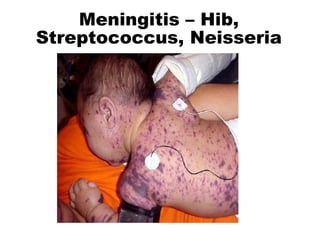
Meningitis – Hib,
Streptococcus, Neisseria
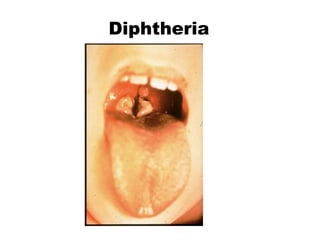
Diphtheria
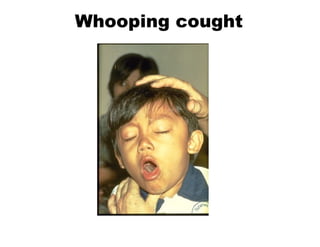
Whooping cought
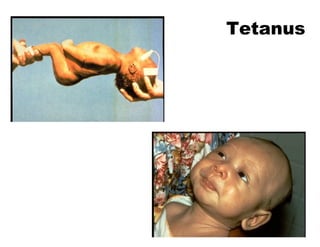
Tetanus
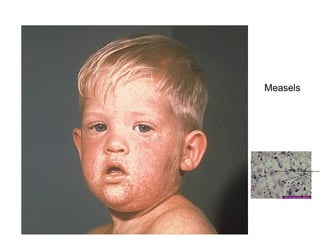
Measels
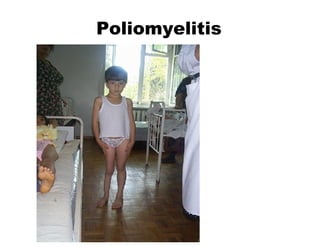
Poliomyelitis
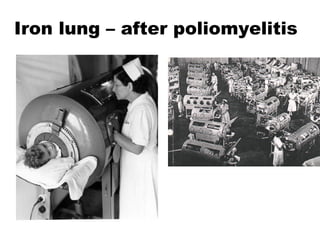
Iron lung – after poliomyelitis
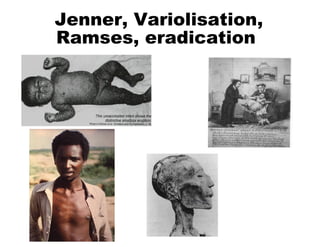
Jenner, Variolisation,
Ramses, eradication
Principles of Vaccination
• Self vs. nonself
• Protection from infectious disease
• Usually indicated by the presence
of antibody
• Very specific to a single organism
Immunity
Principles of Vaccination
• Protection produced by the person's
own immune system
• Usually permanent
• Protection transferred from another
person or animal
• Temporary protection that wanes
with time
Active Immunity
Passive Immunity
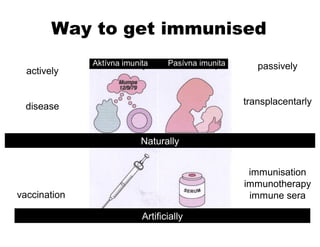
Way to get immunised
Aktívna imunita Pasívna imunita
Prirodzene získaná Prirodzene získaná
Umelo navodená Umelo
navodená
Stávame sa imúnnymi prirodzenou cestou alebo umelo. Očkovaním si vytvárame
umelo získanú aktívnu imunitu voči chorobám.
actively
disease
vaccination
passively
transplacentarly
immunisation
immunotherapy
immune sera
Naturally
Artificially
Principles of Vaccination
• A live or inactivated substance
(e.g., protein, polysaccharide)
capable of producing an immune
response
• Protein molecules (immuno-
globulin) produced by B
lymphocytes to help eliminate an
antigen
Antigen
Antibody
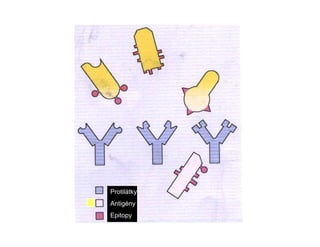
Protilátky produkované bunkami imunitného systému rozpoznávajú cudzie antigény –
ich charakteristické molekuly – antigénne determinanty - epitopy
Protilátky
Antigény
Epitopy
Passive Immunity
• Transfer of antibody produced by
one human or other animal to
another
• Temporary protection
• Transplacental most important
source in infancy
Sources of Passive Immunity
• Almost all blood or blood
products
• Homologous pooled human
antibody (immune globulin)
• Homologous human
hyperimmune globulin
• Heterologous hyperimmune
serum (antitoxin)
Monoclonal Antibody
• Derived from a single type, or
clone, of antibody-producing cells
(B cells)
• Antibody is specific to a single
antigen or closely related group of
antigens
• Used for diagnosis and therapy of
certain cancers and autoimmune
and infectious diseases
Vaccination
• Active immunity produced by
vaccine
• Immunity and immunologic
memory similar to natural
infection but without risk of
disease
Classification of Vaccines
• Live attenuated
– viral
– bacterial
• Inactivated
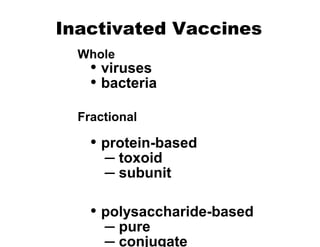
Inactivated Vaccines
• viruses
• bacteria
• protein-based
– toxoid
– subunit
• polysaccharide-based
– pure
– conjugate
Whole
Fractional
Principles of Vaccination
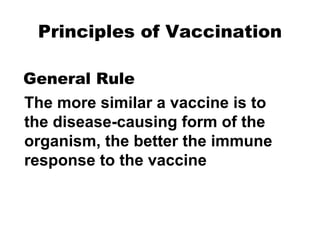
General Rule
The more similar a vaccine is to
the disease-causing form of the
organism, the better the immune
response to the vaccine
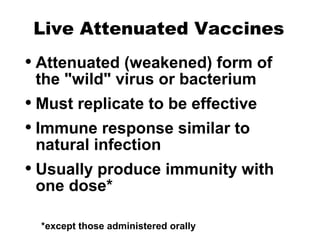
Live Attenuated Vaccines
• Attenuated (weakened) form of
the "wild" virus or bacterium
• Must replicate to be effective
• Immune response similar to
natural infection
• Usually produce immunity with
one dose*
*except those administered orally
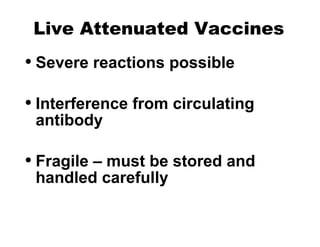
Live Attenuated Vaccines
• Severe reactions possible
• Interference from circulating
antibody
• Fragile – must be stored and
handled carefully
Live Attenuated Vaccines
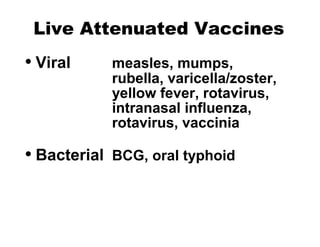
• Viral measles, mumps,
rubella, varicella/zoster,
yellow fever, rotavirus,
intranasal influenza,
rotavirus, vaccinia
• Bacterial BCG, oral typhoid
Inactivated Vaccines
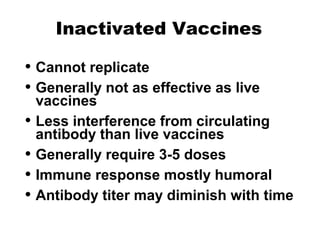
• Cannot replicate
• Generally not as effective as live
vaccines
• Less interference from circulating
antibody than live vaccines
• Generally require 3-5 doses
• Immune response mostly humoral
• Antibody titer may diminish with time
Inactivated Vaccines
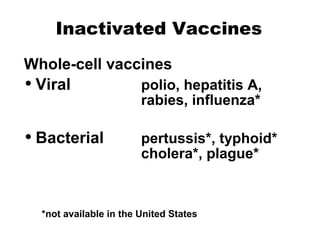
• Viral polio, hepatitis A,
rabies, influenza*
• Bacterial pertussis*, typhoid*
cholera*, plague*
Whole-cell vaccines
*not available in the United States
Inactivated Vaccines
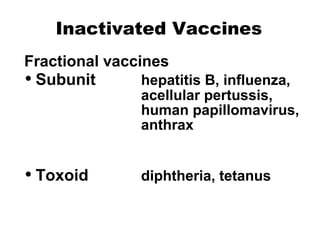
• Subunit hepatitis B, influenza,
acellular pertussis,
human papillomavirus,
anthrax
• Toxoid diphtheria, tetanus
Fractional vaccines
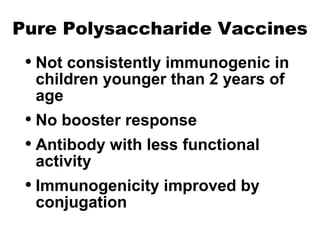
Pure Polysaccharide Vaccines
• Not consistently immunogenic in
children younger than 2 years of
age
• No booster response
• Antibody with less functional
activity
• Immunogenicity improved by
conjugation
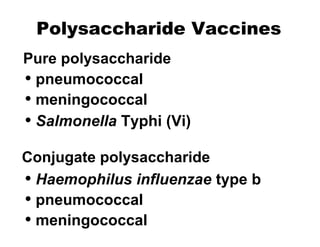
Polysaccharide Vaccines
• pneumococcal
• meningococcal
• Salmonella Typhi (Vi)
• Haemophilus influenzae type b
• pneumococcal
• meningococcal
Pure polysaccharide
Conjugate polysaccharide
Future of vaccine
• Antiidiotype vaccines, DNA vaccines,
• One, not hurting, for everybody,
immunogenic, not harming, protecting
against all diseases, only one
disadvantage = not real
• Multivalent vaccines – more
immunogenic
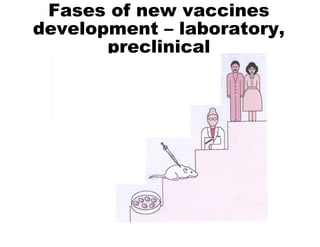
Fases of new vaccines
development – laboratory,
preclinical
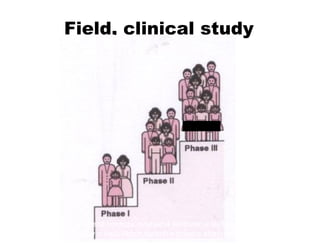
Field, clinical study
Skôr ako je vakcíne udelená licencia, prebieha testovanie jej bezpečnosti a stanovenie
účinnosti u dobrovoľníkov v niekoľkých fázach s presne stanovenými podmienkami
Risks of immunisation
• Side effects on any part of vaccine -
redness, indurance, ache, fever, cry,
alergy
• Immunisation – small regulated
infection - mild reaction, not target
tissue infection
• Not real expectances
Population immunity
• Collectove immunity – more than 85%
vaccinated against infection spread
from 1 to the other
• Protection of not immunisable or not
immunised „herd effect“
• Not present for tetanus, rabies
Surveillance a immunological
surveys
• Surveillance – system of epidemiological
patrolling
• Immunological surveys – targeted
sampling of sera from different age
groups to find not protected groups, to
organise aimed vaccination - mopping,
or catch up vaccination or changes of
immunisation schedule
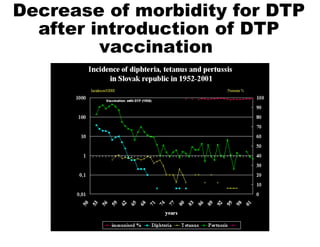
Decrease of morbidity for DTP
after introduction of DTP
vaccination
0
5
10
15
20
1 2 3 4 5 6 7 8 9
všetky
0 rokov
1- 4 rokov
0
50 000
100 000
150 000
200 000
1
´94 ´95 ´96 ´97 ´98 ´99 ´00 ´01
´02
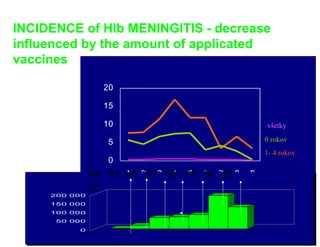
INCIDENCE of HIb MENINGITIS - decrease
influenced by the amount of applicated
vaccines
Antivaccination activity
• Vaccination mostly in child population
• very sesitive topic, period of discovery of
many diseases and handicapes in children
• demagogical arguments,
• not causal connection,
• medialisation, not medically graduated
people, usually educated in other vague
topics – ecology, homeopathy.....
• Dangerous – more people affected by
vaccination preventable diseases in USA
and Germany then for bioterroristic threat

Principles of Vaccination

  • 1.
  • 2.
  • 3.
  • 4.
  • 5.
  • 6.
  • 7.
  • 8.
    Iron lung –after poliomyelitis
  • 9.
  • 10.
    Principles of Vaccination •Self vs. nonself • Protection from infectious disease • Usually indicated by the presence of antibody • Very specific to a single organism Immunity
  • 11.
    Principles of Vaccination •Protection produced by the person's own immune system • Usually permanent • Protection transferred from another person or animal • Temporary protection that wanes with time Active Immunity Passive Immunity
  • 12.
    Way to getimmunised Aktívna imunita Pasívna imunita Prirodzene získaná Prirodzene získaná Umelo navodená Umelo navodená Stávame sa imúnnymi prirodzenou cestou alebo umelo. Očkovaním si vytvárame umelo získanú aktívnu imunitu voči chorobám. actively disease vaccination passively transplacentarly immunisation immunotherapy immune sera Naturally Artificially
  • 13.
    Principles of Vaccination •A live or inactivated substance (e.g., protein, polysaccharide) capable of producing an immune response • Protein molecules (immuno- globulin) produced by B lymphocytes to help eliminate an antigen Antigen Antibody
  • 14.
    Protilátky produkované bunkamiimunitného systému rozpoznávajú cudzie antigény – ich charakteristické molekuly – antigénne determinanty - epitopy Protilátky Antigény Epitopy
  • 15.
    Passive Immunity • Transferof antibody produced by one human or other animal to another • Temporary protection • Transplacental most important source in infancy
  • 16.
    Sources of PassiveImmunity • Almost all blood or blood products • Homologous pooled human antibody (immune globulin) • Homologous human hyperimmune globulin • Heterologous hyperimmune serum (antitoxin)
  • 17.
    Monoclonal Antibody • Derivedfrom a single type, or clone, of antibody-producing cells (B cells) • Antibody is specific to a single antigen or closely related group of antigens • Used for diagnosis and therapy of certain cancers and autoimmune and infectious diseases
  • 18.
    Vaccination • Active immunityproduced by vaccine • Immunity and immunologic memory similar to natural infection but without risk of disease
  • 24.
    Classification of Vaccines •Live attenuated – viral – bacterial • Inactivated
  • 25.
    Inactivated Vaccines • viruses •bacteria • protein-based – toxoid – subunit • polysaccharide-based – pure – conjugate Whole Fractional
  • 26.
    Principles of Vaccination GeneralRule The more similar a vaccine is to the disease-causing form of the organism, the better the immune response to the vaccine
  • 27.
    Live Attenuated Vaccines •Attenuated (weakened) form of the "wild" virus or bacterium • Must replicate to be effective • Immune response similar to natural infection • Usually produce immunity with one dose* *except those administered orally
  • 28.
    Live Attenuated Vaccines •Severe reactions possible • Interference from circulating antibody • Fragile – must be stored and handled carefully
  • 29.
    Live Attenuated Vaccines •Viral measles, mumps, rubella, varicella/zoster, yellow fever, rotavirus, intranasal influenza, rotavirus, vaccinia • Bacterial BCG, oral typhoid
  • 30.
    Inactivated Vaccines • Cannotreplicate • Generally not as effective as live vaccines • Less interference from circulating antibody than live vaccines • Generally require 3-5 doses • Immune response mostly humoral • Antibody titer may diminish with time
  • 31.
    Inactivated Vaccines • Viralpolio, hepatitis A, rabies, influenza* • Bacterial pertussis*, typhoid* cholera*, plague* Whole-cell vaccines *not available in the United States
  • 32.
    Inactivated Vaccines • Subunithepatitis B, influenza, acellular pertussis, human papillomavirus, anthrax • Toxoid diphtheria, tetanus Fractional vaccines
  • 33.
    Pure Polysaccharide Vaccines •Not consistently immunogenic in children younger than 2 years of age • No booster response • Antibody with less functional activity • Immunogenicity improved by conjugation
  • 34.
    Polysaccharide Vaccines • pneumococcal •meningococcal • Salmonella Typhi (Vi) • Haemophilus influenzae type b • pneumococcal • meningococcal Pure polysaccharide Conjugate polysaccharide
  • 35.
    Future of vaccine •Antiidiotype vaccines, DNA vaccines, • One, not hurting, for everybody, immunogenic, not harming, protecting against all diseases, only one disadvantage = not real • Multivalent vaccines – more immunogenic
  • 36.
    Fases of newvaccines development – laboratory, preclinical
  • 37.
    Field, clinical study Skôrako je vakcíne udelená licencia, prebieha testovanie jej bezpečnosti a stanovenie účinnosti u dobrovoľníkov v niekoľkých fázach s presne stanovenými podmienkami
  • 38.
    Risks of immunisation •Side effects on any part of vaccine - redness, indurance, ache, fever, cry, alergy • Immunisation – small regulated infection - mild reaction, not target tissue infection • Not real expectances
  • 39.
    Population immunity • Collectoveimmunity – more than 85% vaccinated against infection spread from 1 to the other • Protection of not immunisable or not immunised „herd effect“ • Not present for tetanus, rabies
  • 40.
    Surveillance a immunological surveys •Surveillance – system of epidemiological patrolling • Immunological surveys – targeted sampling of sera from different age groups to find not protected groups, to organise aimed vaccination - mopping, or catch up vaccination or changes of immunisation schedule
  • 41.
    Decrease of morbidityfor DTP after introduction of DTP vaccination
  • 42.
    0 5 10 15 20 1 2 34 5 6 7 8 9 všetky 0 rokov 1- 4 rokov 0 50 000 100 000 150 000 200 000 1 ´94 ´95 ´96 ´97 ´98 ´99 ´00 ´01 ´02 INCIDENCE of HIb MENINGITIS - decrease influenced by the amount of applicated vaccines
  • 43.
    Antivaccination activity • Vaccinationmostly in child population • very sesitive topic, period of discovery of many diseases and handicapes in children • demagogical arguments, • not causal connection, • medialisation, not medically graduated people, usually educated in other vague topics – ecology, homeopathy..... • Dangerous – more people affected by vaccination preventable diseases in USA and Germany then for bioterroristic threat