Sericulture
Dr. Dinesh C. Sharma
• Sericulture is the cultivation of silkworms to
produce silk. Bombyx mori (the caterpillar of the
domesticated silk moth) is the most widely used
species of silkworms.
• Silk was first produced in China as early as the
Neolithic period.
• Sericulture has become an important cottage
industry in countries such
as Brazil, China, France, India, Italy, Japan,
Korea, and Russia.
• Today, China and India are the two main
producers, with more than 60% of the world's
annual production.
History
• Sericulture is both an art and science of raising silkworms for silk
production. Silk as a weavable fiber was first discovered by the Chinese
empress Xi Ling Shi during 2,640 B.C. and its culture and weaving was
a guarded secret for more than 2,500 years by the Chinese.
• As per archaeological records silk cultivation starts in the Yangshao
period (5000 – 3000 BC).
• By about the first half of the 1st century AD it had reached ancient
Khotan, by a series of interactions along the Silk Road.
• By 140 AD the practice had been established in India. In the 6th
century the smuggling of silkworm eggs into the Byzantine Empire led
to its establishment in the Mediterranean, remaining a monopoly in the
Byzantine Empire for centuries (Byzantine silk). In 1147, during
the Second Crusade, Roger II of Sicily (1095–1154) attacked Corinth
and Thebes, two important centres of Byzantine silk production,
capturing the weavers and their equipment and establishing his own
silkworks in Palermo and Calabria, eventually spreading the industry to
Western Europe.
• Mahatma Gandhi was critical of silk
production based on the Ahimsa philosophy
"not to hurt any living thing".
• Mahatma Gandhi promoted "Ahimsa silk",
made without boiling the pupa to procure
the silk and wild silk made from the
cocoons of wild and semi-wild silk moths.
• In the early 21st century the
organisation PETA has campaigned against
silk.
India is the second
largest producer of raw
silk after China and the
biggest consumer of raw
silk and silk fabrics.
Stages of production
The stages of production are as follows:
1. The silk moth lays thousands of eggs.
2. The silk moth eggs hatch to form larvae or caterpillars, known as silkworms.
3. The larvae feed on mulberry leaves.
4. Having grown and moulted several times, the silkworm extrudes a silk fiber and forms a net to hold
itself.
5. It swings its head from side to side in a figure '8' distributing the saliva that will form silk.
6. The silk solidifies when it contacts the air.
7. The silkworm spins approximately one mile of filament and completely encloses itself in a
cocoon in about two or three days. The amount of usable quality silk in each cocoon is small.
As a result, about 6000 silkworms are required to produce a Kilogram of raw silk.
8. The intact cocoons are boiled, killing the silkworm pupa.
9. The silk is obtained by brushing the undamaged cocoon to find the outside end of the filament.
10.The silk filaments are then wound on a reel. One cocoon contains approximately 915
meter of silk filament. The silk at this stage is known as raw silk. One thread comprises up to 48
individual silk filaments.
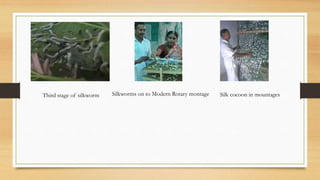
Third stage of silkworm Silkworms on to Modern Rotary montage Silk cocoon in mountages
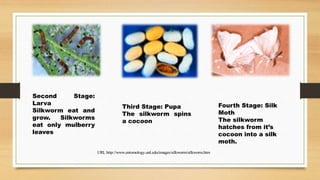
Their life cycles consist of
four stages:
1. egg
2. larva: caterpillar and
silkworm
3. pupa: cocoon or
chrysalis
4. butterfly or silk moth
Life cycle
Silkworm lays
hundreds of
eggs in neat
rows. They
may be round
like balls or
flat like
pancakes
www.panoptikum. net/naturfotografie/ eier2_6e.htm
URLhttp://www.entomology.unl.edu/images/silkworm/silkworm.htm
Second Stage:
Larva
Silkworm eat and
grow. Silkworms
eat only mulberry
leaves
Third Stage: Pupa
The silkworm spins
a cocoon
Fourth Stage: Silk
Moth
The silkworm
hatches from it’s
cocoon into a silk
moth.
URL http://www.entomology.unl.edu/images/silkworm/silkworm.htm
The silk moth lay eggs to start the lifecycle again.
www.panoptikum. net/naturfotografie/ eier2_6e.htm URL http://www.entomology.unl.edu/images/silkworm/silkworm.htm
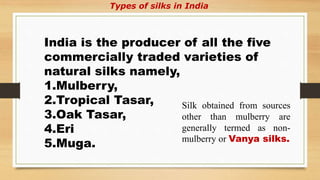
Types of silks in India
India is the producer of all the five
commercially traded varieties of
natural silks namely,
1.Mulberry,
2.Tropical Tasar,
3.Oak Tasar,
4.Eri
5.Muga.
Silk obtained from sources
other than mulberry are
generally termed as non-
mulberry or Vanya silks.
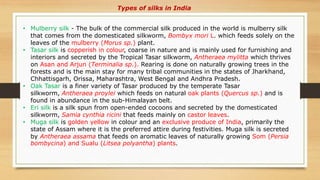
• Mulberry silk - The bulk of the commercial silk produced in the world is mulberry silk
that comes from the domesticated silkworm, Bombyx mori L. which feeds solely on the
leaves of the mulberry (Morus sp.) plant.
• Tasar silk is copperish in colour, coarse in nature and is mainly used for furnishing and
interiors and secreted by the Tropical Tasar silkworm, Antheraea mylitta which thrives
on Asan and Arjun (Terminalia sp.). Rearing is done on naturally growing trees in the
forests and is the main stay for many tribal communities in the states of Jharkhand,
Chhattisgarh, Orissa, Maharashtra, West Bengal and Andhra Pradesh.
• Oak Tasar is a finer variety of Tasar produced by the temperate Tasar
silkworm, Antheraea proylei which feeds on natural oak plants (Quercus sp.) and is
found in abundance in the sub-Himalayan belt.
• Eri silk is a silk spun from open-ended cocoons and secreted by the domesticated
silkworm, Samia cynthia ricini that feeds mainly on castor leaves.
• Muga silk is golden yellow in colour and an exclusive produce of India, primarily the
state of Assam where it is the preferred attire during festivities. Muga silk is secreted
by Antheraea assama that feeds on aromatic leaves of naturally growing Som (Persia
bombycina) and Sualu (Litsea polyantha) plants.
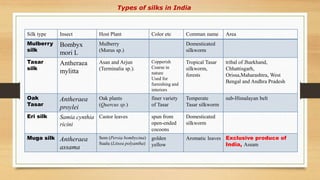
Types of silks in India
Silk type Insect Host Plant Color etc Comman name Area
Mulberry
silk
Bombyx
mori L
Mulberry
(Morus sp.)
Domesticated
silkworm
Tasar
silk
Antheraea
mylitta
Asan and Arjun
(Terminalia sp.).
Copperish
Coarse in
nature
Used for
furnishing and
interiors
Tropical Tasar
silkworm,
forests
tribal of Jharkhand,
Chhattisgarh,
Orissa,Maharashtra, West
Bengal and Andhra Pradesh
Oak
Tasar
Antheraea
proylei
Oak plants
(Quercus sp.)
finer variety
of Tasar
Temperate
Tasar silkworm
sub-Himalayan belt
Eri silk Samia cynthia
ricini
Castor leaves spun from
open-ended
cocoons
Domesticated
silkworm
Muga silk Antheraea
assama
Som (Persia bombycina)
Sualu (Litsea polyantha)
golden
yellow
Aromatic leaves Exclusive produce of
India, Assam
Types of silks in India
Except mulberry, other non-mulberry varieties of silks are generally termed as vanya silks.
India has the unique distinction of producing all these commercial varieties of silk.
Variety-wise raw silk production (2007-08)
Source: Indian Silk 47(5), 2008
Central Silk Board (CSB), Bangalore under the Ministry of Textiles, Govt. of India
Silk statistics of India
Source: DGCIS, Ministry of Commerce, Govt. of India.
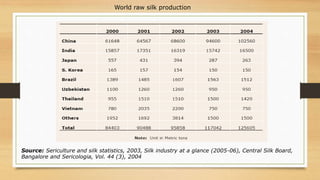
World raw silk production
Source: Sericulture and silk statistics, 2003, Silk industry at a glance (2005-06), Central Silk Board,
Bangalore and Sericologia, Vol. 44 (3), 2004
• Central Silk Board (CSB), Bangalore (Karnataka) under the
Ministry of Textiles, Govt. of India
• Established in 1948.
• Central Silk Board has established 10 Regional Offices at
New Delhi, Mumbai, Kolkata, Jammu, Hyderabad, Chennai,
Bhubaneshwar, Guwahati, Lucknow, Patna and 3
Certification Centres at Bangalore, Varanasi & Srinagar.
• Central Silk Technological Research Institute (CSTRI) at
Bangalore.
• Silkworm Seed Technology Laboratory (SSTL) in
Bangalore
• Central Sericultural Germplasm Resource Centre
(CSGRC) at Hosur (Tamil Nadu)
• Seri-Biotech Research Laboratory (SBRL) at Bangalore.
http://www.csb.gov.in/silk-sericulture/sericulture/
Sericulture

Sericulture

  • 1.
  • 2.
    • Sericulture isthe cultivation of silkworms to produce silk. Bombyx mori (the caterpillar of the domesticated silk moth) is the most widely used species of silkworms. • Silk was first produced in China as early as the Neolithic period. • Sericulture has become an important cottage industry in countries such as Brazil, China, France, India, Italy, Japan, Korea, and Russia. • Today, China and India are the two main producers, with more than 60% of the world's annual production.
  • 3.
    History • Sericulture isboth an art and science of raising silkworms for silk production. Silk as a weavable fiber was first discovered by the Chinese empress Xi Ling Shi during 2,640 B.C. and its culture and weaving was a guarded secret for more than 2,500 years by the Chinese. • As per archaeological records silk cultivation starts in the Yangshao period (5000 – 3000 BC). • By about the first half of the 1st century AD it had reached ancient Khotan, by a series of interactions along the Silk Road. • By 140 AD the practice had been established in India. In the 6th century the smuggling of silkworm eggs into the Byzantine Empire led to its establishment in the Mediterranean, remaining a monopoly in the Byzantine Empire for centuries (Byzantine silk). In 1147, during the Second Crusade, Roger II of Sicily (1095–1154) attacked Corinth and Thebes, two important centres of Byzantine silk production, capturing the weavers and their equipment and establishing his own silkworks in Palermo and Calabria, eventually spreading the industry to Western Europe.
  • 4.
    • Mahatma Gandhiwas critical of silk production based on the Ahimsa philosophy "not to hurt any living thing". • Mahatma Gandhi promoted "Ahimsa silk", made without boiling the pupa to procure the silk and wild silk made from the cocoons of wild and semi-wild silk moths. • In the early 21st century the organisation PETA has campaigned against silk.
  • 5.
    India is thesecond largest producer of raw silk after China and the biggest consumer of raw silk and silk fabrics.
  • 6.
    Stages of production Thestages of production are as follows: 1. The silk moth lays thousands of eggs. 2. The silk moth eggs hatch to form larvae or caterpillars, known as silkworms. 3. The larvae feed on mulberry leaves. 4. Having grown and moulted several times, the silkworm extrudes a silk fiber and forms a net to hold itself. 5. It swings its head from side to side in a figure '8' distributing the saliva that will form silk. 6. The silk solidifies when it contacts the air. 7. The silkworm spins approximately one mile of filament and completely encloses itself in a cocoon in about two or three days. The amount of usable quality silk in each cocoon is small. As a result, about 6000 silkworms are required to produce a Kilogram of raw silk. 8. The intact cocoons are boiled, killing the silkworm pupa. 9. The silk is obtained by brushing the undamaged cocoon to find the outside end of the filament. 10.The silk filaments are then wound on a reel. One cocoon contains approximately 915 meter of silk filament. The silk at this stage is known as raw silk. One thread comprises up to 48 individual silk filaments.
  • 7.
    Third stage ofsilkworm Silkworms on to Modern Rotary montage Silk cocoon in mountages
  • 8.
    Their life cyclesconsist of four stages: 1. egg 2. larva: caterpillar and silkworm 3. pupa: cocoon or chrysalis 4. butterfly or silk moth Life cycle
  • 9.
    Silkworm lays hundreds of eggsin neat rows. They may be round like balls or flat like pancakes www.panoptikum. net/naturfotografie/ eier2_6e.htm URLhttp://www.entomology.unl.edu/images/silkworm/silkworm.htm
  • 10.
    Second Stage: Larva Silkworm eatand grow. Silkworms eat only mulberry leaves Third Stage: Pupa The silkworm spins a cocoon Fourth Stage: Silk Moth The silkworm hatches from it’s cocoon into a silk moth. URL http://www.entomology.unl.edu/images/silkworm/silkworm.htm
  • 11.
    The silk mothlay eggs to start the lifecycle again. www.panoptikum. net/naturfotografie/ eier2_6e.htm URL http://www.entomology.unl.edu/images/silkworm/silkworm.htm
  • 12.
    Types of silksin India India is the producer of all the five commercially traded varieties of natural silks namely, 1.Mulberry, 2.Tropical Tasar, 3.Oak Tasar, 4.Eri 5.Muga. Silk obtained from sources other than mulberry are generally termed as non- mulberry or Vanya silks.
  • 13.
    • Mulberry silk- The bulk of the commercial silk produced in the world is mulberry silk that comes from the domesticated silkworm, Bombyx mori L. which feeds solely on the leaves of the mulberry (Morus sp.) plant. • Tasar silk is copperish in colour, coarse in nature and is mainly used for furnishing and interiors and secreted by the Tropical Tasar silkworm, Antheraea mylitta which thrives on Asan and Arjun (Terminalia sp.). Rearing is done on naturally growing trees in the forests and is the main stay for many tribal communities in the states of Jharkhand, Chhattisgarh, Orissa, Maharashtra, West Bengal and Andhra Pradesh. • Oak Tasar is a finer variety of Tasar produced by the temperate Tasar silkworm, Antheraea proylei which feeds on natural oak plants (Quercus sp.) and is found in abundance in the sub-Himalayan belt. • Eri silk is a silk spun from open-ended cocoons and secreted by the domesticated silkworm, Samia cynthia ricini that feeds mainly on castor leaves. • Muga silk is golden yellow in colour and an exclusive produce of India, primarily the state of Assam where it is the preferred attire during festivities. Muga silk is secreted by Antheraea assama that feeds on aromatic leaves of naturally growing Som (Persia bombycina) and Sualu (Litsea polyantha) plants. Types of silks in India
  • 14.
    Silk type InsectHost Plant Color etc Comman name Area Mulberry silk Bombyx mori L Mulberry (Morus sp.) Domesticated silkworm Tasar silk Antheraea mylitta Asan and Arjun (Terminalia sp.). Copperish Coarse in nature Used for furnishing and interiors Tropical Tasar silkworm, forests tribal of Jharkhand, Chhattisgarh, Orissa,Maharashtra, West Bengal and Andhra Pradesh Oak Tasar Antheraea proylei Oak plants (Quercus sp.) finer variety of Tasar Temperate Tasar silkworm sub-Himalayan belt Eri silk Samia cynthia ricini Castor leaves spun from open-ended cocoons Domesticated silkworm Muga silk Antheraea assama Som (Persia bombycina) Sualu (Litsea polyantha) golden yellow Aromatic leaves Exclusive produce of India, Assam Types of silks in India
  • 15.
    Except mulberry, othernon-mulberry varieties of silks are generally termed as vanya silks. India has the unique distinction of producing all these commercial varieties of silk.
  • 16.
    Variety-wise raw silkproduction (2007-08) Source: Indian Silk 47(5), 2008 Central Silk Board (CSB), Bangalore under the Ministry of Textiles, Govt. of India
  • 17.
    Silk statistics ofIndia Source: DGCIS, Ministry of Commerce, Govt. of India.
  • 18.
    World raw silkproduction Source: Sericulture and silk statistics, 2003, Silk industry at a glance (2005-06), Central Silk Board, Bangalore and Sericologia, Vol. 44 (3), 2004
  • 19.
    • Central SilkBoard (CSB), Bangalore (Karnataka) under the Ministry of Textiles, Govt. of India • Established in 1948. • Central Silk Board has established 10 Regional Offices at New Delhi, Mumbai, Kolkata, Jammu, Hyderabad, Chennai, Bhubaneshwar, Guwahati, Lucknow, Patna and 3 Certification Centres at Bangalore, Varanasi & Srinagar. • Central Silk Technological Research Institute (CSTRI) at Bangalore. • Silkworm Seed Technology Laboratory (SSTL) in Bangalore • Central Sericultural Germplasm Resource Centre (CSGRC) at Hosur (Tamil Nadu) • Seri-Biotech Research Laboratory (SBRL) at Bangalore. http://www.csb.gov.in/silk-sericulture/sericulture/