By-
Dr. Dinesh C. Sharma
Head, Zoology
K.M. Govt. Girls P. G. College
Badalpur, G.B. Nagar
dr_dineshsharma@hotmail.com
1
2
Pheromone: a chemical signal
transmitted between individuals
of the same species.
From 2 Greek words:
• pherein, to transfer
• hormōn, to excite
Pheromones
Do not fit definition of a true
hormone
Produced by one organism, travel by
air and affect a second organism.
Example musk oil, sexual attractant
in insects, etc.
3
4
Pheromone is a chemical secreted by
an animal that influences the
behavior or development of other
members of the same species. Queen
bees, for example, give off a
pheromone that prevents other
females in the hive from becoming
sexually mature, with the result that
only the queen bee mates and lays
eggs. In many animal species,
pheromones are used to establish
territory and attract mates.
5
A pheromone (in any animal):
• A chemical signal between
members of same species
• Behavioural and/or physiol
response
• Same mol(s) in e.g. all males of the
species (but poss different amounts)
• Usually a combination of molecules
• Detected by sense of smell (usually)
6
Pheromones are …
“molecules that are evolved signals, in
defined ratios in the case of multiple
component pheromones, which are
emitted by an individual and received
by a second individual of the same
species, in which they cause a specific
reaction, for example, a stereotyped
behavior or a developmental process”
7
Invisible signals
• Ancient Greeks : female dog
• 17th C : bee keeping manual
• 19th C J-H Fabre : moths
Charles Darwin (1871) The descent of man and selection
in relation to sex
“During the season of love, a musky odour is emitted
by … glands of the crocodile, and pervades their
haunts.”
Also: smelly male elephants, goats, pythons, birds …
Gradual evolution of male scent glands by female
choice-Success of the smelliest
8
Surely these smells were chemical signals … but the
quantities were far too small to identify (pico / micro
gram per individual)
First pheromone identification: 1959 female sex
pheromone of silk moth Bombyx mori by Adolf
Butenandt et.al
Wing fluttering by male gives test that
pheromone is present
= bioassay ( = reliable test)
9
10
Types of Pheromonoes
There are different types of pheromones. Some of these are
alarm, food trail and sex pheromones.
Alarm pheromones are produced by certain insect that will
act when attacked. Insects such as ants, termites and bees
will produce a certain smell when they are attacked by a
predator.
In insects, there are epideictic pheromones that are used to
mark territories. Insects will lay their eggs on certain fruits
to signal to other insects that they should find other places
to clutch.
11
Territorial pheromones are quite similar to the epideictic ones. It is
a term that is used to refer to pheromones produced to mark
boundaries by animals like dogs and cats. These animals may use
urine as a pheromone sign.
Releaser pheromones are the most commonly produced. They are
secreted in order to influence the behavior of the same species. Some
insects will produce molecules in order to attract males that may be
at a distance. This distance may vary from one to two miles, and the
smell does not usually last for long.
Processing chemosignals like pheromones has evolved in all
animal phyla and thus is the oldest phylogenetic receptive system
shared by all organisms including bacteria. It has been suggested that
it serves survival by generating appropriate behavioral responses to
the signals of threat, sex and dominance status among members of
the same species.
12
13
Every kind of animal, not just sex
• Aggregation pheromones – both sexes
attractive e.g. bark beetles
• Nematode dauer (development)
• Mammary pheromones – rabbit
Social insects (ants, bees, wasps)
• Alarm pheromones
• Trail pheromones e.g. ants, termites
• Primer effects e.g. queen pheromones
14
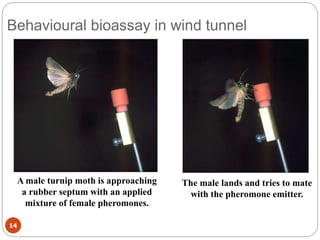
Behavioural bioassay in wind tunnel
A male turnip moth is approaching
a rubber septum with an applied
mixture of female pheromones.
The male lands and tries to mate
with the pheromone emitter.
15
Philip McCabe's bee beard
200 000 bees (27 kg) are attracted by swarm lures and queen
bee pheromone on Philip’s skin!
16
Human pheromones
Sex pheromones are chemical (olfactory)
signals, pheromones, released by an organism
to attract an individual of the opposite sex,
encourage them to mate with them, or
perform some other function closely related
with sexual reproduction. While humans are
highly dependent upon visual cues, when in
proximity, smells also play a role
in sociosexual behaviors.
17
An inherent difficulty in studying
human pheromones is the need for
cleanliness and odorlessness in
human participants.
Experiments have focused on three
classes of putative human
pheromones:
1. Axillary steroids,
2. Vaginal aliphatic acids,
3. Stimulators of the vomeronasal
organ.
18
Axillary steroids- are produced by
the testes, ovaries, apocrine glands
and adrenal glands.
These chemicals are not biologically active until puberty
when sex steroids influence their activity. The activity
change during puberty suggest that humans communicate
through odors.
Several axillary steroids have been described as possible
human
pheromones: androstadienol, androstadienone, andro
stenone, androstenol and androsterone.
19
Androstenol is the putative female pheromone.
In a 1978 study by Kirk-Smith, people wearing surgical masks treated with
androstenol or untreated were shown pictures of people, animals and buildings
and asked to rate the pictures on attractiveness. Individuals with their masks
treated with androstenol rated their photographs as being "warmer" and "more
friendly“.
The best-known case study involves the synchronization of menstrual
cycles among women based on unconscious odor cues, the McClintock effect,
named after the primary investigator, Martha McClintock, of the University of
Chicago. A group of women were exposed to a whiff of perspiration from other
women. Depending on the time in the month the sweat was collected (before,
during, or after ovulation), there was an association with the recipient woman's
menstrual cycle to speed up or slow down.
The 1971 study proposed two types of pheromone involved: "One, produced
prior to ovulation, shortens the ovarian cycle; and the second, produced just
at ovulation, lengthens the cycle". However, recent studies and reviews of the
methodology have called the validity of her results into question.[
20
Androstenone is postulated to be secreted only by
men as an attractant for women and is also thought to
affect their mood positively. It seems to have different
effects on women, depending on where a female is in
her menstrual cycle, with the highest sensitivity to it
during ovulation. In 1983, study participants exposed
to androstenone were shown to undergo changes in
skin conductance. Androstenone has been found to be
perceived as more pleasant to women at a woman’s
time of ovulation. It is hypothesized that this may be a
way for a male to detect an ovulating female who
would be more willing to be involved in sexual
interaction.
21
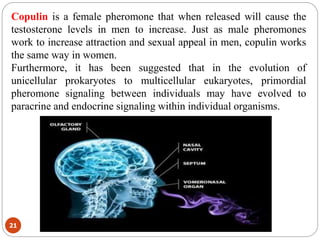
Copulin is a female pheromone that when released will cause the
testosterone levels in men to increase. Just as male pheromones
work to increase attraction and sexual appeal in men, copulin works
the same way in women.
Furthermore, it has been suggested that in the evolution of
unicellular prokaryotes to multicellular eukaryotes, primordial
pheromone signaling between individuals may have evolved to
paracrine and endocrine signaling within individual organisms.
22
23
24
25

Pheromone

  • 1.
    By- Dr. Dinesh C.Sharma Head, Zoology K.M. Govt. Girls P. G. College Badalpur, G.B. Nagar dr_dineshsharma@hotmail.com 1
  • 2.
    2 Pheromone: a chemicalsignal transmitted between individuals of the same species. From 2 Greek words: • pherein, to transfer • hormōn, to excite
  • 3.
    Pheromones Do not fitdefinition of a true hormone Produced by one organism, travel by air and affect a second organism. Example musk oil, sexual attractant in insects, etc. 3
  • 4.
    4 Pheromone is achemical secreted by an animal that influences the behavior or development of other members of the same species. Queen bees, for example, give off a pheromone that prevents other females in the hive from becoming sexually mature, with the result that only the queen bee mates and lays eggs. In many animal species, pheromones are used to establish territory and attract mates.
  • 5.
    5 A pheromone (inany animal): • A chemical signal between members of same species • Behavioural and/or physiol response • Same mol(s) in e.g. all males of the species (but poss different amounts) • Usually a combination of molecules • Detected by sense of smell (usually)
  • 6.
    6 Pheromones are … “moleculesthat are evolved signals, in defined ratios in the case of multiple component pheromones, which are emitted by an individual and received by a second individual of the same species, in which they cause a specific reaction, for example, a stereotyped behavior or a developmental process”
  • 7.
    7 Invisible signals • AncientGreeks : female dog • 17th C : bee keeping manual • 19th C J-H Fabre : moths Charles Darwin (1871) The descent of man and selection in relation to sex “During the season of love, a musky odour is emitted by … glands of the crocodile, and pervades their haunts.” Also: smelly male elephants, goats, pythons, birds … Gradual evolution of male scent glands by female choice-Success of the smelliest
  • 8.
    8 Surely these smellswere chemical signals … but the quantities were far too small to identify (pico / micro gram per individual) First pheromone identification: 1959 female sex pheromone of silk moth Bombyx mori by Adolf Butenandt et.al Wing fluttering by male gives test that pheromone is present = bioassay ( = reliable test)
  • 9.
  • 10.
    10 Types of Pheromonoes Thereare different types of pheromones. Some of these are alarm, food trail and sex pheromones. Alarm pheromones are produced by certain insect that will act when attacked. Insects such as ants, termites and bees will produce a certain smell when they are attacked by a predator. In insects, there are epideictic pheromones that are used to mark territories. Insects will lay their eggs on certain fruits to signal to other insects that they should find other places to clutch.
  • 11.
    11 Territorial pheromones arequite similar to the epideictic ones. It is a term that is used to refer to pheromones produced to mark boundaries by animals like dogs and cats. These animals may use urine as a pheromone sign. Releaser pheromones are the most commonly produced. They are secreted in order to influence the behavior of the same species. Some insects will produce molecules in order to attract males that may be at a distance. This distance may vary from one to two miles, and the smell does not usually last for long. Processing chemosignals like pheromones has evolved in all animal phyla and thus is the oldest phylogenetic receptive system shared by all organisms including bacteria. It has been suggested that it serves survival by generating appropriate behavioral responses to the signals of threat, sex and dominance status among members of the same species.
  • 12.
  • 13.
    13 Every kind ofanimal, not just sex • Aggregation pheromones – both sexes attractive e.g. bark beetles • Nematode dauer (development) • Mammary pheromones – rabbit Social insects (ants, bees, wasps) • Alarm pheromones • Trail pheromones e.g. ants, termites • Primer effects e.g. queen pheromones
  • 14.
    14 Behavioural bioassay inwind tunnel A male turnip moth is approaching a rubber septum with an applied mixture of female pheromones. The male lands and tries to mate with the pheromone emitter.
  • 15.
    15 Philip McCabe's beebeard 200 000 bees (27 kg) are attracted by swarm lures and queen bee pheromone on Philip’s skin!
  • 16.
    16 Human pheromones Sex pheromonesare chemical (olfactory) signals, pheromones, released by an organism to attract an individual of the opposite sex, encourage them to mate with them, or perform some other function closely related with sexual reproduction. While humans are highly dependent upon visual cues, when in proximity, smells also play a role in sociosexual behaviors.
  • 17.
    17 An inherent difficultyin studying human pheromones is the need for cleanliness and odorlessness in human participants. Experiments have focused on three classes of putative human pheromones: 1. Axillary steroids, 2. Vaginal aliphatic acids, 3. Stimulators of the vomeronasal organ.
  • 18.
    18 Axillary steroids- areproduced by the testes, ovaries, apocrine glands and adrenal glands. These chemicals are not biologically active until puberty when sex steroids influence their activity. The activity change during puberty suggest that humans communicate through odors. Several axillary steroids have been described as possible human pheromones: androstadienol, androstadienone, andro stenone, androstenol and androsterone.
  • 19.
    19 Androstenol is theputative female pheromone. In a 1978 study by Kirk-Smith, people wearing surgical masks treated with androstenol or untreated were shown pictures of people, animals and buildings and asked to rate the pictures on attractiveness. Individuals with their masks treated with androstenol rated their photographs as being "warmer" and "more friendly“. The best-known case study involves the synchronization of menstrual cycles among women based on unconscious odor cues, the McClintock effect, named after the primary investigator, Martha McClintock, of the University of Chicago. A group of women were exposed to a whiff of perspiration from other women. Depending on the time in the month the sweat was collected (before, during, or after ovulation), there was an association with the recipient woman's menstrual cycle to speed up or slow down. The 1971 study proposed two types of pheromone involved: "One, produced prior to ovulation, shortens the ovarian cycle; and the second, produced just at ovulation, lengthens the cycle". However, recent studies and reviews of the methodology have called the validity of her results into question.[
  • 20.
    20 Androstenone is postulatedto be secreted only by men as an attractant for women and is also thought to affect their mood positively. It seems to have different effects on women, depending on where a female is in her menstrual cycle, with the highest sensitivity to it during ovulation. In 1983, study participants exposed to androstenone were shown to undergo changes in skin conductance. Androstenone has been found to be perceived as more pleasant to women at a woman’s time of ovulation. It is hypothesized that this may be a way for a male to detect an ovulating female who would be more willing to be involved in sexual interaction.
  • 21.
    21 Copulin is afemale pheromone that when released will cause the testosterone levels in men to increase. Just as male pheromones work to increase attraction and sexual appeal in men, copulin works the same way in women. Furthermore, it has been suggested that in the evolution of unicellular prokaryotes to multicellular eukaryotes, primordial pheromone signaling between individuals may have evolved to paracrine and endocrine signaling within individual organisms.
  • 22.
  • 23.
  • 24.
  • 25.