Fat soluble
Vitamins
Dr. Farhana Atia
Assistant Professor
Department of Biochemistry
Nilphamari Medical College, Bangladesh
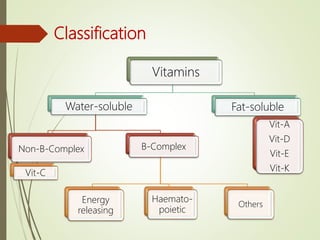
Classification
Vitamins
Water-soluble
Non-B-Complex
Vit-C
B-Complex
Energy
releasing
Haemato-
poietic
Others
Fat-soluble
Vit-A
Vit-D
Vit-E
Vit-K
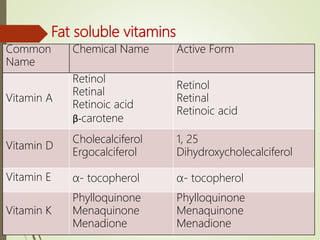
Fat soluble vitamins
Common
Name
Chemical Name Active Form
Vitamin A
Retinol
Retinal
Retinoic acid
β-carotene
Retinol
Retinal
Retinoic acid
Vitamin D
Cholecalciferol
Ergocalciferol
1, 25
Dihydroxycholecalciferol
Vitamin E α- tocopherol α- tocopherol
Vitamin K
Phylloquinone
Menaquinone
Menadione
Phylloquinone
Menaquinone
Menadione
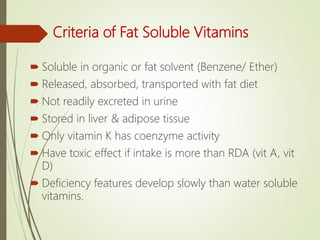
Criteria of Fat Soluble Vitamins
 Soluble in organic or fat solvent (Benzene/ Ether)
 Released, absorbed, transported with fat diet
 Not readily excreted in urine
 Stored in liver & adipose tissue
 Only vitamin K has coenzyme activity
 Have toxic effect if intake is more than RDA (vit A, vit
D)
 Deficiency features develop slowly than water soluble
vitamins.
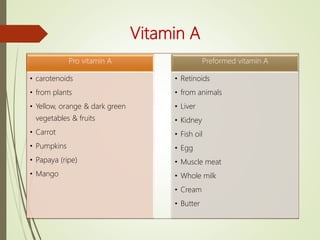
Vitamin A
Pro vitamin A
• carotenoids
• from plants
• Yellow, orange & dark green
vegetables & fruits
• Carrot
• Pumpkins
• Papaya (ripe)
• Mango
Preformed vitamin A
• Retinoids
• from animals
• Liver
• Kidney
• Fish oil
• Egg
• Muscle meat
• Whole milk
• Cream
• Butter
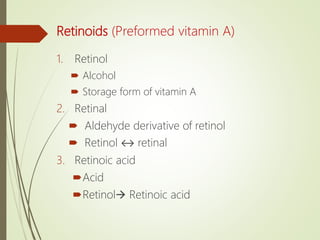
Retinoids (Preformed vitamin A)
1. Retinol
 Alcohol
 Storage form of vitamin A
2. Retinal
 Aldehyde derivative of retinol
 Retinol ↔ retinal
3. Retinoic acid
Acid
Retinol Retinoic acid
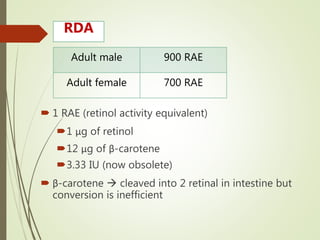
 1 RAE (retinol activity equivalent)
1 μg of retinol
12 μg of β-carotene
3.33 IU (now obsolete)
 β-carotene  cleaved into 2 retinal in intestine but
conversion is inefficient
Adult male 900 RAE
Adult female 700 RAE
RDA
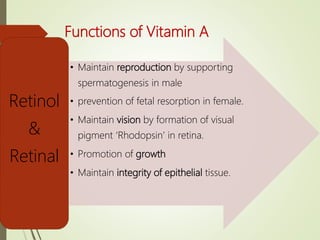
Functions of Vitamin A
• Maintain reproduction by supporting
spermatogenesis in male
• prevention of fetal resorption in female.
• Maintain vision by formation of visual
pigment ‘Rhodopsin’ in retina.
• Promotion of growth
• Maintain integrity of epithelial tissue.
Retinol
&
Retinal
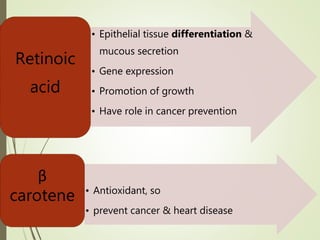
• Epithelial tissue differentiation &
mucous secretion
• Gene expression
• Promotion of growth
• Have role in cancer prevention
Retinoic
acid
• Antioxidant, so
• prevent cancer & heart disease
β
carotene
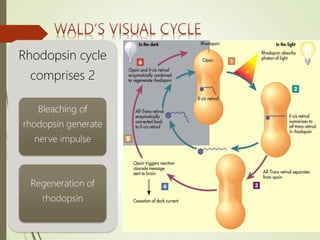
Rhodopsin cycle
comprises 2
Bleaching of
rhodopsin generate
nerve impulse
Regeneration of
rhodopsin
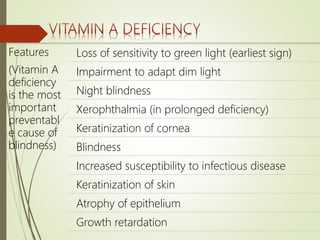
Features
(Vitamin A
deficiency
is the most
important
preventabl
e cause of
blindness)
Loss of sensitivity to green light (earliest sign)
Impairment to adapt dim light
Night blindness
Xerophthalmia (in prolonged deficiency)
Keratinization of cornea
Blindness
Increased susceptibility to infectious disease
Keratinization of skin
Atrophy of epithelium
Growth retardation
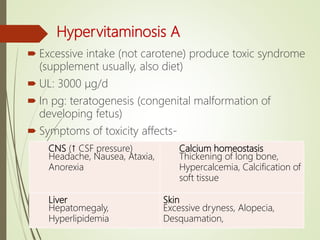
Hypervitaminosis A
 Excessive intake (not carotene) produce toxic syndrome
(supplement usually, also diet)
 UL: 3000 μg/d
 In pg: teratogenesis (congenital malformation of
developing fetus)
 Symptoms of toxicity affects-
CNS (↑ CSF pressure)
Headache, Nausea, Ataxia,
Anorexia
Calcium homeostasis
Thickening of long bone,
Hypercalcemia, Calcification of
soft tissue
Liver
Hepatomegaly,
Hyperlipidemia
Skin
Excessive dryness, Alopecia,
Desquamation,
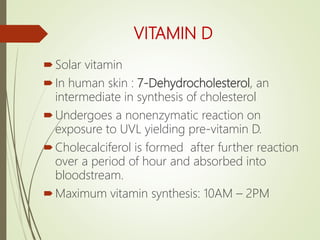
VITAMIN D
Solar vitamin
In human skin : 7-Dehydrocholesterol, an
intermediate in synthesis of cholesterol
Undergoes a nonenzymatic reaction on
exposure to UVL yielding pre-vitamin D.
Cholecalciferol is formed after further reaction
over a period of hour and absorbed into
bloodstream.
Maximum vitamin synthesis: 10AM – 2PM
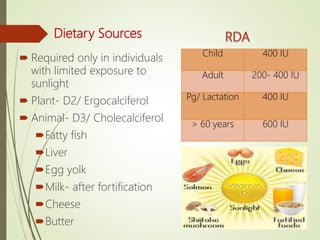
Dietary Sources
 Required only in individuals
with limited exposure to
sunlight
 Plant- D2/ Ergocalciferol
 Animal- D3/ Cholecalciferol
Fatty fish
Liver
Egg yolk
Milk- after fortification
Cheese
Butter
Child 400 IU
Adult 200- 400 IU
Pg/ Lactation 400 IU
> 60 years 600 IU
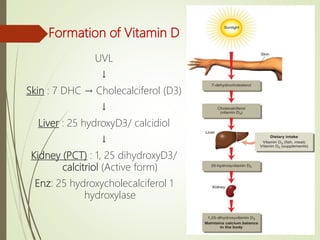
Formation of Vitamin D
UVL
↓
Skin : 7 DHC → Cholecalciferol (D3)
↓
Liver : 25 hydroxyD3/ calcidiol
↓
Kidney (PCT) : 1, 25 dihydroxyD3/
calcitriol (Active form)
Enz: 25 hydroxycholecalciferol 1
hydroxylase
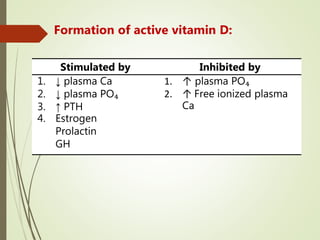
Formation of active vitamin D:
Stimulated by Inhibited by
1. ↓ plasma Ca
2. ↓ plasma PO₄
3. ↑ PTH
4. Estrogen
Prolactin
GH
1. ↑ plasma PO₄
2. ↑ Free ionized plasma
Ca
Functions of vitamin D
Maintain adequate plasma Ca level by
 ↑ uptake of Ca by intestine
 Minimize excretion of Ca by kidney
(stimulate reabsorption in distal renal
tubule)
 Stimulate Ca mobilization from bone when
necessary
Functions of vitamin D
Regulate gene expression & cell differentiation
 Insulin secretion
 Synthesis & secretion of parathyroid & thyroid
hormones
 Inhibit production of interleukins by activated T-
lymphocytes & immunoglobulin by activated B-
lymphocytes
 Differentiation of monocyte precursor cells
 Modulation of cell proliferation
Parathyroid hormone & vitamin D
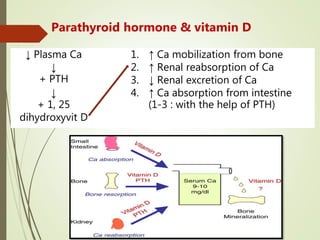
↓ Plasma Ca
↓
+ PTH
↓
+ 1, 25
dihydroxyvit D
1. ↑ Ca mobilization from bone
2. ↑ Renal reabsorption of Ca
3. ↓ Renal excretion of Ca
4. ↑ Ca absorption from intestine
(1-3 : with the help of PTH)
Vitamin D & Ca Homeostasis
Condition GIT Bone Kidney
↓ [Ca]
↑ Ca
absorption
↑ mobilization Active vit D formation
↑ [Ca]
↓ Ca
absorption
[+] Calcitonin
[-] Ca mobilization
↑ excretion (calcitonin)
↓ reabsorption (PTH)
Inactive vit D formation
↓ vit D
No
absorption
[+] Ca mobilization
(PTH)
↓ excretion (PTH)
↑ reabsorption (PTH)
↑ vit D ↑ absorption
↑↑ mobilization
↑ accumulation
↑ excretion (calcitonin)
Inactive vit D formation
Deficiency of vitamin D
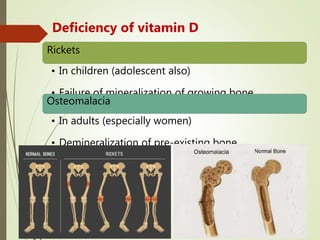
Rickets
• In children (adolescent also)
• Failure of mineralization of growing bone
Osteomalacia
• In adults (especially women)
• Demineralization of pre-existing bone
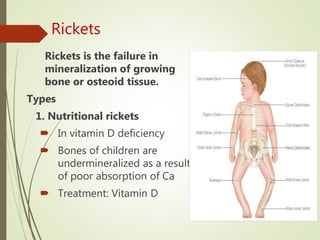
Rickets
Rickets is the failure in
mineralization of growing
bone or osteoid tissue.
Types
1. Nutritional rickets
 In vitamin D deficiency
 Bones of children are
undermineralized as a result
of poor absorption of Ca
 Treatment: Vitamin D
Rickets
2. Renal rickets
In CRF- ↓ Ability to form active vitamin D
Treatment: Active vitamin D
3. Hypophosphatemic rickets (vit D resistant rickets)
Defective tubular reabsorption of PO₄
Treatment: Vit D analog + PO₄
4. Vitamin D dependent rickets
Defective tubular reabsorption of HCO₃⁻, PO₄,
Glucose & AA .
Treatment: High dose of vitamin D
Osteomalacia
In adults
Demineralization of preexisting bones
as a result bone soften & osteoporosis occurs.
↑ Susceptibility to fracture.
More incidence- persons in poor daylight
Findings
↓ Serum Ca
↓ Serum PO₄
↑↑ Serum alkaline phosphatase
Toxicity of vitamin D
 Most toxic (only in dietary excess, not in excess
exposure to sunlight)
 100,000 IU for wks/ months
 Cl/F
↑ Plasma Ca (↑ absorption & bone resorption)
↑ Deposition of Ca in many organs (artery, kidney)
Calcification of soft tissue
Loss of appetite
Nausea, thirst, stupor
↑ BP
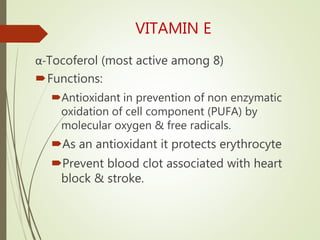
VITAMIN E
α-Tocoferol (most active among 8)
Functions:
Antioxidant in prevention of non enzymatic
oxidation of cell component (PUFA) by
molecular oxygen & free radicals.
As an antioxidant it protects erythrocyte
Prevent blood clot associated with heart
block & stroke.
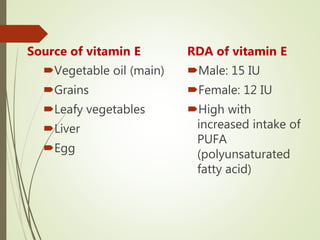
Source of vitamin E
Vegetable oil (main)
Grains
Leafy vegetables
Liver
Egg
RDA of vitamin E
Male: 15 IU
Female: 12 IU
High with
increased intake of
PUFA
(polyunsaturated
fatty acid)
Deficiency of vitamin E
 Unknown
 Severe fat malabsorption
Cystic fibrosis
CLD
 Premature infant
Born with inadequate reserve
Erythrocyte- abnormally fragile
Hemolytic anemia
Toxicity: Least toxic
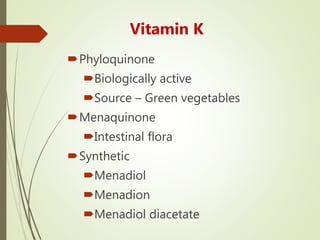
Vitamin K
Phyloquinone
Biologically active
Source – Green vegetables
Menaquinone
Intestinal flora
Synthetic
Menadiol
Menadion
Menadiol diacetate
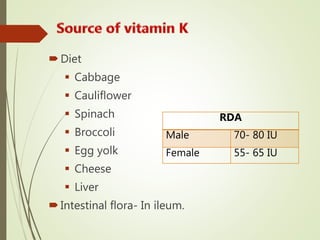
Diet
 Cabbage
 Cauliflower
 Spinach
 Broccoli
 Egg yolk
 Cheese
 Liver
Intestinal flora- In ileum.
RDA
Male 70- 80 IU
Female 55- 65 IU
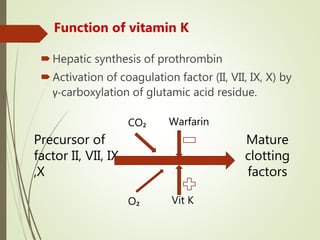
Function of vitamin K
Hepatic synthesis of prothrombin
Activation of coagulation factor (II, VII, IX, X) by
γ-carboxylation of glutamic acid residue.
Precursor of
factor II, VII, IX
,X
CO₂ Warfarin
Mature
clotting
factors
O₂ Vit K
Deficiency of vitamin K
True deficiency is unusual
(Bacterial flora)
Steatorrhea
Administration of broad
spectrum antibiotic (alter
intestinal bacterial flora → ↓
synthesis of vit K)
Deficiency feature
Bleeding tendency
Prolong PT
Large dose &
prolong
administration
 Hemolytic anaemia
 Jaundice (due to
toxic effect on RBC
membrane)
Toxicity
Newborn has less vitamin K
Very little can be transported across the placenta
Sterile intestine
Protein synthesis has not yet reach full adult
capacity particularly in premature infant
Deficiency is severe enough to cause
hemorrhagic disease of newborn (2- 3 days of
birth)
Treatment- Single I/M inj. of Vitamin K as
prophylaxis
Thank You

Fat soluble vitamins

  • 1.
    Fat soluble Vitamins Dr. FarhanaAtia Assistant Professor Department of Biochemistry Nilphamari Medical College, Bangladesh
  • 2.
  • 3.
    Fat soluble vitamins Common Name ChemicalName Active Form Vitamin A Retinol Retinal Retinoic acid β-carotene Retinol Retinal Retinoic acid Vitamin D Cholecalciferol Ergocalciferol 1, 25 Dihydroxycholecalciferol Vitamin E α- tocopherol α- tocopherol Vitamin K Phylloquinone Menaquinone Menadione Phylloquinone Menaquinone Menadione
  • 4.
    Criteria of FatSoluble Vitamins  Soluble in organic or fat solvent (Benzene/ Ether)  Released, absorbed, transported with fat diet  Not readily excreted in urine  Stored in liver & adipose tissue  Only vitamin K has coenzyme activity  Have toxic effect if intake is more than RDA (vit A, vit D)  Deficiency features develop slowly than water soluble vitamins.
  • 5.
    Vitamin A Pro vitaminA • carotenoids • from plants • Yellow, orange & dark green vegetables & fruits • Carrot • Pumpkins • Papaya (ripe) • Mango Preformed vitamin A • Retinoids • from animals • Liver • Kidney • Fish oil • Egg • Muscle meat • Whole milk • Cream • Butter
  • 6.
    Retinoids (Preformed vitaminA) 1. Retinol  Alcohol  Storage form of vitamin A 2. Retinal  Aldehyde derivative of retinol  Retinol ↔ retinal 3. Retinoic acid Acid Retinol Retinoic acid
  • 7.
     1 RAE(retinol activity equivalent) 1 μg of retinol 12 μg of β-carotene 3.33 IU (now obsolete)  β-carotene  cleaved into 2 retinal in intestine but conversion is inefficient Adult male 900 RAE Adult female 700 RAE RDA
  • 8.
    Functions of VitaminA • Maintain reproduction by supporting spermatogenesis in male • prevention of fetal resorption in female. • Maintain vision by formation of visual pigment ‘Rhodopsin’ in retina. • Promotion of growth • Maintain integrity of epithelial tissue. Retinol & Retinal
  • 9.
    • Epithelial tissuedifferentiation & mucous secretion • Gene expression • Promotion of growth • Have role in cancer prevention Retinoic acid • Antioxidant, so • prevent cancer & heart disease β carotene
  • 10.
    Rhodopsin cycle comprises 2 Bleachingof rhodopsin generate nerve impulse Regeneration of rhodopsin
  • 11.
    Features (Vitamin A deficiency is themost important preventabl e cause of blindness) Loss of sensitivity to green light (earliest sign) Impairment to adapt dim light Night blindness Xerophthalmia (in prolonged deficiency) Keratinization of cornea Blindness Increased susceptibility to infectious disease Keratinization of skin Atrophy of epithelium Growth retardation
  • 12.
    Hypervitaminosis A  Excessiveintake (not carotene) produce toxic syndrome (supplement usually, also diet)  UL: 3000 μg/d  In pg: teratogenesis (congenital malformation of developing fetus)  Symptoms of toxicity affects- CNS (↑ CSF pressure) Headache, Nausea, Ataxia, Anorexia Calcium homeostasis Thickening of long bone, Hypercalcemia, Calcification of soft tissue Liver Hepatomegaly, Hyperlipidemia Skin Excessive dryness, Alopecia, Desquamation,
  • 13.
    VITAMIN D Solar vitamin Inhuman skin : 7-Dehydrocholesterol, an intermediate in synthesis of cholesterol Undergoes a nonenzymatic reaction on exposure to UVL yielding pre-vitamin D. Cholecalciferol is formed after further reaction over a period of hour and absorbed into bloodstream. Maximum vitamin synthesis: 10AM – 2PM
  • 14.
    Dietary Sources  Requiredonly in individuals with limited exposure to sunlight  Plant- D2/ Ergocalciferol  Animal- D3/ Cholecalciferol Fatty fish Liver Egg yolk Milk- after fortification Cheese Butter Child 400 IU Adult 200- 400 IU Pg/ Lactation 400 IU > 60 years 600 IU
  • 15.
    Formation of VitaminD UVL ↓ Skin : 7 DHC → Cholecalciferol (D3) ↓ Liver : 25 hydroxyD3/ calcidiol ↓ Kidney (PCT) : 1, 25 dihydroxyD3/ calcitriol (Active form) Enz: 25 hydroxycholecalciferol 1 hydroxylase
  • 16.
    Formation of activevitamin D: Stimulated by Inhibited by 1. ↓ plasma Ca 2. ↓ plasma PO₄ 3. ↑ PTH 4. Estrogen Prolactin GH 1. ↑ plasma PO₄ 2. ↑ Free ionized plasma Ca
  • 17.
    Functions of vitaminD Maintain adequate plasma Ca level by  ↑ uptake of Ca by intestine  Minimize excretion of Ca by kidney (stimulate reabsorption in distal renal tubule)  Stimulate Ca mobilization from bone when necessary
  • 18.
    Functions of vitaminD Regulate gene expression & cell differentiation  Insulin secretion  Synthesis & secretion of parathyroid & thyroid hormones  Inhibit production of interleukins by activated T- lymphocytes & immunoglobulin by activated B- lymphocytes  Differentiation of monocyte precursor cells  Modulation of cell proliferation
  • 19.
    Parathyroid hormone &vitamin D ↓ Plasma Ca ↓ + PTH ↓ + 1, 25 dihydroxyvit D 1. ↑ Ca mobilization from bone 2. ↑ Renal reabsorption of Ca 3. ↓ Renal excretion of Ca 4. ↑ Ca absorption from intestine (1-3 : with the help of PTH)
  • 20.
    Vitamin D &Ca Homeostasis Condition GIT Bone Kidney ↓ [Ca] ↑ Ca absorption ↑ mobilization Active vit D formation ↑ [Ca] ↓ Ca absorption [+] Calcitonin [-] Ca mobilization ↑ excretion (calcitonin) ↓ reabsorption (PTH) Inactive vit D formation ↓ vit D No absorption [+] Ca mobilization (PTH) ↓ excretion (PTH) ↑ reabsorption (PTH) ↑ vit D ↑ absorption ↑↑ mobilization ↑ accumulation ↑ excretion (calcitonin) Inactive vit D formation
  • 21.
    Deficiency of vitaminD Rickets • In children (adolescent also) • Failure of mineralization of growing bone Osteomalacia • In adults (especially women) • Demineralization of pre-existing bone
  • 22.
    Rickets Rickets is thefailure in mineralization of growing bone or osteoid tissue. Types 1. Nutritional rickets  In vitamin D deficiency  Bones of children are undermineralized as a result of poor absorption of Ca  Treatment: Vitamin D
  • 23.
    Rickets 2. Renal rickets InCRF- ↓ Ability to form active vitamin D Treatment: Active vitamin D 3. Hypophosphatemic rickets (vit D resistant rickets) Defective tubular reabsorption of PO₄ Treatment: Vit D analog + PO₄ 4. Vitamin D dependent rickets Defective tubular reabsorption of HCO₃⁻, PO₄, Glucose & AA . Treatment: High dose of vitamin D
  • 24.
    Osteomalacia In adults Demineralization ofpreexisting bones as a result bone soften & osteoporosis occurs. ↑ Susceptibility to fracture. More incidence- persons in poor daylight Findings ↓ Serum Ca ↓ Serum PO₄ ↑↑ Serum alkaline phosphatase
  • 25.
    Toxicity of vitaminD  Most toxic (only in dietary excess, not in excess exposure to sunlight)  100,000 IU for wks/ months  Cl/F ↑ Plasma Ca (↑ absorption & bone resorption) ↑ Deposition of Ca in many organs (artery, kidney) Calcification of soft tissue Loss of appetite Nausea, thirst, stupor ↑ BP
  • 26.
    VITAMIN E α-Tocoferol (mostactive among 8) Functions: Antioxidant in prevention of non enzymatic oxidation of cell component (PUFA) by molecular oxygen & free radicals. As an antioxidant it protects erythrocyte Prevent blood clot associated with heart block & stroke.
  • 27.
    Source of vitaminE Vegetable oil (main) Grains Leafy vegetables Liver Egg RDA of vitamin E Male: 15 IU Female: 12 IU High with increased intake of PUFA (polyunsaturated fatty acid)
  • 28.
    Deficiency of vitaminE  Unknown  Severe fat malabsorption Cystic fibrosis CLD  Premature infant Born with inadequate reserve Erythrocyte- abnormally fragile Hemolytic anemia Toxicity: Least toxic
  • 29.
    Vitamin K Phyloquinone Biologically active Source– Green vegetables Menaquinone Intestinal flora Synthetic Menadiol Menadion Menadiol diacetate
  • 30.
    Diet  Cabbage  Cauliflower Spinach  Broccoli  Egg yolk  Cheese  Liver Intestinal flora- In ileum. RDA Male 70- 80 IU Female 55- 65 IU
  • 31.
    Function of vitaminK Hepatic synthesis of prothrombin Activation of coagulation factor (II, VII, IX, X) by γ-carboxylation of glutamic acid residue. Precursor of factor II, VII, IX ,X CO₂ Warfarin Mature clotting factors O₂ Vit K
  • 32.
    Deficiency of vitaminK True deficiency is unusual (Bacterial flora) Steatorrhea Administration of broad spectrum antibiotic (alter intestinal bacterial flora → ↓ synthesis of vit K) Deficiency feature Bleeding tendency Prolong PT Large dose & prolong administration  Hemolytic anaemia  Jaundice (due to toxic effect on RBC membrane) Toxicity
  • 33.
    Newborn has lessvitamin K Very little can be transported across the placenta Sterile intestine Protein synthesis has not yet reach full adult capacity particularly in premature infant Deficiency is severe enough to cause hemorrhagic disease of newborn (2- 3 days of birth) Treatment- Single I/M inj. of Vitamin K as prophylaxis
  • 34.