B-COMPLEX VITAMINS
Dr. M. Siva Kumar Reddy MBBS.,MD
Post graduate
Department of biochemistry
CLASSIFICATION
• A
• D
• E
• K
FAT
SOLUBLE
VITAMINS
• B-COMPLEX
• C
WATER
SOLUBLE
VITAMINS
WSV vs FSV
Water soluble vitamins Fat soluble vitamins
Function as Precursor
for co-enzymes & anti oxidants
Function as co-enzymes ,
harmones, and anti-oxidants
Excess amounts non toxic Excess amounts are toxic
These vitamins are not stored
except B12
These vitamins are stored
Body requires them frequently They are not required frequently
B- COMPLEX VITAMINS
B1- THIAMINE
B2-RIBOFLAVIN
B3-NIACIN
B5-PANTOTHENIC ACID
B6-PYRIDOXINE
BIOTIN
FOLIC ACID
B12-CYANOCOBALAMINE
THIAMINE – B1
You should at least know
these…….
 Specific co-enzyme of thiamine?
 Dietary sources of thiamine?
 Antimetabolites of thiamine?
 RDA of thiamine
 Types of beri beri & most complicated
form of beri beri
 Metabolic reactions where TPP is
involved
 Most commonly effected people?
 Investigations and treatment?
OTHER NAMES OF
THIAMINE
 Anuerine
 Thiamin
 Thio-vitamine
 Anti beriberi factor
 Sulphur containing vitamine
HISTORY OF THIAMINE
KANEHIRO TAKAKI
SURGEON GENERAL IN JAPANESE NAVY
found seamen and crew were effected
CHRISTIAN
EIJKMAN
Dutch physician and
professor of physiology
nobel prize winner
accidentally found the cause
in fowls fed with cooked rice
Structure of
thiamine
ADOLF OTTO
WINDAUS
NP 1928
THIAMINE PYROPHOSPHATE
(SPECIFIC CO-ENZYME)
Glucose Glucose – 6 P
Pyruvate
Acetyl CoA
TPP PDH
TCA
TPP
Citrate
Oxaloacetate
α- Ketoglutarate
α- Ketoglutarate
dehydrogenase
Succinyl CoA
Ribose - 5P
Transketolase
TPP
Seduheptulose - 7P
Xylulose - 5P
Glyceraldehyde - 3P
Pyruvat
e
Acetyl -
CoA
NAD+ NADH+H+
CO2
Oxidative decarboxylation
TPP
PD
H
α ketoglutarate
Succinyl -
CoA
NAD+ NADH+H+
CO2
Oxidative decarboxylation
TPP
Xylose-5 phosphate Ribose-5 phosphate
Glyceraldehyde-3 phosphate Sedoheptulose-7 phosphate
Transketolase TPP
And also…..
 Essential for transmission of nerve
impulse
TPP is required for synthesis of
Acetylcholine.
DUE TO LACK OF TPP………………
 Increased plasma levels of pyruvate &
lactate due to low activity of PDH
complex
 Accumilation of pentose sugars in
erythrocytes is due to decreased activity
of transketolase
 Measurement of Transketolase activity is
common test used for the diagnosis of
B1 deficiency
Sources of thiamine
Rich
Sources
Good
sources
Fair
sources
• Outer coatings of
food grains like
rice, wheat and
yeast.
• Whole cereals,
pulses, oilseeds
and nuts.
• Meat, liver and
egg and fish.
 Thiaminase
 It is present in raw fish & seafood
 Thiaminase destroys thiamine if it is
present in the diet
ANTIMETABOLITES
 ABSORBTION:
Thiamine is carried by the portal blood to
the liver, present as free thiamine
 STORAGE:
Usually stored as thiamine pyrophosphate
Mainly stored in skeletal muscle and also
present in significant amounts in liver,
heart, kidneys, erythrocytes and nervous
system
RDA
 Adults - 1-1.5 mg/day
 Children - 0.7-1.2 mg/day
 Pregnancy & lactation - 2 mg/day
 REQUIREMENT INCREASES WITH-
 increased carbohydrate intake
 Pregnancy
 Lactation
 Smoking
 Alcoholism
 Prolonged antibiotic intake
 Serious or prolonged illness
Food containing a high level of
thiaminase, including milled rice, raw
freshwater fish, raw shellfish, and
ferns
Lack of thiamine intake
Food high in anti-thiamine factor, such
as tea, coffee, and betel nuts
Processed food with a content high in
sulfite, which destroys thiamine
Alcoholic state
Starvation state
Causes of thiamine deficiency
Increased depletion
Diarrhea
Diuretic therapies
Peritoneal dialysis
Hemodialysis
Hyperemesis gravidarum
Decreased absorption
Chronic intestinal disease
Alcoholism
Malnutrition
Gastric bypass surgery
Mal absorption syndrome - Celiac and
tropical sprue
Increased consumption states
Diets high in carbohydrate or
saturated fat intake
Pregnancy
Hyperthyroidism
Lactation
Fever - severe infection
Increased physical exercise
Failure of
carbohydrate
metabolism
↓ATP
production
Impaired
cellular
functions
BERI BERI CLASSIFICATION
 Dry Beriberi
Wet Beriberi
Infantile Beriberi
Shoshin Beriberi
Wernicke-Korsakoff
syndrome
INVESTIGATIONS
 erythrocyte Transketolase activity
and 24-h urinary thiamine excretion
may be measured.
 Need to rule out other causes.
TREATMENT
Supplement thiamine, with dose based
on clinical manifestations
For mild polyneuropathy, thiamine 10
to 20 mg once/day is given for 2 wk.
For moderate or advanced
neuropathy, the dose is 20 to 30
mg/day; it should be continued for
several weeks after symptoms
disappear.
For edema and congestion due to
cardiovascular beriberi, thiamine 100
mg IV once/day is given for several
days.
The prognosis for beriberi is usually
good, unless patients have
established Korsakoff syndrome.
 When patients have progressed to
this stage, the degree of damage is
only minimally reversible.
PROGNOSIS OF BERIBERI
RIBOFLAVIN
VITAMIN- B2
You should at least know
these…….
 Specific co-enzyme of Riboflavin?
 Dietary sources of Riboflavin?
 RDA of Riboflavin?
 Riboflavin deficiency clinical
features?
 Metabolic reactions where FAD and
FMN are involved?
 Most commonly effected people?
 Investigations and treatment?
OTTO HEINRICH
WARBURG
 Isolated the "yellow
enzyme” of cellular
respiration.
He was nominated 47
times for Nobel prize
Known for his works in
cancers
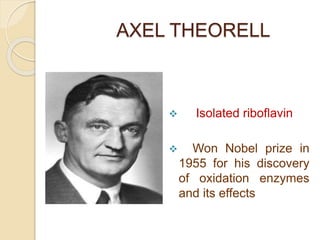
AXEL THEORELL
 Isolated riboflavin
 Won Nobel prize in
1955 for his discovery
of oxidation enzymes
and its effects
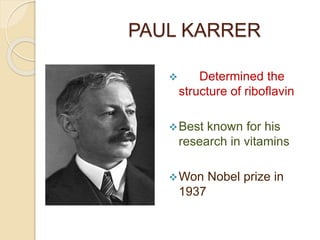
PAUL KARRER
 Determined the
structure of riboflavin
Best known for his
research in vitamins
Won Nobel prize in
1937
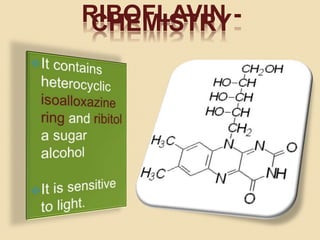
RIBOFLAVIN -CHEMISTRY
38
Absorbed in small
intestine and distributed to
all tissues by circulation.
1.3 –
1.7mg/day
RIBOFLAVIN – ACTIVE
FORMS
FMN
FAD
RIBOFLAVIN – ACTIVE
FORMS
RIBOFLAVIN – ACTIVE
FORMS
Active forms of this vitamins(FMN &
FAD) are involved in…
Carbohydrate metabolism(PDH
&TCA)
Lipid metabolism
Protein metabolism
Purine metabolism
Active
forms of
riboflavin
are FMN
and FAD.
They act as
prosthetic
groups of
several
enzymes.
Catalyzes
oxidation-
reduction
reactions.
Growth, repair,
development
of body tissues
- healthy
skin, eyes and
tongue
VITAMIN B2 -RIBOFLAVIN
Co-enzyme
activity
FMN -
dependent
enzymes
FAD -
dependent
enzymes
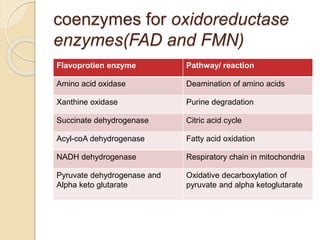
coenzymes for oxidoreductase
enzymes(FAD and FMN)
Flavoprotien enzyme Pathway/ reaction
Amino acid oxidase Deamination of amino acids
Xanthine oxidase Purine degradation
Succinate dehydrogenase Citric acid cycle
Acyl-coA dehydrogenase Fatty acid oxidation
NADH dehydrogenase Respiratory chain in mitochondria
Pyruvate dehydrogenase and
Alpha keto glutarate
Oxidative decarboxylation of
pyruvate and alpha ketoglutarate
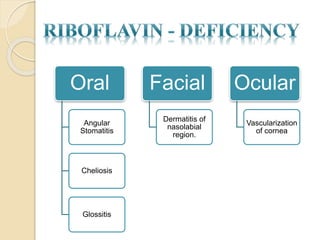
Oral
Angular
Stomatitis
Cheliosis
Glossitis
Facial
Dermatitis of
nasolabial
region.
Ocular
Vascularization
of cornea
CONEAL
VASCULARISATION
INVESTIGATIONS
Urinary riboflavin determination
RBC riboflavin load test
TREATMENT
Riboflavin 2-5 mg PO daily with
incresed intake of B-complex vitamins
Parenteral riboflavin administered if
relief not obtained with oral intake.
References
 Harper’s Biochemistry 25th Edition.
 Fundamentals of Clinical Chemistry by Tietz.
 Text Book of Medical Biochemistry-A R Aroor.
 Text Book of Biochemistry- DM Vasudevan
 Text Book of Biochemistry-MN Chatterjea
 Text Book of Biochemistry-Dr.U.Satyanarana
vitamins B1 and B2
vitamins B1 and B2

vitamins B1 and B2

Editor's Notes

  • #39 In the United States today, the most significant dietary sources of riboflavin are meat and meat products, including poultry and fish, and milk and dairy products, such as eggs and cheese. In developing countries, plant sources contribute most of the dietary riboflavin intake. Green vegetables, such as broccoli, collard greens, and turnip greens, are reasonably good sources of riboflavin. Natural grain products tend to be relatively low in riboflavin, but fortification and enrichment of grains and cereals has led to a great increase in riboflavin intake from these food items. The food sources of riboflavin are similar to those of other B vitamins. Therefore, it is not surprising that if a given individual’s diet has inadequate amounts of riboflavin, it will very likely be inadequate in other vitamins as well. A primary deficiency of dietary riboflavin has wide implications for other vitamins, as flavin coenzymes are involved in the metabolism of folic acid, pyridoxine, vitamin K, niacin, and vitamin D (27). from dietary sources. Appreciable amounts of riboflavin may be lost with exposure to UV light, particularly during cooking and processing. Prolonged storage of milk in clear bottles or containers may result in flavin degradation (28). Fortunately, most milk is no longer sold in clear bottles. There has been some controversy as to whether opaque plastic containers provide greater protection than do cartons, particularly when milk is stored on a grocery shelf exposed to continuous fluorescent lighting.
  • #42 FMN is formed in intestine FAD is formed in Liver Flavin dependent enzymes (flavoproteins)
  • #45 The major function of riboflavin, as noted above, is to serve as the precursor of the flavin coenzymes, FMN and FAD, and of covalently bound flavins. These coenzymes are widely distributed in intermediary metabolism and catalyze numerous oxidation–reduction reactions. Because FAD is part of the respiratory chain, riboflavin is central to energy production. Other major functions of riboflavin include drug and steroid metabolism, in conjunction with the cytochrome P450 enzymes, and lipid metabolism. The redox functions of flavin coenzymes include both one-electron transfers and two-electron transfers from substrate to the flavin coenzyme (10). Flavoproteins catalyze dehydrogenation reactions as well as hydroxylations, oxidative decarboxylations, dioxygenations, and reductions of oxygen to hydrogen peroxide. Thus, many different kinds of oxidative and reductive reactions are catalyzed by flavoproteins.
  • #46 FMN Dependent enzymes: FMN is a cofactor for L- amino acid oxidase. NADH dehydrogenase of respiratory chain contains FMN FAD Dependent enzymes: D-amino oxidase Succinate dehydrogenase Aceyl coA dehydrogenase Xanthine oxidase Pyruvate dehydrogenase A ketoglutarate dehydrogenase Complex II of R chain